Knysna wanted to tell us a story, but there simply wasn’t time.
We were nearly ready to leave when the winds began howling at 34 South, the seafood eatery where we had dined on oysters, beef, beer, and cheesecake. Raindrops swiped against the plate glass windows. A gust of wind rocked the rafters. The bartender looked up from his pour. A squall blustered through Knysna, “the jewel of the Garden Route” in the Western Cape of South Africa.
Locking arms, my daughter and I left the restaurant and headed out, hunch-shouldered, toward our waiting minivan that had been rented for our two-week tour of South Africa’s Garden Route.
Pushed by violent gusts of wind, bistro chairs scooted across the wide concrete sidewalks of The Waterfront of Knysna Quays. One flipped and careened across our path. We shrieked. Maritime flags above us whipped and ripped in the straight-line winds.
We found our van and climbed inside, allowing the wind to heave the doors closed. Rain poured and pounded against the roof and windshield.
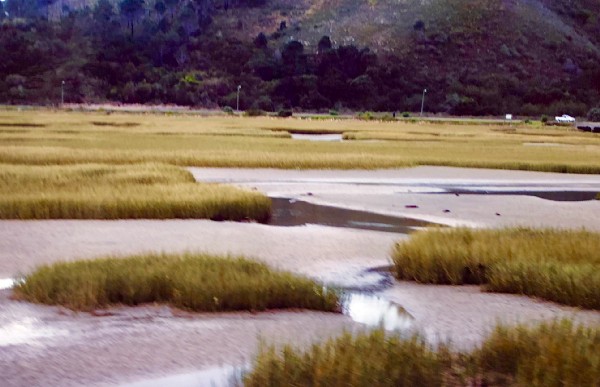
Our host headed back to Leisure Island, an idyllic residential suburb surrounded by an estuary. We crossed the causeway and looked forward to the warmth of our hotel, Cuningham’s Island Guesthouse, one of many quaint lodges nestled along the isle’s manicured avenues.
The estuary that surrounds Leisure Island in Knysna. | Photo: M. Yung
We climbed out of our minivan, splashing on the asphalt driveway. Lifting our jeans above our ankles, we bounded down the complex’s brick-lined paths through water four inches deep.
Once near our respective rooms, our party—my in-laws, husband, our daughter, son, and our professional hunter who had planned this portion of the journey as a prelude to an Eastern Cape safari—escaped the rain, retreating to our rooms without the customary pleasantries. On a calm night, we would have discussed the next day’s plans and determined a time to leave in the morning. However, not tonight.
The next morning we would breakfast on eggs, sausages, and tomatoes, and then emerge from the cocoon of Leisure Island.
We would travel the tidy streets of Knysna and notice the affluence of well-maintained homes surrounded by emerald green lawns.
Moments later, we would pass impoverished townships and notice women sorting through piles of clothing on dirt streets that stretched into the distance.
Township in Knysna | Photo: M. Yung
We would wonder at the disparity. We would question the two extremes.
We spent too little time in Knysna back in 2011. One night anywhere is never enough. This beautiful city wanted to tell us a story—but there simply wasn’t time.
The next evening, we would be in Tsitsikamma, further east on our Garden Route tour. The forecast called for more rain and blustery cold, common for the winter month of June.
I visited South Africa in 2012 and now wish I had written more then about my experiences there. This post is my first attempt to record some details of what I remember. Follow my blog for more stories from this trip.
Loved your concert at Arrowhead Stadium. Really great show as per usual. I appreciated the changes you made to the setlist since your 2017 arena tour, which provided returning fans like us with some variety. Everyone, for example, needs to hear “Tenerife Sea” performed live, so thank you.
But… and I hesitate to say this because it was such an awesome show, but at times, there was a little too much “star power” in the air. Things seemed a little rushed, a little hurried. But just at times, though. Were you bored? (That’s understandable.) Had you performed a few fan favorites a few too many times? (Probably.)
So before you pack your bags and set out for Brazile to continue the tour in February, think about slowing things down a smidge. Here are ten reasons why you might want to do that…
1. Because a stadium concert is not a race. You are not being timed. While you may have performed your setlist 3476249 times on this tour, your fans (most of them, anyway) will only hear it once. Respect that.
2. Because “Perfect” is only perfect when it’s performed perfectly. This ballad recently spent its 52nd week on Billboard’s Hot 100. It may feel dated to you, but it’s still fresh to thousands. Don’t rush the soul You know this.
The Wibbles, Ed’s cats on Instagram.
3. Because if you slowed down, you might be able to figure out a way to include live cats in your show. You know you want to.
4. Because if you would just slow the heck down, you might know where you are. And then you wouldn’t have referred to us several times as “Kansas.” I wasn’t going to mention this not-so-minor detail, but you should know that it was a little irritating because you were actually in Missouri. But I get it. Long tour. Different city every night. Okay, done on that one.
5. Because those moments during the concert when you casually talked at length to the audience were the best. More of that, please. The part about the two groups of men in attendance, disinterested boyfriends and super dads? Kinda true and kinda funny.
6. Because “Thinking Out Loud” deserves better. Don’t speed through this song for the ages. After all, this is the only Ed Sheeran song that many poor, misguided souls can name. Don’t disappoint them (even though they deserve it, dang it, for not knowing your full repertoire.)
Kansas City’s Arrowhead Stadium fills up prior to the show.
7. Because if you slowed down, you might think about performing some earlier songs from Plus or Multiply. Runaway? Nina? The Man? But thanks again, by the way, for that sparkling performance of “Tenerife Sea.” That song truly is one of your best-of-all-times. The silence that enveloped Arrowhead was key, and I’m glad everyone obliged (okay, except for that one guy) when you asked for quiet so we could hear every note.
8. Because seeing you leave was a little harsh. Your exit felt like the ultimate brush-off. As you descended the ramp, you simultaneously tossed your mic, shrugged off your Chiefs jersey, disappeared into your waiting SUV, and sped away to the next gig. And you did all that in less than ten seconds. That hurt, Ed.
9. Because if you slowed down, you might be able, for old times’ sake (or just for me), to throw on a flannel shirt. After all, it was mid-October… prime flannel season. If I was ever to see you perform live in your signature flannel, October was it. Oh, well. Your layered Hoax t-shirt was fine, I guess.
And the final reason you need to slow the heck down…
10. Because many of your fans suspect you’re readying yourself for another long hiatus from the stage, social media, and society in general. Face it: many of your fans still suffer flashbacks from 2016, the first time you did this. Even though I understand the break helped you stay grounded and sober, please slow down and think hard before evaporating again. True, a break would allow you time to create your next album, and I’m all for that, so if a hiatus is what you need, then go for it.
That’s it. Those were my ten mostly serious reasons to slow down, Ed. Three points to summarize: 1) give your songs (and your fans) the attention and time they deserve, 2) star power does not become you, and 3) cats.
Thanks for reading! Click like if you enjoyed this post and feel free to leave a comment. Here are two links to my other Ed Sheeran concert reviews.
When you visit the island of Torcello in the Venetian lagoon, you observe a sign inside the basilica that forbids photography. Ugh, you think. But it’s so beautiful. Inside, the apse—a half-dome of sorts—is encrusted in gold mosaic. The Virgin Mary resides in its center, alone, regal, royal. It’s graphically arresting and elegant in its simplicity; it contrasts with the opposite wall, a riot of colors, shapes, lines… Biblical scenes of the Last Judgment.
The cathedral is exquisite. One simply must have pictures to remember. So you plan to purchase them in the form of postcards from the adjacent gift shop when you leave. Problem solved.
Why then, the click? Why then is that woman over there snapping away? Lost in thought, she roams the chapel, gazing at the art, studying the expressive scenes, recording her visit on her sleek 35mm Canon.
Your immediate thought: she must have special permission. She must be a researcher working on a project. You explain as much to your husband. No, he says, she’s just ignoring the sign. His nonchalance startles you. As if this is just what people do, and in this case, a woman.
Oh, you reply, secretly envying this woman’s quiet rebellion that allows her a certain freedom that you will never claim. Disobey a sign that clearly states no photos? You shake your head. It’s right there in 96-point Times New Roman even. You roll your eyes at her audacity. This disregard for convention and rules astounds you.
You wonder how much inevitable damage each click does to the Byzantine masterpieces. Over the decades, who knows? She could be causing irreparable harm, you think. This should go down on her permanent record, wherever those are.
You ask your husband about the inevitable damage. Probably doesn’t hurt the art at all, he explains, adding something he read reported most cameras have filters that limit or remove UV waves. Doesn’t damage a thing, he says.
Here I’ve been, you think, following all the rules all this time.
You continue to stare at this renegade designing her destiny, staking her claim with a few flashes that you still cannot bear to sneak on your measly iPhone. It’s true, you think, this woman has shown you to be the fool that you are.
She clicks another shot and checks the tiny screen. It must have been good, you think.
Her crimes finally and fully committed, the woman strides purposefully across the nave, stuffing her camera into a turquoise canvas tote bag. On the side of the bag is a design: two kitschy, feathery angel wings protruding from behind a shield. The design is cliché and you abhor that about things.
Thanks for reading! This is another story generated by a week-long trip to Italy I took in 2017. There are more stories on the way. Feel free to leave a comment and click follow for more.
When the security employee at the gate asked me to step aside, I remembered. My pocket knife. Oh no, my pocket knife, I thought, realizing I had left it earlier in the little cosmetic bag inside my purse. I had forgotten to check it with my luggage and now I was at the gate and my knife was going away.
The uniformed employee explained in her thick Venetian accent, “We must take this from you. If it’s you really need, you go downstairs, fill out the form, and it be sent to you.”
Standing there, I knew we wouldn’t have time to make those arrangements. And besides, it wasn’t a valuable possession. But then again, it was.
For twenty-five years, I had carried that pocket knife.
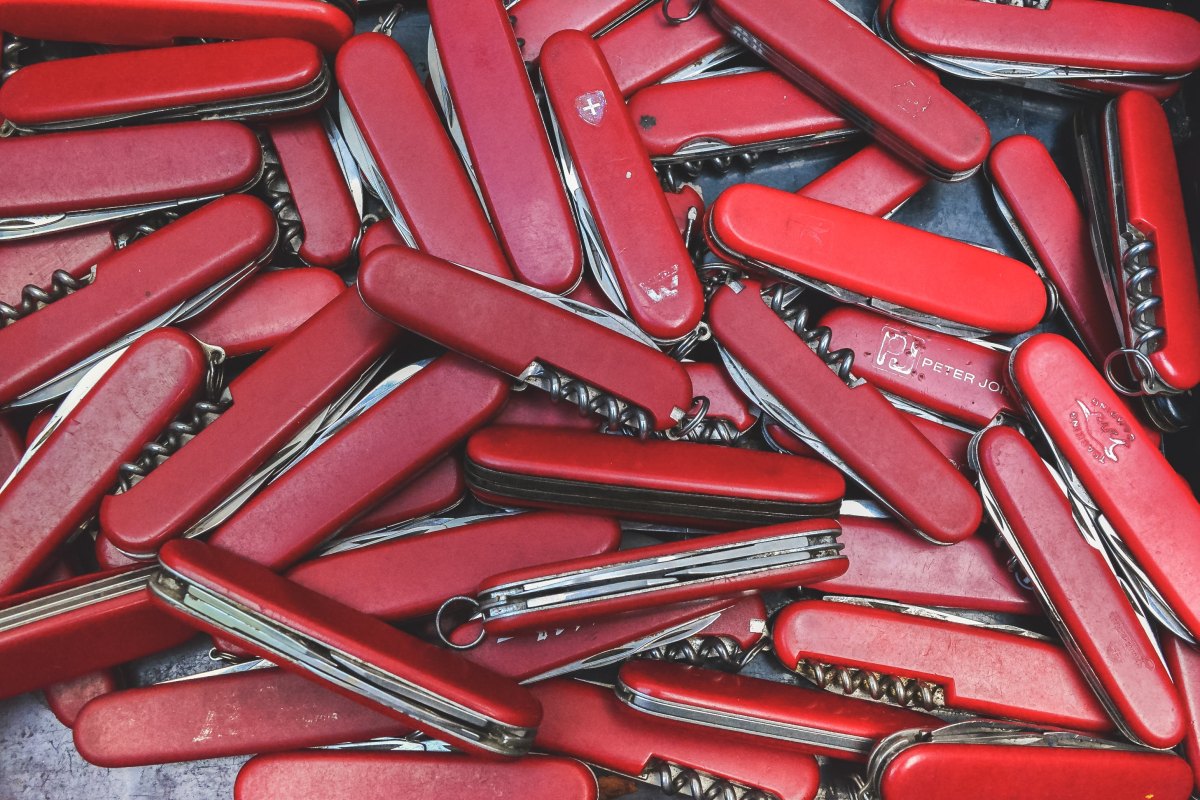
Back in 1990, I had chosen it from a mound of identical ones heaped in a small cardboard box next to a cash register in the sporting goods department at a Kmart in Topeka, Kansas. It had cost my boyfriend (now my husband) an entire dollar. It featured a steel blade, a wooden casing, and bronze hardware that over the years, had polished to a golden shine from being nestled in my purse for so long.
Similar to how candy bars are placed at checkout stands to captivate small children, that box of $1 knives held equal allure for the fishermen and hunters who visited that department. Not that I was one of them. We had gone to the store to use the restrooms tucked away behind the restaurant at the back of the store. As he waited on me, he spotted the knives and bought one for me.
“Keep it in your purse. It’ll come in handy,” he told me. He was right.
That little knife had been many places… all over Missouri and Kansas, Nashville, Asheville, several cities in Maine and Vermont, Columbus, Atlanta, Sarasota, Highland Park, Phoenix and other Arizona locals, multiple sights in the Los Angeles area, Oregon and Washington State, Cape Town and other South African cities, DC, New York City, Taos, Breckenridge, Crested Butte, Dallas, New Orleans. Over the years, we had journeyed across the country to attend annual family reunions, exhibit my husband’s ceramic art at festivals, and accompany him as he served artist residencies.
And now, its final destination would be Venice, Italy, where it would be left behind, a hindrance to a quick departure, discarded inside a gray plastic tub under the counter.
I regret leaving that silly little knife because it wasn’t just a pocket knife. It was a symbol of family life and motherhood and had been more often used for non-cutting tasks. That knife spread peanut butter on sandwiches many more times that it ever cut into a fish or snipped a cord on a tent or tarp. It was this mother’s indispensable tool. As such, it was always easy to locate.
My son and daughter both knew I carried a pocket knife and I passed it back to them at least once or twice on every road trip we took over the years. Need to break open a family-sized plastic bag of M&Ms? Get Mom’s knife. Opening a DVD? Get Mom’s knife. Got a stray thread hanging from your hem? Ask Mom to hand back her pocket knife.
Just prior to leaving Venice, as I buckled up inside the plane, regretting my decision to leave my knife, I recalled how six years earlier, I had flown from Johannesburg to Atlanta with a knife my son had purchased as a souvenir. Despite its massive four-inch blade, he had somehow forgotten to pack it in a checked bag. I offered to stow it inside my purse, warning him it would likely be confiscated at our first departure.
Nope. X-rays and inspections by hand never discovered it. Of course, that would happen to a brand new knife without any peanut butter experience. And of course, that knife has since been long forgotten, I might add.
As for my knife, I have since replaced it, but the blade on my new one is narrower and not quite as functional as the one left in Venice. I mean, you can spread peanut butter on a slice of bread if you really want to, but it’s the not the same as my Kmart special.
I’m one of those people who feels sorry for the last Christmas tree on the lot. So it’s no surprise that I’m still feeling nostalgic for my lost pocket knife… a year and a half later.
Somewhere in Italy, it’s languishing in a gray bin of confiscated sharp objects. Maybe it’s been recycled by now. Maybe it’s been donated to a charity. Hopefully, it’s performing some mother’s mundane tasks, making her life a little easier, and definitely more memorable.
Had an experience similar to mine? Like this post, follow my blog, and feel to leave a comment about any precious object that’s drifted out of your life. Thanks for reading!
The name change was made, according to this document from then ALSC President Nina Lindsay to the group’s board of directors, because “Laura Ingalls Wilder has long held a complex legacy, as her books (the Little House on the Prairie series) reflect racist and anti-Native sentiments and are not universally embraced.”
My mind fixes on “not universally embraced” over the words “racist” and “anti-Native,” since those two elements would preclude the approval, and I ask myself, So is that what this is all about? Being approved by all? No dissension? No variety of opinion? No provocation?
Wouldn’t that make for boring reading?
Diversity in literature is what I would rather see. Latino perspectives. Native perspectives. African perspectives. European perspectives. Historical perspectives. Contemporary perspectives. I want to read it all.
And I would think the ALSC does, too. Here’s what Lindsay wrote in a bio on the organization’s website, “At its best, the public library enables a freedom of the mind that is foundational to social equity.” Sounds like an open and appreciative mind. Sounds like someone who values all perspectives.
So why the snub to Wilder? Why deny inclusion to Wilder? Because someone somewhere disagrees with her perspective? Because someone somewhere in the universe doesn’t embrace her?
If the ALSC wishes to honor only an author who is universally embraced, well, no thank you. And good luck finding one.
Even though it’s been a few months since the ALSC changed the name of its award, I’m still mulling it over. Leave a comment with your thoughts on this topic. Thanks for reading!
Photo Credit: NBC Television Network [Public domain], via Wikimedia Commons
Those spires. Those ledges. Those bluffs. Behemoths of weight and mass, rising from the high desert floor with quiet heft and bulk.
The space between them is as much a part of the experience as the monuments themselves. My perspective disintegrates. My awe overwhelms. There is no way to determine: how far is that from me? How much expanse between those mittens?
The valley appears surreal, other-worldly. The interior of a cave where the sky forms the walls.
I hear the purr of a single car traveling the dusty road, a red thread snaking in the distance. Other than that, nothing. Even the breeze is silent, its sound swallowed in the burnt sienna drapery of rocky canyon gowns.
The valley transforms me and I am small, insignificant, a dot of breath in the stillness.
We travelled to Monument Valley three years ago and I’m still thinking about it.
Click like if you enjoyed this piece and follow me for an occasional travel post. Also… I would love to hear about your own canyonland experiences. Feel free to comment!
“Laura was frightened. Jack had never growled at her before. Then she looked over her shoulder, where Jack was looking, and she saw two naked, wild men coming, one behind the other, on the Indian trail.
‘Mary! Look!’ she cried. Mary looked and saw them, too.
They were tall, thin, fierce-looking men. Their skin was brownish-red. Their heads seemed to go up to a peak, and the peak was a tuft of hair that stood straight up and ended in feathers. Their eyes were black and still and glittering, like snake’s eyes.”
I remember reading this excerpt as a young girl when prairie mania reigned in one small slice of American pop culture. The craze for all things “prairie” owed its popularity to a series of nine volumes collectively called the Little Housebooks. Written by Laura Ingalls Wilder, the series’ popularity was aided by the launch of a TV drama, Little House on the Prairie, starring Michael Landon. I owned the entire Little House set and a pricey collectible wall calendar. I even visited Mansfield, Mo. with my family to tour Wilder’s final home where she wrote her books.
Spellbound through that breathless chapter where the Indians later entered the Ingalls cabin for tobacco and cornbread prepared by the girls’ mother, I considered how vulnerable the Ingalls were as they settled into the frontier of the Osage Indians who lived nearby. Based on my own background and Wilder’s perspective as told through the eyes of Laura, I never considered the vulnerability of the Osage and their culture. I just wanted to keep reading and turning the pages, so I could finish the book and dash off to the bookstore to buy the next.
The sage was enthralling and heart-breaking: white settlers making a home on the American frontier, occasional clashes with the Native Americans, Laura’s coming-of-age, tenuous friendships with the Olson family, Mary’s blindness.
Diverse? Not at all. Inclusive? Nope. It was 1975. As such, Wilder’s Little House series was considered a darn good story and was deemed worthy of recognition.
Until last week.
That’s when the American Library Association (ALA) and its branch, the Association for Library Service to Children (ALSC), decided to change the name of its prestigious Laura Ingalls Wilder Award to the Children’s Literature Legacy Award. Inaugurated in 1954 and awarded to Wilder herself for her book series, “This award honors an author or illustrator whose books, published in the United States, have made, over a period of years, a significant and lasting contribution to children’s literature,” according to this ALA newsletter.
Sounds reasonable. Few would disagree that Wilder’s books indeed made “a significant and lasting contribution to children’s literature” over the years, albeit not universally among readers.
Here’s how ALSC President Nina Lindsay explained the name change in a letter to her board of directors: “Laura Ingalls Wilder has long held a complex legacy, as her books reflect racist and anti-Native sentiments and are not universally embraced…”
She continued, “Today, this award elevates a legacy that is not consistent with values of diversity and inclusion—something we did not fully understand as a profession when we created the award. While many of Wilder’s books received Newbery honors, (and one may easily find other books within our award canon that don’t live up completely to our current values), we recognize that the name of an award itself holds significant power… The ALSC Executive Committee noted that the name of the award is a currently potentially significant barrier to achieving our goals, and is within our power to change.”
To counter these messages that misinform young children, the AICL website recommends works “by Native authors who write books that provide children with accurate information about American Indians.”
After all, Wilder’s books do contain racist depictions and stereotypes (in Chapter 11 of Little House on the Prairie and in other books in the series) of Native Americans and Africans. In addition, Reese cites Wilder’s recurring descriptions of the land as “empty” and her arguable notions that Indians were primitive beings without civilized, autonomous societies.
And let’s not forget this: the ALSC is not censoring Wilder’s work. Anyone can still purchase her books or find them at their local library. The ALSC merely removed Wilder’s name from its prestigious award.
It should also be noted that the decision does not appear to have been made hastily and members did not unanimously favor the change. An ALSC task force conducted a survey of members and ALA ethnic affiliates. The results: 305 favored the name change; 156 did not. Still, according to the ALSC task force’s recommendation, “We believe that this decision serves the best interest of our Association, its members, and all of those they serve, not only now, in 2018, but in the long term.
But what about history? Is it wise to attempt to remove evidence of the prejudicial attitudes from our past by denigrating the authors who recorded them? Wilder’s works were clearly set in the past and while they contain objectionable content for some, they remain a historical account. According to a statement from the Laura Ingalls Wilder Historic Home and Museum in Mansfield, Mo., “Mrs. Wilder believed her books to be historically accurate and reflect American life during the Western Movement. However difficult it may be to agree with social mores within these years, the fact remains that was a different time and what was accepted then would not be today.”
Even so, the quest for diversity and inclusion in historical literature takes precedence. With its action, the ALSC is indirectly controlling authors by condoning the events, characters and the actions of the characters those authors write about, historical or otherwise.
Regardless, the end result of all this is that now Laura Ingalls Wilder’s name comes with a warning label attached. And so does the Children’s Literature Legacy Award. This is what that label says:
Your characters will speak and behave with respect for all.
Your plot’s conflict must offend no one now nor in the future, and include the diverse views of all parties.
Your character’s thoughts and impressions must not be their own, or the author’s, but of those with the ability to make institutional change within the prevailing culture.
In short, write inclusively or you will be punished.
Thank you for reading! What are your thoughts? Click like and leave a comment so more people may see this and be able to weigh in.
I asked myself this question recently as I perused an English Language Arts curriculum map for grades 6–8 and found that out of dozens of texts the curriculum uses over the three years, only one text addressed or had any connection to World War II: Unbroken by Laura Hillenbrand. However, this book, while an excellent and necessary text, does not focus on the Holocaust; instead, it depicts Japan’s brutal treatment of American POWs during wartime.
The curriculum map I browsed through recently is commonly known to teachers as Engage New York. It is more accurately called EL Education, formerly known as Expeditionary Learning, an open educational resource that can be accessed at no cost online. It is a rigorous Common Core curriculum that “supports teachers in making the transition to Common Core instruction,” according to this informational brochure.
I’m afraid the omission of Holocaust literature from this curriculum means we are forgetting one of history’s most horrific sins.
· Seven out of ten Americans say fewer people seem to care about the Holocaust than they used to
· Nearly 31 percent of all Americans and 41 percent of Millennials believe that substantially fewer than six million Jews were killed (two million or fewer) during the Holocaust
· 45 percent of all Americans and 49 percent of Millennials cannot name a single concentration camp or ghetto of the 40,000 that existed
In fairness, the Engage New York middle school ELA curriculum does list other grievous events in world history. The curriculum contains a diverse range of texts. For example, A Long Walk to Water by Linda Sue Park chronicles the life of Salva Dut, a “lost boy” refugee fleeing the war in South Sudan. Inside Out & Back Again by Thanhha Lai tells the story of Ha, a ten-year-old Vietnamese girl forced to flee the violence of her home country to find refuge in the United States. Narrative of the Life of Frederick Douglass recounts the hardships and dehumanization in the slavery system of the American South.
And yes, perhaps placing emphasis on these other events adds greater relevancy to classroom discussions of oppression. Students can, after all, livestream discussions with Salva Dut. Also, some middle schoolers have grandparents and great-grandparents who may have fought in Vietnam. The effects of American slavery are still reverberating in our current racial divisions and controversies. In contrast, very few Holocaust survivors are alive today. I’m sure that in the minds of many kids, the Holocaust is ancient history.
Without doubt, the inhumane intention, shocking magnitude, and cold machinations of Nazi Germany reveal humanity’s darkest side. We must learn from the Holocaust to prevent its reoccurrence. As Wiesel wrote in his lecture, “Remembering is a noble and necessary act. The call of memory, the call to memory, reaches us from the very dawn of history…It is incumbent upon us to remember the good we have received, and the evil we have suffered.”
Here’s another major finding from the Holocaust Knowledge and Awareness Study: a majority of Americans (58 percent) believe something like the Holocaust could happen again. I fear that if students don’t read about the Holocaust, it will be forgotten, and could likely reoccur.
In case you’re wondering why an English teacher is teaching history, it’s really a very common approach educators take to teach literacy skills. It’s necessary to provide a context within which language arts skills — reading, writing, speaking and listening — can be taught. Comma worksheets don’t engage students; real-world events do.
Concentration camps, including Auschwitz, posted these words: Work sets you free. | Photo: Pixabay
Are we forgetting the Holocaust?
I asked myself this question recently as I perused an English Language Arts curriculum map for grades 6-8 and found that out of dozens of texts the curriculum uses over the three years, only one text addressed or had any connection to World War II: Unbroken by Laura Hillenbrand. However, this book, while an excellent and necessary text, does not focus on the Holocaust; instead, it depicts Japan’s brutal treatment of American POWs during wartime.
The curriculum map I browsed through recently is commonly known to teachers as Engage New York. It is more accurately called EL Education, formerly known as Expeditionary Learning, an open educational resource that can be accessed at no cost online. It is a rigorous Common Core…
Here’s a scenario: Your daughter requests sprinkles on the Easter cupcakes you’re baking. However, pretend the shaker needed to sprinkle on the dotted decorations has not been invented yet, and the only way to get the sprinkles perfectly placed and evenly dispersed on the cupcakes is not by scattering them with your fingers, but by applying them one by one… with tweezers perhaps.
Photo: Unsplash
Adding sprinkles to the cupcakes now will take days, weeks or longer. The task will be one of intense devotion and labor, simply because of the time involved and the perseverance needed to complete it.
Now imagine that each one of those precisely placed sprinkles is similar—I know it’s a stretch, but stay with me—to a shimmering miniature glass tile positioned into a mosaic inside the Basilica of San Vitale in Ravenna, Italy, a city of 160,000 near the Adriatic Sea.
A detail of Empress Theodora, from the mosaic in the apse of San Vitale. | [Public domain], via Wikimedia Commons
One by one, each tile is placed into the scene. One by one, each tile forms a bit more of the image. This will take twenty years at least. It’s a painstaking process and creating the picture would be much faster with brushwork, but glass is the medium and a stunning mosaic is the goal.
Each tiny piece of glass—some are half the size of your pinky nail—symbolizes perseverance and an acute attention to detail and artistry, and—by extension—to Jesus Christ.
Cupcake sprinkles are the comparison that came to mind when I began to write about the mosaics inside the Basilica of San Vitale. My family visited the basilica in March of 2017, during a much too brief daytrip to Ravenna. The church, whose namesake was a Roman soldier martyred during the Christian persecutions, was begun in 526 and consecrated in 548.
The mosaics of San Vitale are so well-known in art history circles that they have earned the basilica the description, “the most glorious example of Byzantine art in the West,” according to Ravenna: City of Art.
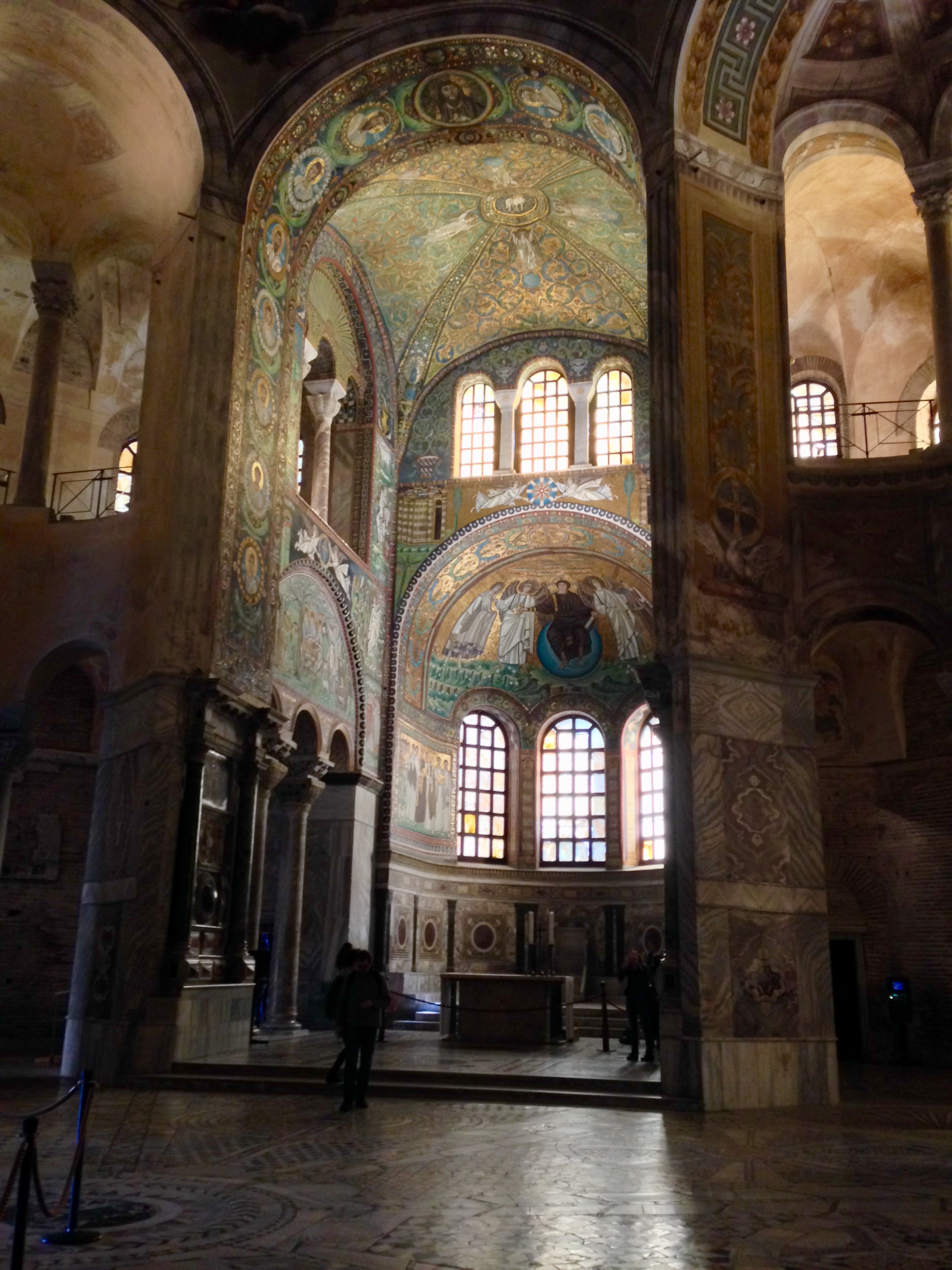
On the morning we visited, the interior of San Vitale glowed in the sunlight that streamed in through the windows of the church.
A photo from across the basilica. Notice the intense patterning even in the marble floor. It’s difficult to stand close to the tesserae at San Vitale. Most of the mosaics are positioned above eight feet. The patterns you see below the windows are mostly marble mosaics. | Photo: M. Yung
As I stood in the grandeur of San Vitale, sheer awe at the handiwork overtook me.
Sheer wonderment…
…at the dedication and tedium.
Sheer astonishment…
…at the skill and collaboration it required to not only conceive the images contained in the mural, but also to source the materials, create the artwork, and execute their application and installation on the high walls of this old, old church.
In the sunlight, the golden tesserae dazzled.
These are actually pieces of gold leaf sandwiched between pieces of clear glass. When they were pressed into place by medieval workmen, the gold tiles were angled to best reflect the sunlight, or the glow of a candle or lantern.
A closer photo of the apse and the mosaic that shows Jesus Christ resting on a globe surrounded by angels. The far right figure in brown carries a miniature version of the basilica, offering it to Jesus in service. | Photo: M. Yung
As we took our self-tour, I stared up and pondered the mosaics and felt nearer to those laborers and artists who spent many years of their lives creating these mosaics. I marveled at their tenacity to produce these works without power tools and machinery, electricity, plumbing and other conveniences.
Would this sort of devotion be practiced today?
I don’t think so, but then maybe it was different for these medieval workers.
Even though creating the mosaics may have been their “job,” would the tedium of producing these masterpieces have been more endurable for those to whom the time of Christ was only four hundred years earlier? True, four hundred years is a long time, but wouldn’t the time of Christ have been within their mental grasp?
To compare, would I find it easier to devote myself to glorifying the Pilgrims who landed at Plymouth Rock? I don’t know of anyone from that era, but I do feel a connection of sorts. I know about their concerns and their motivations. I can identify with them to a degree, while I find it nearly impossible to identify with people of Biblical times. Perhaps medieval workers could.
As I continued in my thoughts, my husband and daughter sought the two mosaics-within-the-mosaics below.
The mosaics of Byzantine Emperor Justinian and Empress Theodora are considered the masterpieces of San Vitale.
The first photo below shows Justinian surrounded by his court, clergy members and soldiers. The emperor holds a bowl that contains bread for the Eucharist. Justinian never visited this basilica, according to Dr. Steven Zucker in this Khan Academy video lesson, but this mosaic was his way of asserting his power and authority from Constantinople, the Byzantine capital.
The figures in both mosaics are highly stylized. Laura Morelli, art historoian and author of The Gondola Maker, explains it this way:
“A more eastern aesthetic characterizes the mosaics completed in Ravenna during this early period. Elegant, slender, flattened figures on a shallow spatial plane stare out with huge, staring eyes.”
The two famous mosaics clearly reveal this style.
The mosaic that shows Emperor Justinian with his court, clergy, and soldiers at left. Even the borders and frames that surround the central image are mosaic. | Photo: Katherine Yung
The mosaic of Empress Theodora rests on the opposite side of the apse and mirrors Justinian’s mosaic. In this piece, the empress carries a chalice of wine for the Eucharist. Wearing a finely detailed gown, Empress Theodora is surrounded by her imperial court and attendants. She wears elaborate jewelry, and, like Justinian, is surrounded by a halo.
The mosaics of Justinian and Theodora are the “pieces de resistance” of Basilica San Vitale. They are found in art history textbooks as supreme examples of medieval Byzantine art. | Photo: Katherine Yung
Ready to finally move my gaze from the brilliance of the gold, I focused on the frescoes that cover the ceiling of San Vitale.
They were completed much later—in 1780—by artists from Bologna and Venice. While they are beautiful, they cannot compare, in my opinion, with the luster of the mosaics.
Frescoes, water-based paintings on plaster, adorn the center dome of San Vitale. Photo: M. YungMy husband and son, at left, gaze up at the frescoes that surround the mosaic-drenched apse. | Photo: M. Yung
I felt our visit was coming to its end, and I noticed that even the floors of San Vitale were intricately decorated. Minuscule marble tiles did their best to distract me from the golden “eye candy” above. Over the centuries, the floor tiles do show some wear, but are amazingly colorful and durable. The most wear is to the floor surface itself, which, in some places within the basilica, contains depressions from heavy traffic patterns from worshipers and tourists.
The detail in the flooring reinforced my thoughts about the devotion of those early medieval artists; they spared nothing—not even the floor—in their pursuit to create a beautiful place to glorify God.
Photo: M. Yung
As we exited the basilica, we took photos of its rustic appearance and its unusual structure of two stacked octagons. Its unusual shape does not follow cathedrals designed in the typical shape of the Latin cross, but instead evokes eastern influence from Byzantium.
From the outside, one would have no idea of the grandeur within.
The contrast between the exterior and the interior of the Basilica of San Vitale is striking. The bricks were repurposed from demolished structures in Rome. Photo: M. Yung
Visiting the Basilica of San Vitale was a lesson in humility, reverence, and connection.
As I walked across the same floors, gazed up at the same artwork, and whispered in the same hushed tones that countless others whispered down through the ages, I knew that my visit was not about sprinkles on Easter cupcakes.
It wasn’t even about the magnificent golden mosaic masterpieces. It was instead about connecting to Jesus Christ and historical Christianity… and in a broader sense, to humanity.
Thanks for reading! Please click “like” so others can find this post more easily. Feel free to leave a comment about what your mind wanders to when you gaze at something truly beautiful.
It’s time to choose a name for your baby, the most beautiful baby who has ever existed in the entire history of the Earth. How do you even begin to accomplish this most important of destiny-defining parental tasks?
Well, based on recent trends, you start by choosing a somewhat traditional name, but then you spell it weird. For example, thinking about Sarah? Go with it, but make sure you spell it Sarrah. Prefer Sydney? That’s fine, just spell it Sidnee. It’s cuter that way, and complicated, too, and besides, everybody’s doing it. All good reasons.
To help you choose a name and spell it weird, below please find a two-step form so you too can make life difficult for your newborn.
Step 1: Once you understand your motivations behind choosing a name for your baby, you’ll know nothing more than exactly why you would do this to a kid. Check no more than two, (okay, maybe three), below:
___I want to make my child re-spell their name a bajillion times.
___I want to take revenge on my child for a difficult labor and/or delivery.
___I want to show the world how creative and individual my child will be and I’m going to do it with my child’s primary identifier.
___I want to make my child repeat the re-spelling of their name, double-check and triple-confirm that it’s right, only to see it still spelled wrong on the receipt, coffee cup, diploma, etc.
___I want to ensure that my child will never find a pre-printed personalized key chain, miniature license plate, or bracelet ever in their entire life, thereby saving me $5.95 plus tax at least three times every time we go someplace new.
___I want everyone to know that my child is so unique, I have no choice but to bestow him or her with an equally unique name that makes everyone ask, “What?! Who?! Whyyyyyy?”
Step 2: Once you understand your “why,” test drive some of the names below. You’ll find more girl choices than boy choices. Not sure the reason, but it seems people spend way more time trying to be cute with girls than boys. Circle your first, second, and third choices, and then apply them to your dog or spouse over a two- or three-day period or to save time, go with your number one choice and force it upon your child for all time.
The names and their traditional spellings are on the left below, followed by the weirdly spelled variants, which by the way, are actually spellings I’ve seen lately on social media and on TV.
Girls’ Names
Abigail–Abagayle
Alexis–Allexous
Britney—Brytani
Cassidy—Kassadee
Casey—Kaci
Chloe—Chloey
Crystal—Chrystle
Emily—Emmali
Hailey—Halee
Katie—Kadee
Kimberly—Kymberleigh
Kinsley—Kinzlea
Lexi—Leksei
Lindsay—Linsie
Madeline—Madalynne
Mikayla—Micayla, Makaila, Makayla
Olivia—Alivia
Sierra—Syiera
Boys’ Names
Caley—Kaylyb
Conrad—Konrad
Jared—Jarid
Jordan—Jorden
Lucas—Lukus
Trey—Tray
Cameron—Kamryn
These are all I’ve been able to collect so far, but they should be enough to get you well on your way to complicating your child’s life. So don’t forget: as the parent, you are in total control here. Consider the long-term effects of your spelling choice… then choose the weirdest spelling you can dream up.
Heard or seen any outlandishly creative spellings for traditional names? Click “like” below and reply in the comments. Also, feel free to correct me if I’m taking this a bit far or have failed to see some redeeming value in the weird spellings of names.









 Concentration camps, including Auschwitz, posted these words: Work sets you free. | Photo:




 Marilyn Yung