Categories
Greece (Athens, Delphi)

Don’t Touch the Marble!

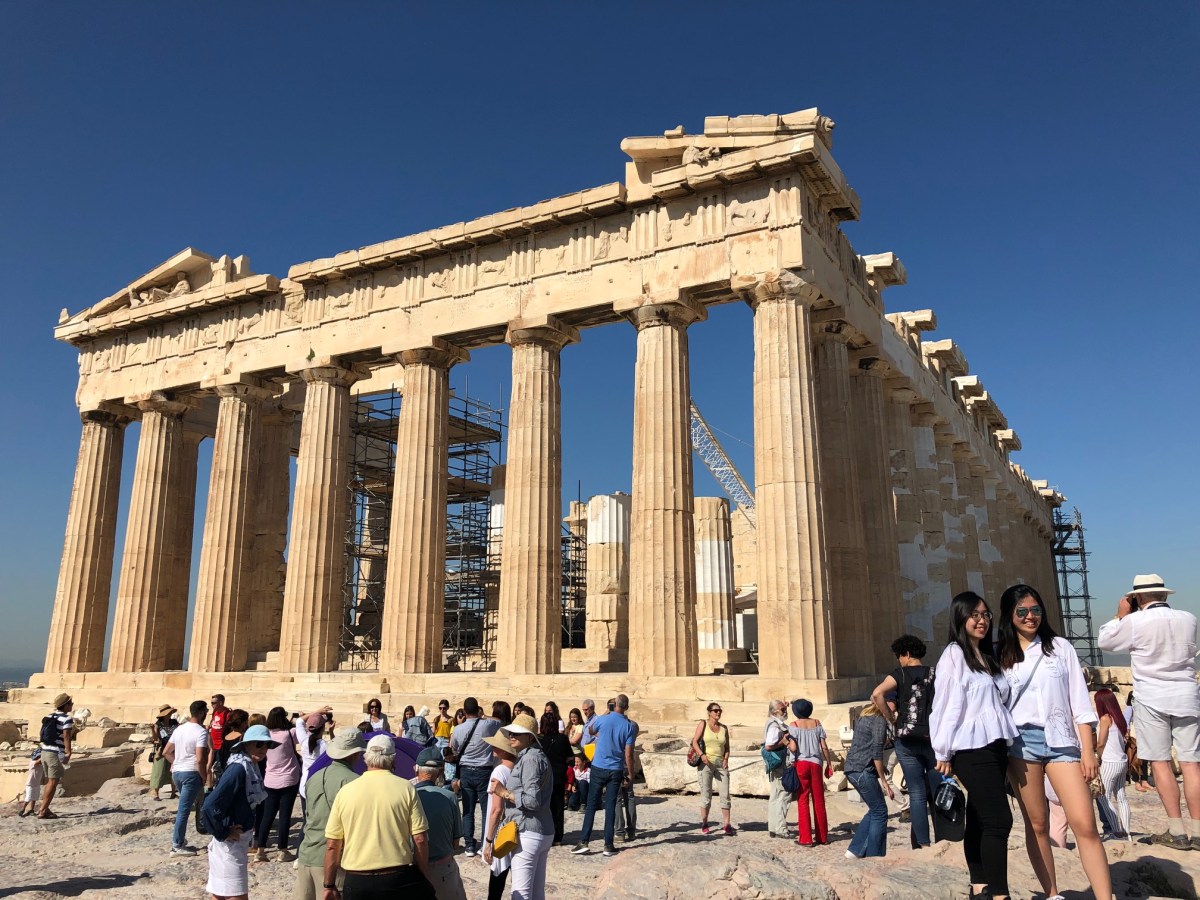
“Don’t touch the marble!” a thirty-something woman called out into the distance from her perch in front of the Parthenon. With one hand on her hip, and another shading her eyes beneath her billed beach cap, she waited and watched. About thirty feet below, a woman with short, curly hair had just rested her canvas tote bag on a large, rectangular-shaped stone and was digging through the bag, searching.

“Don’t touch the marble!” the guard called out again. Oblivious, the woman dug deeper into the bag, craning her neck to see into the folds and pockets that held gum, ticket stubs, or sunscreen.

IMG_8986
Looking up at The Acropolis from the Temple of Zeus Olympios, which was even larger than the Parthenon. Photo: M. Yung

“Ma’am! Please don’t touch the marble!” the guard called out for the third time. The woman shifted the bag against the marble stone, and continued looking.

With this final and futile reprimand, the guard hopped down from the boulder and walked briskly down to the offender. When she arrived, the woman looked up, surprised. The guard pointed at the stone, then turned and motioned to the tattered gray ropes that set the limits on the Acropolis. The woman covered her mouth with her hands, slung her bag over her shoulder, and stepped back onto the walkway. Crisis averted, the guard climbed back to her boulder, placed her hands on her hips, and continued scanning the global audience taking in the Acropolis.

Planning to visit the Acropolis yourself someday?

Avoid being “that tourist,” (and get the most out of your €20 ticket, by the way) with these tips for touring the Parthenon, the Propylaea (with the Temple Athena Nike off to the side), and the Erectheion… the most prominent structures on top of the Acropolis, Greece’s most famous landmark.

  1. If it shines, step aside. Other than a paved walkway, the walking surface on the Acropolis is rugged. Stones jut up from the ground to create uneven areas, including some larger ledges and steps. Thousands of people walk here daily and it’s been this way for millennia. In fact, all the buildings you see on the Acropolis were built or rebuilt during the 500-300 B.C. As a result, the rocks are very shiny and SLICK. Walk on the connecting mortar or other stones. We witnessed one husband helping his wife, who had apparently just slipped, return to the Propylea (the first building you’ll walk through and the entrance to the hilltop) for an early walk back down.
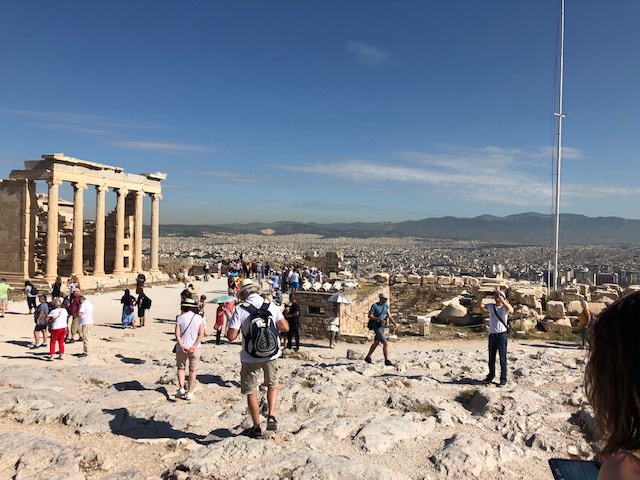
IMG_8999
See what I mean about rough terrain?  That’s the Erechtheion on the left. Photo: M. Yung
  • Wear good shoes. These should be banned on the Acropolis: flip-flops, any shoe without a tread, a wedge greater than two inches, and heels of any height. Believe it or not, I did see women in heels. In the age of Instagram, some people will wear anything for the perfect post. No, you don’t have to wear orthopedic shoes, but definitely wear something sturdy with a tread.
  • IMG_0673
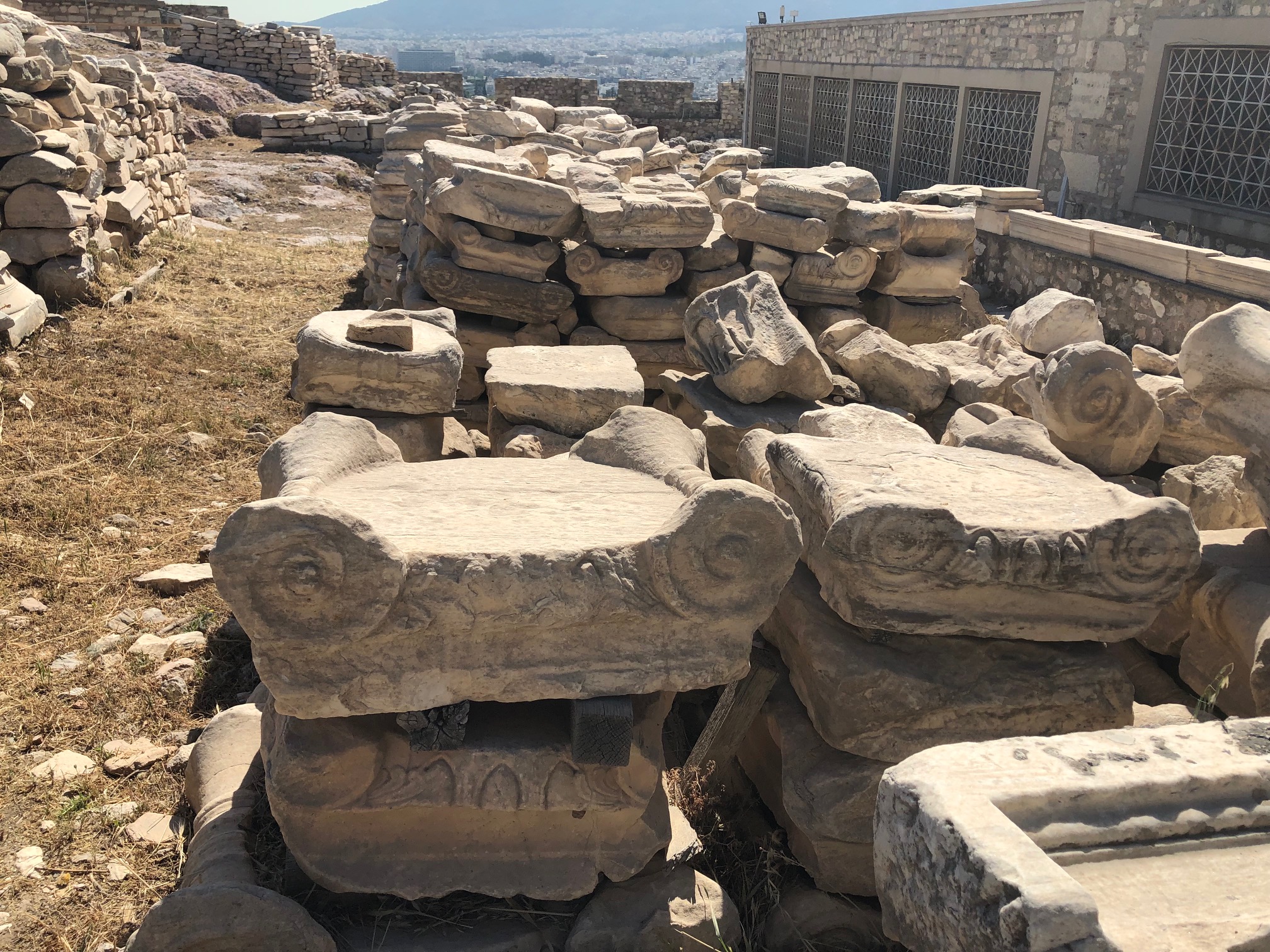
    Here are some of the stacks of remnant pieces from the Parthenon area. The closest section contains fragments of Ionic capitals.  Stacks of Doric and Corinthian capitals were nearby. Photo: M. Yung
  • Be aware of the construction. This is a construction zone and you’ll see a variety of work happening. You may be lucky enough to see a stone carver working on a new marble replacement column. We watched as men strolled across plots of ground covered with mounds of old stones sorted by size, shape, or style.
  • IMG_0950
    Can you imagine being the sculptor assigned or hired to carve new columns for the Parthenon??? Photo: M. Yung

    Also, you’ll see roped-off pits that contain stone walls and equipment near the Erectheion, the temple dedicated to Athena and Poseidon with its five “caryatids,” stunning female sculptures that served as support columns. Other areas on the grounds are filled with huge marble chunks, an iron cannon, and other remnants of past activity.

    4. Get there early. Lines begin forming at 8 a.m. in early June, so be there early to avoid crowds. We didn’t arrive at the ticket booths until about 8:45. As a result, we crept up the steps of the Propylaea with a steady stream of tourists.  I can only imagine how much busier it became as the day continued.

    5. Bring sunscreen. Obviously, you’ll be in direct sunlight for an hour or more. Put on sunscreen before you leave your hotel room, and take it with you to reapply when you’re on top.

    IMG_0633 (1)
    This photo shows the Erechtheion and a construction office on the right. Various piles of stones, column pieces are strewn about on the grounds. This area was not accessible to the public. Photo: M. Yung

    6. Finish your food before entering. Food is not allowed inside the gates. When we entered and showed our ticket to the man at the gate, he requested I finish the cookie I was eating with my dose of Ibuprofen. He was polite about it, but did ask that I finish it before going much further.
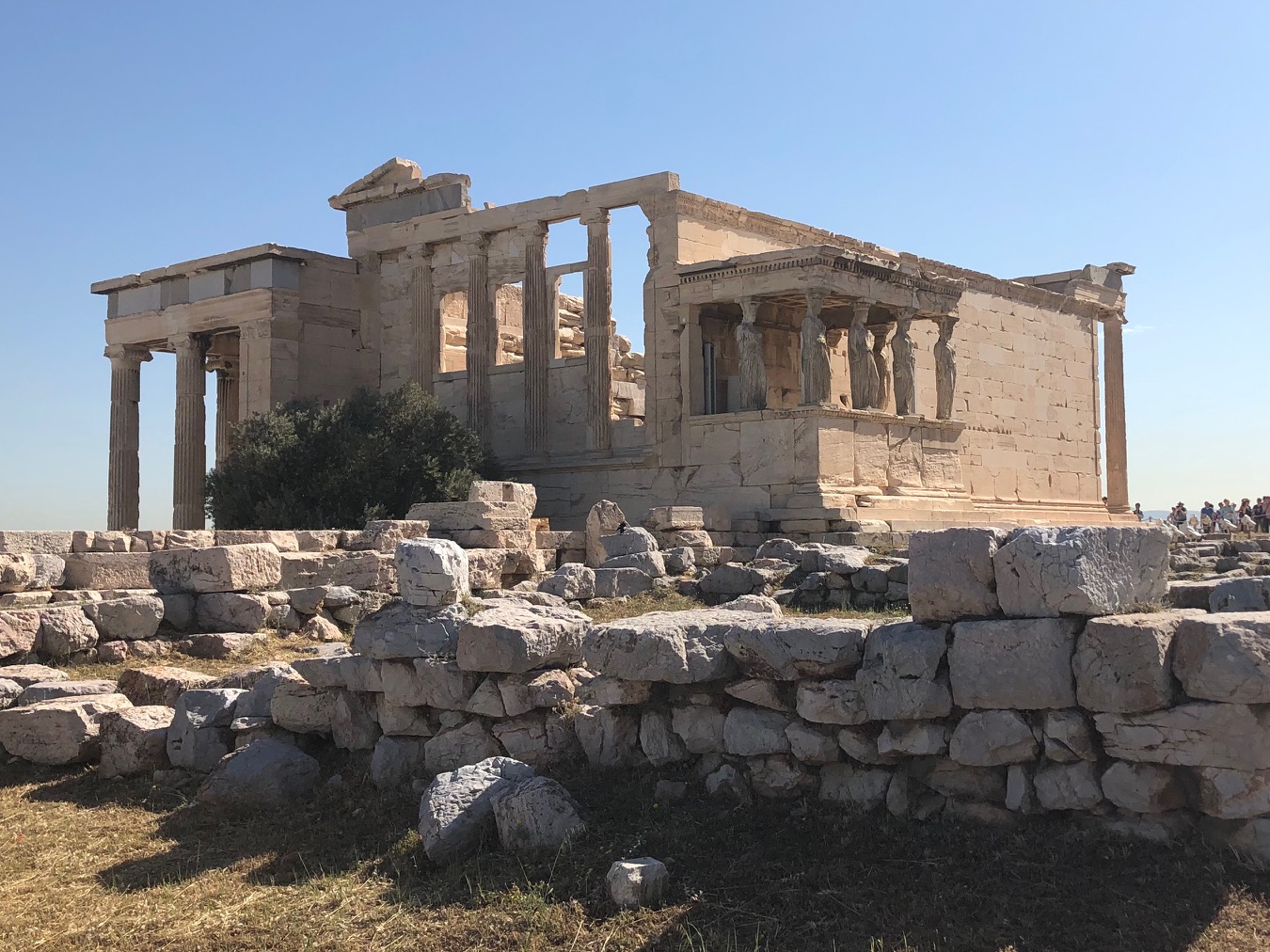
    IMG_0637
    This is a picture of the side of the Erechtheion that shows the caryatid statues on the right. These are exact copies of the originals, which are in the Acropolis Museum except for one that’s at the British Museum. It was removed by Lord Elgin, British Ambassador to the Ottoman Empire, in 1801. Photo: M. Yung

    7. Leave your water at home or bring an empty bottle. If you don’t want to lug the extra weight of water in your backpack or purse, you don’t need to. Depending on the crowd, the walk up will only take twenty to thirty minutes, after which you can venture over to a water fountain adjacent to the Parthenon. There you’ll find three bubblers and one bottle filler. The water is clean and cold. In fact, there are water fountains here and there across the grounds, not only  next to the Parthenon, but also below near the Theater of Dionysus.

    And finally,…

    8. Don’t touch the marble. Avoid the reprimand. If a stone is especially light in color, has an unnatural shape (as if it’s been cut or chiseled), or otherwise appears to have been shaped by human hands, don’t touch it. It’s probably marble. Just think, all those missing stones from the structures have fallen nearby and the walking paths weave among them. If you think a stone could be marble, it probably is.
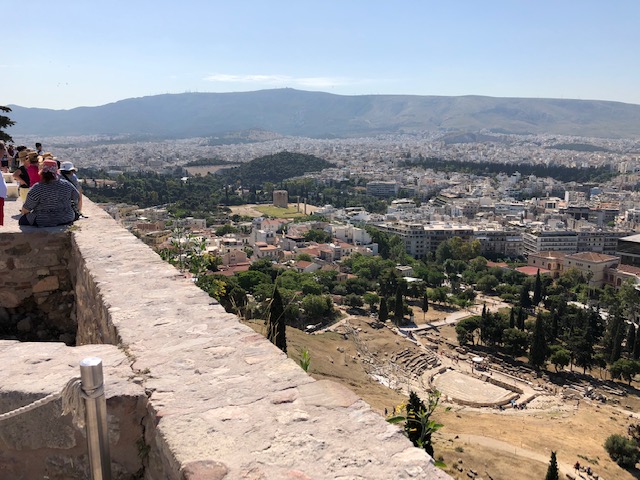
    IMG_9018
    Looking down onto the Theatre of Dionysos from atop the walled limestone crag known as The Acropolis. | Photo: M. Yung

    We toured the Acropolis on Friday, May 31, and spent about three hours on the site. The top (the site of the Parthenon, the Erechtheion, the Propylaea, and the Temple of Athena Nike) occupied about two hours, while other structures on the slopes of the Acropolis (such as the Theatre of Dionysos and The Odeion of Herodes Atticus) balanced out the morning. Following our tour, we lunched at The Cave at The Acropolis, a restaurant in the Plaka neighborhood district around the base of the Acropolis. I’ll be posting more about our trip. Follow my blog for updates!

    Categories
    Greece (Athens, Delphi)

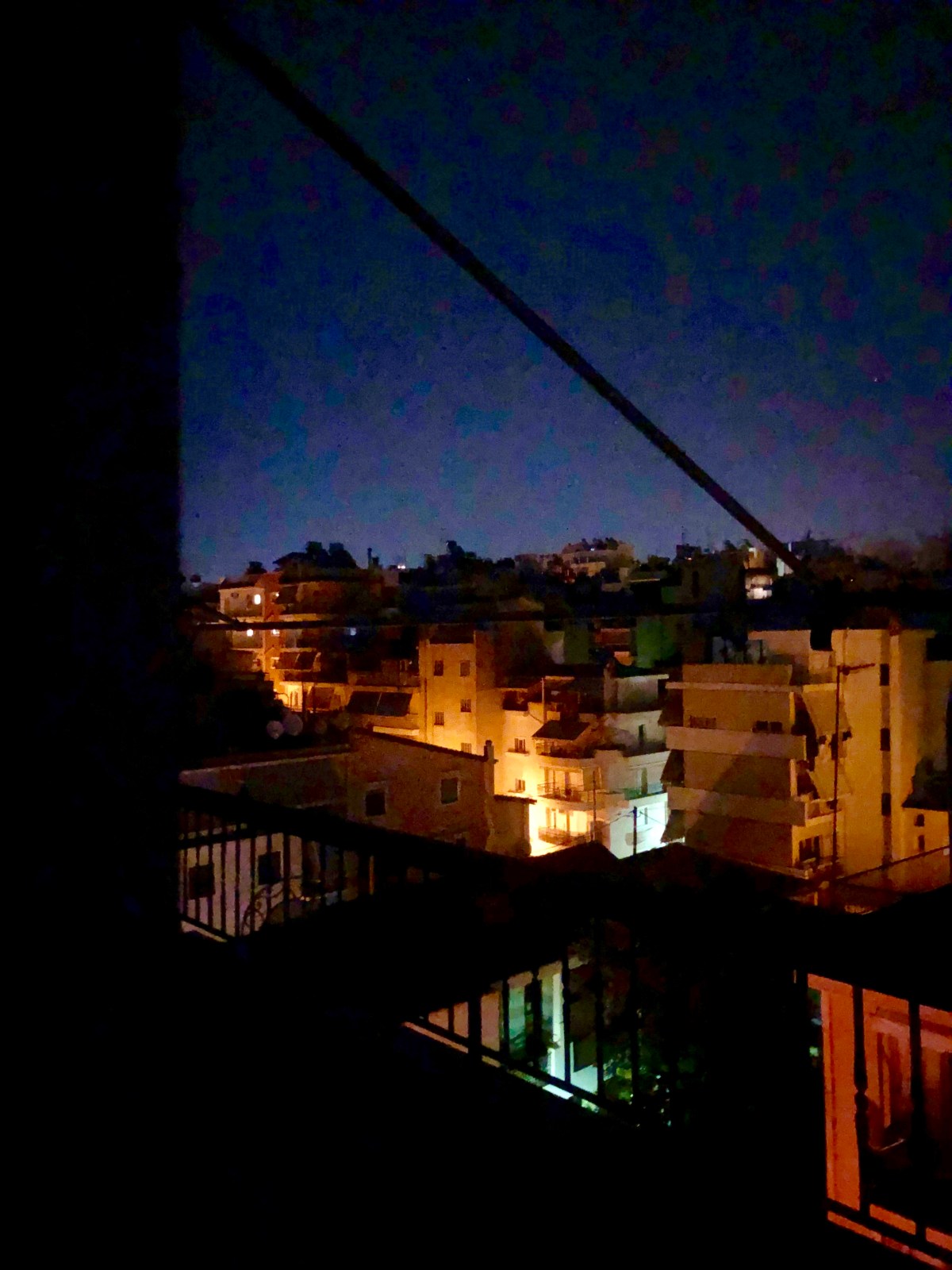
    Athens at Night from a Balcony on Sostratou

    The hum of an occasional car darting through the maze of streets below

    The mournful hiss of a street cat

    The cubist composition of layered apartments

    A woman’s silhouette within a window

    The clanging of bells, frenetic with energy

    The clink of forks and knives on ceramic plates

    The glitter of solar-powered water heaters

    The fizz of a scooter shooting around a corner

    The bored bay of a dog in the dwelling below

    The squeals of children running and playing

    The Parthenon, silent and glowing, supervising the

    Sights and sounds of Athens at night

    IMG_9062
    Another photo from our balcony. On the horizon, the Parthenon glows from the Acropolis.

    Thanks for reading! Last Thursday evening, I recorded what I saw and heard from our balcony in Athens. I hope you feel as if you were there with the details I gathered. Follow my blog for more from our excursion to Greece and Skopelos Island, specifically.

    Categories
    Italy Motherhood parenting

    How far will you go to teach your daughter to lead?

    And there I was, simply her mom letting her be brave so she could develop this thing called courage.

    When it comes to teaching our daughters to lead, how do we do that? How far should we go? Encourage good grades? Encourage career over all else? Do we teach them to forge ahead first? To seek and take advantage of each and every opportunity that comes along?

    How about if we teach our daughters this: to have courage. “Courage, fortunately, is a teachable and learnable skill,” according to Bill Treasurer, Kimberly Adelman, and Laura Cohn of Giant Leap Consulting in their article, “The Power of Courage for Women Leaders.”

    “The trick to building courage competency is to purposefully move outside of your comfort zone on a regular basis. Don’t move so far out as to become petrified with fear, but enough that your body starts to give you the physiological cues that you’ve become uncomfortable,” write the authors.

    My daughter knows these physiological cues. Two years ago, she was completing a three-month internship in Venice, Italy at the Peggy Guggenheim Collection, a well-known modern art museum located on the Grand Canal. At first, her foray to the floating city caused much stress and worry, especially in the early days of her time there. She experienced stomach aches, anxiety, and a lack of appetite.

    She also experienced environmental and social challenges: Venice’s maze-like corridors, the language barrier, new colleagues and workplace. And then there was the peeping Tom.

    However, as her internship continued, she became accustomed to her experience there, and she was able to enjoy it completely. It was good to feel courageous despite the difficulties. I remember my daughter saying this about her day-to-day experience alone in Italy: “I became comfortable being uncomfortable.” She even said one day about a month after she returned home that she missed the feeling of discomfort she had become so accustomed to.

    “Moving into your discomfort zone is how you learn and grow,” writes Treasurer. Believe it or not, true discomfort will build courage. And courage is at least part of the solution to overcoming the organizational biases that “inadvertently favor men” for leadership roles, writes Treasurer, Adelman, and Cohn.

    Well, guess what? My daughter recently returned to Venice for two months for another internship… to help staff the U.S. Pavilion at the Venice Biennale, the renowned international exhibition of contemporary art from countries across the globe.

    In the weeks prior to her departure, my friends and co-workers asked me how I felt about her return to Italy. They asked me:

    “It’s so far away. That doesn’t bother you?”

    “How are you handling it?”

    “Aren’t you worried about her?”

    I told them that I was fine with it. I told them that I encouraged her to apply for the opportunity.

    And then I doubted myself and wondered…

    Should I feel this unfazed?

    Am I being careful enough?

    Should I be so willing to let her go so far?

    This was followed by a confident second or two when I asked myself, “Aren’t I just doing what mothers should do with their daughters?”

    Shouldn’t I let my daughter be brave? Let her travel? Let her get so far outside her comfort zone that being uncomfortable feels comfortable? Isn’t this what the authors of The Power of Courage for Women Leaders are getting at? After all, aren’t I just allowing my daughter to grow in ways I was never encouraged to? Independently? Without commitments?

    Don’t we encourage our sons this way?

    And yes, I get it, she’s an adult and completely able to navigate across time zones, oceans, and mountain ranges. And yes, she did eventually meet up with a roommate. But until then, she was simply my daughter venturing forth alone in a big, big world. And there I was, simply her mom letting her be brave so she could develop this thing called courage.

    So, is this the price I must pay—this apprehension and fear that comes and goes when I imagine her navigating Venice, alone, head down, leaning into the misty winds of early May? Is this the price I must pay to demonstrate to my daughter that she deserves to be brave and to venture forth into the world?

    Is this the price I will pay to teach her to lead with courage? Will I go farther or have I gone far enough?


    These are the wonderings of an anxious mother’s heart. Feel free to leave a comment to share your thoughts. Have you ever watched your child venture forth into the world, yet had your own reservations about watching them do just that? Follow my blog for more posts on parenting, travel, and education.

    Featured Photo: Lorri Lang on Pixabay

    Categories
    Greece (Skopelos) Life lessons

    What Dream are You Trading for New Hardwood Flooring?

    The linoleum flooring in my kitchen is really old. In fact, it’s no longer white. It’s now off-white with an uneven pattern of nicks and dings that has, over the past twenty-four years, resulted in a floor that looks ugly, dirty, and tired. The linoleum, with its four-inch gray grid, was patterned to resemble white ceramic tile. And it did resemble that for the first five years, which was as long as we had originally planned for the flooring to last.

    But, if you’re a homeowner, you know how that goes. Often, those initial fixtures outlast their welcome. And for us, that has especially been the case because we’ve never been in a financial position to update our flooring AND pay our bills.

    Owning a ceramic studio, freelance writing, college adjunct positions, public school teaching, and an array of part-time retail stints have always managed to pay our basic expenses, but rarely anything additional. Hence, the ugly and outdated off-white linoleum.

    So what does one do when one has a dream but also needs new kitchen flooring? My answer: go for the dream.

    Yes, in our case, the practical solution would be to update the floor… to build value in the largest investment my husband and I have ever made. But we also know that paying for a new floor will only defer our creative goals. In other words, practicality has its limits and we have quite a dream: one month in Greece next summer.

    My husband and I are travelling to Skopelos, a Greek island in the Sporades archipelago east of the mainland. Here, my husband will work a three-week residency at The Skopelos Foundation for the Arts. I, on the other hand, plan to experiment with a new writing genre (travel writing) while lingering on the island for an extended time.

    greece-2766305_1920
    Photo: Dimitris Vetsikas on Pixabay

    Staying anywhere for an extended time requires money, and no, we don’t have the funds right now to go, but we are saving. We have ceased eating out on Friday evenings, for example. We are putting away what we can, and plan to have the majority of our trip paid for before our departure date.

    Of course, that departure will lead to a return date. Once home, when I step into our kitchen, flip the light switch, and see the same old linoleum, what thoughts will cross my mind? Will I be glad I still have that flooring because keeping it allowed me to write in a new environment and experience new cultures and people? Or will I scowl at the floor, its ugliness reminding me of what I will still have in my life: uncertainty, bills to pay, the meager income that results when both spouses teach?

    Will I be grateful for the dream that we chose to chase? Yes, I think so.

    In the end, I believe that one can afford what one wants to afford. And when it comes right down to it, I would rather marvel at a Greek monastery than new hardwood flooring. If I can’t have both, I’ll take the dream.


    Many things have happened since I originally published this post last fall on Medium.com. My husband was offered a full-time position at a nearby university, and we are moving from our home (with its aging linoleum) later this summer after our stay in Greece. Since we’re moving into a new home, we’ll take a pass on the upgrade to new hardwood flooring. 

    Categories
    Memoir & Narratives Reviews of Books/Music/Films

    Madeline, Me, and the Cathedral of Notre Dame

    The classic children’s book caused me to feel the tragedy of the fire

    I don’t possess any personal connection to the Cathedral of Notre Dame in Paris. I’ve never even been to the City of Light. I don’t have a selfie to post or a brochure or keychain from the grand gothic masterpiece that was nearly destroyed by fire last week.

    I do, however, have a copy of Madeline by Ludwig Bemelmans, the classic 1939 children’s book, somewhere in our house.

    At least, the book supposed to be here. I vaguely remember stowing it away in a box several years back in the attic for safe-keeping with other beloved and well-worn children’s books my daughter and son read with me in recliners and on couches some twenty years ago.

    1_BAHbc0E3F_FWOxEYeknDTA
    Photo: Unsplash

    It was a sweet story to savor about the adventures of Miss Clavel and the eleven little girls plus Madeline, who wasn’t afraid of mice and “loved winter, snow, and ice.” The story’s closing lines, “‘Good night, little girls! Thank the Lord you are well! And now go to sleep!’ said Miss Clavel,” ended the tale every time with poignancy and satisfaction.

    Because my only association with the cathedral is through Madeline, my thoughts returned to the 1940 Caldecott Honor-winning book upon hearing of the fire that swept through Paris’ Notre Dame Cathedral on April 15.

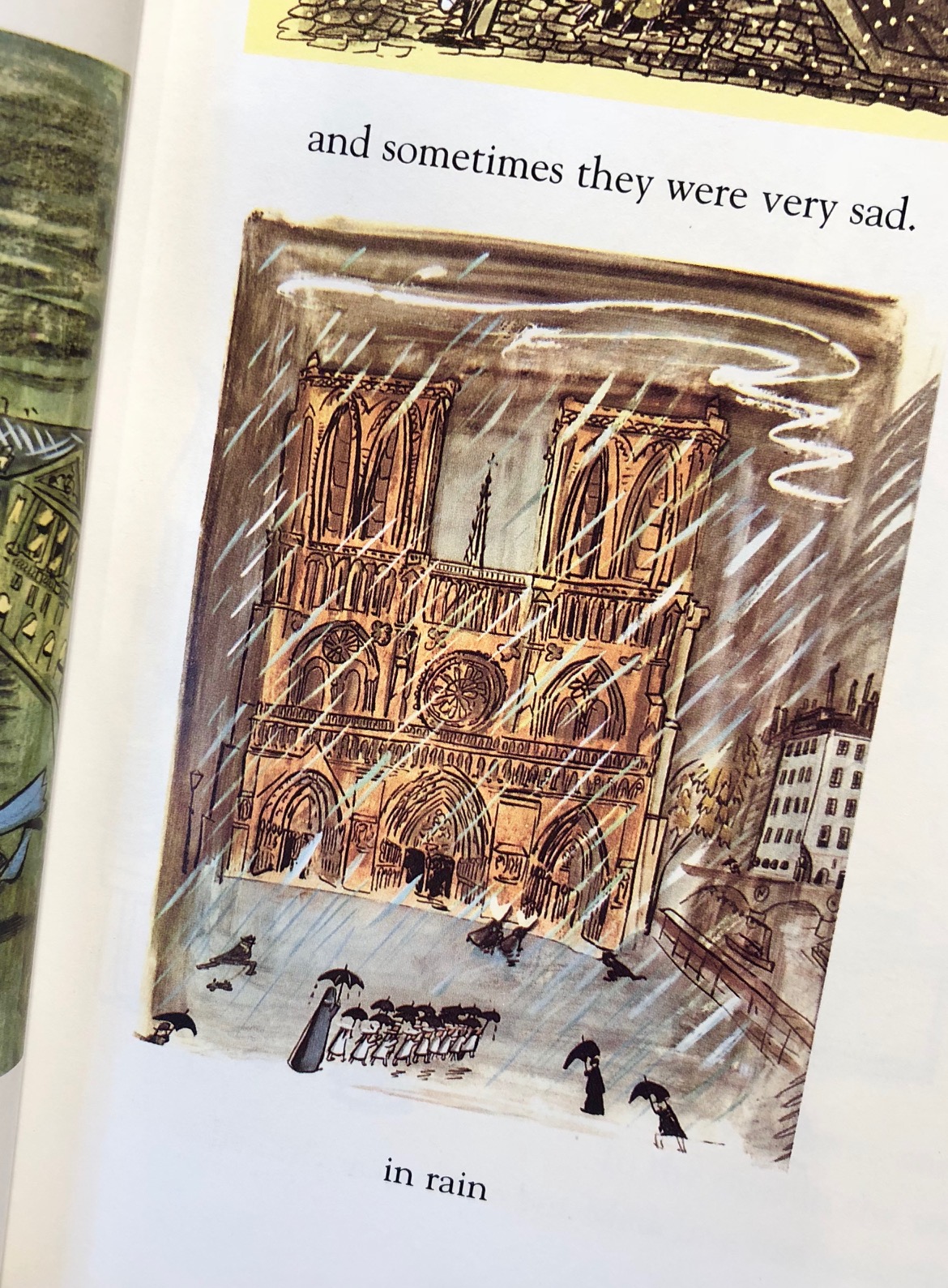
    Somewhere within my copy of Madeline, if I could find it, is Bemelmans’ illustration of the cathedral’s front facade with its nearly identical towers. I remember that the picture looms large on the over-sized page and appears dreary, especially since the church is depicted during a downpour.

    IMG_8619 (1)
    I do have a “copy” of Madeline inside an anthology of classic children’s books from the 20th century. The full-size images are printed four to a page, so the illustrations don’t have the presence that they do in the stand-alone storybook. 

    Like thousands of others last week, I was saddened by the images of the violent flames raging through the ancient timber roof, toppling the spire, and bringing a centuries-old structure to its knees within minutes.

    Seeing any building burn is difficult, but as I watched Madeline’s cathedral burn last week, it was especially so. And yes, I realize that part of my endearment to the cathedral could be chalked up to nostalgia for my kids’ childhoods; however, there was much to lose in that awful fire when one considers…

    Despite the damages and loss of important areas of the cathedral, however, I do know that I gained this: a deeper appreciation for the power that a children’s book can possess. Last week, Madeline helped me to connect with others around the world saddened by the cathedral fire.

    No, I haven’t been to Paris, but a classic children’s book–and not a selfie–transported me there. Thanks to Madeline, I felt and understood the loss of the fire when I wouldn’t have otherwise.


    Books can provide more than just entertainment. Thanks for reading! Feel free to leave a comment and follow my blog for more stories on travel, art, and education.

    Categories
    Art & Architecture US (Southwest) US Travel

    Frank Lloyd Wright Wronged

    It’s important to see the beauty in our midst.

    One day many years ago when we lived in Phoenix, my husband and I were invited to visit an acquaintance and her young daughter who happened to be occupying a house designed by the world-renowned architect, Frank Lloyd Wright.

    While cruising down Camelback Road, we would often look up and scan the cactus-dotted hillsides to spot the house nestled in the rugged terrain. We would admire its unusual appearance with its exterior winding walkways, circular windows, and austere concrete block masonry. Wright originally designed the 2,300 square foot structure for his son, David, and his wife, Gladys. It was built in 1952.

    The home was intriguing and beckoned a closer look, so we took up our friend’s offer one sunny afternoon to visit the home, whose design was named by the senior Wright, “How to Live in the Southwest.”

    living room
    In recent years, the home was restored and made available for tours. | Photo: for Media Use | http://davidwrighthouse.org/media/

    We’re not sure about the arrangement between the homeowners and our acquaintance. Maybe she was renting it or acting as a caretaker while the owners were away temporarily. We can’t even recall her name now.

    Perched in the Camelback Mountains, the spiral home was indeed stunning and modern and magical.

    It was also trashed.

    Bedroom floors held oceans of wadded-up loads of laundry. Dirty dishes lined the kitchen counters. Smudges and stains sullied the bathroom mirrors and floors. Crumpled junk mail littered the hallways. We were dumbfounded.

    All this disappointment obscured the home’s jaw-dropping features: an entrance preceded by a spiral walkway ramp, ubiquitous concealed built-ins, custom carpets, a rooftop deck, panoramic views of the rocky desert terrain, and Philippine mahogany ceilings, cabinetry, and furniture.

    As we roamed through the home, with its desert views, calming circular design, and ingenious use of space, our acquaintance apologized for her poor housekeeping habits. “Oh, well… yeah,” we answered, laughing nervously, embarrassed for her—and the house.

    A few years ago, I was curious about the status of the home and wanted to see what had become of it since our move to Missouri about a year after our tour. So I googled the house while my husband and I reminisced about our Phoenix experiences.

    Yes, the house did survive that messy time. And many people today care about the newly named David & Gladys Wright House’s existence and condition.

    kitchen
    The kitchen as seen during public tours. | Photo: for Media Use | http://davidwrighthouse.org/media/

    After the Wright’s deaths in 1997 and 2008, concerned citizens protested the house’s demolition, which was planned by a developer who had purchased it. In 2012, a Las Vegas attorney devised a strategy to preserve and operate the home and grounds for tours and cultural performances. However, concerns about traffic and noise from the surrounding neighborhoods blemished the whole affair. Eventually, the home was donated to benefit Scottsdale’s The School of Architecture at Taliesin, formerly known as the Frank Lloyd Wright School of Architecture. However, those agreements have been abandoned. The home is now for sale for just under $13 million.

    outside
    The exterior in recent years. Photo: for Media Use | http://davidwrighthouse.org/media/

    And to think our friend had trashed it all those years ago. How did she not revel in the structure that couched her every daily activity in architectural significance? Was she, like many of us, too distracted? Depressed? Too concerned with meeting daily obligations to notice? Too busy being human?

    It’s understandable. Life happens.

    But it’s still important to try to see the beauty in our midst. The beauty of a yellow leaf resting against a rusty brick sidewalk. The beauty of the intricate shell of a snail. The beauty of an architectural wonder your all-too-human eyes have become accustomed to.


    Thanks for reading! Ever had a similar experience? Feel free to leave a comment or click “like” to show that this story resonated with you. Also—click follow or enter your email address to receive a notification when I publish a new post. 

    Categories
    US (NYC) US Travel

    Five questions not to ask New Yorkers when you’re building a travel writing portfolio

    If travel writing is all about storytelling, then I’m in big trouble

    1_VvkWSWNY1it7LQX5scBmuQ
    This guy didn’t want to answer any of my deep questions. Photo: M. Yung

    As a Midwesterner and an aspiring travel writer visiting the Big Apple over spring break, I wanted to use a trip to New York City to build my portfolio. Sounds easy enough, right?

    However, good travel writing is all about storytelling, or so the big-time travel bloggers tell me. And in order to tell a story, one must fully immerse oneself in a new culture. One must talk with the natives, learn the local customs, and ask the hard questions. Y’know, the questions that reveal fresh cultural perspectives and which way is north.

    Watch out world, my travel storytelling is gonna take off any minute based on the slew of revelatory conversations I generated with New Yorkers by asking them these five riveting questions:

    Number 1: Where am I?

    I asked this question of a 60-something man standing against a concrete column at LaGuardia Airport. I was trying to find the pick-up spot for the Uber I had reserved. “D Terminal. The lower,” he informed me before shifting his feet and looking away.

    See what I mean? There’s good fodder for a story.

    Number 2: How do we get to the ferry?

    The 20-something construction worker rose from the barrel he was leaning against and walked toward us. I think I had interrupted the break he had been taking at the far west end of Huron Street in Greenpoint. He pointed one block down, toward India Street, just south of where we stood. “Go through all the construction, keep to the right, and you’ll get there,” he offered.

    Can’t wait to build a ten-minute read off that one, I told myself.

    Number 3: Why do you think I need a fork?

    Just as I uttered this profound query,  a rice noodle slinked off my chopsticks, splashing a drop of broth onto my glasses. The young waiter at Lao Ma Spicy in Greenwich Village had just walked by our table and offered me an alternative utensil. Apparently, I seemed to be struggling.

    I mulled over his offer. My stomach rumbled. “Yes, that would be fine,” I said. I set down my chopsticks, blotted my glasses with the corner of my napkin, and waited for a fork to appear.

    A travel tale for the ages, folks.

    Number 4: Is this train headed south?

    When I asked this head-scratcher, I had just become separated from my daughter as we headed back to our flat one evening. She had boarded the train; I missed it. Man, those doors move fast. So I hopped on another train on the opposite side of the platform. After finding a seat, I wanted to verify that I was indeed on the right bullet to Brooklyn. I asked an Orthodox Jewish man next to me; he looked up from his scriptures and confirmed that yes, the G train would take me south.

    A novel will come from that encounter. I just know it.

    Number 5: How do we get out of here?

    After wandering around the subway maze that exists below Times Square, I posed this question to a man striding by in a navy blue uniform. He looked to the ceiling, waved his finger back and forth as if tracing some imaginary constellation and replied, pointing off in the distance, “Take that train to Court Square.”

    Yet another meaningful exchange.

    All right, maybe my conversations weren’t the kind to evoke rich and meaningful dialogues upon which to build fascinating tales of travel and intrigue. Oh, well. Maybe next time I’ll be able to focus on the people and places I’m experiencing instead of merely focusing on how to navigate public transit.

    So, thank you, New Yorkers, for exploring my existential wanderings on street corners and in subway stations, and for not ducking away too quickly when you realized that I was just another tourist, confused, bewildered, and amazed at the city you know and love so well.


    My daughter and I visited NYC for a week in mid-March. We asked questions when we needed to, just not ones that will give my travel writing the shot in the arm that it needs. It was a great trip, nevertheless. Feel free to leave a comment or follow my blog for more. And thanks for reading!

    Categories
    Art & Architecture US (NYC) US Travel

    Stop and Gawk: The MTA’s Newest Mosaic Stunner

    You’re a lost cause.

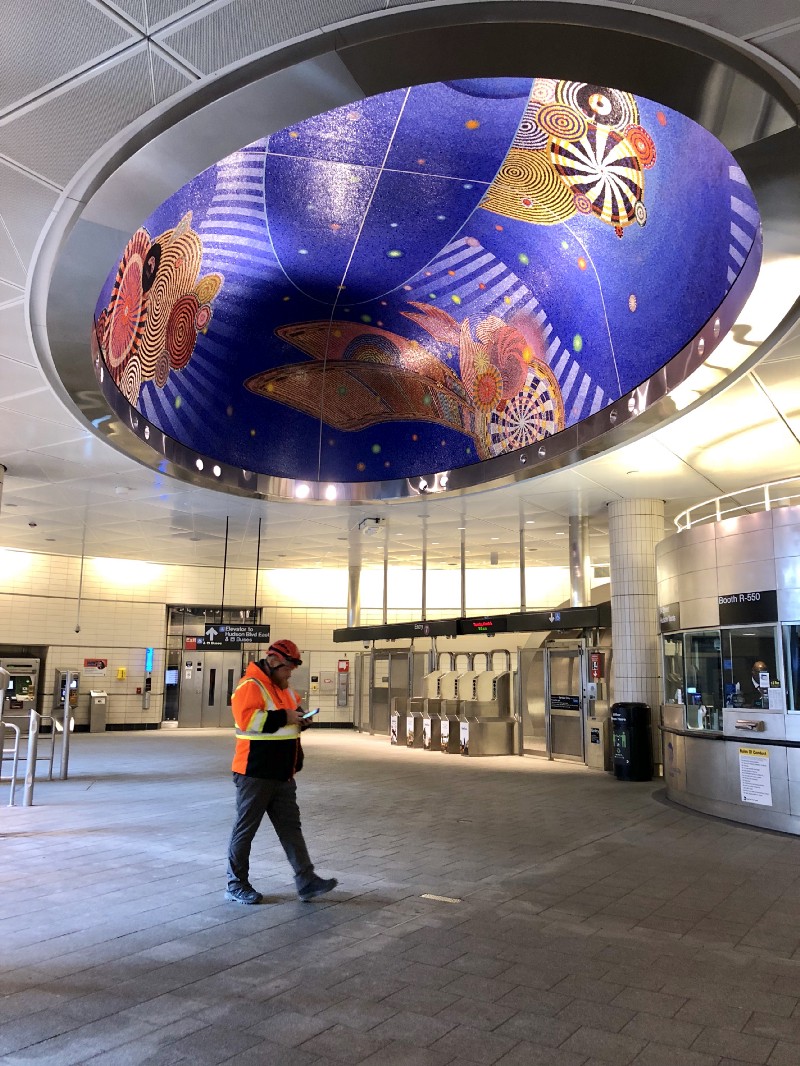
    When you push against the turnstile to exit the subway at 34th St.-Hudson Yards in New York, you can’t help it. The brilliant cobalt of Funktional Vibrations snags your attention and stops you in your tracks. That’s okay. In an hour or so, this last stop on the 7 line will be bustling and you’ll have to get out of the way. But for now, go ahead and gawk.

    After all, you came all the way over here, one day before parts of the Hudson Yards complex even officially open, to see the latest and one of the largest additions to the public art collection of the Metropolitan Transportation Authority (MTA). Funktional Vibrations is a mammoth mosaic (2,788 square feet, according to artnet news) that fills the ceiling of the station’s mezzanine and then oozes outside onto the wall surfaces above escalators.

    Created and designed by fiber artist Xenobia Bailey, Funktional Vibrations riots on a field of cobalt blue within its dome.

    mezzanine
    Funktional Vibrations in the mezzanine. | Photo: M. Yung

    It’s colorful. Abstract. Lava lampy.

    Kaleidoscopic in color and pattern. And you notice there’s an Atlantic vinyl record, too, tucked into the design. (It’s the black dot on the left side of the photo below.)

    A closer look. | Photo: M. Yung

    To your eye, Funktional Vibrations pulsates with life. “Bailey sees the work as speaking to the universal idea of creation and has created artwork that vibrates with energy,” according to an MTA website article. “(Bailey) refers to her accumulation of materials as in the tradition of African-American art—reflected in the music of the 60’s she grew up with—and its material culture and design, where one made do with what was available and made it into something new and wonderful.”

    So that explains the Atlantic record, you think… an earlier era’s musical relic retrofitted for contemporary times. It fits perfectly—seamlessly even—into the mandala-like charms and spheres that vibrate all shape-shifty and cloud-like across the glass mosaic cosmos.

    Bailey, originally an ethnomusicologist (here’s what that means!), worked in costume design before transitioning to fibers, specifically crochet, as noted by Manhattan’s Museum of Arts and Design. She is known best for her colorful crocheted hats and mandala design. Funktional Vibrations evokes that aesthetic, which observes African, Native American, and 70’s funk motifs.

    So how does an artist who specializes in fibers transform her designs onto glass tile? With the assistance of mosaicist Stephen Miotto of Miotto Mosaic Studio in Carmel, NY. In fact, Miotto’s team have helped many artists selected by MTA’s Arts and Design Program craft and install their mosaic interpretations.

    tesserae
    A detail shot of the outer wall surface. | Photo: M. Yung

    You learn later that Funktional Vibrations includes a total of three—not two—mosaic installations by Bailey. You vow to return another time to photograph the third. For now, you revel in the vibrancy, the touch of the human hand, and the simple rush of this subway stunner.

    me
    Funktional Vibrations was worth the search. | Photo: K. Yung


    I went to New York City with my daughter in 2019 for spring break. I’m still tripping out over the mosaics (and the tile work in general) that adorn the entire subway system. How did I not know about this underground art museum? Follow my blog for more posts on subway artworks.

    Categories
    South Africa

    Postcards from the seductive edge of South Africa

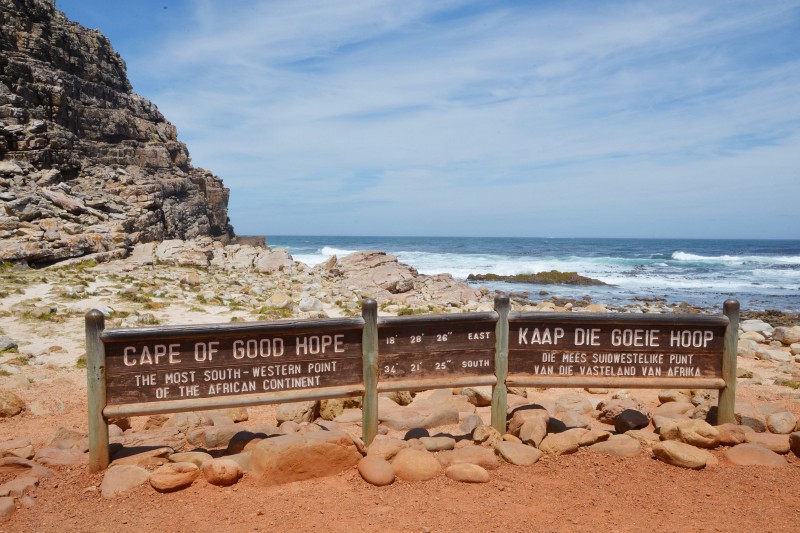
    Peering from the Cape of Good Hope

    What is it about edges that attracts us? Why do we gladly stand, albeit timidly, at the precipice of a cliff? Why the compulsion to see the very last tip of land? When all that we know for sure is safely and surely behind us, why linger at the edge to gaze squinty-eyed at the breathless gap before us?

    The Cape of Good Hope is the ultimate edge experience. It seduces with the wild, the open, the unknown.

    1_l7H_QIvuBnjaTvMKPyESpw
    Photo: Pixabay

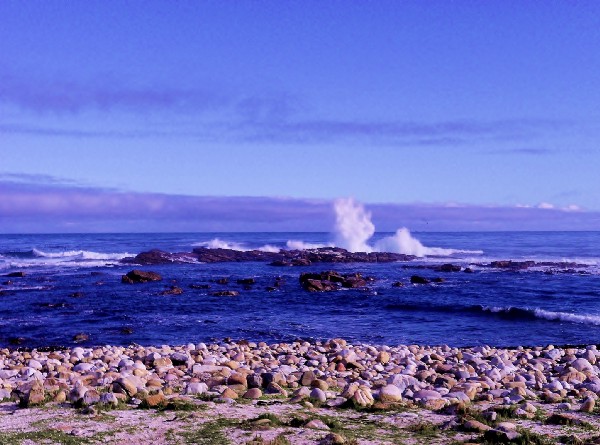
    The rugged outcropping holds what many believe to be South Africa’s southernmost grain of sand and its southernmost sun-bleached rocky beaches. (Actually, Cape Agulhas, 95 miles east, is the continent’s most southern point.) No matter. The Cape of Good Hope holds our fascination.

    waves
    Photo: M. Yung

    And because the edge is there, the people arrive. In cars and SUVs, pickups and taxis, they arrive and park along the asphalt road and near the Cape Point Visitors Centre.

    They park, step out of their vehicles and walk south toward the vast emptiness. They walk single file along the road. They say “Excuse me” to others they pass who have already had their turn. They notice the hardy purple daisies—here, vegetation of South Africa’s Fynbos biome—that line the road.

    1_BIUFZOBVaRDwmSsIlEiWhA
    Photo: M. Yung

    They eye the ostriches grazing in the distance. They see the large kelpy swaths that flutter to shore and snag on the rocks and driftwood from unknown, faraway voyages. They stand on tip-toe in the cool gusts that stir and blend the merging waters of the Indian and Atlantic Oceans.

    They smile, teary-eyed, into the blinding noonday sun for photos to mark this occasion. They know they will never return.

    1_FeZTkPfLrVCvq4TdoGfmJA
    Photo: M. Yung

    For many of us traveling from other continents, the pilgrimage is made to the Cape of Good Hope for the first and last time. We know this.

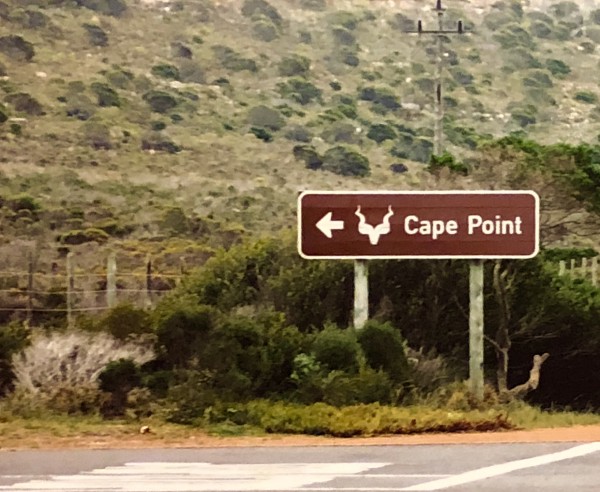
    Tucked inside airliners that require eleven hours to traverse Africa, we envision our eventual walk on the beach at the Cape of Good Hope. We land at Cape Town, fit in a night’s sleep and make the 45-mile southerly drive to arrive at the inevitable, exotic edge.

    We peer into the distance at the unknown, watery wilderness, teetering at the tip of South Africa. We stare at the seduction, we embrace the edge… and then we leave.


    Thanks for reading! We traveled to South Africa with family in 2012. I’m documenting some of my memories from the trip in short essays. Next up: touring the Cathedral of St. Michael and St. George in Grahamstown.

    Categories
    Italy Italy (Venice)

    Dear Venice… We have to talk.

    Finally, I’ve found a city I can trust myself with — Ravenna, Italy.

    I didn’t mean to fall in love. I wasn’t looking for someone new. I had never even heard of Ravenna until I went to Italy.

    But, Venice, I’m torn. In so many ways, Ravenna attracts me.

    It’s untouristy. Affordable. Strangely familiar.

    And yes, I’ll admit that although our relationship was brief and passionate, it has withstood the test of time, Venice. After all, I still long for your watery passageways and roaring, rushing boulevards. I fantasize over your shimmering lagoon and all those glossy gondolas slicing through the wakes of vaporettos, taxis, delivery boats.

    But Ravenna, well… Ravenna is different. It grounds me. Located just three short hour away from you by train, its rugged stability thrills me in a comfortable, predictable way.

    Finally, I’ve found a city I can trust myself with.

    Ravenna is real. For one thing, there are cars. There are people looking right and left. There are horns blaring instead of gondoliers chanting gondullah gondullah gondullah.

    IMG_3731

    And Ravenna’s mosaics! That austere 6th-century Byzantine architecture! I can’t deny that jewels such as these drew me in: Sant Apollinare Nuovo, the Basilica of San Vitale, Galla Placidia’s Mausoleum, the Archiepiscopal Museum, and the Neonian Baptistery.

    FullSizeRender (3)

    In Ravenna, the sights are spectacular, seductive, strong, and silent. And a quick glance in any guidebook shows that my new love interest holds thirty more palazzo and churches from antiquity.

    IMG_6531
    Photo: Katherine Yung

    Frankly, Venice, I never thought I would say this, but I see a future in Ravenna, but not necessarily in you. I fear you’re too exotic for a long-term relationship.

    IMG_3757

    After all, I’ve stood in St. Mark’s, your gold-drenched basilica. I’ve felt the reflections from the ceilings and walls warm first my cheek, my neck and then my shoulders as the afternoon sun dipped below the Adriatic. In fact, you’re so beautiful it terrifies me.

    IMG_3754

    Yes, Venice, you have the glitz, the passion, the prestige. You have those opulent icons: St. Mark’s, Santa Maria Della Salute, the Grand Canal. Rialto.

    What am I leaving out? Oh, your cruise ships. Your crowds. Your selfie-stick vendors on the Accademia Bridge.

    And that’s another reason why I’m torn, Venice. You make me dizzy with love and desperate with doubt at the same time. Have those annoying tourist trappings driven me away?

    Four words: Possibly and I’m sorry.

    Despite your glamour, Ravenna captivates me. This quiet city has stolen my heart with its own brand of starry-eyed elation. Its warm, steady embrace just feels right.

    IMG_3759

    Thanks for reading! Have you been to Ravenna, Italy? Have you ever traveled somewhere only to find a hidden gem you weren’t expecting to find? Feel free to leave a comment!