Categories
Italy

Verona, Italy is the bomb dot com

And other observations my daughter made when she visited on a daytrip from Venice
FullSizeRender
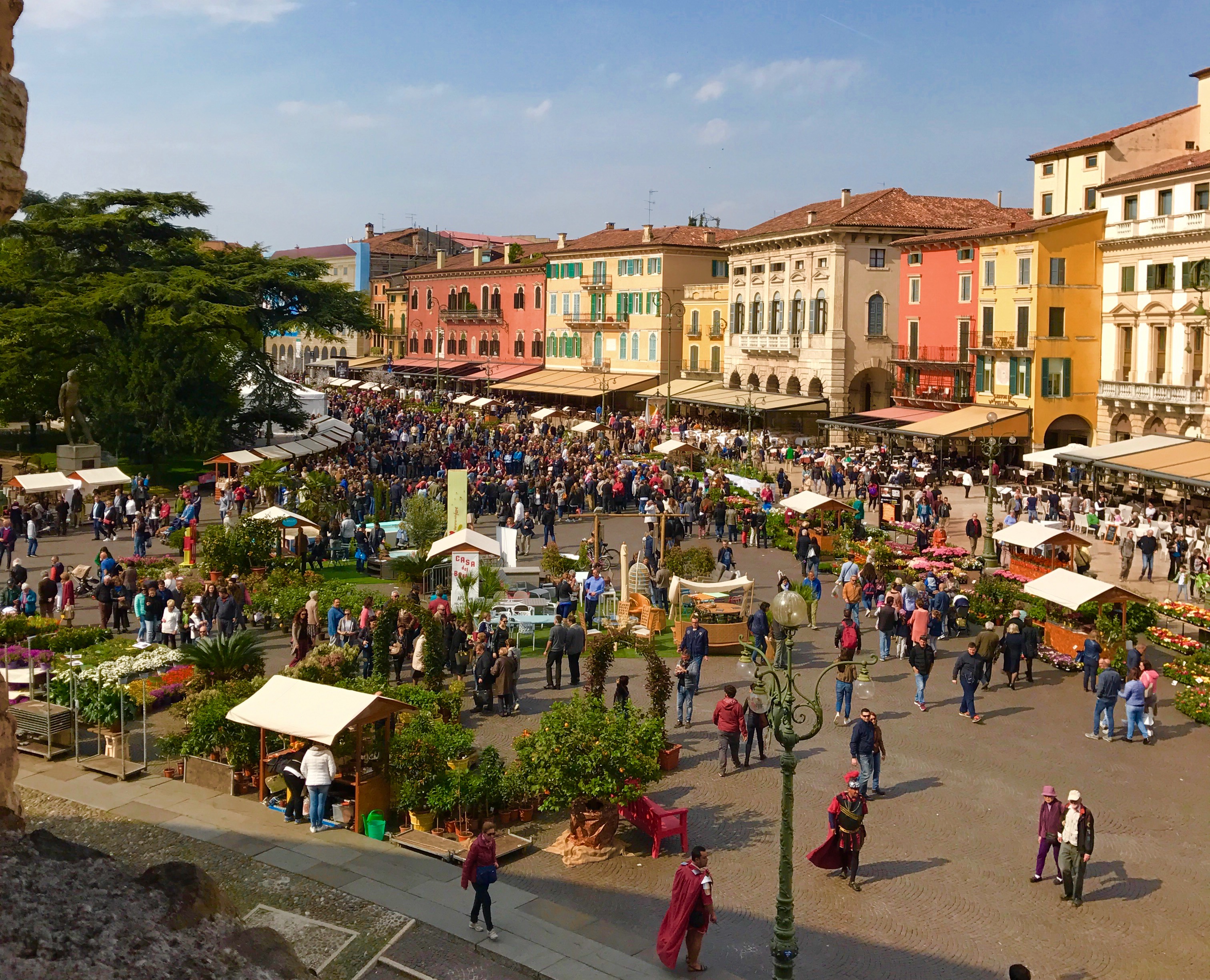
From the Arena di Verona, the city bustles with vitality during a spring garden show in Piazza Bra, one of the largest public squares in Italy. Photo: Katherine Yung

My daughter spent three months living in Venice in 2017 as an intern at the Peggy Guggenheim Collection, a small, yet world-renowned modern art museum located on the Grand Canal. Her time there was magical, challenging, beautiful, and life-changing. On four occasions, she day-tripped with her friends away from the 124 islands that compose Venice to visit these cities: Bologna, Padua, Verona, and Vicenza.

Since her return, we’ve enjoyed many conversations about her time in Italy. This post is about her daytrip to Verona, home to 257,000 residents and located on the Adige River in northern Italy.

The interview answers are just the two of us talking; see the photo captions for more detailed notes and facts about her trip.

How did you get to Verona? We left the train station in Venice around 8:45 in the morning and arrived in Verona around 9:30. It really doesn’t take long to get there! And let me just start by saying it was the first sunny and clear day of spring. The weather in Venice during the first month or so of my stay there had been rainy, gray and cold, and we were all ready for some sunshine. I didn’t have to wear a jacket at all. It was absolutely beautiful.

Once we arrived at the train station, we had to walk quite a distance to reach the central historic part of the city. It probably took around twenty to thirty minutes. We walked past a café and decided to get cappuccinos for breakfast and then we kept walking to get to the old city walls. This is considered the heart of Verona. The walls are about fifty feet high.

IMG_6297
The old city walls of Verona mark the historic center of the city. Photo: Katherine Yung

What was first on the agenda? After reaching the center of the city, we decided to go to the arena first to meet Alessandra, one of the interns at the  Guggenheim museum in Venice who had returned on her days off that week to Verona, her hometown. She was going to be our guide for the day.

IMG_6304
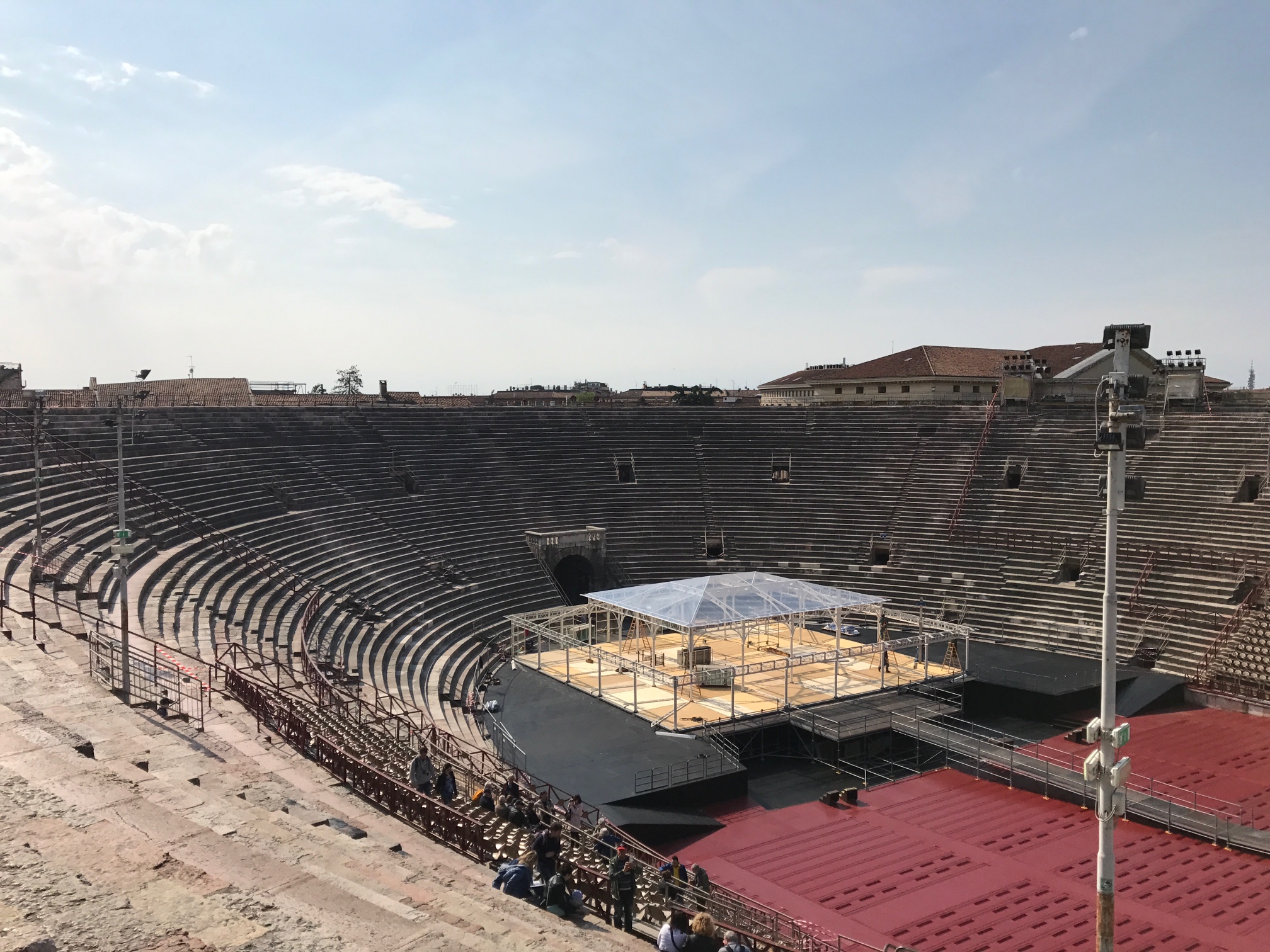
Arena di Verona was the third-largest amphitheater in the Roman Empire. The 20,000-seat arena has a packed schedule for 2018. Built during the first century, the arena is home to a full schedule of productions, including an opera festival held every summer. Seats range from 18€ to over 200€, depending on the production and performance. Photo: Katherine Yung

To get to the arena, we walked through Piazza Bra, one of the largest public squares in Italy. There was a garden show going on. Vendors were selling flowers and citrus trees and other plans and lawn supplies. It was very busy. There were people everywhere.

The arena di Verona looks like a coliseum. It’s made entirely of stone and is literally a big stadium. They still hold concerts and theater productions there. It’s crazy old. The day we went to Verona was the first Sunday of the month and throughout Italy, there are discounts to state-run museums. At first, after meeting Alessandra outside the arena, we couldn’t decide if we wanted to go inside, but because it cost only 1€, we went in to see just how large it was.
IMG_6307
Inside the Arena di Verona. There’s not a lot to see, but my daughter and her friends decided to go in anyway, since entrance cost only 1€. Here’s a spectacular nighttime photo of the arena. Photo: Katherine Yung

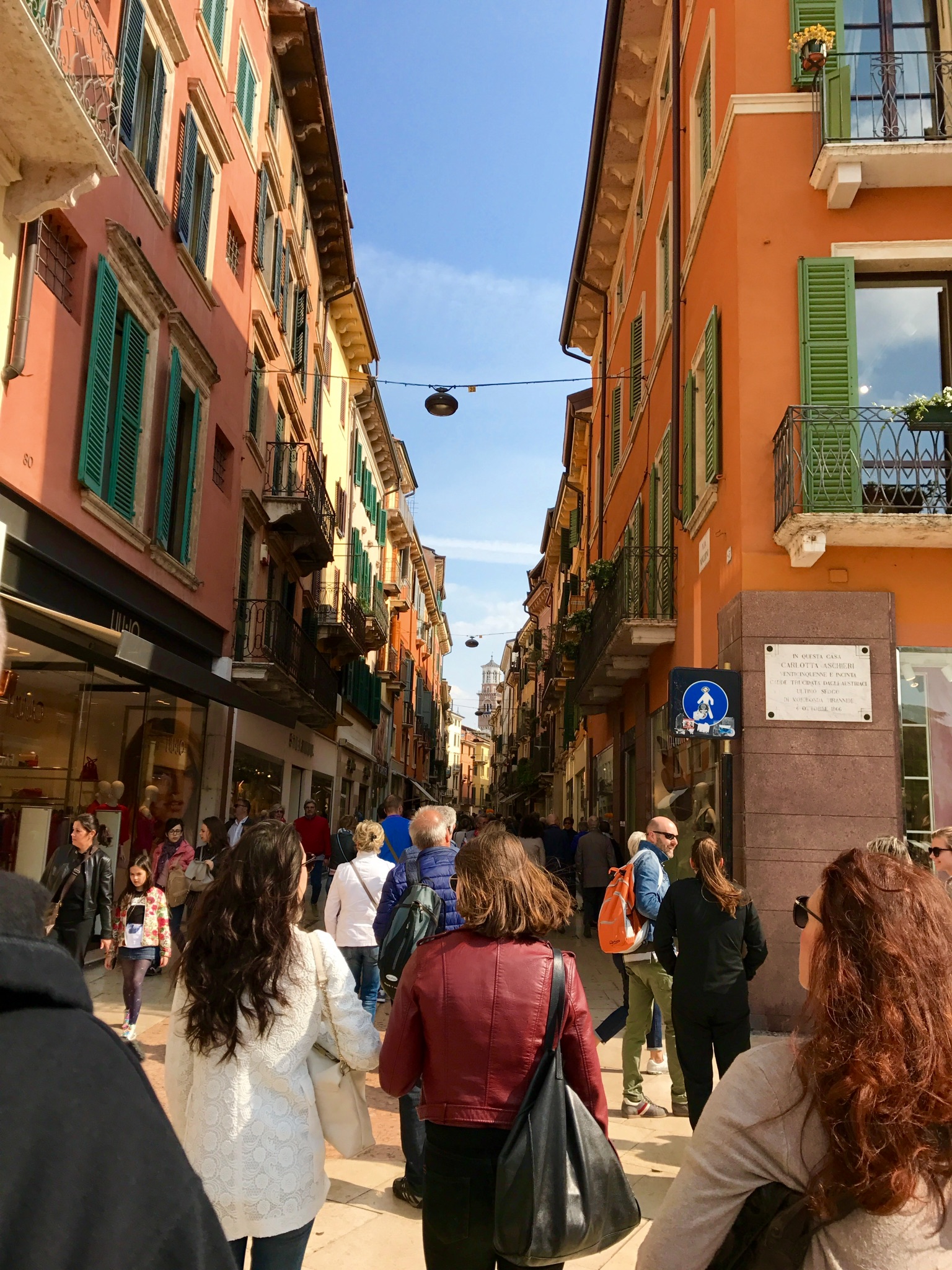
Where did you go next? After we saw the arena, Alessandra took us down one of the main streets, Via Mazzini. It’s a pedestrian-only street. It has tons of shopping with lots of retail clothing shops.
IMG_6314_sRGB
Walking down Via Mazzini in the retail heart of Verona. Photo: Katherine Yung

Did you see anything touristy? Yes! That was next! From Via Mazzini, we continued down to Casa di Giulietta, the “house of Juliet” from Shakespear’s Romeo and Juliet. Legend has it that the stone balcony that’s in the courtyard was the inspiration for the scene in Shakespeare’s play.

IMG_6318
The balcony at Casa di Giulietta. Photo: Katherine Yung

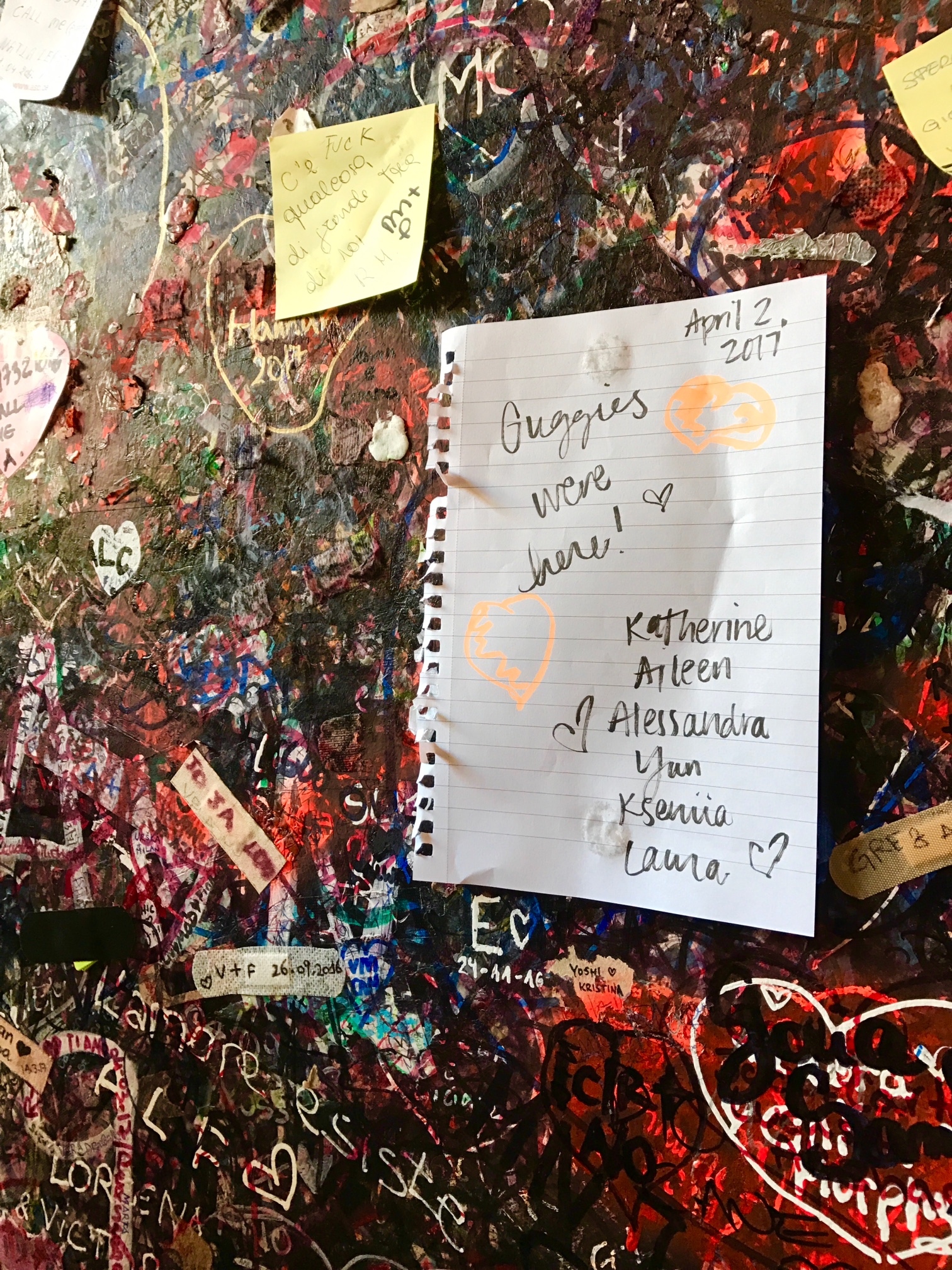
The balcony looks exactly like what you would expect it to. There’s also a statue of Juliet in the courtyard. It’s free to see. You pay, however, to stand on the balcony where you can have your picture taken. There’s a sotoportego—a tunnel-like walkway—you walk through to get to the courtyard. There’s a wall where people have written love notes on this wall. It’s totally black with writing and spray paint. It’s covered with notes and anything and everything people can find to stick their notes to the wall with… gum, Band-Aids, whatever.
FullSizeRender (5)
The wall at Casa di Giulietta is plastered with notes of love and friendship. Here, my daughter and her fellow interns from the Guggenheim in Venice left their mark. Photo: Katherine Yung

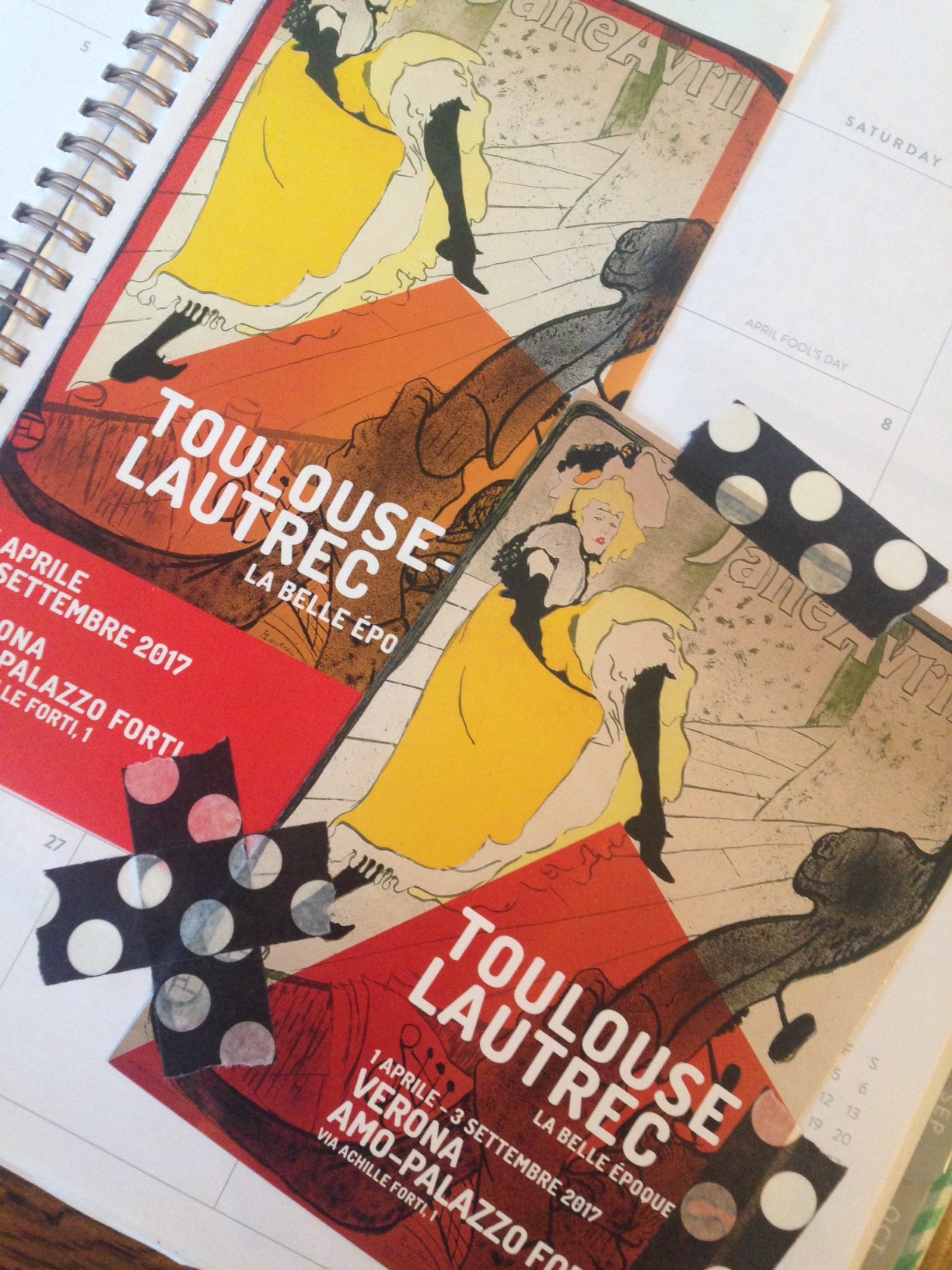
Did you see any art while you were there? Yes, we were in Verona on the very first day of an exhibition of Toulouse Lautrec, the French illustrator and painter. The show was at the Verona AMO-Palazzo Forti. It was a show totally devoted to his work. I really wanted to see it, so another intern and I went. The tickets cost 15€. We were at the museum for an hour and fifteen minutes. It was an incredible show. The galleries were painted in French blue and a dark, muted magenta. There was one room where all of his prints were displayed. This room was arranged like a café with tales in the middle and strings of light bulbs that led to the center of the ceiling. Seeing this show in this gallery was the highlight of the day for me.
FullSizeRender (6)
Photos weren’t allowed in the Lautrec exhibition. These are brochures from a page in my daughter’s travel journal.

Where did you go for lunch? We went to a restaurant my friend knew about. It was called Terrazza Bar al Ponte. You can sit outside on a balcony over the river that runs through Verona. We were hoping to find a place on the balcony, but it was so crowded outside that we had to sit inside. I ordered totellini with sausage. The pasta was a very thin dough and there was sausage flavored with rosemary and cheese. It had a spicy flavor, but the spiciness wasn’t overkilled. The tortellini was in an olive oil and light butter sauce. It was super light… a lot of food, but very light. The service was great. We did have to wait around forty minutes, but in Italy no one seems rushed when there’s food involved and there were five of us. Also, the staff let me charge my phone behind the counter.

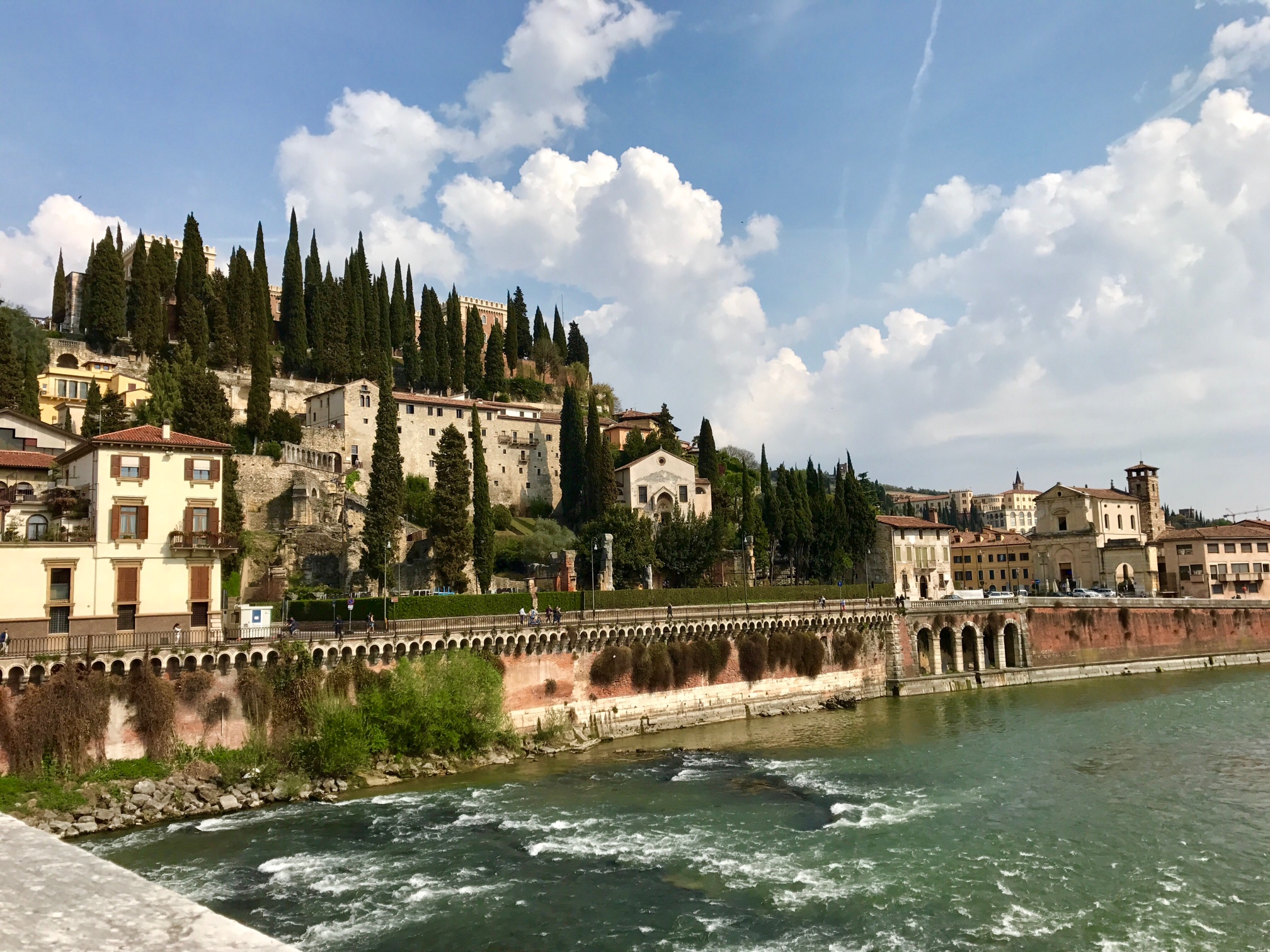
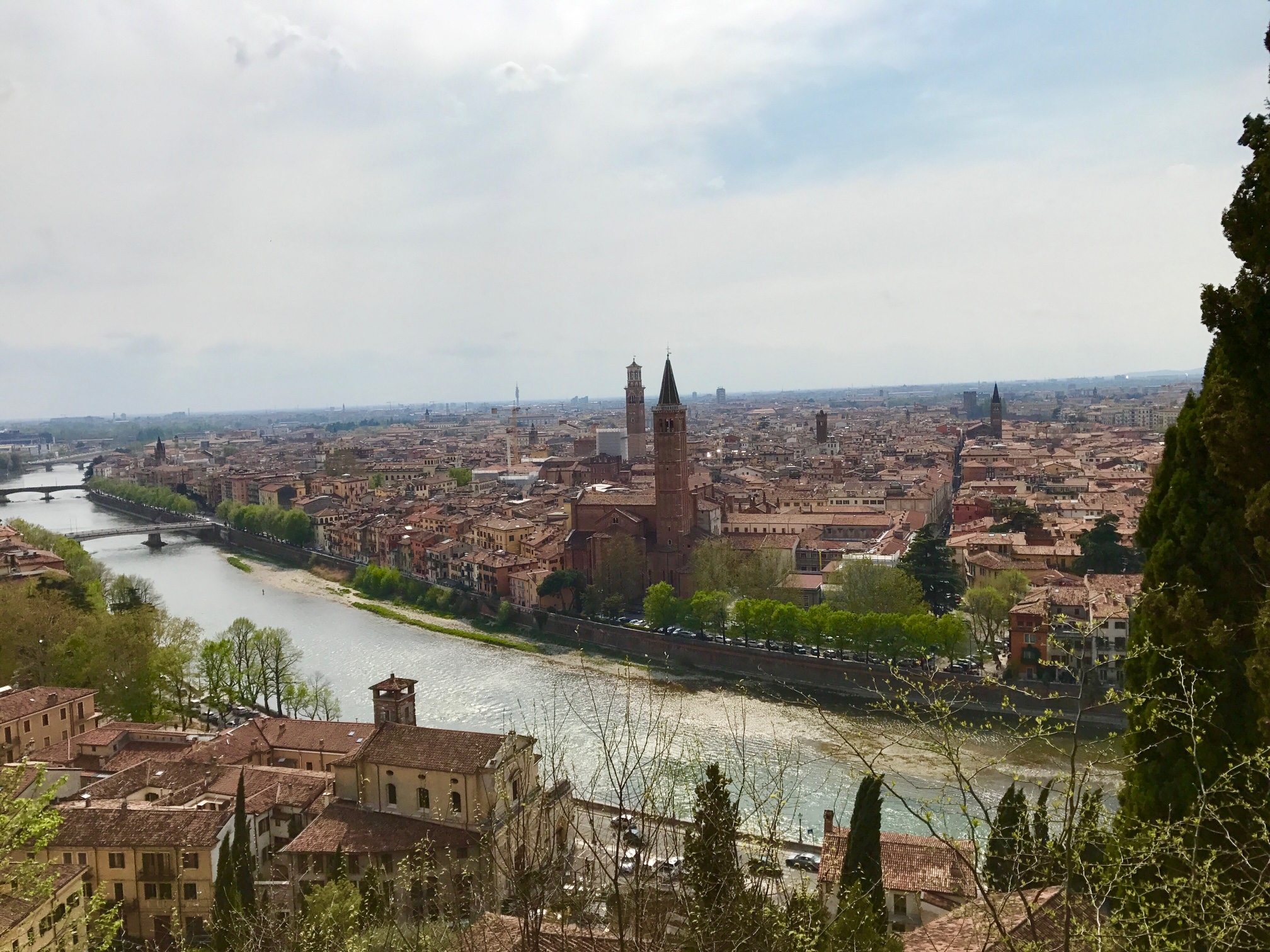
Where did you go after lunch? After lunch, we crossed the Ponte Pietra, a stone bridge that crosses the Adige River and then we walked to the top of Castel San Pietro, the location of the first settlements of Verona. The settlements date from the 7th century… before Christ! From the castle, you get this amazing panoramic view of Verona. There are restaurants there for lunch, but since we had just eaten, we took a walk to the top of the castle instead. There were stairs everywhere. It was quite a hike to get all the way up there, but I’m so glad we did because the views were incredible.
IMG_6312
Looking up at Castel San Pietro from the walk across the Ponte Pietra (the stone bridge) over the Adige River. Photo: Katherine Yung
IMG_6300
Looking down from Castel San Pietro to the Adige River and Verona. Photo: Katherine Yung

Where did you go after the Castel San Pietro? We went to see the Arco dei Gavi, an arch constructed to honor a family by the name of Gavi. Under the arch, you’ll see stones from an ancient Roman road. We walked over the stones—they’re smooth and rounded around the edged—under the arch. You can see the ruts from wheeled chariots and whatnot that used the roads back during Roman times.

FullSizeRender (7)
The famous Arco dei Gavi, one of the few arches not constructed to commemorate a military event, but rather a family. Napoleon dismantled the arch, but it was rebuilt in 1932. Photo: Katherine Yung

What, no gelato yet?! After the Arco dei Gavi, we went to Piazza delle Erbe, a square that’s the business center of the city. And business for us meant, I guess you could say, the business of gelato. I had one dip each of raspberry and lemon-mint from a shop called Pretto Gelato arte Italiana. It was so good. I really preferred the lemon-mint and wished I had ordered two dips of it.

FullSizeRender (11)
Raspberry and lemon-mint gelato in Piazza delle Erbe, the political and economic center of the city. Photo: Katherine Yung

What was next on the schedule? After gelato, we walked to the Castelvecchio & Museum. It was old and beautiful. So much history right there.

IMG_6309
The spectacular brick ramparts of Castelvecchio, now Castelvecchio & Museum, which protected Verona in medieval times. Built in 1354, the castle sits alongside the Adige River. Photo: Katherine Yung

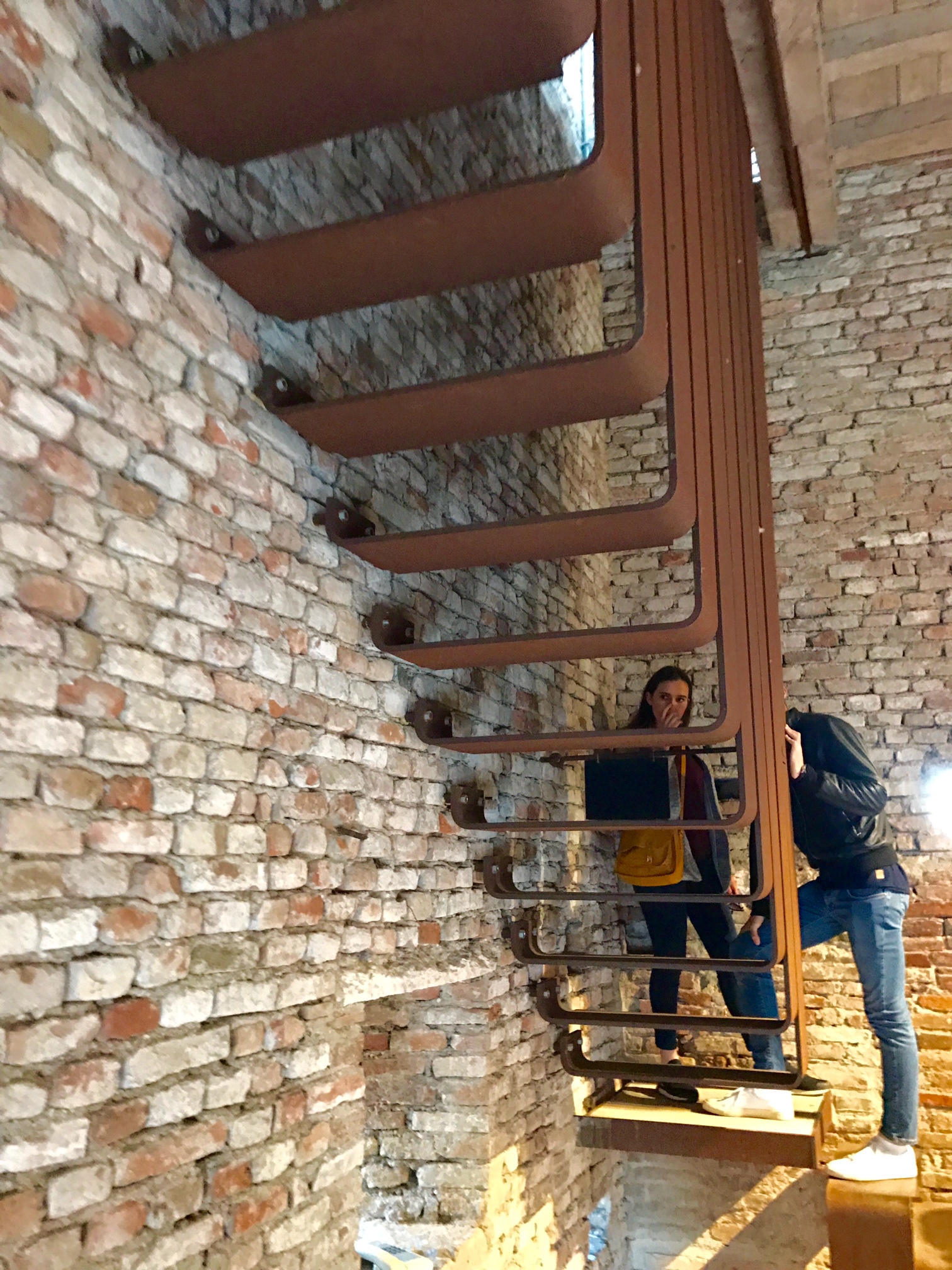
In 1957, Carlo Scarpa, who’s a famous modern Italian architect, began renovating the castle. This in effect created the museum. Throughout the museum, there are rooms with paintings and sculpture. There are also rooms full of weapons that were used back during the era when the castle guarded Verona.

When he was doing the renovations, Scarpa put a modern spin right on top of the ancient. He was making the castle usable again and also put his modern style on top of the old. He intentionally made details stand out so you’d notice the contrast between the old and the new.
FullSizeRender (13)
This staircase inside the museum shows Carlo Scarpa’s mixing together the new with the old. Photo: Katherine Yung

After touring the Castelvecchio, we noticed it was around five o’clock, so we decided to head back to Venice. We got back to Venice around six o’clock.

Where does Verona rank on your list of the cities you visited? Well, no doubt, I think it’s the most vibrant. It was the most surprisingly charming. Before we went to Verona, I didn’t know what to expect, but I didn’t expect it to be so packed with activity and with so many things to see. There were so many sights… and maybe the weather spoiled me a little, but it is probably the one city I would go back to first and spend more time in.


I make no apologies. As a writer and parent, I feel perfectly entitled to take full advantage of my daughter’s experiences in Italy by wringing every possible story idea from it! Yes, our family did visit her in Venice for a week, and while we saw so much in that time, we envied the luxury of time her three-month internship allowed.

Thank you for reading! If you enjoyed this post, click “like” so more people can find it, and feel free to leave a comment!

Categories
Italy

Vicenza, Italy: where the art is the city itself

And other observations made on a daytrip from Venice to the City of Palladio

My daughter spent three months living in Venice in 2017 as an intern at the Peggy Guggenheim Collection, a small, yet world-renowned modern art museum located on the Grand Canal. Her time there was magical, challenging, beautiful, and life-changing. On four occasions, she day-tripped with her friends away from the 124 islands that compose Venice to visit these cities: Bologna, Padua, Verona, and Vicenza. 

Since her return, we’ve enjoyed many conversations about her time in Italy. In this and future posts, I’ll be relaying the details of each of these short excursions. This post is about her daytrip to Vicenza, a city with an approximate population of 113,000 full of architectural gems that was designated a World Heritage Site in 1994.

The interview answers are just the two of us talking; see the photo captions for more detailed notes and facts about her trip.

How far is Vicenza from Venice? It’s only a 45-minute train ride that goes through Mestre, which is near Venice on the mainland and then Padua before arriving in Vicenza.

What did you do first? We first walked from the train a few minutes to the city walls. Then we made our way to the Palladio Museum. It’s a large museum situated within the Palazzo Barbarano. The museum showcases Andrea Palladio, the Italian architect who designed tons of buildings all around the city. Palladio lived in the early 1500s, so he can be considered a High Renaissance artist.

FullSizeRender (13)
The city walls of Vicenza. At this location, pedestrians enter beneath the arch in the darker portion of the wall. Photo: K. Yung

The museum has old and rare sketchbooks and drawings by Palladio. Those were so interesting. It was amazing to see how well-preserved the papers were.

FullSizeRender (14)

The museum is also famous for all of the dioramas they have of Palladio’s designs. These aren’t old, but they are really valuable, so anyone—and especially art historians and architects—can understand more about how the buildings were designed. You can get a sense of the effects that Palladio achieved with his symmetry, like the long views down corridors.

FullSizeRender (15)
Dioramas attract many to the Palladio Museum. Here, architecture and art history scholars can see up close the Palladian features that created this ubiquitous architectural style. Photo: K. Yung
FullSizeRender (16)
Photo: K. Yung

Was symmetry his trademark? Well, one of them, along with columns. He’s why columns are popular in homes and public buildings. Basically, his work was about highlighting classical Roman architecture, and symmetry was one characteristic. His designs influenced architecture around the world. It eventually became called Palladianism. Palladio’s work is easy to recognize because he had a very distinct style that totally revolutionized the architecture game. And lots of people are familiar with Palladianism, even if they don’t realize it. The White House and the U.S. Capitol—and thousands more examples around the world—are good examples. So is Thomas Jefferson’s home, Monticello.

Did you have a tour of the Palladio Museum? Yes, we had a guide who spent 2 ½ – 3 hours showing us the museum, which was our main goal in visiting Vicenza. There was an exhibition being shown there called “The Mysteries of Palladio’s Face.” It was all about portraits of Palladio—or the fact that there aren’t portraits of him. No one really knows for sure what he looked like. Even drawings of him are different. However, there was a drawing we saw where he had actually sketched his hand onto the paper. Kinda cool because at least we know it’s his hand, y’know?

You were there such a short time. Did you miss anything? The Villa Rotonda was closed when we were there and that’s one of Palladio’s most famous and influential works. It’s a square building with four entrances, one on each side. It’s one of the most recognizable structures of the Renaissance.

Villa_Rotonda_front
The Villa Rotonda contains four identical facades, which add balance to the complete design. Photo: Stefan Bauer, http://www.ferras.at [CC BY-SA 2.5 (https://creativecommons.org/licenses/by-sa/2.5)%5D, from Wikimedia Commons

What did you do after the Palladio Museum? After that, we walked around downtown to see some of the other buildings. There’s a whole street in Vicenza called Corso Andrea Palladio… it’s lined with multiple palaces and buildings that were at least designed by Palladio if they were constructed during his lifetime.

IMG_6503
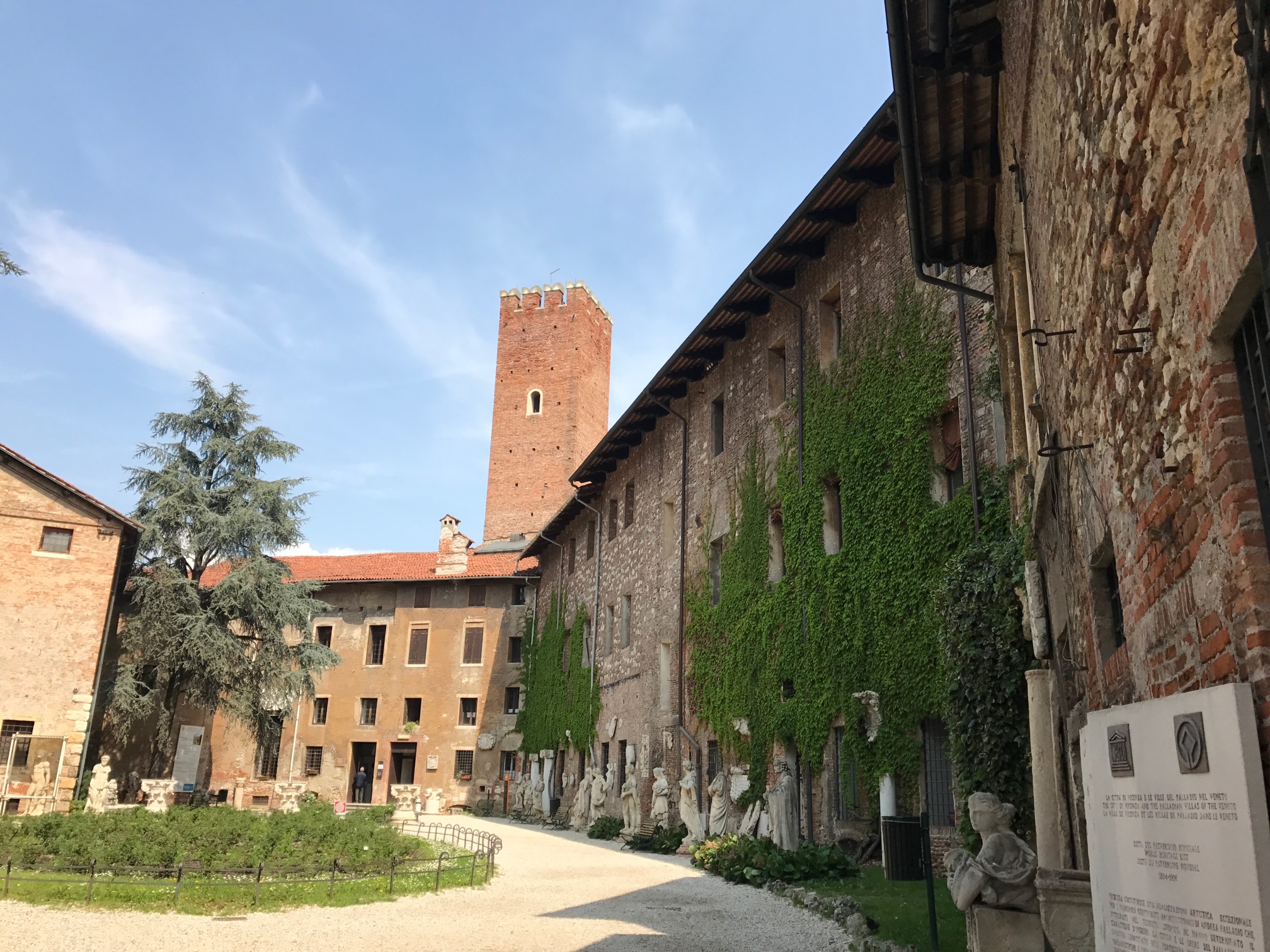
In this photo, you see the Teatro Olimpico on the right. Built from 1580-1585, the theater appears deceptively rustic on the exterior, but on the inside, the design does an “about face” and High Renaissance style takes center stage. The plaque that declares the theater’s designation at a UNESCO World Heritage Site is displayed at right. Photo: K. Yung

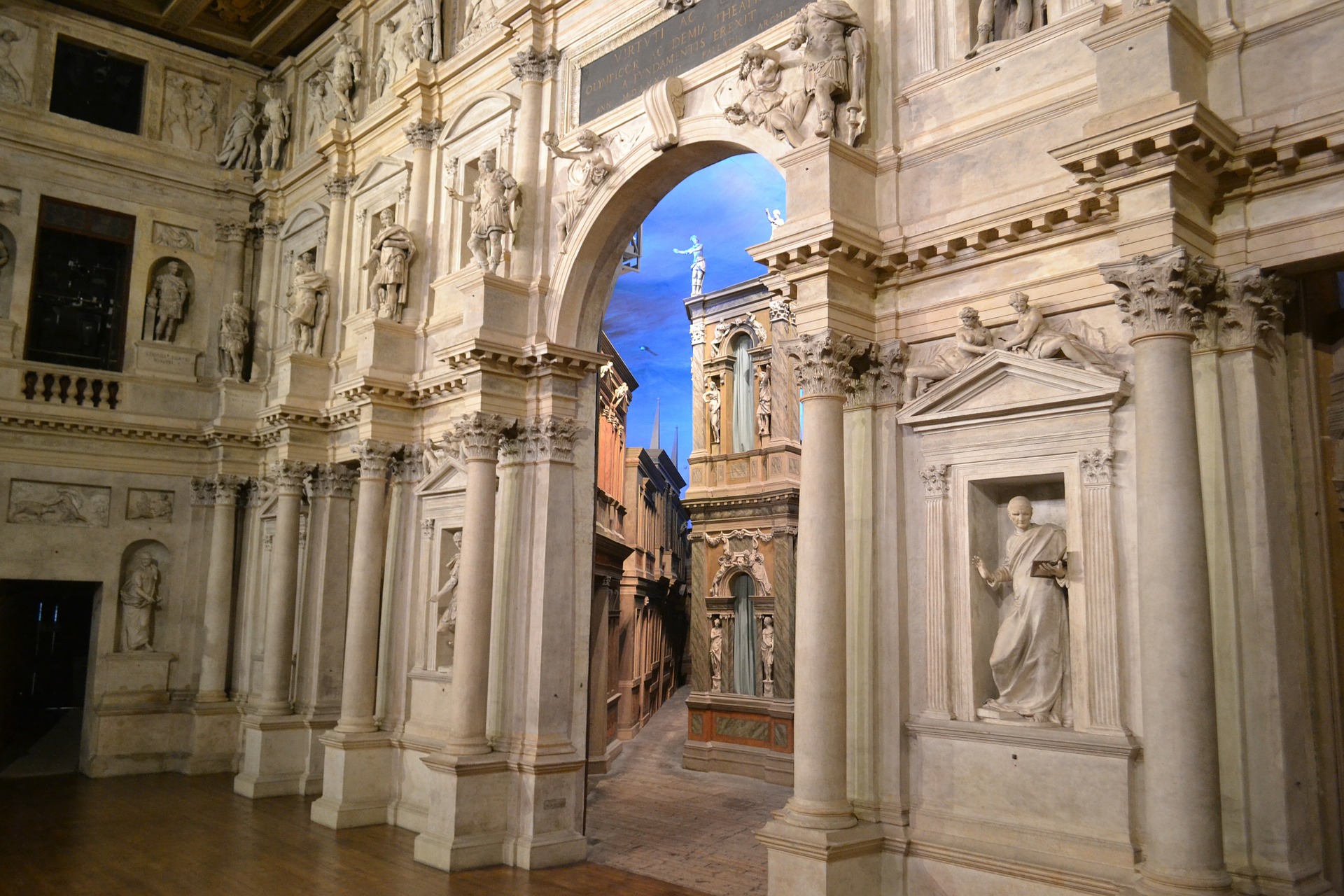
Then we went to the Teatro Olimpico. It’s a performing arts theater that Palladio designed. Today, the theater does live theater productions. You can go inside the actual theater and sit and look at the paintings. You can also see the façade that Palladio designed and the illusion of the set itself.

theatre-515655_1920
This photo does not show the theater’s majestic interior in its entirety. Visit here for fabulous photos and a full explanation of how optically revolutionary this theater is. Photo: juliacasado1 on Pixabay.

On the interior, parts of it plays tricks on your mind due to optical techniques. For example, it appears that the set is very deep based on the perspective you see through the entrance with the blue sky beyond. The ceiling of the theater is painted like the sky and it’s encircled by large-scale Olympic figures.

IMG_6509
The theater hosts dance and theater productions today. Photo: K. Yung

What else did you see on such a short trip? We went and saw the Basilica Palladiana. It’s a building downtown that you can easily identify because of its copper roof. They issued a contract to Palladio in 1549 to renovate the building because of structural problems that occurred over the years. Today, there are restaurants and shops around it, plus exhibition spaces for art and architecture shows. One thing that makes the basilica significant is that it shows the first example of the Palladian window. Palladian windows have a center window with a semi-circular top and then one rectangular identical window on each side.

vicenza-1683975_1920
Vincenza’s Piazza dei Signori, where the Basilica Palladiana is located to the right of the dark brick tower in the photo above. The distinctive copper roof is visible behind the statues that line the upper edge. Photo: cusarina on Pixabay.

After going to the basilica, we decided we wanted to have lunch outside on the plaza, the Piazza dei Signori. We found a quaint café in the sun and… wait for it… had some pizza that was altogether forgettable. It was more like American pan pizza. I’m sure some people liked it, but I was disappointed. I didn’t even make a note of the name of the place. Oh, well. That was literally the only downside to the whole day. I would love to go back!

How would you sum up Vicenza? It’s a quiet city with an off-the-beaten-path feel to it. It’s very beautiful and important. It’s like a giant art museum, but the art is the city itself.


I make no apologies. As a writer and parent, I feel perfectly entitled to take full advantage of my daughter’s experiences in Italy by wringing every possible story idea from it! Yes, our family did visit her in Venice for a week, and while we saw so much in that time, we envied the luxury of time her three-month internship allowed. Check out my profile on Medium.com and find more stories about my daughter’s other daytrips around northern Italy.

Categories
Italy

Padua, Italy: The bluest blue I’ve ever seen

And other observations my daughter made during a quick morning trip to Padua from Venice

My daughter spent three months living in Venice in 2017 as an intern at the Peggy Guggenheim Collection, a small, yet world-renowned modern art museum located on the Grand Canal. Her time there was magical, challenging, beautiful, and life-changing. On four occasions, she day-tripped with her friends away from the 124 islands that compose Venice to visit these cities: Bologna, Padua, Verona, and Vicenza. One day, she travelled to Ravenna with my husband, our son and me when we visited over spring break.

Since her return, we’ve enjoyed many conversations about her time in Italy. In this and future posts, I’ll be relaying the details of each of these short excursions. This post is about her morning trip to Padua, a city that claims to be the oldest city in northern Italy. It’s a short 26 miles from Venice.

The interview answers are just the two of us talking; see the photo captions for more detailed notes and facts about her trip.

How did you travel to Padua? We left from the Venice train station at 9 a.m. It took barely thirth minutes to get there.

What was the most important thing you saw in Padua? Our goal in going to Padua—of Padova, as the Italians say—was to see the Scrovegni Chapel. It’s covered on the inside with many famous frescoes by Giotto. He was a painter during the Middle Ages. He was known for the expressions he painted on people. The frescoes in the chapel are literally in every art history textbook I’ve ever seen. The chapel is extremely small and floor to ceiling it’s jammed with frescoes.

IMG_6380
Another view of the floor-to-ceiling frescoes painted by Giotto at the Scrovegni Chapel. Giotto is considered pre-Renaissance; his work takes a step away from the Medieval style. Photo: K. Yung

Did the chapel meet your expectations? Yes! It was exactly what I hoped it would be. Giotto was known for using blue and the frescoes there were way more intensely vibrant than I expected them to be. The color was the bluest blue I’ve ever seen.

Before you even enter the chapel, it must be readied by the staff. They adjust the humidity level in order to control the air quality inside and they also regulate your entrance time because the air quality must be adjusted to protect the frescoes. Many of them are fragile. Some are entirely gone. Some are faded and chipping away. They were completed in 1305, so that explains the deterioration.

IMG_6383
This photo shows the most famous fresco (center) in the Scrovegni Chapel entitled “Lamentation of Christ.” The anguish in the facial expressions of the figures is one characteristic that makes this fresco so well-known. Photo: K. Yung
IMG_6378
The gardens and grounds that surrounded the Scrovegni Chapel were lush with the spring season in Padua. Photo: K. Yung

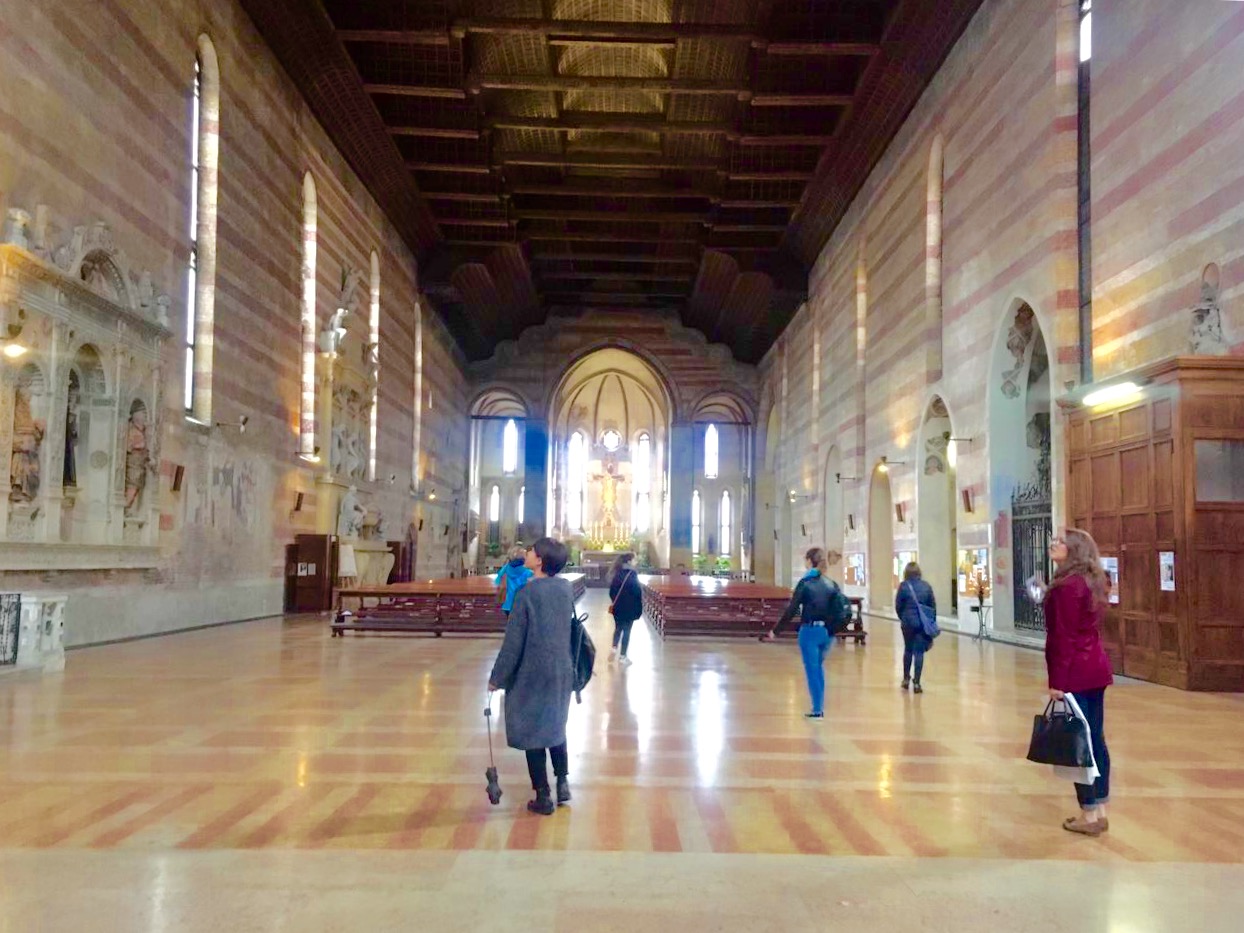
Where did you go after the Scrovegni? We went to Chiesa degli Eremitani, literally the Church of the Hermits, which was a religious order under St. Augustine. It’s a very tall church with a woven, wooded lattice roof. There area frescoed bricks on the wall. At the front where the altar is, there are two or three little chapels. There are interesting frescoes that go up into the domes, but only to a point.

The church was bombed in World War II and they were almost totally destroyed. Over the years, the building has been renovated. There are fragmented frescoes where black paint has been applied showing what the image would have been had it not been bombed.

FullSizeRender (7)
Inside the Chiesa degli Eremitani, the frescoes show scenes from the life of St. Augustine. The damage done to this church is considered by art historians to be Italy’s “greatest artistic wartime loss.” Photo: K. Yung
FullSizeRender (11)
This photo shows the devastation of the bombing from 1944. Fragments from the destroyed frescoes have been found over the years and inserted onto the plaster in the precise spots where they were believed to have been placed originally. Photo: K. Yung

Did you grab a meal while you were there? Yes, after the Chiesa, we ran to get pizza somewhere on the way to the train station. We also managed to find an American coffee shop and I ordered a chai tea latte for the first time while I was in Italy. Chai tea is not a thing in Italy, by the way.

That was also about the time we realized we had bought the wrong returning ticket to Venice. We made our way onto the next train back, but didn’t have time to purchase tickets. It was a confusing ordeal. We planned to pay while we were onboard the train, but no one ever checked our tickets.

We made it back to Venice by 2 in the afternoon, which was around the time we were scheduled to get ready to tour Damien Hirst’s mammoth exhibition, which is totally another story.

Would you like to go back to Padua since you were only there for a few hours? Yes, of course, it would be great to go back. There are so many things I know we just didn’t have time for. One would be the Basilica of Saint Anthony. Someday… someday.


Featured Photo: The Scrovegni Chapel was commissioned by Enrico degli Scrovegni, a Paduan lender. It is considered one of the masterpieces of Western art. Giotto di Bondone, considered the first of the Italian masters, painted the frescoes in the intimate space. Giotto, (1276-1337), is considered the most important Italian painter of the 14th century.“His works point to the innovations of the Renaissance style, which developed a century later,” according to Encyclopedia Britannica. Photo: K. Yung


I make no apologies. As a writer and parent, I feel perfectly entitled to take full advantage of my daughter’s experiences in Italy by wringing every possible story idea from it! Yes, our family did visit her there for a week, and while we saw so much in that time, we envied the luxury of time her three-month internship allowed. Check out my profile on Medium.com and find more stories about my daughter’s daytrips around northern Italy.

Categories
Italy Italy (Venice) Motherhood parenting

Yes, send your daughter to Italy. Alone.

Last December 2, I backed out of the driveway headed for the rural middle school in southwestern Missouri where I teach language arts. It was 7:02 a.m. My phone rang. I saw it was my daughter. Awfully early to get a call. I wondered whether something was wrong.

“Mom!?”

“Yeah, what’s going on?”

“I got the internship!” My heart soared. Two months earlier, she had applied for an internship at the Peggy Guggenheim Collection, a modern art museum in Venice, Italy. She would venture to the beautiful floating city to undertake museum duties such as guarding masterpieces, giving presentations, hosting tours, and sculpture cleaning from Feb. 2 to May 2.

She was beyond excited. So was I, but now that her acceptance was official, it was impossible to imagine her moving to a foreign country and working for three long months away from her home, her language, her friends, her family, her life. The night she received the acceptance email, I lay in bed and cried.

I simply could not see it happening. but it did. True, it was a rough transition for everyone at first, but we made it, and it was a beautiful, life-changing experience… for her and me.

And let’s be honest, I realize this isn’t intimidating for everyone. Many kids and their parents have no problem doing this type of thing; however, for Midwesterners like us, just traveling to the coasts of the U.S. is a major excursion. In our eyes, Venice might as well have been Venus.

Internships that pay, like my daughter’s, are popular and highly valued. Study abroad programs are also. Should you ever be so fortunate as to have your child venture out alone on a similar endeavor, here are some tips to get you through it.

1. Be Strong. Even though I was excited, I was also scared for her, but I couldn’t let my reservations known. I had to be strong and encouraging because I knew that deep down she likely had reservations as well. Even though living in Italy and this particular internship had been her dream ever since we discovered it on Google, interrupting her college career and moving to a foreign country would definitely be outside her “comfort zone.” I had to show I was positive about this opportunity.

2. Send your spouse to get her settled. This was my first and best idea. My husband would fly over with her in January to help her get settled and accustomed to her new home. After all, she had never been to Italy, or even Europe for that matter. She had traveled with our family to South Africa five years earlier, and with a group of other college students and veterans to Vietnam in 2015. But Italy? For three months? Alone?

3. Make sure she doesn’t stand out. We Americans like our colors. Once my husband realized her bright floral umbrella could be spied far ahead through a crowd, he purchased her a black one. In looking at her Facebook posts that first week, I noticed her eye-catching, crimson-red purse.  I texted my husband to make sure to get her a black one of those, too. Maybe we were being overly protective, but after watching a few Youtube videos of tourists and residents walking around Venice, we knew the city is a labyrinth of narrow, sometimes dark, walkways interspersed with those picture-perfect canals. No reason to look like an outsider, especially if you’re female.

4. Use technology. Numerous Facetime calls, the app People Tracker, Facebook, and Instagram made Italy seem not quite so far away. She started a blog called “From Venice with Love” that kept her in touch with friends at home. Happily, her work and social schedule quickly filled her time, and posting to Facebook and Instagram became more convenient.

5. Send a care package. We waited a couple of weeks, but then sent things from home she couldn’t find there. For example, the Venice grocery stores she frequented didn’t carry American basics such as Ranch salad dressing or pancake syrup. Peanut butter is  hard to find. So are Ziploc bags.

6. Visit. If possible, visit for a short time about halfway through. This helped me understand the new lifestyle my daughter was experiencing. Her pictures and posts made more sense and I gained a new appreciation for the life-changing time she was having. Plus, it was Venice, people. We had to.

7. Break the trip into “chunks.” This made the trip seem more “doable.” My daughter’s internship broke down into three parts: one five-week period after my husband left, one weeklong chunk when we would visit, and finally one six-week chunk. Honestly, this last part flew by for both my daughter and I as she was finally comfortable and confidently knew her way around the city.

8. Pray. I relied on this daily. It was a great comfort to know that He would protect and care for her continually.

My daughter’s Venice experience was indeed life-changing. She now has an international set of friends she keeps up with daily through What’s App and she can’t wait to return and tour southern Italy. Her internship also confirmed her next steps: to complete her bachelor’s degree in Art Education and then pursue a master’s degree in Art History with the intention of working in a museum setting someday. She is already filling out applications for another overseas internship. I, on the other hand, am writing myself a note to re-read this post when she lands it.