…Stafilos had a dog, so that pushed it ahead of the pack
We visited four beaches (Glisteri, Glifoneri, Panormos, and Stafilos) during our three weeks on Skopelos Island and they each were clean, comfortable, and drop-dead gorgeous.
However, Stafilos Beach had a dog, so Stafilos for the win.
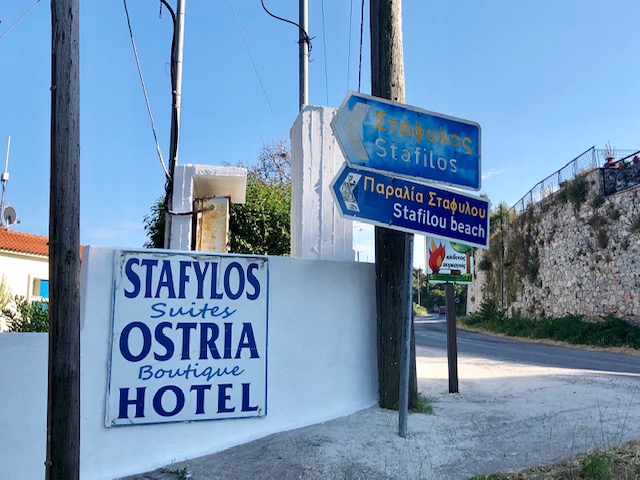
Follow the signs down the hill after you exit the bus.
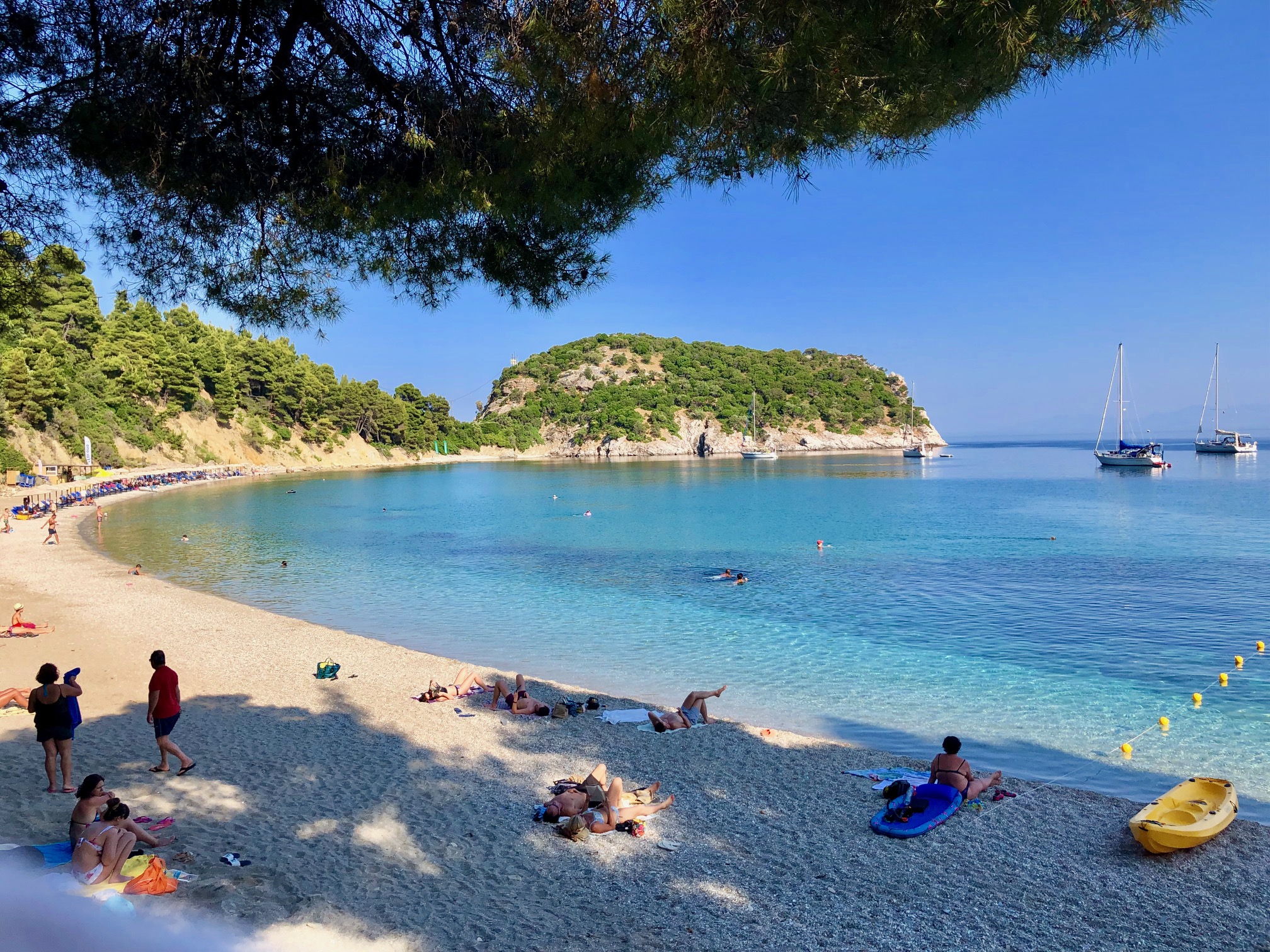
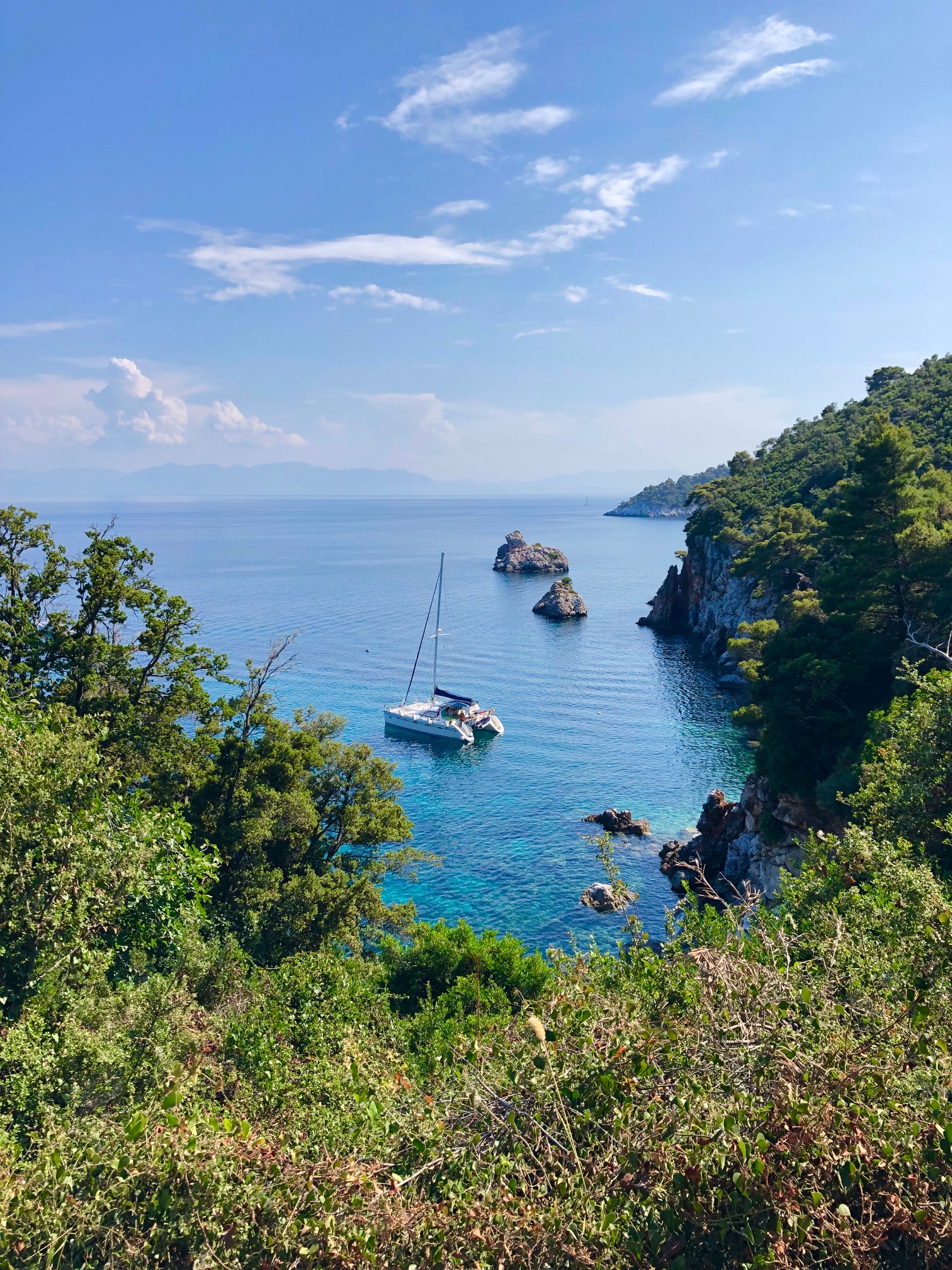
The beach is big and beautiful.
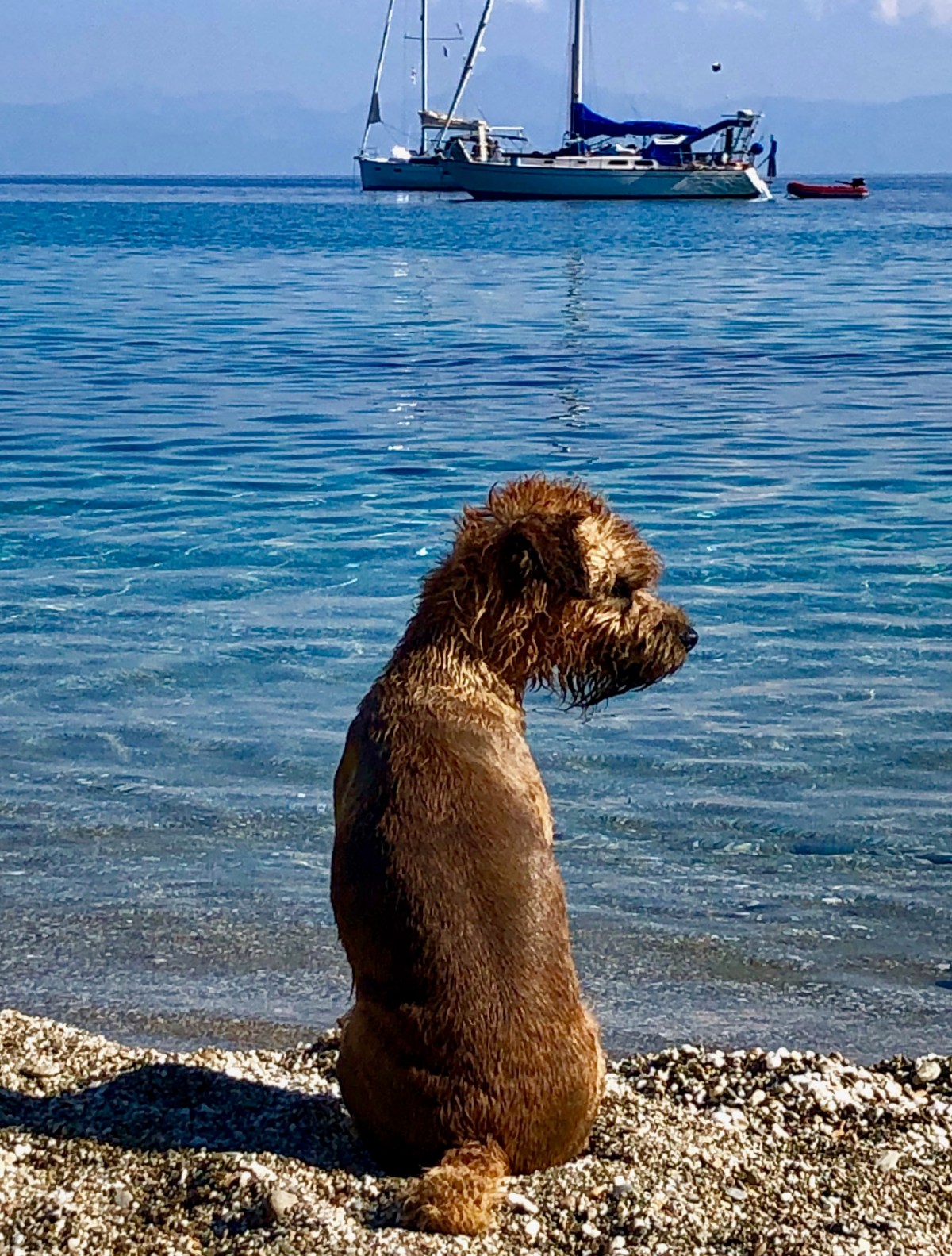
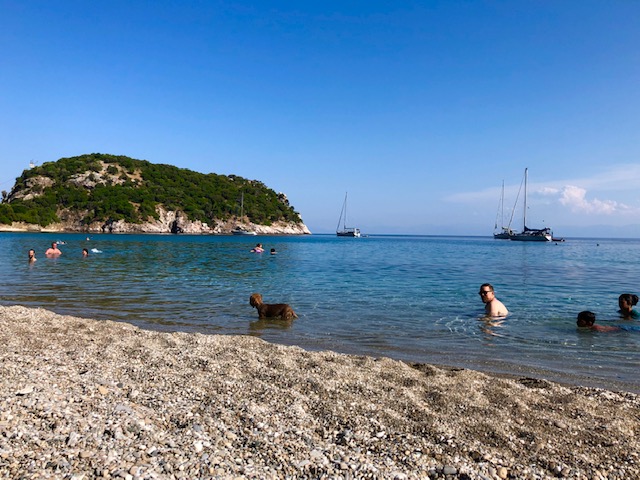
When we visited Stafilos last Friday afternoon, a brown, wiry-haired dog made its rounds to the various beach-goers settled on towels and blankets. It greeted each visitor it met and then flopped down, soaking wet, and wriggled in the tiny pebbles. It was truly this dog’s dream come true, apparently.
The dog cooling off in the water.
Never one to ignore an animal, Mitch and the little dog became fast friends. The dog sat with us on our towel and surveyed the kids and adults sunning, swimming, and snorkeling around us. And then she returned to the water and swam out to her owner anchored out in the cove. With her head just a tiny brown dot on the surface of the water, she amazed us by soon returning to the beach for another dose of interaction with strangers.
Mitch and man’s best friend
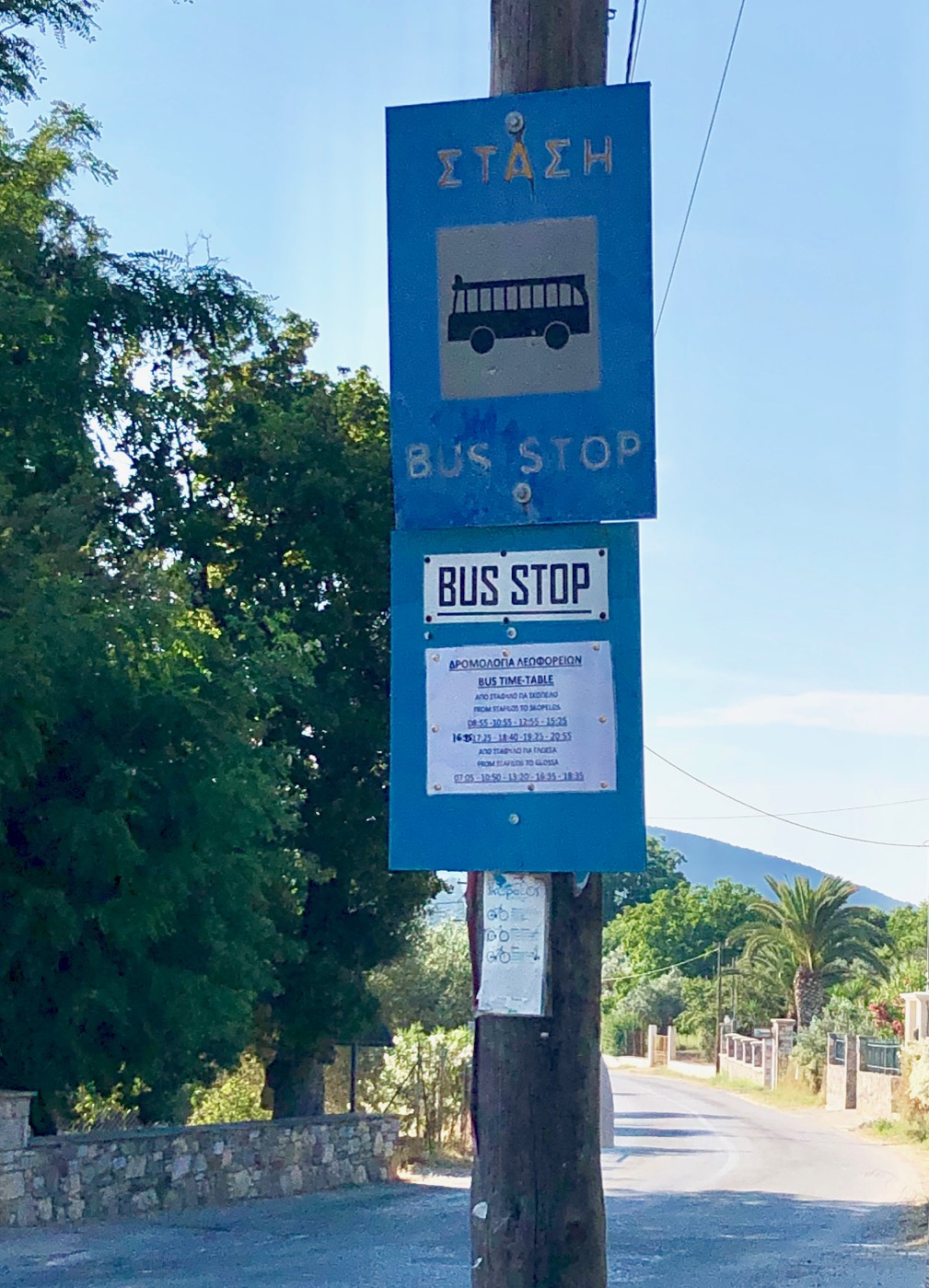
Stafilos is just a ten-minute bus ride from downtown Skopelos. Check the bus schedule board at the bus kiosk, arrive at the designated time, board and pay your 1.60€ when the attendant comes to you during the ride.
We headed out in the late afternoon and returned about two hours later.
Make sure you wear good shoes when you go, since you’ll have to walk about 500 yards or so downhill.
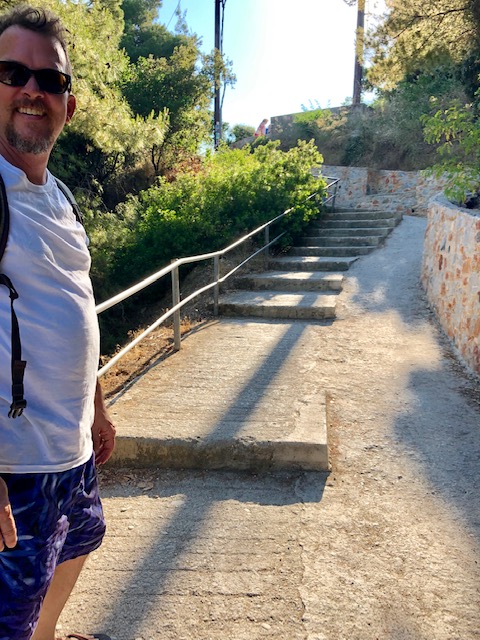
The road down to Stafilos Beach looks like this…
The walk is steep, so watch your step. However, pause to catch the gorgeous views.
…and this…
and this.
Once you arrive at the beach, you can just spread out a blanket or towel at no charge or 2) pay 7€ for a beach umbrella and two wooden chaise lounges. You can see the umbrella section at the far left edge of the second photo in this story.
When it’s time to go, don’t forget you’ll have a hike back up the hill.
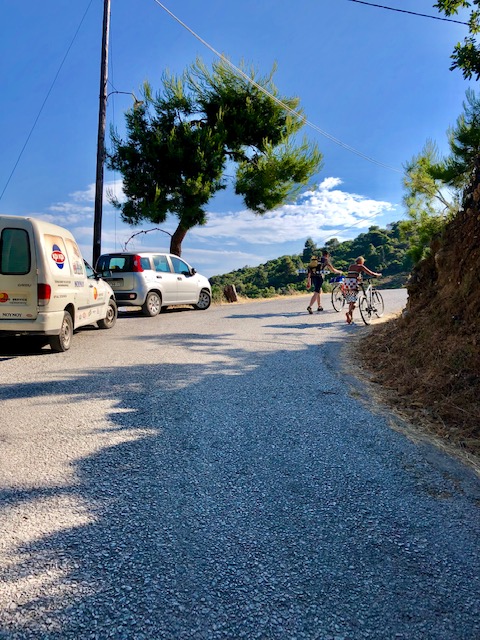
The road back up the hill from Stafilos Beach looks like this…
…and this.
There are a couple of tavernas you can visit on your walk up. These are casual cafes that serve fresh seafood, salads, and drinks.
You may see some tiny churches on the hillside…
As you walk up, look around at the hillsides to see the occasional private Greek Orthodox churches. Here’s another one across from the bus stop:
…or at the bus stop.
Also near the bus stop: chickens pecking underneath an olive tree. What a great scene!
Chickens feeding beneath an olive tree.
We stood across the street in the shade and waited near this sign for the bus. It was right on time!
And finally… the bus stop.
Thanks for reading again today! We are en route to Mycenae today via Athens. In fact, I’m writing this post in the Skiathos Alexander Papadiamantis Airport. Click like, leave a comment or follow my blog for more stories on the daily.
When we booked our return ferry tickets from Skiathos to Skopelos last week, the woman at the ticket office confirmed our booking by asking, “There’s a Flying Dolphin you could take. Would a Flying Dolphin be okay?”
That’s strange, I thought. Of course, a Flying Dolphin would be fine, I wanted to say. After all, we just need to get from Skiathos to Skopelos, and why not get there as quickly as possible?
But then the next morning, bags in hand, standing at the Skiathos port, we saw the Flying Dolphin pull in. Or should I say float in. Or ski in. Or jostle in. From a distance, this vessel flew fast above the water. We could actually see daylight between the bottom of the hull and the surface of the water. Yes, the name “Flying Dolphin” described this vessel perfectly.
The Flying Dolphin is a hydrofoil passenger ferry operated by Aegean Flying Dolphins in Piraeus, Greece, a port city near Athens. According to the company’s website, it “offers daily service with two modern high speed flying dolphins from the port of Piraeus to Aegina and from the port of Volos (Thessaly region) to the islands of Skiathos, Skopelos and Alonissos all year.”
Because of its speed, taking a Flying Dolphin will be a bumpier ride. (Ahhh… that’s why the ticket clerk made sure we knew what we were getting ourselves into.)
In addition, a Flying Dolphin will cost more than a traditional ferry, such as ANES Ferries’ Proteus or Blue Star Ferries’ Flying Cat. (But then again, like us, you may not have a choice: only one morning ferry left for Skopelos on our travel day.)
A more traditional passenger ferry, ANES Ferries’ Proteus
Don’t expect a lot on the inside of a Flying Dolphin (and there’s no sitting outside either, by the way). Yes, it’s perfectly clean and adequate, but doesn’t have the top-rate feel of other ferries… no coffee shop, no lounge seating at tables. No flat screen TVs or fancy lighting.
Fairly basic seating. Nothing fancy. A tray table if you need it. Seating includes a large center section of rows and and a single column of double seating along each side.
However, what the Flying Dolphin lacks on the interior,
it makes up for with one thing: speed.
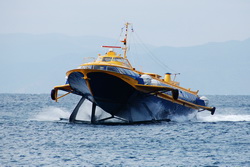
Once the Dolphin reaches full speed, it coasts across the surface of the water, skimming along on fin-like hydrofoils that lift the hull out of the water.
And with that speed, expect a bumpy ride… especially if there are higher than average winds on the water.
We saw the “flight” attendant, who also took our tickets as we boarded, deliver two paper bags to seasick riders about halfway through our fifty-minute ride, which made a stop in Glossa (another town on Skopelos) on our way to Skopelos Town.
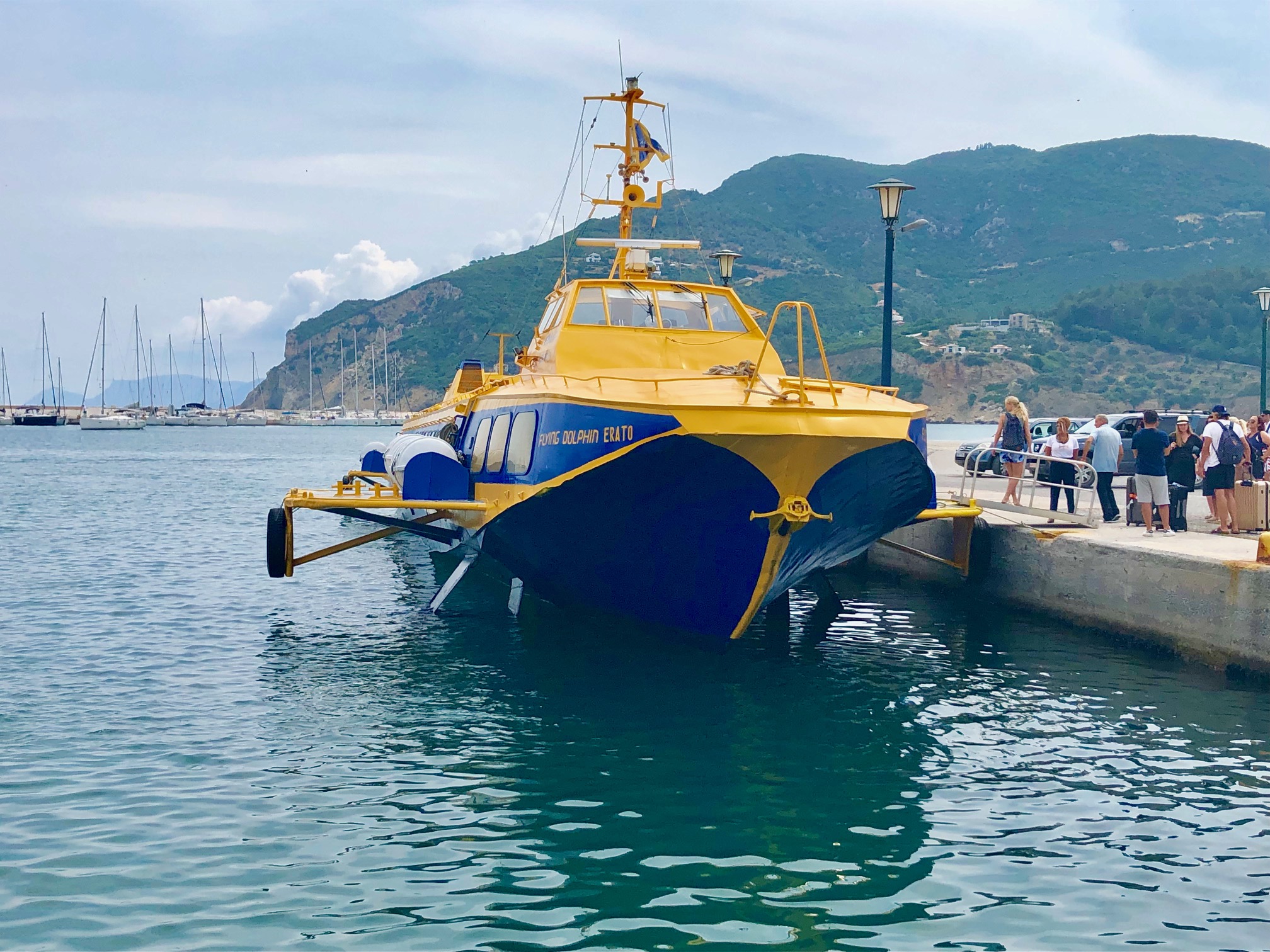
Notice the hydrofoils that become the “wings” of the Flying Dolphin, allowing it to go faster than other vessels. The tires provide a cushion for the vessel when it meets up to dockside.
The water splashes continually onto the windows of the Flying Dolphin as you ride.
At one point, a turn in the water and an especially strong gust of wind caused our boat to tilt right, surprising several riders on board. A few passengers called out with a holler when that happened.
This photo shows the hydrofoils more clearly.
The crew attaches a walkway to the Flying Dolphin as passengers wait to board.
We leave Skopelos Island tomorrow morning and are taking a ferry to the island of Skiathos where we will fly to Athens. There are winds forecast for the morning as a cold front is coming in. Passengers taking a Flying Dolphin should take warning (or even prepare for a cancellation, we’ve been told).
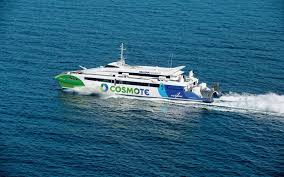
The Flying Cat, a catamaran.
Luckily, we’re not one of them. We’ll be taking Blue Star Ferries’ Flying Cat, a catamaran ferry, instead.
Thanks for reading! I’ve been really surprised by the variety of ferries— and watercraft in general— on our Greek tour. Feel free to click “like,” leave a comment or follow my blog for more.
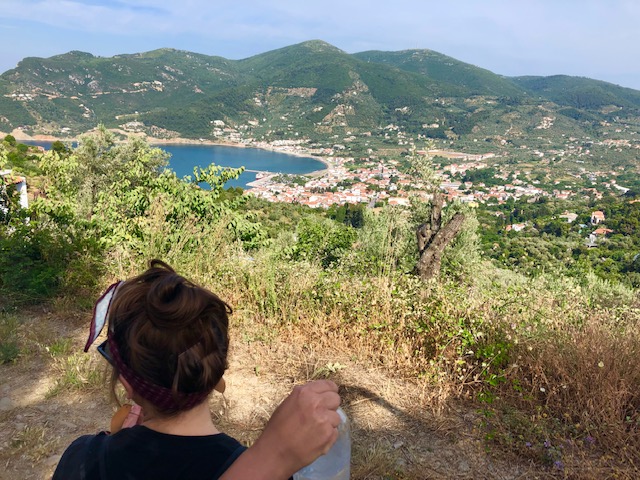
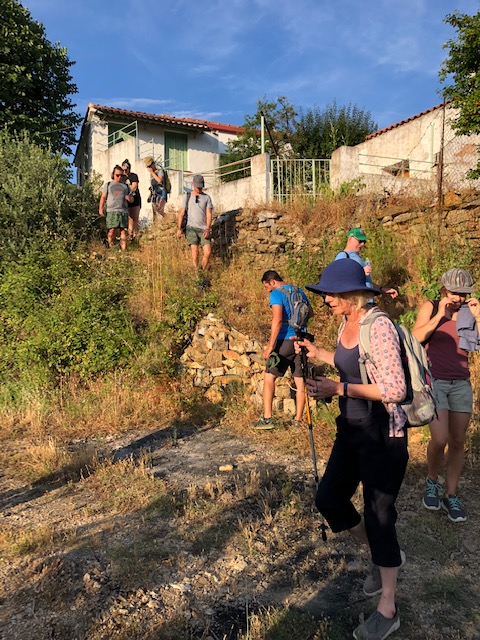
On Wednesday night (June 12), Mitch and I hiked across Skopelos Island from Skopelos Town to the little seaside town of Panormos. The three-hour hike was organized by Heather Parsons, founder of Skopelos Trails.
I had heard of Parsons last fall when I found her in an online search. It seems when you research Skopelos Island, her name will eventually surface. Her organization, Skopelos Trails, is dedicated to restoring, maintaining and improving the ancient stone pathways, called calderimi, that are sprinkled across the island.
Victoria Rose Phillips, Grayson Phillips, Mitch and I
Parsons has written and published a book as well, called Skopelos Trails. It shows the paths for the island’s many walking and hiking trails. Parsons has provided detailed—almost step-by-step directions— for finding and following the paths either on your own or with guidance from her or her business partner and our guide, Emmanuel.
According to a post on Facebook just today, the local forestry department recently asked Skopelos Trails to provide them with details of all the closed trails.
In the post it says that Emmanuel had drawn in by hand 116 km of trails on the department’s terrain map. Clearly, Skopelos Trails knows the land better than most.
Parson’s book also contains hand-drawn illustrated maps that appear alongside the directions and description of the Trails. The illustrations may not be drawn to scale and if a business was used as a landmark on the map, it may have changed, especially if you are using an older edition of the book.
The trails are marked and rated by level of difficulty and the trail we walked Wednesday night, the Coast to Coast Trail, is considered “not strenuous,” or at least that’s how Parsons described it to me in her reply to an email I had sent her as we were making arrangements. (Since I had a 7 a.m. ferry ride to catch the next morning, I wanted to make sure the three-hour Coast to Coast Trail would not wipe me out for the next day’s travel to Venice to see my daughter.)
Starting off from Skopelos Town below.
With Parsons’ “not strenuous” description, we decided to sign up for the 25€ hike, but we opted to take the bus back later from Panormos to Skopelos Town instead of going to a restaurant with the other hikers. I would have loved to socialize more with the others, since during the hike we were able to visit for only a short while.
The plan was to meet at 5 pm at Kahili’s Bakery and Cafe down on the harbor front street or at 5:15 further up the hill near our apartment, where the calderimi, which started just down the hill a small distance, passed by.
Mitch next to a small family Greek Orthodox church
As we stood near the telephone pole with a Skopelos Trails trail marker (a 3″- diameter white circle with a yellow hiking boot footprint), we began to hear huffing and puffing from an approaching group.
To our left, trudging up the hill with the entire town of Skopelos spread behind them as a backdrop, proceeded two couples from England; Anna, a young Athens native who lives in Skopelos; a woman from Skopelos who had built a brand new home in the mountains of Skopelos; and our guide, Emmanuel.
Our addition to the group included Mitch and I plus Grayson and Victoria Phillips, who is serving an artist residency at Skopart.
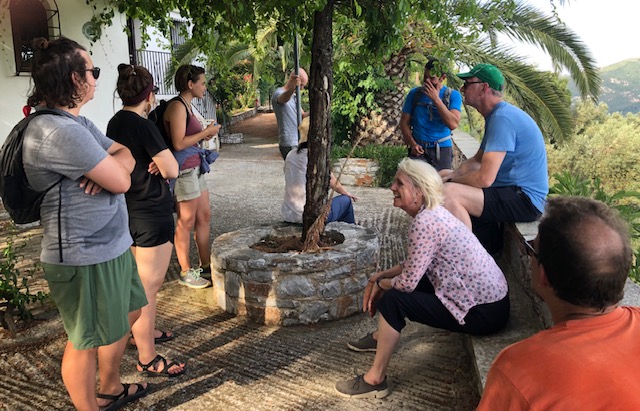
In total, there were eleven of us—quite a good number for an end-of-day stroll (and I use that term loosely) across the island.
The previous Thursday, according to the Skopelos Trails’ Facebook page, a group of five hiked the path starting at 9 a.m.
It would have ended in the heat of the day, so maybe an evening hike, with its cooler temperatures during the latter two-thirds of the hike, makes for a more tempting outing and attracts more participants.
One of the natural springs we came upon
We did stop occasionally during the hike— about five times. During our stops, we would take a photo, drink water, or refill our water bottles at a natural spring. There are several of these springs on the island and many islanders use them for their drinking water.
The water was cold and clean, Emmanuel assured us. Our bottles were nearly full, so we didn’t drink from the spring, but I wish I had. Should have tasted natural Greek spring water. How often do you get to do that? I did scoop up some of the icy water and rubbed it on my arms and neck for a cool-down, though.
We arrived right on schedule at 8:15 pm in Panormos, having traversed the island through olive groves, along stone-walked paths, on top of stone-bordered terraces, alongside pastures where goats and an occasional horse roamed.
The hike took a solid three hours and fifteen minutes. I’m writing this post in Venice; when I return to Skpelos, I’ll look into my copy of Skopelos Trails to see how many kilometers we covered. I’m guessing right now about five.
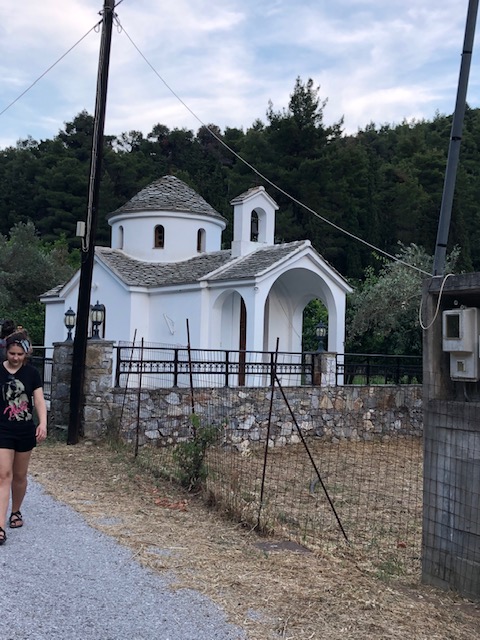
We also came upon five tiny and well-maintained Greek Orthodox churches. Our guide told us that many of the churches were built by families so their members would have a central location for burial. In at least one, a single candle glowed in the darkened nave.
I was tired when it was over. I would definitely label the hike “moderately strenuous.” It’s very rocky, and very steep in parts, and in many places we were walking in thigh-high grasses or on steep grades that were covered with a cushion of small, smooth leaves (a eucalyptus variety?) that made a few of us nearly fall.
Even though it was a challenging three hours, it was very enjoyable literally getting off the beaten path to see the rural Greek countryside and rugged, forested mountains, which are particularly unique to Skopelos.
We also enjoyed meeting and visiting with people from around the world. As Judy, an British hiker from Bristol said, “It’s so interesting when people from all different parts of the world with different lives come together to connect in this way.”
Thanks for reading! This was a fun experience and when I return to Skopelos next week, Mitch and I hope to take another (probably shorter!) hike using the Skopelos Trails book. Follow my blog for more posts from our summer travels and feel free to leave a comment about some interesting hikes you’ve taken recently.
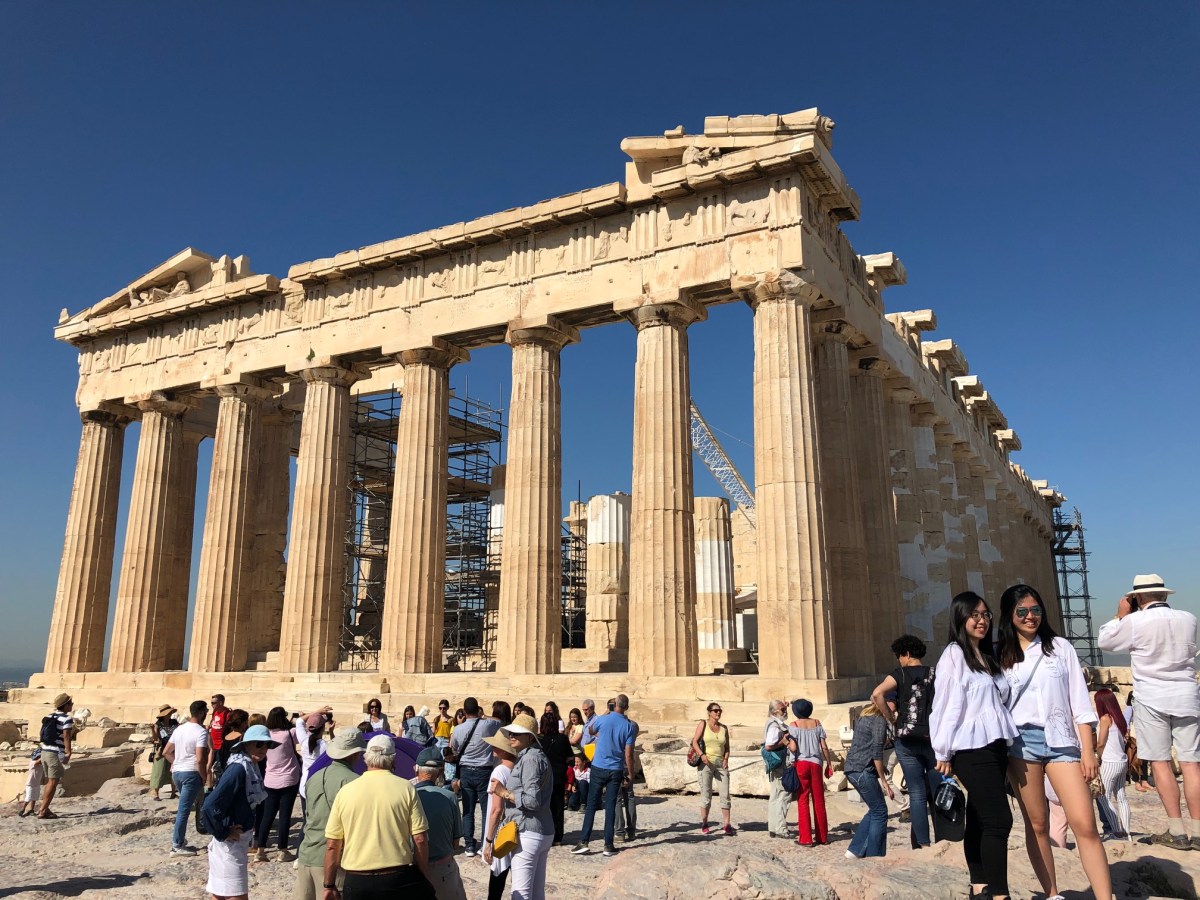
“Don’t touch the marble!” a thirty-something woman called out into the distance from her perch in front of the Parthenon. With one hand on her hip, and another shading her eyes beneath her billed beach cap, she waited and watched. About thirty feet below, a woman with short, curly hair had just rested her canvas tote bag on a large, rectangular-shaped stone and was digging through the bag, searching.
“Don’t touch the marble!” the guard called out again. Oblivious, the woman dug deeper into the bag, craning her neck to see into the folds and pockets that held gum, ticket stubs, or sunscreen.
Looking up at The Acropolis from the Temple of Zeus Olympios, which was even larger than the Parthenon. Photo: M. Yung
“Ma’am! Please don’t touch the marble!” the guard called out for the third time. The woman shifted the bag against the marble stone, and continued looking.
With this final and futile reprimand, the guard hopped down from the boulder and walked briskly down to the offender. When she arrived, the woman looked up, surprised. The guard pointed at the stone, then turned and motioned to the tattered gray ropes that set the limits on the Acropolis. The woman covered her mouth with her hands, slung her bag over her shoulder, and stepped back onto the walkway. Crisis averted, the guard climbed back to her boulder, placed her hands on her hips, and continued scanning the global audience taking in the Acropolis.
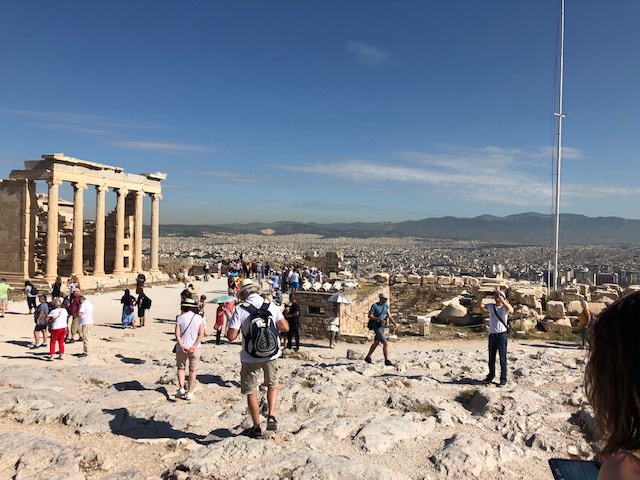
If it shines, step aside. Other than a paved walkway, the walking surface on the Acropolis is rugged. Stones jut up from the ground to create uneven areas, including some larger ledges and steps. Thousands of people walk here daily and it’s been this way for millennia. In fact, all the buildings you see on the Acropolis were built or rebuilt during the 500-300 B.C. As a result, the rocks are very shiny and SLICK. Walk on the connecting mortar or other stones. We witnessed one husband helping his wife, who had apparently just slipped, return to the Propylea (the first building you’ll walk through and the entrance to the hilltop) for an early walk back down.
See what I mean about rough terrain? That’s the Erechtheion on the left. Photo: M. Yung
Wear good shoes. These should be banned on the Acropolis: flip-flops, any shoe without a tread, a wedge greater than two inches, and heels of any height. Believe it or not, I did see women in heels. In the age of Instagram, some people will wear anything for the perfect post. No, you don’t have to wear orthopedic shoes, but definitely wear something sturdy with a tread.
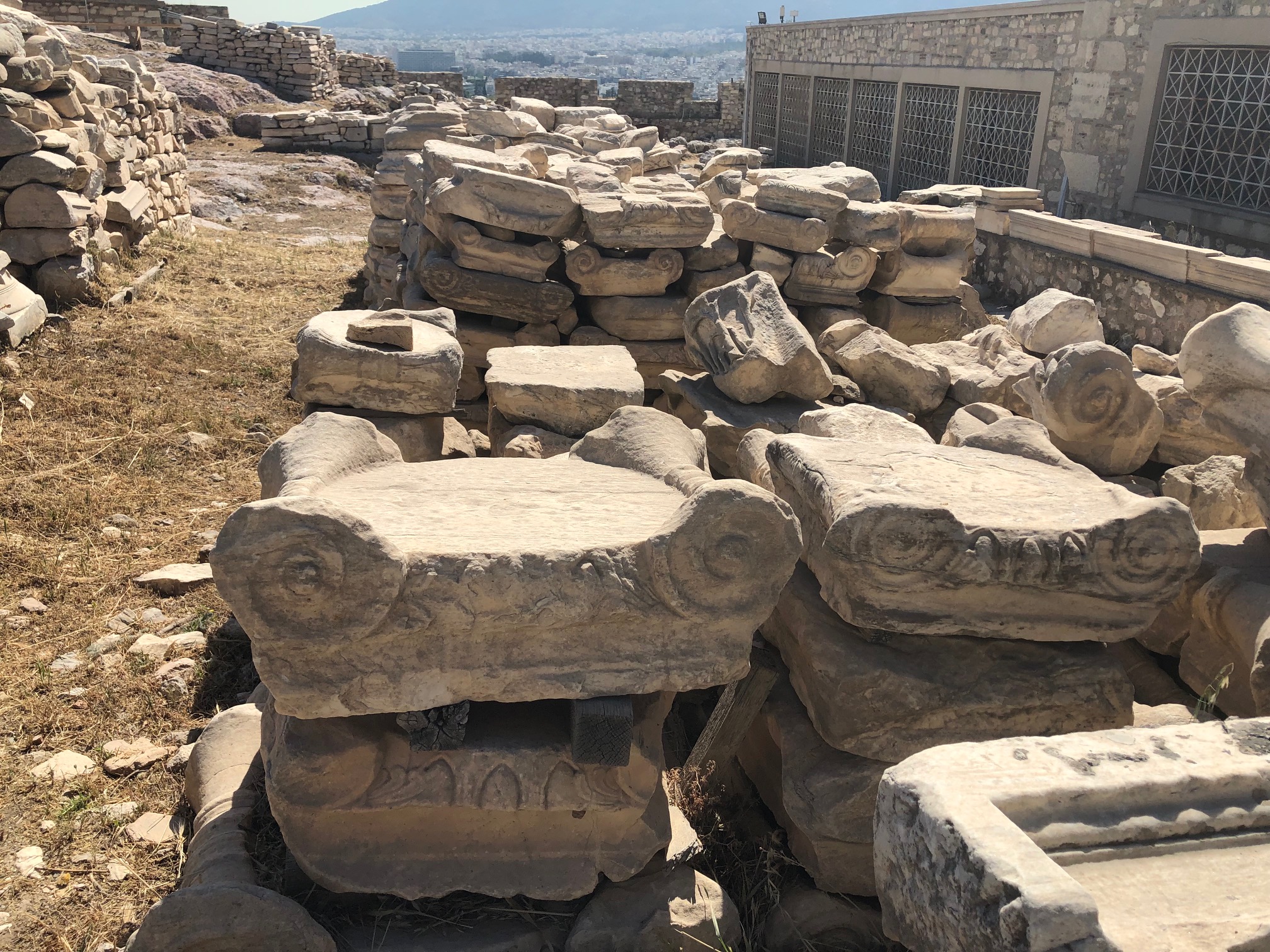
Here are some of the stacks of remnant pieces from the Parthenon area. The closest section contains fragments of Ionic capitals. Stacks of Doric and Corinthian capitals were nearby. Photo: M. Yung
Be aware of the construction. This is a construction zone and you’ll see a variety of work happening. You may be lucky enough to see a stone carver working on a new marble replacement column. We watched as men strolled across plots of ground covered with mounds of old stones sorted by size, shape, or style.
Can you imagine being the sculptor assigned or hired to carve new columns for the Parthenon??? Photo: M. Yung
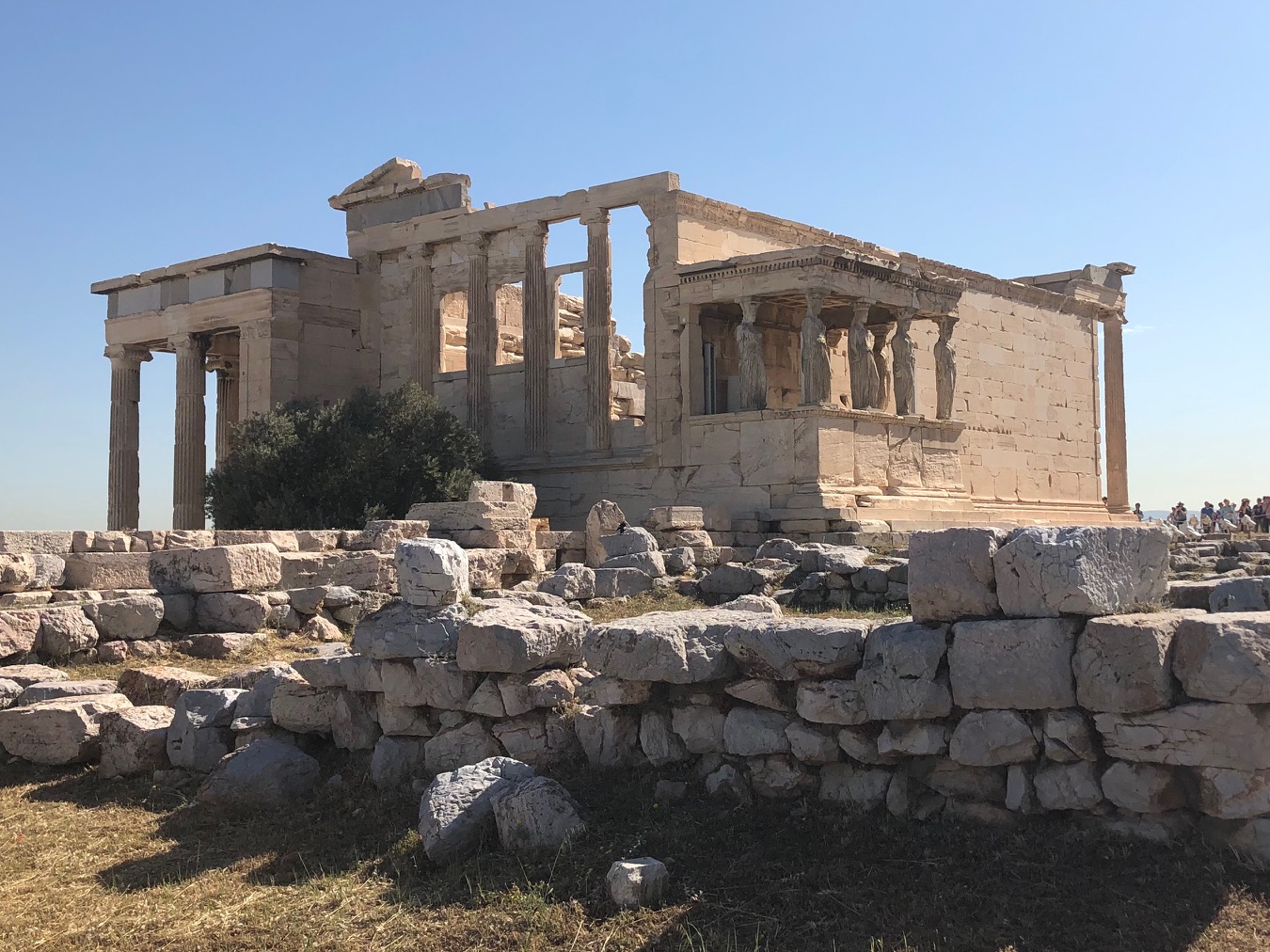
Also, you’ll see roped-off pits that contain stone walls and equipment near the Erectheion, the temple dedicated to Athena and Poseidon with its five “caryatids,” stunning female sculptures that served as support columns. Other areas on the grounds are filled with huge marble chunks, an iron cannon, and other remnants of past activity.
4. Get there early. Lines begin forming at 8 a.m. in early June, so be there early to avoid crowds. We didn’t arrive at the ticket booths until about 8:45. As a result, we crept up the steps of the Propylaea with a steady stream of tourists. I can only imagine how much busier it became as the day continued.
5. Bring sunscreen. Obviously, you’ll be in direct sunlight for an hour or more. Put on sunscreen before you leave your hotel room, and take it with you to reapply when you’re on top.
This photo shows the Erechtheion and a construction office on the right. Various piles of stones, column pieces are strewn about on the grounds. This area was not accessible to the public. Photo: M. Yung
6. Finish your food before entering. Food is not allowed inside the gates. When we entered and showed our ticket to the man at the gate, he requested I finish the cookie I was eating with my dose of Ibuprofen. He was polite about it, but did ask that I finish it before going much further.
This is a picture of the side of the Erechtheion that shows the caryatid statues on the right. These are exact copies of the originals, which are in the Acropolis Museum except for one that’s at the British Museum. It was removed by Lord Elgin, British Ambassador to the Ottoman Empire, in 1801. Photo: M. Yung
7. Leave your water at home or bring an empty bottle. If you don’t want to lug the extra weight of water in your backpack or purse, you don’t need to. Depending on the crowd, the walk up will only take twenty to thirty minutes, after which you can venture over to a water fountain adjacent to the Parthenon. There you’ll find three bubblers and one bottle filler. The water is clean and cold. In fact, there are water fountains here and there across the grounds, not only next to the Parthenon, but also below near the Theater of Dionysus.
And finally,…
8. Don’t touch the marble. Avoid the reprimand. If a stone is especially light in color, has an unnatural shape (as if it’s been cut or chiseled), or otherwise appears to have been shaped by human hands, don’t touch it. It’s probably marble. Just think, all those missing stones from the structures have fallen nearby and the walking paths weave among them. If you think a stone could be marble, it probably is.
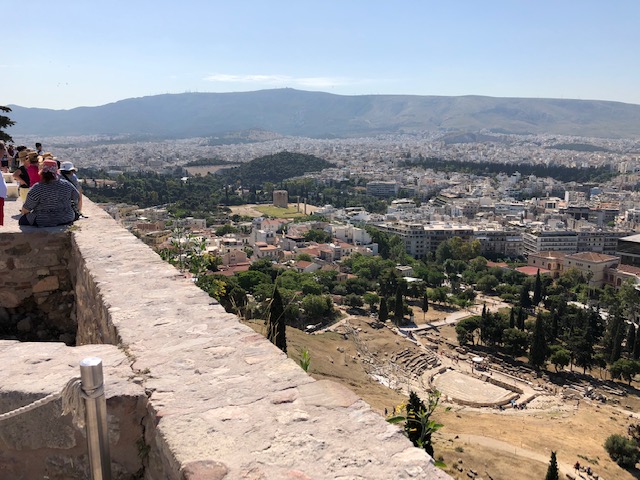
Looking down onto the Theatre of Dionysos from atop the walled limestone crag known as The Acropolis. | Photo: M. Yung
We toured the Acropolis on Friday, May 31, and spent about three hours on the site. The top (the site of the Parthenon, the Erechtheion, the Propylaea, and the Temple of Athena Nike) occupied about two hours, while other structures on the slopes of the Acropolis (such as the Theatre of Dionysos and The Odeion of Herodes Atticus) balanced out the morning. Following our tour, we lunched at The Cave at The Acropolis, a restaurant in the Plaka neighborhood district around the base of the Acropolis. I’ll be posting more about our trip. Follow my blog for updates!
The linoleum flooring in my kitchen is really old. In fact, it’s no longer white. It’s now off-white with an uneven pattern of nicks and dings that has, over the past twenty-four years, resulted in a floor that looks ugly, dirty, and tired. The linoleum, with its four-inch gray grid, was patterned to resemble white ceramic tile. And it did resemble that for the first five years, which was as long as we had originally planned for the flooring to last.
But, if you’re a homeowner, you know how that goes. Often, those initial fixtures outlast their welcome. And for us, that has especially been the case because we’ve never been in a financial position to update our flooring AND pay our bills.
Owning a ceramic studio, freelance writing, college adjunct positions, public school teaching, and an array of part-time retail stints have always managed to pay our basic expenses, but rarely anything additional. Hence, the ugly and outdated off-white linoleum.
So what does one do when one has a dream but also needs new kitchen flooring? My answer: go for the dream.
Yes, in our case, the practical solution would be to update the floor… to build value in the largest investment my husband and I have ever made. But we also know that paying for a new floor will only defer our creative goals. In other words, practicality has its limits and we have quite a dream: one month in Greece next summer.
My husband and I are travelling to Skopelos, a Greek island in the Sporades archipelago east of the mainland. Here, my husband will work a three-week residency at The Skopelos Foundation for the Arts. I, on the other hand, plan to experiment with a new writing genre (travel writing) while lingering on the island for an extended time.
Photo: Dimitris Vetsikas on Pixabay
Staying anywhere for an extended time requires money, and no, we don’t have the funds right now to go, but we are saving. We have ceased eating out on Friday evenings, for example. We are putting away what we can, and plan to have the majority of our trip paid for before our departure date.
Of course, that departure will lead to a return date. Once home, when I step into our kitchen, flip the light switch, and see the same old linoleum, what thoughts will cross my mind? Will I be glad I still have that flooring because keeping it allowed me to write in a new environment and experience new cultures and people? Or will I scowl at the floor, its ugliness reminding me of what I will still have in my life: uncertainty, bills to pay, the meager income that results when both spouses teach?
Will I be grateful for the dream that we chose to chase? Yes, I think so.
In the end, I believe that one can afford what one wants to afford. And when it comes right down to it, I would rather marvel at a Greek monastery than new hardwood flooring. If I can’t have both, I’ll take the dream.
Many things have happened since I originally published this post last fall on Medium.com. My husband was offered a full-time position at a nearby university, and we are moving from our home (with its aging linoleum) later this summer after our stay in Greece. Since we’re moving into a new home, we’ll take a pass on the upgrade to new hardwood flooring.






















 Marilyn Yung