Categories
Greece (Crete)

Phaistos, Crete

A peek into the past in the hills of southern Crete

Phaistos. Phaestos. Festos. Faistos. And then in Greek, it’s spelled Φαιστός.  No matter how you spell it, each name refers to Phaistos Minoan Palace, the second most important site (after Knossos Palace in Heraklion) of the Minoan civilization on the island of Crete.

We visited Phaistos last summer in late June. After touring the archaeological sites at Athens, Mycenae, Delphi, Olympia, and Knossos, we made a final stop at Phaistos. After a confusing morning journey by public bus from Heraklion, we made it to Phaistos in plenty of time to take a leisurely self-guided tour, eat a small lunch beneath a pine tree, and have a cold drink and ice cream in the small, on-site gift shop before hopping on a bus back to Heraklion. Here’s my post about how to get from Heraklion to Phaistos, click here.

If Minoans are new to you, here are a few facts about the culture from my husband:

  • The Minoans, named for their ruler, the mythical King Minos, are known for their advanced civilization that settled the island of Crete and other surrounding islands.
  • The Minoans were great sea travelers.
  • They built enormously sophisticated palaces for their royalty. The palaces were very “high tech” for the time period and exhibited a distinctive and advanced architectural style.
  • Phaistos was the region that produced Kamares ware, a pottery style dating from the 1800-1700 BC. Kamares ware, named for the nearby cave where it was found, is known for its dark background and white brushwork. Kamares wares were considered luxurious to own and were exported throughout the Mediterranean to Cyprus, Egypt and Palestine.
IMG_0876
Kamares ware, including these vessels, were found at the Minoan palaces at Knossos and Phaistos. | Photo: M. Yung

A self-guided tour of Phaistos is relaxing and quiet. Unlike Knossos, there are no guides-for-hire who approach you as you enter offering to walk you through the site for a fee.

While these guides are likely very helpful for many tourists, we doubted that they were truly needed, considering the large number of detailed placards placed throughout the site. Granted, that assumes one doesn’t mind reading.

phaistos distance
This photo is taken from the opposite side of the palace grounds.   Jerzy Strzelecki [CC BY-SA (https://creativecommons.org/licenses/by-sa/3.0)%5D

When you do stop to read the signs, you can learn a lot. Here are some basic facts taken from a placard found at the entry to the main site:

  • The hill of Phaistos was inhabited as early as 4500-3200 BC in the Final Neolithic Age.
  • The first palace of Phaistos was active from 1900-1700 BC. The palace controlled the plains and valleys found below the palace hilltop.
  • The city of Phaistos — and Minoan culture in general — flourished until  323-367 BC.
  • The Phaistos Palace grounds included a central court, surrounding wings, multi-story buildings (similar to Knossos), gateways and open balconies.
  • More facts follow the next few photos.
IMG_1129
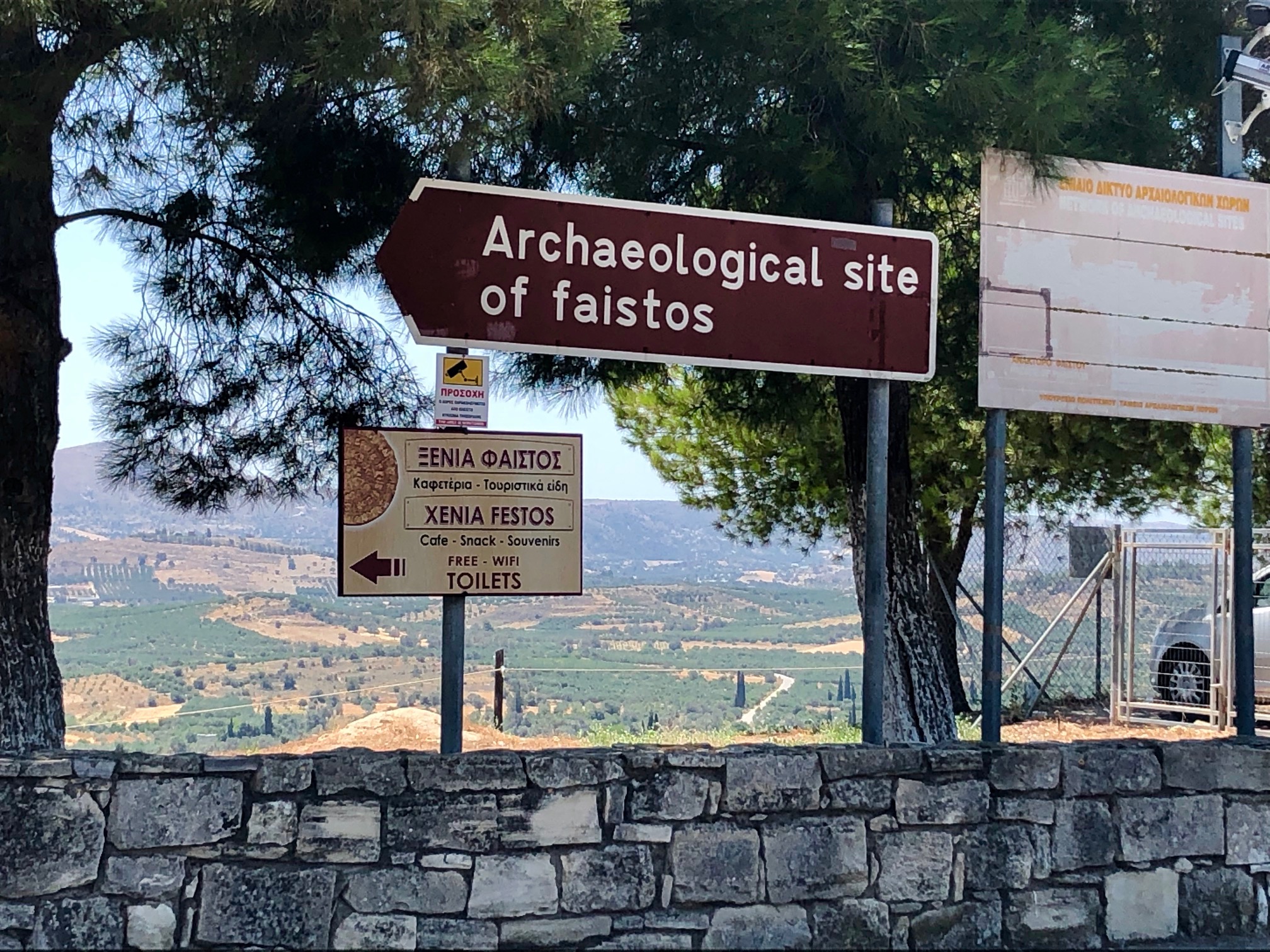
Phaistos is found on a hilltop in southern Crete. The valleys on all sides of the hilltop are blanketed with olive trees, grape vineyards, cypress trees, and farms. There are several caves in the surrounding hills also. Many items, including pottery, have been found in these caves. | Photo: M. Yung
  • The first Phaistos Palace was built around 1900 BC.
  • It covered 8,000 square kilometers over three terraces.
IMG_1077
Tickets to the Phaistos site are 8€ each. Getting there is inexpensive, too, via public bus.
  • The original palace was inhabited for 250 years and destroyed and rebuilt three times.
  • It was destroyed the last time by an earthquake around 1700 BC.

It’s amazing that visitors are allowed to walk on stones laid nearly 3,700 years ago!

IMG_1079
Little at Phaistos seems to have changed since the 1919 photo above. It’s still isolated, quiet, and remote. | Photo: M. Yung
  • After the earthquake, the ruins were covered and a new palace was constructed on that.
  • This last palatial site was smaller, but according to the placard, “more monumental.”
  • This last Phaistos Palace was destroyed in 1450 BC, but not rebuilt.
  • Two more facts follow below.
Phaestos_Vue_générale_Au_fond,_la_plaine_de_la_Messara_-_Baud-bovy_Daniel_Boissonnas_Frédéric_-_1919
It’s amazing how little has changed over the years. This photo from 1919 shows the steps leading to the West Court. The theatral area and diagonal wall appear in the lower half of the picture. | Frederic Boissonnas [Public domain]
  • The city of Phaistos continued to be inhabited and thrived in Hellenistic times from 323-367 BC.
  • In 150 BC, Phaistos was finally destroyed by Gortys. When Rome conquered Crete in 67 BC, Gortys became the capital, replacing Knossos.

But back to our tour…

The main reason we wanted to visit Phaistos: the pithoi.

IMG_1084
Two pithoi appear below a reconstructed walkway. | Photo: M. Yung

These pithoi (the singular word is pithois) are well-known in art history circles and Phaistos is considered the premier site for this particular kind of storage vessel. In fact, my husband hoped the site would have more available to see, as he had seen photos of many more pithoi on display here.

IMG_1088
A room with storage jars known as pithoi. | Photo: M. Yung

Still, it was fun to wander the grounds and find a pithois tucked away here and there. There were more to see in an area of the grounds covered with metal shelters; however, these shelters were in large areas closed off to visitors.

IMG_1090
Mitch walked as far as he could into the Magazine of the Giant Pithoi, a room that contained  several large pithoi jars. | Photo: M. Yung

In fact, this was our main disappointment with Phaistos:

a good portion of the site was closed.

IMG_1096
The shrines of the West Wing were predominantly small rectangular rooms that contained benches. According to the placard, inside these rooms excavators found ritual vessels, figurines of deities and other cult objects. | Photo: M. Yung

There was definitely a feeling that Phaistos is overlooked and forgotten.

  • a few signs were missing
  • some barriers were broken
  • a wooden observation deck had missing boards

Generally, Phaistos seemed neglected. And this isn’t really surprising, considering Greece’s other economic priorities.

True, due to its location, Phaistos sees fewer visitors than other more popular Greek archaeological sites. In fact, Phaistos doesn’t even make this Top 20 list of Greek ruins.

IMG_1106
Photo: M. Yung

Still, Phaistos is a valuable peek into the past, and among art historians, it’s well-known and revered.

The Phaistos Minoan Palace reminds us that we shouldn’t underestimate the abilities and ingenuity of ancient cultures. For example, precisely placed stairs and drainage pipes made of solid stone show us the resourcefulness of the Minoans.

IMG_1104
Drainage pipes were used at Phaistos. | M. Yung
IMG_1109
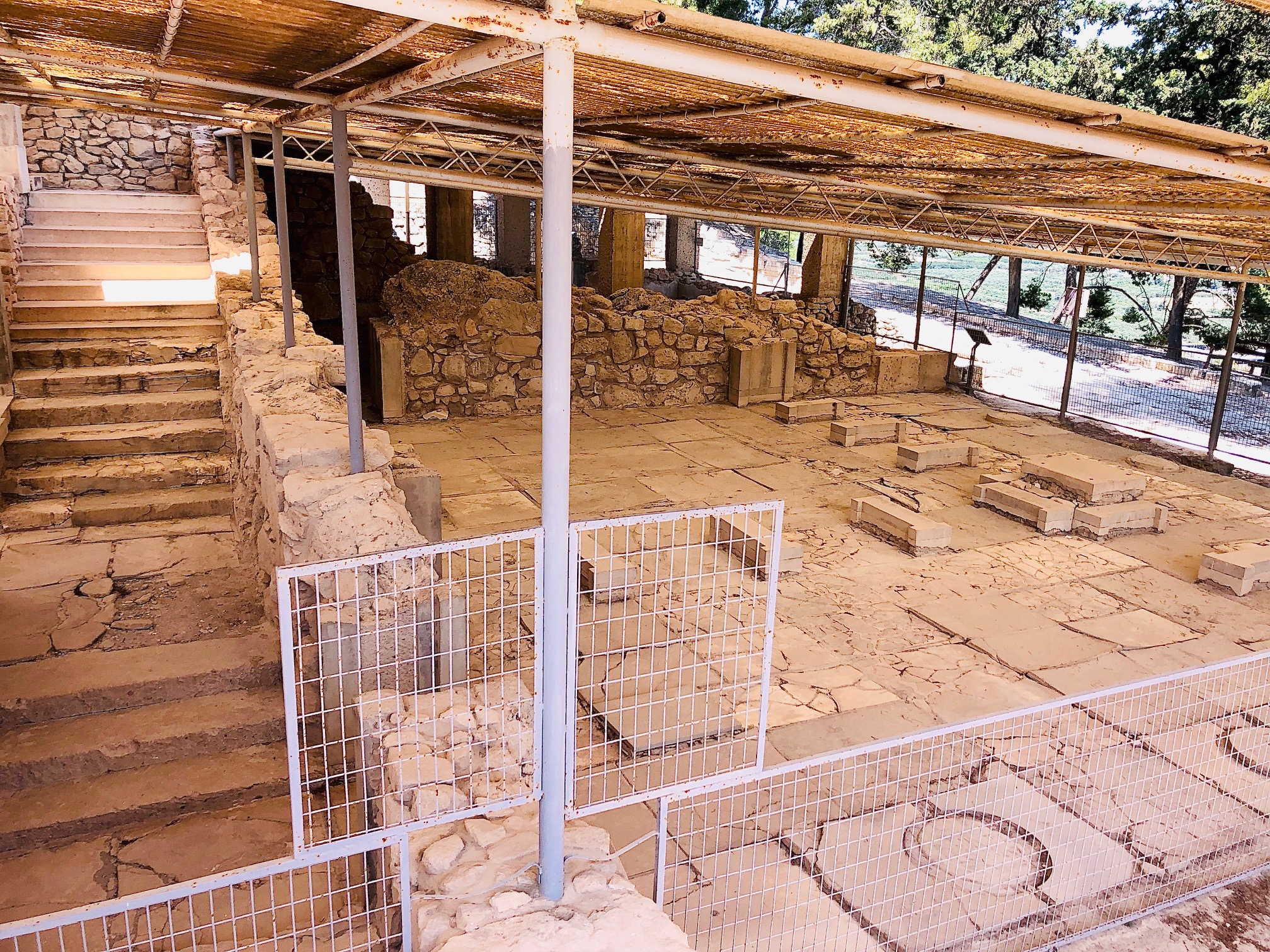
This is the Queen’s Megaron (throne room) found at Phaistos. It is covered by a metal shelter on this side…
IMG_1110
…and this side, too. | Photo: M. Yung
IMG_2460
The Phaistos Disk is on display at the Heraklion Archaeological Museum. The disk represents one of the greatest mysteries of archaeology. No one knows the meaning of the symbols incised into the clay. It was made between 2000-1000 BC. It measures about six inches in diameter. | Photo: M. Yung
IMG_1093
Photo: M. Yung

It was a beautiful sunny day when we visited Phaistos. In fact, by early afternoon, we were ready to hop on an air-conditioned bus and make the trip back to Heraklion.
IMG_1113
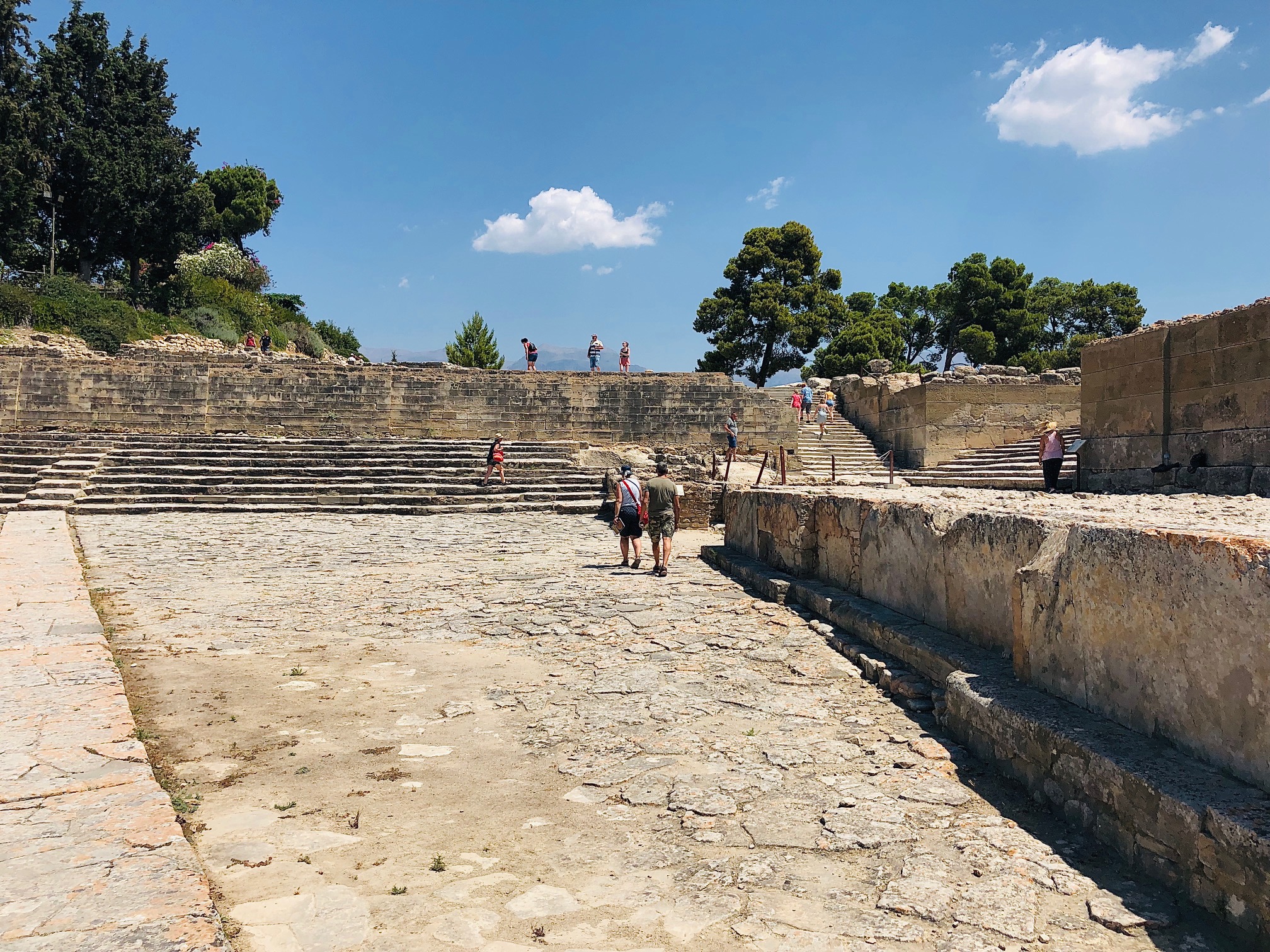
This photo shows the theatral area on the left and stairway to the West Court on the right. | Photo: M. Yung
IMG_1154
Here I am walking near the theatral area in the West Court. The wall to my left can be seen on the left side of the preceding photo.
IMG_1116
Kouloures, large stone-built structures, show time-consuming craftsmanship. | Photo: M. Yung
IMG_1101
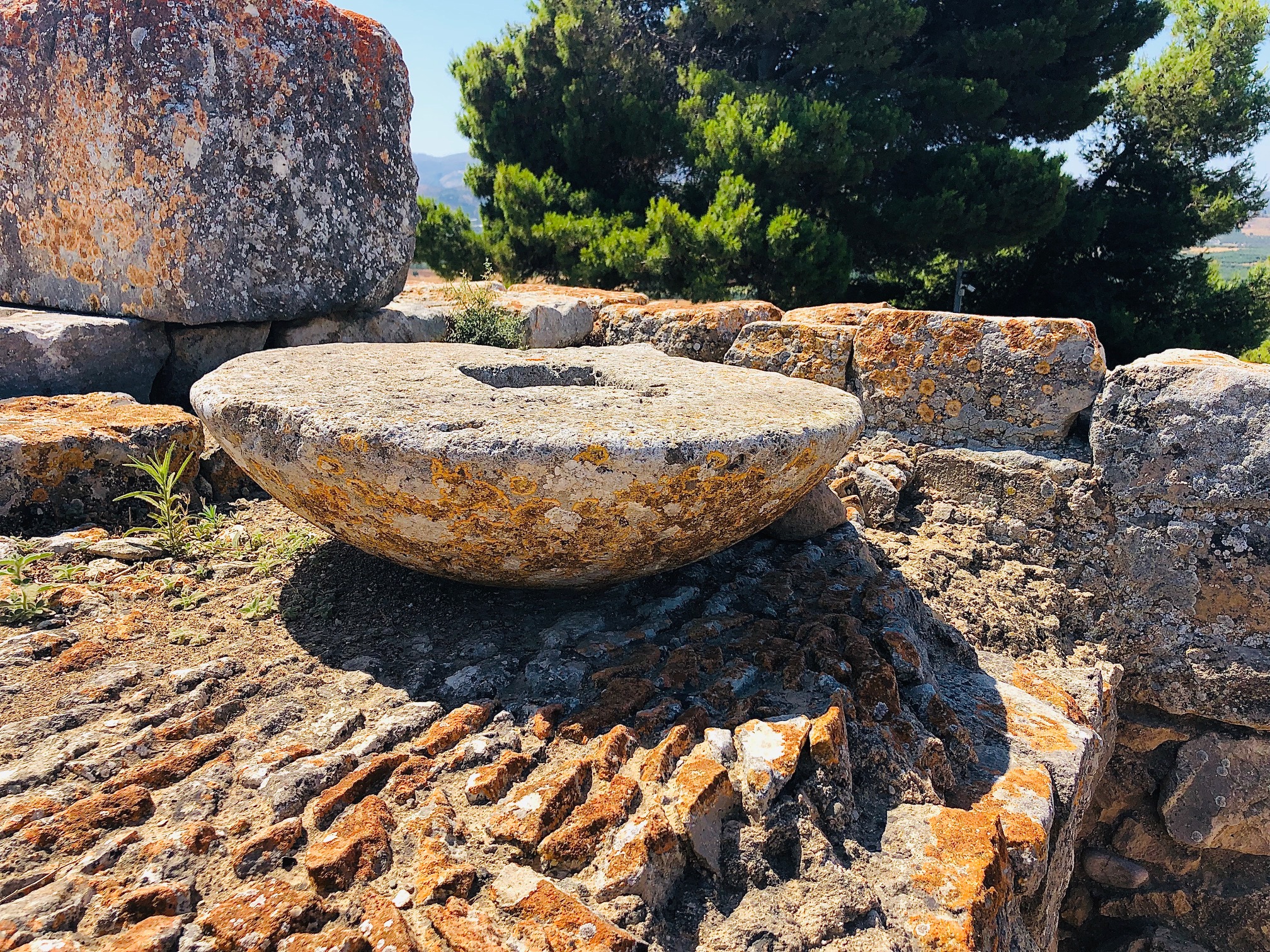
Relics from the past are scattered across the grounds. | Photo: M. Yung
IMG_1112
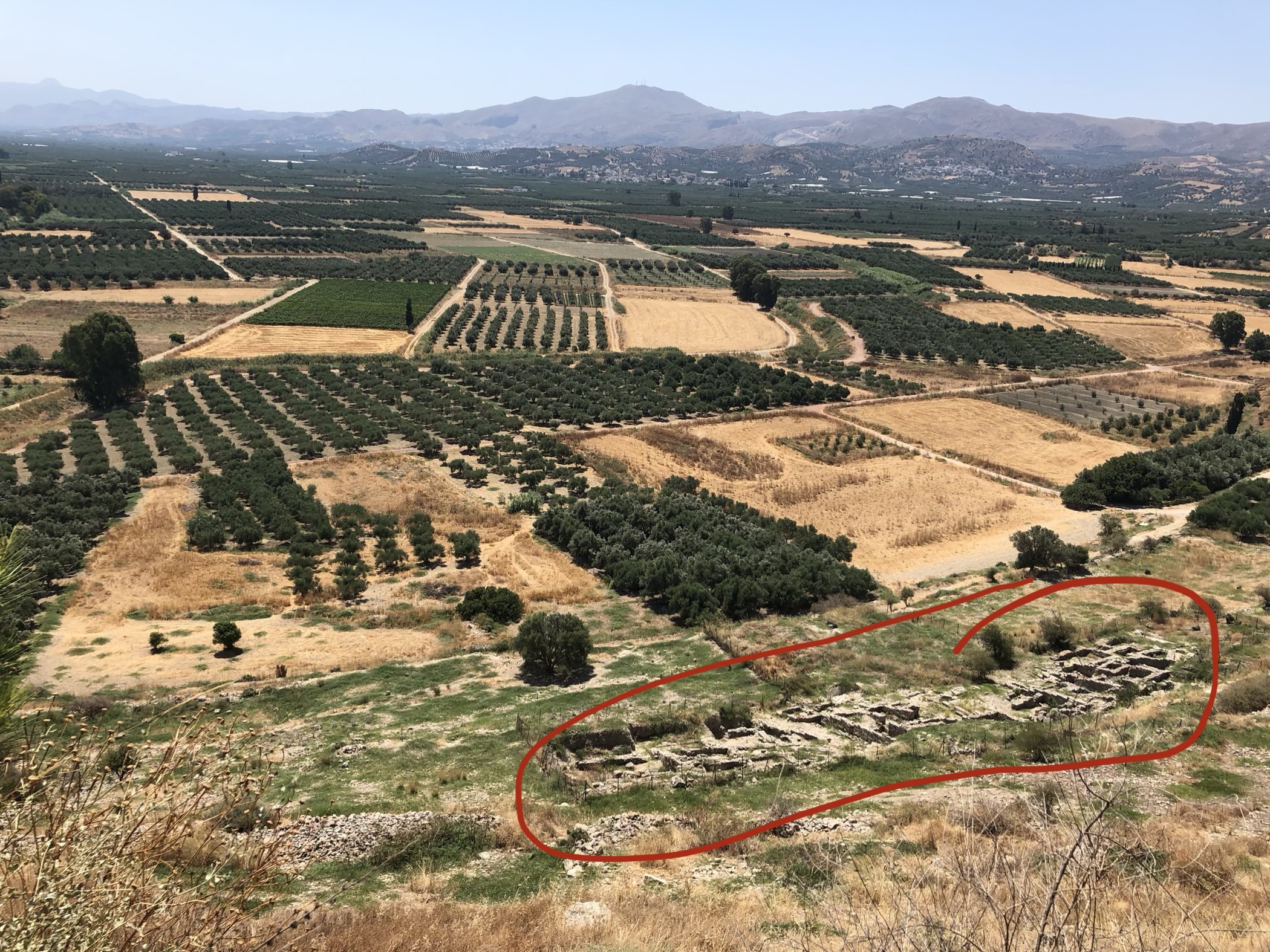
This photos shows the surrounding hillsides. I’ve circled in red additional outlying structures that were subordinate to the palatial hilltop above.  We ate our lunch (that we had packed and brought with us) on benches beneath a pine tree right above this scene. | Photo: M. Yung

Mysteriously, no one knows for sure the reasons for the collapse of Minoan culture, including the civilization at Phaistos.

Perhaps that’s a fitting conclusion for this archaeological site that today is still out-of-the-way, obscure, and famous.


Thanks for reading! This post is another installment from our cross-country Greek odyssey last summer. It’s amazing how many more sights I have yet to write about. Follow my blog for more travel posts, including this one from our final day in Greece when we visited the site of Paul’s To an Unknown God sermon.

Categories
Greece (Crete)

A Week in Heraklion, Crete

At first, Crete’s largest city threw us for a loop

The arrivals terminals at Crete’s airport may disappoint you.

First, it’s curiously dim. I remember telling my husband it felt like a Walmart store. Its cold LED lighting cast a cool glow on the blue and gray interior.

Second, the ladies bathroom was a mess. Forget toilet seats. Apparently, they were deemed unnecessary. And the hand dryers seemed pointless also. That’s because they blew a softer gale than the one outside. Shaking the excess water from my hands, I left the bathroom and joined my husband to explore our ground transportation options.

As we walked, I asked myself, This is Heraklion? My preconceived ideas of a sunny, bright and sparkling Crete had quickly evaporated and we weren’t even outside yet.

IMG_0781
We flew to Crete on Volotea Airlines, a regional carrier based in Madrid.

But that would change soon enough. After fielding a taxi to our AirBnb, checking in with our host, picking up some groceries at the small corner market, things improved.

Yes, Heraklion, the largest city on Crete with a population of 174,000 and Greece’s fourth largest city threw us for a loop at first. However, it took just overnight for us to become more accustomed to our corner of Greek life in Heraklion’s Fortetsa neighborhood.

Over the next five days, we explored much of Heraklion’s major attractions, navigated its bus lines, and took a daytrip into the countryside south of Heraklion to the Phaistos archaeological site.

IMG_0783
We sat down and surveyed the ground transportation options before deciding to take a taxi to the Fortetsa neighborhood. Our driver had a difficult time finding it. Apparently, the neighborhood is not a regular stop for tourists.
IMG_0811
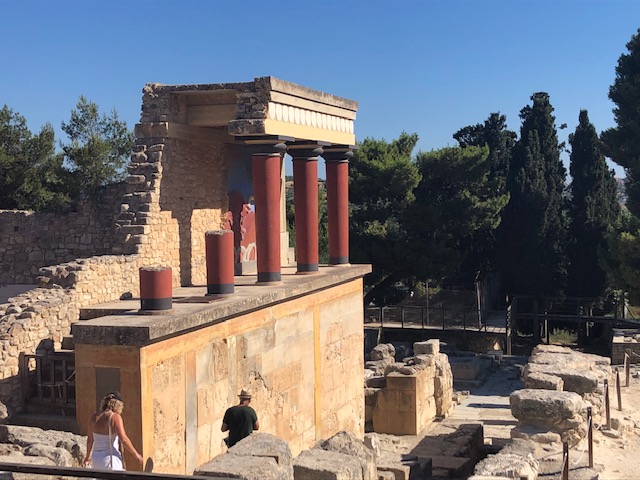
At the top of Crete’s historical attractions is the Knossos Palace, the center of Minoan culture; read my post for more information. This is the oldest city in Europe and dates from 1380-1100 BC.
IMG_0913
This strolling Greek band was loud and persuasive. The man on the left approached out table and held out his tambourine for a 2 Euro donation.
IMG_0915
If you look deep into this photo, you can see several tavernas and restaurants ready to snag tourists with cappuccinos and gyros.
IMG_0936
This is part of the Venetian shipyards, erected during the Venetian occupation of the port and the island in general, which in those days was known as Candia.
IMG_0937
This sign will fill you in on basic Heraklion history, including a history of Crete in general.
IMG_0998
This portion of the Venetian wall extends into Heraklion.
IMG_1071
This fountain is another relic of the Venetian period.
IMG_1144
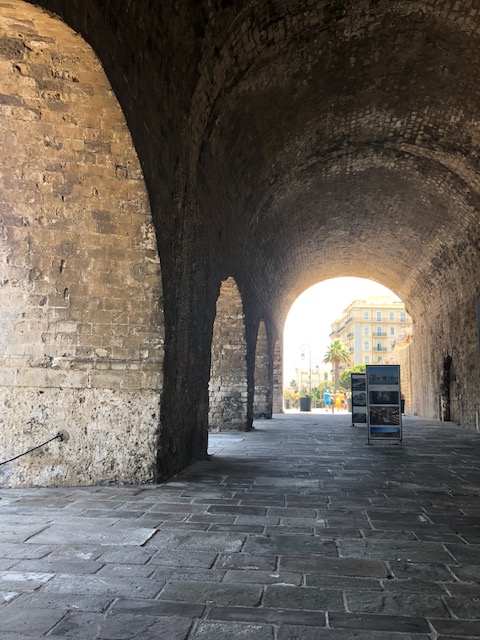
Pedestrians pass under and through the Venetian wall on foot or in vehicles. They can walk up the stairs beyond the tree on the right-hand side of the photo and walk on top of the wall.
IMG_0952
This portion of the Venetian fortress extends into the harbor. It protected the city from invaders. Notice the symbol of Venice, the lion, in the relief sculpture at left. For scale, also notice people between the crenellations along the top of the wall.
IMG_0970
I just couldn’t get over the blue-green waters of the Sea of Crete north of Heraklion.
IMG_0967
We walked inside the Venetian Fortress Museum. It was well worth the 2 Euro ticket price to learn a little history along the way.
IMG_1005
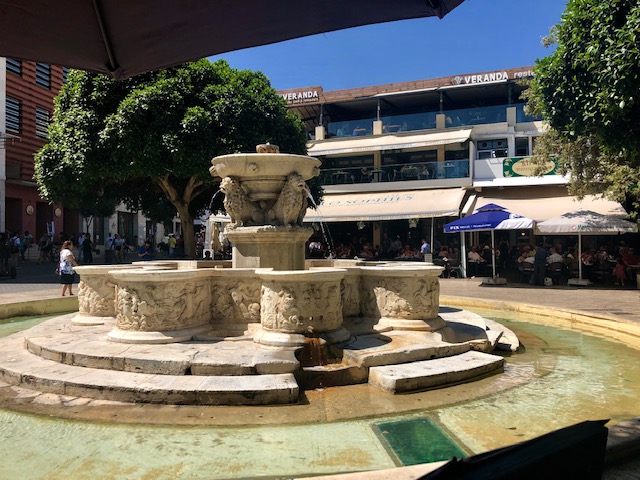
This is Morosini Fountain in city center Heraklion. It’s a remnant of the city’s glory days under Venetian influence and rule.
IMG_1004
IMG_1022
This is the sunny plaza at noontime just outside the Church of San Minas.
IMG_1143
The front entrance to the Heraklion Archaeological Museum in the center of the city.
IMG_1017
The interior of the Church of Saint Minas
IMG_1033
Adjacent to the Church of Saint Minas is the Church of Saint Katherine Museum of Christian Art. It showcases a collection of Greek Orthodox artwork, including murals, tapestries, metallurgy, and, of course, incredible icons.
IMG_1036
A detail from a painting inside the Museum of Christian Art. This painting is called
IMG_1059
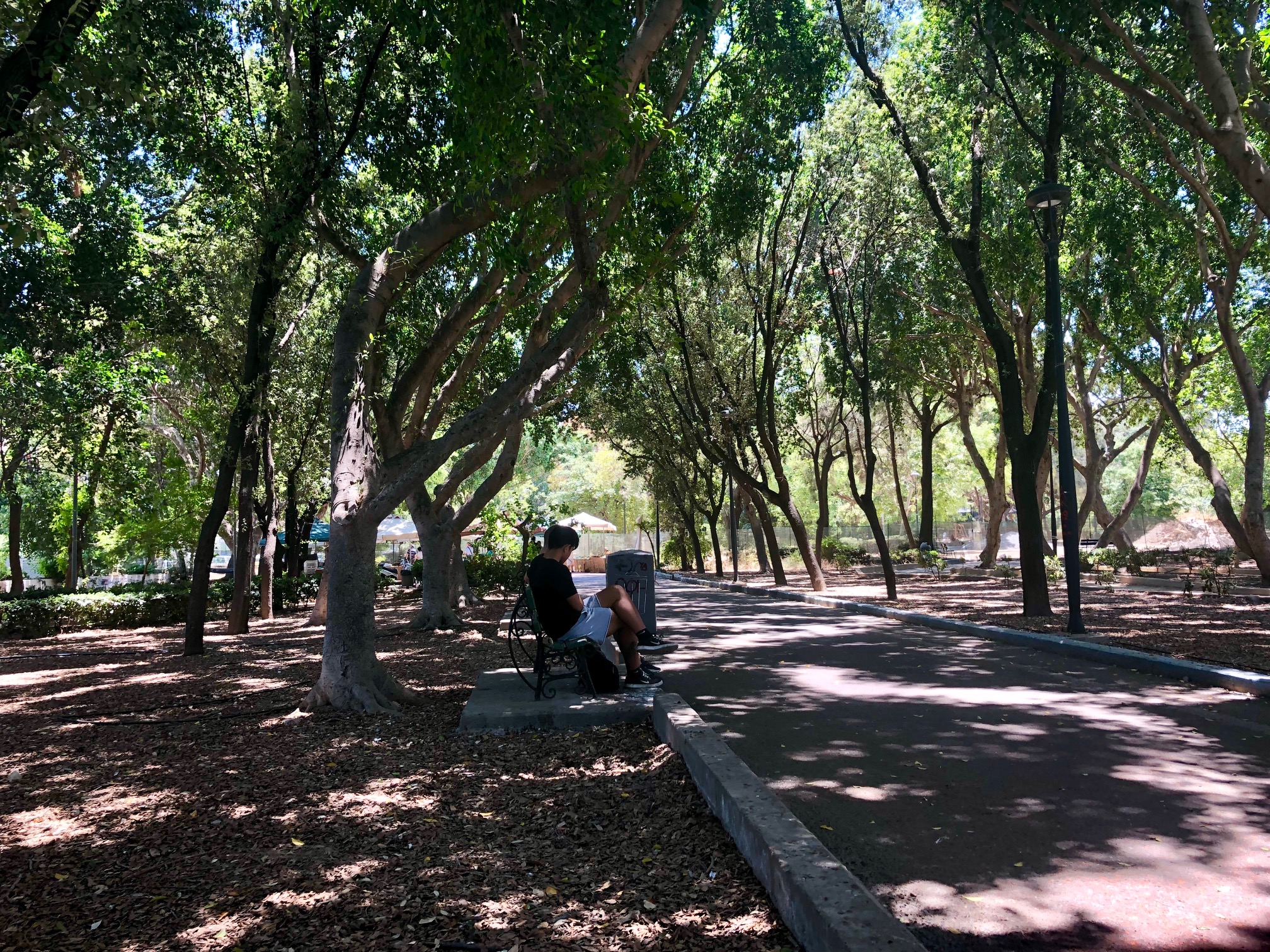
We rested inside this shady park situated next to a portion of the Venetian wall.
IMG_1136
This outdoor mural in inspired by the “Ladies in Blue,” a fresco originally found at Knossos. The original fragments are displayed inside the Heraklion Archaeological Museum.
IMG_1046
Scooters everywhere!
IMG_1056
Snack kiosks such as this one are ubiquitous in Heraklion. Some of these also sell city bus tickets.
IMG_1138
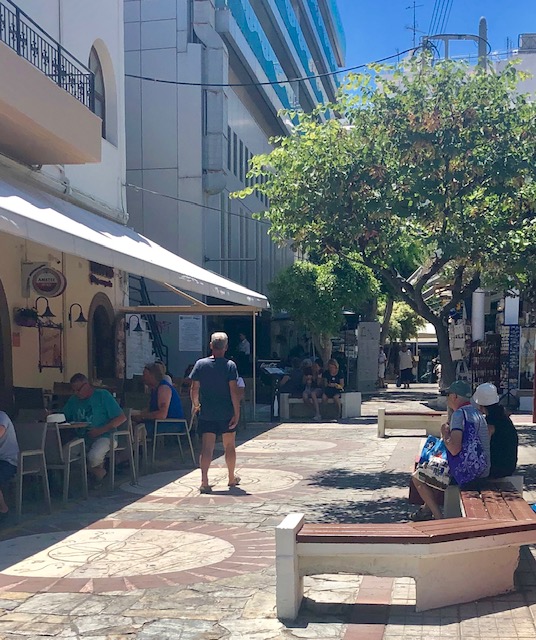
This is a popular retail district in Heraklion. Notice the brilliant blue of the ocean in the distance.
IMG_0987
IMG_0942
The harbor at Heraklion with the Venetian fortress on the left.
IMG_1089
Pottery found at Phaistos, which we visited one day when we took a daytrip south. A post on this daytrip is forthcoming. Stay tuned! Check out this post for how to get to Phaistos by bus.
IMG_1148
The front door of our AirBnb in the Fortetsa neighborhood of Heraklion.
IMG_1063
The street outside our AirBnb. Our taxi driver seemed a little surprised that we were staying here. I guess it’s not the expected tourist neighborhood; however, it was safe and quiet. We felt like we were getting to see the real Heraklion that many tourists may not be privy to.
IMG_1147
We stayed in Fortetsa. Notice the Greek spelling above the Roman or Latin letters.
IMG_1146
Greece held elections on July 7. All 300 seats in the Hellenic Parliament were in play, including president. Posters were plastered in bus stops and in other public areas throughout the city.
IMG_1070
I took this photo while sitting in the bus stop looking up into our Fortetsa neighborhood. We were getting ready to board a bus downtown.
IMG_0992
We stopped in at this market a few times during our stay in Heraklion. The melons were perfectly sweet.
IMG_1064
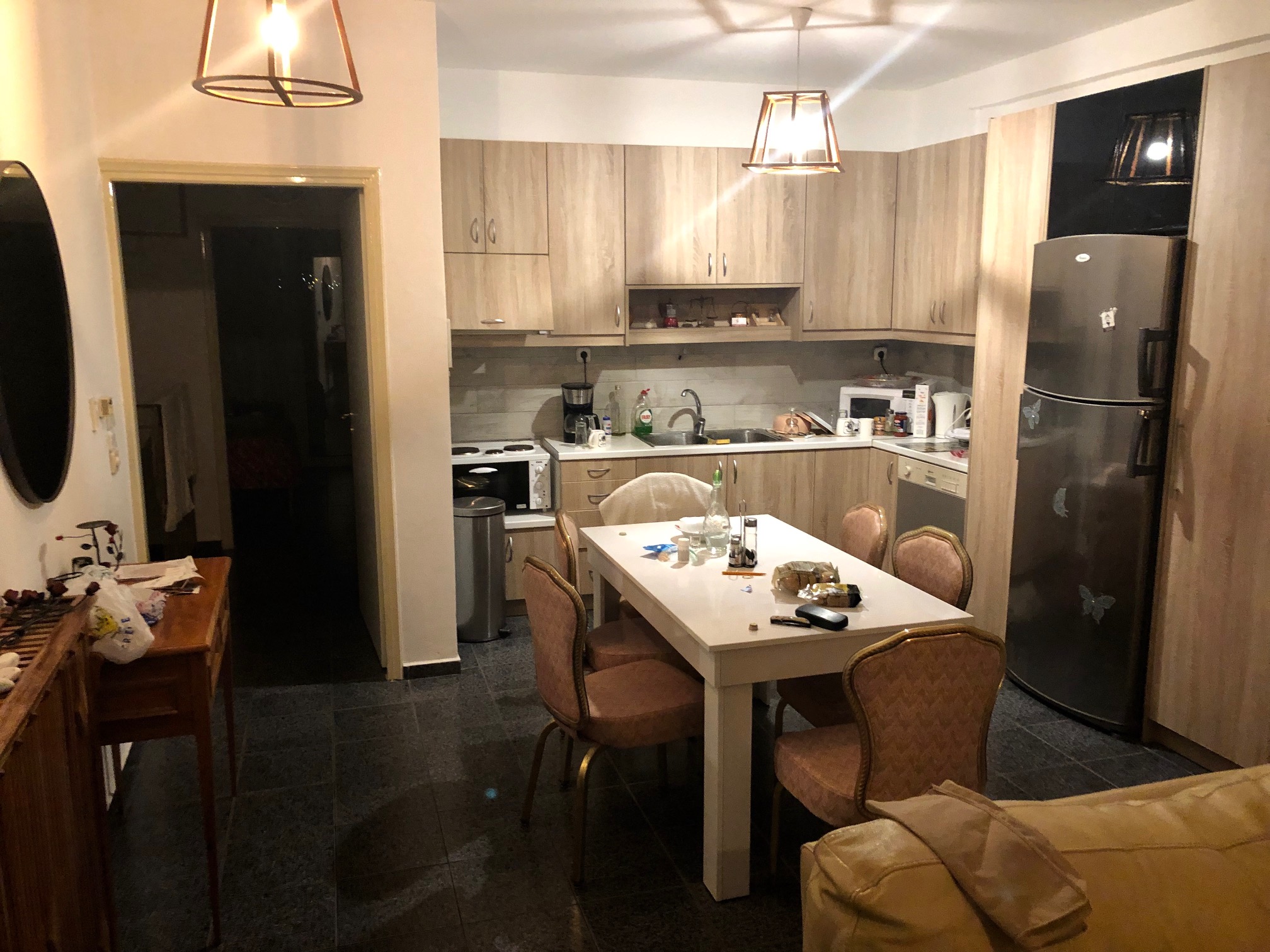
The living room of our AirBnb in Heraklion.
IMG_1067
Another photo of our AirBnB.
IMG_1160
The ceiling in the departures terminal of the Heraklion airport (above) is quite a dramatic difference from the arrivals terminal. The arrivals area was stark and uninviting  in comparison.

Featured Photo Credit: Marilyn Yung | Central Heraklion from the top of the Venetian fortress in the harbor.


Thanks for reading! My husband and I are in the process of moving out of the house we’ve lived in for 25 years. It’s been a job accomplishing the move and writing more about our trip this summer to Greece. I plan to add several more posts over the end of summer and fall. That’s my plan; however, with a new teaching job starting in a little over a week, it will be a challenge.