Categories
Poetry

Dear Kitchen Cabinets: An Apology Poem

Dear Kitchen Cabinets,

I apologize for slamming

You so much in my 30s.

You were there and

You had a handle.

In a way you

Were asking for it.

But there were

One too many dirty plates

Left in the living room.

(What am I,

The maid?)

And there was

My desire to complete

One measly thought

Without interruption.

(What is “alone time”

Anyway?)

These are little things,

I know, but

These distractions,

These unintended discourtesies,

Are the big stuff of every mother’s life

And, sadly and simply,

They are not to be avoided.

Therefore,

I’m sorry

I took it out on you,

kitchen cabinets of 

Lightly stained maple.

You never broke down

To hang limp from a torn hinge. 

Well…

Except

For that one time.

–Marilyn Yung


Thanks for reading! For more poetry, visit my poetry page. For teaching poetry, visit my teaching website, ELA Brave and True, with more than 350 posts, including a large collection of poetry lesson plans.

Photo by: Eric Nuhr on Unsplash

Categories
Italy Motherhood parenting

How far will you go to teach your daughter to lead?

And there I was, simply her mom letting her be brave so she could develop this thing called courage.

When it comes to teaching our daughters to lead, how do we do that? How far should we go? Encourage good grades? Encourage career over all else? Do we teach them to forge ahead first? To seek and take advantage of each and every opportunity that comes along?

How about if we teach our daughters this: to have courage. “Courage, fortunately, is a teachable and learnable skill,” according to Bill Treasurer, Kimberly Adelman, and Laura Cohn of Giant Leap Consulting in their article, “The Power of Courage for Women Leaders.”

“The trick to building courage competency is to purposefully move outside of your comfort zone on a regular basis. Don’t move so far out as to become petrified with fear, but enough that your body starts to give you the physiological cues that you’ve become uncomfortable,” write the authors.

My daughter knows these physiological cues. Two years ago, she was completing a three-month internship in Venice, Italy at the Peggy Guggenheim Collection, a well-known modern art museum located on the Grand Canal. At first, her foray to the floating city caused much stress and worry, especially in the early days of her time there. She experienced stomach aches, anxiety, and a lack of appetite.

She also experienced environmental and social challenges: Venice’s maze-like corridors, the language barrier, new colleagues and workplace. And then there was the peeping Tom.

However, as her internship continued, she became accustomed to her experience there, and she was able to enjoy it completely. It was good to feel courageous despite the difficulties. I remember my daughter saying this about her day-to-day experience alone in Italy: “I became comfortable being uncomfortable.” She even said one day about a month after she returned home that she missed the feeling of discomfort she had become so accustomed to.

“Moving into your discomfort zone is how you learn and grow,” writes Treasurer. Believe it or not, true discomfort will build courage. And courage is at least part of the solution to overcoming the organizational biases that “inadvertently favor men” for leadership roles, writes Treasurer, Adelman, and Cohn.

Well, guess what? My daughter recently returned to Venice for two months for another internship… to help staff the U.S. Pavilion at the Venice Biennale, the renowned international exhibition of contemporary art from countries across the globe.

In the weeks prior to her departure, my friends and co-workers asked me how I felt about her return to Italy. They asked me:

“It’s so far away. That doesn’t bother you?”

“How are you handling it?”

“Aren’t you worried about her?”

I told them that I was fine with it. I told them that I encouraged her to apply for the opportunity.

And then I doubted myself and wondered…

Should I feel this unfazed?

Am I being careful enough?

Should I be so willing to let her go so far?

This was followed by a confident second or two when I asked myself, “Aren’t I just doing what mothers should do with their daughters?”

Shouldn’t I let my daughter be brave? Let her travel? Let her get so far outside her comfort zone that being uncomfortable feels comfortable? Isn’t this what the authors of The Power of Courage for Women Leaders are getting at? After all, aren’t I just allowing my daughter to grow in ways I was never encouraged to? Independently? Without commitments?

Don’t we encourage our sons this way?

And yes, I get it, she’s an adult and completely able to navigate across time zones, oceans, and mountain ranges. And yes, she did eventually meet up with a roommate. But until then, she was simply my daughter venturing forth alone in a big, big world. And there I was, simply her mom letting her be brave so she could develop this thing called courage.

So, is this the price I must pay—this apprehension and fear that comes and goes when I imagine her navigating Venice, alone, head down, leaning into the misty winds of early May? Is this the price I must pay to demonstrate to my daughter that she deserves to be brave and to venture forth into the world?

Is this the price I will pay to teach her to lead with courage? Will I go farther or have I gone far enough?


These are the wonderings of an anxious mother’s heart. Feel free to leave a comment to share your thoughts. Have you ever watched your child venture forth into the world, yet had your own reservations about watching them do just that? Follow my blog for more posts on parenting, travel, and education.

Featured Photo: Lorri Lang on Pixabay

Categories
Italy Motherhood

A dull ache for a sharp object

When Mom’s pocket knife gets confiscated

When the security employee at the gate asked me to step aside, I remembered. My pocket knife. Oh no, my pocket knife, I thought, realizing I had left it earlier in the little cosmetic bag inside my purse. I had forgotten to check it with my luggage and now I was at the gate and my knife was going away.

The uniformed employee explained in her thick Venetian accent, “We must take this from you. If it’s you really need, you go downstairs, fill out the form, and it be sent to you.”

Standing there, I knew we wouldn’t have time to make those arrangements. And besides, it wasn’t a valuable possession. But then again, it was.

For twenty-five years, I had carried that pocket knife.

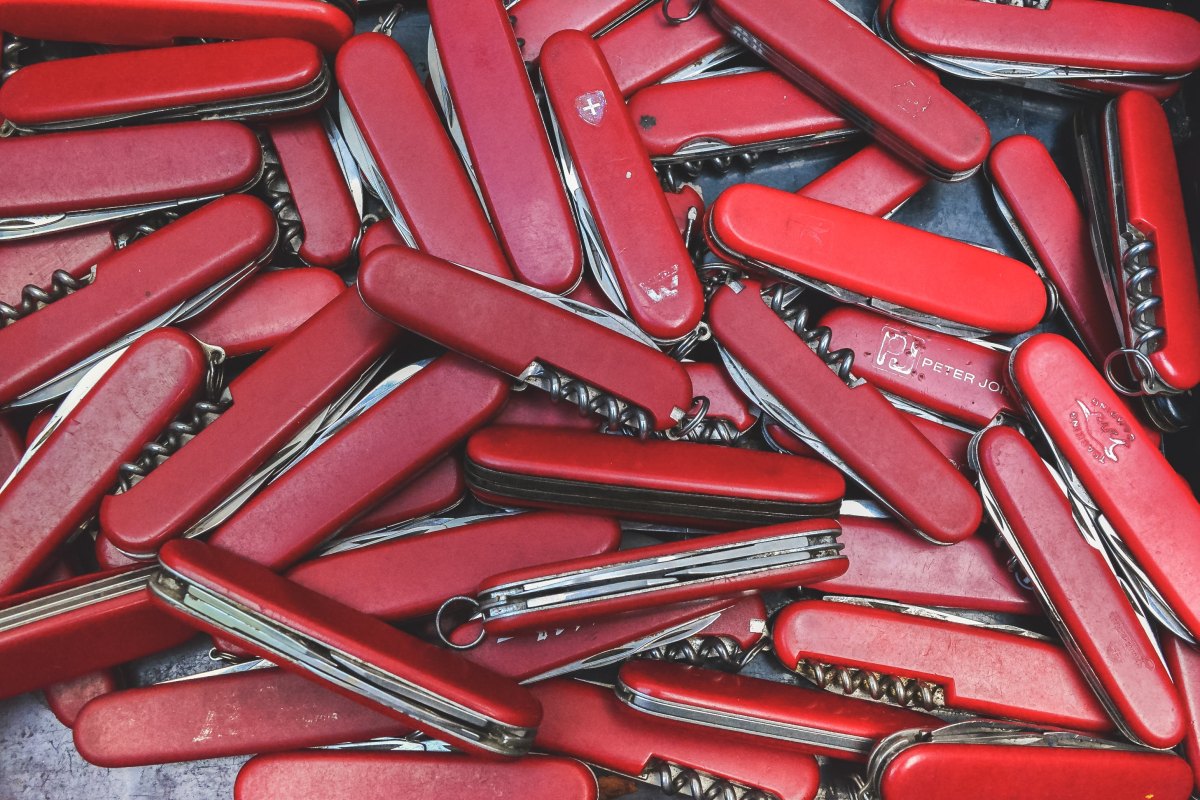
Back in 1990, I had chosen it from a mound of identical ones heaped in a small cardboard box next to a cash register in the sporting goods department at a Kmart in Topeka, Kansas. It had cost my boyfriend (now my husband) an entire dollar. It featured a steel blade, a wooden casing, and bronze hardware that over the years, had polished to a golden shine from being nestled in my purse for so long.

Similar to how candy bars are placed at checkout stands to captivate small children, that box of $1 knives held equal allure for the fishermen and hunters who visited that department. Not that I was one of them. We had gone to the store to use the restrooms tucked away behind the restaurant at the back of the store. As he waited on me, he spotted the knives and bought one for me.

“Keep it in your purse. It’ll come in handy,” he told me. He was right.

That little knife had been many places… all over Missouri and Kansas, Nashville, Asheville, several cities in Maine and Vermont, Columbus, Atlanta, Sarasota, Highland Park, Phoenix and other Arizona locals, multiple sights in the Los Angeles area, Oregon and Washington State, Cape Town and other South African cities, DC, New York City, Taos, Breckenridge, Crested Butte, Dallas, New Orleans. Over the years, we had journeyed across the country to attend annual family reunions, exhibit my husband’s ceramic art at festivals, and accompany him as he served artist residencies.

And now, its final destination would be Venice, Italy, where it would be left behind, a hindrance to a quick departure, discarded inside a gray plastic tub under the counter.

I regret leaving that silly little knife because it wasn’t just a pocket knife. It was a symbol of family life and motherhood and had been more often used for non-cutting tasks. That knife spread peanut butter on sandwiches many more times that it ever cut into a fish or snipped a cord on a tent or tarp. It was this mother’s indispensable tool. As such, it was always easy to locate.

My son and daughter both knew I carried a pocket knife and I passed it back to them at least once or twice on every road trip we took over the years. Need to break open a family-sized plastic bag of M&Ms? Get Mom’s knife. Opening a DVD? Get Mom’s knife. Got a stray thread hanging from your hem? Ask Mom to hand back her pocket knife.

Just prior to leaving Venice, as I buckled up inside the plane, regretting my decision to leave my knife, I recalled how six years earlier, I had flown from Johannesburg to Atlanta with a knife my son had purchased as a souvenir. Despite its massive four-inch blade, he had somehow forgotten to pack it in a checked bag. I offered to stow it inside my purse, warning him it would likely be confiscated at our first departure.

Nope. X-rays and inspections by hand never discovered it. Of course, that would happen to a brand new knife without any peanut butter experience. And of course, that knife has since been long forgotten, I might add.

As for my knife, I have since replaced it, but the blade on my new one is narrower and not quite as functional as the one left in Venice. I mean, you can spread peanut butter on a slice of bread if you really want to, but it’s the not the same as my Kmart special.

I’m one of those people who feels sorry for the last Christmas tree on the lot. So it’s no surprise that I’m still feeling nostalgic for my lost pocket knife… a year and a half later.

Somewhere in Italy, it’s languishing in a gray bin of confiscated sharp objects. Maybe it’s been recycled by now. Maybe it’s been donated to a charity. Hopefully, it’s performing some mother’s mundane tasks, making her life a little easier, and definitely more memorable.


Had an experience similar to mine? Like this post, follow my blog, and feel to leave a comment about any precious object that’s drifted out of your life. Thanks for reading!

Categories
Italy

Vicenza, Italy: where the art is the city itself

And other observations made on a daytrip from Venice to the City of Palladio

My daughter spent three months living in Venice in 2017 as an intern at the Peggy Guggenheim Collection, a small, yet world-renowned modern art museum located on the Grand Canal. Her time there was magical, challenging, beautiful, and life-changing. On four occasions, she day-tripped with her friends away from the 124 islands that compose Venice to visit these cities: Bologna, Padua, Verona, and Vicenza. 

Since her return, we’ve enjoyed many conversations about her time in Italy. In this and future posts, I’ll be relaying the details of each of these short excursions. This post is about her daytrip to Vicenza, a city with an approximate population of 113,000 full of architectural gems that was designated a World Heritage Site in 1994.

The interview answers are just the two of us talking; see the photo captions for more detailed notes and facts about her trip.

How far is Vicenza from Venice? It’s only a 45-minute train ride that goes through Mestre, which is near Venice on the mainland and then Padua before arriving in Vicenza.

What did you do first? We first walked from the train a few minutes to the city walls. Then we made our way to the Palladio Museum. It’s a large museum situated within the Palazzo Barbarano. The museum showcases Andrea Palladio, the Italian architect who designed tons of buildings all around the city. Palladio lived in the early 1500s, so he can be considered a High Renaissance artist.

FullSizeRender (13)
The city walls of Vicenza. At this location, pedestrians enter beneath the arch in the darker portion of the wall. Photo: K. Yung

The museum has old and rare sketchbooks and drawings by Palladio. Those were so interesting. It was amazing to see how well-preserved the papers were.

FullSizeRender (14)

The museum is also famous for all of the dioramas they have of Palladio’s designs. These aren’t old, but they are really valuable, so anyone—and especially art historians and architects—can understand more about how the buildings were designed. You can get a sense of the effects that Palladio achieved with his symmetry, like the long views down corridors.

FullSizeRender (15)
Dioramas attract many to the Palladio Museum. Here, architecture and art history scholars can see up close the Palladian features that created this ubiquitous architectural style. Photo: K. Yung
FullSizeRender (16)
Photo: K. Yung

Was symmetry his trademark? Well, one of them, along with columns. He’s why columns are popular in homes and public buildings. Basically, his work was about highlighting classical Roman architecture, and symmetry was one characteristic. His designs influenced architecture around the world. It eventually became called Palladianism. Palladio’s work is easy to recognize because he had a very distinct style that totally revolutionized the architecture game. And lots of people are familiar with Palladianism, even if they don’t realize it. The White House and the U.S. Capitol—and thousands more examples around the world—are good examples. So is Thomas Jefferson’s home, Monticello.

Did you have a tour of the Palladio Museum? Yes, we had a guide who spent 2 ½ – 3 hours showing us the museum, which was our main goal in visiting Vicenza. There was an exhibition being shown there called “The Mysteries of Palladio’s Face.” It was all about portraits of Palladio—or the fact that there aren’t portraits of him. No one really knows for sure what he looked like. Even drawings of him are different. However, there was a drawing we saw where he had actually sketched his hand onto the paper. Kinda cool because at least we know it’s his hand, y’know?

You were there such a short time. Did you miss anything? The Villa Rotonda was closed when we were there and that’s one of Palladio’s most famous and influential works. It’s a square building with four entrances, one on each side. It’s one of the most recognizable structures of the Renaissance.

Villa_Rotonda_front
The Villa Rotonda contains four identical facades, which add balance to the complete design. Photo: Stefan Bauer, http://www.ferras.at [CC BY-SA 2.5 (https://creativecommons.org/licenses/by-sa/2.5)%5D, from Wikimedia Commons

What did you do after the Palladio Museum? After that, we walked around downtown to see some of the other buildings. There’s a whole street in Vicenza called Corso Andrea Palladio… it’s lined with multiple palaces and buildings that were at least designed by Palladio if they were constructed during his lifetime.

IMG_6503
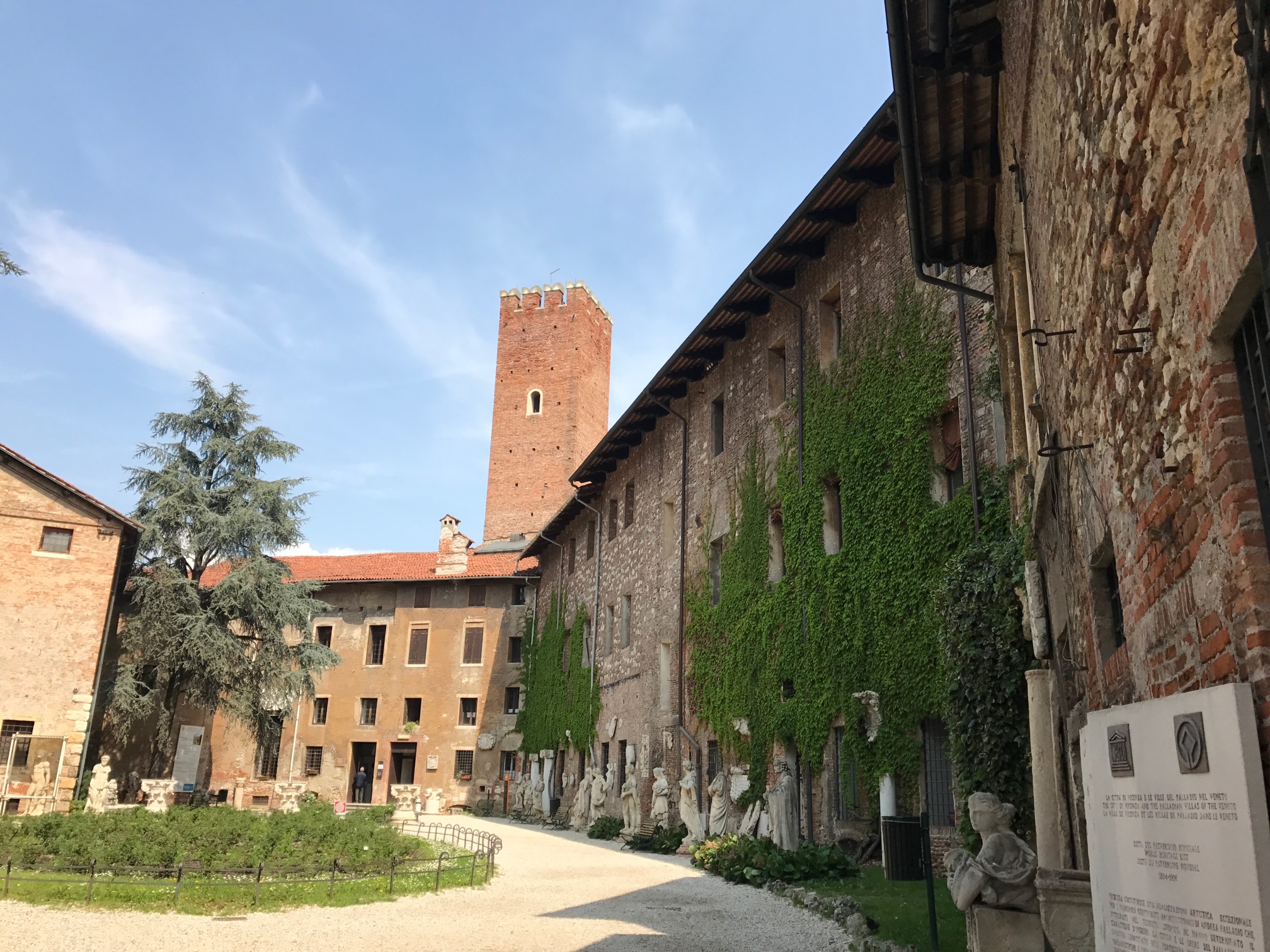
In this photo, you see the Teatro Olimpico on the right. Built from 1580-1585, the theater appears deceptively rustic on the exterior, but on the inside, the design does an “about face” and High Renaissance style takes center stage. The plaque that declares the theater’s designation at a UNESCO World Heritage Site is displayed at right. Photo: K. Yung

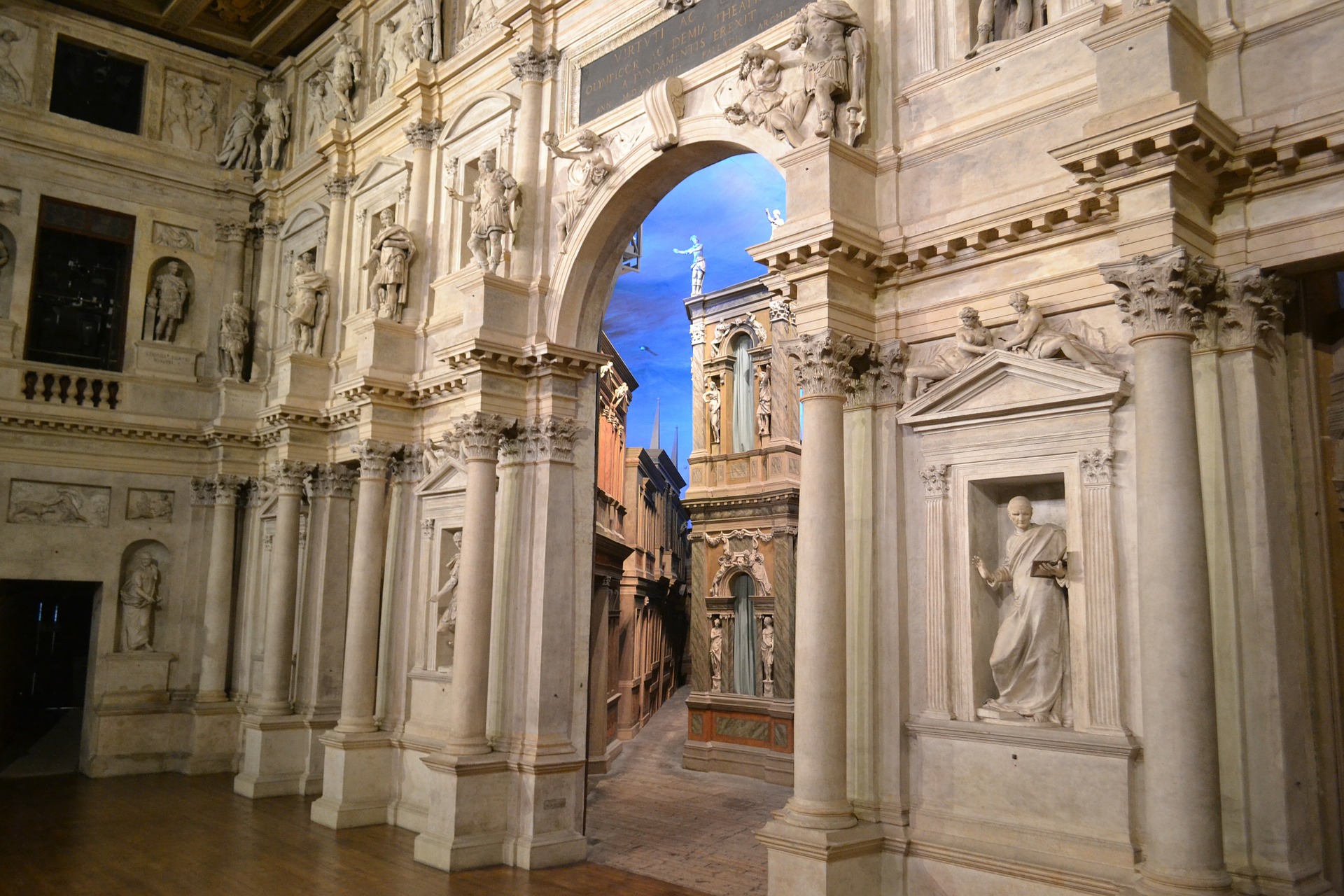
Then we went to the Teatro Olimpico. It’s a performing arts theater that Palladio designed. Today, the theater does live theater productions. You can go inside the actual theater and sit and look at the paintings. You can also see the façade that Palladio designed and the illusion of the set itself.

theatre-515655_1920
This photo does not show the theater’s majestic interior in its entirety. Visit here for fabulous photos and a full explanation of how optically revolutionary this theater is. Photo: juliacasado1 on Pixabay.

On the interior, parts of it plays tricks on your mind due to optical techniques. For example, it appears that the set is very deep based on the perspective you see through the entrance with the blue sky beyond. The ceiling of the theater is painted like the sky and it’s encircled by large-scale Olympic figures.

IMG_6509
The theater hosts dance and theater productions today. Photo: K. Yung

What else did you see on such a short trip? We went and saw the Basilica Palladiana. It’s a building downtown that you can easily identify because of its copper roof. They issued a contract to Palladio in 1549 to renovate the building because of structural problems that occurred over the years. Today, there are restaurants and shops around it, plus exhibition spaces for art and architecture shows. One thing that makes the basilica significant is that it shows the first example of the Palladian window. Palladian windows have a center window with a semi-circular top and then one rectangular identical window on each side.

vicenza-1683975_1920
Vincenza’s Piazza dei Signori, where the Basilica Palladiana is located to the right of the dark brick tower in the photo above. The distinctive copper roof is visible behind the statues that line the upper edge. Photo: cusarina on Pixabay.

After going to the basilica, we decided we wanted to have lunch outside on the plaza, the Piazza dei Signori. We found a quaint café in the sun and… wait for it… had some pizza that was altogether forgettable. It was more like American pan pizza. I’m sure some people liked it, but I was disappointed. I didn’t even make a note of the name of the place. Oh, well. That was literally the only downside to the whole day. I would love to go back!

How would you sum up Vicenza? It’s a quiet city with an off-the-beaten-path feel to it. It’s very beautiful and important. It’s like a giant art museum, but the art is the city itself.


I make no apologies. As a writer and parent, I feel perfectly entitled to take full advantage of my daughter’s experiences in Italy by wringing every possible story idea from it! Yes, our family did visit her in Venice for a week, and while we saw so much in that time, we envied the luxury of time her three-month internship allowed. Check out my profile on Medium.com and find more stories about my daughter’s other daytrips around northern Italy.

Categories
Life lessons Memoir & Narratives Motherhood parenting

The Toy I Trashed: The Hot Wheels Slimecano

Every parent has been there. You buy that cool toy your child yearns for and within minutes you realize: BIG MISTAKE.

So, in the spirit of Christmas, I thought I would relate my own such experience with the Hot Wheels Slimecano Playset… y’know, to relive the “joy” once again and possibly save another parent from buying this behemoth. After all, even though some cursory online searching indicates this toy has been discontinued, one or two units could still be lurking out there on a dusty store shelf or in an online retailer’s inventory.

In a word, the Hot Wheels Slimecano was formidable. Introduced in 2004, this apparatus was composed of an armload of plastic pieces that snapped or otherwise fit together. My eight-year-old son had seen it advertised on TV and wanted it desperately.

All those plastic pieces were accompanied by directions that explained which parts attached to which other parts, which combined to form race tracks, slime reservoirs, ramps, and other components that, when completely assembled, resulted in an ominous and wobbly gray, brown and orange tripod-like structure down which my son could send his cars. So awesome, Mom.

Also, there was somehow a skull or dragon head involved in the design of the thing, although I don’t remember the significance of that, other than maybe it was there to advise parents in “Jolly Roger”-style of the gooey mess that was about to be made.

An unsettling slime concoction was key to the Slimecano. I don’t remember if it was a slime we made ourselves from ingredients supplied in the box, or if it was included in the package already prepared in packets, but it was there, a thick, gloppy translucent orange goop dotted with dark specks. This slime provided the magic of the toy.

For a fleeting five minutes, my son played with the Slimecano. He was mesmerized watching his car careen down the plastic track… until it hit the slime and needed to be pushed through an oozing river of the stuff and then guided around a puddle at the bottom of the track. This all happened to the same unfortunate car. After all,  the wheels on a car can only move when they are not embedded with slime. My son soon figured out that this was a toy that required him to sacrifice his least favorite car. Send that car down the Slimecano once, clog up the wheels, tire treads, and undercarriage, and voila! auto salvage in miniature.

Then came the very unmagical clean-up time. While snapping apart the Slimecano, my son discovered the entire apparatus was encrusted with the orange goo. So was the floor. And his mom’s patience. As he dismantled the game, washed off each piece, and shoved the plastic collection back into the box, we knew that the Slimecano may have just had its one and only use. The game was over and disappointment was the victor. Thanks, Hot Wheels.

So there you have it, my gift to you: a cautionary tale of the toy I trashed. Have a similar toy story in your family? Tell me about it in the comments. We can laugh about it now, can’t we?!


If you enjoyed this post, click like so others can find it. Follow my blog for more posts. Thanks for reading!

Photo: Christopher Harris | Unsplash