Categories
Greece (Peloponnese)

When Your AirBnb Host Shows You the Town

…to share his enthusiasm for Olympia

As with all three of the towns we have visited so far in Greece since we left Skopelos Island, there is more to the towns than just the historical sites. For example, Delphi is a quaint Alpine-style village full of shops and establishments that cater to the tourist market that is always in town, at least in the summer months.

Mycenae is also a sleepy little village just down the mountain from its own historical site. There are a few tavernas, a mini-market, a bus stop, and a few other businesses that keep the town humming along.

Olympia is much the same.

When we arrived there a few nights ago in a taxi, we saw from a distance our AirBnB host, Kostas (another Kostas, not the one from Mycenae) standing in the middle of the street in front of our flat waving his arms at us. We pulled up, paid the driver, and lifted our bags from the trunk. Once we all shook hands, Kostas showed us our small studio apartment and gave us an impromptu history lesson about Olympia.

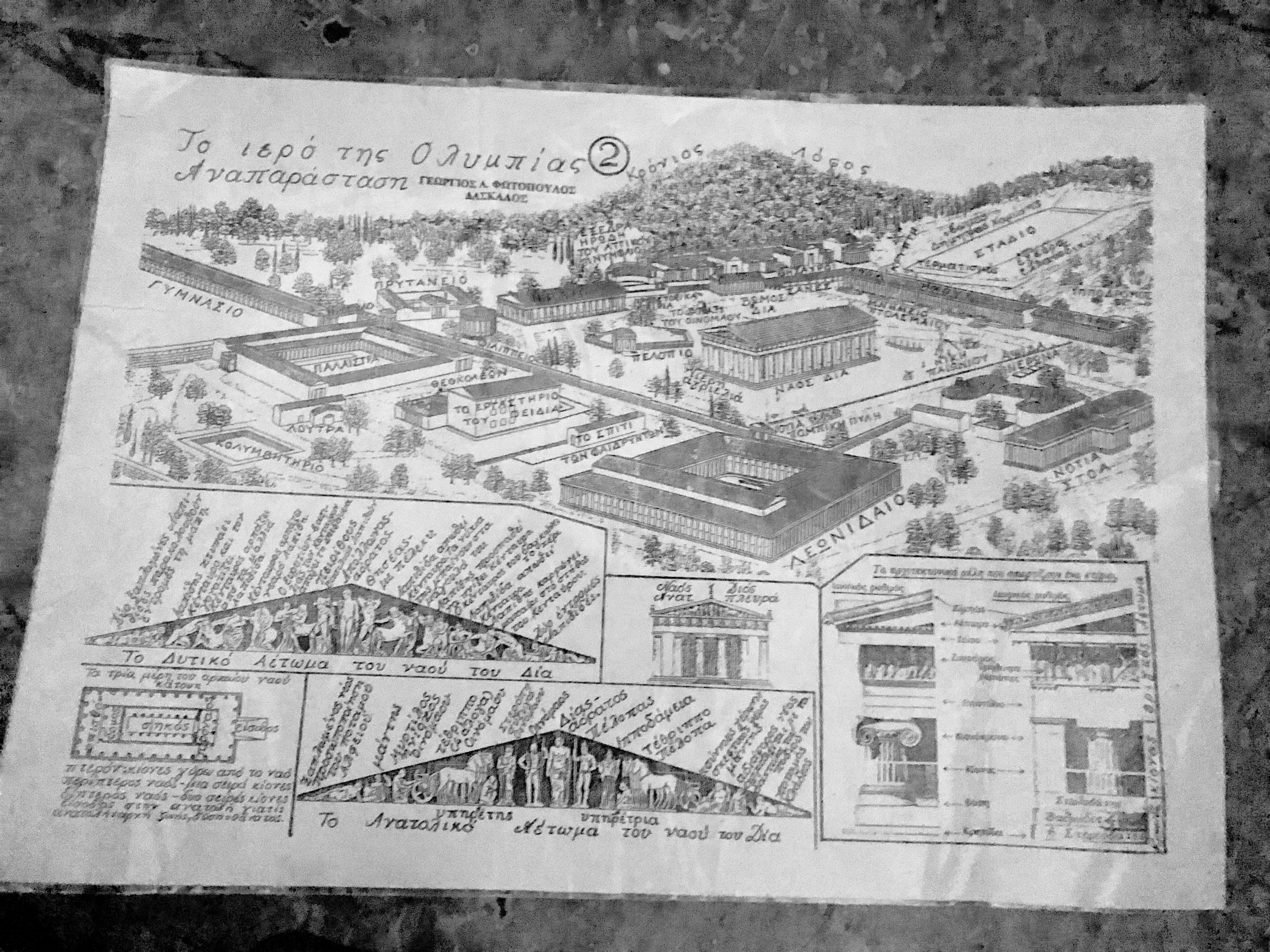
Standing inside our apartment, he showed us the laminated map below. He proudly explained several things to us in a deep, warm voice: how the ancient Greeks counted years by the Olympic games, details about the sculptures found at the site, and how the games were used by the Greeks to unite people and solve differences.

IMG_0709

A history buff, it’s obvious that Kostas loves his town and its prominent place in world history.  In fact, he reminds me of the enthusiastic Venetian tour guide I met a couple of weeks ago.

And then Kostas walked us downtown and over to the archaeological site so we would know exactly how to get there the next morning. When I say walked us downtown, I really mean that we walked down a series of steps from our studio to the main retail street that connects the modern town to the historical site.

IMG_0712
The door to our apartment is on the far right. The main street is right at the bottom of these stairs.

The main retail street, as one would expect, is full of tourist shops, clothing stores, jewelry shops, restaurants, tavernas, a grocery store, The Archimedes Museum (a free museum dedicated to the inventions and discoveries of Archimedes) and the town hall.

The three of us did make one stop along the way to the site. Kostas asked us to wait outside the little super market so he could go inside and buy a can of dog food. He wanted to feed a dog that lived inside the Olympia site.

Kostas told us that several dogs live around town that the locals look after. Once we crossed the bridge and neared the edge of the park, Kostas let out a distinctive whistle. Suddenly, we saw a white and black-spotted border collie mix bound out from the monument grounds. It sprinted for Kostas, who peeled off the lid of the can and flung the food out on the road for the dog to lap up.

Wow, I remember thinking, this is a nice guy.

IMG_0610
A jewelry shop owner snagged us inside with a tale of his brother who carried the Olympic torch during the 2004 games. He wanted to take this picture of us. I wish I had taken one of him!

After our history lesson and our tour about town, Kostas bade us farewell, asked us to contact him if we needed anything over the next two days, and took off back to his home.

At that point, we went back to our apartment and collapsed. It had been a long afternoon of bus riding from Delphi, through Itea and then along the edge of the Gulf of Corinth to Patras, and down to Pyrgos, where  we missed our connecting bus by about ten minutes.

IMG_0479
Once we made it to Patras, Greece’s third largest city, we barely made it on this connecting bus to Pyrgos. For some reason, the ride took longer than it was supposed to and we had to taxi to Olympia. Still don’t know what happened.

In a few hours, however, hunger called and we walked across the street to Kostas’ recommended taverna, Taverna Orestis. He told us it was where the locals ate since it was off the main street. He was right. By 11 o’clock p.m., the outside seating area was chock full of people.

IMG_0489
On our first night in town, I took this picture from our balcony right after we got back from Taverna Orestis, located across the street from our flat. Kostas recommended it as a non-touristy choice since it wasn’t on the main tourist street. We ordered grilled sardines, dolmades, Greek salad, and tzatziki with bread. It was excellent and fun to see the locals socializing.

There were two large groups of about twenty each, several couples, and a family or two with children. I was surprised by how busy they were and so late at night! Our sleeping and eating schedules are so vastly different from those of the Europeans.

IMG_0664
We found this taverna right in the center of the main district. It was so quaint and also had the misters running in the afternoon, so we decided to enjoy the place with some cappuccini.
IMG_0666
Mitch had a freddo cappucino (iced) and I had a regular hot one.
IMG_0612
After a morning of sightseeing at the Sanctuary of Olympia, we took a break for gyros and sodas at another local taverna. Then we headed back during the hot afternoon to the air-conditioned museum. See this post for more about the archaeological site.
IMG_0705
During our second night in Olympia, we opted to eat in with food from the market on the main street. We bought some toasts, gouda cheese, a freshly-picked orange from a tree, some salami, and Greek olives. 
IMG_0711
Another view from our balcony.
IMG_0708

The morning after our visit to the archaeological site, we asked Kostas to confirm for us the time of the first express bus back to Athens. It’s very difficult to find current bus schedules and to know that they’re right.

At left is a screenshot that Kostas sent us via the AirBnB app so we would have a current schedule. We took the 9:30 express  along the southern edge of the Gulf of Corinth and made it back to Athens by 1:30 p.m.

Olympia is small and comfortable. It’s busy when loads of buses drop off tourists, but after they leave for the day, it’s a very quiet town. In fact, there are several unoccupied hotel buildings scattered about town. I’m not sure if that’s an after-effect of the 2004 Olympic Games building boom or not. Regardless, the town is a winner and was definitely worth the three bus rides and a taxi to get there.

Featured Photo Credit: Marilyn Yung | Kostas, our AirBnb host in Olympia, Greece. The town has a permanent population of 700 residents, he told us.

Thanks for reading! Click “like,” leave a comment and follow my blog for more stories from Greece.

Categories
Greece (Peloponnese)

Carrying a Torch for Olympia, Greece

Olympia, Greece was worth three bus rides and a taxi

Yesterday, we toured the Sanctuary of Olympia, the mammoth archaeological site at Olympia, Greece.  Thanks to the Olympic Games, I would venture to say that most of us have heard of this site. However, I myself didn’t realize that there was virtually a complete city in this location, in addition to the athletic contests.

Above is a diagram of the Olympia site that our AirBnb host showed us when we arrived at our apartment. See what I mean by city?!

It’s a good thing the archaeologists and designers placed an ample supply of informational placards around the site so people like me can understand and appreciate more of what they’re seeing.

To summarize, the placards placed at two locations near the front of the site read as follows:

“In this place Zeus, father of the Olympian gods, was worshipped, and splendid athletic contests, the Olympic Games, were celebrated. In the cella of the temple of Zeus was placed the enthroned gold-and-ivory made cult statue of the god, work of the famous Greek sculptor Pheidias, one of the seven wonders of the antiquity. Here too, nowadays the ceremony of lighting the flame for the modern Olympic Games is held.”

After I read those placards, I looked around and here was my first thought:  this place is huge.

IMG_0501
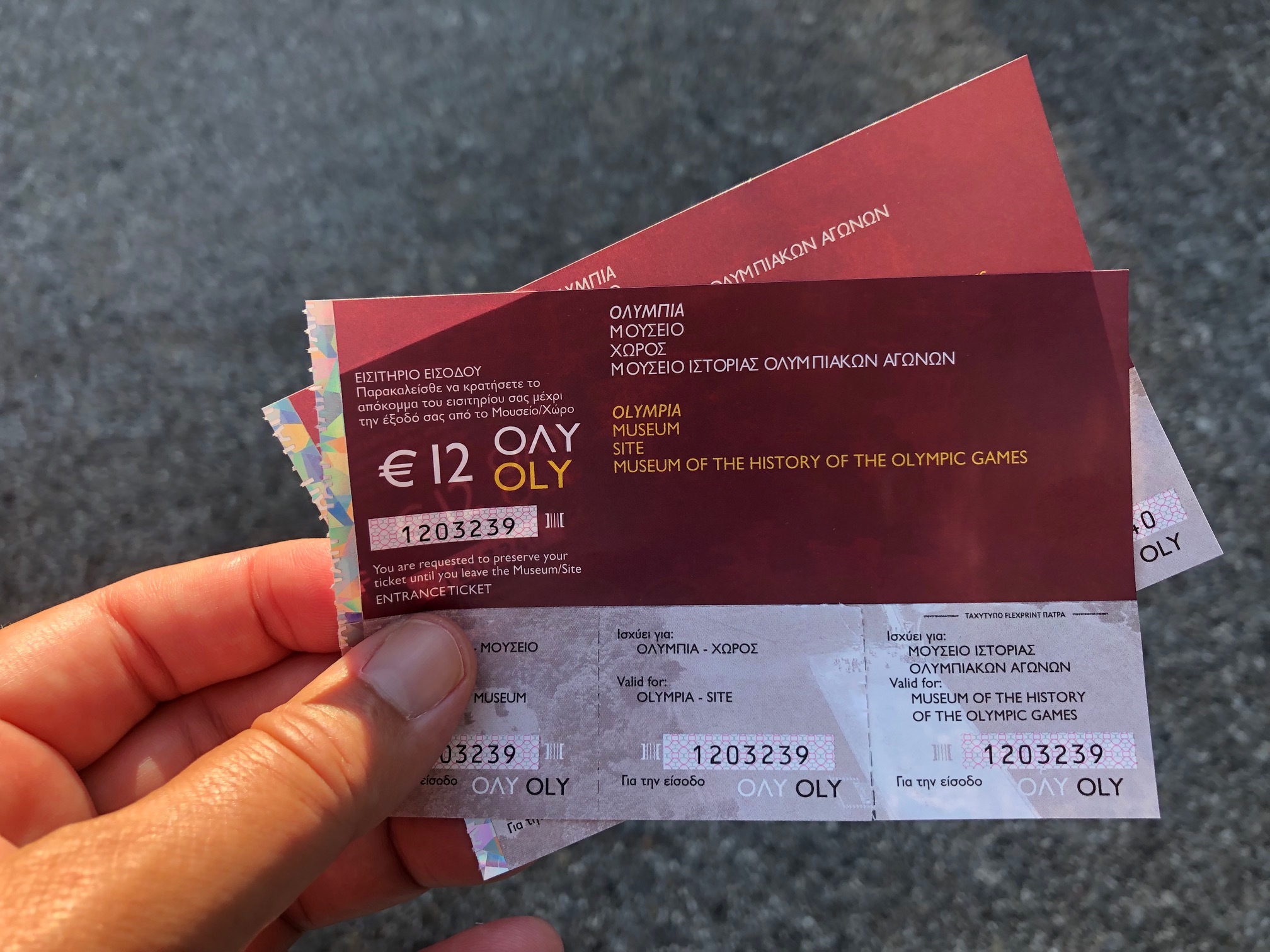
One ticket gets you into the archaeological site, the archaeological museum, and the museum of the history of  the Olympics.The site and museums are open from 8 a.m. to 8 p.m. daily. Adult tickets are 12€ each. You can leave and return later in the day to any of the sites and even return the next day to continue your visit or see more. Note: We did not visit the Museum of the History of the Olympic Games. There was only so much time. If we had had another morning, we could have visited it then.


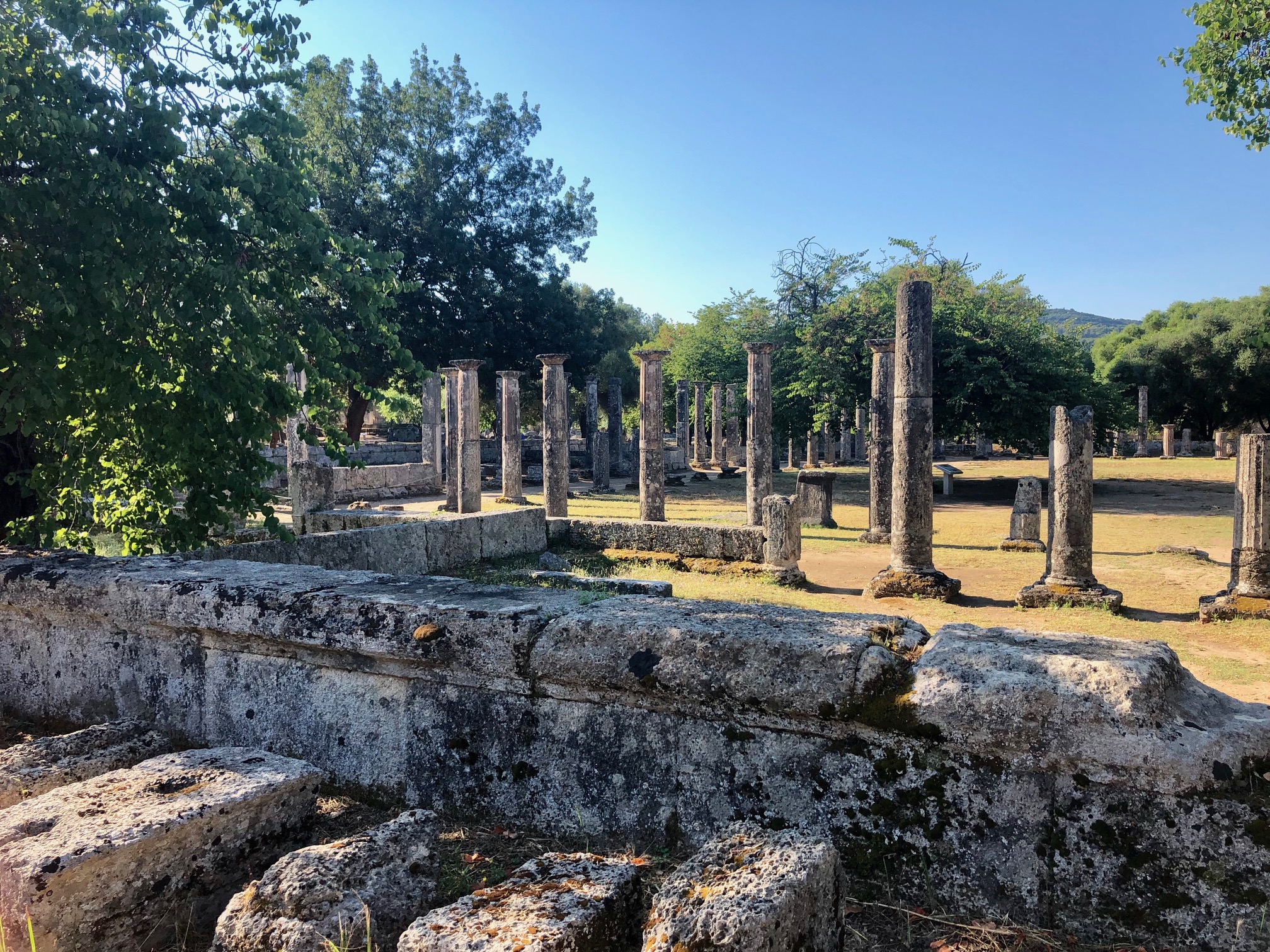
As I gazed across the grounds, as far as I could see were partially reconstructed colonnades, temples, baths, workshops, dwellings, and myriad other structures.

IMG_0506
The colonnade is a popular photo subject. Google “Olympia” and you will see lots of pictures of these columns.

This ability to see layers upon layers of excavations is the one major difference when I compare Olympia to Mycenae and Delphi, two other sites we had just seen during the previous three days.

IMG_0680
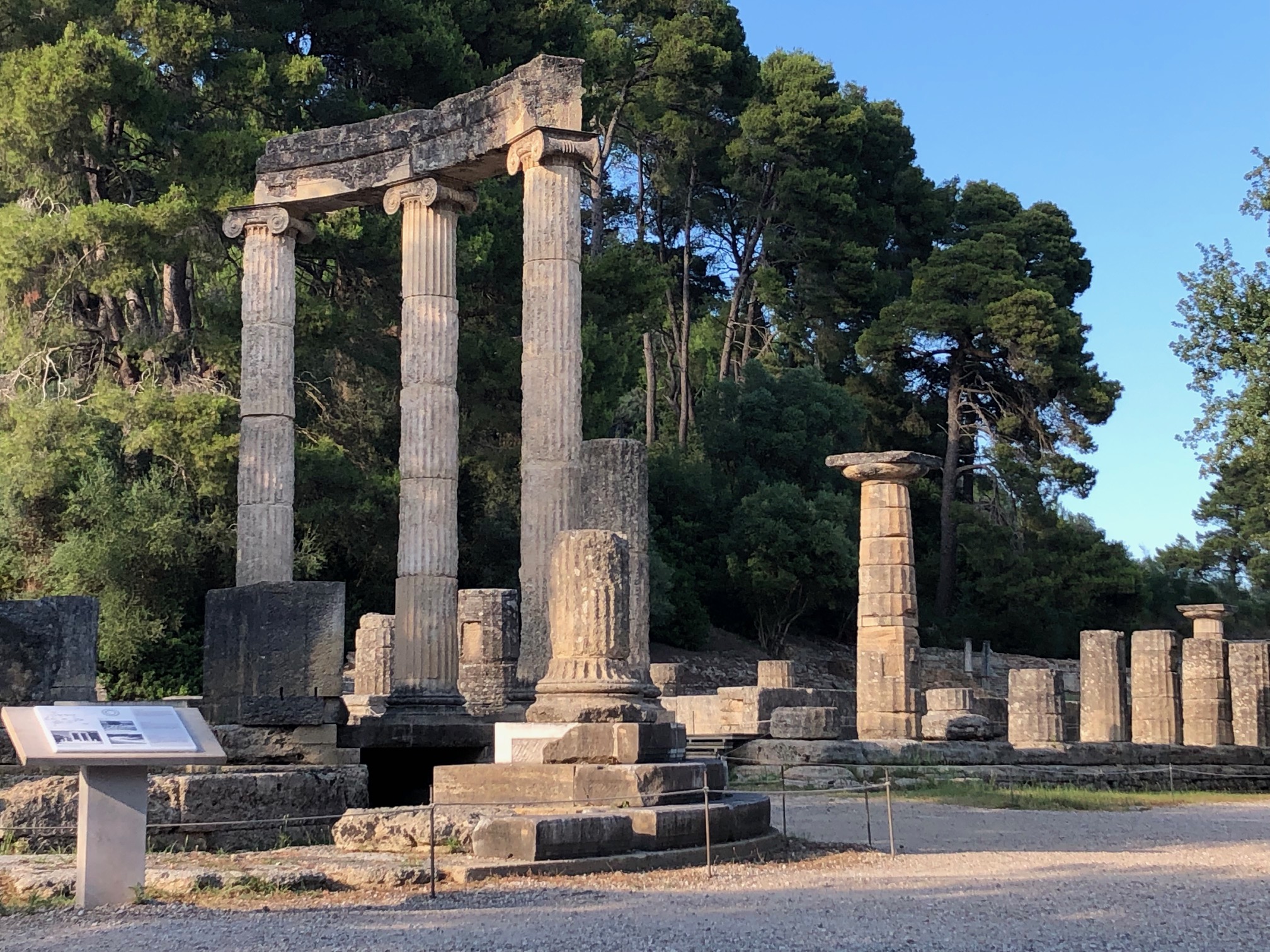
The Philippeion Tholos, a circular temple,  and the Temple of Hera in the background

By the way, we’re on a whirlwind tour of Greece. We’ve spent three weeks on the island of Skopelos and now we’re taking two weeks to see Athens, Mycenae, Delphi, Olympia and Crete. We will return home July 9.

IMG_0563
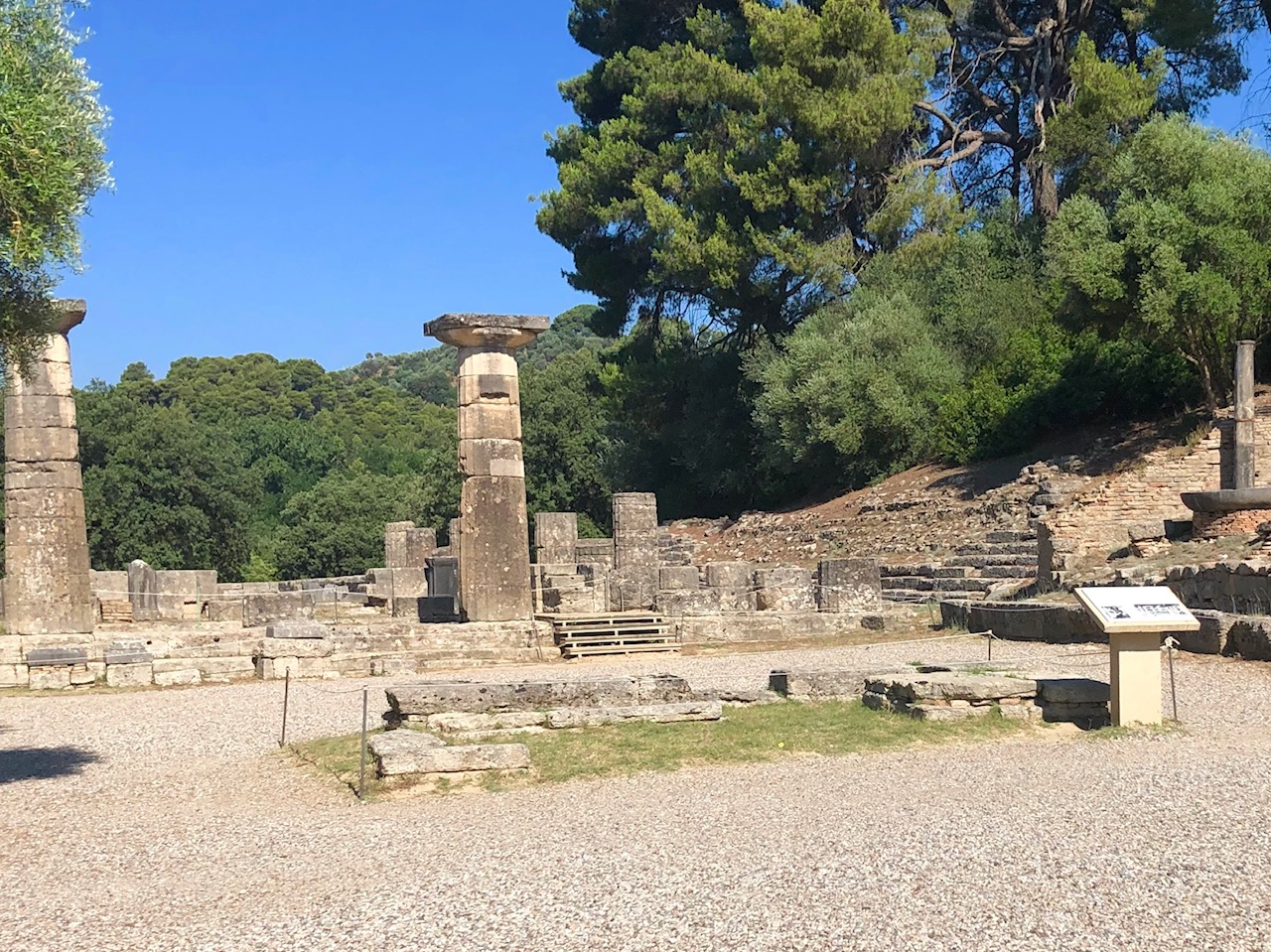
The Temple of Hera is in the background. In the foreground is the site of the lighting of the Olympic Torch that begins each modern Olympic Games.

At Mycenae and Delphi, you can definitely survey the sites across a hillside or from a high point (The Citadel at Mycenae, the Stadium at Delphi); however, at Olympia, you are looking through the site.

IMG_0519
The Tholos, a circular temple
IMG_0521
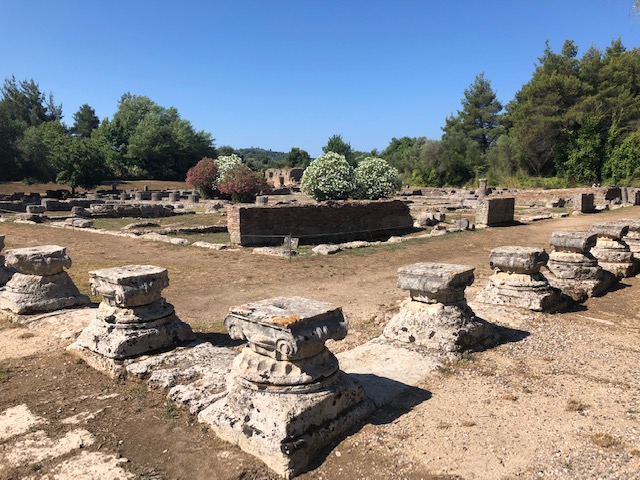
I took this picture because I couldn’t believe how sharp the scroll carving still is on these Ionic capitals.

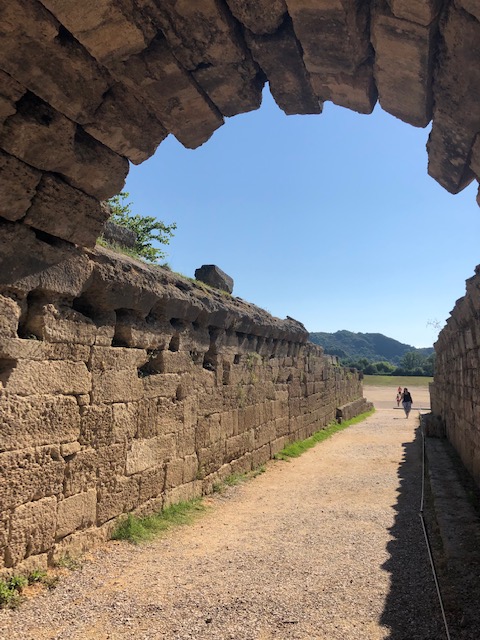
For example, before you stands the colonnade of Palaistra. Beyond that, however, you see the impressive Tholos, and beyond that you see the standing columns of the Temple of Hera, and beyond that you see  the multi-tiered Nymphaion aqueduct fountain, through which you see the arched entrance to the stadium, the site of the first Olympic Games in 776 BC.

IMG_0554
Passing through the arched entry to The Stadium
IMG_0557
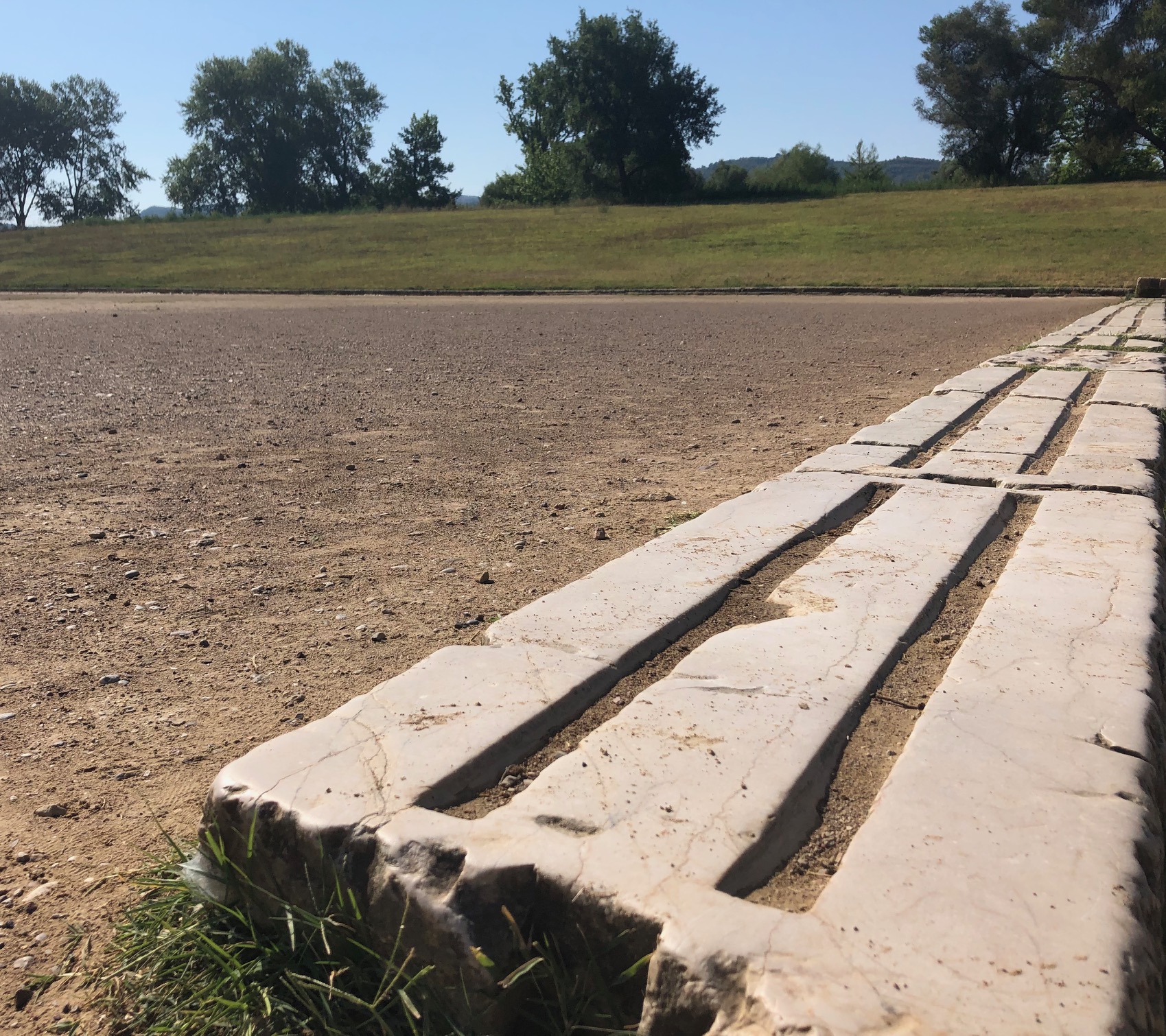
The marble starting blocks for the competing athletes at The Stadium
IMG_0558
The stadium, where foot races (forerunner to today’s 200-meter races) were held in the ancient Olympic Games.
IMG_0569
This is the workshop of Pheidias, the sculptor for the statue of ivory, gold, and bronze status of Zeus housed in the Temple of Zeus, one of the seven wonders of the ancient world.
IMG_0570
This slab of carved marble is in Pheidias’ workshop

In other words, from any spot at Olympia, you will see layer upon layer of ruins in various stages of reconstruction. And then compressed between all those layers are stashes of more pieces.

IMG_0702
An earthquake in 522 AD 551 AD toppled these columns that stood in the Temple of  Zeus, one of the seven wonders of the ancient world. Notice how the drums fell and appear almost like dominoes.

Perhaps a field of column drums, a row of lion head water spouts, a random six-foot-tall triglyph, a plot of Ionic column drums, then a plot of Doric drums, then a composition of more rare Corinthian capitals.

IMG_2232
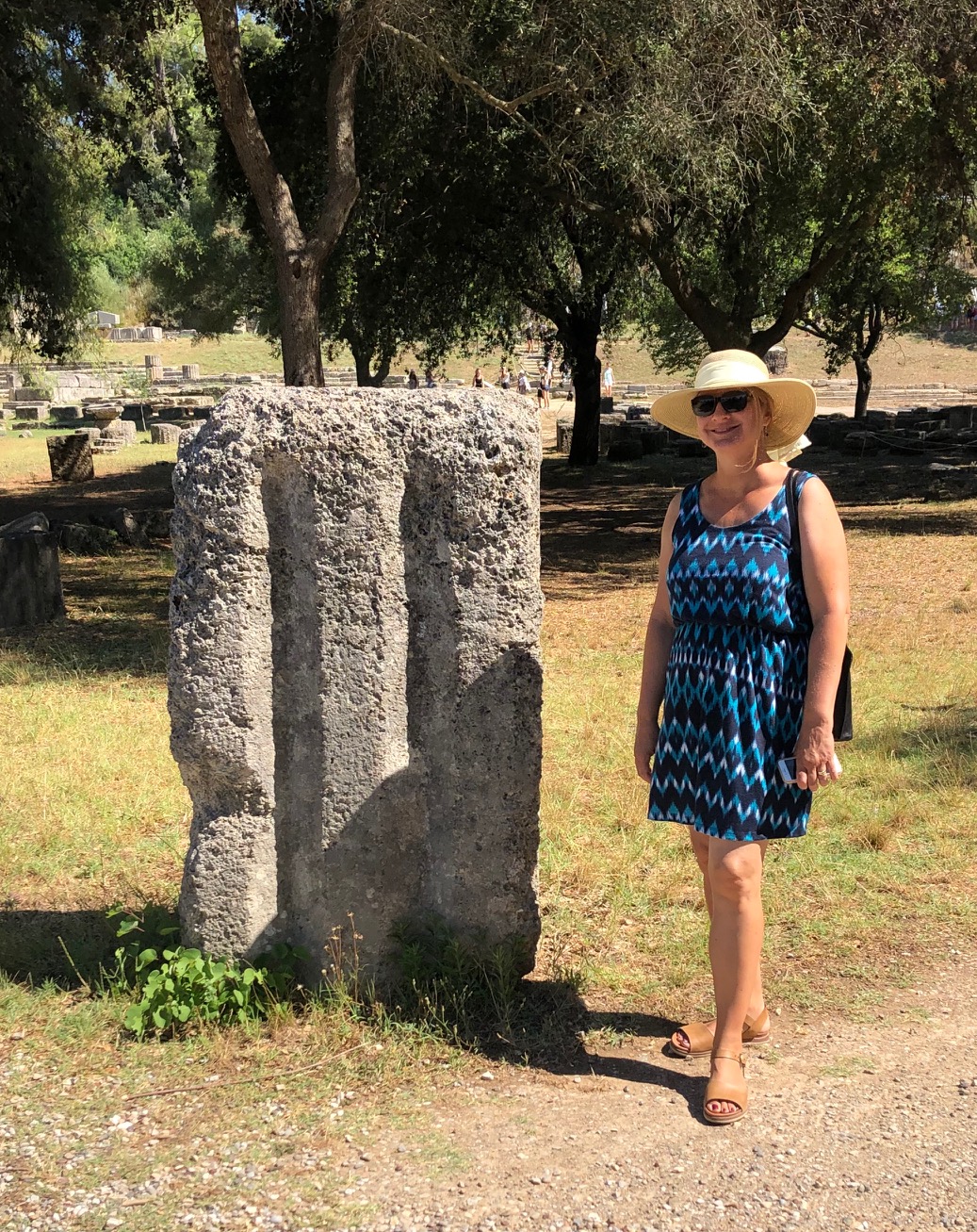
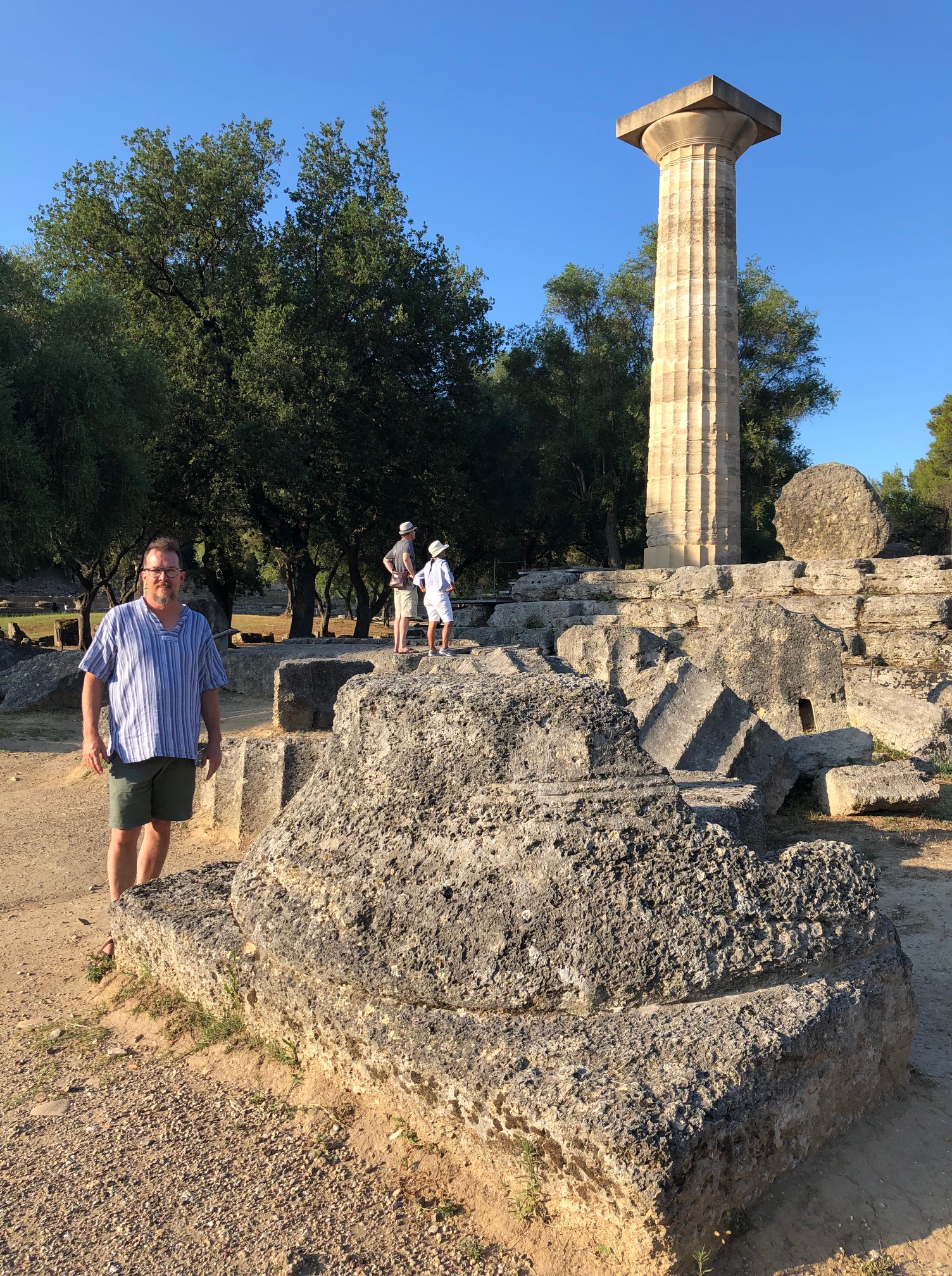
Here I’m standing next to a triglyph, three carved “columns” that were placed between metopes, relief sculptures below the pediment (the triangular-shaped friezes). See caption for next image.
IMG_0752
I’ve circled a triglyph in the image above. I’m standing next to one of these in the preceding picture. I couldn’t believe how large it was.

So many pieces and parts, but if you need a quick list of the top sights within Olympia, I think they would be:

  • The Temple of Zeus
  • The Temple of Hera
  • The Tholos
  • The Stadium
  • Workshop of Pleiades
  • The Palaistra , which includes the Colonnade

What’s more, when you tour the park, you will walk right among most of the artifacts and monuments and stones. You may even walk right on the original marble steps placed in this city of 2,500 years ago.

IMG_0595
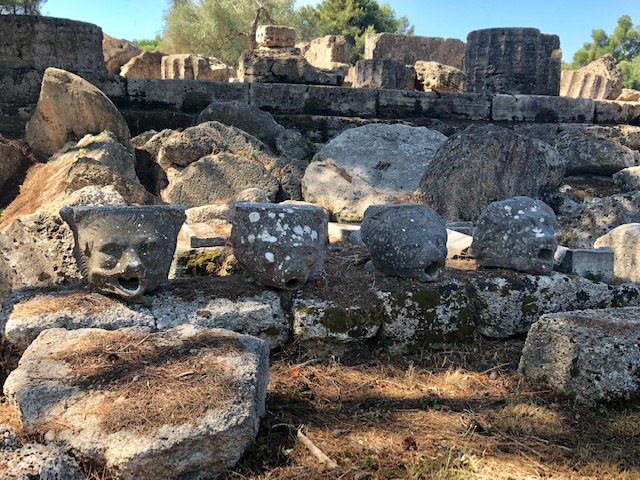
Lion water spouts in a row on the ground surrounding the Temple of Zeus.

There are 1/2″-inch ropes that show you where you can and can’t go, and if you stray where you shouldn’t, you’ll hear a park employee sitting on a nearby park bench remind you with a sharp blast on a whistle.

IMG_0578
More columns.
IMG_0583
This was a building for council members. It contained water around the outside of this “curvy” centerpiece and also around the inner section.

Late last night, one couple climbed upon a large “rock” to see the floor of the Temple of Zeus, which was roped off unfortunately. (You can see them in the picture below.) Suddenly, a shrill blast! They didn’t hear or didn’t recognize their offense. Another blast! They looked around, the park employees shouted something in Greek, and down they jumped.

IMG_0692
We couldn’t believe how large this capital (the top of a column) that  once topped a column on the Temple of Zeus. Note the visitors standing on the stone shelf—that’s a major no-no.
IMG_0695
Each capital had these notches carved into them to help them lock onto the column.

Perhaps they didn’t realize they were standing on an architectural relic. After all, there are so many stones EVERYWHERE.

IMG_2585
We returned in the evening to see parts of Olympia again. The light put a different cast on the monuments.

To be safe, when you’re at Olympia, assume that any rock is not actually a rock, but rather an artifact. If you want to sit down for a bit, look for an actual park bench. There are several. That’s the safest bet.

Or head over to the Olympia Archaeological Museum.

IMG_0613
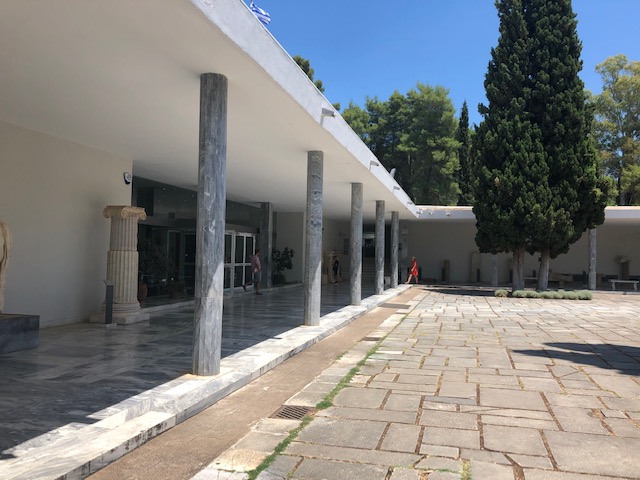
The Olympia Archaeological Museum front entrance
IMG_0617
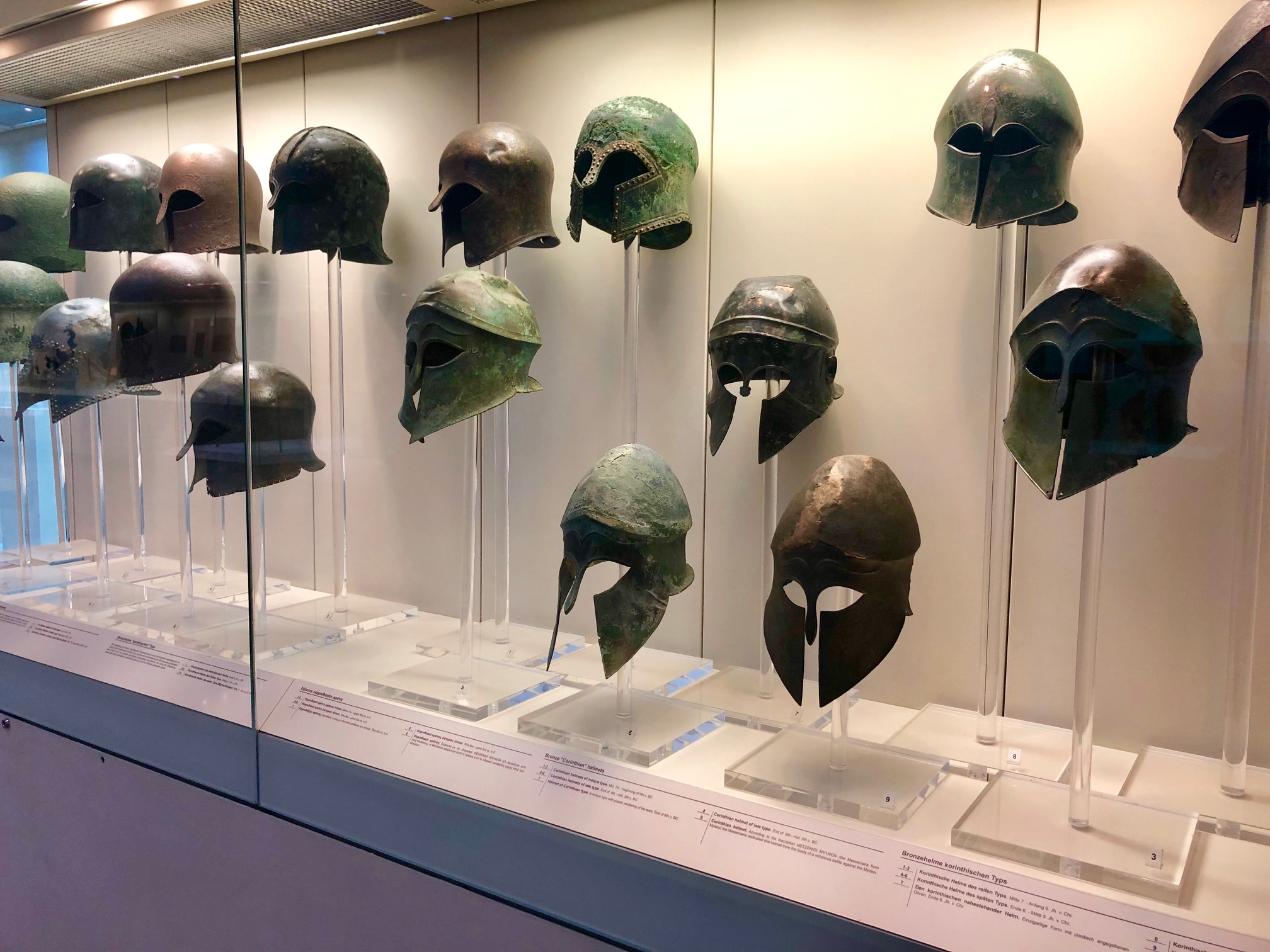
Various helmets excavated at Olympia
IMG_0623
This was a statue of Nike that used to be mounted on the Temple of Zeus.
IMG_0629
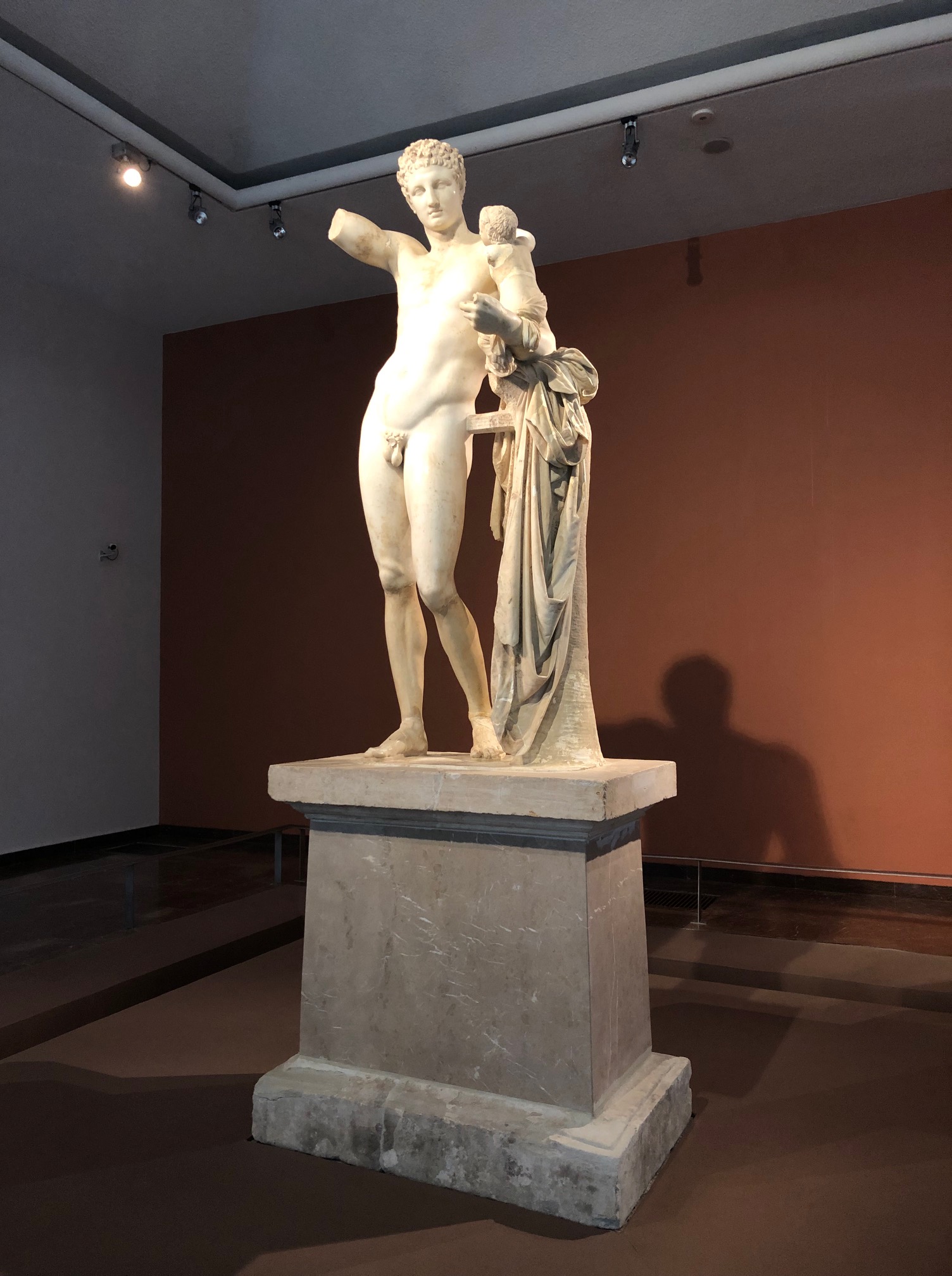
This is a statue of Hermes and was found in the Temple of Hera.
IMG_0648
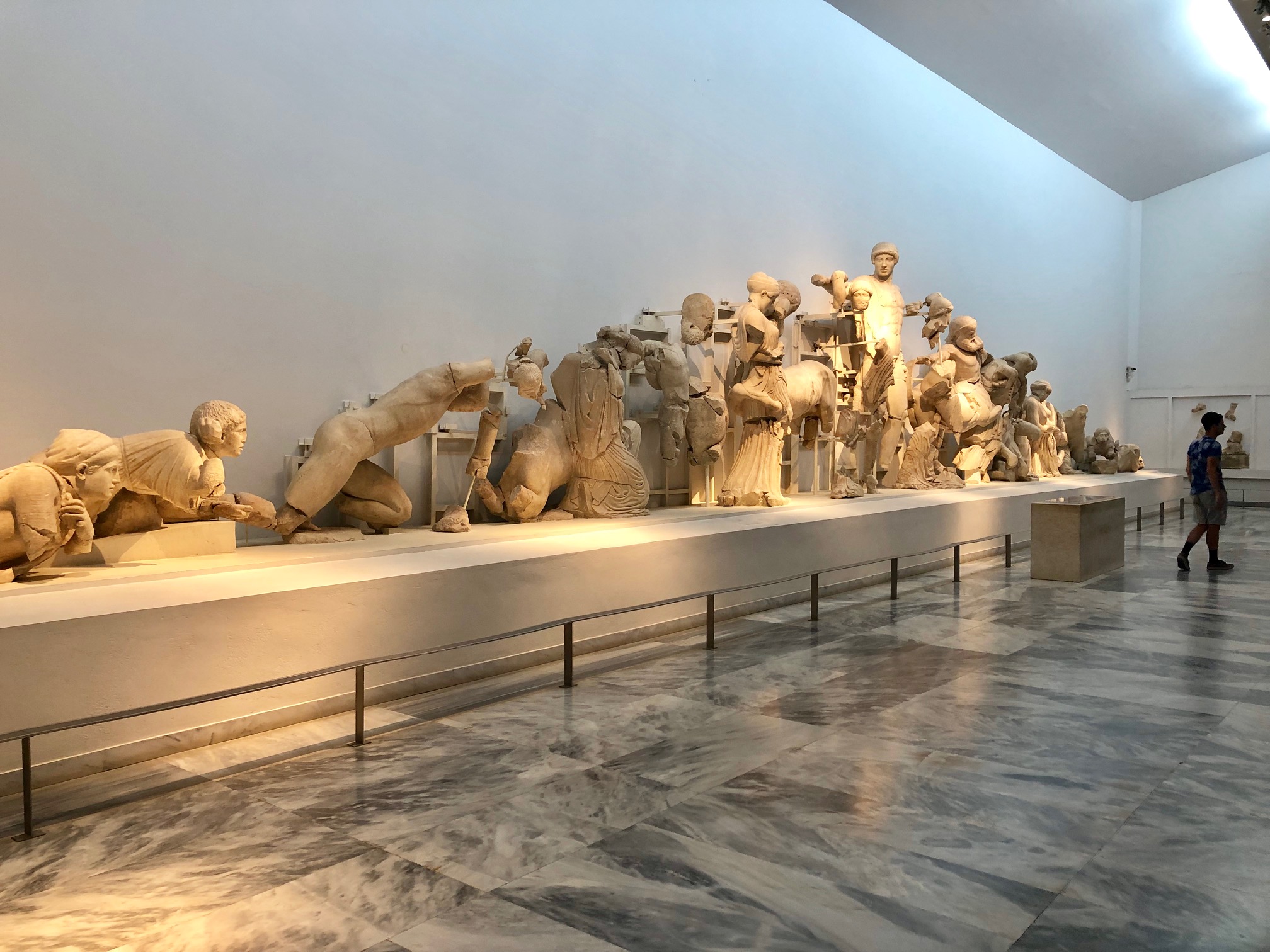
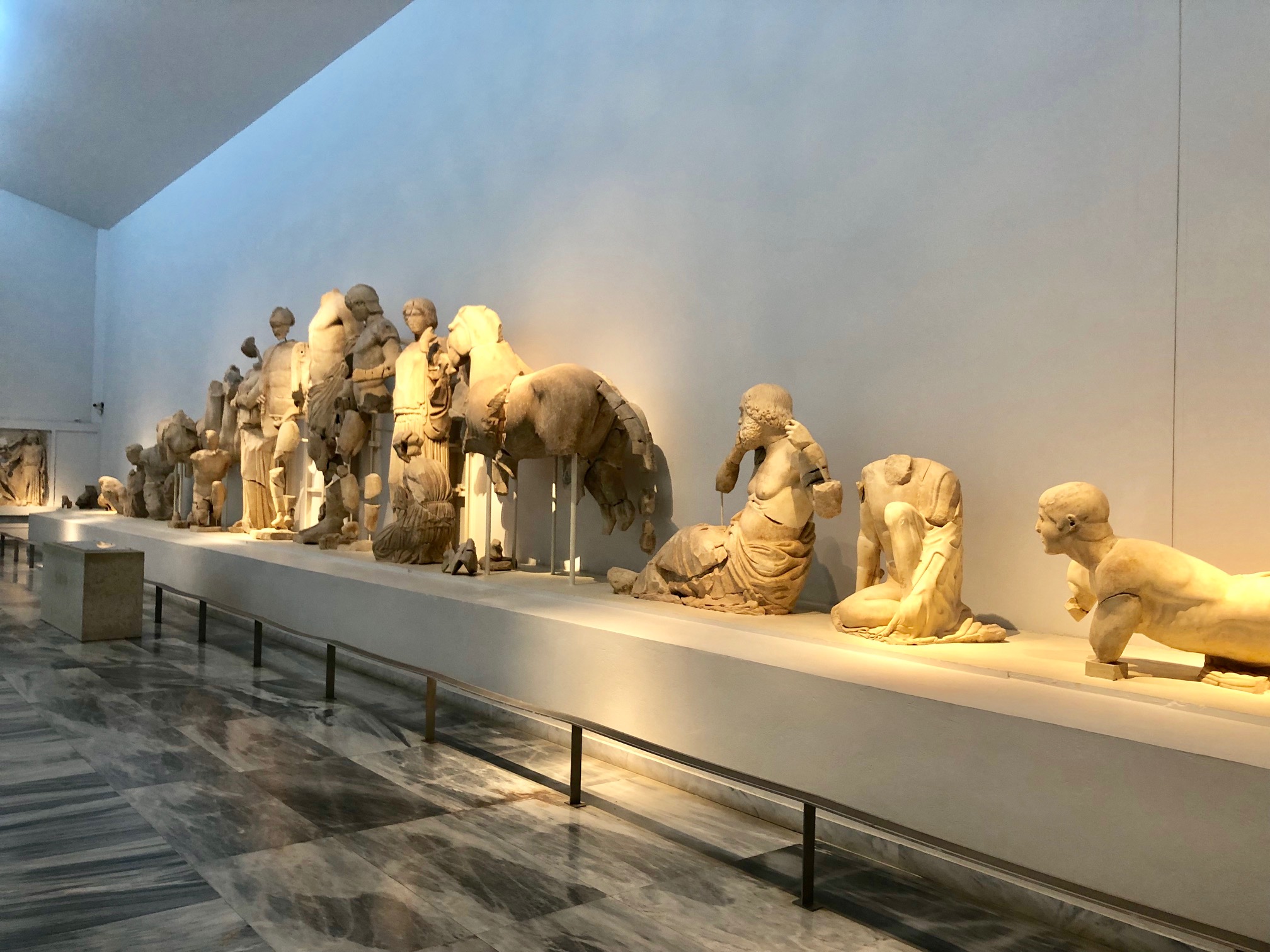
One of two reconstructed friezes from one of the pediments on the Temple of Zeus. This one features Apollo (son of Zeus) in the middle.
IMG_0649
One of two reconstructed friezes from one of the pediments on the Temple of Zeus. This one features Zeus in the middle.
IMG_0653
More lion water spouts and other prominent sculptures are placed around the outside loggia of the museum. You can just walk right up to these. But don’t touch, obviously. There were no guards anywhere around, which surprised us.

Although Olympia takes some planning to reach, it’s definitely worth the visit.

The site and museums are open from 8 a.m. to 8 p.m. Adult tickets are 12€ each. You can leave and return later in the day to any of the sites and even return the next day to continue your visit or see more. We arrived at the archaeological site at 8:30 a.m. and left about two and a half hours later. Tour bus groups arrived around 10.

As it was getting quite hot, we left at 10:40, went out for gyros and a soda, and then returned to the air-conditioned museum for about two hours in the afternoon.

Later that evening, we returned to the archaeological site to see more and take pictures with the sun coming from a different angle.


The modern city of Olympia is a beautiful little city that is literally about two blocks from the archaeological site. I’ll write a short post about the town tomorrow. Our AirBnb host told us the permanent population is only about 700 people! 

Thanks for reading! Click like, leave a comment and follow my blog for more stories about travelling in Greece.