A sneak peek at my future post about the churches of Skopelos Chora
On every Sunday morning last June, my husband and I were mesmerized by the calming tones of musical chants floating on the breezes wafting across the natural amphitheater arrangement of Skopelos Town. Also known as the Old Town or Skopelos Chora, the largest town on Skopelos Island is home to 123 churches Greek Orthodox churches.
We discovered this church last June when we visited the island, one of three that compose the Northern Sporades east of Athens on the Pelion Peninsula. I’m not sure exactly where this church is within the town… somewhere down the hill, tucked among whitewashed homes and shops, nestled along a cobblestone street that may or may not show on Google Maps.
Follow my blog to catch my next post on the churches of Skopelos (both those in the Old Town and those scattered about the island), where I’ll show you a slew of charming places of worship, both private and others.
Click on this video to hear music similar to that heard on Sunday morning in Skopelos.
On Wednesday night (June 12), Mitch and I hiked across Skopelos Island from Skopelos Town to the little seaside town of Panormos. The three-hour hike was organized by Heather Parsons, founder of Skopelos Trails.
I had heard of Parsons last fall when I found her in an online search. It seems when you research Skopelos Island, her name will eventually surface. Her organization, Skopelos Trails, is dedicated to restoring, maintaining and improving the ancient stone pathways, called calderimi, that are sprinkled across the island.
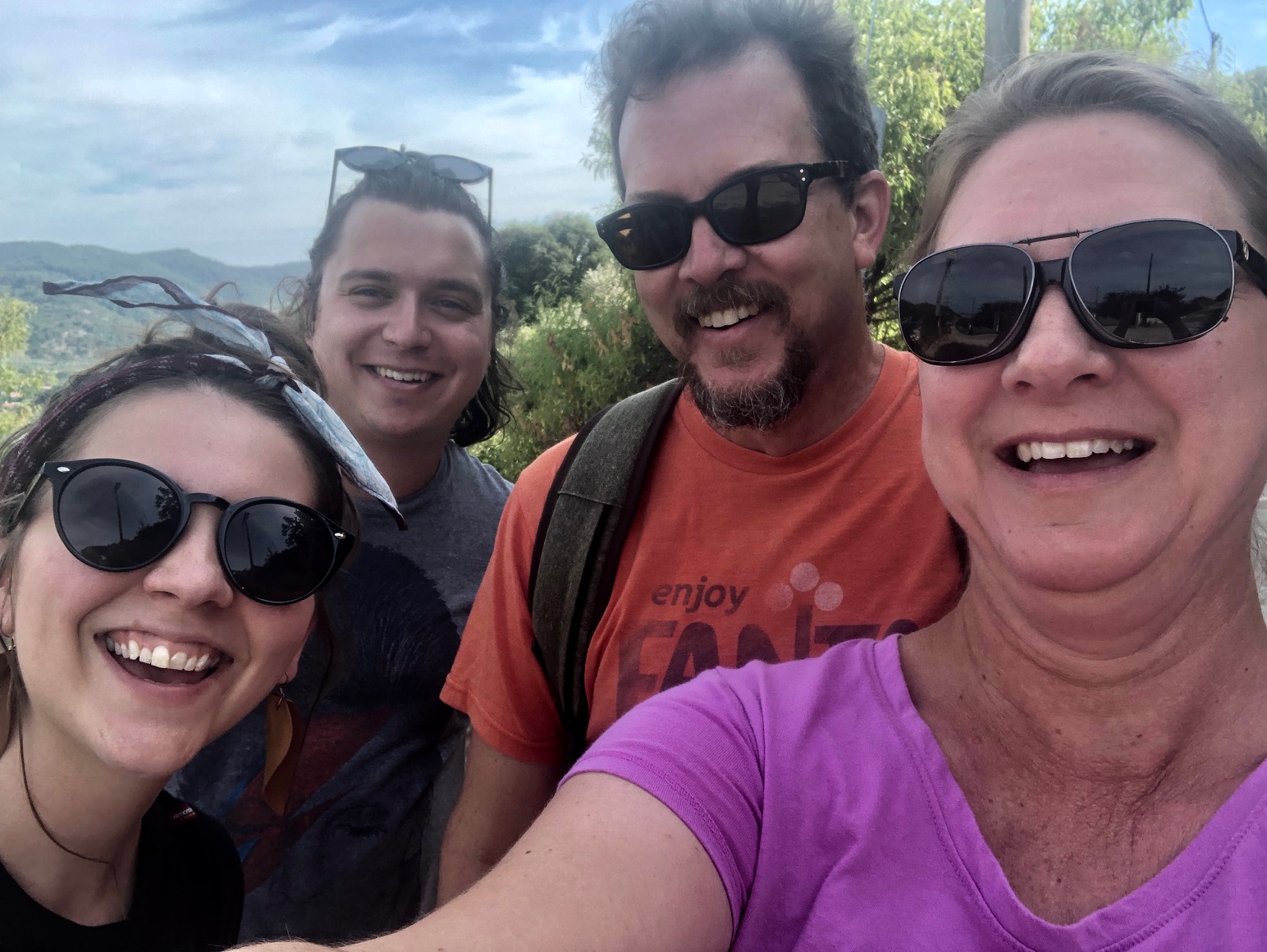
Victoria Rose Phillips, Grayson Phillips, Mitch and I
Parsons has written and published a book as well, called Skopelos Trails. It shows the paths for the island’s many walking and hiking trails. Parsons has provided detailed—almost step-by-step directions— for finding and following the paths either on your own or with guidance from her or her business partner and our guide, Emmanuel.
According to a post on Facebook just today, the local forestry department recently asked Skopelos Trails to provide them with details of all the closed trails.
In the post it says that Emmanuel had drawn in by hand 116 km of trails on the department’s terrain map. Clearly, Skopelos Trails knows the land better than most.
Parson’s book also contains hand-drawn illustrated maps that appear alongside the directions and description of the Trails. The illustrations may not be drawn to scale and if a business was used as a landmark on the map, it may have changed, especially if you are using an older edition of the book.
The trails are marked and rated by level of difficulty and the trail we walked Wednesday night, the Coast to Coast Trail, is considered “not strenuous,” or at least that’s how Parsons described it to me in her reply to an email I had sent her as we were making arrangements. (Since I had a 7 a.m. ferry ride to catch the next morning, I wanted to make sure the three-hour Coast to Coast Trail would not wipe me out for the next day’s travel to Venice to see my daughter.)
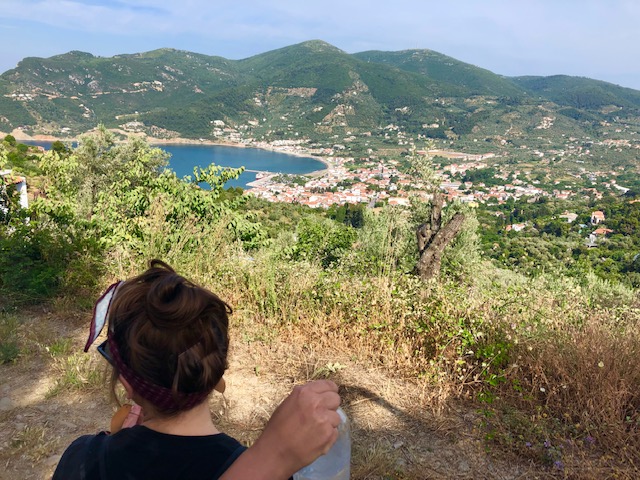
Starting off from Skopelos Town below.
With Parsons’ “not strenuous” description, we decided to sign up for the 25€ hike, but we opted to take the bus back later from Panormos to Skopelos Town instead of going to a restaurant with the other hikers. I would have loved to socialize more with the others, since during the hike we were able to visit for only a short while.
The plan was to meet at 5 pm at Kahili’s Bakery and Cafe down on the harbor front street or at 5:15 further up the hill near our apartment, where the calderimi, which started just down the hill a small distance, passed by.
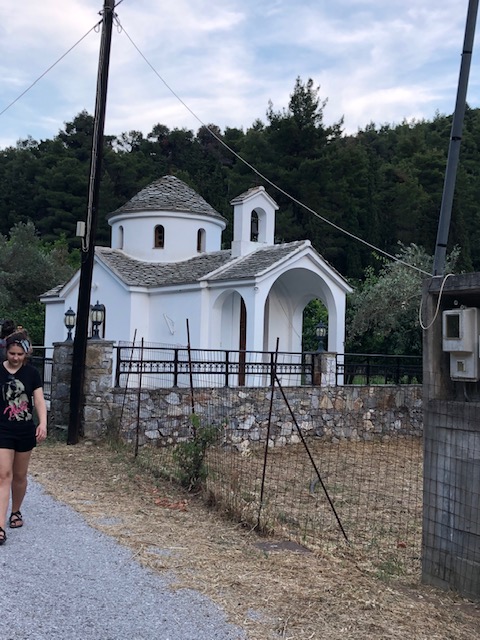
Mitch next to a small family Greek Orthodox church
As we stood near the telephone pole with a Skopelos Trails trail marker (a 3″- diameter white circle with a yellow hiking boot footprint), we began to hear huffing and puffing from an approaching group.
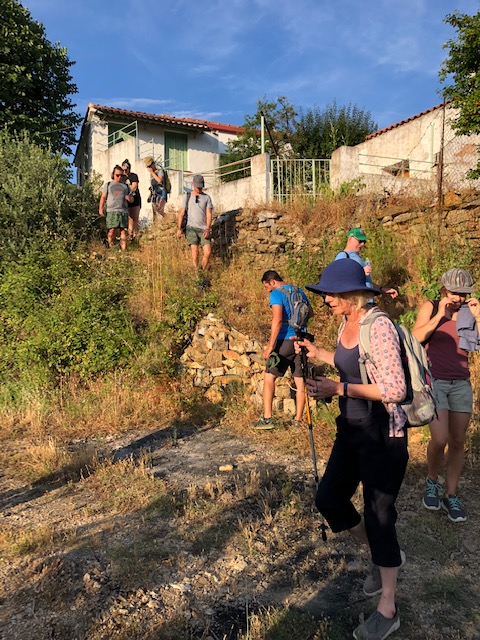
To our left, trudging up the hill with the entire town of Skopelos spread behind them as a backdrop, proceeded two couples from England; Anna, a young Athens native who lives in Skopelos; a woman from Skopelos who had built a brand new home in the mountains of Skopelos; and our guide, Emmanuel.
Our addition to the group included Mitch and I plus Grayson and Victoria Phillips, who is serving an artist residency at Skopart.
In total, there were eleven of us—quite a good number for an end-of-day stroll (and I use that term loosely) across the island.
The previous Thursday, according to the Skopelos Trails’ Facebook page, a group of five hiked the path starting at 9 a.m.
It would have ended in the heat of the day, so maybe an evening hike, with its cooler temperatures during the latter two-thirds of the hike, makes for a more tempting outing and attracts more participants.
One of the natural springs we came upon
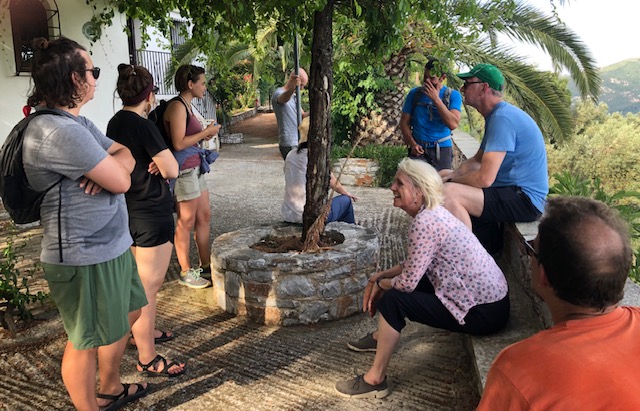
We did stop occasionally during the hike— about five times. During our stops, we would take a photo, drink water, or refill our water bottles at a natural spring. There are several of these springs on the island and many islanders use them for their drinking water.
The water was cold and clean, Emmanuel assured us. Our bottles were nearly full, so we didn’t drink from the spring, but I wish I had. Should have tasted natural Greek spring water. How often do you get to do that? I did scoop up some of the icy water and rubbed it on my arms and neck for a cool-down, though.
We arrived right on schedule at 8:15 pm in Panormos, having traversed the island through olive groves, along stone-walked paths, on top of stone-bordered terraces, alongside pastures where goats and an occasional horse roamed.
The hike took a solid three hours and fifteen minutes. I’m writing this post in Venice; when I return to Skpelos, I’ll look into my copy of Skopelos Trails to see how many kilometers we covered. I’m guessing right now about five.
We also came upon five tiny and well-maintained Greek Orthodox churches. Our guide told us that many of the churches were built by families so their members would have a central location for burial. In at least one, a single candle glowed in the darkened nave.
I was tired when it was over. I would definitely label the hike “moderately strenuous.” It’s very rocky, and very steep in parts, and in many places we were walking in thigh-high grasses or on steep grades that were covered with a cushion of small, smooth leaves (a eucalyptus variety?) that made a few of us nearly fall.
Even though it was a challenging three hours, it was very enjoyable literally getting off the beaten path to see the rural Greek countryside and rugged, forested mountains, which are particularly unique to Skopelos.
We also enjoyed meeting and visiting with people from around the world. As Judy, an British hiker from Bristol said, “It’s so interesting when people from all different parts of the world with different lives come together to connect in this way.”
Thanks for reading! This was a fun experience and when I return to Skopelos next week, Mitch and I hope to take another (probably shorter!) hike using the Skopelos Trails book. Follow my blog for more posts from our summer travels and feel free to leave a comment about some interesting hikes you’ve taken recently.
When you learn (yet again) how much you don’t know
We weren’t inside this little church for more than twenty minutes, but that was long enough to be reminded yet again of my ignorance on… well, so many things. Architecture and Greek Orthodoxy are topics that come to mind, as well as the history of the 100+ public and private churches that exist in Skopelos, the little Greek town we’re residing in while my husband completes an artist residency.
We discovered one of those churches, the Church of Agios Michael Synadon, on our second night on Skopelos Island northeast of mainland Greece. The church is tightly wedged into a small neighborhood and you can easily pass right by it if you’re talking or, like my husband Mitch and me, concentrating on the steep walk down from the top of the hill to the harbor-front shops and restaurants of Skopelos Town.
It’s easy to overlook Agios Michael Synadon unless you notice the curved apse jutting out into the stone path.
As you walk by, following the well-marked path from the hilltop, you pass the backside of the church. The apse first caught Mitch’s eye and caused us to stop and wander around the corner to the front of the church.
In fact, according to this Skopelos News blog, another detail that makes the church so notable is the stele placed just below the apse window (see the light-colored stone directly below the dark window in the picture above). A stele is a piece from an old Greek grave that dates from the second century B.C. Steles may feature carvings such as flowers and inscribed names, as this one does.
Another detail worth noting, according to Skopelos News, are five large gray stones, remnants from Roman-era sarcophagi (coffins). There are three on the front side of the church and two on the back. They are the largest stones that you see in the pictures above.
The main front doors of the church were locked, but a door off to the side was not. We knocked and walked inside to meet a woman with shoulder-length brunette hair and dark brown eyes.
“Καλησπέρα,” the woman said, Greek for “good evening.”
“Kali-spera,” we replied and followed her into the nave, the main sanctuary. Inside, it was musty and dark, lit only by a box of candles burning on a table near the front.
Agios Michael Synadon was nearly dark until the woman attendant turned on this chandelier.
“You are Greek Orthodox?” the woman asked us quietly, hesitating in her choice of English words.
“No,” I replied, wondering if that would affect our visit.
She continued, “You are from where?”
“United States,” I replied. She nodded and smiled, and walked to the wall to turn on the lights. The chandelier hanging above us glowed brilliantly, illuminating the entire room filled with icons, paintings, frescoes and artwork, carved chairs and other furniture.
We walked to the front to view the icons there. Finely applied oil paints revealed brilliant cheekbones and almond-shaped eyes, typical for post-Byzantine era portraits. Several had pierced silver elements attached to the paintings, in effect creating mixed media icon artworks.
The fresco in the dome is difficult to discern due to age and years of exposure to candle smoke.
I stood below and to the side of the chandelier and gazed up at the fresco-painted dome and then around me. There was simply too much, too many details to absorb. I didn’t even think to ask when the church was built.
I still haven’t been able to determine how old the church is, but it does resemble another church in style and materials that we stumbled upon in Skopelos known as Panagia Eleftherotria. According to Skopelos News, archaeologist Adamatios Sampson claims Panagia Eleftherotria was originally built in the 16th century.
Wanting a photo, I asked the woman if I might take one. She smiled and sighed and I wondered if I had overstepped. Surely I wasn’t the first tourist wanting to capture the beauty of this small place. But then she nodded and I took two pictures on my iPhone, taking care to silence it to avoid that annoying click.
We then thanked the woman and the three of us walked back to where we had entered. On the white plaster walls of this side room thirty to forty small paintings, miniature icons, hung from two wires. The woman searched for the English words that suggested these paintings were created by her students. She showed us some larger paintings also tucked behind the smaller ones, which I believe she said she had painted. One Virgin Mary rendition measured approximately 24″ x 30″.
I asked her if the artwork was for sale, since the manner in which they were displayed indicated that they might be. She shook her head, and then I remembered that buying and selling wouldn’t be appropriate in a place of worship. She motioned with her hand to her side and said, “Shops,” indicating perhaps that her work was available elsewhere in town.
Finally, we asked where we could leave a donation. She led Mitch back into the sanctuary, where he placed a €5 into a brass offering box near the front of the nave. We then exited the Church of Agios Michael Synadon.
Outside, we took another few minutes to study the exterior, which was covered with a mixture of bricks, marble stones, the large sarcophagi, plus an assortment of porcelain dinner and serving plates inset as accents into the facade.
Our souvenir from Agios Michael Synadon.
In the short span of twenty minutes at the church, there was just too much to see and honestly, I felt like an intruder… an outsider very ignorant of the traditions and rituals that this little building upholds. Maybe that’s the most valuable lesson that traveling to new places teaches us: how much we don’t know.
As we left, the woman called to my husband from the doorway of the side entrance. He walked back to her and then returned with a souvenir for each of us: a small color printout of her Virgin Mary painting.
Thanks for reading! So far during our time in Greece, we have never been treated like outsiders. On Skopelos Island, the residents seem eager to ask where you are from and always have a “Ya-sis” for you in the day or a “Kali-spera” in the evenings. Even when we visit a church we know very little about, the Greeks seem eager to inform us– if they speak English, which most do– about what we are seeing.
Please click like to show your support for my blog and feel free to follow for more posts about our time on Skopelos.










 Marilyn Yung