Categories
Greece (Crete)

Phaistos, Crete

A peek into the past in the hills of southern Crete

Phaistos. Phaestos. Festos. Faistos. And then in Greek, it’s spelled Φαιστός.  No matter how you spell it, each name refers to Phaistos Minoan Palace, the second most important site (after Knossos Palace in Heraklion) of the Minoan civilization on the island of Crete.

We visited Phaistos last summer in late June. After touring the archaeological sites at Athens, Mycenae, Delphi, Olympia, and Knossos, we made a final stop at Phaistos. After a confusing morning journey by public bus from Heraklion, we made it to Phaistos in plenty of time to take a leisurely self-guided tour, eat a small lunch beneath a pine tree, and have a cold drink and ice cream in the small, on-site gift shop before hopping on a bus back to Heraklion. Here’s my post about how to get from Heraklion to Phaistos, click here.

If Minoans are new to you, here are a few facts about the culture from my husband:

  • The Minoans, named for their ruler, the mythical King Minos, are known for their advanced civilization that settled the island of Crete and other surrounding islands.
  • The Minoans were great sea travelers.
  • They built enormously sophisticated palaces for their royalty. The palaces were very “high tech” for the time period and exhibited a distinctive and advanced architectural style.
  • Phaistos was the region that produced Kamares ware, a pottery style dating from the 1800-1700 BC. Kamares ware, named for the nearby cave where it was found, is known for its dark background and white brushwork. Kamares wares were considered luxurious to own and were exported throughout the Mediterranean to Cyprus, Egypt and Palestine.
IMG_0876
Kamares ware, including these vessels, were found at the Minoan palaces at Knossos and Phaistos. | Photo: M. Yung

A self-guided tour of Phaistos is relaxing and quiet. Unlike Knossos, there are no guides-for-hire who approach you as you enter offering to walk you through the site for a fee.

While these guides are likely very helpful for many tourists, we doubted that they were truly needed, considering the large number of detailed placards placed throughout the site. Granted, that assumes one doesn’t mind reading.

phaistos distance
This photo is taken from the opposite side of the palace grounds.   Jerzy Strzelecki [CC BY-SA (https://creativecommons.org/licenses/by-sa/3.0)%5D

When you do stop to read the signs, you can learn a lot. Here are some basic facts taken from a placard found at the entry to the main site:

  • The hill of Phaistos was inhabited as early as 4500-3200 BC in the Final Neolithic Age.
  • The first palace of Phaistos was active from 1900-1700 BC. The palace controlled the plains and valleys found below the palace hilltop.
  • The city of Phaistos — and Minoan culture in general — flourished until  323-367 BC.
  • The Phaistos Palace grounds included a central court, surrounding wings, multi-story buildings (similar to Knossos), gateways and open balconies.
  • More facts follow the next few photos.
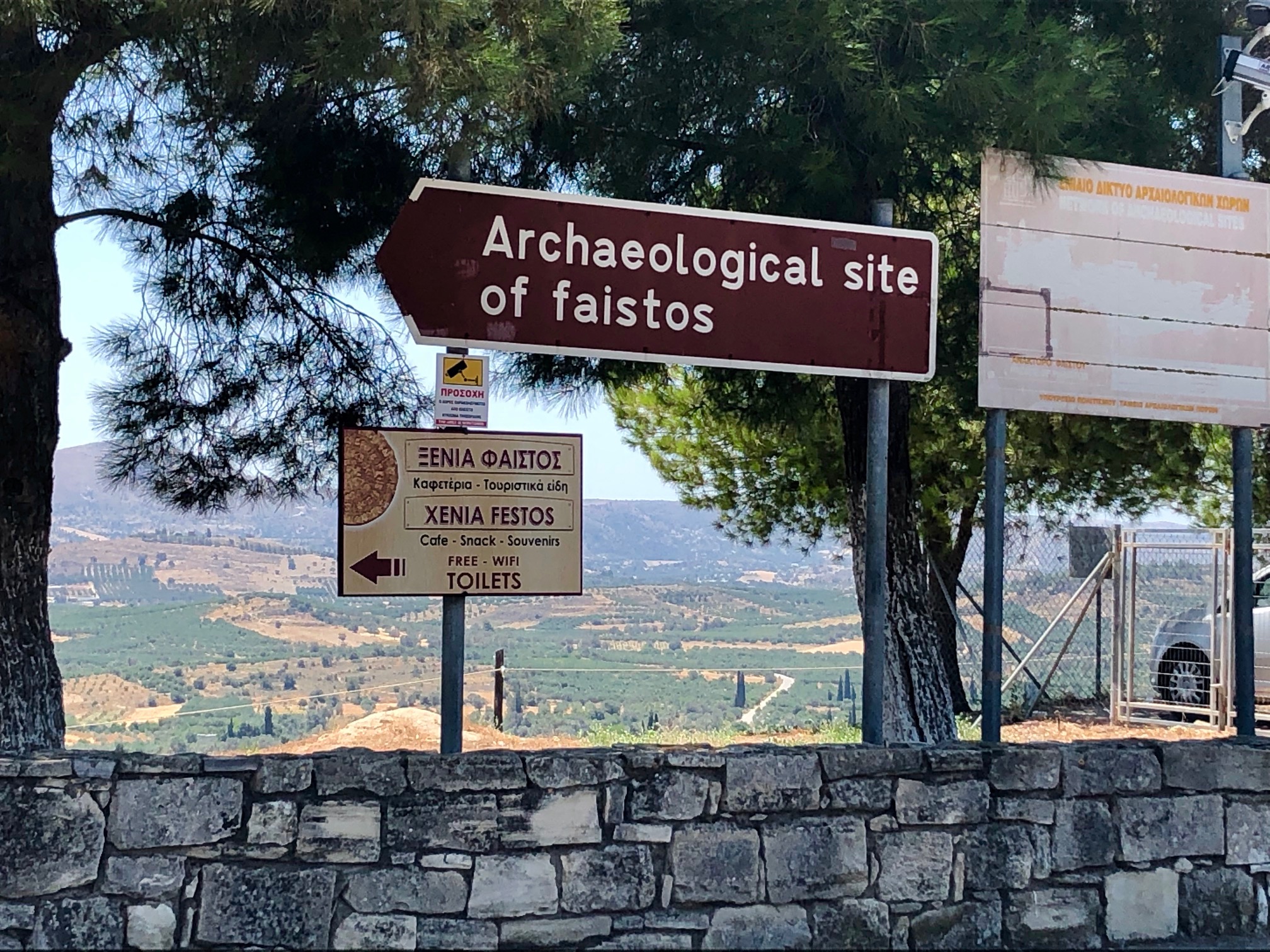
IMG_1129
Phaistos is found on a hilltop in southern Crete. The valleys on all sides of the hilltop are blanketed with olive trees, grape vineyards, cypress trees, and farms. There are several caves in the surrounding hills also. Many items, including pottery, have been found in these caves. | Photo: M. Yung
  • The first Phaistos Palace was built around 1900 BC.
  • It covered 8,000 square kilometers over three terraces.
IMG_1077
Tickets to the Phaistos site are 8€ each. Getting there is inexpensive, too, via public bus.
  • The original palace was inhabited for 250 years and destroyed and rebuilt three times.
  • It was destroyed the last time by an earthquake around 1700 BC.

It’s amazing that visitors are allowed to walk on stones laid nearly 3,700 years ago!

IMG_1079
Little at Phaistos seems to have changed since the 1919 photo above. It’s still isolated, quiet, and remote. | Photo: M. Yung
  • After the earthquake, the ruins were covered and a new palace was constructed on that.
  • This last palatial site was smaller, but according to the placard, “more monumental.”
  • This last Phaistos Palace was destroyed in 1450 BC, but not rebuilt.
  • Two more facts follow below.
Phaestos_Vue_générale_Au_fond,_la_plaine_de_la_Messara_-_Baud-bovy_Daniel_Boissonnas_Frédéric_-_1919
It’s amazing how little has changed over the years. This photo from 1919 shows the steps leading to the West Court. The theatral area and diagonal wall appear in the lower half of the picture. | Frederic Boissonnas [Public domain]
  • The city of Phaistos continued to be inhabited and thrived in Hellenistic times from 323-367 BC.
  • In 150 BC, Phaistos was finally destroyed by Gortys. When Rome conquered Crete in 67 BC, Gortys became the capital, replacing Knossos.

But back to our tour…

The main reason we wanted to visit Phaistos: the pithoi.

IMG_1084
Two pithoi appear below a reconstructed walkway. | Photo: M. Yung

These pithoi (the singular word is pithois) are well-known in art history circles and Phaistos is considered the premier site for this particular kind of storage vessel. In fact, my husband hoped the site would have more available to see, as he had seen photos of many more pithoi on display here.

IMG_1088
A room with storage jars known as pithoi. | Photo: M. Yung

Still, it was fun to wander the grounds and find a pithois tucked away here and there. There were more to see in an area of the grounds covered with metal shelters; however, these shelters were in large areas closed off to visitors.

IMG_1090
Mitch walked as far as he could into the Magazine of the Giant Pithoi, a room that contained  several large pithoi jars. | Photo: M. Yung

In fact, this was our main disappointment with Phaistos:

a good portion of the site was closed.

IMG_1096
The shrines of the West Wing were predominantly small rectangular rooms that contained benches. According to the placard, inside these rooms excavators found ritual vessels, figurines of deities and other cult objects. | Photo: M. Yung

There was definitely a feeling that Phaistos is overlooked and forgotten.

  • a few signs were missing
  • some barriers were broken
  • a wooden observation deck had missing boards

Generally, Phaistos seemed neglected. And this isn’t really surprising, considering Greece’s other economic priorities.

True, due to its location, Phaistos sees fewer visitors than other more popular Greek archaeological sites. In fact, Phaistos doesn’t even make this Top 20 list of Greek ruins.

IMG_1106
Photo: M. Yung

Still, Phaistos is a valuable peek into the past, and among art historians, it’s well-known and revered.

The Phaistos Minoan Palace reminds us that we shouldn’t underestimate the abilities and ingenuity of ancient cultures. For example, precisely placed stairs and drainage pipes made of solid stone show us the resourcefulness of the Minoans.

IMG_1104
Drainage pipes were used at Phaistos. | M. Yung
IMG_1109
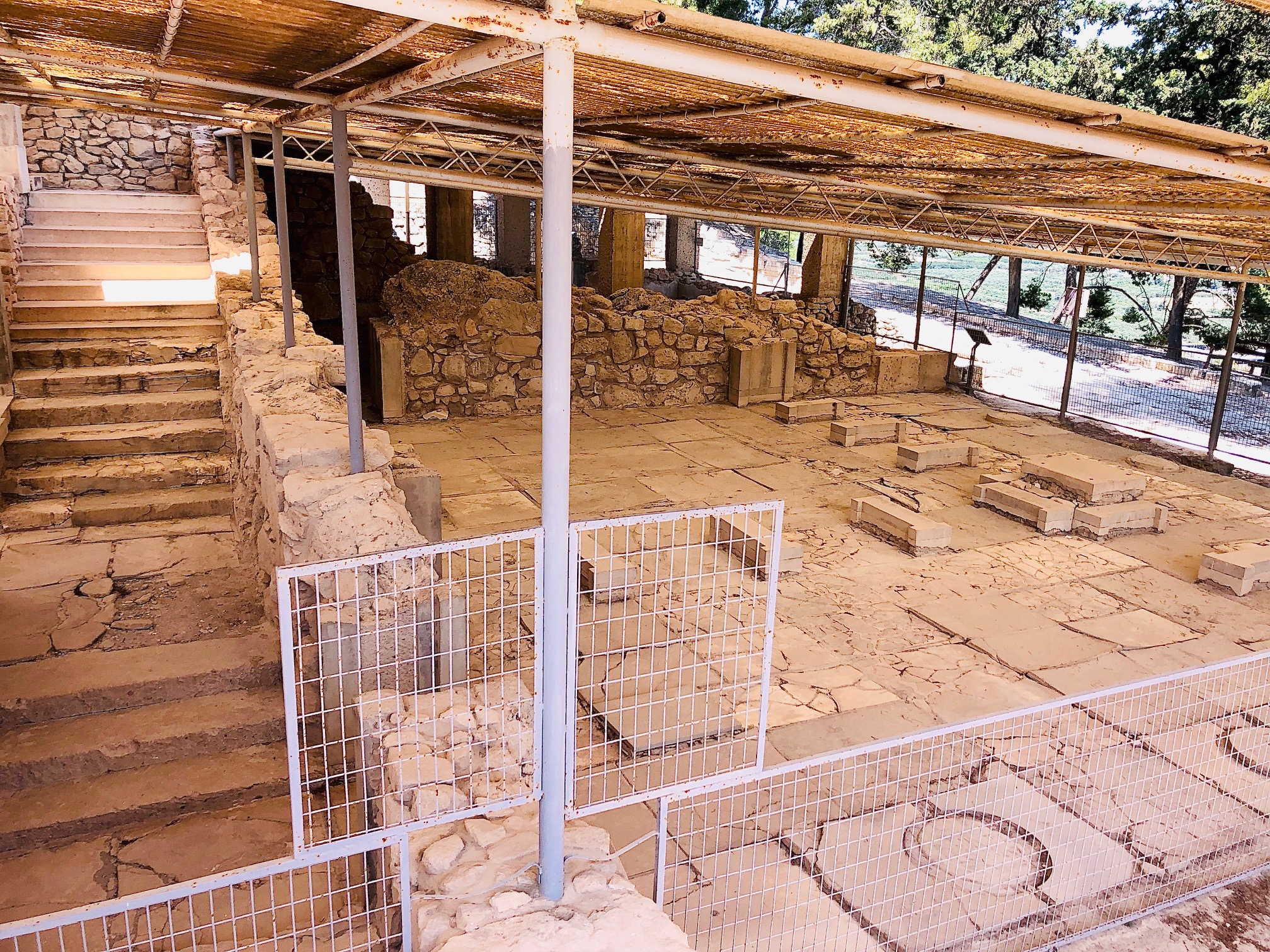
This is the Queen’s Megaron (throne room) found at Phaistos. It is covered by a metal shelter on this side…
IMG_1110
…and this side, too. | Photo: M. Yung
IMG_2460
The Phaistos Disk is on display at the Heraklion Archaeological Museum. The disk represents one of the greatest mysteries of archaeology. No one knows the meaning of the symbols incised into the clay. It was made between 2000-1000 BC. It measures about six inches in diameter. | Photo: M. Yung
IMG_1093
Photo: M. Yung

It was a beautiful sunny day when we visited Phaistos. In fact, by early afternoon, we were ready to hop on an air-conditioned bus and make the trip back to Heraklion.
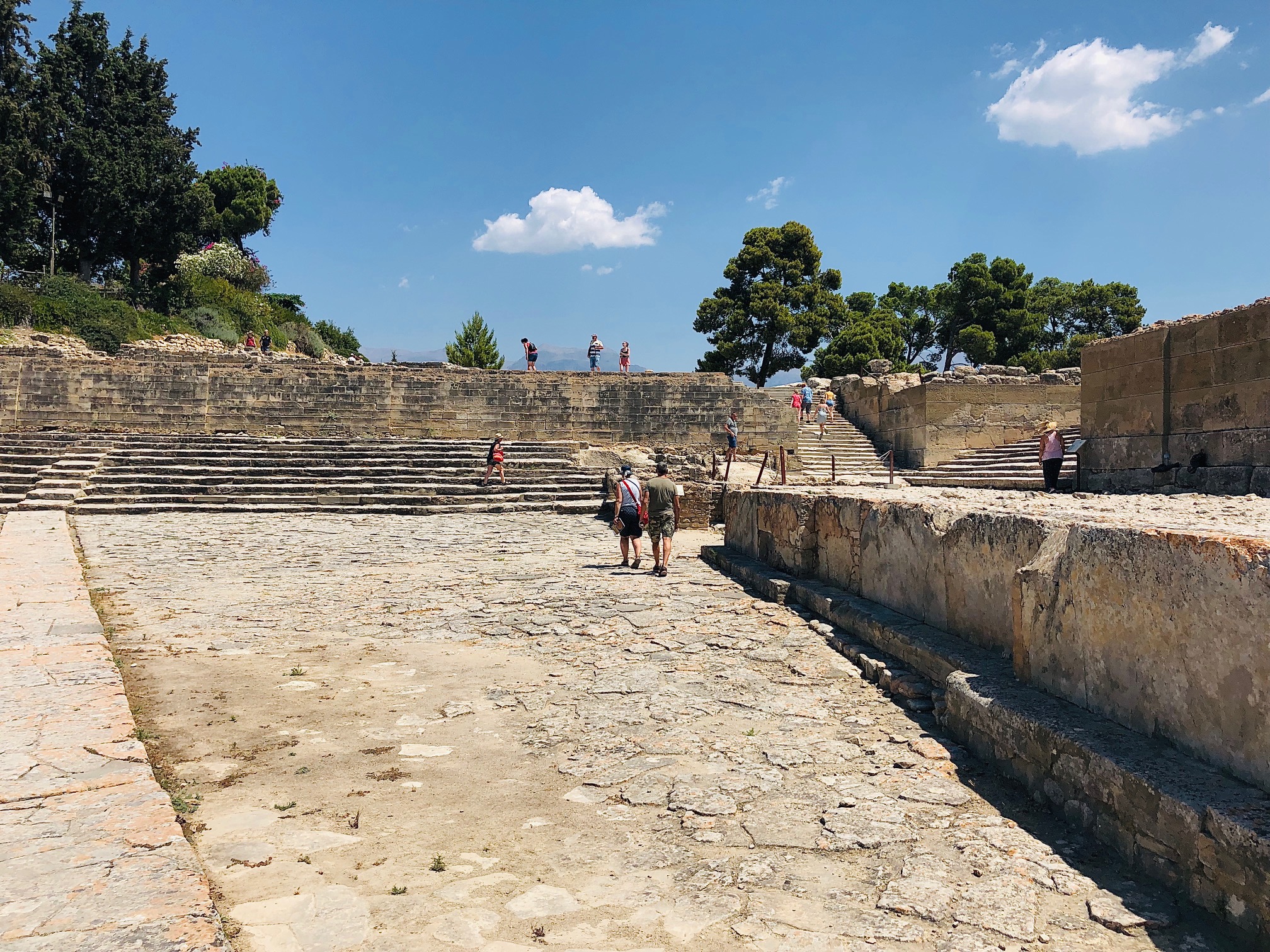
IMG_1113
This photo shows the theatral area on the left and stairway to the West Court on the right. | Photo: M. Yung
IMG_1154
Here I am walking near the theatral area in the West Court. The wall to my left can be seen on the left side of the preceding photo.
IMG_1116
Kouloures, large stone-built structures, show time-consuming craftsmanship. | Photo: M. Yung
IMG_1101
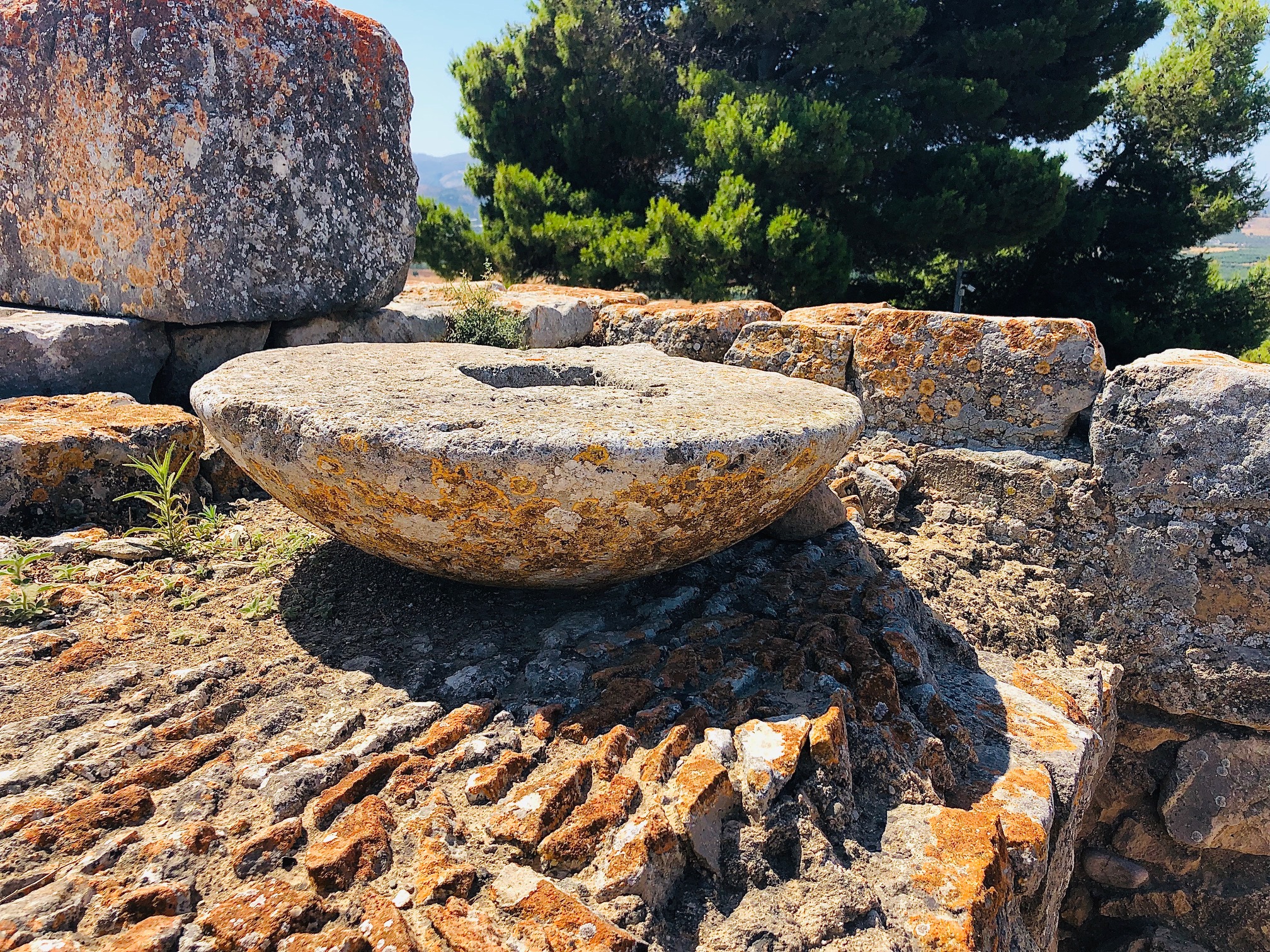
Relics from the past are scattered across the grounds. | Photo: M. Yung
IMG_1112
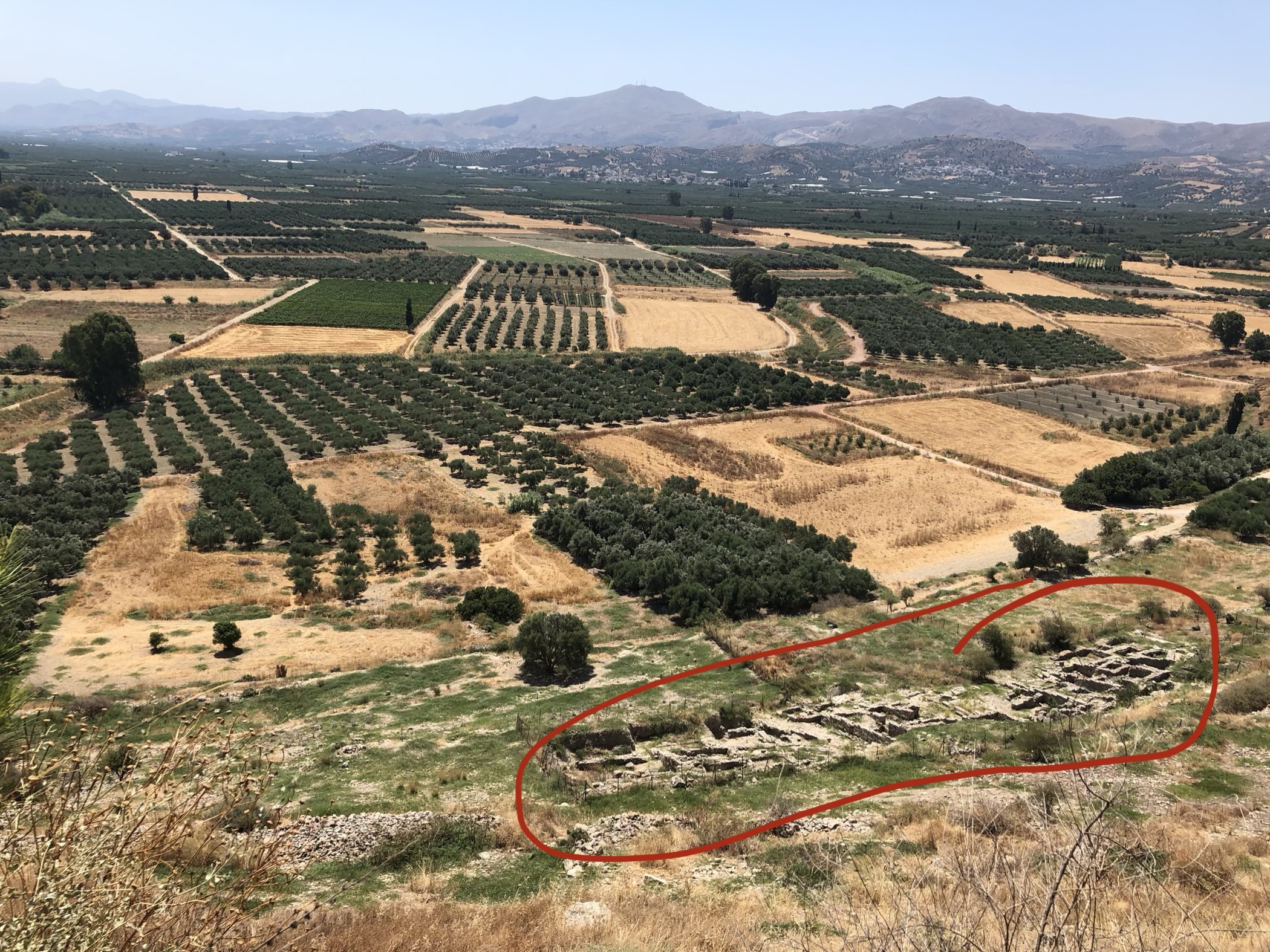
This photos shows the surrounding hillsides. I’ve circled in red additional outlying structures that were subordinate to the palatial hilltop above.  We ate our lunch (that we had packed and brought with us) on benches beneath a pine tree right above this scene. | Photo: M. Yung

Mysteriously, no one knows for sure the reasons for the collapse of Minoan culture, including the civilization at Phaistos.

Perhaps that’s a fitting conclusion for this archaeological site that today is still out-of-the-way, obscure, and famous.


Thanks for reading! This post is another installment from our cross-country Greek odyssey last summer. It’s amazing how many more sights I have yet to write about. Follow my blog for more travel posts, including this one from our final day in Greece when we visited the site of Paul’s To an Unknown God sermon.

Categories
Greece (Peloponnese)

Visit Mycenae


What you can expect to see at Mycenae

Ask an art historian about Mycenae and they will likely mention the Lion Gate, the monumental sculptures carved at the entrance to the citadel at the Mycenaean acropolis.  While the Mycenaean civilization they guarded through the millennia was buried and ravaged by time and destruction, the lions remained quietly standing, sentinels that protected the inhabitants within.

Today, Mycenae is still a protected site. Mycenae and the nearby Tyrins were inscribed upon the UNESCO World Heritage Liston December 4, 1999.

IMG_0064

According to a placard at the entrance to the site, “Inscription on this list confirms the outstanding universal value of a cultural or natural property which deserves protection for the benefit of all humanity. The two most important centers of the Mycenaean culture dominated the Eastern Mediterranean from the 15th to the 12th centuries B.C. and played a vital role in the development of the culture of Classical Greece.  The two citadels are indissolubly linked with the Homeric epics, the Iliad and the Odyssey, that affected European art and literature for more than three millennia.”

This isn’t the first post I’ve written about Mycenae. My first post was written on the road during  the middle of our cross-country six-week Greek odyssey last summer. That post was much more concise; it included a handful of photos, but nowhere near the number of photos in this post.

Enjoy these photos and if you have a visit to Mycenae in your future or if you’ve been there already, please leave a comment and share your thoughts.

IMG_0034
Tickets are 12€ each and include entrance to the archaeological site, the museum and the Treasury of Atreus.

After purchasing your ticket, you’ll walk on grounds that surround the hillside below the citadel on the acropolis, the uppermost part of the site. Beehive tombs and other city structures can be seen around you.

IMG_0048
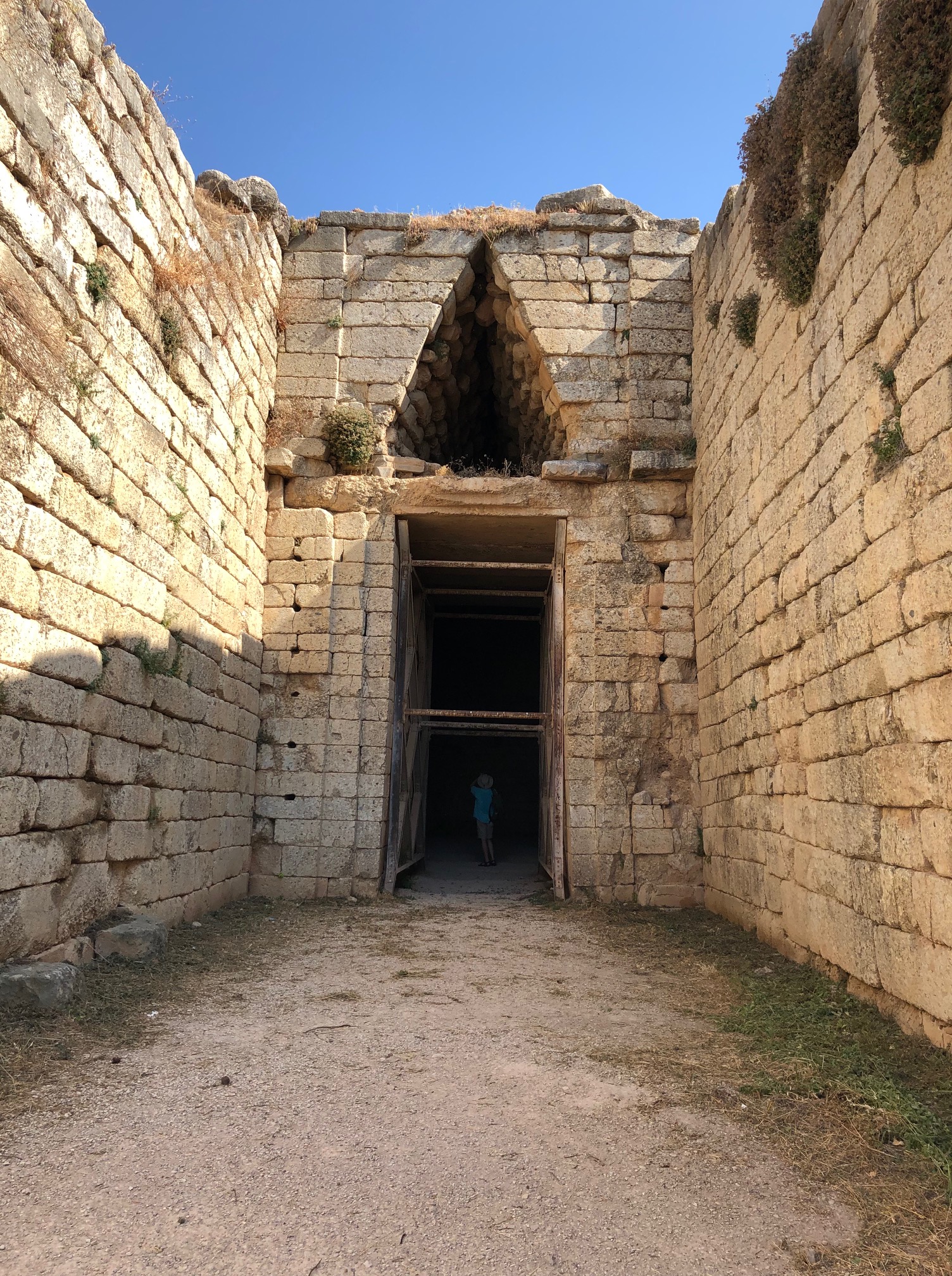
The latest “funerary monument” beehive tomb is on the hillside below the acropolis. It was discovered by chance by villagers during the time of Ottoman rule.
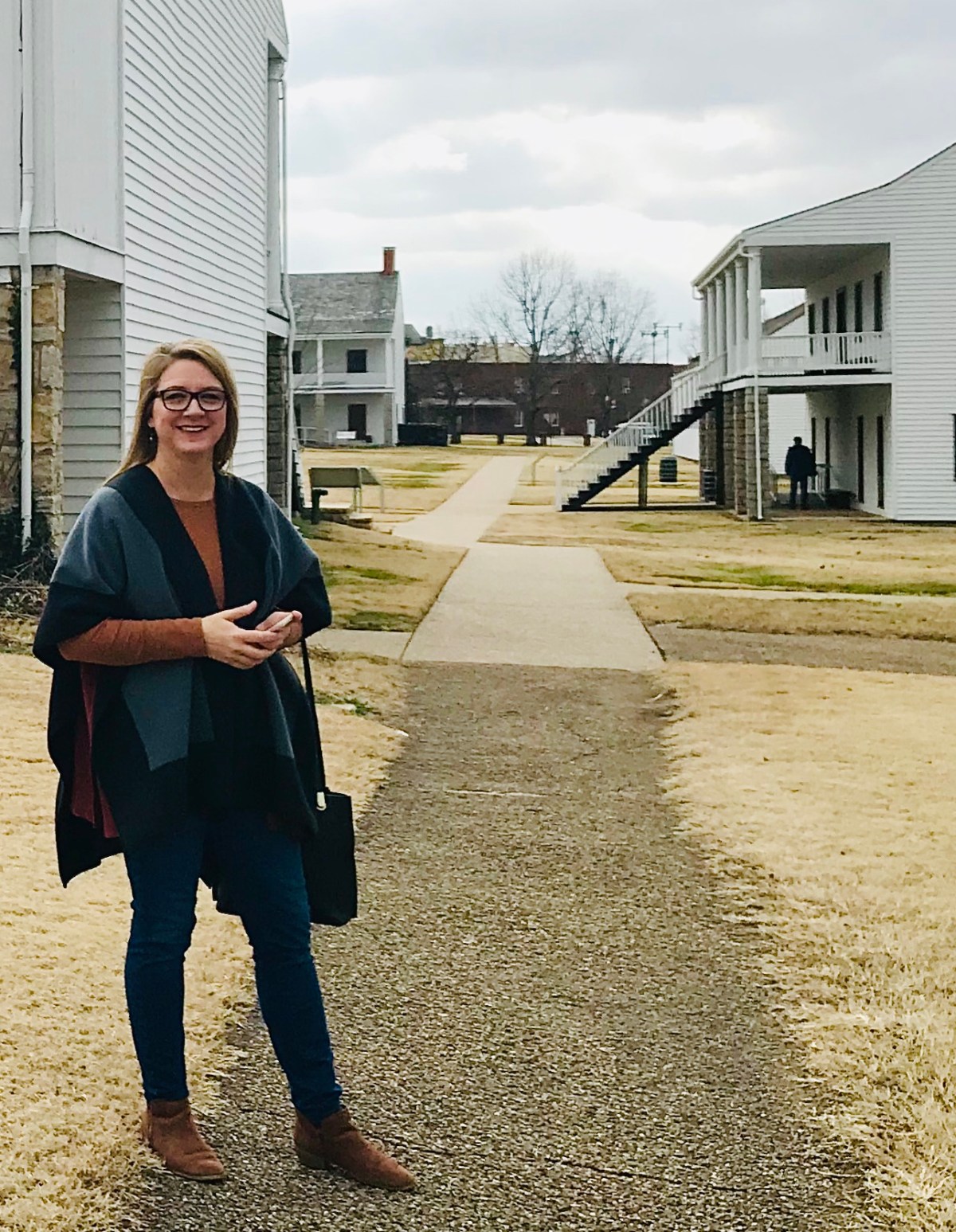
IMG_0050
The same tomb… just a little closer.
IMG_0054
And closer still. Here, I’m standing in the doorway where apparently some scaffolding is used to bolster the heavy stones. My husband, Mitch, is standing along the far wall, to show the size of the tomb.
IMG_0057
And… looking up at the ceiling of the beehive tomb.
IMG_0061
Outside the tomb, you can see theater seating (circled above in red) put in place by Greeks in Hellenistic times.

And another tomb…

IMG_0038
Another beehive tomb we encountered on our way up to the acropolis.
IMG_0042
I took this shot inside the tomb. The stonework is unbelievable.
IMG_0045
Get a load of those lintels above!
IMG_0041
Here’s a shot looking straight up at the underside of those mammoth lintel stones.
IMG_0126
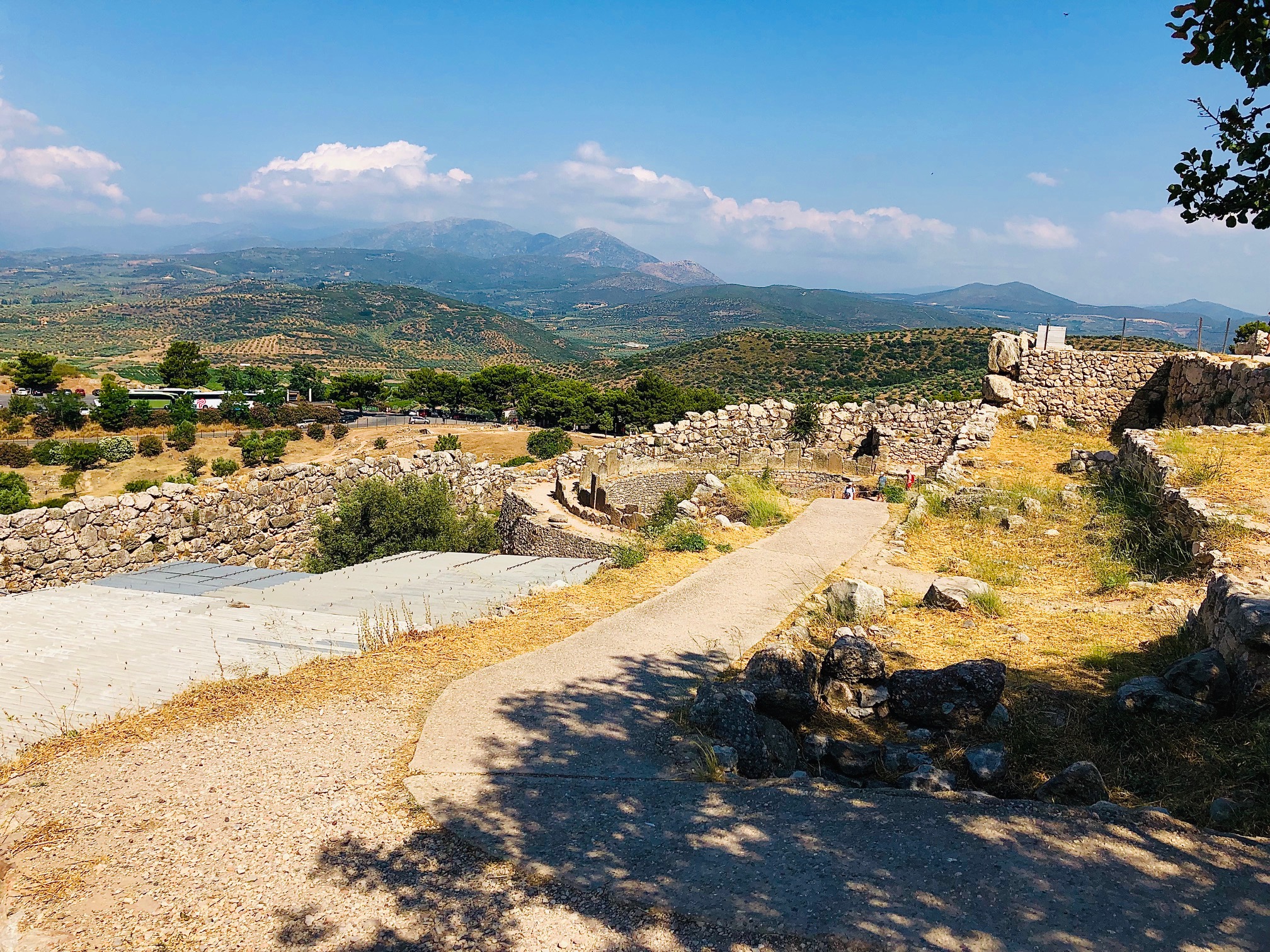
There’s more than one acropolis in Greece. This is the acropolis –the highest place — at Mycenae. It is also referred to as the citadel and was the home of the palace, House of Columns, grave circles, and other structures. If you tap the photo and zoom in you can see tiny figures walking along the very uppermost edge. The walking tour takes you from the edge of this parking lot up to the various sights on the acropolis and the surrounding hillsides.
IMG_0073
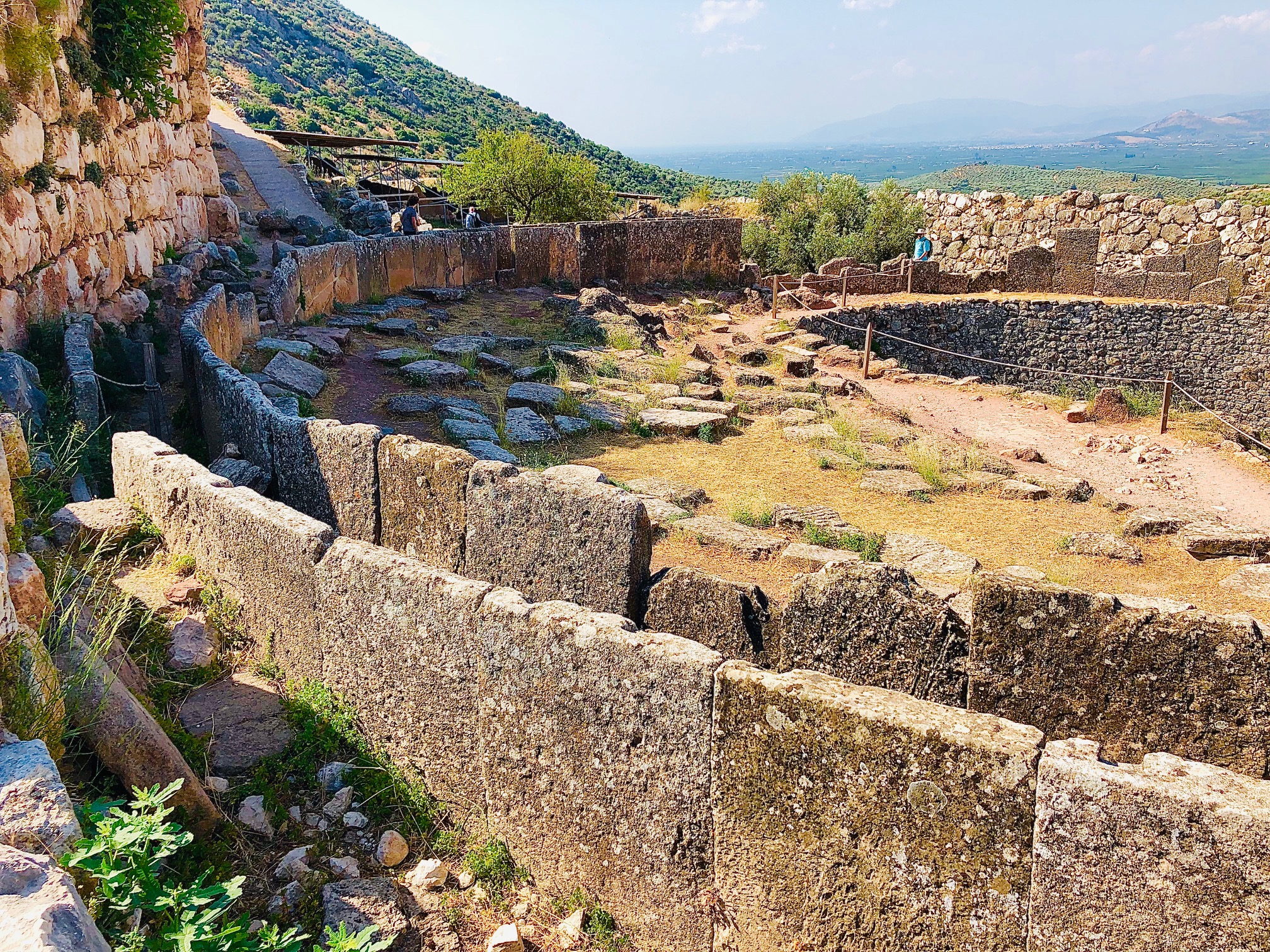
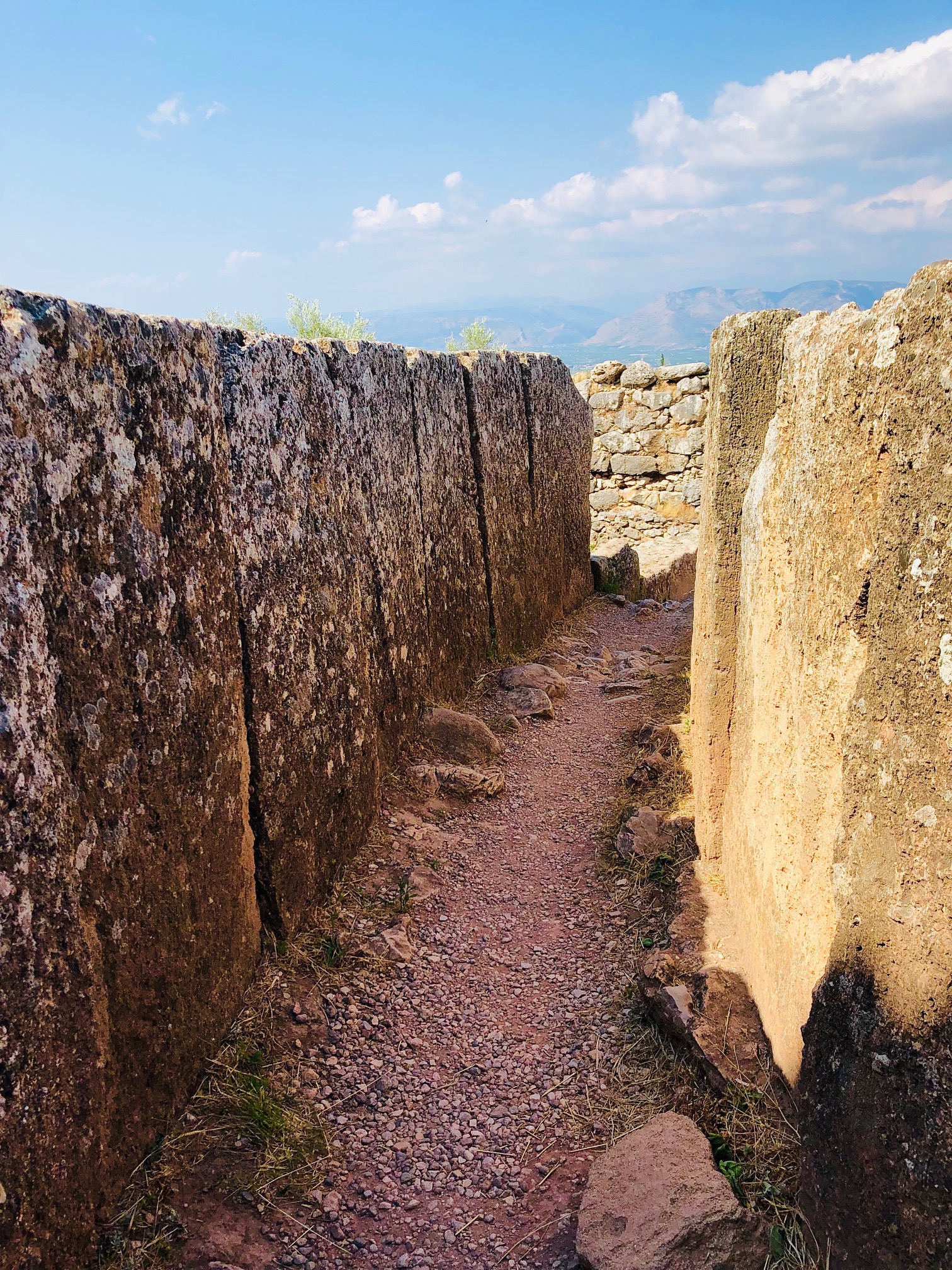
This is Grave Circle A, part of “an extensive cemetery” at Mycenae, according to a placard at the spot. “It was used exclusively for royal burials during the 1500s BC. The shafts, which you can walk down (see below), were near graves that held the bodies of royal family members and grave goods. Those goods can be found at the National Archaeological Museum in Athens. Here’s my post on that museum.
IMG_0075
This circular enclosure was an updated feature added to enhance the royal burial ground. When was the updating done? 1250 BC.
IMG_0080
A view from the citadel at the acropolis. The hillside is filled with myriad structures, foundations, and remains.  According to a nearby placard, most of the ruins visible today date to the 13th century B.C., but there is evidence that use of the site began in the Early Helladic period (3000-2000 BC.) 
IMG_0074
This is another photo from the citadel. Some of the structures on the acropolis include a large court complete with porticoes and antechamber, and the megaron, a political hub with administrative and military functions.
IMG_1615
We marveled at the size of this lintel piece on the citadel. 

There’s much more on the acropolis at Mycenae. Click here to see my other post about Mycenae that includes more photos from the top, including the House of Columns.

But for now, on to the museum…

IMG_0108
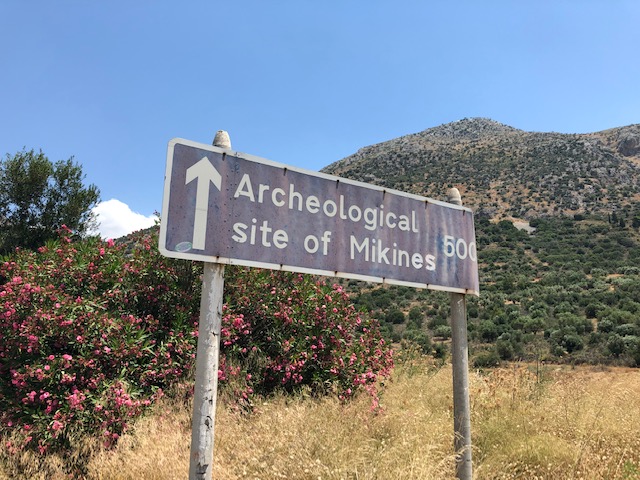
The sign at the entrance  to the museum reads in Greek “Archaeological Museum Mykines,” which English speakers say Mycenae.
IMG_0115
The cup looks very contemporary; however, it was made from 1350-1300 BC. The deep bowl in the back was made 1250-1150 BC.
IMG_0122
This ivory Mycenaean sculpture was made between 1250-1180 BC. It stands between only 3-4″ h. Read this post for more information about this little number.
IMG_0118
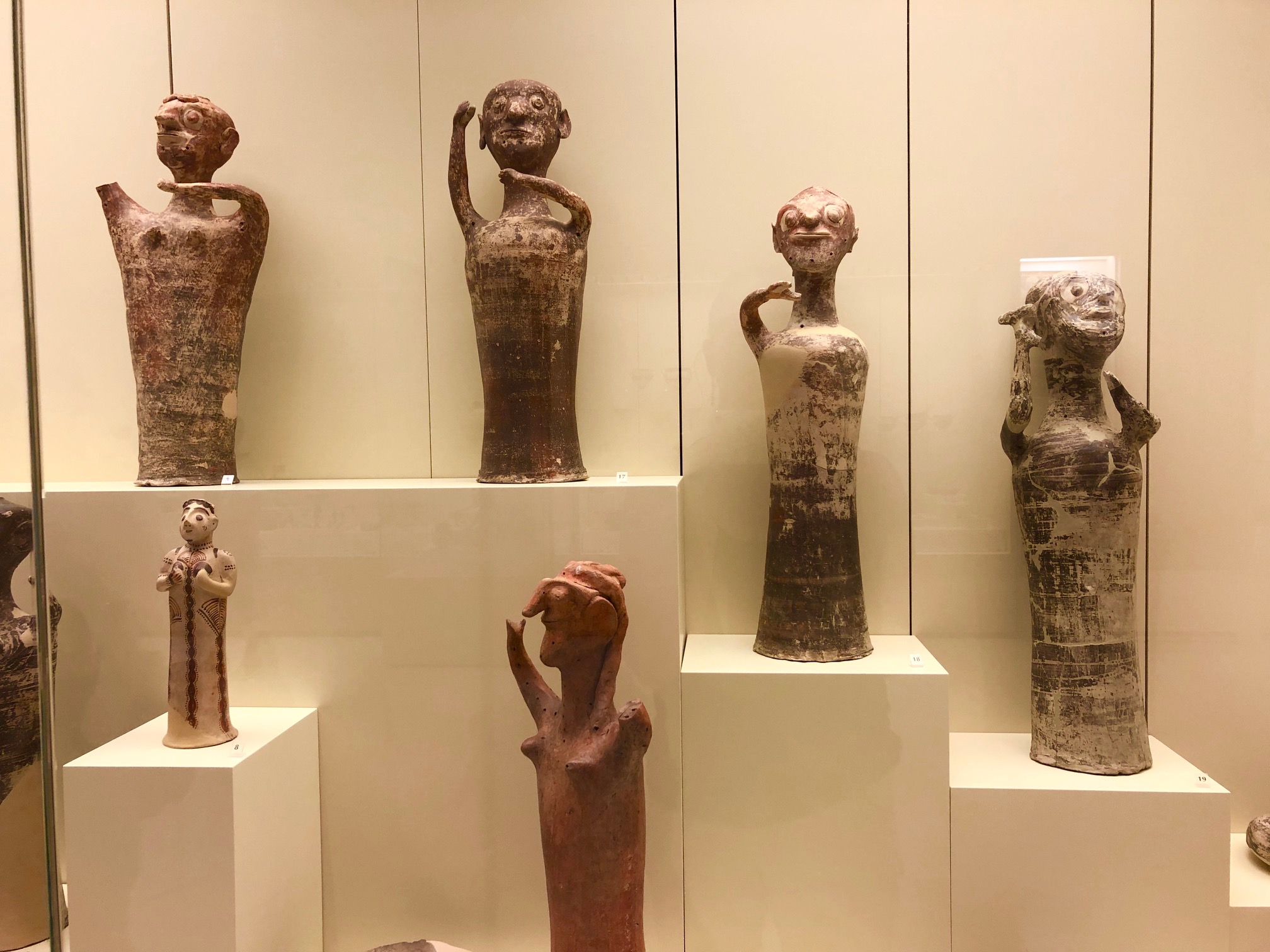
These “anthropomorphic figure” sculptures captivated me. I still am surprised at how contemporary the expressions and poses appear. These were made about 3,200 years ago… 1250-1180 BC! Simply stunning. 
IMG_0119
This anthropomorphic figure appears at the far right in the photo above.
IMG_0117
The spiral motif is timeless. This stairstep was decorated with a repeating pattern. 1450-1350 BC.
IMG_0124
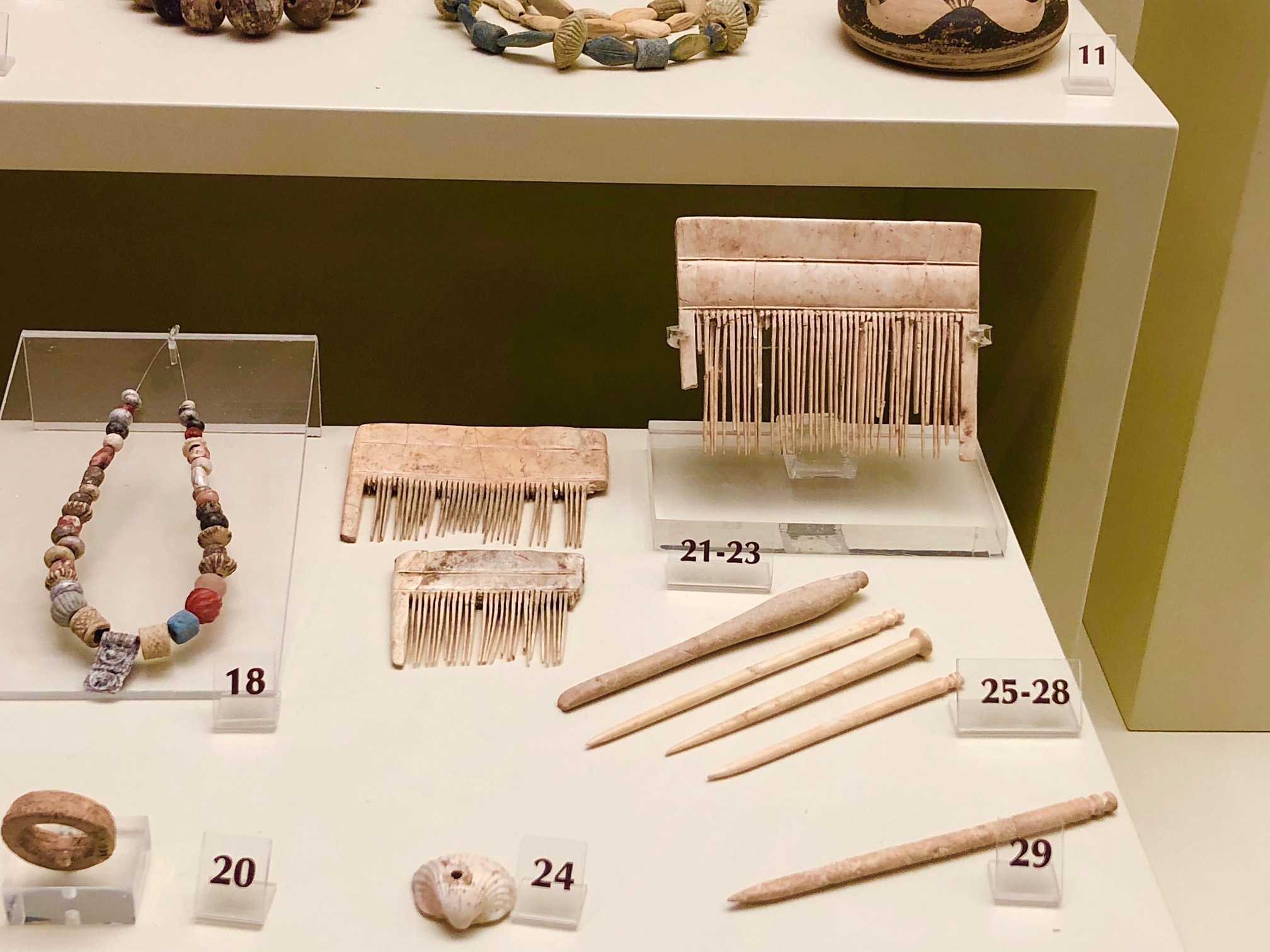
A variety of personal items were excavated from the sites at Mycenae. These combs are dated 1300-1180 BC. The colorful faience and glass necklace at left? 1400-1040 BC.
IMG_0121
This large storage jar is overwhelming in its size. 
Archaeological_Museum_of_Mycenae
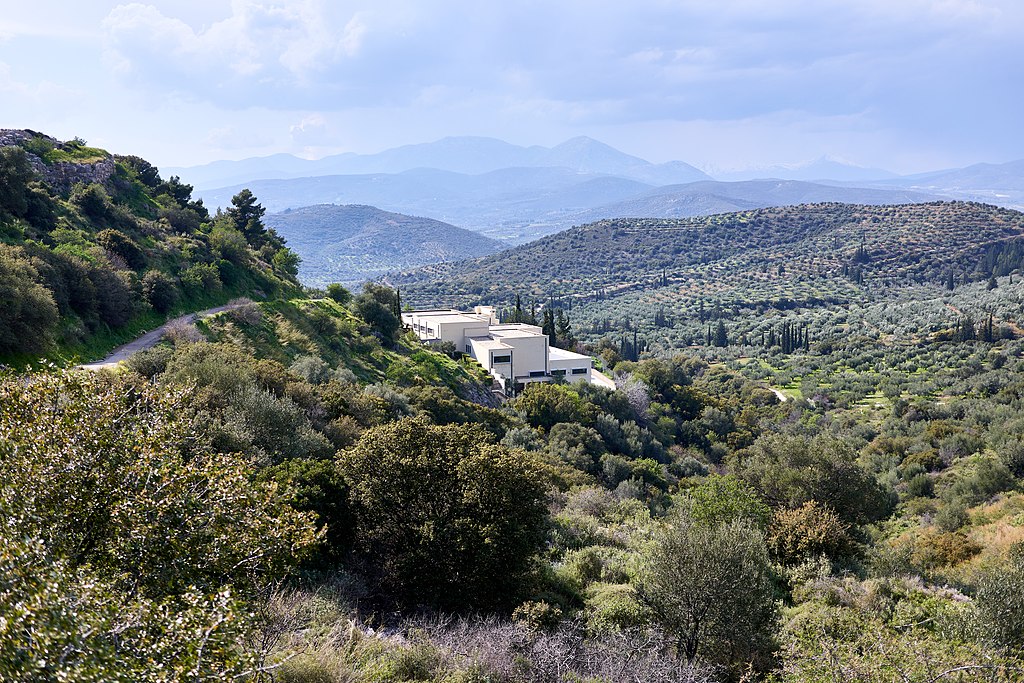
This photo, found on Creative Commons, shows the back side of the museum. When you visit the museum, you enter on the opposite side and and unable to see the various levels of the museum that descend down the mountain slope. Photo Credit: George E. Koronaios [CC BY-SA (https://creativecommons.org/licenses/by-sa/4.0)%5D

After touring the museum, we decided to leave the main site and walk back down the highway to bring our Mycenaean odyssey to a close. The sun was out in full force and we felt the pull of a mid-afternoon nap in our comfortable AirBnB. Here’s a post about our wonderful hosts.

IMG_0106
By the time we left, the crowds were increasing. Even so, the park wasn’t especially crowded. No lines. No waiting. No hassle.

But before that, we knew we wanted to check out the Treasury of Atreus, also known as the  Tomb of Agamemnon. One arrives at it when you head back down the highway toward the town of Mycenae. We had noticed it on our way up earlier that morning.

The Treasury of Atreus isn’t an afterthought… it’s a must-see.

IMG_1610
Just outside the main site, your ticket will allow you into the Treasury of Atreus. Here, you’ll find a guard station, a park bench or two under some pine trees, and, if I remember correctly, a vending machine. There are no facilities. 

But why is it called a treasury?

It’s called a treasury — and not a tomb — because treasures were placed inside to commemorate the ruler buried within.

IMG_0127
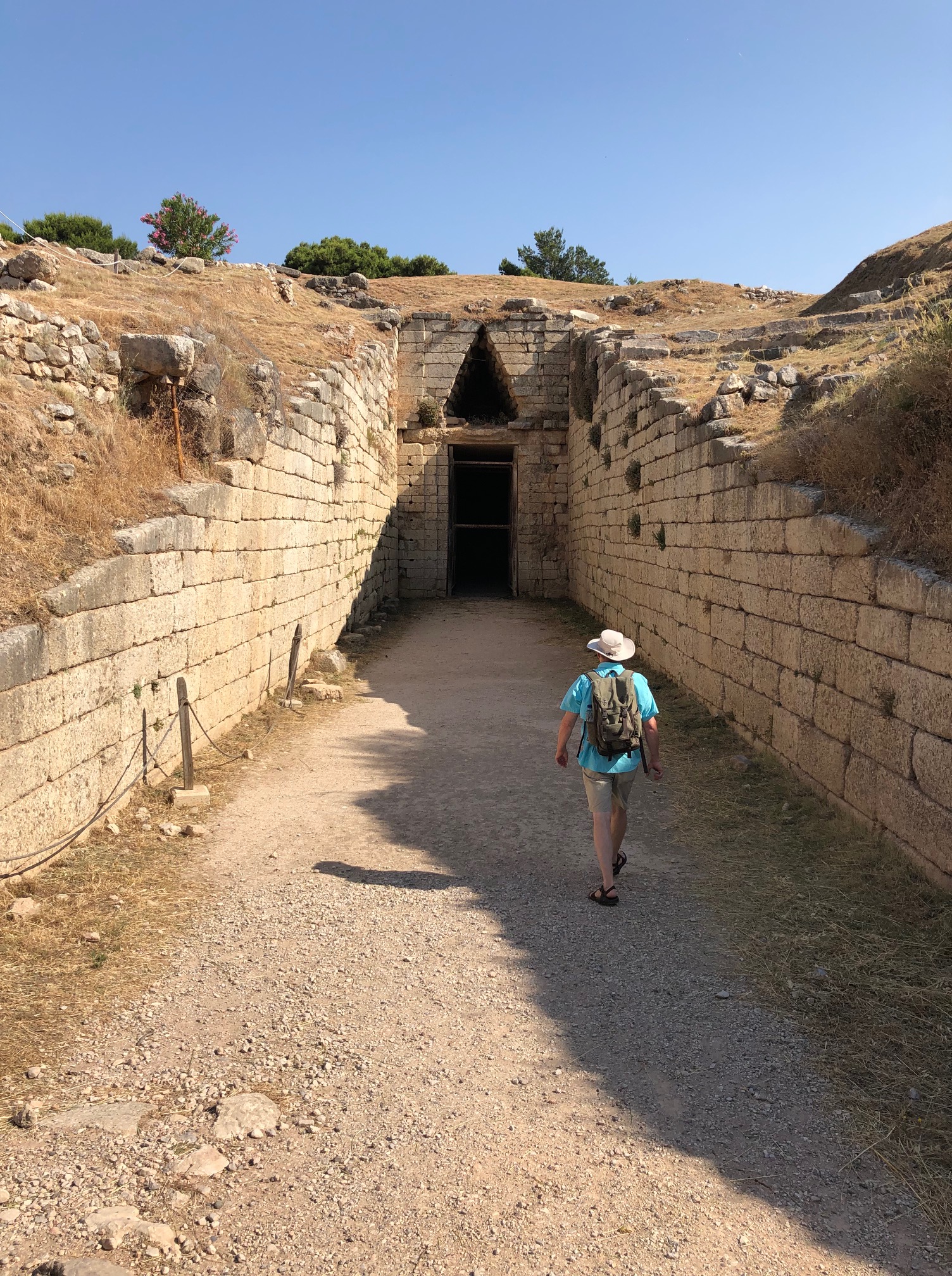
This is the Treasury of Atreus, also known as the Tomb of Agamemnon. It’s a large “tholos,” or beehive tomb on Panagitsa Hill at Mycenae. It was built in 1250 BC.

Just so you know…

The Treasury of Atreus has no real connection to Agamemnon. The Mycenae archaeologist Heinrich Schliemann named it thus and the popular name persisted. According to this article, the royal buried here would have ruled at an earlier date than Agamemnon.

IMG_0140
I took this picture looking back from the entrance to the Treasury of Atreus.
IMG_0134
That lintel above the entrance to the tomb weighs 120 tons!
IMG_0135
This is a more accurate picture of the inside of the Treasury of Atreus. It’s dark inside… and nice and cool, too.
IMG_0142
We walked along an asphalt highway up to the Mycenae Archaeological Site. It was a sunny and breezy day. 

I hope you enjoyed this photo essay about Mycenae. It’s a lonely yet so important archaeological site.

Greece, including the Peloponnese region (that part of Greece connected to the mainland by the land bridge at Corinth), offers a plethora of ancient sites. It’s truly difficult to visit them all. In fact, we already are making a list for sites to see when we return someday.

But in the meantime, if Greece is in your future, make time for Mycenae.


Thanks for reading! Make sure to leave a comment or share a thought about this post or to share news about your own visit to Greece. I’m looking forward to hearing from you. 

Featured Photo Credit: Marilyn Yung | Walking in the Grave Circle at Mycenae

Categories
Food & Recipes

Robert Redford Would Never be Pie

Lemon-baked Tilapia with Mango Chutney

Seasoned Wild Rice Garnished with Parsley

Dinner Roll White

Tossed Greens

Ranch Italian Lemon-Poppyseed Choose One

Robert Redford Dessert

My eyes lingered over the last line on the menu planned for Tuesday, January 7 at the Presbyterian Village, a retirement community located about a mile from my parents’ house. My daughter and I had picked up the menus to take to my parents who were planning to order a few meals for delivery.

“Robert Redford Dessert,” I said aloud.

“What’s Robert Redford Dessert?” my daughter asked.

“I don’t know, but it sounds delicious,” I said.  “I’m guessing it’s creamy, dreamy, and sweet,” I added.

This would be a good time to issue a disclaimer:

If you were born after, say 1990, you probably don’t know who Robert Redford is. Poor you. Redford is an actor and director with classic good looks, more than seventy movies to his name, and classic good looks. That’s all you need to know for now.

My daughter laughed because she fully appreciates my full appreciation for Robert Redford. I’ve made sure of that.

If there’s one thing we must teach our children it is this: Robert Redford.

True, thanks to her father she also appreciates Johnny Cash, Roger Miller, and The Dead Milkmen, but thanks to me, Robert Redford holds a special place in her heart — and on the menu of the Presbyterian Village.

Still, I wondered, how do I — of all people — not know what Robert Redford Dessert is? I suddenly doubted my self-worth. I swerved into my parents’ driveway. I pictured myself perusing the meal options with my parents before googling “Robert Redford Dessert” once we got inside.

We got inside.

I thrust the menus at my mom and reached for my phone.

I googled Robert Redford Dessert. The first result: Better than Robert Redford Dessert.

I scoffed. Better than Robert Redford Dessert?

Who do these people think they are?  

Don’t they know that Robert Redford cannot be improved upon? Obviously, these lost souls have drifted far and I’ll have nothing to do with them. I scrolled down the page.

The next result: Next Best Thing to Robert Redford Dessert.

I scoffed again, but not as much.  After all, at least these wayward souls acknowledge that their dessert — whatever that is — isn’t as good as the actual Robert Redford Dessert — whatever it is. I continued to scroll.

The next result: Robert Redford Dessert (My Way).

Okay, I can get behind that one, I thought. But I still want to find the original recipe and by original recipe, I’m not talking about this guy:

Col._Harland_Sanders'_Portrait_Commissioned_by_Winston_L._Shelton
Oil painting by: Norman Rockwell (Public Domain)

Nope. I’m talking about this guy:

Robert_Redford,_pastel_portrait_by_Robert_Perez_Palou
Pastel portrait by: Robert Pérez Palou [CC BY (https://creativecommons.org/licenses/by/3.0)%5D

I kept scrolling. The next result: another ill-fated Next-Best-Thing-to-Robert Redford recipe. But this one was a PIE.  I laughed. Robert Redford and pie? Right. Robert Redford would never be a pie.

I paused… or would he?  Have I totally missed the mark on what Bob is all about?

What if I’ve been thinking he’s whipped topping and creamy French silk when all along he’s been pie?

Naaaahhhh. Keep scrolling, I told myself.

The next result: another twisted Better than Robert Redford Dessert.

Away from me, Satan! I kept scrolling.

The next result: Robert Redford Dessert Recipe.

I sighed. Finally. The one true Robert Redford Dessert recipe and possible key to the universe.

I read from the Food.com website:

  • ½ c. butter, softened (of course)
  • 1 c. all-purpose flour (you had me at butter)
  • 1 c. pecans (well, this makes me skeptical, but okay)
  • 8 ozs. cream cheese, softened (yes)
  • 1 c. powdered sugar (double yes)
  • (1) 10-oz. container frozen whipped topping, thawed (yes yes yes)
  • 2 c. prepared chocolate pudding (even better)
  • 2 c. prepared vanilla pudding (kind of a let-down, but whatever)
  • Chopped pecans and grated chocolate for garnish (as if he needs a garnish!)

The recipe directed to combine the first three ingredients to make a crust that bakes at 350 degrees. The rest are folded together and eventually layered into the cooled crust. The garnishes garnish. And voila! It’s Robert Redford in a pan, I thought.

Another website told me the dessert became popular in the ‘70s when Redford’s career was in full throttle. Think Butch Cassidy and the Sundance Kid and The Sting. At potlucks, women could prepare the popular dessert and tell everyone they were bringing Robert Redford.

I skimmed the ingredients again. They were dreamy. Creamy. Silky. Smooth. Suave. Rugged. Weathered. Sophisticated. Creative. Classic. Yep, that’s Robert Redford Dessert.

All these years and I never knew such a decadent dish existed.

I returned to the kitchen table where my parents were making their meal selections. Neither of them mentioned anything about the Robert Redford Dessert.

I found that curious because when I was about eleven, they obviously understood the importance of teaching the next generation about Robert Redford. After all, they took me with them to the theater to see All the President’s Men, starring you-know-who along with Dustin Hoffman.

I sat down with my parents at the kitchen table. I leaned forward where the menus were arranged. One for my dad. One for my mom.

A feeling of gratitude washed over me.

“Thank you for taking me to see All the President’s Men,” I told them.

My mother looked up from the menus. “What are you talking about?”

“Thank you for taking me to see All the President’s Men. Thank you for teaching me about Robert Redford.”

She wrinkled her brow. “Okay,” she mumbled, clearly confused.

I prompted her. “The dessert. Did you see the dessert? Robert Redford Dessert? On Tuesday. The eighth? I appreciate him. And now Katherine appreciates him. You did your part. And now I’ve done mine. Y’know, teaching the next generation?”

Her eyes locked on mine a little too long… and then she turned to my dad, who was checking off their selections for the next week.

“Just circle the pork chop entrée for me,” she said quietly.

I dropped off their menus at the Presbyterian Village later that afternoon.


It’s true. I had never heard of  Robert Redford Dessert until a few weeks ago. For being his biggest fan, I found that shocking and just had to tell you about it. Have you ever heard of Robert Redford Dessert? Do tell. Or click here to read about another celebrity experience.

Featured Photo Credit: Wikimedia Commons

Categories
US (Kansas) US Travel

Timing is everything: Fort Scott National Historic Site

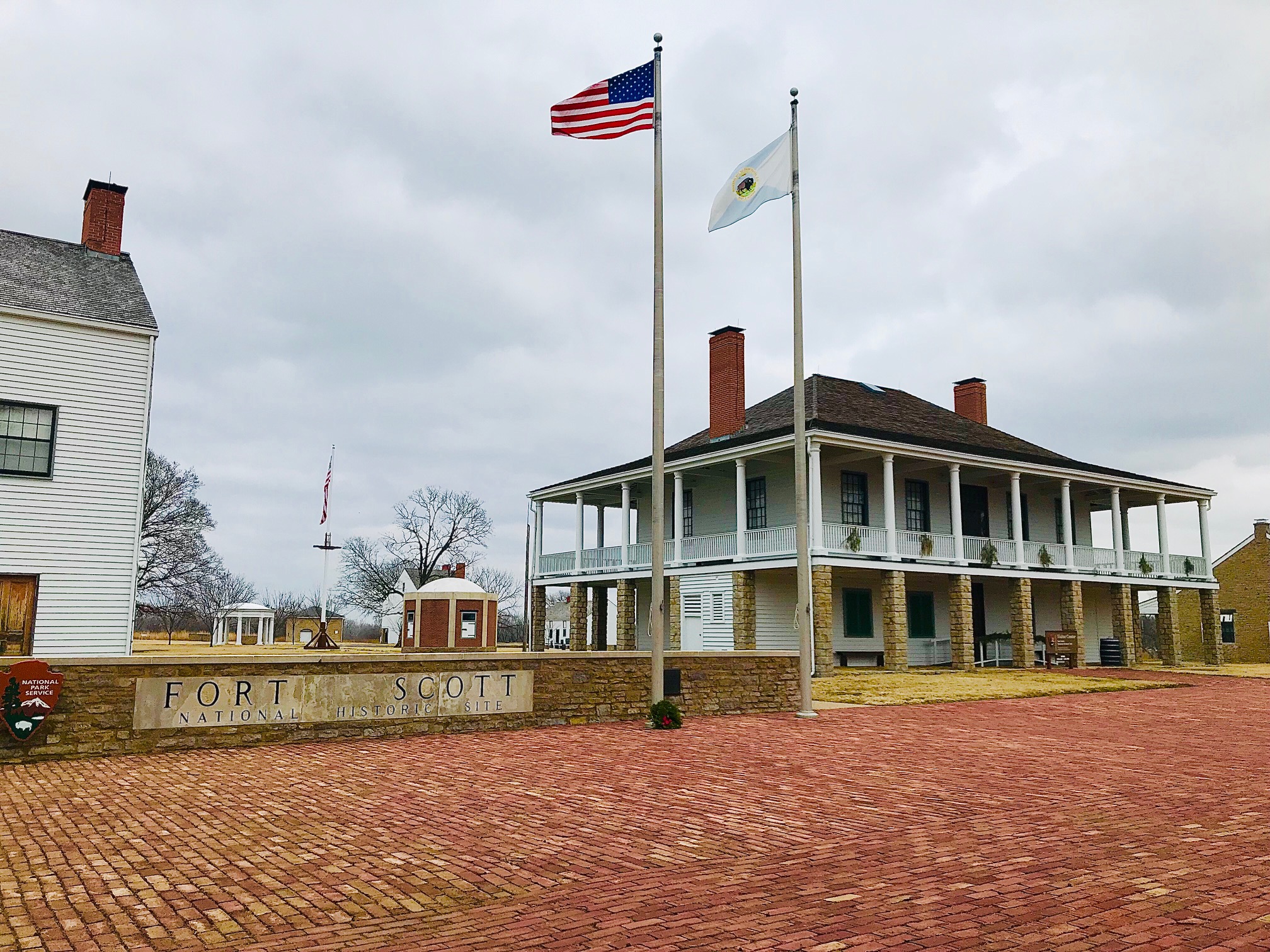
Above: The dark buildings straight down this path include retail shops, restaurants, and a senior services center. During the fort’s early years as a frontier outpost, the view down this path would have included only empty open prairie.

Photos and fun facts from Fort Scott National Historic Site

Over the Christmas holidays, my daughter and I visited my hometown, Fort Scott, Kansas (pop. 8,000) in the southeast corner of the state. While there, we decided to visit what locals call “the fort” —  Fort Scott National Historic Site.

During my growing up years, I toured the fort numerous times, and my daughter had taken the tour when she was little. Even so, we were both up for a refresher tour of the fort that, in 1853, was closed by the time it was truly needed about ten years later.

According to American Heritage, “…the fort was a very peaceful place in its first years, sending escorts on occasional excursions West and troops to the Mexican War but seeing no action whatever nearby. In 1853 so little was happening that the fort was abandoned, its buildings sold. More bad luck: This happened just in time for Bleeding Kansas, the civil war that preceded the Civil War, when a fort here was truly needed.”

Yes, timing is everything.

IMG_8411 (1)
The hospital building at right contains the visitors’ entrance and gift shop on the lower floor. The upper floor contains medical exhibits, including a sick ward, and a multi-media theater.

We visited the fort on Thursday, January 2, and it was obviously a slow day for tours. We arrived at the entrance at 1 p.m. Park Ranger Laura Abbott was gearing up to conduct a tour that would begin in about five minutes, so we decided to wait a few minutes and then take a tour that she told us would last about one hour.

Since no one else was waiting in the visitors’ center, we enjoyed a private tour with Abbott. It was nice to be able to take our time and experience a more personalized tour than we would have experienced in the busy season. Plus, I was able to ask lots of questions and re-learn lots of forgotten facts, such as…

  • Fort Scott was established in 1842 and was one of a line of nine forts from Minnesota to Louisiana that promised a “permanent Indian frontier.”
  • Fort Scott was named for U.S. Army Gen. Winfield Scott.
  • Infantry and dragoons from Fort Scott left the fort to fight in the Mexican-American War from 1846-48.
  • The fort was abandoned in 1853 as the idea of Manifest Destiny took hold, causing the promise of a “permanent Indian frontier” to die.
  • Fort Scott served as a major supply depot for the Union armies and a hospital 
  • Fort Scott also served as a refuge for people fleeing the war, such as displaced Indians, escaped slaves and white farmers.
  • Kansas entered the Union as a free state on Jan. 29, 1861.
  • The 1st Kansas Colored Infantry was sworn in at Fort Scott. “This was one of the first African American regiments to engage Confederates in combat,” according to the National Park Service’s Fort Scott brochure.
  • The fort became a national historic site in 1978 after decades of random use and misuse, and the kind of neglect that just happens with old, always-been-there structures. 

These photos follow the route we took through the seventeen-acre historic site. The last building we toured was the Western Hotel, located just north of the large, square hospital, contains new interactive displays with video interviews with historical characters. Scroll to the bottom of this post to see two of those videos.

IMG_2290
This gift shop and book store is located inside the Visitors Center, which is located on the first floor of the hospital building. The hospital is shown in the top photo. Free tours start here.
IMG_2294
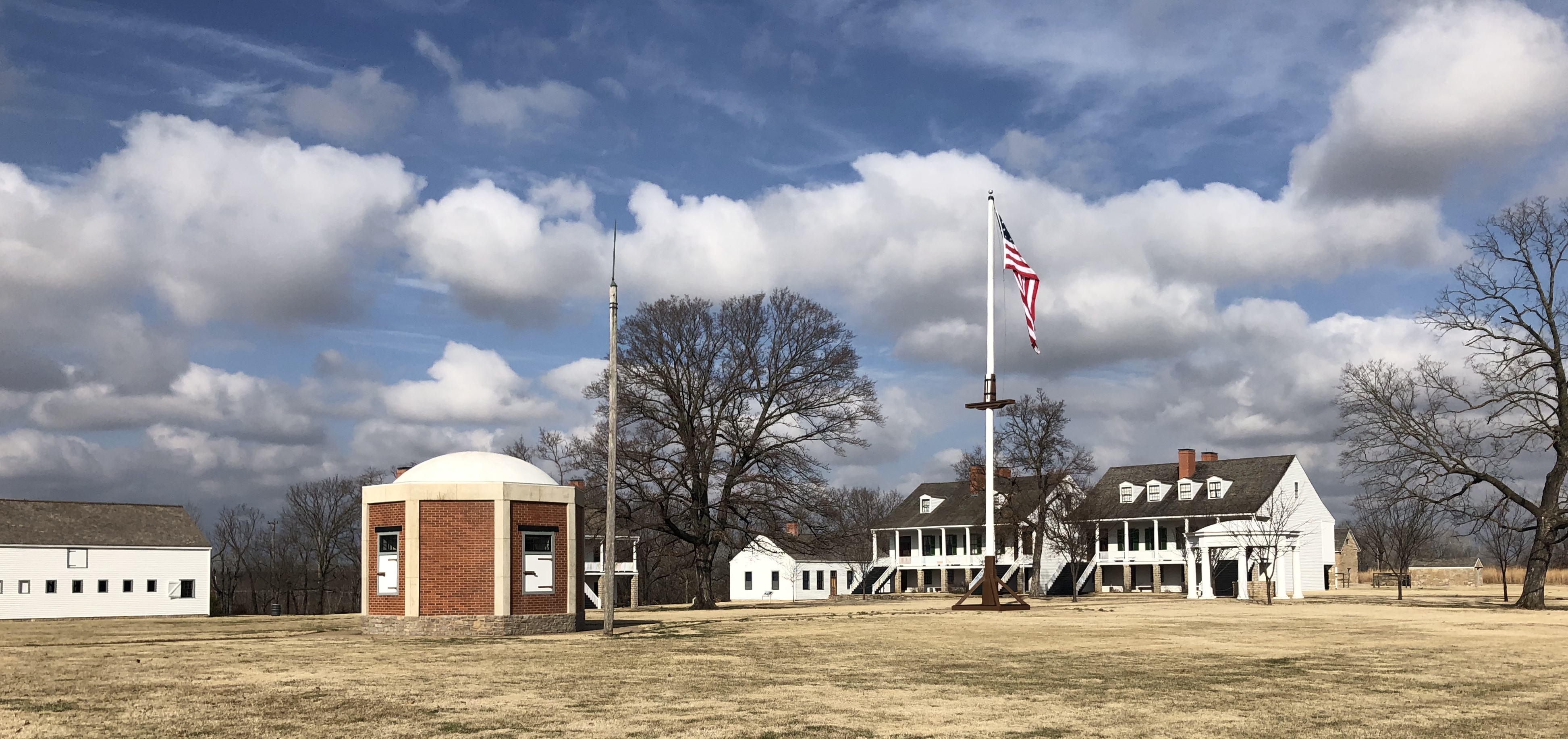
When we began our tour, the skies were bright with clouds and sun. Officers’ Quarters No. 1 and No. 2 are shown in the distance. Dragoon Stables are on the left. The Gunpowder Magazine stands at center left.


IMG_2390
After its initial closure in 1853, the fort’s Infantry Barracks became the pro-slavery Western Hotel in 1855. The building in the distance on the right was the anti-slavery Fort Scott “Free State” Hotel. The fort would become caught up in the controversy over whether Kansas would become a free or slave state during the Bleeding Kansas years before the war. 

Let’s start the photo tour…

IMG_2292
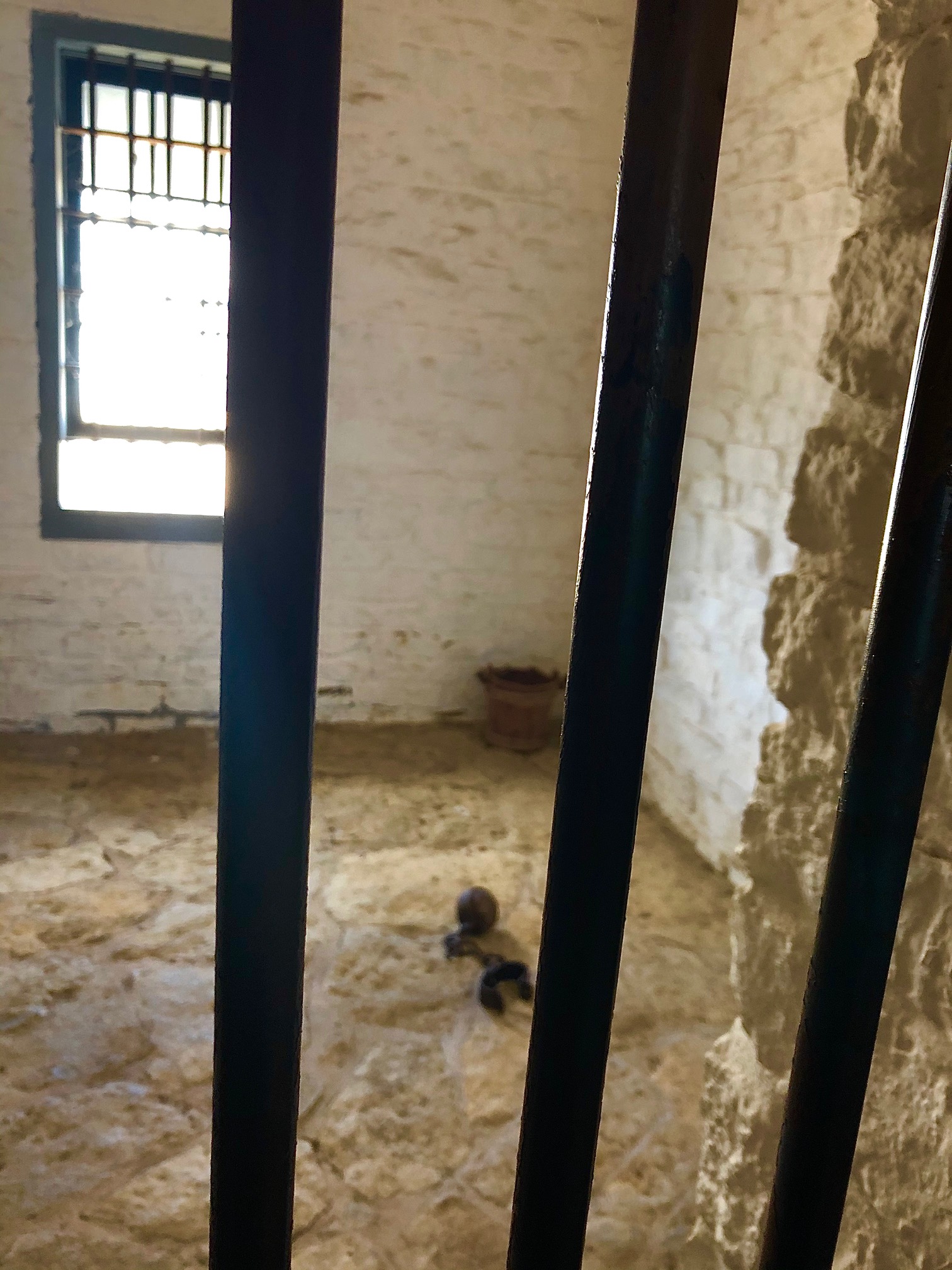
The Guardhouse, located right next to the Visitor Entrance, was where soldiers were stationed to receive arriving visitors, who could even sleep overnight on wooden shelving. The stone house was also used to discipline criminals in cells such as this one. 
IMG_2298
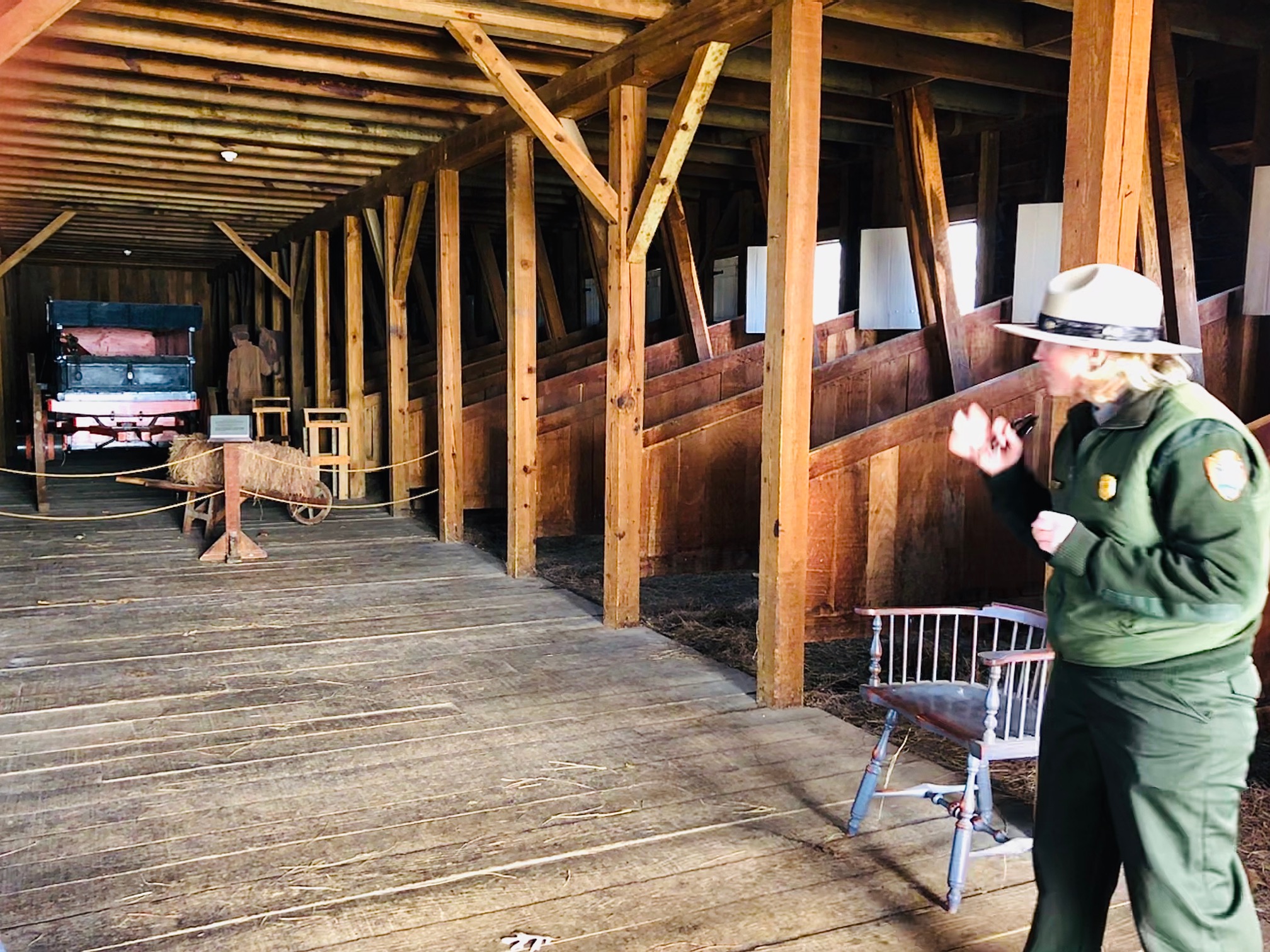
Ranger Laura Abbott shows us the Dragoon Stables…

Did you know that the colors of horses were used to identify army regiments?

IMG_2301
…and the Dragoon Barracks’ mess hall…
IMG_2303
…with its kitchen…
IMG_2306
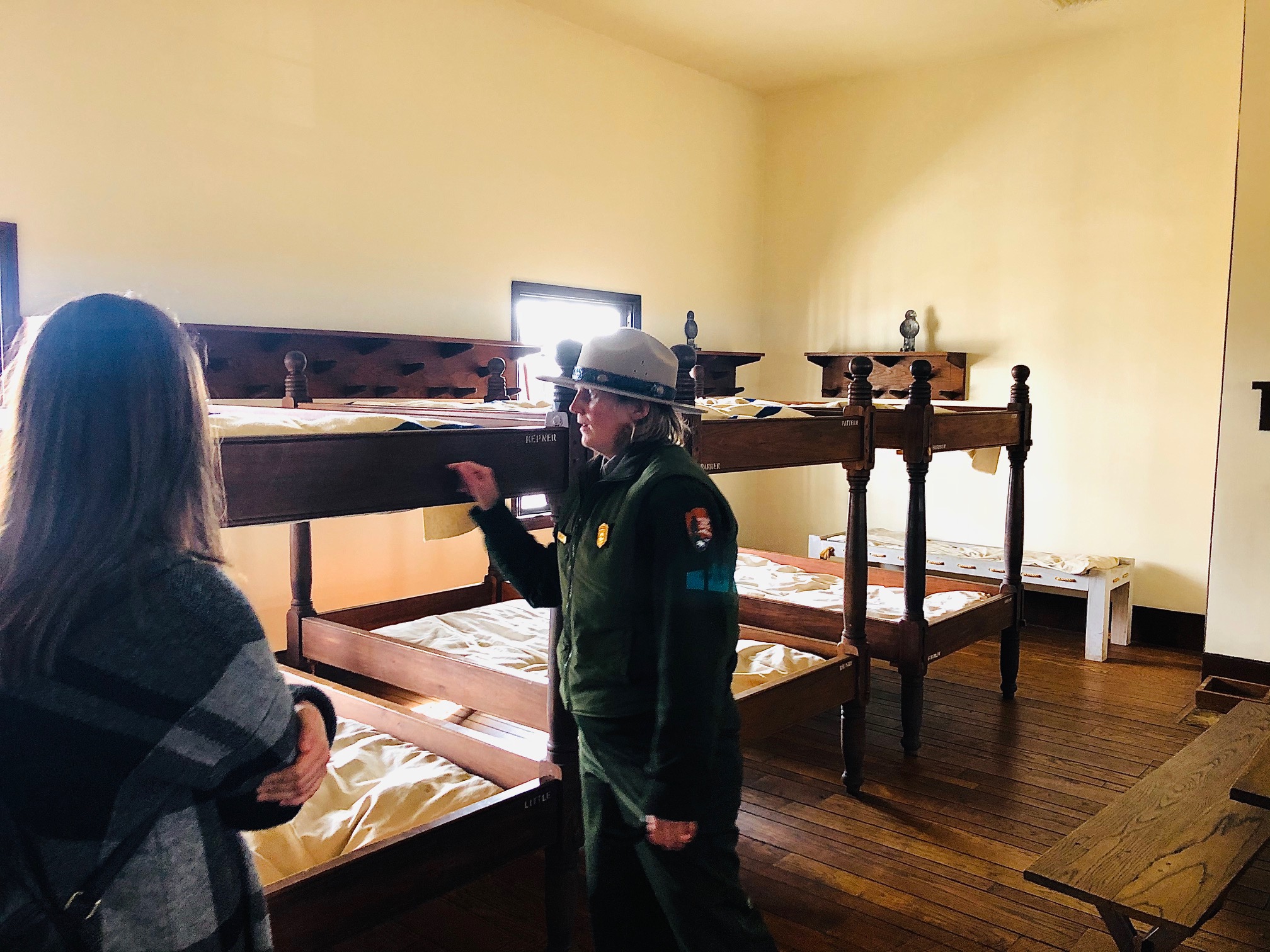
…and the sleeping dorms upstairs. Enlisted men slept in the bunks, while non-commissioned officers slept in the narrow gray cot along the wall near the fireplace.
IMG_2307
Four enlisted soldiers shared each bunk bed. Yes, two men slept on each mattress. The beds were labelled with their names, which I’ve circled on the photo above. 

Did you know four men shared one bunk bed in the sleeping dorm?

IMG_2304
The laundresses worked and stayed in this room down from the mess hall. These quarters contained a bed on the opposite wall (not shown). 
IMG_2311
Park Ranger Laura Abbott leads the way to Officers Row.
IMG_2317
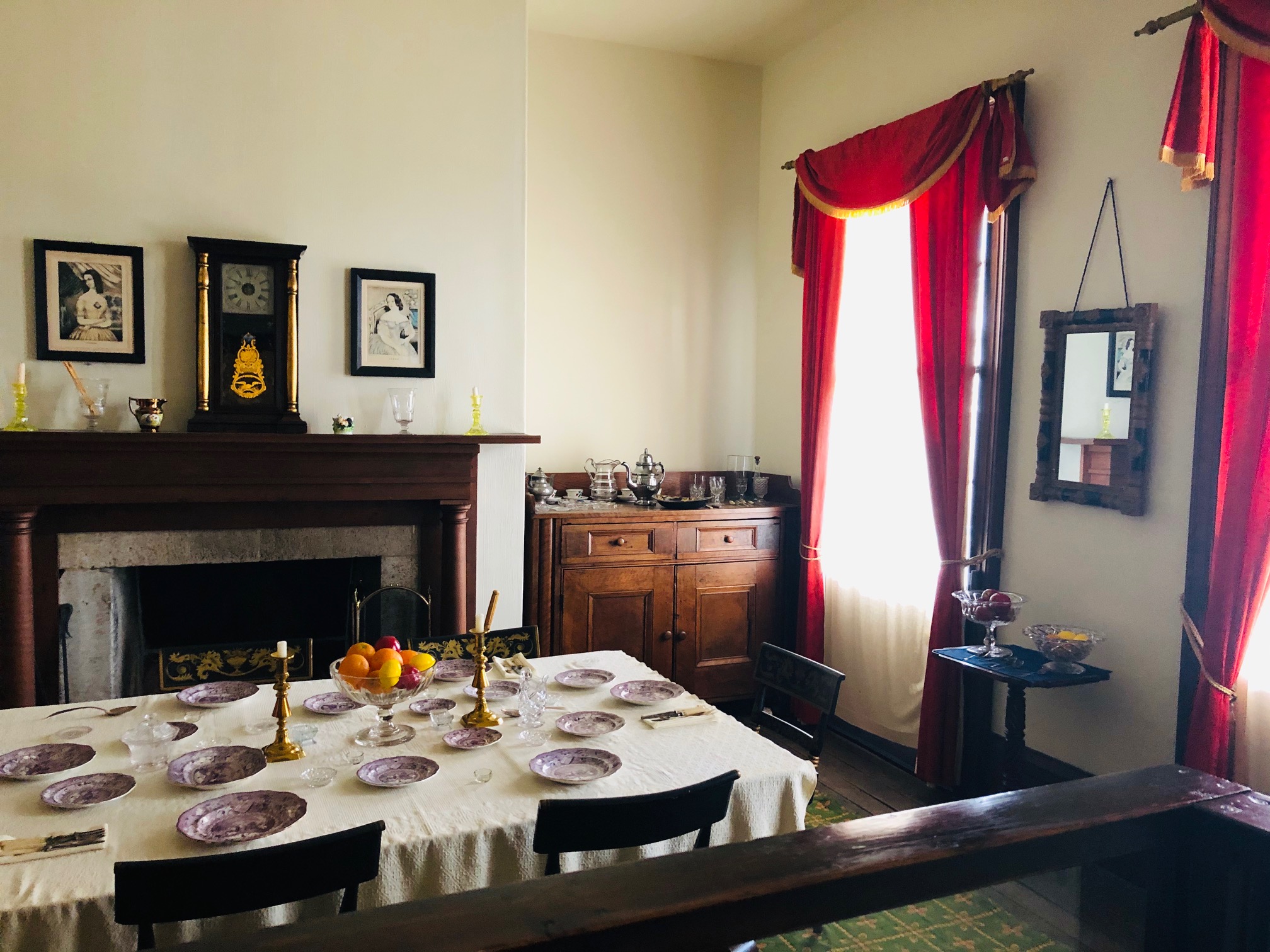
Inside the residence of Captain Thomas Sword, family and guests were entertained in these second floor rooms. The building contained three floors.
IMG_2319
The parlor at Captain Sword’s residence on Officers Row.
IMG_2323
On the third floor, the Sword’s clothing is laid out.
IMG_2327
The Sword Family enjoyed a large front porch view of the entire fort grounds.
IMG_2344
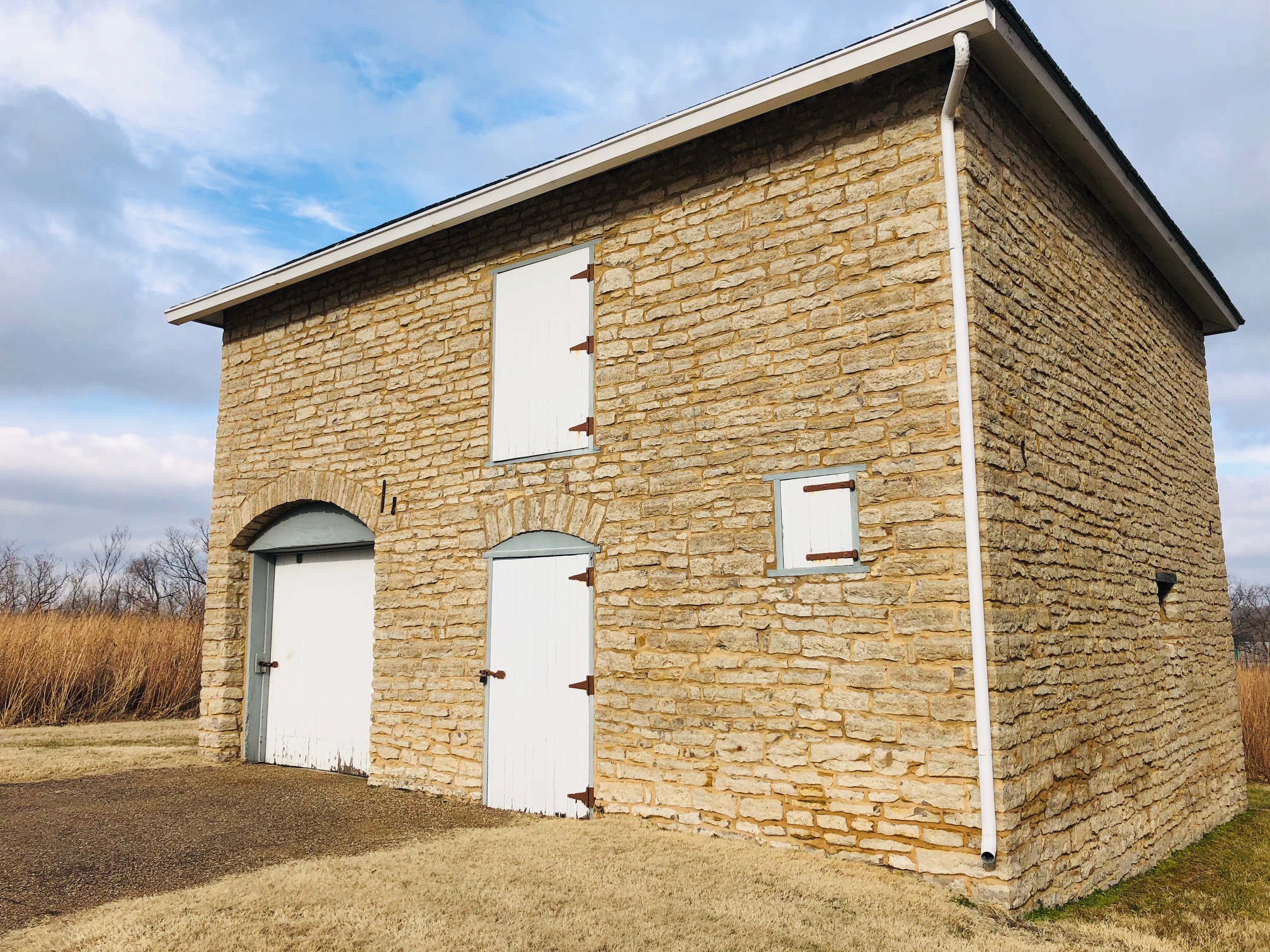
The Quartermaster’s Storehouse contains food and other basic supplies on three levels, including a totally dry stone basement.
IMG_2330
The Quartermaster Storehouse kept basic food supplies.
IMG_2332
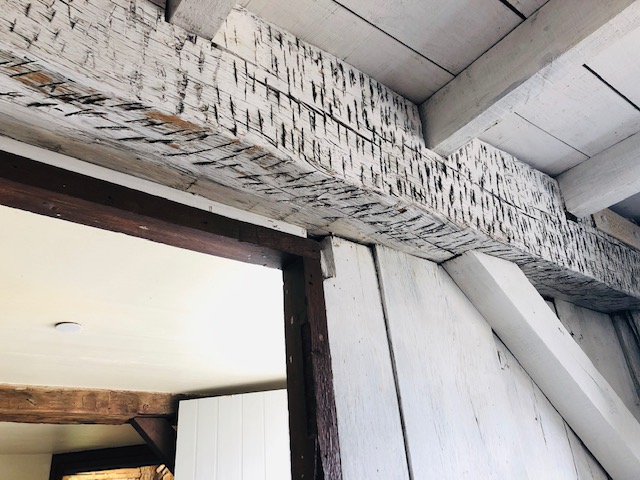
The marks of a diligent craftsmen’s hewing marks still show themselves today in the storehouse.
IMG_2335
Audio narrations are available when you dial the number shown on cards at many points across the grounds. 
IMG_2339
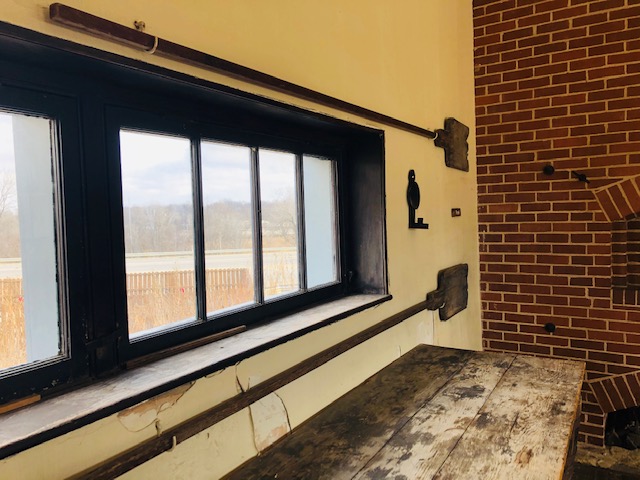
Inside the Bake House, large ovens provided bread on a daily basis.

Did you know the army didn’t issue bread recipes until the late 1800s and that men were not allowed to eat fresh bread? Stale bread was thought to be better for digestion, according to a placard in the Bake House.

IMG_2340
Wooden spatulas needed to be long enough to extend through the entire ovens to pull out the bread.
IMG_2345
A tallgrass prairie trail shows what the area surrounding the fort would have looked like.
IMG_2343
Near the tallgrass prairie trail, you’ll see several tidy stone structures used to house carriages and other vehicles.


IMG_2354
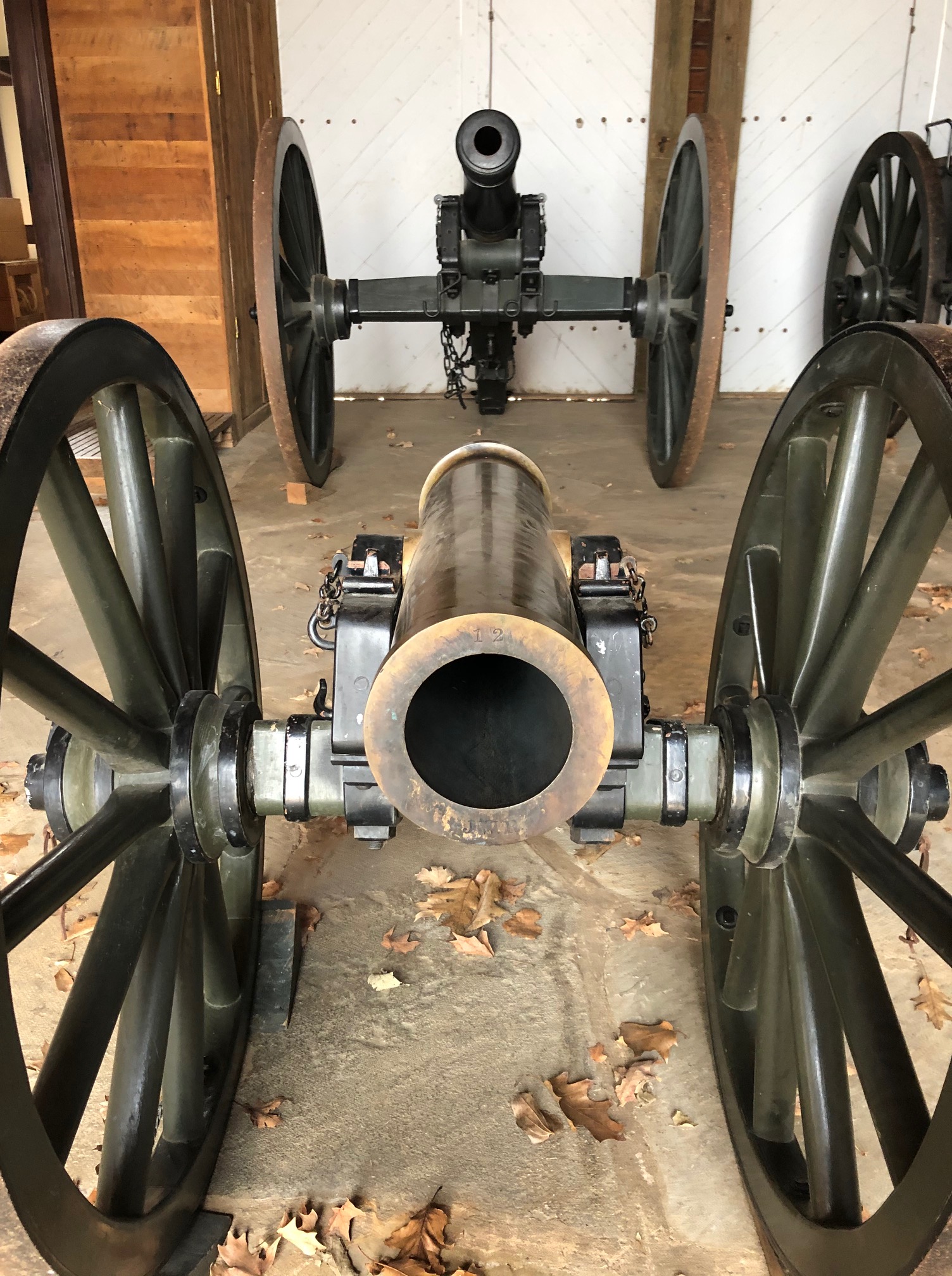
Howitzer and artillery cannons stand quietly in the Post Headquarters.

Did you know that a howitzer was carried in three pieces by donkeys? It could be reassembled and fired within one minute, according to a placard inside the Post Headquarters.

IMG_2361
Artillery notes and inventories decorate the wall in the Post Headquarters.
IMG_2364
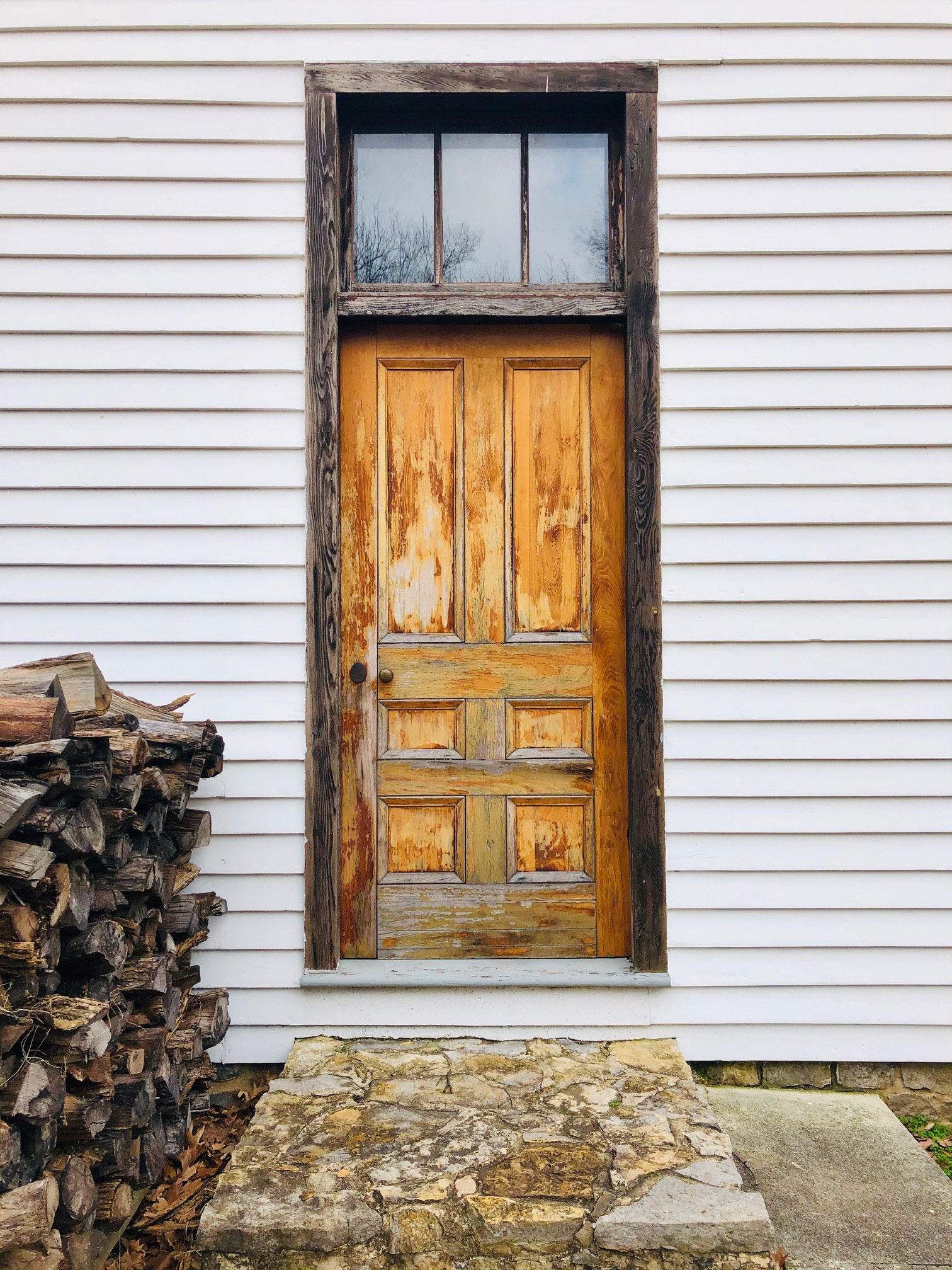
The backdoor and transom windows of the Post Headquarters make a nice picture, I think.
IMG_8397 (1)
The backside of Officers Row looks nearly identical to the front side.
IMG_2365
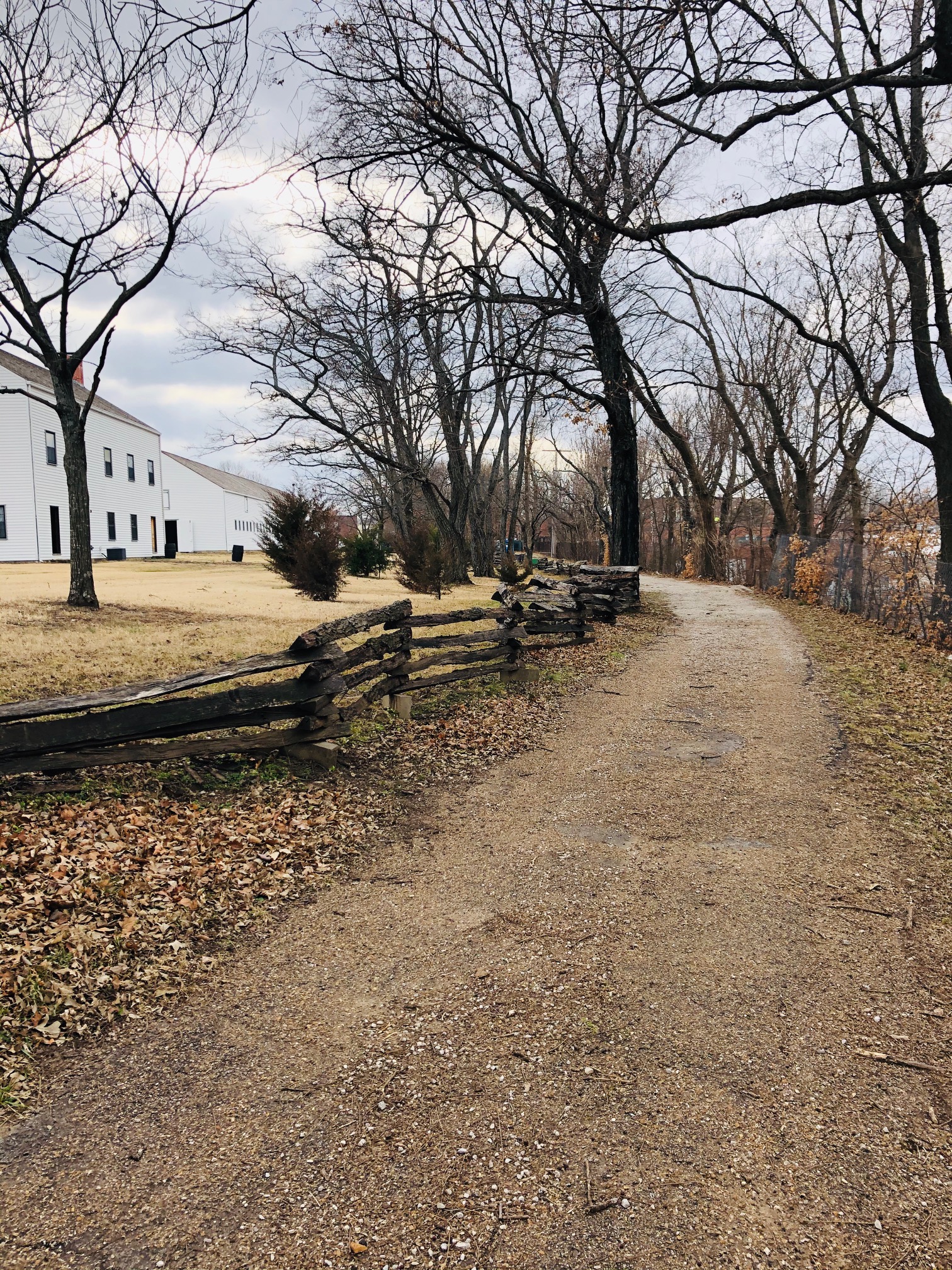
A perimeter walking trail borders the northern edge of the grounds. The banks of the Marmaton River are just a short distance further north of this trail. The river formed a protective boundary for the fort, eliminating the need for walls on Fort Scott, Abbott said.
IMG_2366
This structure is not identified on the park’s brochure and I didn’t ask the ranger, but if memory serves me right, it is a replica of the original well house.
IMG_2367
The ammunition magazine, a round brick building isolated in the middle of the fort, stored gunpowder. Notice the lightning rod (circled in red) placed precisely to keep lightning away from the explosives inside the structure…
IMG_2370
…like these.
IMG_2372
The upper floor of the hospital building, shown here, houses a sick ward and medical equipment and supplies. 

Did you know that many soldiers left the hospital in worse shape than when they entered, due to ignorance about sterilization?

According to a placard in the Fort Hospital, “In threading the needle for stitches, it was customary to point the silk by wetting it with saliva and rolling it between the fingers.”

IMG_2388 (1)
Abbott invited us to visit in early December to attend an annual candlelight Christmas tour of the fort.

Inside the Infantry Barracks, new displays and exhibits bring tourists back to the past when these areas composed Bleeding Kansas, a region torn between Union and Confederate causes and beliefs.

Interviews with a variety of area residents speak directly to you in these video displays inside the Infantry Barracks. Here are two previews of the video exhibits.

IMG_2386
New displays and interactive exhibits keep visitors involved and learning.
IMG_2394 (1)
Believe it or not, these bricks cause controversy in my hometown. Many people don’t like to drive on the rough, loud, and bumpy brick-paved streets.
IMG_2396
Fort Scott National Historic Sites owes its existence to Congressman Joe Skubitz, who served the local constituency from 1963-1969, and saw to it that this area be turned back into a historical tour destination.
IMG_2334
Park Ranger Laura Abbott wraps up our tour near the Bake House. Before moving to Fort Scott, she worked as a Park Ranger on the National Mall in Washington, D.C.


Stop in at Fort Scott National Historic Site the next time you’re in southeast Kansas. Thousands of people cruise right by Fort Scott on U.S. Highway 69, which bypasses the town, as they make their way north to Kansas City (about an hour and a half away) or to points south. Plan out your itinerary to take a tour or just walk across the grounds; it would make a nice break on your journey. After all, timing is everything.


Thanks for reading! Touring the fort took about an hour and a half and was a great way to spend part of an afternoon. Also, it reminded me how fortunate Fort Scott, Kansas is to have this important historic site preserved and honored here. 

Don’t forget to tour the destinations near your home. Here’s a recent post about another local getaway.