Categories
Greece (Peloponnese)

When Your AirBnb Host Shows You the Town

…to share his enthusiasm for Olympia

As with all three of the towns we have visited so far in Greece since we left Skopelos Island, there is more to the towns than just the historical sites. For example, Delphi is a quaint Alpine-style village full of shops and establishments that cater to the tourist market that is always in town, at least in the summer months.

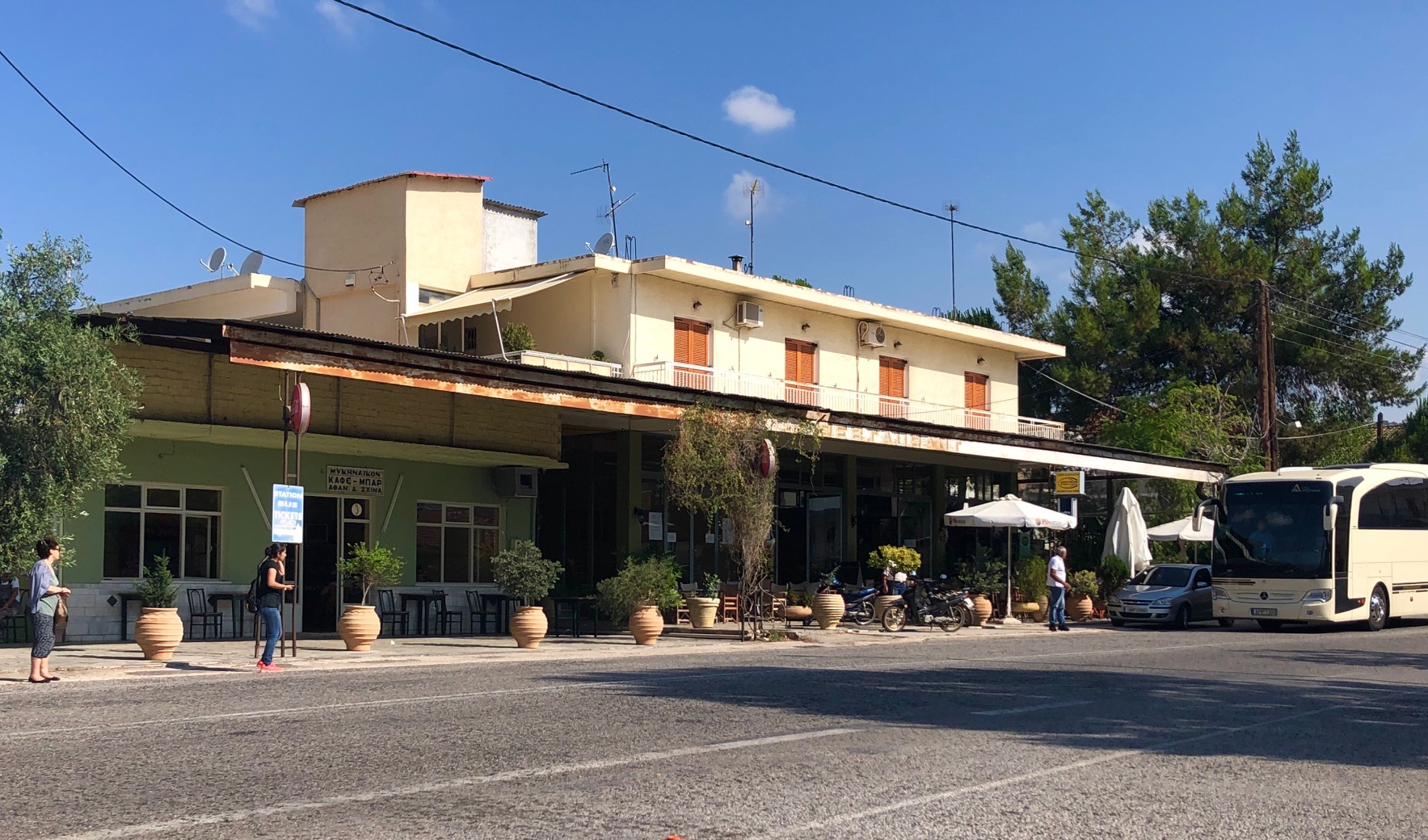
Mycenae is also a sleepy little village just down the mountain from its own historical site. There are a few tavernas, a mini-market, a bus stop, and a few other businesses that keep the town humming along.

Olympia is much the same.

When we arrived there a few nights ago in a taxi, we saw from a distance our AirBnB host, Kostas (another Kostas, not the one from Mycenae) standing in the middle of the street in front of our flat waving his arms at us. We pulled up, paid the driver, and lifted our bags from the trunk. Once we all shook hands, Kostas showed us our small studio apartment and gave us an impromptu history lesson about Olympia.

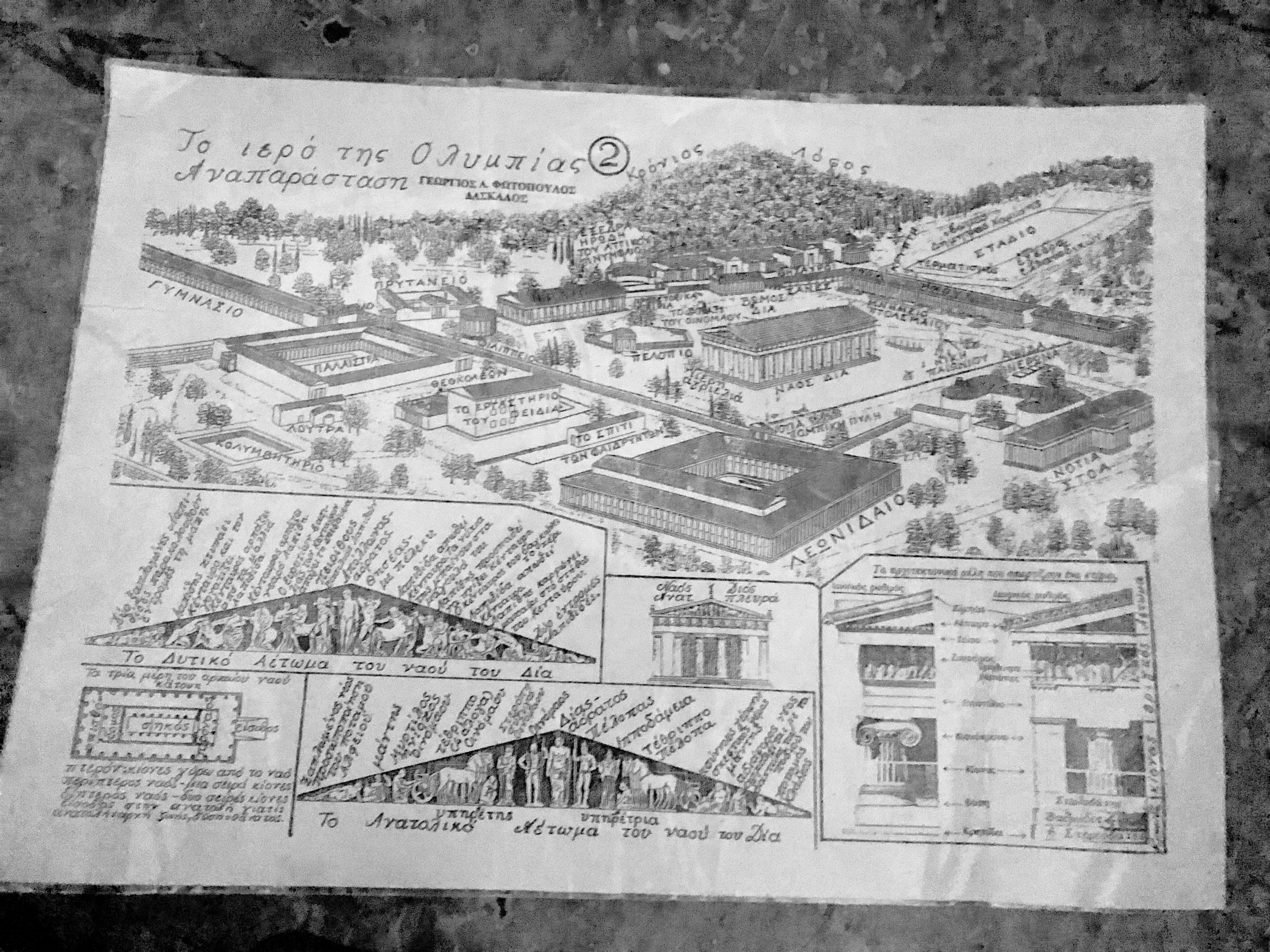
Standing inside our apartment, he showed us the laminated map below. He proudly explained several things to us in a deep, warm voice: how the ancient Greeks counted years by the Olympic games, details about the sculptures found at the site, and how the games were used by the Greeks to unite people and solve differences.

IMG_0709

A history buff, it’s obvious that Kostas loves his town and its prominent place in world history.  In fact, he reminds me of the enthusiastic Venetian tour guide I met a couple of weeks ago.

And then Kostas walked us downtown and over to the archaeological site so we would know exactly how to get there the next morning. When I say walked us downtown, I really mean that we walked down a series of steps from our studio to the main retail street that connects the modern town to the historical site.

IMG_0712
The door to our apartment is on the far right. The main street is right at the bottom of these stairs.

The main retail street, as one would expect, is full of tourist shops, clothing stores, jewelry shops, restaurants, tavernas, a grocery store, The Archimedes Museum (a free museum dedicated to the inventions and discoveries of Archimedes) and the town hall.

The three of us did make one stop along the way to the site. Kostas asked us to wait outside the little super market so he could go inside and buy a can of dog food. He wanted to feed a dog that lived inside the Olympia site.

Kostas told us that several dogs live around town that the locals look after. Once we crossed the bridge and neared the edge of the park, Kostas let out a distinctive whistle. Suddenly, we saw a white and black-spotted border collie mix bound out from the monument grounds. It sprinted for Kostas, who peeled off the lid of the can and flung the food out on the road for the dog to lap up.

Wow, I remember thinking, this is a nice guy.

IMG_0610
A jewelry shop owner snagged us inside with a tale of his brother who carried the Olympic torch during the 2004 games. He wanted to take this picture of us. I wish I had taken one of him!

After our history lesson and our tour about town, Kostas bade us farewell, asked us to contact him if we needed anything over the next two days, and took off back to his home.

At that point, we went back to our apartment and collapsed. It had been a long afternoon of bus riding from Delphi, through Itea and then along the edge of the Gulf of Corinth to Patras, and down to Pyrgos, where  we missed our connecting bus by about ten minutes.

IMG_0479
Once we made it to Patras, Greece’s third largest city, we barely made it on this connecting bus to Pyrgos. For some reason, the ride took longer than it was supposed to and we had to taxi to Olympia. Still don’t know what happened.

In a few hours, however, hunger called and we walked across the street to Kostas’ recommended taverna, Taverna Orestis. He told us it was where the locals ate since it was off the main street. He was right. By 11 o’clock p.m., the outside seating area was chock full of people.

IMG_0489
On our first night in town, I took this picture from our balcony right after we got back from Taverna Orestis, located across the street from our flat. Kostas recommended it as a non-touristy choice since it wasn’t on the main tourist street. We ordered grilled sardines, dolmades, Greek salad, and tzatziki with bread. It was excellent and fun to see the locals socializing.

There were two large groups of about twenty each, several couples, and a family or two with children. I was surprised by how busy they were and so late at night! Our sleeping and eating schedules are so vastly different from those of the Europeans.

IMG_0664
We found this taverna right in the center of the main district. It was so quaint and also had the misters running in the afternoon, so we decided to enjoy the place with some cappuccini.
IMG_0666
Mitch had a freddo cappucino (iced) and I had a regular hot one.
IMG_0612
After a morning of sightseeing at the Sanctuary of Olympia, we took a break for gyros and sodas at another local taverna. Then we headed back during the hot afternoon to the air-conditioned museum. See this post for more about the archaeological site.
IMG_0705
During our second night in Olympia, we opted to eat in with food from the market on the main street. We bought some toasts, gouda cheese, a freshly-picked orange from a tree, some salami, and Greek olives. 
IMG_0711
Another view from our balcony.
IMG_0708

The morning after our visit to the archaeological site, we asked Kostas to confirm for us the time of the first express bus back to Athens. It’s very difficult to find current bus schedules and to know that they’re right.

At left is a screenshot that Kostas sent us via the AirBnB app so we would have a current schedule. We took the 9:30 express  along the southern edge of the Gulf of Corinth and made it back to Athens by 1:30 p.m.

Olympia is small and comfortable. It’s busy when loads of buses drop off tourists, but after they leave for the day, it’s a very quiet town. In fact, there are several unoccupied hotel buildings scattered about town. I’m not sure if that’s an after-effect of the 2004 Olympic Games building boom or not. Regardless, the town is a winner and was definitely worth the three bus rides and a taxi to get there.

Featured Photo Credit: Marilyn Yung | Kostas, our AirBnb host in Olympia, Greece. The town has a permanent population of 700 residents, he told us.

Thanks for reading! Click “like,” leave a comment and follow my blog for more stories from Greece.

Categories
Greece (Peloponnese)

Carrying a Torch for Olympia, Greece

Olympia, Greece was worth three bus rides and a taxi

Yesterday, we toured the Sanctuary of Olympia, the mammoth archaeological site at Olympia, Greece.  Thanks to the Olympic Games, I would venture to say that most of us have heard of this site. However, I myself didn’t realize that there was virtually a complete city in this location, in addition to the athletic contests.

Above is a diagram of the Olympia site that our AirBnb host showed us when we arrived at our apartment. See what I mean by city?!

It’s a good thing the archaeologists and designers placed an ample supply of informational placards around the site so people like me can understand and appreciate more of what they’re seeing.

To summarize, the placards placed at two locations near the front of the site read as follows:

“In this place Zeus, father of the Olympian gods, was worshipped, and splendid athletic contests, the Olympic Games, were celebrated. In the cella of the temple of Zeus was placed the enthroned gold-and-ivory made cult statue of the god, work of the famous Greek sculptor Pheidias, one of the seven wonders of the antiquity. Here too, nowadays the ceremony of lighting the flame for the modern Olympic Games is held.”

After I read those placards, I looked around and here was my first thought:  this place is huge.

IMG_0501
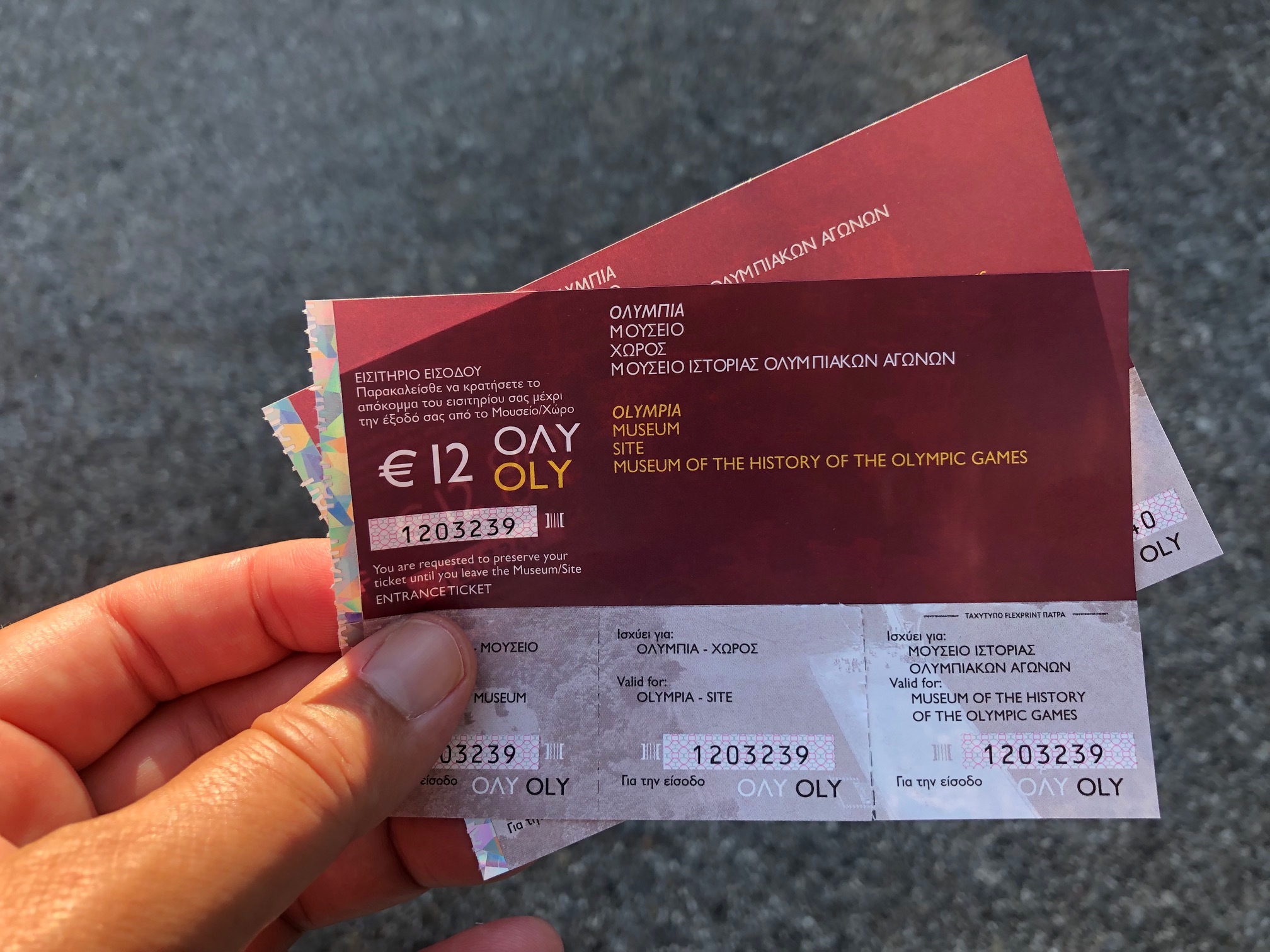
One ticket gets you into the archaeological site, the archaeological museum, and the museum of the history of  the Olympics.The site and museums are open from 8 a.m. to 8 p.m. daily. Adult tickets are 12€ each. You can leave and return later in the day to any of the sites and even return the next day to continue your visit or see more. Note: We did not visit the Museum of the History of the Olympic Games. There was only so much time. If we had had another morning, we could have visited it then.


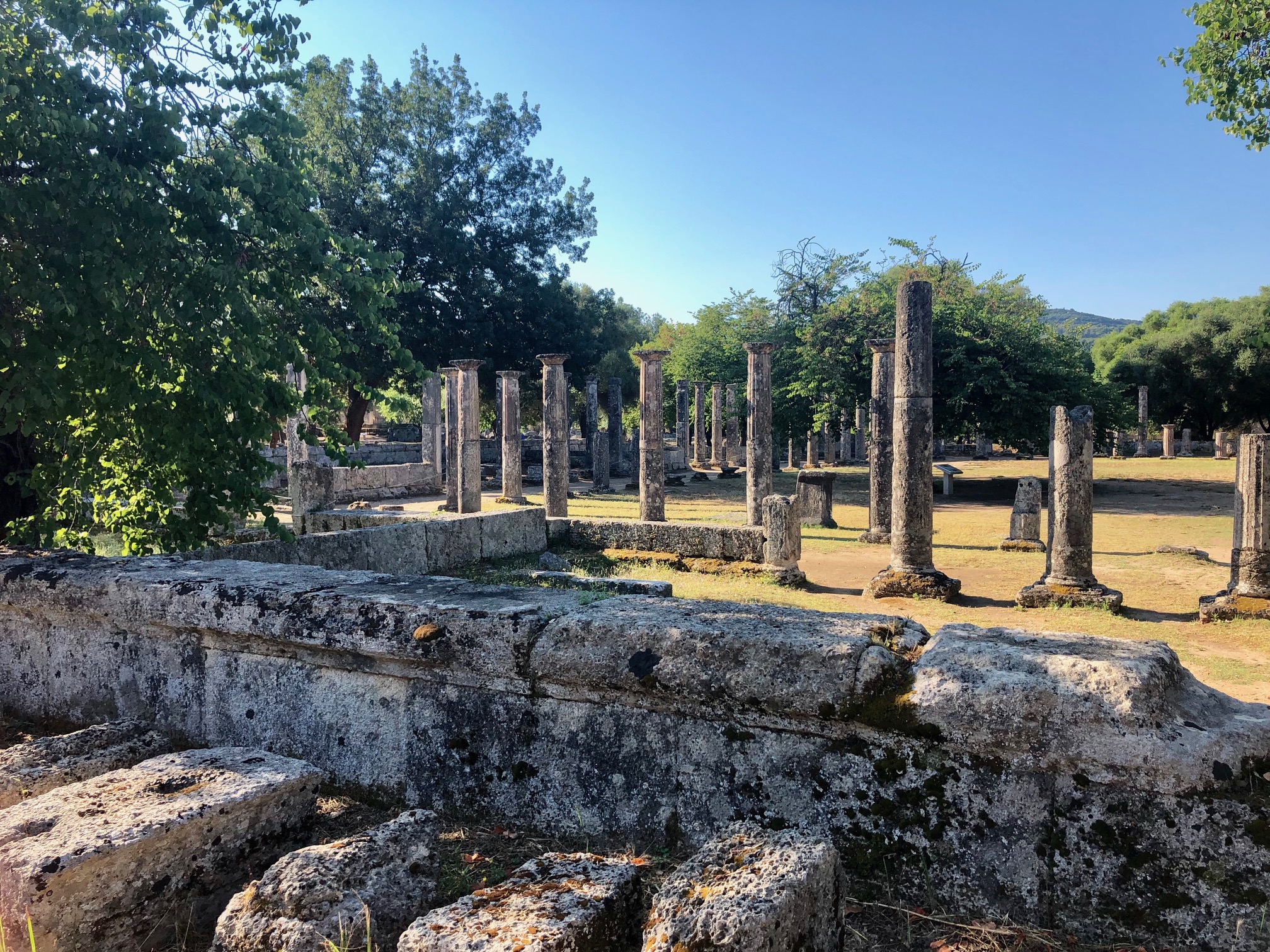
As I gazed across the grounds, as far as I could see were partially reconstructed colonnades, temples, baths, workshops, dwellings, and myriad other structures.

IMG_0506
The colonnade is a popular photo subject. Google “Olympia” and you will see lots of pictures of these columns.

This ability to see layers upon layers of excavations is the one major difference when I compare Olympia to Mycenae and Delphi, two other sites we had just seen during the previous three days.

IMG_0680
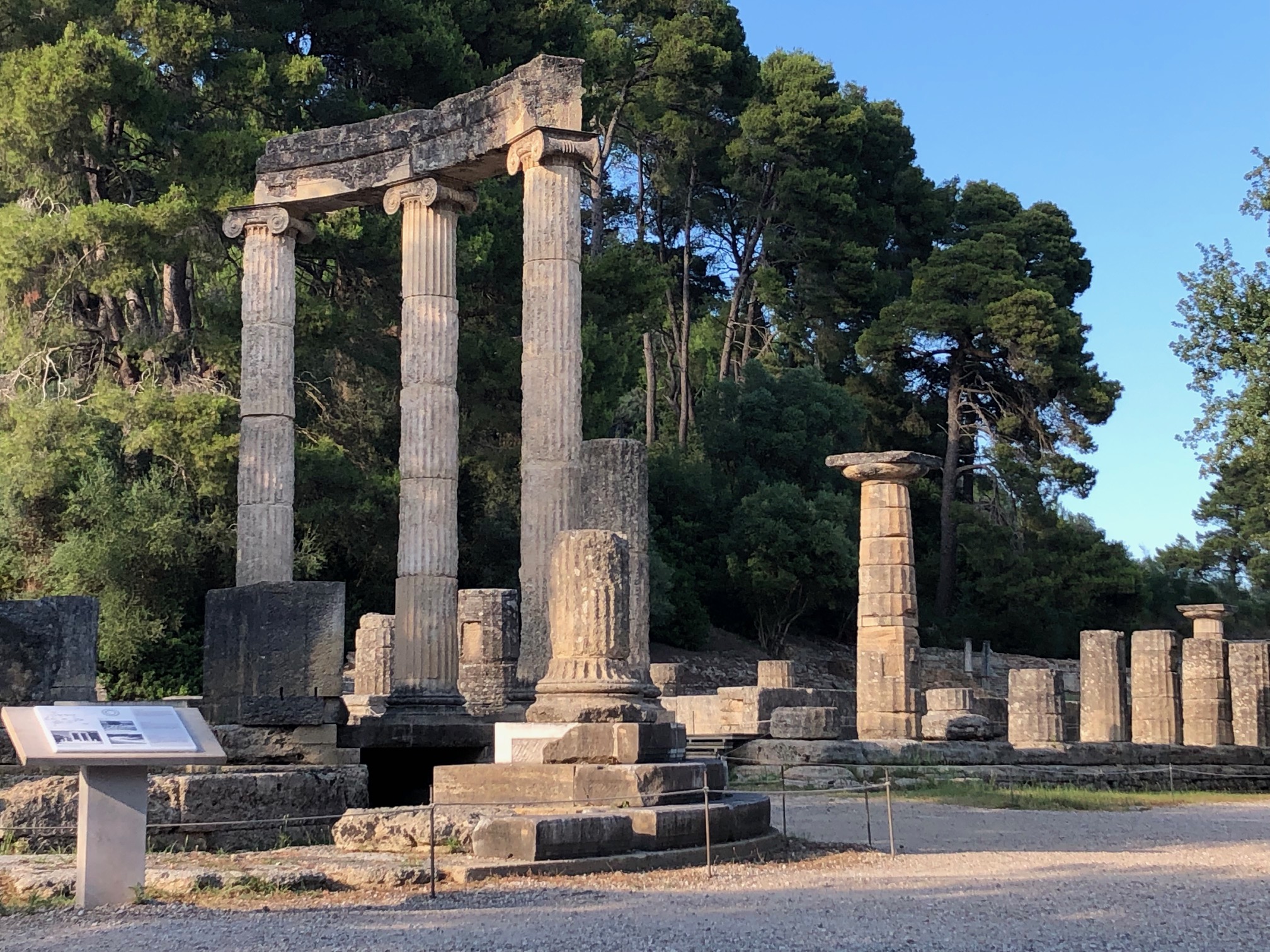
The Philippeion Tholos, a circular temple,  and the Temple of Hera in the background

By the way, we’re on a whirlwind tour of Greece. We’ve spent three weeks on the island of Skopelos and now we’re taking two weeks to see Athens, Mycenae, Delphi, Olympia and Crete. We will return home July 9.

IMG_0563
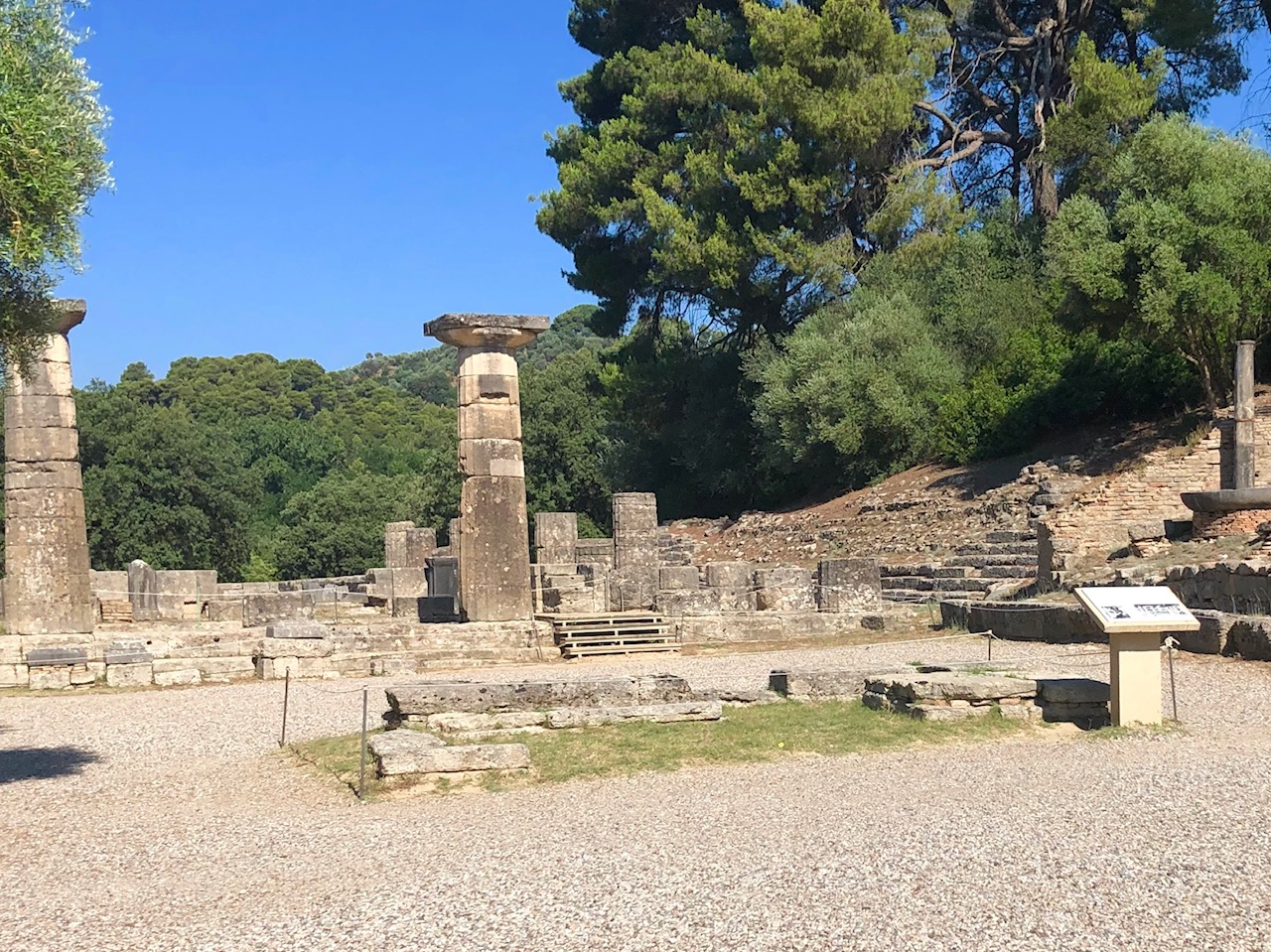
The Temple of Hera is in the background. In the foreground is the site of the lighting of the Olympic Torch that begins each modern Olympic Games.

At Mycenae and Delphi, you can definitely survey the sites across a hillside or from a high point (The Citadel at Mycenae, the Stadium at Delphi); however, at Olympia, you are looking through the site.

IMG_0519
The Tholos, a circular temple
IMG_0521
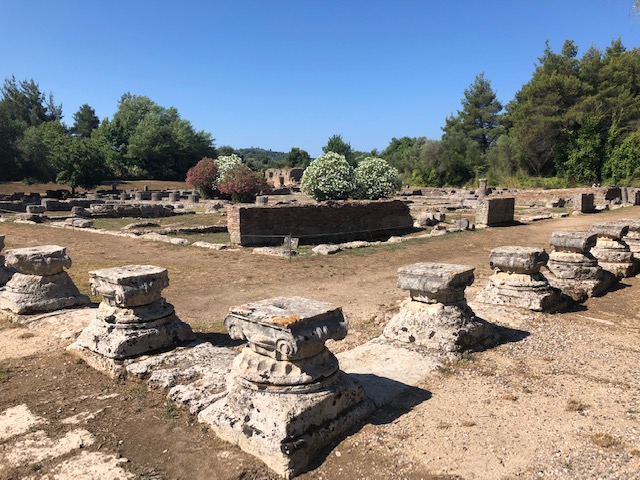
I took this picture because I couldn’t believe how sharp the scroll carving still is on these Ionic capitals.

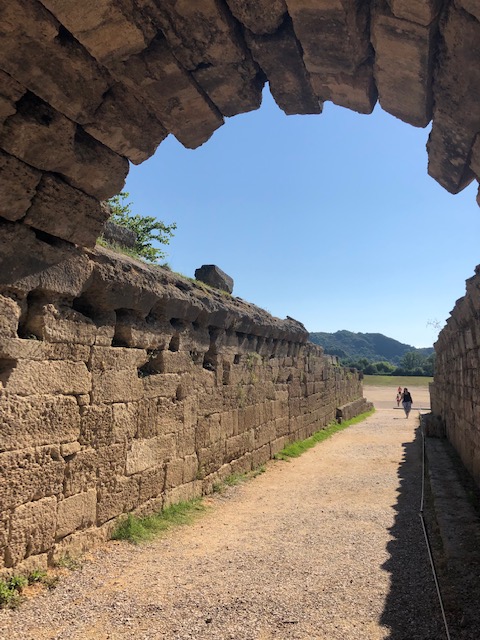
For example, before you stands the colonnade of Palaistra. Beyond that, however, you see the impressive Tholos, and beyond that you see the standing columns of the Temple of Hera, and beyond that you see  the multi-tiered Nymphaion aqueduct fountain, through which you see the arched entrance to the stadium, the site of the first Olympic Games in 776 BC.

IMG_0554
Passing through the arched entry to The Stadium
IMG_0557
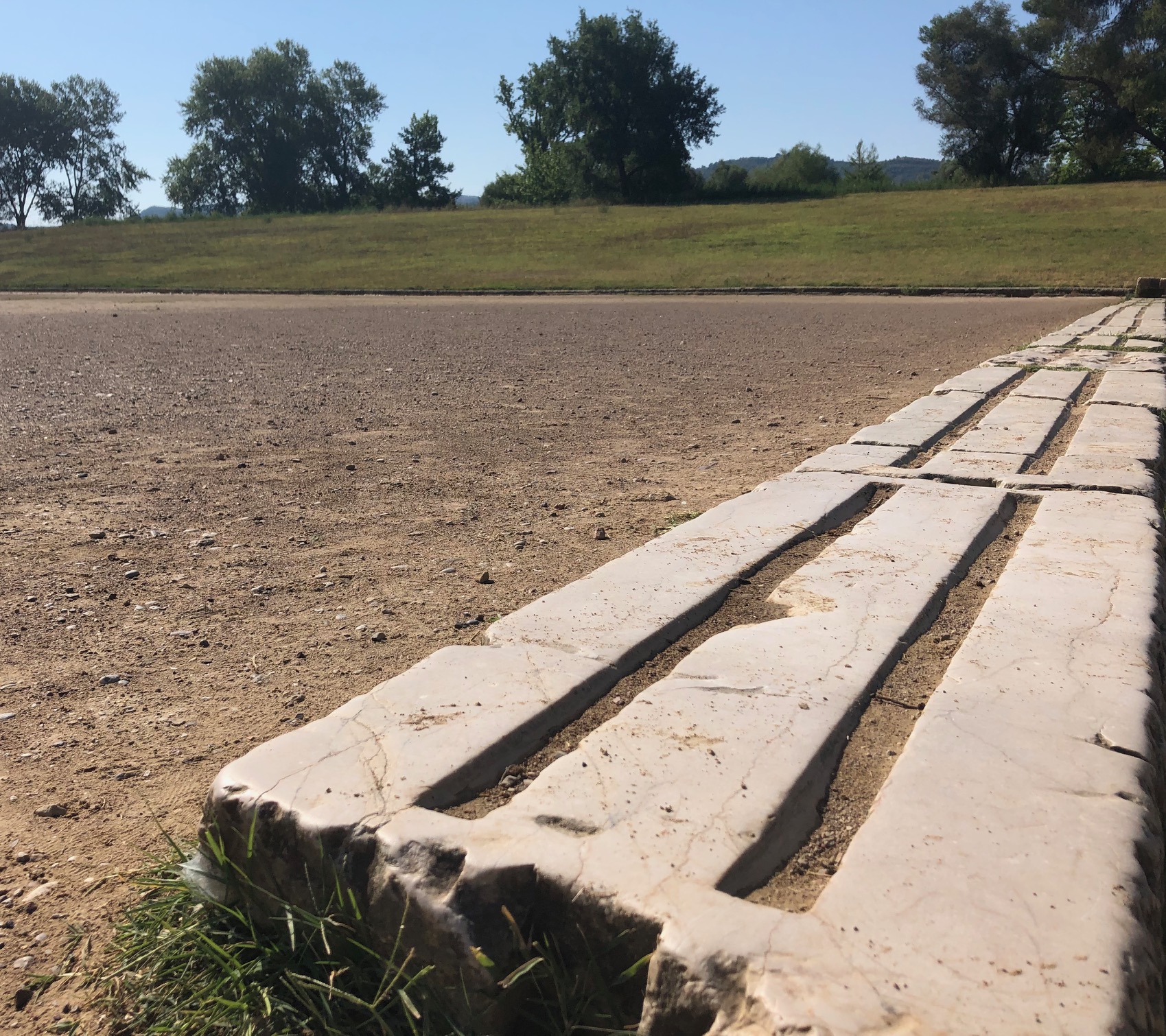
The marble starting blocks for the competing athletes at The Stadium
IMG_0558
The stadium, where foot races (forerunner to today’s 200-meter races) were held in the ancient Olympic Games.
IMG_0569
This is the workshop of Pheidias, the sculptor for the statue of ivory, gold, and bronze status of Zeus housed in the Temple of Zeus, one of the seven wonders of the ancient world.
IMG_0570
This slab of carved marble is in Pheidias’ workshop

In other words, from any spot at Olympia, you will see layer upon layer of ruins in various stages of reconstruction. And then compressed between all those layers are stashes of more pieces.

IMG_0702
An earthquake in 522 AD 551 AD toppled these columns that stood in the Temple of  Zeus, one of the seven wonders of the ancient world. Notice how the drums fell and appear almost like dominoes.

Perhaps a field of column drums, a row of lion head water spouts, a random six-foot-tall triglyph, a plot of Ionic column drums, then a plot of Doric drums, then a composition of more rare Corinthian capitals.

IMG_2232
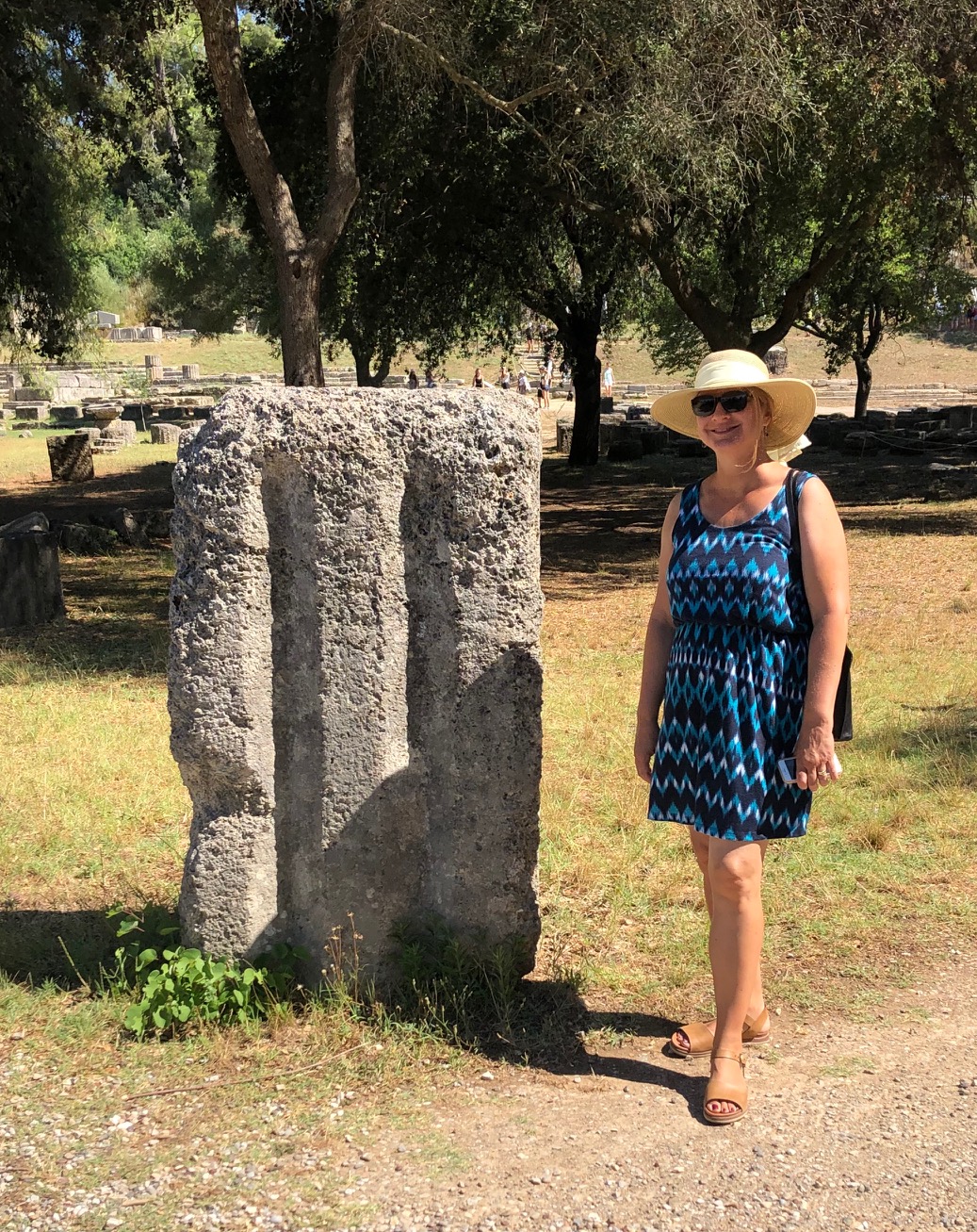
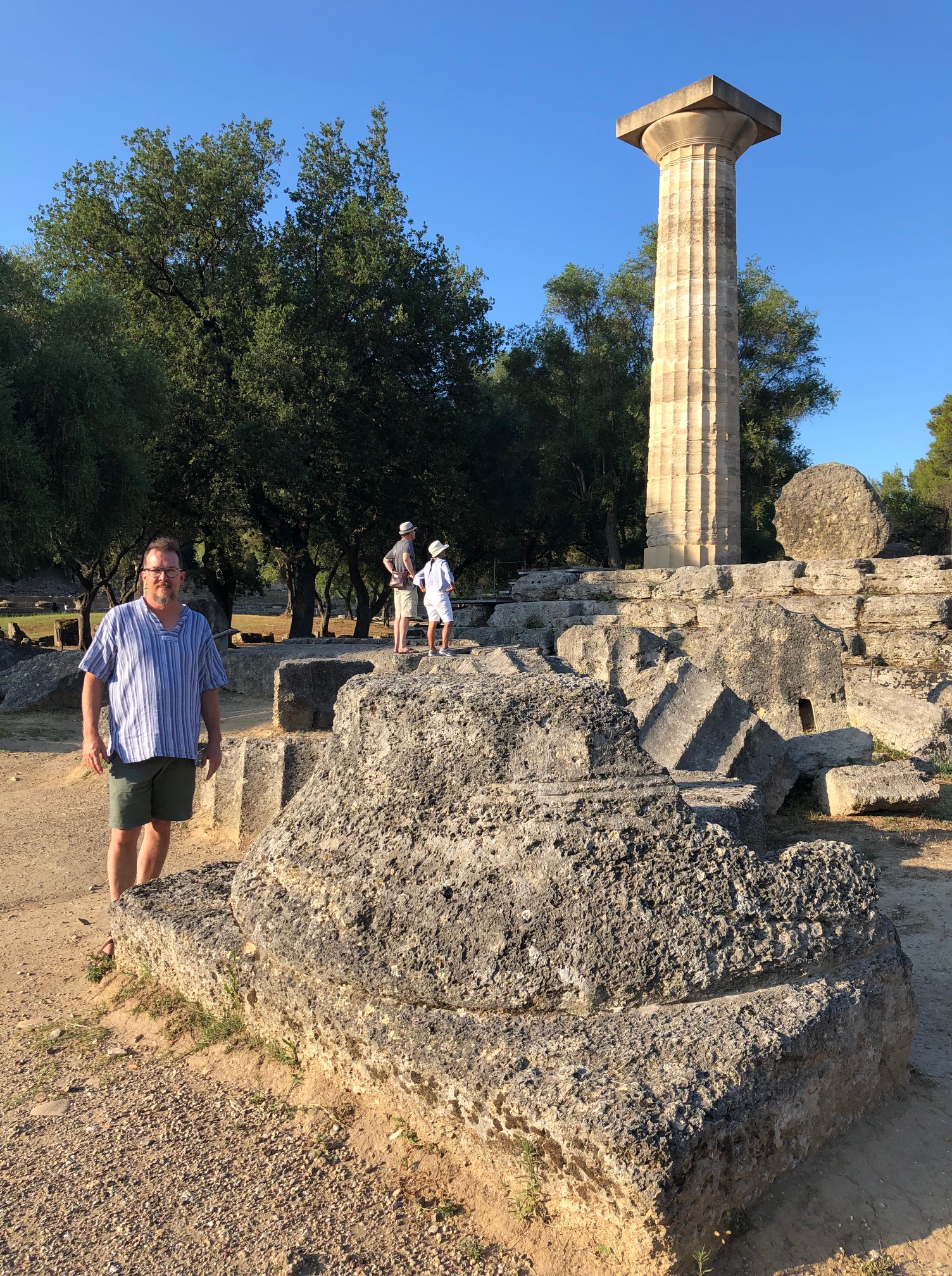
Here I’m standing next to a triglyph, three carved “columns” that were placed between metopes, relief sculptures below the pediment (the triangular-shaped friezes). See caption for next image.
IMG_0752
I’ve circled a triglyph in the image above. I’m standing next to one of these in the preceding picture. I couldn’t believe how large it was.

So many pieces and parts, but if you need a quick list of the top sights within Olympia, I think they would be:

  • The Temple of Zeus
  • The Temple of Hera
  • The Tholos
  • The Stadium
  • Workshop of Pleiades
  • The Palaistra , which includes the Colonnade

What’s more, when you tour the park, you will walk right among most of the artifacts and monuments and stones. You may even walk right on the original marble steps placed in this city of 2,500 years ago.

IMG_0595
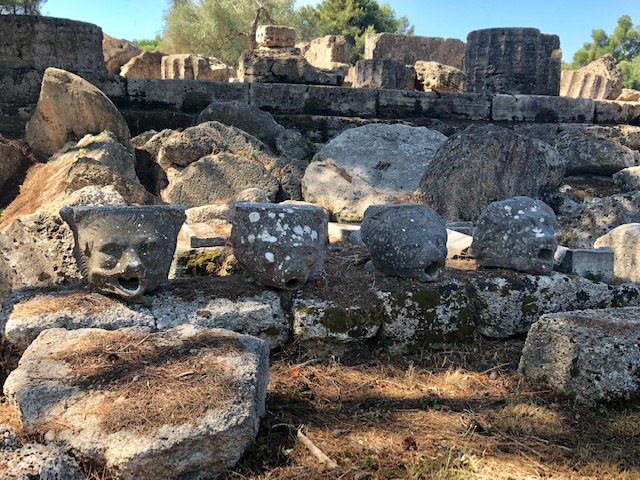
Lion water spouts in a row on the ground surrounding the Temple of Zeus.

There are 1/2″-inch ropes that show you where you can and can’t go, and if you stray where you shouldn’t, you’ll hear a park employee sitting on a nearby park bench remind you with a sharp blast on a whistle.

IMG_0578
More columns.
IMG_0583
This was a building for council members. It contained water around the outside of this “curvy” centerpiece and also around the inner section.

Late last night, one couple climbed upon a large “rock” to see the floor of the Temple of Zeus, which was roped off unfortunately. (You can see them in the picture below.) Suddenly, a shrill blast! They didn’t hear or didn’t recognize their offense. Another blast! They looked around, the park employees shouted something in Greek, and down they jumped.

IMG_0692
We couldn’t believe how large this capital (the top of a column) that  once topped a column on the Temple of Zeus. Note the visitors standing on the stone shelf—that’s a major no-no.
IMG_0695
Each capital had these notches carved into them to help them lock onto the column.

Perhaps they didn’t realize they were standing on an architectural relic. After all, there are so many stones EVERYWHERE.

IMG_2585
We returned in the evening to see parts of Olympia again. The light put a different cast on the monuments.

To be safe, when you’re at Olympia, assume that any rock is not actually a rock, but rather an artifact. If you want to sit down for a bit, look for an actual park bench. There are several. That’s the safest bet.

Or head over to the Olympia Archaeological Museum.

IMG_0613
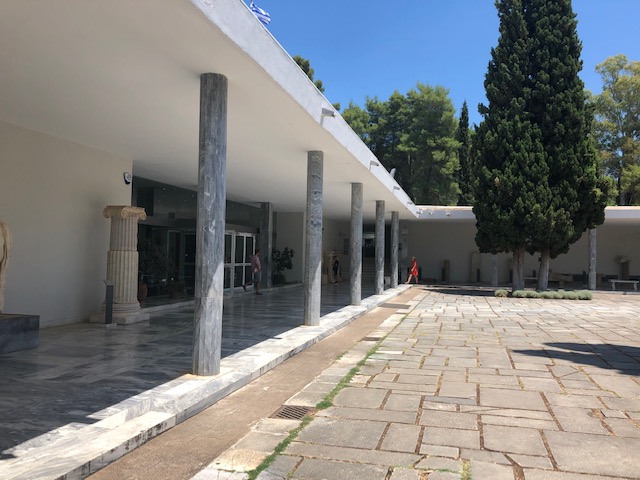
The Olympia Archaeological Museum front entrance
IMG_0617
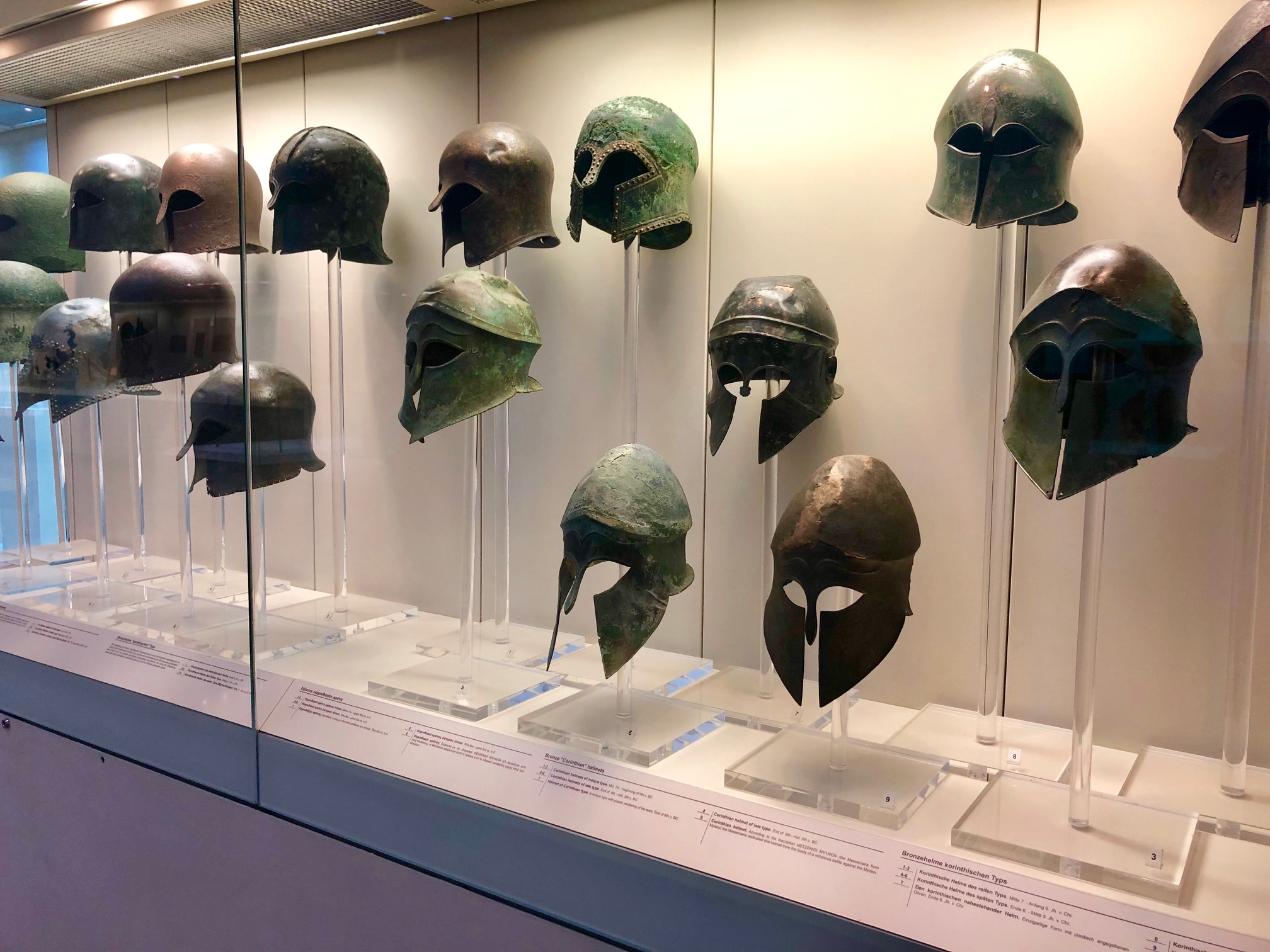
Various helmets excavated at Olympia
IMG_0623
This was a statue of Nike that used to be mounted on the Temple of Zeus.
IMG_0629
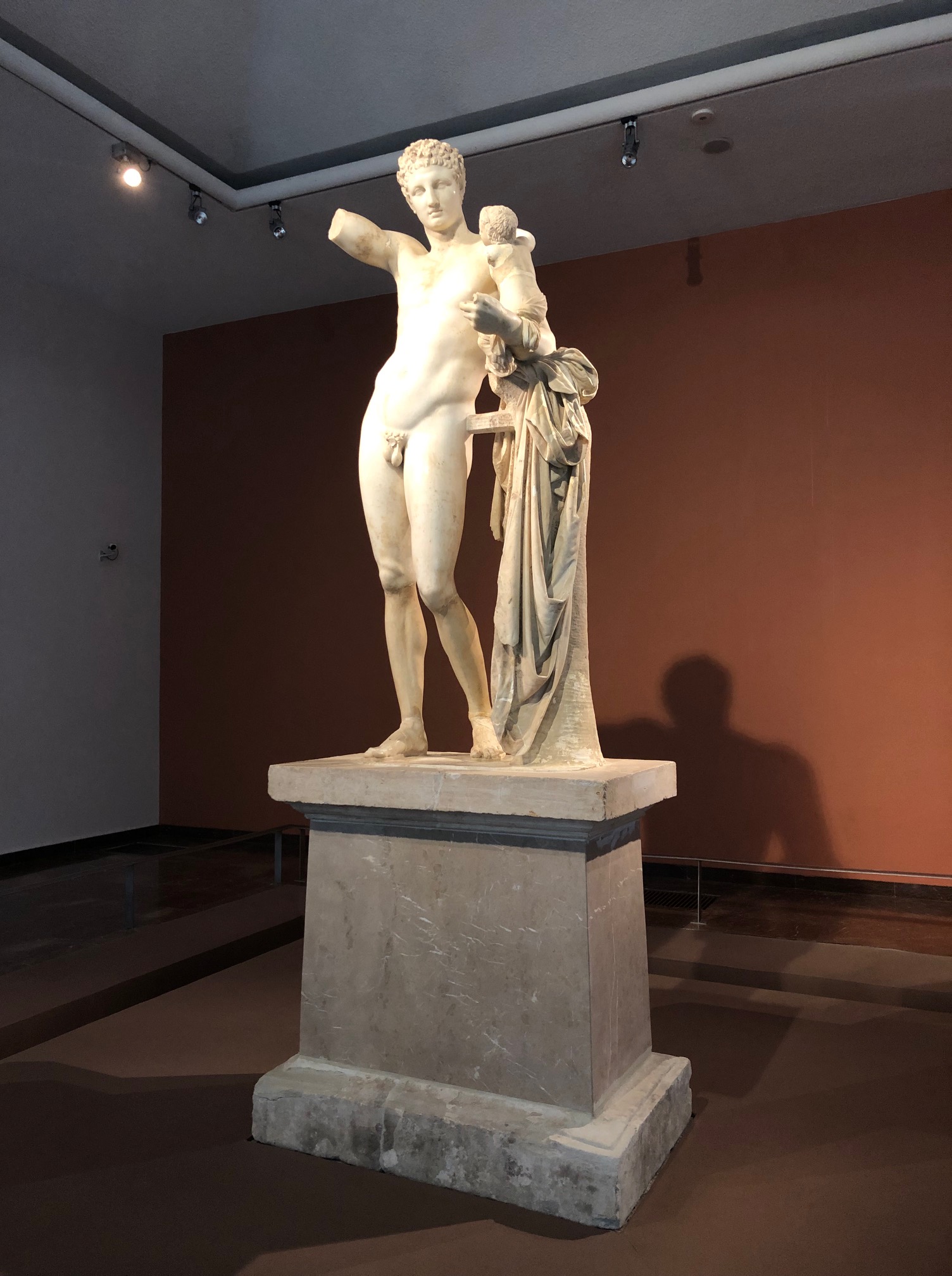
This is a statue of Hermes and was found in the Temple of Hera.
IMG_0648
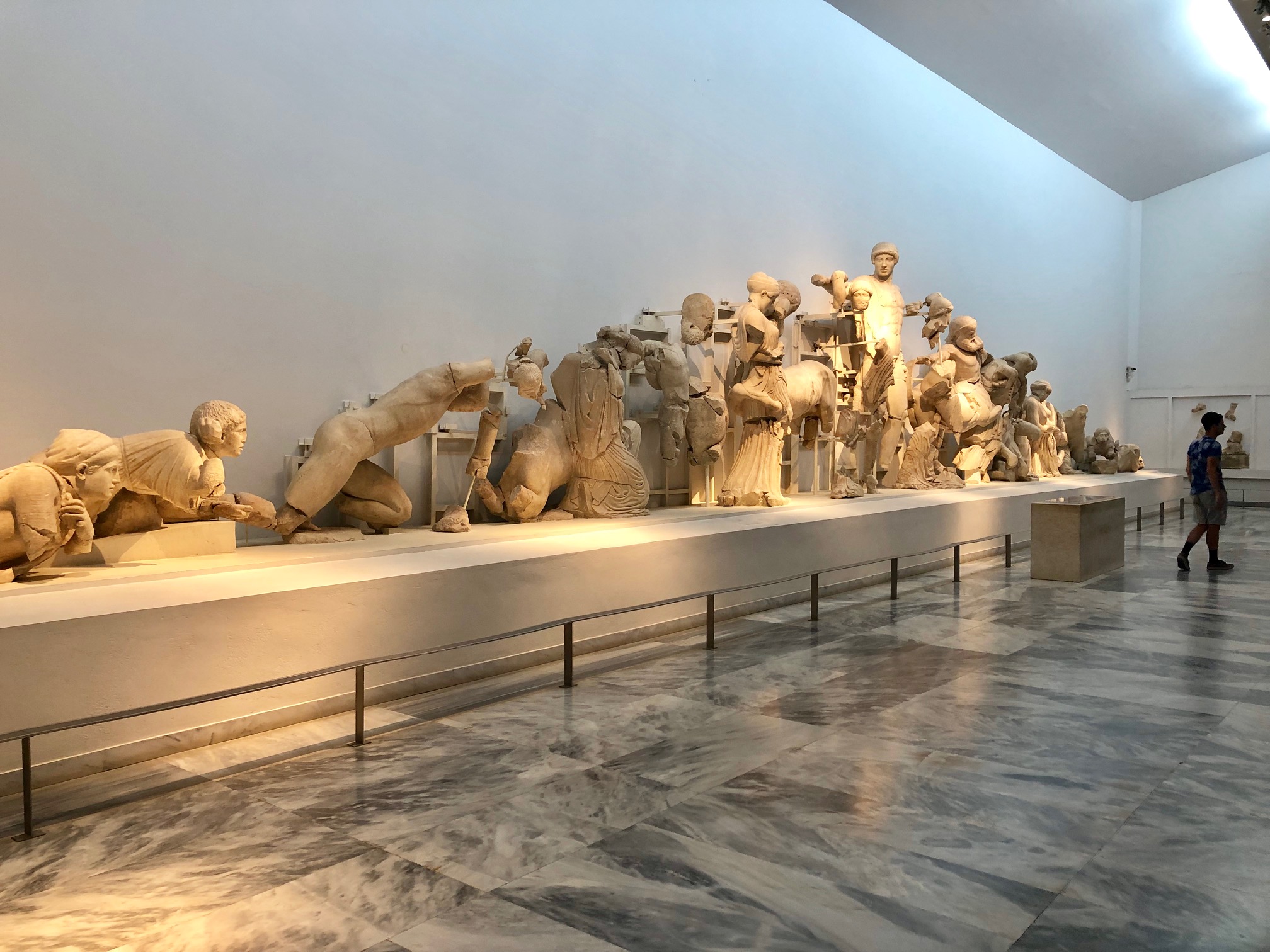
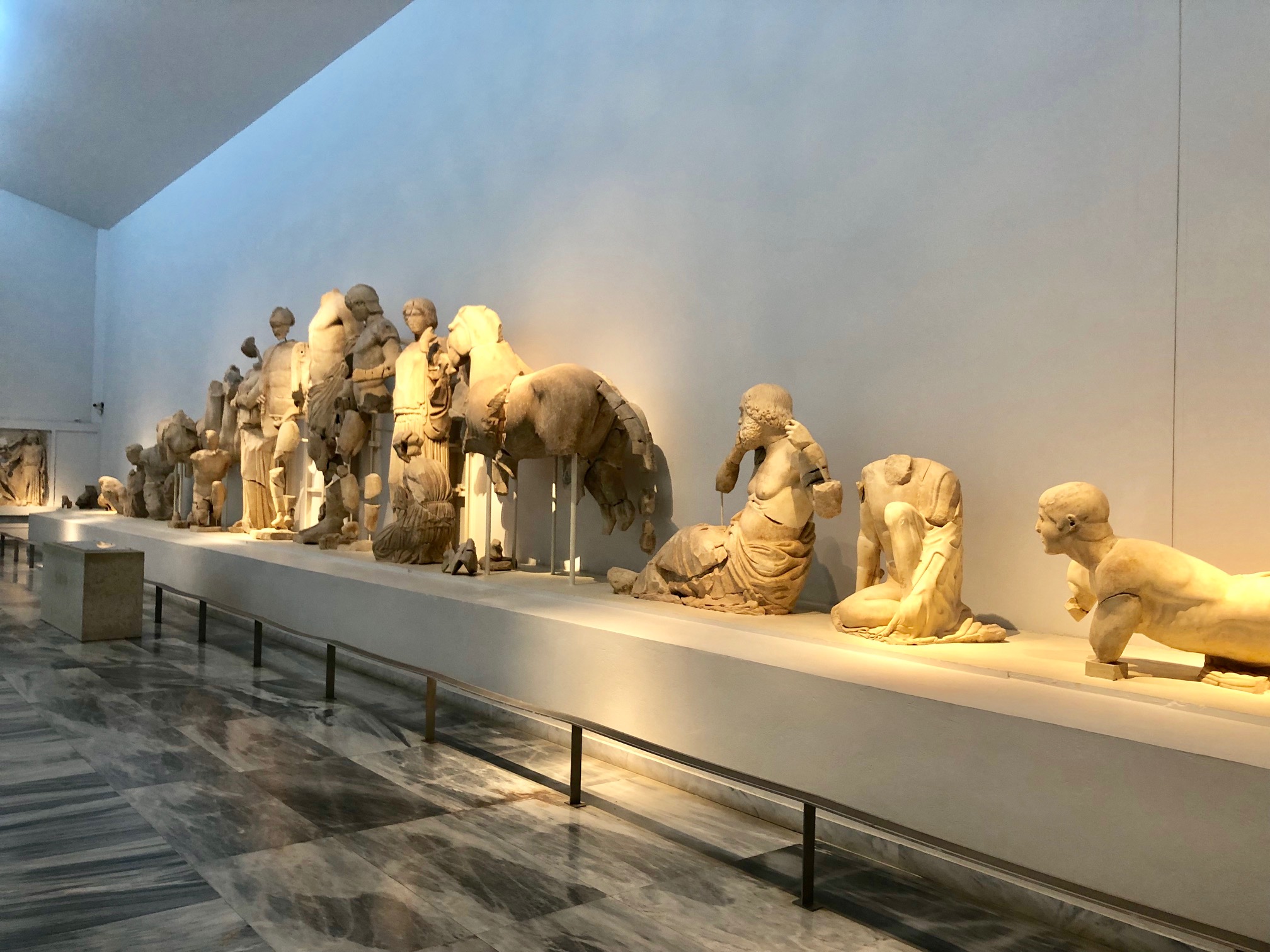
One of two reconstructed friezes from one of the pediments on the Temple of Zeus. This one features Apollo (son of Zeus) in the middle.
IMG_0649
One of two reconstructed friezes from one of the pediments on the Temple of Zeus. This one features Zeus in the middle.
IMG_0653
More lion water spouts and other prominent sculptures are placed around the outside loggia of the museum. You can just walk right up to these. But don’t touch, obviously. There were no guards anywhere around, which surprised us.

Although Olympia takes some planning to reach, it’s definitely worth the visit.

The site and museums are open from 8 a.m. to 8 p.m. Adult tickets are 12€ each. You can leave and return later in the day to any of the sites and even return the next day to continue your visit or see more. We arrived at the archaeological site at 8:30 a.m. and left about two and a half hours later. Tour bus groups arrived around 10.

As it was getting quite hot, we left at 10:40, went out for gyros and a soda, and then returned to the air-conditioned museum for about two hours in the afternoon.

Later that evening, we returned to the archaeological site to see more and take pictures with the sun coming from a different angle.


The modern city of Olympia is a beautiful little city that is literally about two blocks from the archaeological site. I’ll write a short post about the town tomorrow. Our AirBnb host told us the permanent population is only about 700 people! 

Thanks for reading! Click like, leave a comment and follow my blog for more stories about travelling in Greece. 


Categories
Greece (Peloponnese)

Meet our AirBnB hosts: Kostas and Toula

Our fabulous hosts at Mycenae

AirBnb offers something that a traditional hotel doesn’t: contact with local residents. We met Kostas and Toula on our first night in Mycenae after three weeks on Skopelos Island.

That day, we had ferried to Skiathos Island, flown for 25 minutes to Athens, then taken a bus to Athens’ KTEL terminal, and finally taken a 1.5-hour bus ride to Fichti, which is just down the road from Mycenae.

Kostas was waiting for us under an olive tree in Fichti. When the bus stopped, the driver made no announcement and there were no signs indicating we were at our destination. Mitch decided to ask the driver where exactly we were and when the driver replied, “Fichti,” Mitch scurried to get our luggage from the hold. At that point, I realized that Mitch was not coming back. (He told me later he thought iI was right behind him.)

So I quickly grabbed my purse and hurried off the bus.

IMG_0143
Our AirBnb at Kostas’. We climbed up that spiral staircase to our door.

Kostas was expecting us to be arriving on this particular bus. I had been in contact as our plans unfolded throughout the day with his daughter Sophia, and she had kept him in the loop.

However, since we had booked our Airbnb under my name, when Mitch climbed down from the bus first, Kostas asked him, “Marilyn?”

But then Kostas saw me climb down, realized that Mitch was not Marilyn and we made our introductions.

Kostas was so friendly. He talked the whole drive back to our apartment. He told us about his daughter and son, who currently lives in Canada. In fact, Kostas lived in Canada at one time for several years, which explains why we were able to communicate so well. He struggled with finding words at times, but overall his English is excellent considering he is a native Greek and nearing retirement age.

IMG_0142
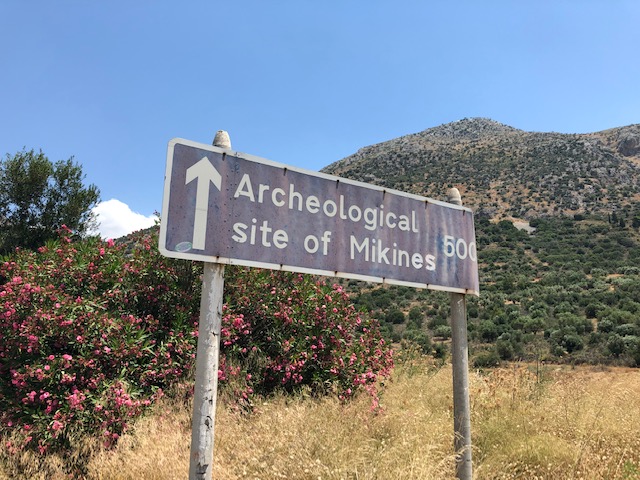
The sign on the outskirts of town showing the way to the ruins.

When we reached the little town of Mycenae, where our apartment was located, Kostas pointed out the mini-market and two or three tavernas, which we visited the next day.

Inside our apartment, Kostas and Toula showed us around the one-bedroom apartment. It had a nice living room, large eat-in kitchen, full bath, and plenty of seating with an extra couch tucked here and there. There was WiFi, air conditioning, a washer, and a large tile front balcony with clothesline.

They also took great pride to show us the fridge, which they had stocked with six eggs, a small carton of milk, local honey, a loaf of bread and toasts, apples, oranges and apricots. Kostas also showed us a bottle of olive oil fresh from his groves. (He farms olives and oranges, he told us.) We used the olive oil to cook eggs for breakfast the next two mornings. They also provided instant and Greek coffee, which we made on a single-burner stove.

IMG_0153
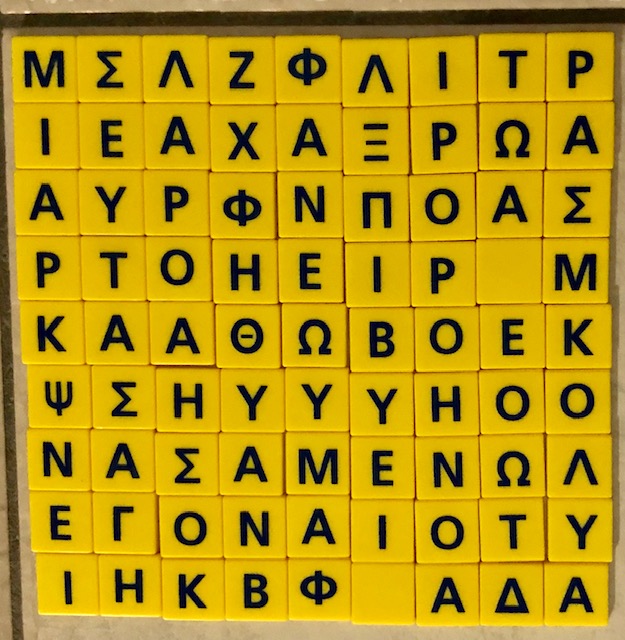
Kostas and Toula kept lots of games in the apartment. Here are Greek Scrabble pieces.

Their generosity and hospitality were incredible… above and beyond! They have definitely mastered the art of what AirBnB calls “the extra touches.”

IMG_0155
The view off the side of our front porch balcony. Those are apricots in that truck. Olive trees in the distance… and right by the truck also.

The next evening, we visited with the couple again when we inquired about how to get a taxi back to Fichti. We visited inside their apartment, which was located on the ground level of their three-story building. Over small porcelain cups of Greek coffee, water, and fresh apricots, Kostas offered to drive us back the next morning, as he and Toula were making a trip to “the big city” of Argos.

IMG_0154
The view off one side of our front porch balcony.

We also met their sweet little Chihuahua-mix dog, Kirra, who sat on my lap and stared deep into my eyes. She is very old, Kostas said, which you could tell from her fully gray nose and jowls. She rolled over on her back in my lap as we talked.

Toula, who speaks as much English as I speak Greek, multi-tasked all the while. (Several times, Kostas would stop the conversation and translate to Toulah.) She kept her eyes on a TV program, and occasionally listened in our conversation about Kostas’ and our kids, job prospects in Greece for young people (there aren’t many, he said), the cycle of world superpowers, and how Greece needs the help of larger countries to succeed.

IMG_0149
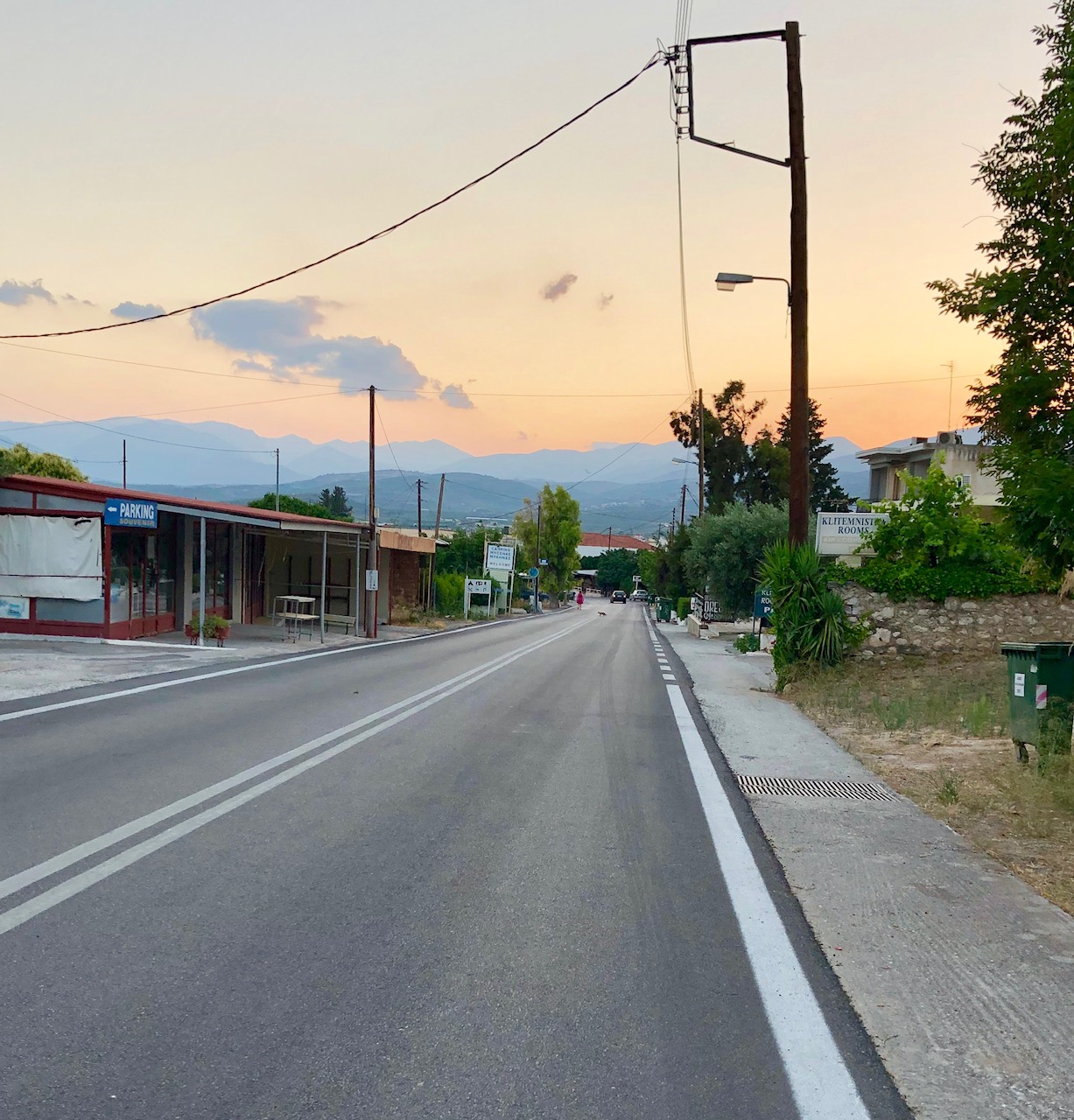
The highway between Fichti and Mycenae was quiet at night. Earlier in the day, tour buses from Argos drive through. It seems that maybe Argos gets most of the tourist business.

Kostas also told us that it had been several years since he had been up the hill to the Mycenaean ruins. In fact, when he had been there before, he had been working there. “They charge too much to see it,” he said. “They think they are the United States and charge a lot for it.”

We explained that the 12€ tickets didn’t seem that high to us, but then again the culture of Ancient and Classical Greece is revered perhaps more when you don’t grow up around it. To us, it’s an amazing site. Perhaps to Kostas, it’s just a bunch of old rocks.

IMG_0148
I had chicken souvlaki and Mitch had pork souvlaki.  Both were served with french fries. We also had tzatziki as an appetizer. The weather was beautiful. Taverna owners and/or waiters walk right up to you on the sidewalk asking you to dine at their establishment.

We then made arrangements to meet outside the apartment at 9:30 the next morning for the drive back to the Fichti bus station. Kostas also said he would help us buy our bus tickets back to Athens.

As promised, we all met the next morning… fifteen minutes ahead of schedule.

The four of us made the ten-minute drive back to Fichti. We unloaded our luggage, then I sat with it under a tree while Mitch and Kostas walked across the street to get the tickets. Toula waited in the car. After a few minutes, she emerged from the car, and we hugged, kissed cheeks European style, and said, “Thank you,” to each other. Soon, Kostas and Mitch emerged from the bus station with tickets in hand.

IMG_0156
The Fichti (say “Fith-ya”) bus station, about ten minutes north of Mycenae

Of course, Kostas absolutely would not accept the 20€ Mitch tried to hand him, waving his arms and stepping back when it was offered. So, while Kostas and I hugged, Mitch tossed the bill onto his car seat. With her limited English, Toula couldn’t refuse it.

We took our seats under the tree, and turned to wave goodbye to our hosts. Kostas, now finding the bill, shook his head. “I don’t want it,” he said.

“Goodbye!” we shouted. He continued to shake his head.

“We would have spent it anyway for a taxi. You take it,” Mitch explained.

IMG_0150
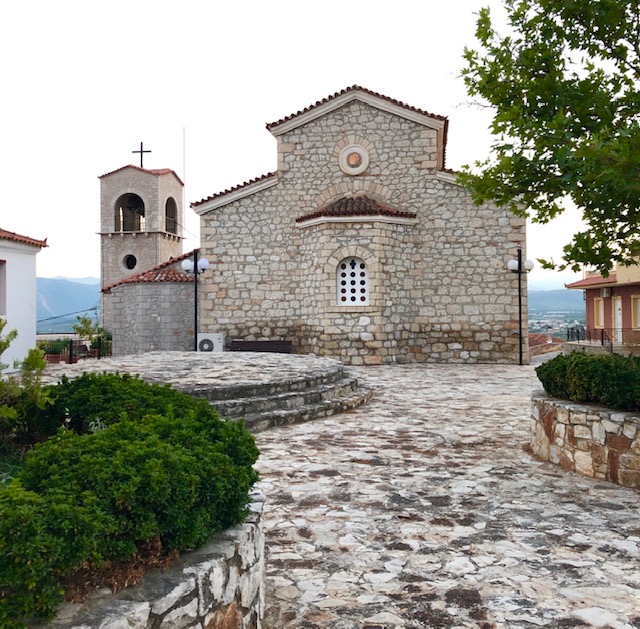
This Greek Orthodox church is right around the corner from Kostas’ and Toula’s place.

Kostas finally conceded, smiled, and pulled away. “It’s been good to meet you,” he said.

“It was good to meet you, too,” we replied.


Thanks for reading! We’re on our way to Olympia today from Delphi. At least two bus station transfers, we think, but we’ll have to confirm with the driver. The bus station in Delphi is actually inside a restaurant. You just ask one of the waiters and he instantly turns into a ticket clerk.

Click like, leave a comment and follow my blog for more stories from our trip to Greece.

Categories
Greece (Athens, Delphi)

A Day in Delphi

Delphi: Greece’s Top Divine Destination

Our visit to Delphi was our favorite single day of our six-week Greek odyssey. Once we figured out the Greeks pronounce the divine destination “Delfie, as if to rhyme with selfie, we settled in and fully enjoyed our day.

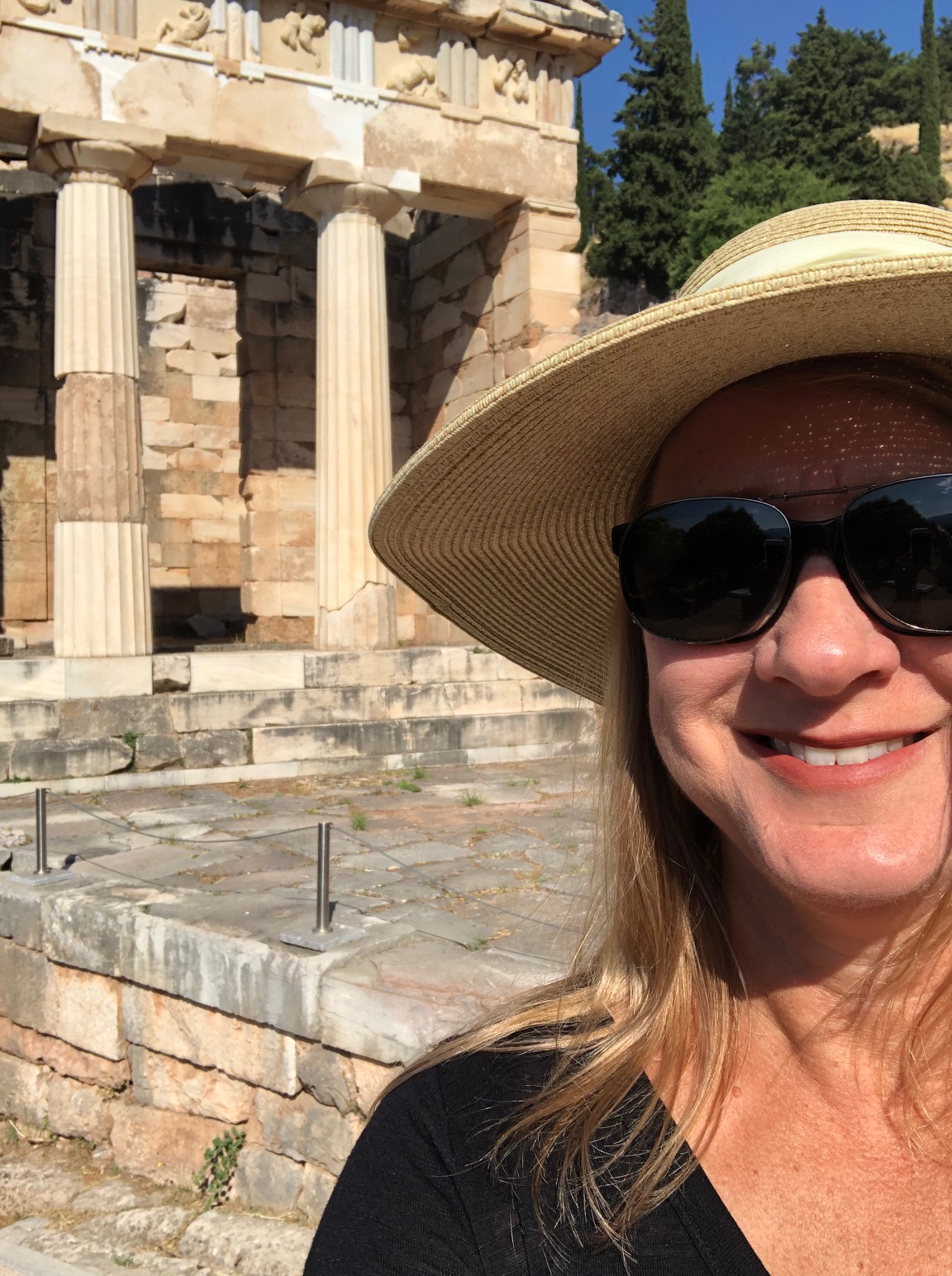
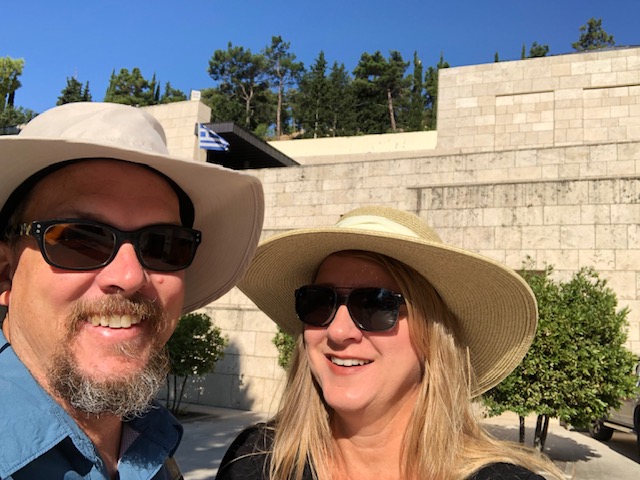
So… I think it made perfect sense to attempt a Delfie selfie today when we visited the archaeological wonder. I don’t take many selfies (and by that I mean as few as possible), but this post includes two or three to take care of the issue for awhile.

IMG_0198
Another selfie in front of the Treasury of the Athenians

When we added Delphi to our list of must-see attractions, I had no idea we would be scouring over a steep mountainside full of pine and cypress trees. In fact, this is snow skiing country. The next town over, Arachova, offers skiing during the winter months. I guess I just didn’t realize how “Alpine” the Delphi would feel.

IMG_0199
Treasury of the Athenians

In a sentence or two, “Delphi could be described as a religious complex centered around the Oracle of Delphi that was located in the Temple Apollo,” according to a book we bought, Delphi and Its Museum, by Panos Valavanis. Delphi flourished during the Archaic and Classical period of Ancient Greece, roughly from the 6th – 4th centuries BC.

On the UNESCO World Heritage site placard near the entrance to the grounds, it reads:

“The archaeological site of Delphi is Panhellenic sanctuary with an international fame. Its remnants represent some of the foremost events of art and architecture. The sanctuary, which combines in a unique manner the natural and historical environment, is related to numerous, key events of Greek history that have an impact on the progress of civilization.”

It continues: “Inscription on this List confirms the outstanding universal value of a cultural or natural property which deserves protection for the benefit of all humanity.”

IMG_0423
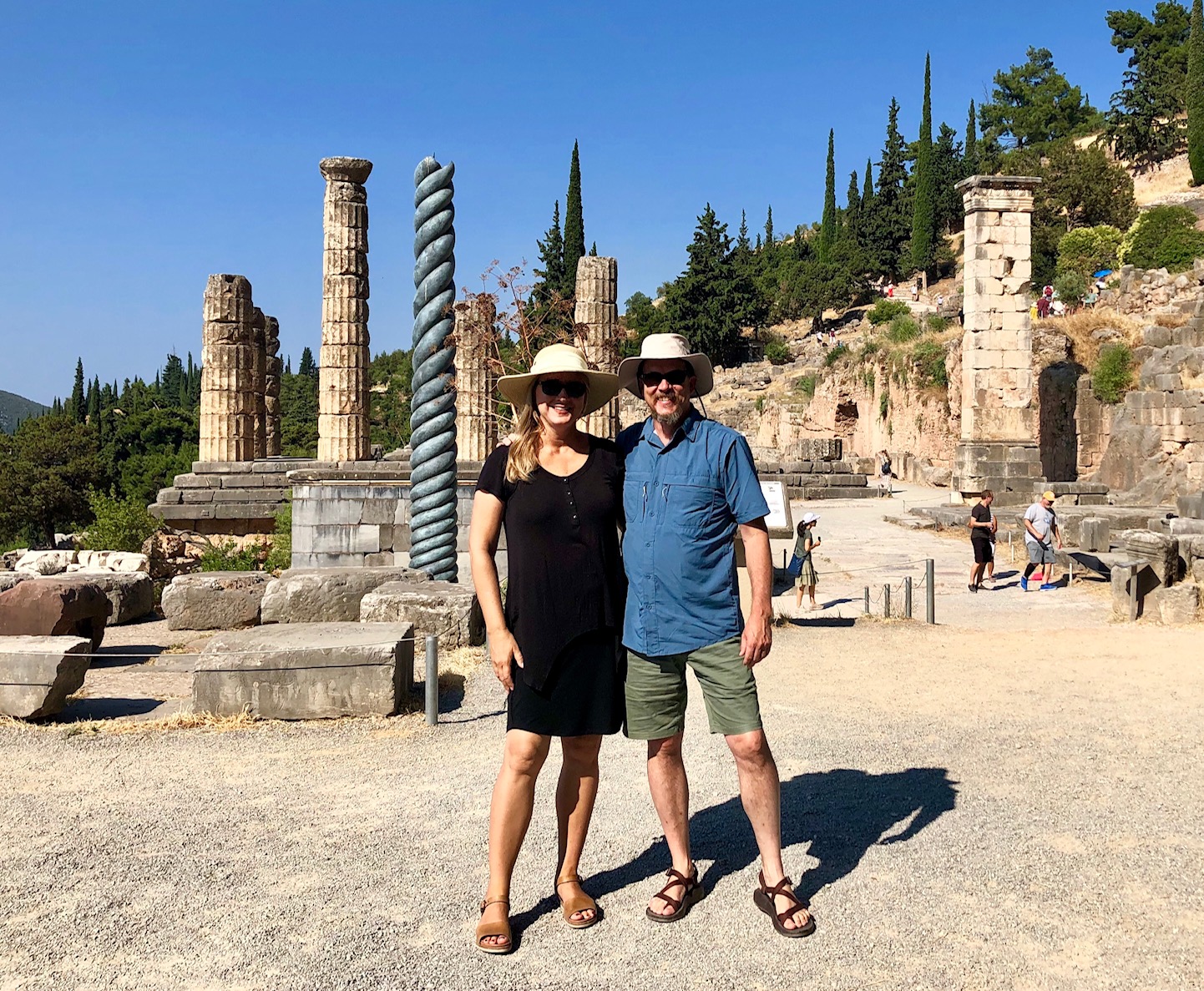
Okay, not exactly a selfie, but a nice lady from Australia took this for us. We’re standing in front of the Temple to Apollo and the Serpentine Column.
Here are some major sites within the Delphi archaeological site:

  • The Treasury of the Athenians
  • Temple to Apollo
  • Theater
  • Stadium
  • Tholos at Delphi
  • The Sanctuary of Athena Pronaia

However, besides all these major sites, there are numerous other objects, foundations, walls, and monuments to distract and fascinate you. And don’t forget the magnificent natural beauty of the place.

IMG_0230
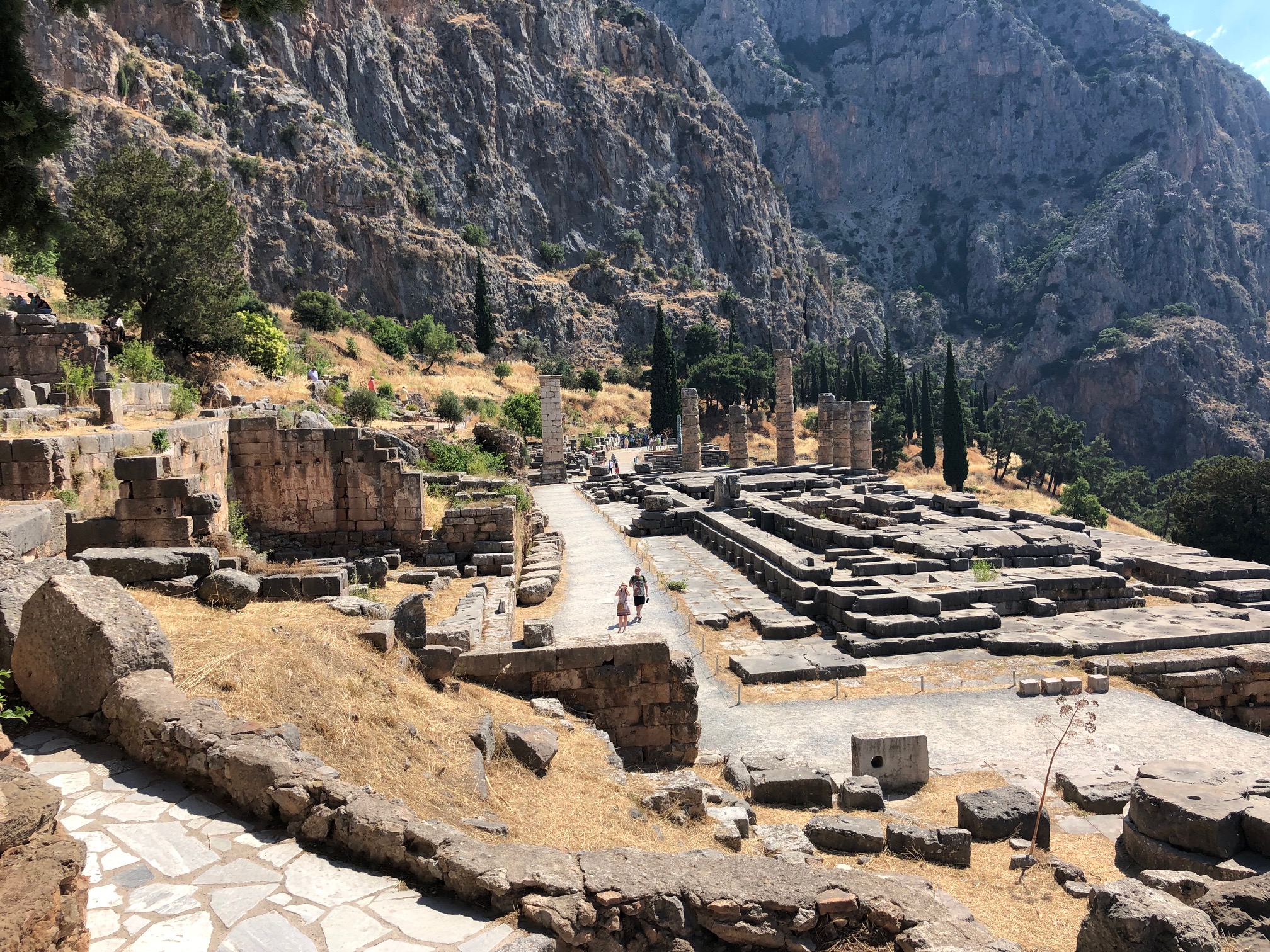
Theater on the left. Temple to Apollo is on the right. Clear down the hill you can see more ruins. This was taken on our way to the stadium all the way at the top of the site.

We took so many pictures at Delphi today that there’s NO WAY I could post them all. Here are a fraction of the photos we took at both the archaeological site and at the museum.

IMG_0249
Temple to Apollo is on the right. Other buildings (there are so many we couldn’t keep track of them all) are on the left.
IMG_0213
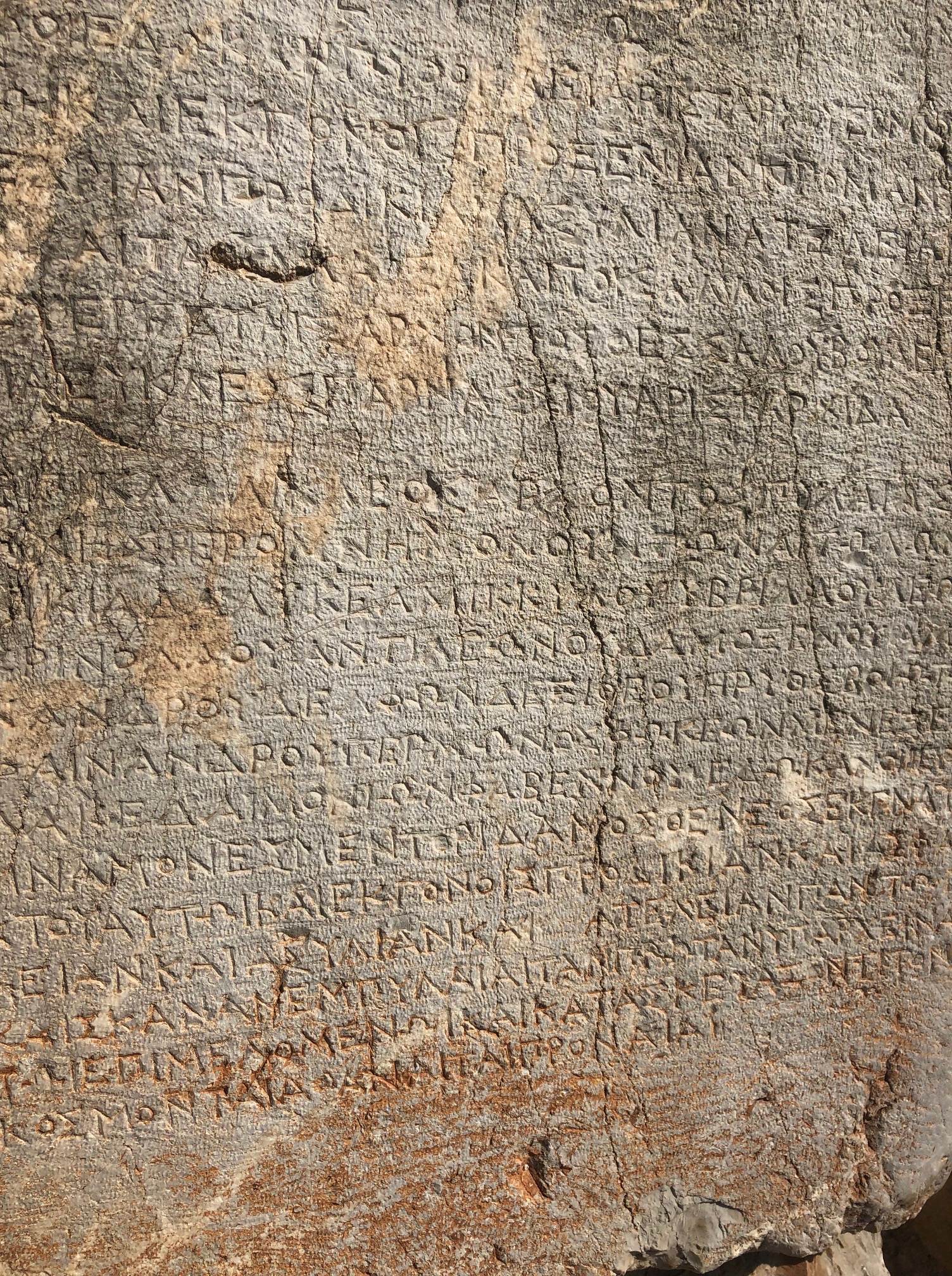
Carved inscriptions are on practically every surface.  Most of these were written by slaves who were guaranteed their freedom by Apollo, according to a book we bought in the museum.
IMG_0214
A closer view of the carved inscriptions.
IMG_0215
The long view of the wall. Most stones had inscriptions on them.
IMG_0259
Capitals that would have topped columns. They’re just here, there and everywhere.
IMG_0360
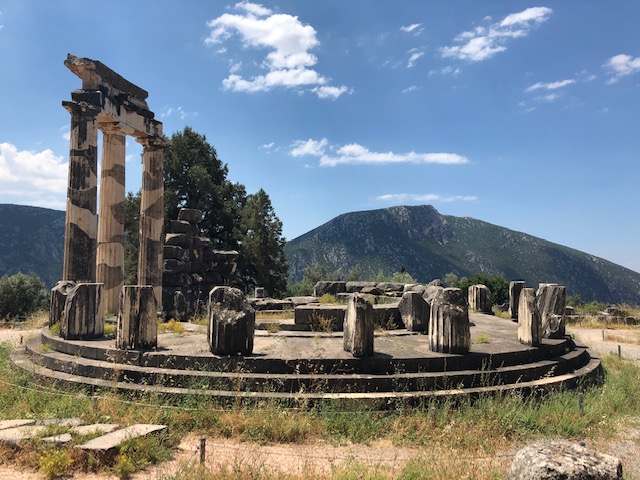
The Tholos, a round temple. This is the structure I’m standing in front of in the selfie at the top of this story.
IMG_0369
I took this to show the detail of the underside of the Tholos.
IMG_0236
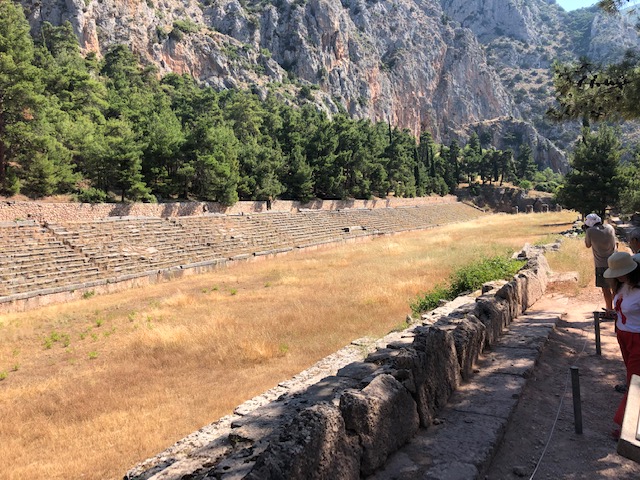
The stadium clear up at the top of the site. Panhellenic Pythian Games were held here.
IMG_0239
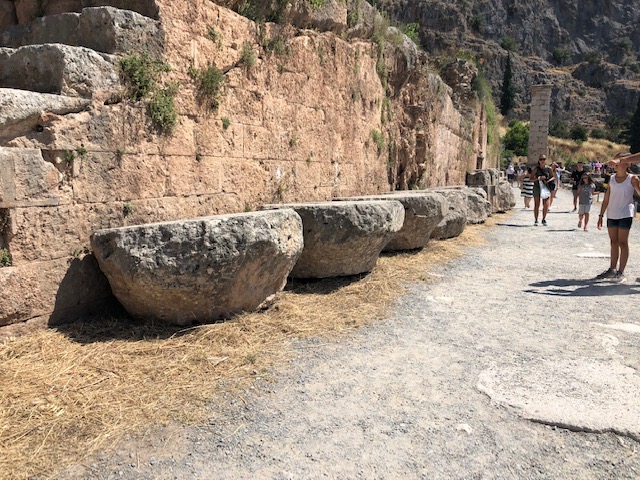
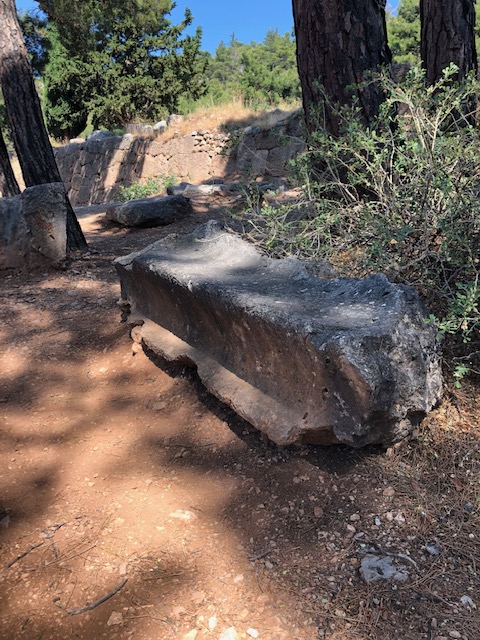
We snacked on this stone bench over by the stadium. I think it could actually be a bench from the stadium itself. There are stone pieces everywhere. They had to fall there from something.
IMG_0258
Column drums that were stacked to form tall columns. That’s my purse next to one to show scale. In the background by the person in the pink shirt, is a base that these columns may have been stacked on.
IMG_0268
I thought this column was interesting because of its sharp edges. If you look closely, you’ll see carved inscriptions on the stones.
IMG_0245
A trough for carrying waters from the natural fountains on the mountain.
IMG_0184
It’s interesting. Right alongside some fire extinguishers and a storage chest, you’ll find ancient Greek columns. No big deal.
IMG_1643
And then we went to the museum.
IMG_0378
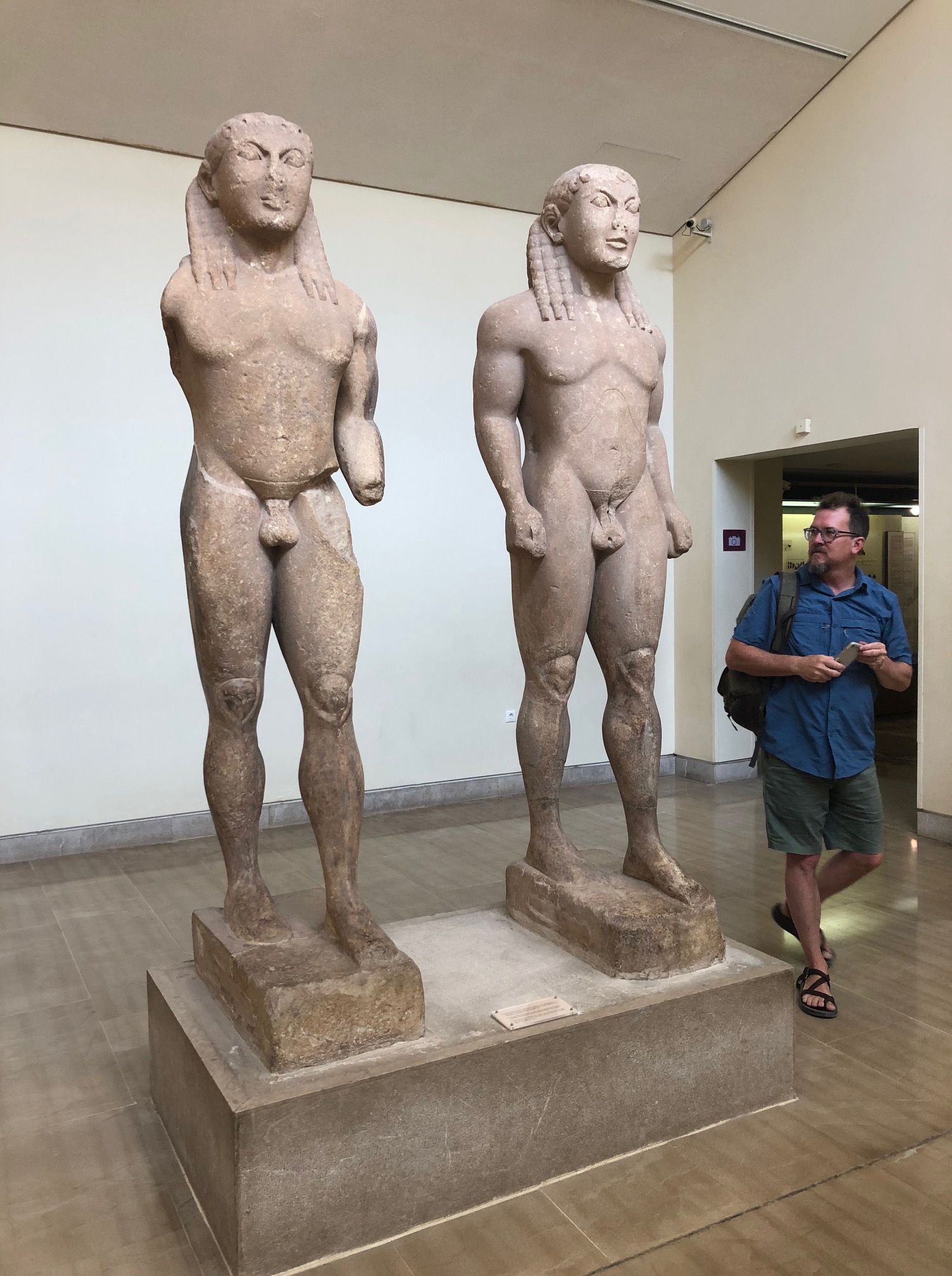
The Argos Twins, Cleobis and  Biton… Careful what you wish for. These were the boys whose mother asked the gods to bless them for carrying her to the temple of Hera. As a result, they were given the greatest gift… death at their finest moment.
IMG_0385
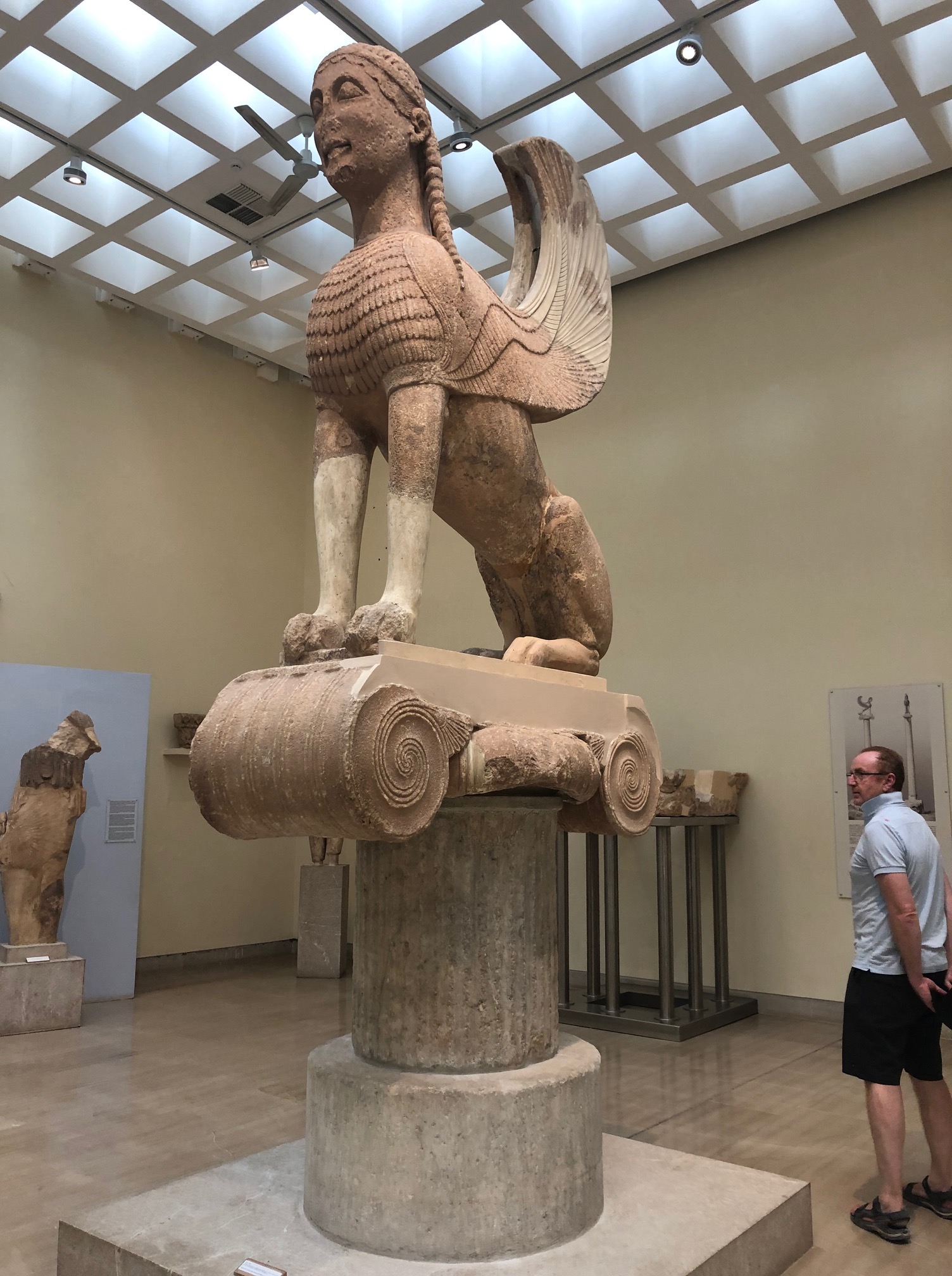
The Sphinx, a gift from the island of Naxos, given to Apollo Delphi to gain the gods’ favor.
IMG_0410
Aghias, son of Aknonis. An athlete (that’s why he’s nude) and shows how the ancient Greeks used contrapposto, which is an assymetrical arrangement of the body. Contrapposto allows a more natural stance.
IMG_1987
The bronze Charioteer is the grand finale of the museum.

We spent about four-plus hours total touring the archaeological sites and the museum. We started in about 9 a.m. and finished up around 1:30 p.m. The weather was very warm, but very nice in the shade.

We had about an hour before the tour buses arrived, so the sites really weren’t that crowded. And because many if not most people don’t go down to the Tholos of Delphi and the Sanctuary of Athena (which are located down the hill and separate from the main complex), we felt like we had a very thorough visit.

Tomorrow… on to Olympia!


Thanks for reading! Leave a comment if you’ve been to Delphi! What was your favorite part of your time there? Follow my blog for more stories from our 2019 Greece trip.

Categories
Greece (Athens, Delphi) parenting

A Boy, a Bird, and a Bus Station in Athens

Parenting looks the same wherever you live

Parenting seems to be the same around the world. Whether you live in the United States or Greece, all parents have their hands full with a four-year-old boy.

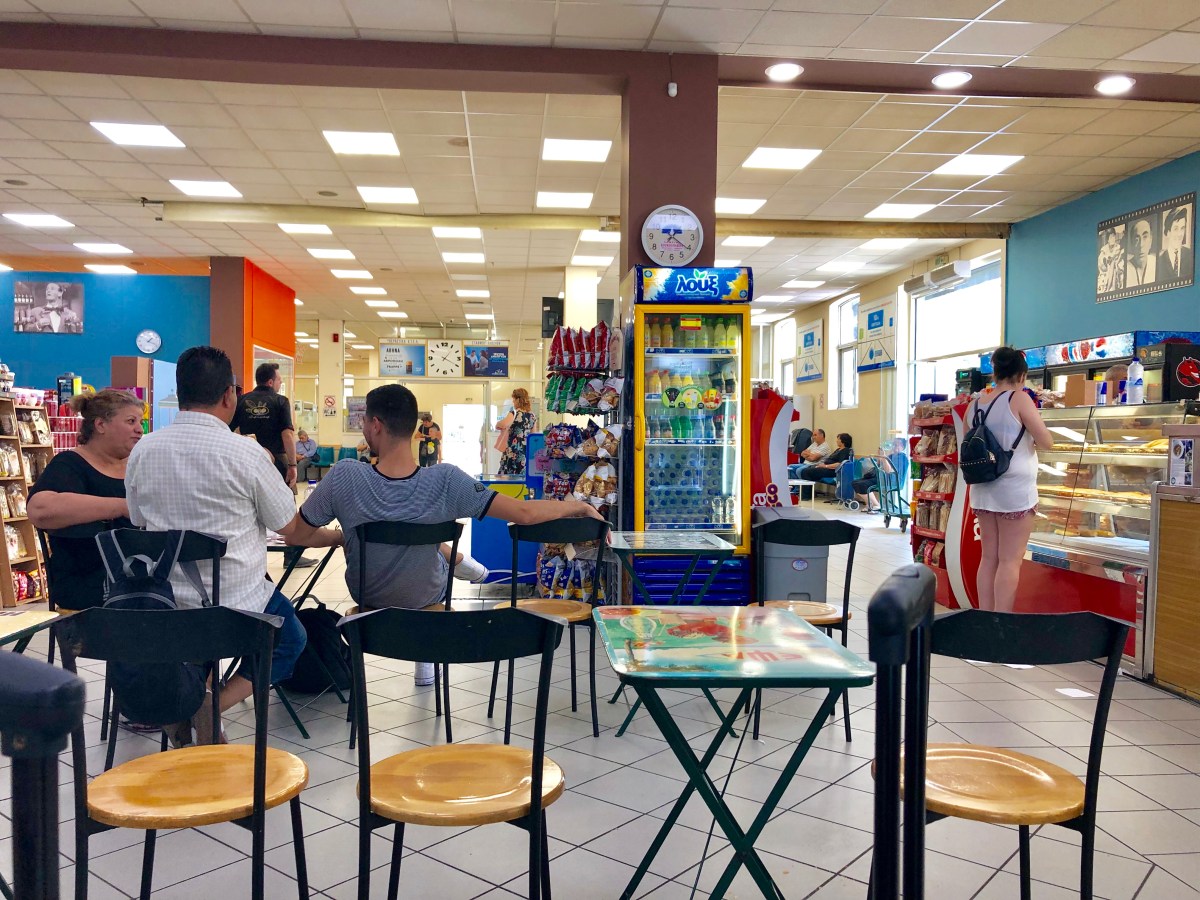
Today, I’m watching a mother, father and their son who looks to be about four at the Liosion Bus Station in central Athens.

A pigeon is swooping its way through the bus station lobby, which includes a cafe, a mini-grocery, a trinket shop, and a bookstore. The pigeon flutters from one side of the lobby to the other.

The patient father follows his son casually around the lobby. The boy jumps high whenever the pigeon swoops low. He can’t reach it, much less catch it. In his green t-shirt with a tiger emblem and bright yellow shorts, ankle socks and grey tennis shoes, he reminds me of my own son many years ago.

He squeals whenever he swipes at the bird, but eventually gives up when the pigeon escapes out the lobby door into the crisp, early afternoon sun.

All the while, Mom has been arranging bags and luggage around a small table in the cafe specifically purposed to provide pastries, sandwiches, candy, and drinks to waiting bus riders.

Eventually Dad and the boy return from their pigeon escapade. Now the boy wants to investigate things over here.

The boy’s mother, wearing jeans and a white t-shirt emblazoned with BEAUTY in large black capital letters, leads him to a freezer case of ice cream novelties. He isn’t interested, but she pulls a treat from the case anyway.

They both step over to the cafe counter to pay. As she pays, the boy lifts a bag of almonds from a nearby display, runs back to the freezer case, and drops the nuts inside. Mom misses it all.

They both return to Dad. He’s wearing a faded blue polo-style shirt with a Union Jack flag on the sleeve and the words GREAT BRITAIN embroidered along the lower edge.

Mom is carrying the ice cream bar, now unwrapped. It’s a strawberry pink bar in the shape of a foot. The toes are dipped in chocolate. She bites off the big toe and sits down.

She spouts off a string of fluent Greek to her husband who nods and smiles.

As she cools off, her son decides to tidy up the place. He picks a plastic straw wrapper off the next table over and wanders over to a nearby trash can and drops it in. At least this time, the object being dropped belongs there.

A tanned old man is sitting by the trash can. He scowls at the boy and glances at his wife as she sips from a can of Coca-Cola Light.

An announcement is made from the station intercom. Time to pack up.

Mom pats her black canvas crossover bag, and then straps on a blue backpack in the shape of an owl. Next, she hoists a purple floral backpack onto her other shoulder.

Next, she lifts the handle on a wheeled suitcase, grabs a plastic grocery bag from the tabletop, and—nearly invisible behind all the luggage—hauls herself out to the platform area.

Dad grabs the boy. Based on the boys’ earlier antics, I’d say the parents have divided the workload evenly.

My eyes return to Mom gliding across the lobby. Two giant black eyes on her owl backpack glare menacingly as they jostle out of sight.


Thanks for reading! I’m sitting in Athens at a bus station watching what’s happening around me as we wait on our 3 o’clock bus to Delphi.

Click like, leave a comment, and follow my blog for more travel stories.

Categories
Greece (Peloponnese)

Marry an Artist and Then Go to Mycenae

A few days ago, I posted on Instagram about how one of the perks of being married to an artist is that you can tag along with them when they serve an artist residency in Greece.

Image-1

Well, if you need another reason to marry an artist, here it is:

You have a built-in tour guide for all things artistic: museums, historical sights, and exhibitions. 

Today, I fully realized the benefits of being married to an artist while walking the grounds of Mycenae. Not having studied these incredible ruins for a degree in journalism and teaching, I really didn’t understand much of what I was seeing.

However, walking around with my husband, I gained a glimmer of understanding about the culture that preceded classical Greece and influenced western art, architecture, and philosophy.

Mitch was able to tell me that: the Lion Gate that leads to the Citadel at Mycenae is important because it shows a monumental post and lintel entry point. Another reason: those lions throughout history never became buried or destroyed. Always visible down through the ages, they created a landmark for historical study that continues in current times.

IMG_0068
A closer shot of the Lion Gate.

The Lion Gate structure, like all of Mycenae, was built  from 1600-1300 BC. When you wrap your head around that date, these ancient ruins— some of them today merely stubs of stone outcroppings and faint traces of walls and foundations–are indeed spectacular.

Many times today, I found myself asking things like:

  • “How in the world were they able to hoist that huge stone all the way up there?” 
  • “And why did they need that large of a stone in the first place?”

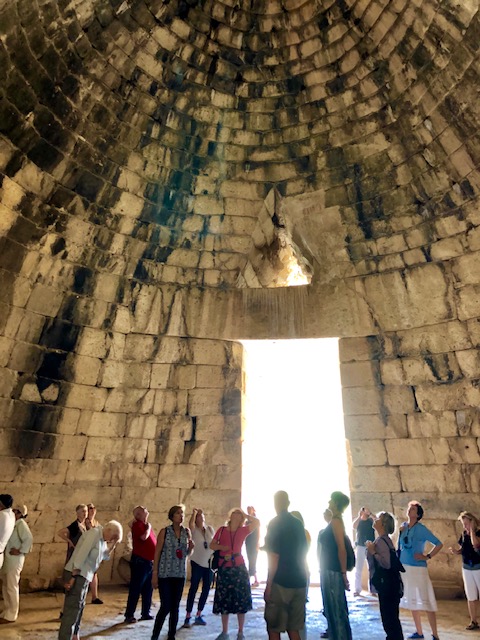
My husband Mitch is also able to tell me about the triangular openings above many entries. These triangular openings displaced the weight from above so the weight didn’t rest directly on the lintel. We saw several of these triangular openings on beehive-shaped tombs. Imagine how many failures were experienced over the years in order for the Mycenaens to learn and then apply this engineering principle in the surviving structures we admire today.

This was taken inside the Treasury of Atreus or the Tomb of Agamemnon. It’s mammoth. In fact, it’s the largest of the nine similar tombs at Mycenae.

IMG_0131
That’s one BIG stone above the doorway. See how it curves?
IMG_0139
See how that curved stone is actually bigger than it looks? You walk under it a good bit when you enter the tomb.

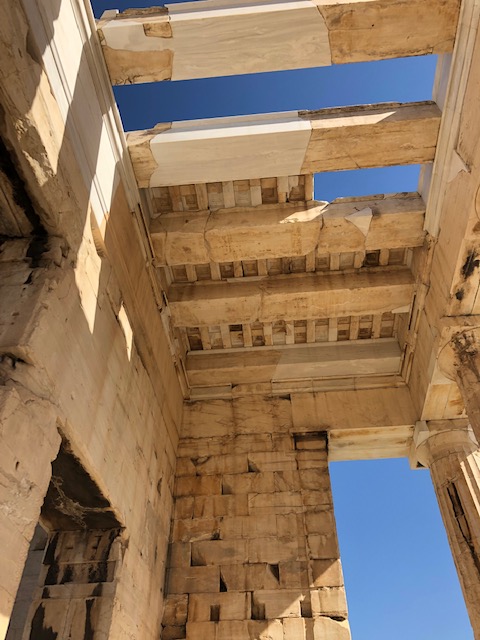
Another example of my husband’s knowledge that comes in handy when you go to places like Greece: Back in Athens, inside the Propylaea, the entrance to the Acropolis, one could easily walk under the ornate “ceiling,” never pausing to consider the enormous stones above.

In the next photo of the Propylaea in Athens, see the large horizontal pieces, some of which have new and whiter marble replacement pieces? Now see those stones in between those horizontal pieces? Those are separate stones placed over the horizontal beams.  Stone on stone on stone. Truly incredible.

IMG_8997
Ceiling of the Propylea at the Acropolis in Athens a few weeks ago.

But let’s return to today’s Mycenae visit.

Here’s I am again walking under a lintel that spans the posts, transferring the weight to the posts. Maybe this is common knowledge to you, but it’s new to me and fun to hear about from my husband.

IMG_1615
Post and lintel doorway at the Citadel

Another spot I saw today: the House of Columns at the Citadel at Mycenae. Notice the large stone in the front of the picture? Now see how there are four more behind it spaced regularly? Those used to be columns. Amazing.

IMG_0094
The House of Columns at Mycenae
IMG_0035
Quick summary of the importance of Mycenae

We walked the mile or so up the road to Mycenae from our AirBnB. It was a breezy, sunny day and warm, but not too warm. It was actually a nice walk full of oleander and olive trees.

IMG_0142

We started out here at our AirBnb. Yesterday was a long day. We arrived here last night after leaving Skopelos, ferrying to Skiathos, flying to Athens, and taking a bus to Fichti, where our host met us at the bus stop before driving us to Mycenae (spelled Mikines in Greece using English alphabet).

IMG_0143
Our AirBnb in Mycenae

Tomorrow, we head to Delphi, where Mitch will get to play tour guide again. What a perk for me!


Thanks for reading! Catch tomorrow’s post by following my blog. Ever been to the Peloponnese? Leave a comment about your experience.

Categories
Greece (Skopelos)

Stafilos Beach for the Win

…Stafilos had a dog, so that pushed it ahead of the pack

We visited four beaches (Glisteri, Glifoneri, Panormos, and Stafilos) during our three weeks on Skopelos Island and they each were clean, comfortable, and drop-dead gorgeous.

However, Stafilos Beach had a dog, so Stafilos for the win.

IMG_9902
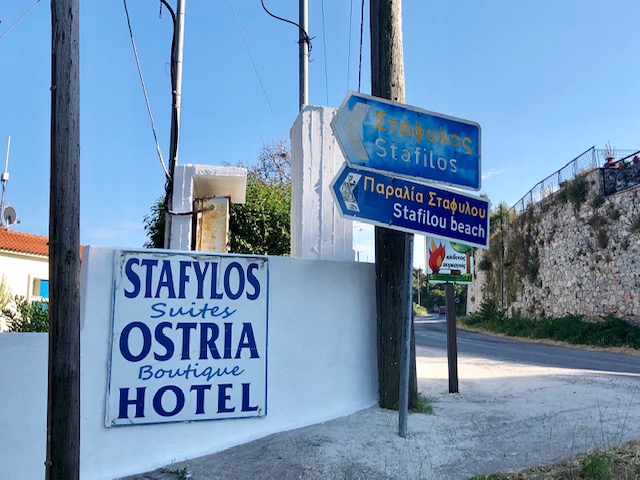
Follow the signs down the hill after you exit the bus.
IMG_9895
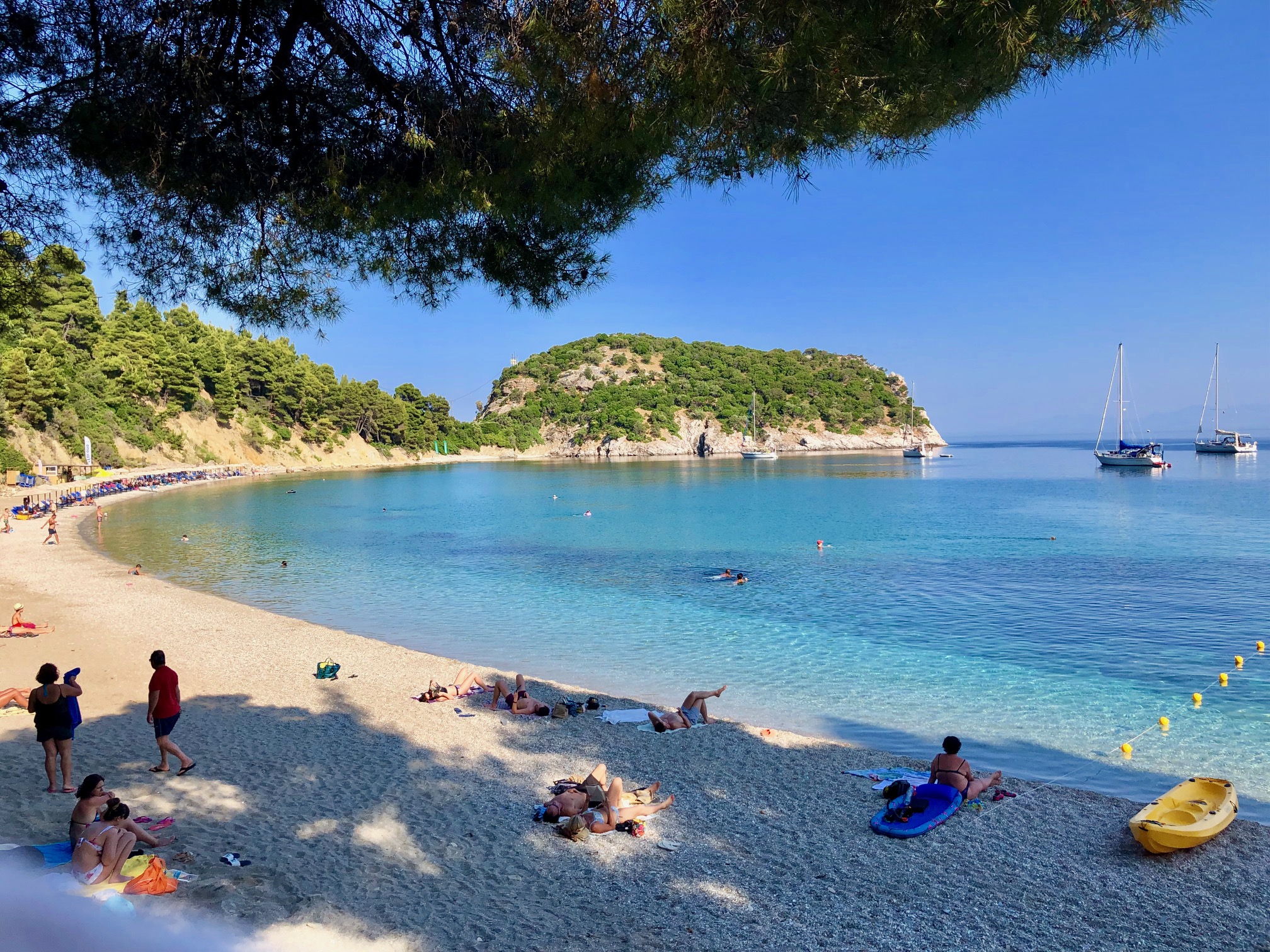
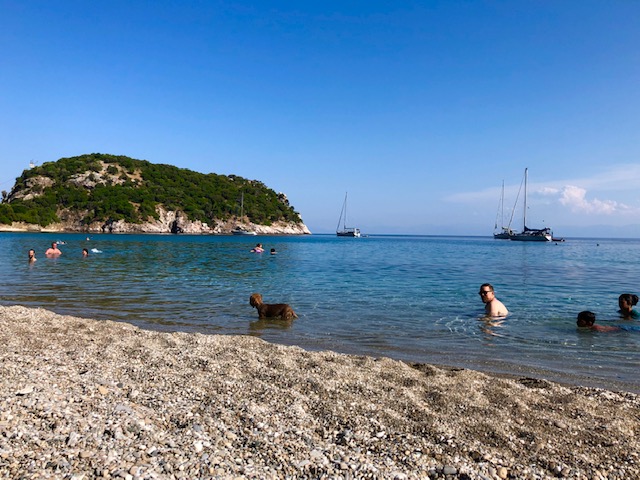
The beach is big and beautiful.
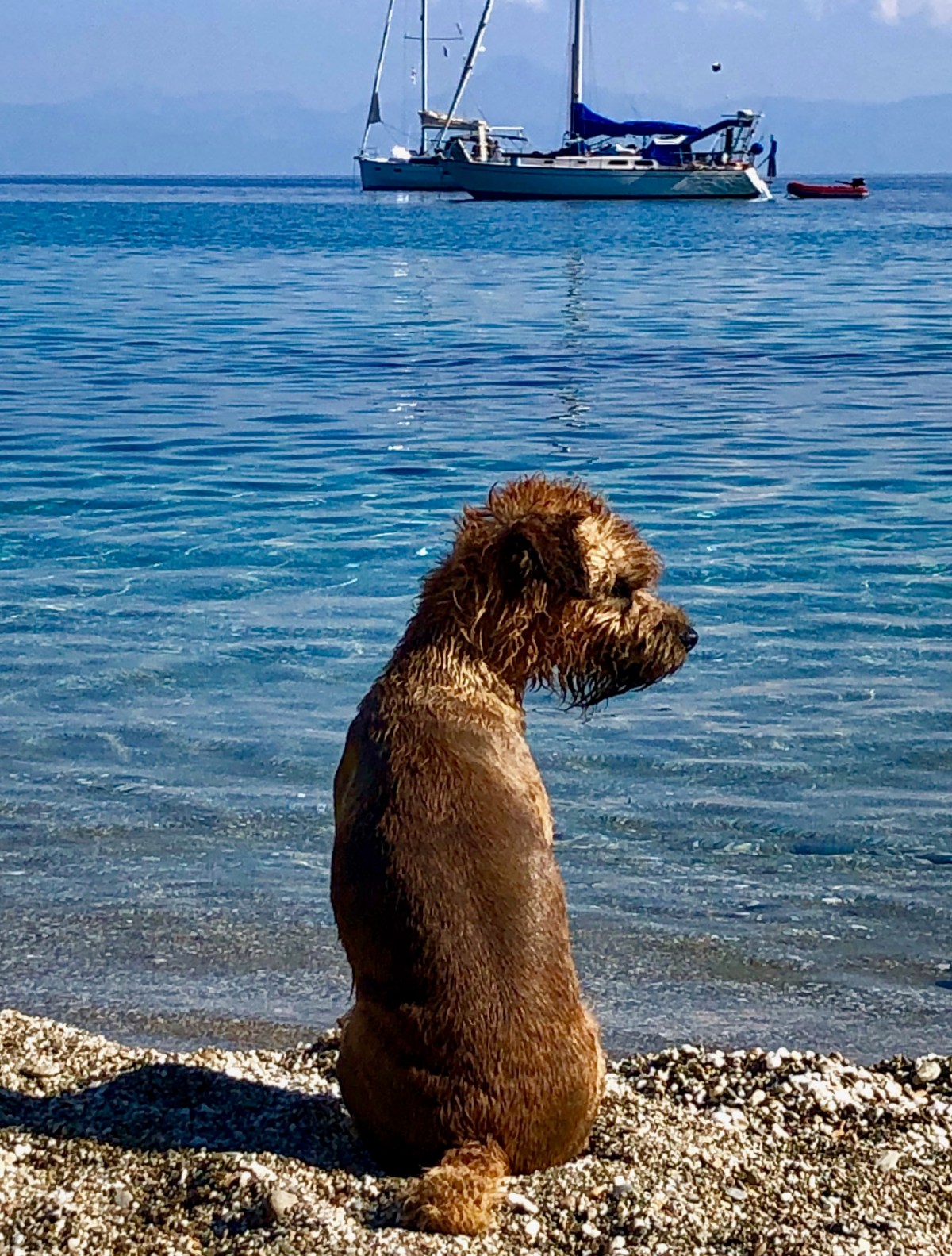
When we visited Stafilos last Friday afternoon, a brown, wiry-haired dog made its rounds to the various beach-goers settled on towels and blankets. It greeted each visitor it met and then flopped down, soaking wet, and wriggled in the tiny pebbles. It was truly this dog’s dream come true, apparently.

IMG_9881
The dog cooling off in the water.

Never one to ignore an animal, Mitch and the little dog became fast friends. The dog sat with us on our towel and surveyed the kids and adults sunning, swimming, and snorkeling around us. And then she returned to the water and swam out to her owner anchored out in the cove. With her head just  a tiny brown dot on the surface of the water, she amazed us by soon returning to the beach for another dose of interaction with strangers.

IMG_9887
Mitch and man’s best friend

Stafilos is just a ten-minute bus ride from downtown Skopelos. Check the bus schedule board at the bus kiosk, arrive at the designated time, board and pay your 1.60€ when the attendant comes to you during the ride.

We headed out in the late afternoon and returned about two hours later.

Make sure you wear good shoes when you go, since you’ll have to walk about 500 yards or so downhill.

IMG_9875
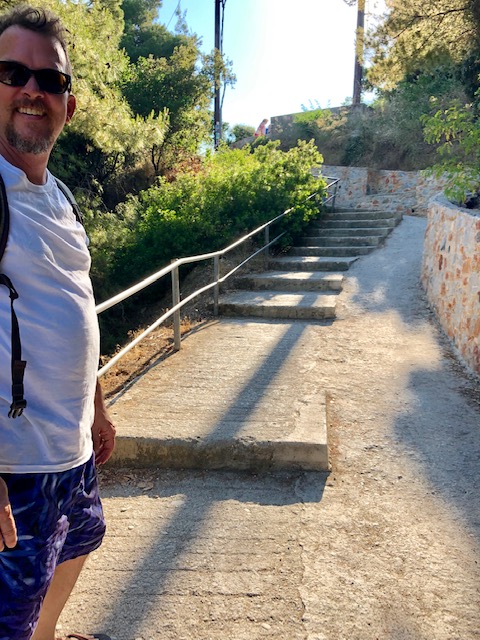
The road down to Stafilos Beach looks like this…

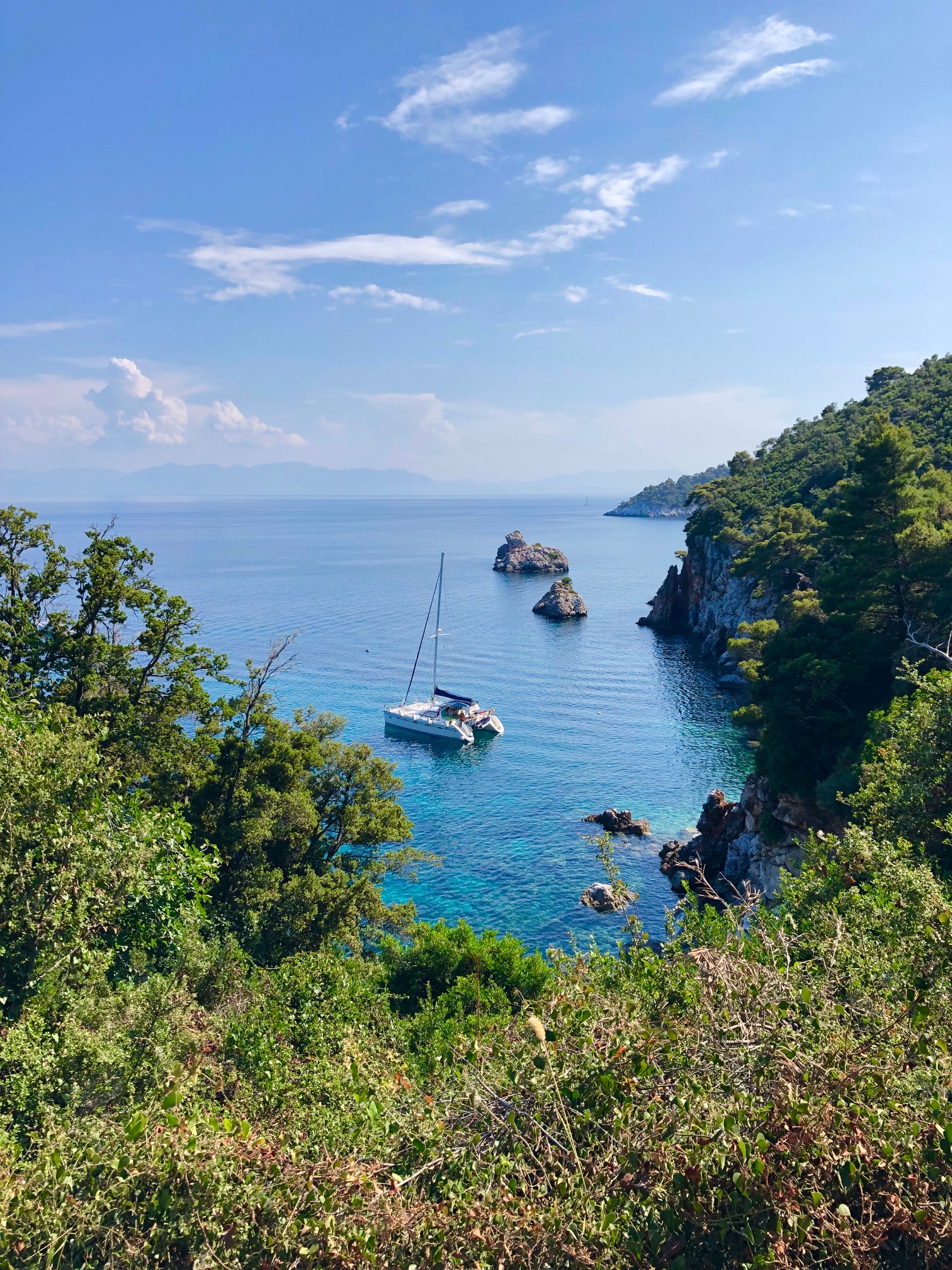
The walk is steep, so watch your step. However, pause to catch the gorgeous views.

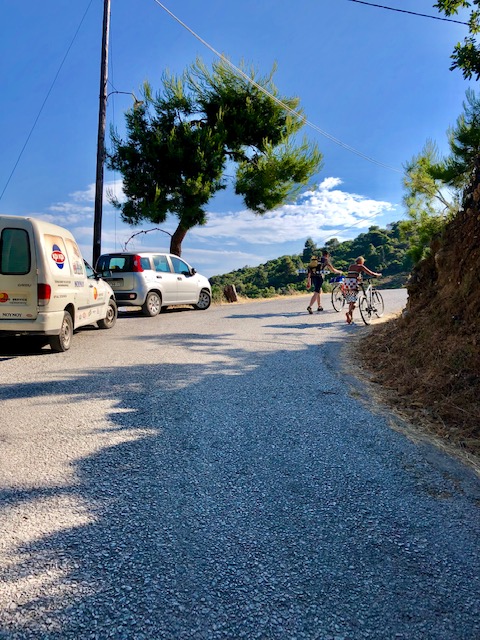
IMG_9877
…and this…
IMG_9880
and this.

Once you arrive at the beach, you can just spread out a blanket or towel at no charge or 2) pay 7€ for a beach umbrella and two wooden chaise lounges. You can see the umbrella section at the far left edge of the second photo in this story.

When it’s time to go, don’t forget you’ll have a hike back up the hill.

IMG_9898
The road back up the hill from Stafilos Beach looks like this…
IMG_9899
…and this.

There are a couple of tavernas you can visit on your walk up. These are casual cafes that serve fresh seafood, salads, and drinks.

IMG_9901
You may see some tiny churches on the hillside…

As you walk up, look around at the hillsides to see the occasional private Greek Orthodox churches. Here’s another one across from the bus stop:

IMG_9907
…or at the bus stop.

Also near the bus stop: chickens pecking underneath an olive tree. What a great scene!

IMG_9906
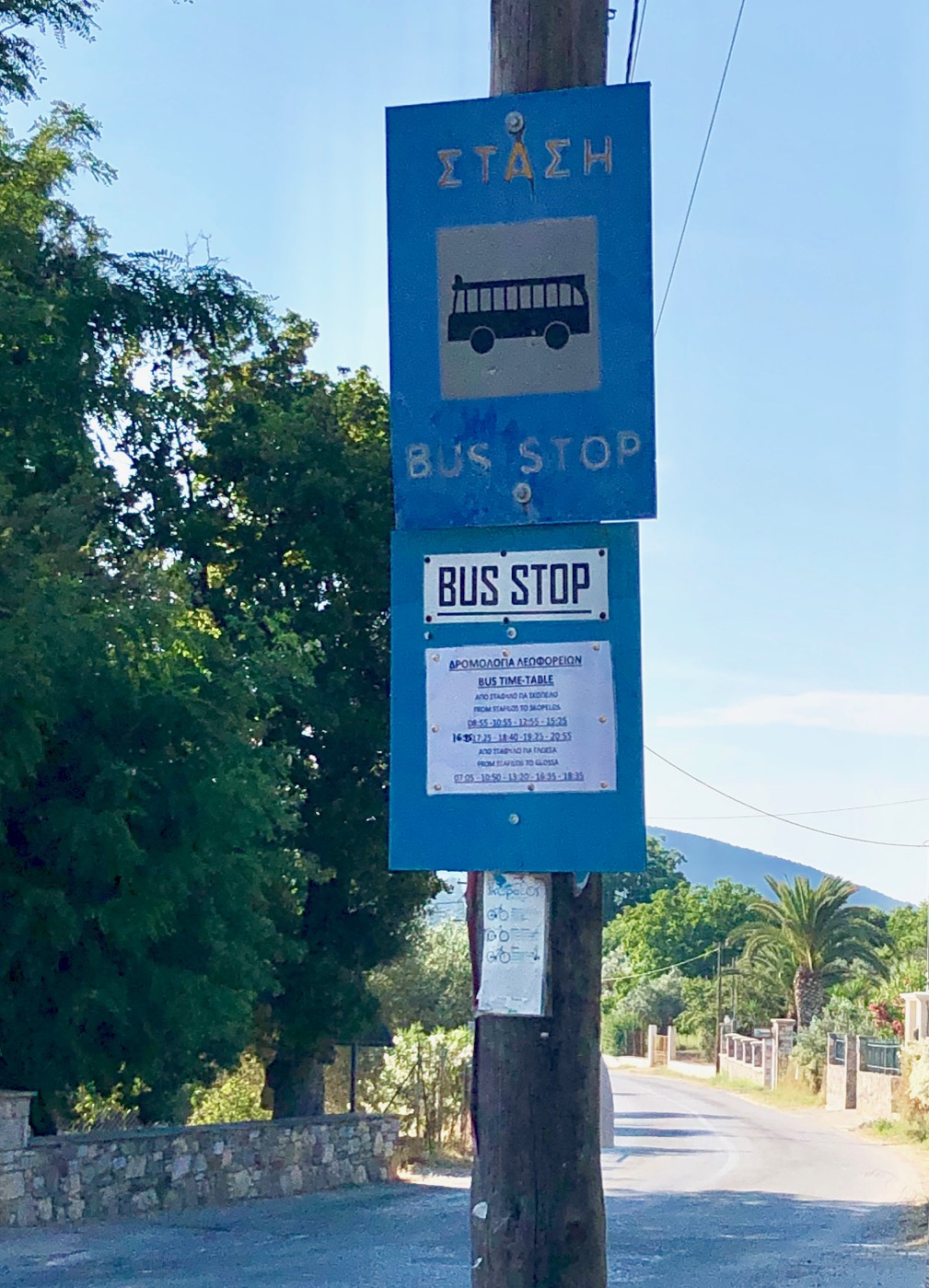
Chickens feeding beneath an olive tree.

We stood across the street in the shade and waited near this sign for the bus. It was right on time!

IMG_9908
And finally… the bus stop.


Thanks for reading again today! We are en route to Mycenae today via Athens. In fact, I’m writing this post in the Skiathos Alexander Papadiamantis Airport. Click like, leave a comment or follow my blog for more stories on the daily.

Categories
Greece (Skopelos)

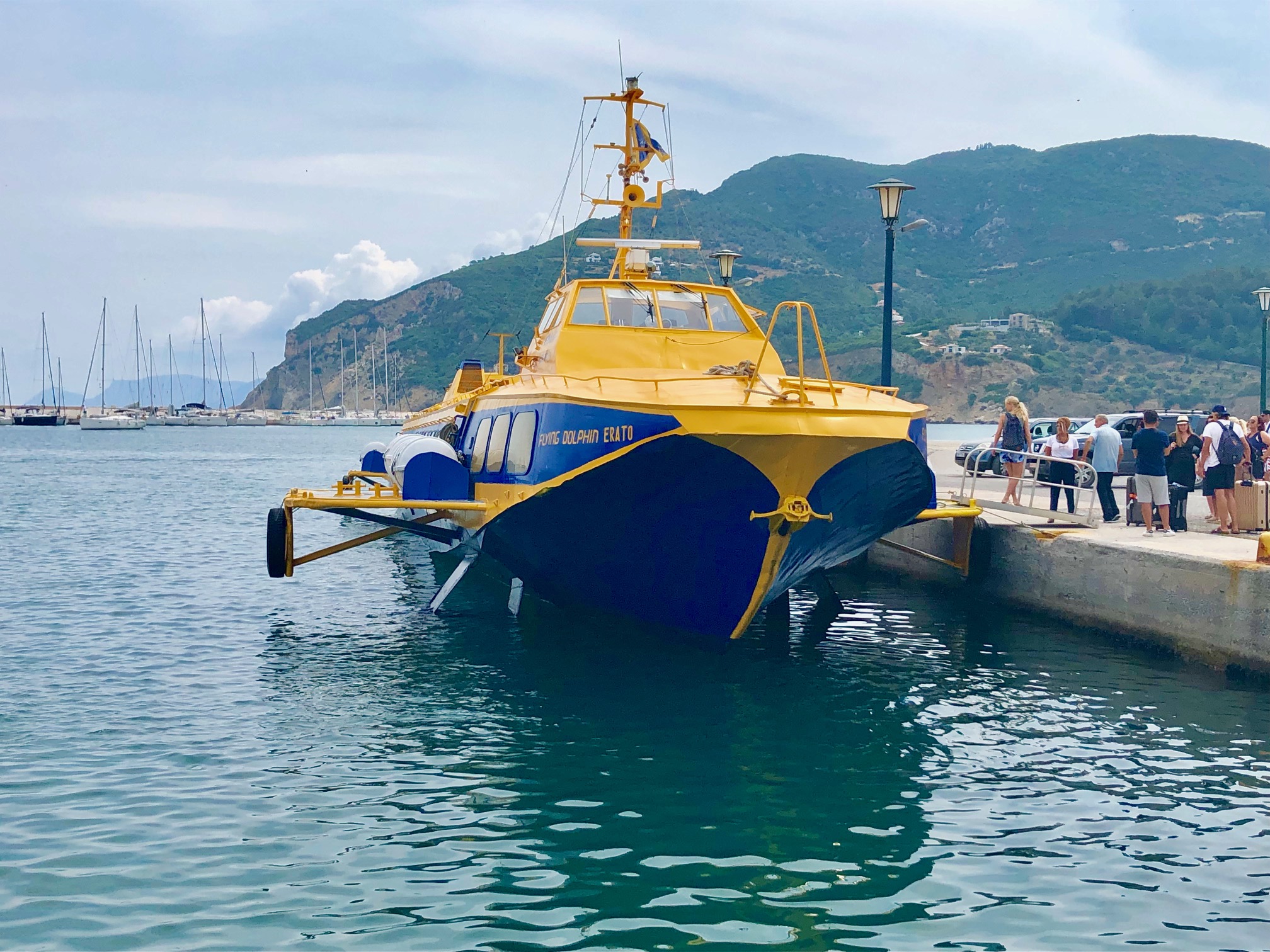
The Flying Dolphin: A Need for Speed

When we booked our return ferry tickets from Skiathos to Skopelos last week, the woman at the ticket office confirmed our booking by asking, “There’s a Flying Dolphin you could take. Would a Flying Dolphin be okay?”

That’s strange, I thought. Of course, a Flying Dolphin would be fine, I wanted to say. After all, we just need to get from Skiathos to Skopelos, and why not get there as quickly as possible?

But then the next morning, bags in hand, standing at the Skiathos port, we saw the Flying Dolphin pull in. Or should I say float in. Or ski in. Or jostle in. From a distance, this vessel flew fast above the water. We could actually see daylight between the bottom of the hull and the surface of the water.  Yes, the name “Flying Dolphin” described this vessel perfectly.

The Flying Dolphin is a hydrofoil passenger ferry operated by Aegean Flying Dolphins in Piraeus, Greece, a port city near Athens. According to the company’s website, it “offers daily service with two modern high speed flying dolphins from the port of Piraeus to Aegina and from the port of Volos (Thessaly region) to the islands of Skiathos, Skopelos and Alonissos all year.”

Because of its speed, taking a Flying Dolphin will be a bumpier ride. (Ahhh… that’s why the ticket clerk made sure we knew what we were getting ourselves into.)

In addition, a Flying Dolphin will cost more than a traditional ferry, such as ANES Ferries’ Proteus or Blue Star Ferries’ Flying Cat. (But then again, like us, you may not have a choice: only one morning ferry left for Skopelos on our travel day.)

PROTEUS 4
A more traditional passenger ferry, ANES Ferries’ Proteus

Don’t expect a lot on the inside of a Flying Dolphin (and there’s no sitting outside either, by the way). Yes, it’s perfectly clean and adequate, but doesn’t have the top-rate feel of other ferries… no coffee shop, no lounge seating at tables. No flat screen TVs or fancy lighting.

IMG_9859
Fairly basic seating. Nothing fancy. A tray table if you need it. 
IMG_9865
IMG_9866
Seating includes a large center section of rows and and a single column of double seating along each side.


However, what the Flying Dolphin lacks on the interior,

it makes up for with one thing: speed.

Once the Dolphin reaches full speed, it coasts across the surface of the water, skimming along on fin-like hydrofoils that lift the hull out of the water.

And with that speed, expect a bumpy ride… especially if there are higher than average winds on the water.

We saw the “flight” attendant, who also took our tickets as we boarded, deliver two paper bags to seasick riders about halfway through our fifty-minute ride, which made a stop in Glossa (another town on Skopelos) on our way to Skopelos Town.

IMG_9860
Notice the hydrofoils that become the “wings” of the Flying Dolphin, allowing it to go faster than other vessels. The tires provide a cushion for the vessel when it meets up to dockside.

The water splashes continually onto the windows of the Flying Dolphin as you ride.

At one point, a turn in the water and an especially strong gust of wind caused our boat to tilt right, surprising several riders on board. A few passengers called out with a holler when that happened.

IMG_9867
This photo shows the hydrofoils more clearly.
IMG_9857
The crew attaches a walkway to the Flying Dolphin as passengers wait to board.

We leave Skopelos Island tomorrow morning and are taking a ferry to the island of Skiathos where we will fly to Athens. There are winds forecast for the morning as a cold front is coming in. Passengers taking a Flying Dolphin should take warning (or even prepare for a cancellation, we’ve been told).

flying cat
The Flying Cat, a catamaran.

Luckily, we’re not one of them. We’ll be taking Blue Star Ferries’ Flying Cat, a catamaran ferry, instead.


Thanks for reading! I’ve been really surprised by the variety of ferries— and watercraft in general— on our Greek tour.  Feel free to click “like,” leave a comment or follow my blog for more.

Categories
Art & Architecture Italy (Venice)

Venice Doesn’t Need Another Tourist Like Me

It just wasn’t as elaborate as I thought it would be, I thought as I surveyed the interior of Venice’s Basilica dei Santi Giovanni e Paolo. Yes, it was beautiful, just not as beautiful as I expected for a “Top 10” ranking in the little book about Venice I had at home.

A sign at the door had notified us of a 3.50€ entrance fee to enter. My daughter and I both agreed that this view from the doorway would suffice. After all, we had been in many other Venetian cathedrals or basilicas.

Just two days before, we had ventured inside the Chiesa di Santo Stefano in the San Marco sestiere.  The previous day, we had taken loads of photos inside Basilica di San Petronio in Bologna. The next day, a second tour inside Saint Mark’s Basilica was on the agenda. And then, two years earlier we had made time not only for Saint Mark’s, but also the Basilica dei Frari, Chiesa di San Zaccaria, and of course, the iconic Basilica di Santa Maria della Salute. In short, we had seen many.

However, I liked the idea of at least a souvenir from Basilica dei Santi Giovanni e Paolo. The rotating stand at the edge of the entry steps might have one I could purchase. I spun the stand, picked out a couple of cards and stepped over to an ornate kiosk. From the back, a man entered the darkened kiosk.

He had just finished setting up for the day—repositioning the “No Photos” sign, stacking up the 1€ kimonos available for purchase by bare-shouldered women, arranging a selection of votive candles.

I slid the two postcards under the slot in the kiosk’s Plexiglass shield. The man looked intently at each one and then met my eyes.

“Did you see the originals?” he asked.

“No.” How could I explain in my non-existent Italian that we had already seen so many churches in this great city? He straightened the cards in his palms with a tap on the marble counter.

“Okay, you must see the originals.” He stepped out from the kiosk and stepped around to meet us. Grabbing the velvet partition rope, he said, “Come with me.”
He handed me the postcards, and we followed him into the cool darkness of the basilica. He strode purposefully to a mammoth collection of oil paintings on the large wall to the right.

As he walked, he spoke over his shoulder, “It’s a crime to come to Venice and buy a postcard and not see the original because you don’t want to pay three-fifty Euro.”

Ouch, I thought.

Here was a Venice enthusiast if I had ever met one. Flashing his dark eyes from beneath even darker curls, he continued: “I will show you the two paintings on your cards.”  He stepped over to the wall behind the oil paintings and tapped a small plastic rectangle. Click. Light saturated the paintings.

My daughter reached for my postcards for a closer look. “This is a Bellini—those are why this church is on the list. These are special,” she whispered.

“Here is the Bellini,” he called from the light switch.”You look at this one, then go over to that one”—he pointed further into the nave directing our eyes to the darker painting of Christ with the apostle Thomas by Leandro da Bassano— “and then come back and see this one again. You turn on the light if you need to.”

“We will. Thank you,” I told him.

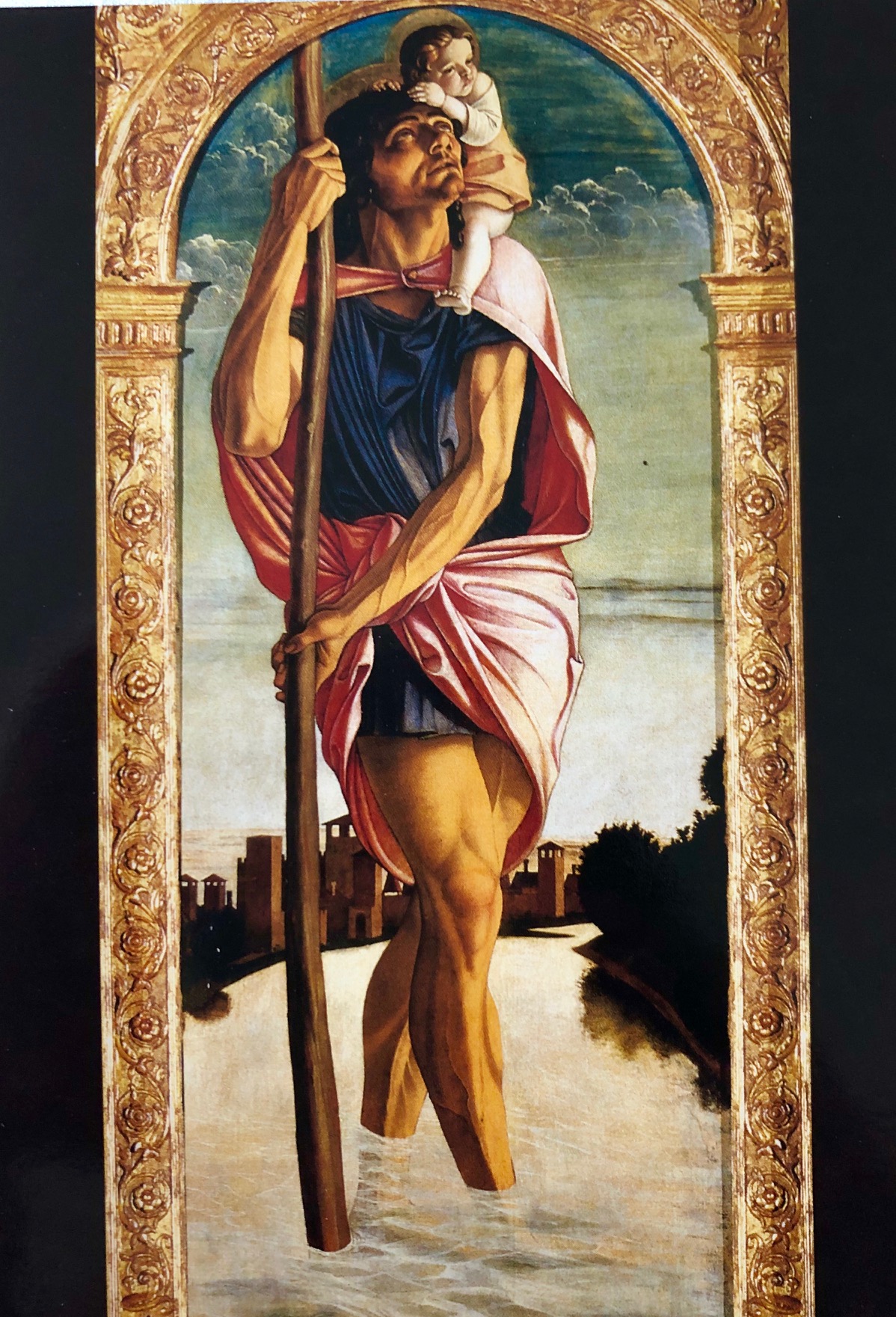
We looked at San Cristoforo and the assemblage of Giovanni Bellini paintings. Each one was large on its own. Framed in gold, the entire altarpiece composition (called the Saint Vincent Ferrer altarpiece, I later learned) spanned nearly nine feet in height.

IMG_9918
San Cristoforo by Giovanni Bellini (1464-1470)

I’m not an art historian, but a little online research revealed these paintings were not made with oils, but tempera paint on wooden panels. This particular one shows the Christ child being carried by Saint Christopher, a 3rd-century church martyr executed by the Roman emperor at the time.  The painting glowed under the light, and reminded me of another glowing Bellini at the Basilica dei Frari. It seems Bellini knew the tempera medium well.

We walked to the other painting we had been permitted to see at no charge.

IMG_9919
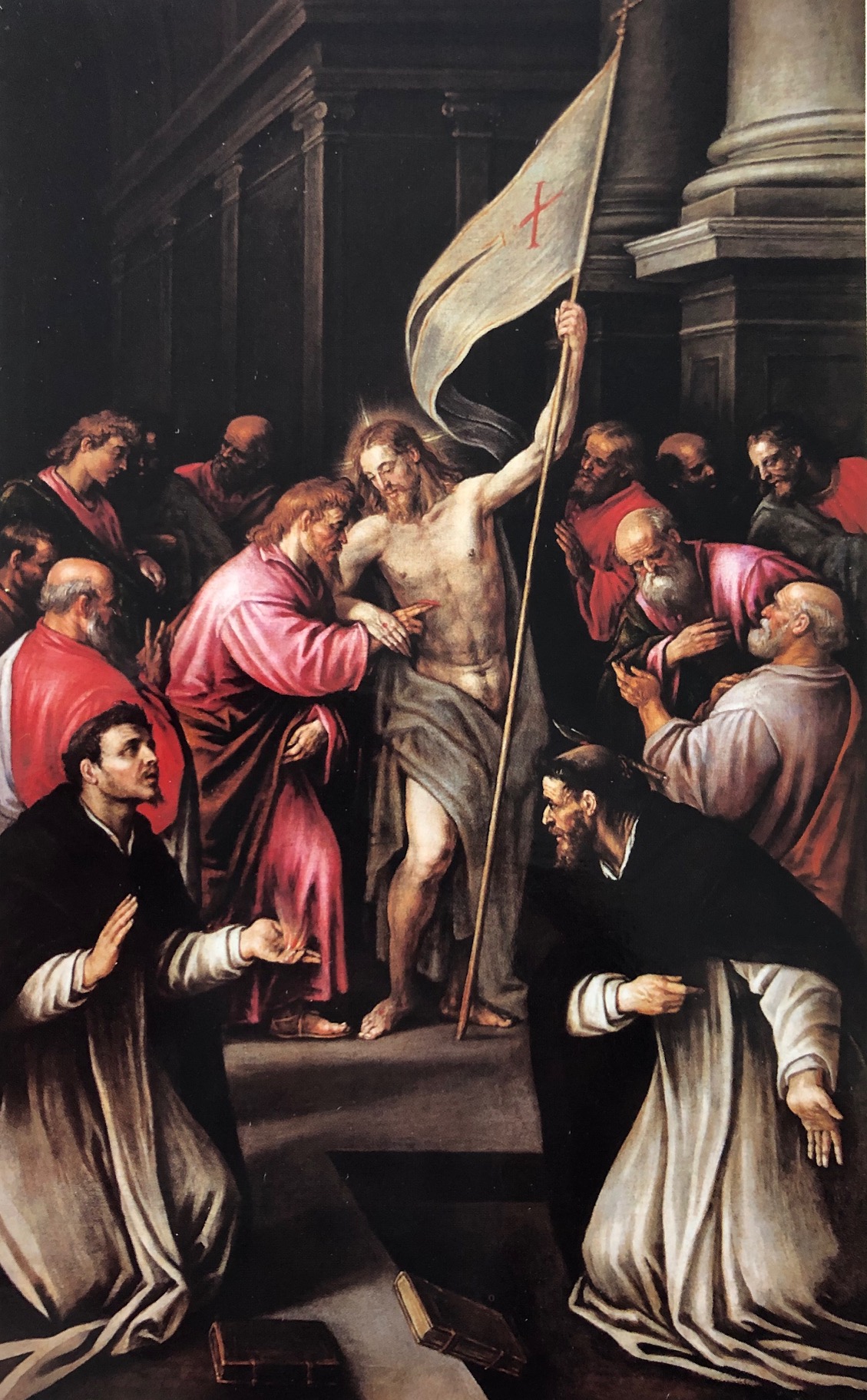
L’incredulita di S. Tommasso by Leandro da Bassano | Notice the books falling to the ground along the lower edge… to show the surprise of the onlookers when they realized that they were in the presence of the resurrected Jesus Christ.

This second painting,  L’incredulita di S. Tommasso by Leandro da Bassano was near the front of the church. It was dark and partially obscured by a screen of sorts. It shows Christ showing the doubtful Thomas his crucifixion wounds, proving the resurrection. I later learned that Leandro da Bassano was a famous painter who followed in his artist father’s footsteps and was later knighted by the Doge of Venice. Many of his works are confused with Tintoretto’s and are difficult to date.

We returned to the Bellini and switched on the lights one more time.

“Oh, thank you,” said a tourist staring at the painting who had entered after us.

We decided our visit was over. As we left, my daughter selected another postcard and paid. She offered the guard 5€ to thank him for allowing us in.

“No, no, you keep,” he said. “I just want to show you what you want to see. A postcard isn’t good enough. It’s how I make you… what to say… better tourists,” he said, smiling and shrugging his shoulders. I could tell he meant no offense by his remark.
He continued. “You know… when you’re inside a church here, tell the guard that you want to light a candle and say a prayer and they will let you in.”

Did I hear him correctly? I asked myself.

Still, I’m not Catholic, and using prayer as my ticket inside a church seems disingenuous. However, I did appreciate his candid tip and his enthusiasm for La Serenissima, the traditional name for the Venetian Republic.

We left the church and entered the campo, the large square outside. I knew I wouldn’t forget this brief encounter in a city coming to grips with the effects of mass tourism. Two weeks before, according to the blog La Venessiana, tugboats had allowed an out-of-control cruise ship to strike an occupied river cruise boat instead of Santa Maria della Salute. To compensate for the wear and tear that throngs of summer tourists wreak upon the city, officials are devising new tourism taxes.

In reflection, the guard at Basilica dei Santi Giovanni e Paolo was merely doing his part… politely doing what he could to help visitors he met to “be better tourists” in his city on the sea.

IMG_9718
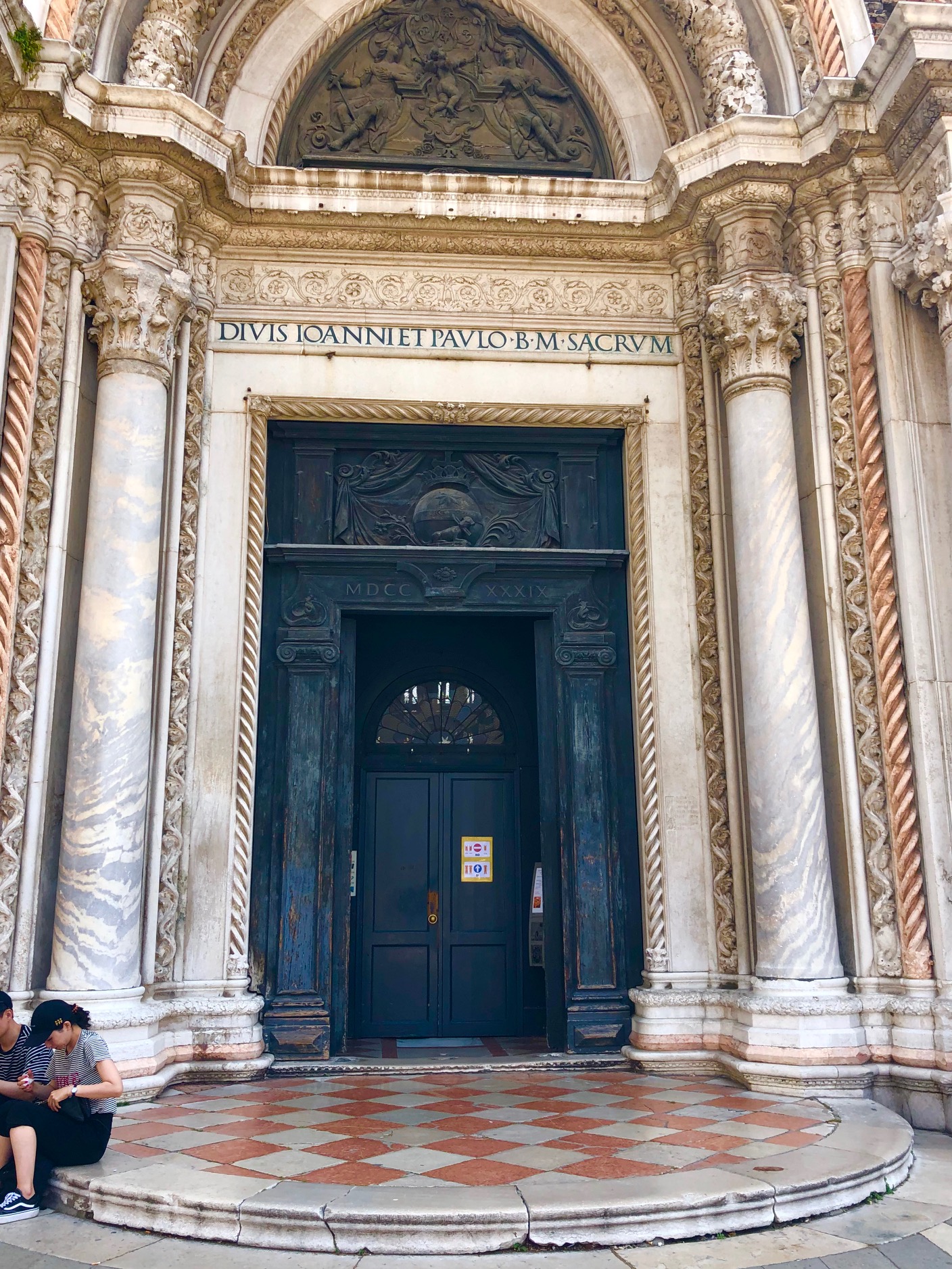
The entrance to Venice’s Basilica dei Santi Giovanni e Paolo | Photo: M. Yung

Featured Image: M. Yung

Categories
Italy (Venice)

Going to the hospital in Venice

H is for Ospedale

I’m betting that the question, “Wonder where the hospital is around here?” passes through the minds of most visitors to Venice… at least those visitors who stay on the island and think about where they would go if they twisted an ankle or suffered whiplash doing a double-take at an especially handsome gondolier.

Last Sunday, my daughter and I wound up at the hospital without really meaning to. We intended to go see the church, Basilica dei Santi Giovanni e Paolo (the Basilica of St. John and Paul). In 2017, I had purchased a little folding picture book of the top ten Venice sights and this church was on that list.

During the week that we visited back then, we simply didn’t get everything accomplished. Back home after our trip, I realized that if I was ever to return to Venice, this church would be on my list of sights to see.

And when one sees this church, one also has the opportunity to see the Venice hospital, the Ospedale SS Giovanni E Paolo Venice. That’s because the church is literally connected to the hospital building. You can enter the hospital from either the black front doors (as seen in the photo above) or you can enter from the backside, which borders the waters of the lagoon.

My daughter and I decided to take the water route around the back of the island. My daughter had never actually ventured on the vaporetto route past her Santa Elena stop, so this was a first-time experience for her, too.

Here’s the sign in the vaporetto bus stop that shows the stop for the Ospedale (Italian for hospital). Note the international symbol for hospital, “H,” below the line.

IMG_9700
Signs like these are posted inside the vaporetto bus stops.
IMG_9702
My daughter has become especially adept at navigating around Venice on water buses, known as vaporetti.

We traveled around the backside of the island to eventually arrive at the church; we didn’t realize it at the time, but the church is joined to the hospital.

castello-map
This map is courtesy of The Venice Insider. The “3” in the picture above marks the hospital’s location. Santa Elena is included in the area inside the green oval.

Here are some more pictures from the vaporetto ride around to the hospital and the basilica.

IMG_9703
The park-like Santa Elena neighborhood of Castello in Venice features lots of bright red wooden park benches.
IMG_9704
This is a view of part of The Arsenale, the area within Castello that was once included shipyards and armories.  The unique “Building Bridges” hands sculpture by Lorenzo Quinn has been installed to commemorate the Venice Biennale.
IMG_9708
Almost there! More of the Arsenale area.

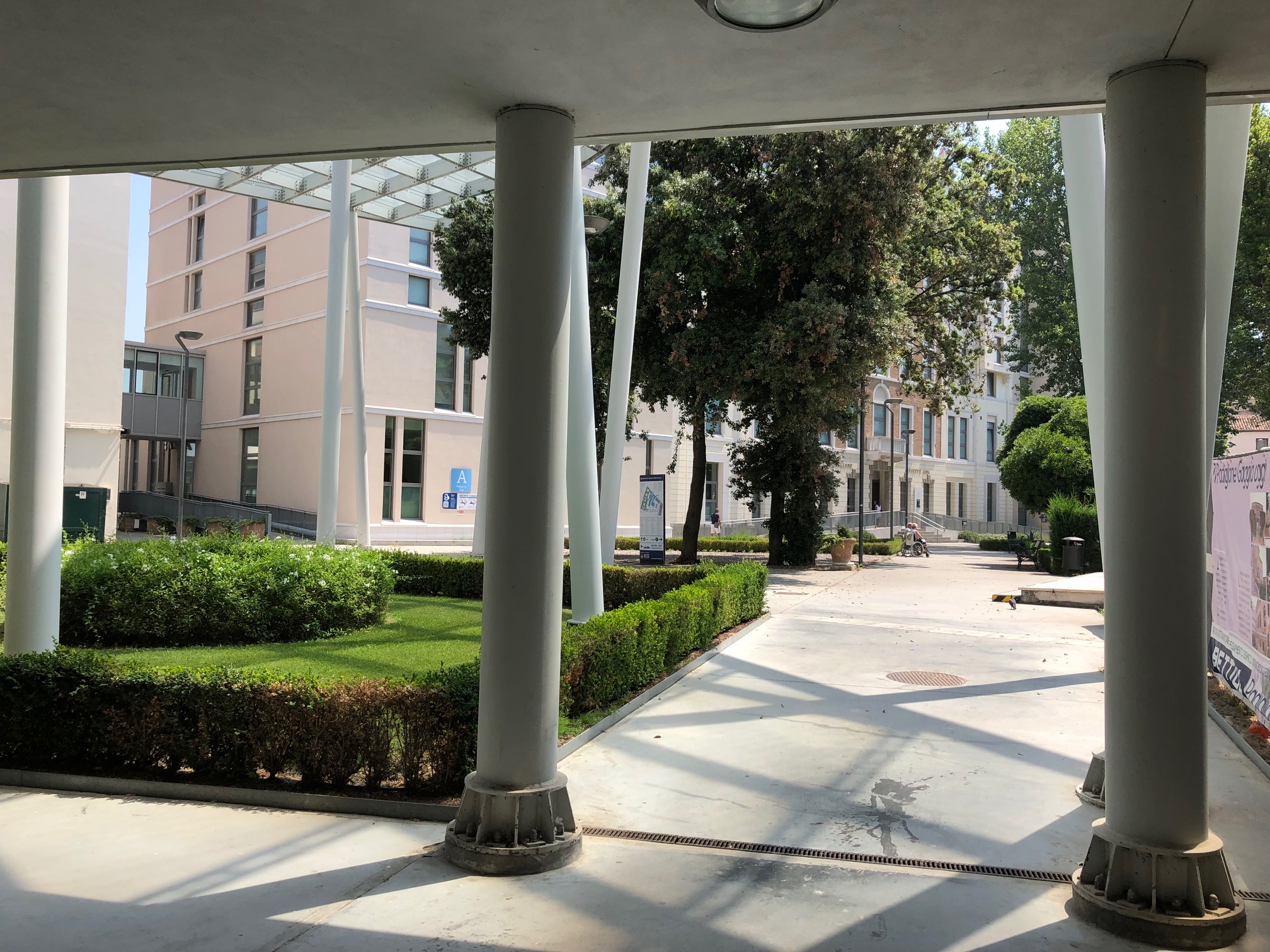
According to The Venice Insider, the hospital grounds are not open for tourists. That being the case, I hesitated to take lots of pictures. However, I did snap a few. Here’s a picture of a modern-looking inner garden area you’ll walk through after leaving the vaporetto and walking through the first doors you come to.

IMG_9711
I took this picture after walking through this inner courtyard.

Katherine’s roommate had told us to look for the gardens with all the cats. We thought that this was the garden she meant. We were wrong, as you will soon see.

Before we would find the garden full of cats, we walked by the Emergency Room doors. Here it is, for all you ankle twisters or gondolier gawkers:

IMG_9712
The E.R.

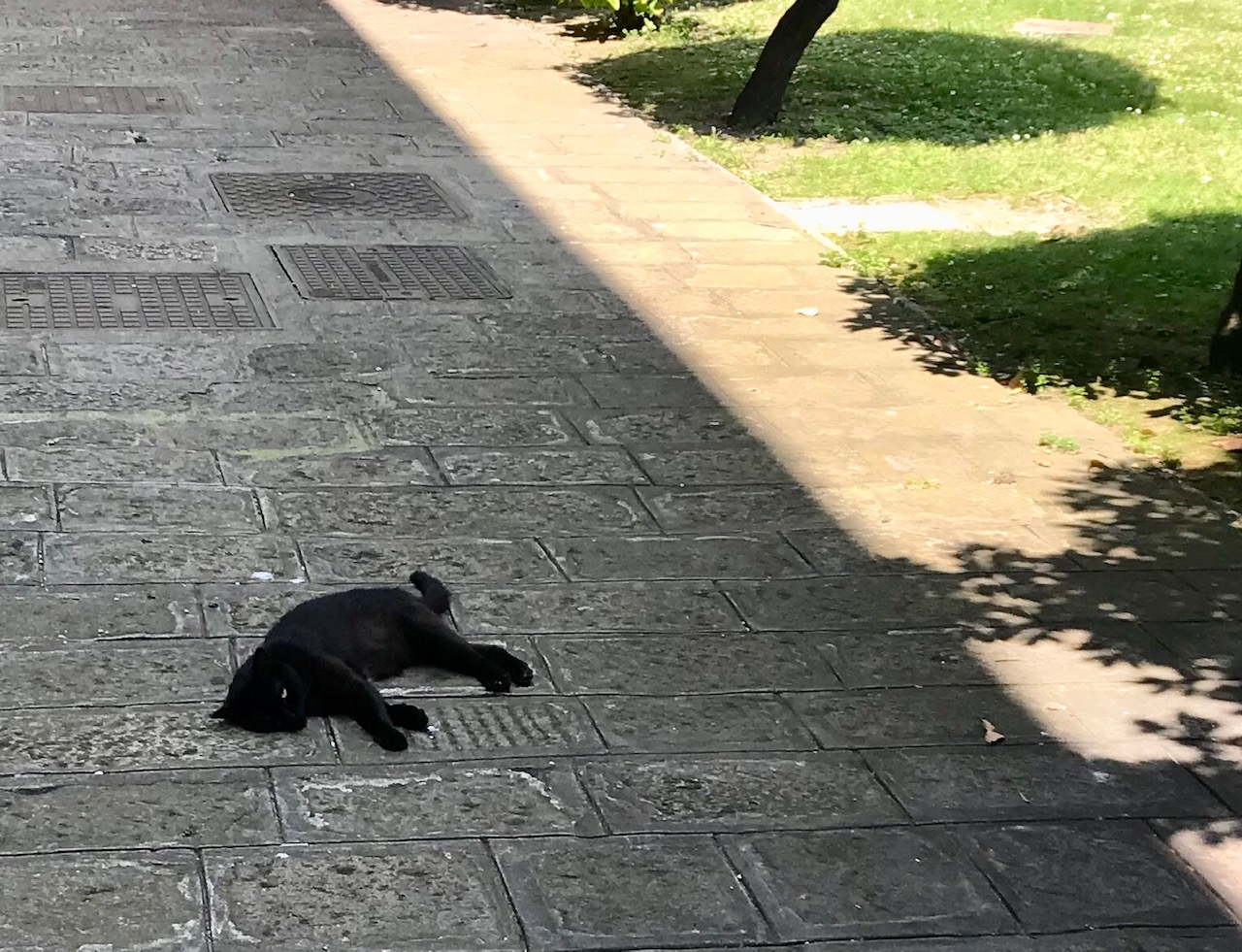
Keep walking past the ER and you will eventually arrive at a beautiful garden, surrounded by loggia walkways and filled with about a dozen stray cats.

Residents and visitors alike care for Venice’s many feral felines. The kitties are quite comfortable during the warmer months. I’ve read that the cat population can become a problem during cooler temperatures and that there are volunteer groups that help with the problem.

IMG_9714
Notice the black and white cat sleeping under the flower pot in the center of the photo. Photo: Katherine Yung
IMG_9917
Photo: Katherine Yung
IMG_9916
This cat is so relaxed we thought he was sick, or worse. No, just very content. Photo: Katherine Yung

After you exit the cat garden, you’ll pass through an exit where you can continue on to the wards of the hospital or turn left to the Scuole Grande, which leads eventually leads outside to the campo with Basilica dei Santi Giovanni e Paolo.

IMG_9713
This is a photo looking back outside from the hallway leading to the Scuole Grande, religious and social groups that provided charitable services, including hospitals. If you turn to the right outside these doors, you will return to the cat garden.

If you continue down these steps, you will enter this grand entrance hall. There are doors and hallways that lead from this hall. This is the Scuole Grande (see caption above). At the end of this hall, is the front door of the hospital shown in the elaborate facade in the first picture of this article.

IMG_9715
Entrance hall just inside the front facade entrance to the hospital. The cat garden and ER are at the far end of this hallway. Most people needing ER services would, I imagine, enter from the backside along the main waterway.

And this brings us to the front entrance of the hospital on the campo, the large square that is the “city center” of this area of Castello.

IMG_9716

In effect, this post has brought you to the hospital from the backside along the water, to the very front door, which is shown in this photo at the far left (see the oval-topped dark door that blends in with the light post).

And this also brings us to the close of this post. I will continue this post tomorrow with our visit to the basilica where you will meet a die-hard Venetian who gave us some very good and timely advice on how to be “better tourists.”


Thanks for reading! Tune in tomorrow for the continuation of our Sunday morning in Venice. Click like, leave a comment, and be sure to follow my blog for the next installment.