
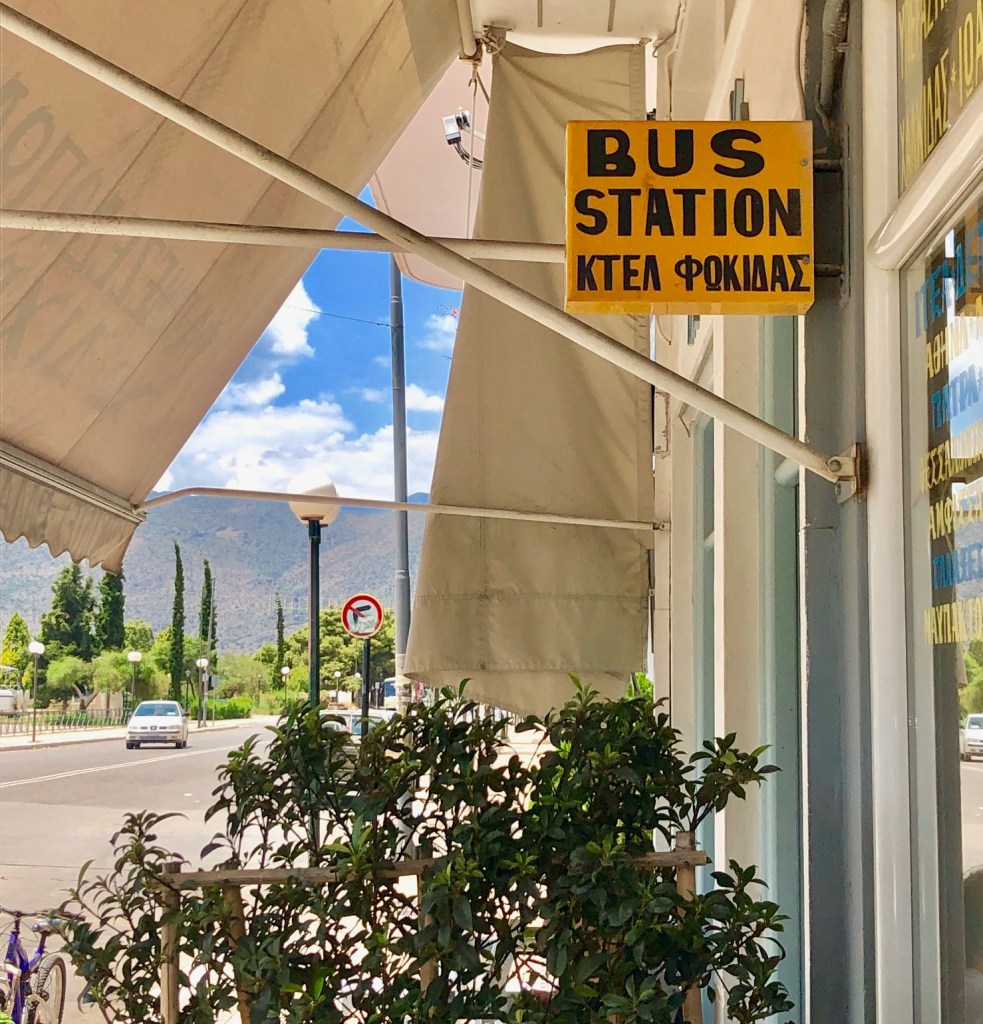
See this restaurant? It doubles as the Delphi bus station.
COVID-19 Preface: Greece officially reopens to travelers on Monday, June 15. According to this Associated Press story published today, “Timely and strictly enforced lockdown measures have so far kept the infection rate in Greece low and the death toll below 200.”)
It was a little confusing. The Delphi bus station appeared closed.
An arrow painted on the building facade, however, pointed to a restaurant called “In Delphi Cafe” next door. Nearby, a man wearing a crisp white shirt and black trousers, waved us down from his curious position in the middle of the street. (It’s a slightly confrontational technique to entice wandering tourists to stop for a bite.)
“Dinner menu?” he asked.
A bus schedule would be more like it, I thought, since my husband and I still needed to plan the next leg of our trip from Delphi to Olympia. We smiled, and asked, “Bus tickets?”
“Go inside the restaurant, please. Someone will help you there,” he answered.
We ventured inside. The restaurant immediately reminded me of the beautiful double-story trattoria from Love Actually where Jamie proposes to Aurelia. A balcony. Warm gold-colored walls. Heavy timbers. Sparkling glassware.
A woman behind the counter asked us if we needed bus tickets in plain-as-day English.
“Yes, we are going to Olympia in two days and we need bus tickets,” my husband explained.
She called to another waiter, who dried his hands and stepped to a computer at the bar.
So this is the bus station, I thought to myself. Hmmm. Interesting.
An employee wearing jeans, t-shirt, and a white apron wrapped around his hips walked in carrying a stainless steel container covered with plastic wrap. He had come from the direction of the “bus station” next door. They must use the “bus station” for storage, I thought.

Our waiter/ticket clerk stared at the computer screen, squinting, and asked us when we wanted to arrive in Olympia.
It would take all day, he said. Of course, that was fine.
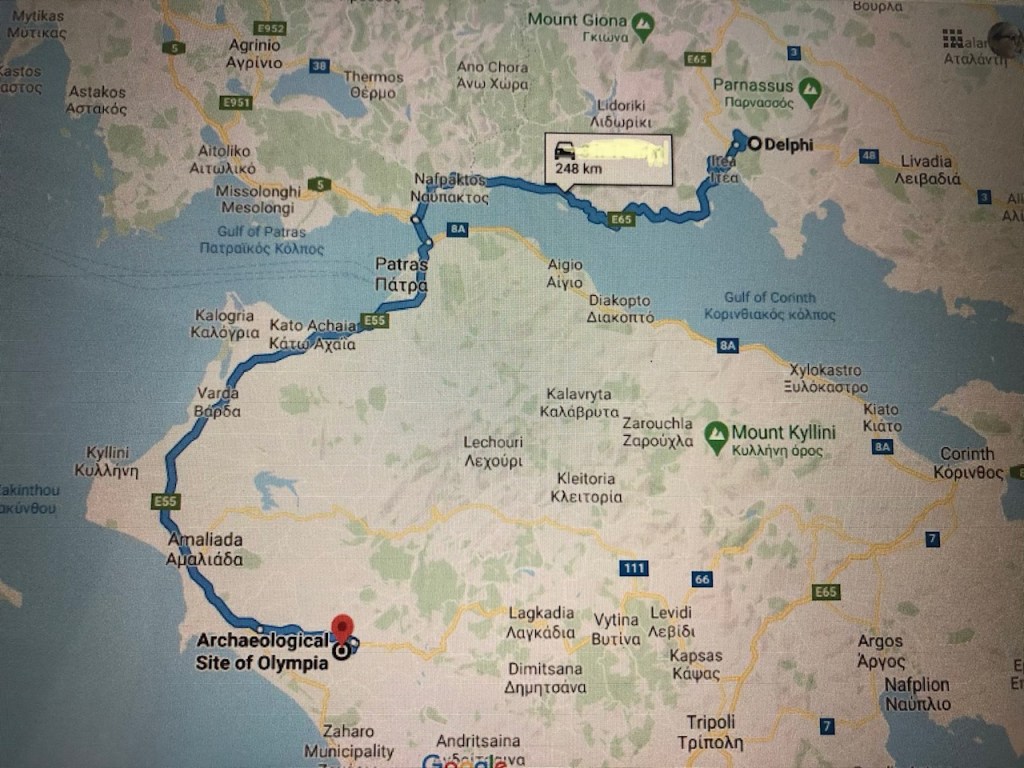
It was what we expected. For although it only appears to be a jog to the southwest on a map, the bus route would take us to Itea, a small town on the shores of the Gulf of Corinth just a few miles south of Delphi.
Then the route would trace the edge of the gulf for nearly three hours before crossing south into Patras. From Patras, we would take a bus to Pyrgos (NOT the Pyrgos on Santorini, by the way).
From there, a final bus would drive us the remaining thirty kilometers to Olympia, where we would meet our AirBnB host, the fifty-seventh (okay, not really, but it seemed like it) man named Kostas who we met on our trip.
Here’s the route our waiter/ticket clerk gave to us, written on the back of a receipt:

We purchased and received our tickets, thanked the young man, and told him we would be back for dinner.
THREE HOURS LATER…
Roast lamb, moussaka, wine, potatoes, salads… all served on a candle-lit table under the leafy branches of a tree so large it sheltered like an umbrella not only the peninsula that served as the outdoor seating area for the restaurant, but also the two streets that ran on either side.

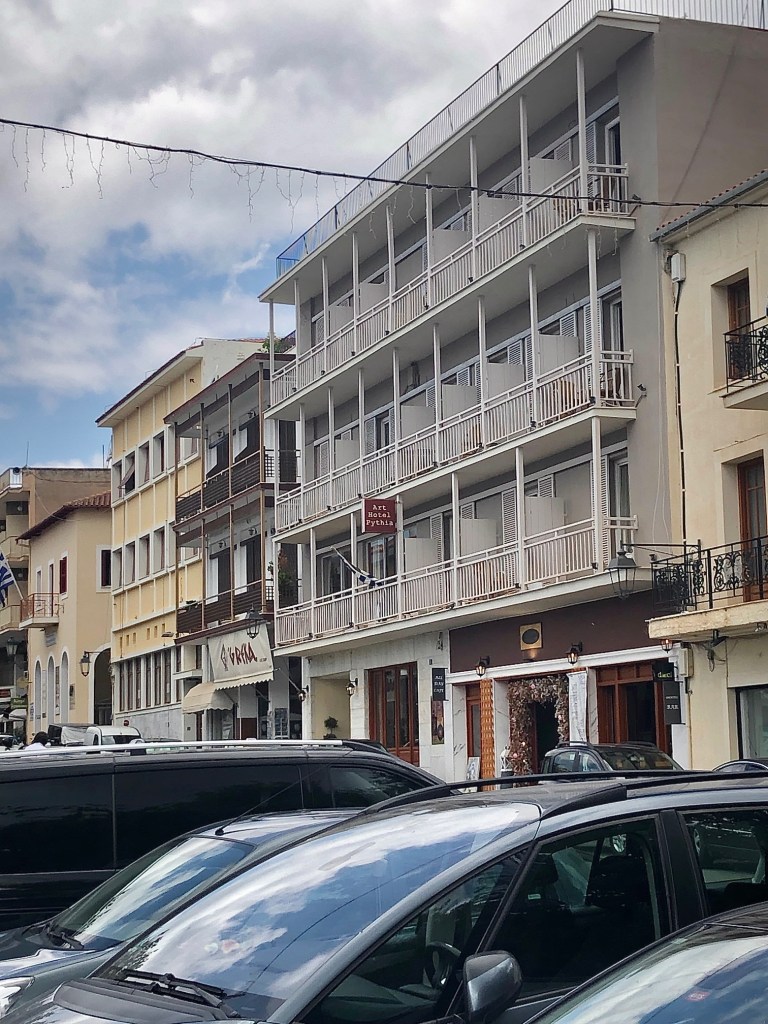
Below is a photo of our hotel, Art Hotel Pythia, in Delphi…it was manned by one employee. In the mornings, he had to cover BOTH the front desk and the upstairs dining room simultaneously. Speaking of the upstairs dining room, it offered a very generous and complete complimentary breakfast selection of eggs, meats, fruits, cereals, coffee, pastries.
It was fabulous breakfast, even though it had been overrun by a large traveling group of students who had already dined and left. Tables were littered with used china and glasses, since the one staff employee hadn’t been able to leave the front desk to clean. Still, there were pastries and eggs to be had, and it was nice to see actual dishes being used instead of paper and plastic.
We sympathized with the employee and knew he was doing the work of three to four people.
This hotel with its impossibly small staff caused us to wonder about Delphi’s economic outlook. The town appears to be a sleepy village holding on for dear life during Greece’s financial crisis. Across the street from Art Hotel Pythia was an abandoned multi-story hotel that was probably packed during the Olympic Games in 2004.
Thank goodness for the amazing archaeological site just down the road! Read my post about the site here.
The day we departed Delphi, we left our hotel around 11 a.m. and waited outside the restaurant/bus station for the large, air-conditioned bus that arrived about fifteen minutes late. We loaded our luggage into the lower bins of the bus and boarded.
It was a packed bus. There was a group of about ten kids travelling to the beach at Itea. Like kids everywhere, they were talking and joking, laughing over shared phone screens.
Our bus made its way down to Itea on the shores of the Gulf of Corinth, which you can see in the distance in the photo below. This was a beautiful drive with two or three tight hairpin curves.

The weather was warm and sunny when we left; as we drove, the temperature rose. Thankfully, our bus was comfortable and air-conditioned.

After passing more and more olive groves on the way, we eventually stopped at the bus station in Itea on a road that fronted the shore of the Gulf of Corinth.
Itea was a quiet little town that, based on the many outdoor cafes and shops, we could tell would be busy with tourists in July and August.
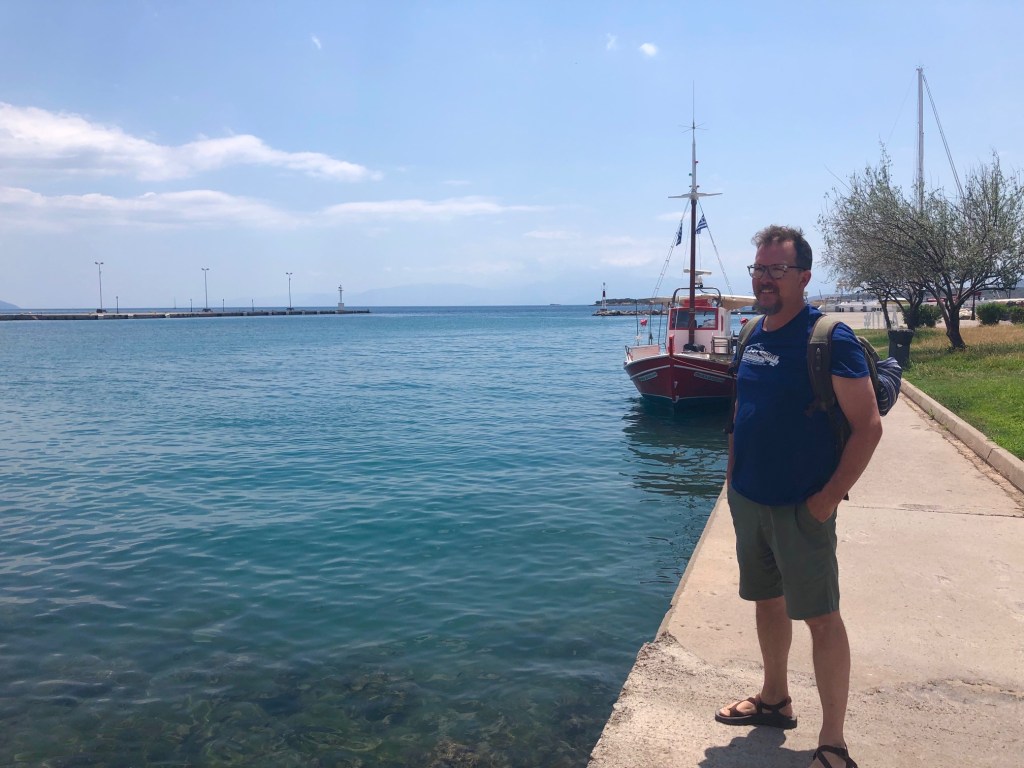
I took this photo of my husband Mitch standing across the street from the bus station at this small dockside park.

We were nervous about missing our bus to further points south, so we crossed back over to the bus station and waited. The bus station was little more than a hallway with a counter at the back, so we couldn’t wait inside where it was warm. Instead, we bought spinach pies at the small restaurant next door and ate them sitting outside on the sidewalk next to our four pieces of luggage.
And then we waited. It was fun.
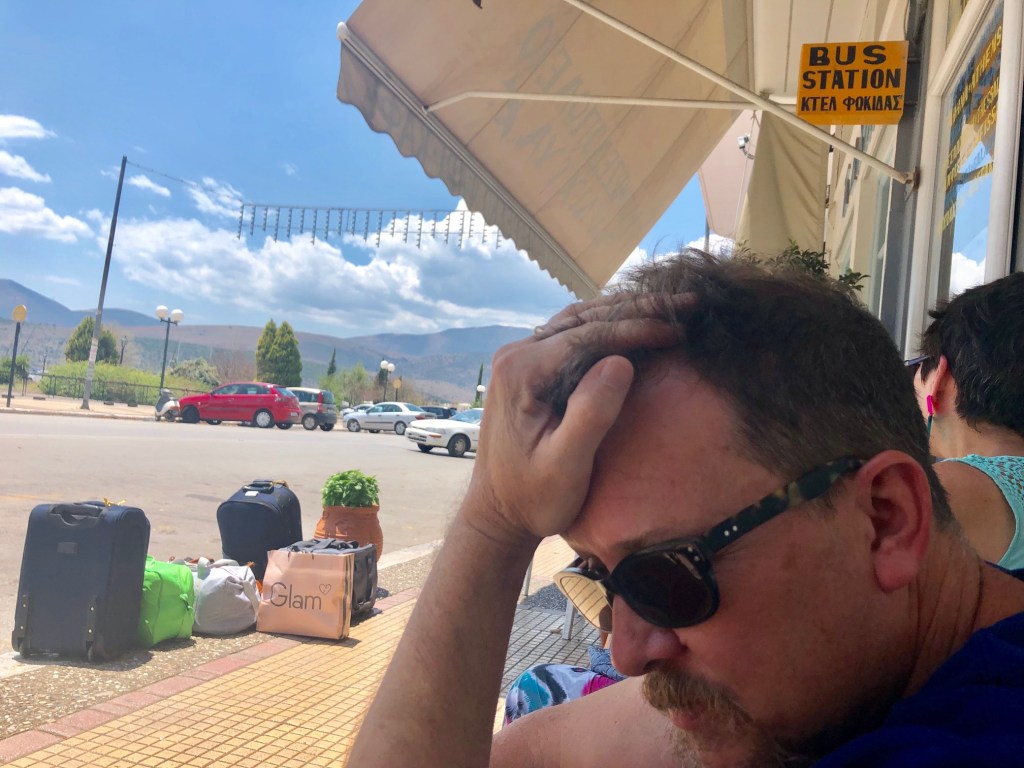
Our bus finally arrived and we boarded, knowing this would be a much longer leg of the trip than the short jaunt down the hill to Itea from Delphi.

Our bus ride meandered part of the way through the lowland hills along the coast of the Gulf of Corinth.
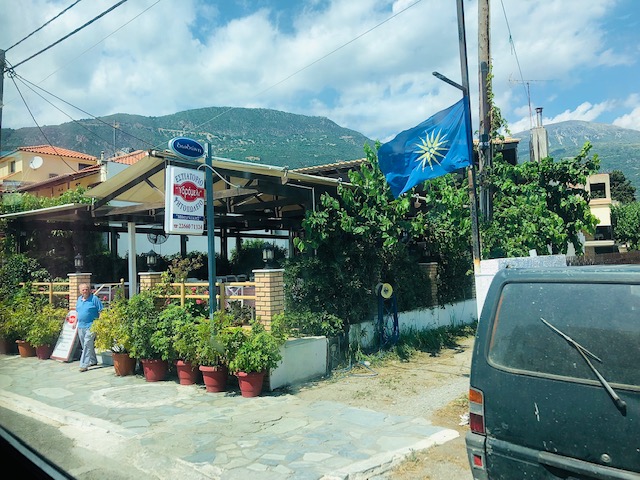
We stopped here and there at several towns to drop people off and allow others to load. In the photo above: a market along the way.
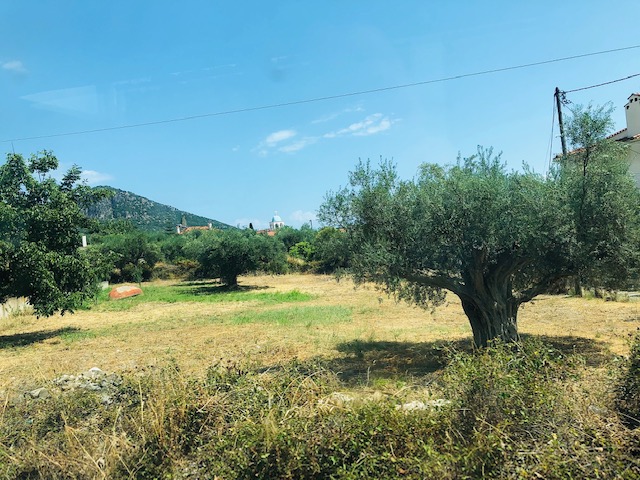
Of course, olive trees were everywhere, tucked into any field available. Note the Greek Orthodox church on the horizon.
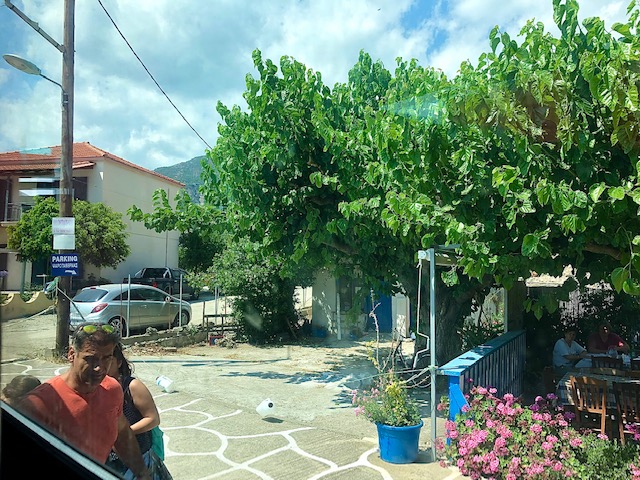
We stopped several times to board more passengers.

Driving along the coast often meant driving about twenty feet from the water. Waves splashed onto the road in several places.

We passed through several nondescript towns. Many have boarded up or shuttered stores and offices. Greece’s financial state is quite obvious, especially in the more remote and smaller towns. Last summer, some blamed the Olympic Games for at least part of the economic crisis.

Along the road, we would often see Olympic statues such as this one that traces the route the torch bearers took as they carried the flame toward the games in Athens in 2004.
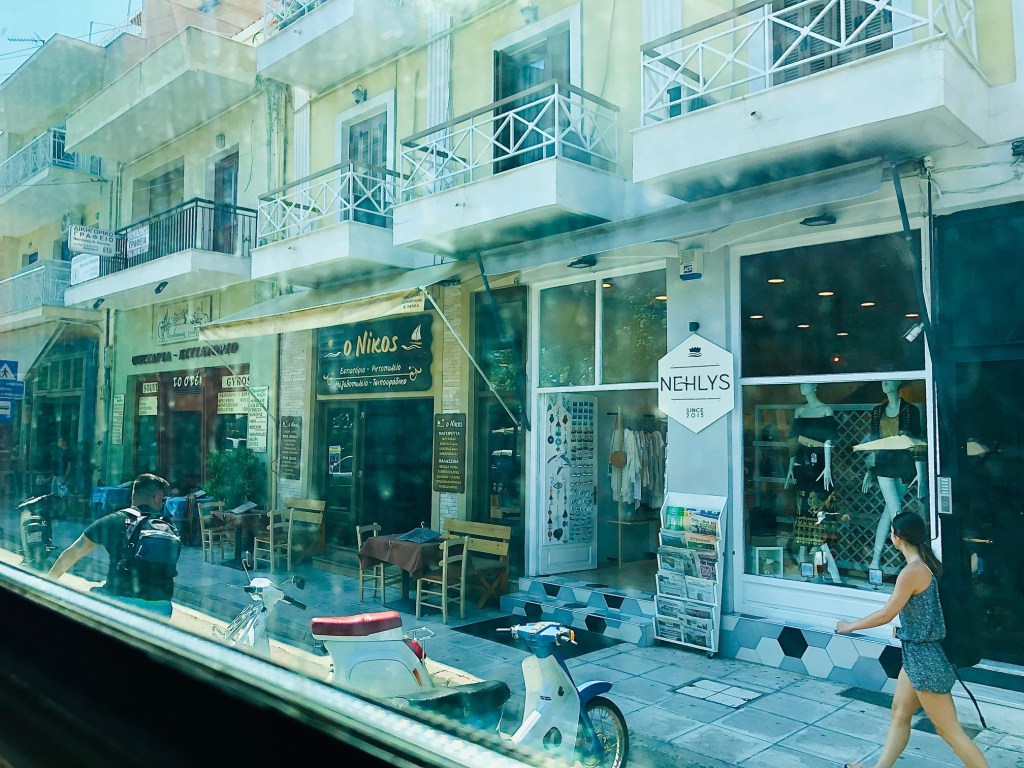
We were nearing Patras, Greece’s third largest city (after Athens and Thessaloniki).

This majestic bridge can be seen from a distance. It’s the doorway into Patras and points south on the Peloponnese peninsula


This photo shows another point on the Olympic torch trail.

We were dropped off in Patras as this bus station. After going inside and inquiring about our next leg of the trip, we discovered we needed to be three blocks away at a different station to meet our bus, which was scheduled to leave in about fifteen minutes.
The only solution to get there quickly was to walk.
We each grabbed our carry-on and pulled our jumbo suitcases and took off for the right train station. We charged through empty sidewalk cafes, deserted in the mid-afternoon. At one, an employee was hosing down the seating area. The coolness from the water kept us moving on.

We finally made it to the Patras train station. As Mitch took care of buying our tickets inside, I waited outside to make sure we got on that bus.
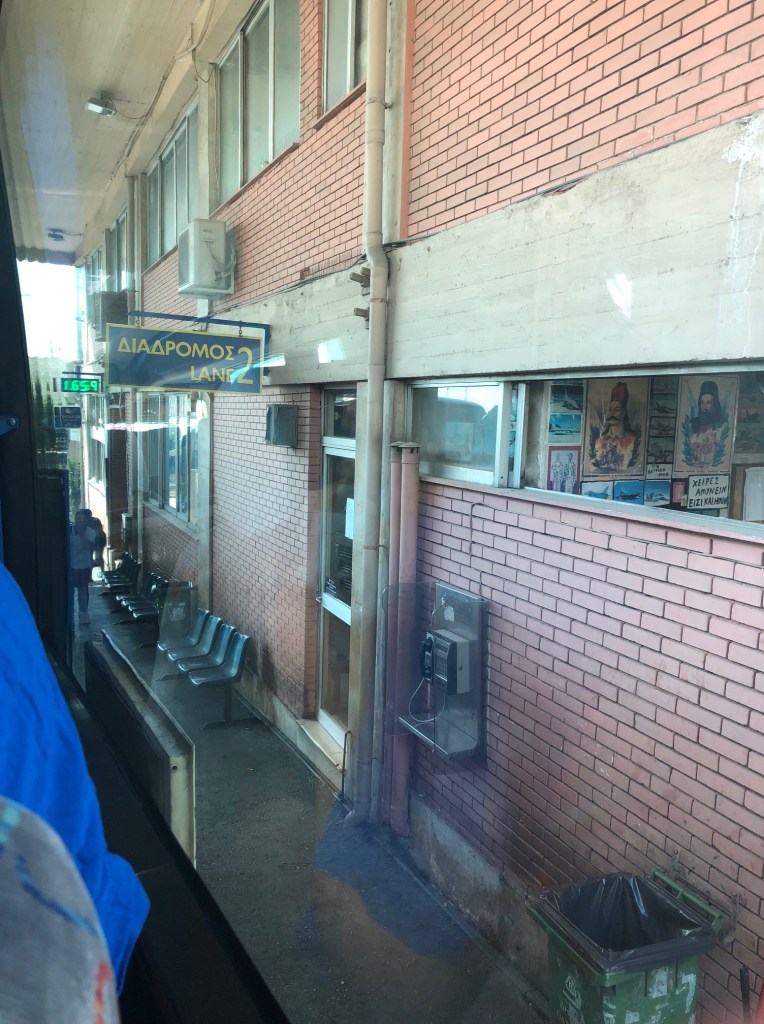
Which we did.
Safe and secure in another air-conditioned motorcoach, we settled in for our next-to-last leg of the trip to Pyrgos.
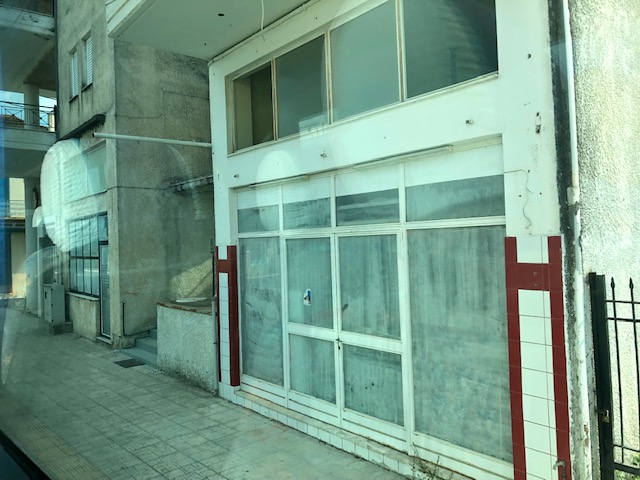
This leg of the trip held its own frustrations for us.
We’re not absolutely sure, but we think we booked a local bus that stopped numerous times. One city we spent an especially long amount of town in was Amaliada. Either our bus driver was lost or he was just playing a trick on us because we spent about an hour piddling our way back and forth in this town.

More dawdling in Alamiada…. but we did spy another church and some non-touristy scenes of typical Greek living: old men sitting at card tables outside of cafes or clubs, kids playing in playgrounds, young men drinking beer in the brittle, dusty grass of an abandoned city park. (I rarely saw women out visiting and socializing, by the way.)
True, Amaliada wasn’t Skopelos, but part of the reason we took bus transit was to see an unfiltered version of Greece. In fact, check out our neighborhood where we stayed in Heraklion.

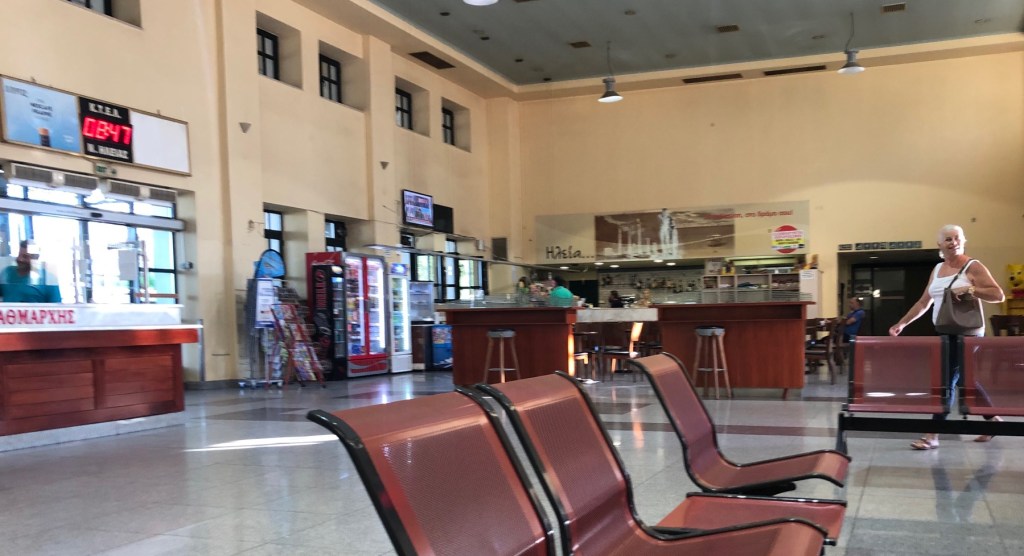
Victory! We finally made it to Pyrgos… ten minutes late.
Our bus to Olympia had departed ten minutes before we arrived. Instead of trying to book another bus for the remaining thirty-mile ride, we opted to take a taxi instead.
It had been a long day, but the end was in sight. And what a different world it was from mountainous Delphi!
Welcome to Olympia! Yesssss.
We met our AirBnB host, the sixtieth man named Kostas, for some friendly introductions. He met us in the middle of the street of our AirBnb, waving his arms to catch our taxi driver’s attention.

It’s quite a haul to get from Delphi to Olympia in one day, but it’s…
- quite possible,
- inexpensive,
- and full of scenery that runs the gamut from the beautiful to the mundane.
While we plan to rent a car the next time we’re in the Greek countryside, we are definitely glad we took the public transit options that were available on our first trip.
Even though taking the bus requires you to engage in some risk-taking, confusion, second-guessing, and moments that will test your patience, we would recommend it if you want to experience authentic Greece.
Thanks for reading! I’m amazed that story ideas are still surfacing from our travels last summer. Leave a like, make a comment and become a follower for more travel posts. While travel stories aren’t my only genre on this blog, they do seem to dominate my posts lately.
Featured Photo Credit: Marilyn Yung











 Marilyn Yung