Categories
Art & Architecture Italy (Venice)

Stepping Across a Controversy in Venice

This past June, I returned to Venice, Italy for five days to visit my daughter who was serving an internship at the U.S. Pavilion of the 2019 Art Biennale. While there, my goal was to experience a few sights I had missed in 2017 when we visited while she served another internship at the Peggy Guggenheim Collection, a small modern art museum on the Grand Canal. (By the way, I plan to write a future post about her overall experience with the PGC internship. If you, your child, or your grandchild are interested in a career in art museum operations or administration, this paid internship is worth looking into.)

There were three Venice sights I missed seeing in 2017: 1) The Basilica of St. John and St. Paul (known in Italian as the Basilica dei Santi Giovanni y Paolo); 2) The Venetian Ghetto (where Jews were compelled to live starting in 1516 and the origin of the English word ghetto); and 3) The Constitution Bridge (known in Italian as the Ponte della Costituzione).

On the last full day of my visit in June, my daughter and I took a vaporetto to Cannaregio, the part of Venice where the Jewish Ghetto and the Ponte della Costituzione are located.
IMG_9812
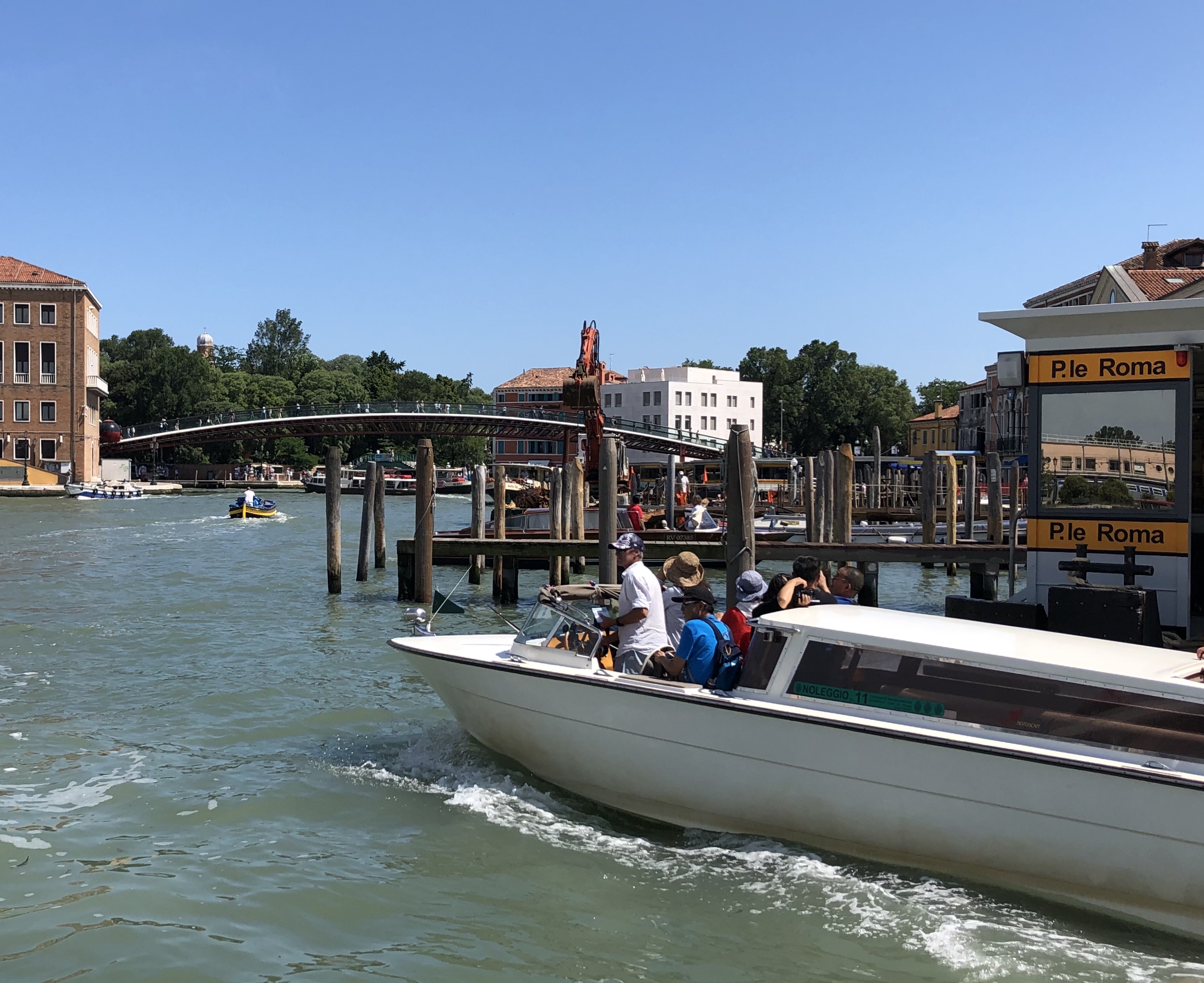
The Constitution Bridge is located at the busy bus terminal known as Piazzale Roma. | Photo: M. Yung

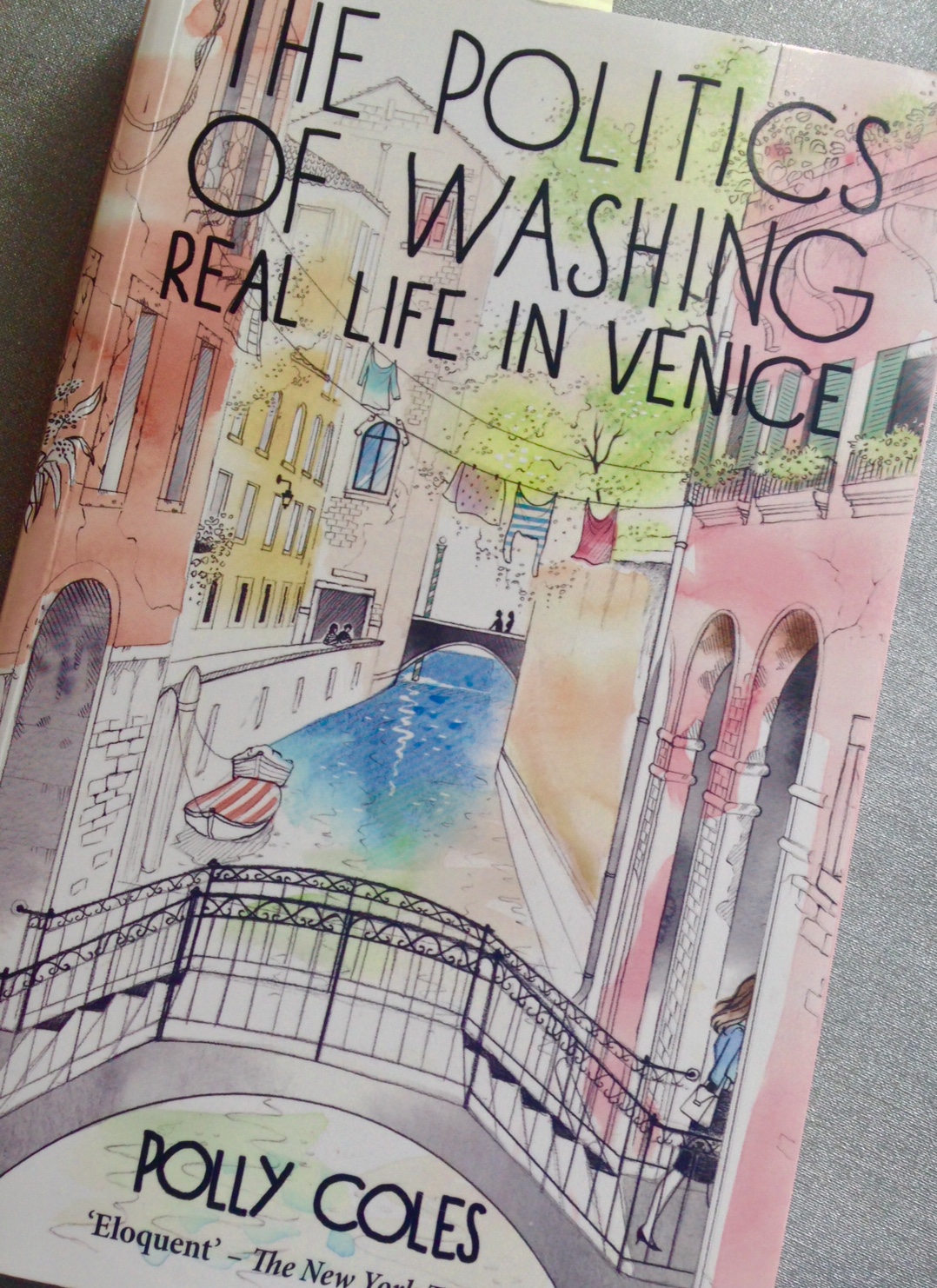
I had first learned of the famous bridge, one of four pedestrian bridges that cross from one side of the Grand Canal to the other, when I read The Politics of Washing: Real Life in Venice. This book, written by Venetian transplant Polly Coles, reveals the daily routines of ordinary Venetians who have made the lagoon city their home. (What’s it like to live in one of the most heavily touristed cities in the world? Read this book. Where are the schools, the hospital, the post office? Read this book.)

Within one chapter of her book, Coles tells of her own experience with the infamous pedestrian bridge designed by Spanish architect Santiago Calatrava.
FullSizeRender (14)

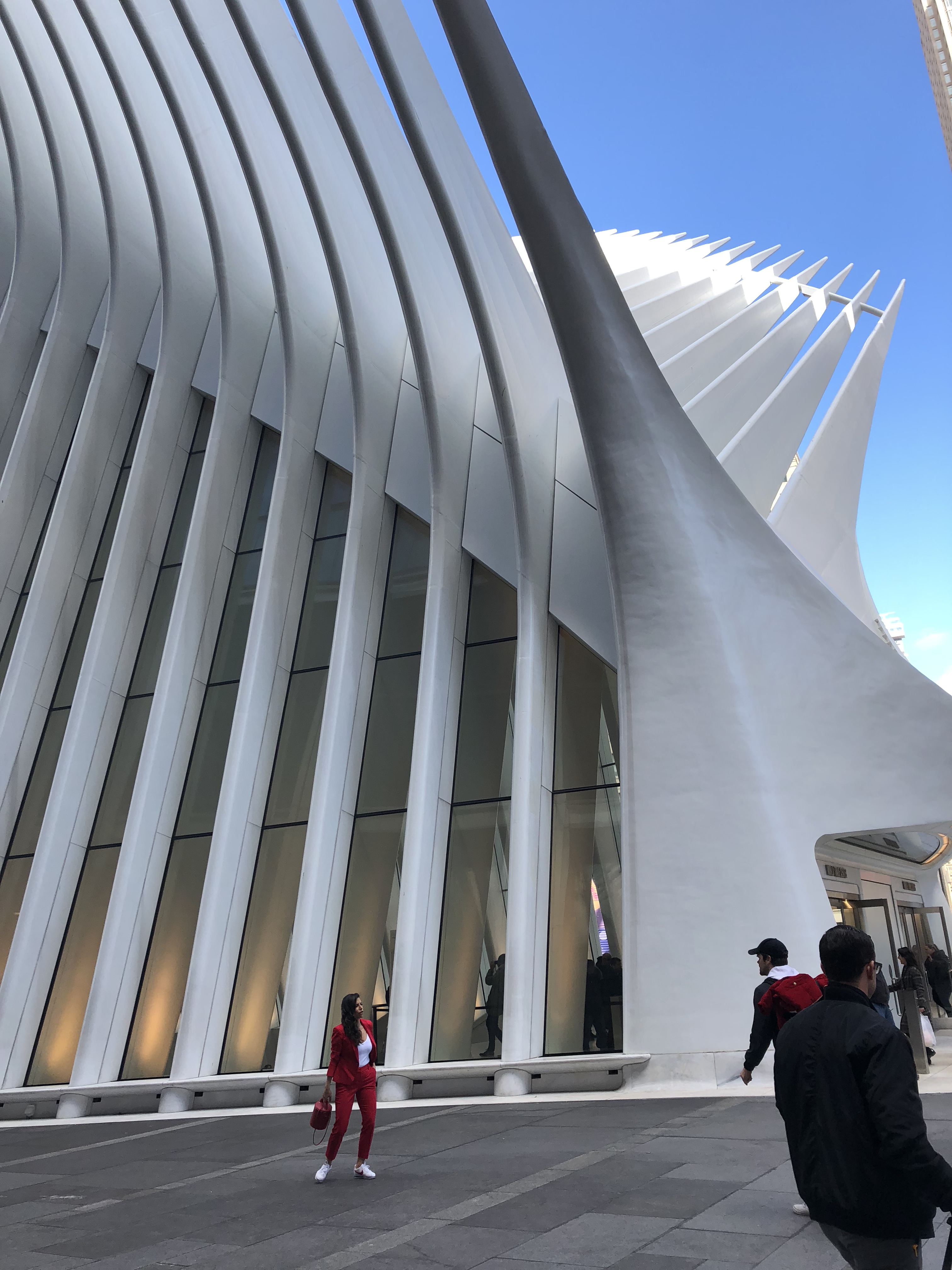
I first learned of Calatrava when we visited “Sculpture into Architecture,” a 2005 exhibition of the artist’s work at the Metropolitan Museum of Modern Art in New York City. The architect’s unusual skeletal forms intrigued me and still do today. For example, the Oculus transit hub near NYC’s One World Trade and the 9/11 Memorial & Museum is one of Calatrava’s more recent U.S. designs. The Oculus’ soaring bird-like structure is a fitting symbol of recovery and growth for the formerly devastated Ground Zero area.
IMG_8345
The Oculus at Ground Zero, New York | Photo: M. Yung

However in Venice, Calatrava’s bridge is a controversial piece of architecture that continues to gain attention today even though it was completed in 2008. Indeed, its troubles started long before the current ones. For example, during its construction, the bridge was budgeted to cost 7 million Euro, but wound up costing 11.6 million Euro. In addition, several delays were required during its construction.

Moreover, other problems have come to light since its construction and subsequent use. These have added to the bridge’s notoriety. Some of these problems include:

  • Limited accessibility for the disabled
  • Its modern design that conflicted stylistically with the city’s historic architecture
  • Its relative close proximity to other bridges that cross the canal, of which there are four in total
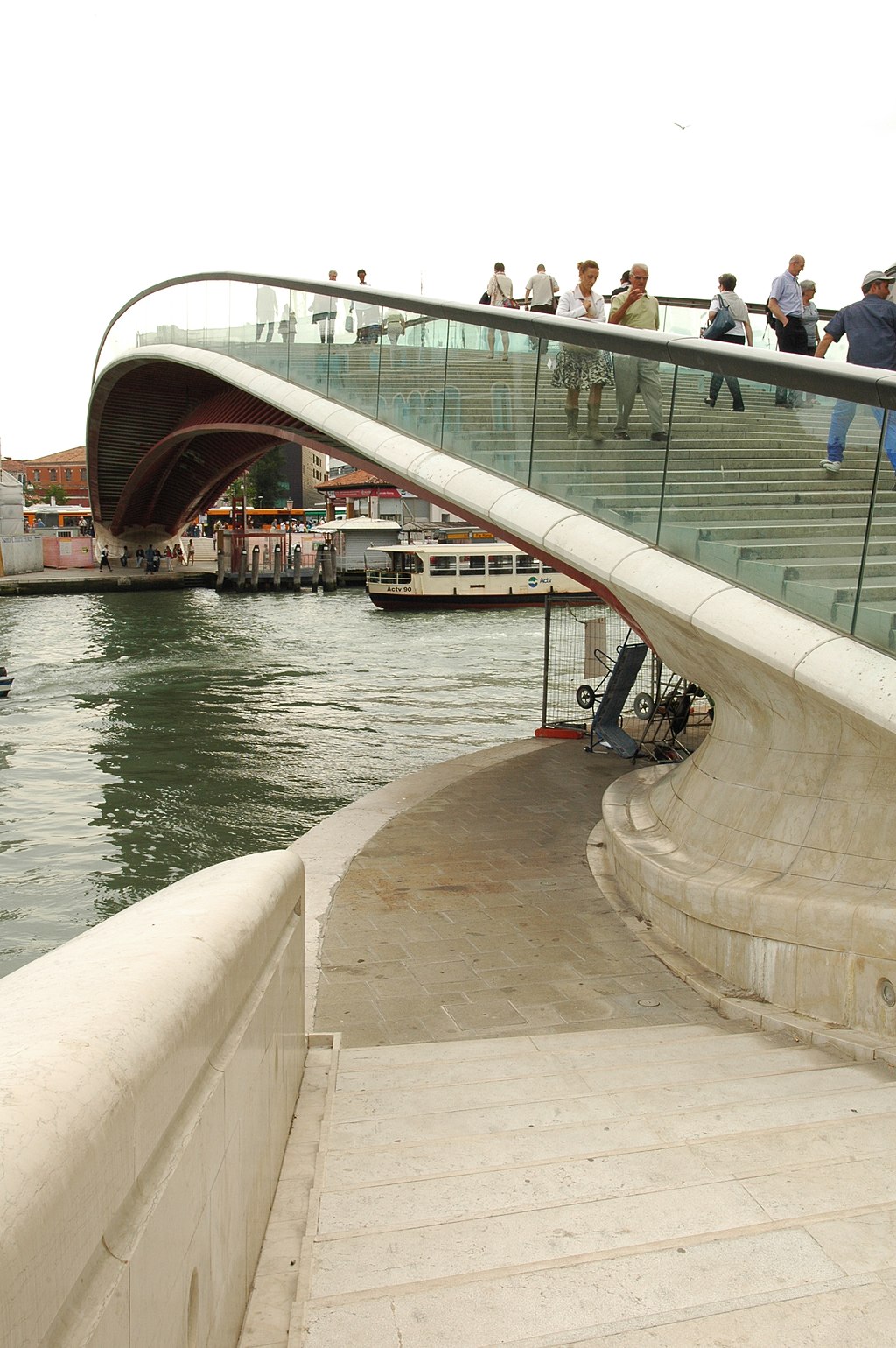
  • Glass panels that pedestrians walk on, which become very slippery in rain and even fog
IMG_9771
As you can see, the bridge’s upper surface is more like a glass arch. On dry days, it’s no problem, but on rainy days, it would be difficult to cross.  | Photo: M. Yung

In addition to the slippery surface, because so many tourists (and residents, alike) carry wheeled luggage over the bridge, the glass panels have worn down, which has caused damage to the panels and to pedestrians alike, if they should fall.

So how was my walk across Calatrava’s Constitution Bridge?

Let’s just say that I was glad it was dry the day we ventured across… it was slick even then. (But let me tell you… the marble steps on nearly every other Venetian bridge are slick, too. On these bridges –and there are hundreds across the city– I had to take care to avoid the worn-down, curved edge of each step where I had nearly fallen more than once.)

On Calatrava’s bridge, there is a narrow walkway of another material (stone? concrete?) you can step across on. And truth be told, that optional surface was more comfortable to use even though it was only a strip the width of a narrow sidewalk positioned in the middle of the walkway, far from a handrail.

But still, I will say this about the Constitution Bridge: it. is. elegant.

Its long arch gracefully extends across the canal. If you have the chance to take the lengthy stroll across it, do. Despite its controversy, the bridge is beautiful, simplistic, and a refreshing contemporary note amidst Venice’s historic facades.

It is also officially crossed off my bucket list.  Been there. Done that.


After traversing the infamous bridge, we then ventured on to find the Jewish Ghetto. I’ll write about this district, which provides the actual origin of the Italian word “ghetto,” as well as the museum title. Stay tuned for that upcoming post, as well as the post about the Peggy Guggenheim Collection internship.

Click like and feel free to leave a comment!

Categories
Art & Architecture Italy (Venice)

Venice Doesn’t Need Another Tourist Like Me

It just wasn’t as elaborate as I thought it would be, I thought as I surveyed the interior of Venice’s Basilica dei Santi Giovanni e Paolo. Yes, it was beautiful, just not as beautiful as I expected for a “Top 10” ranking in the little book about Venice I had at home.

A sign at the door had notified us of a 3.50€ entrance fee to enter. My daughter and I both agreed that this view from the doorway would suffice. After all, we had been in many other Venetian cathedrals or basilicas.

Just two days before, we had ventured inside the Chiesa di Santo Stefano in the San Marco sestiere.  The previous day, we had taken loads of photos inside Basilica di San Petronio in Bologna. The next day, a second tour inside Saint Mark’s Basilica was on the agenda. And then, two years earlier we had made time not only for Saint Mark’s, but also the Basilica dei Frari, Chiesa di San Zaccaria, and of course, the iconic Basilica di Santa Maria della Salute. In short, we had seen many.

However, I liked the idea of at least a souvenir from Basilica dei Santi Giovanni e Paolo. The rotating stand at the edge of the entry steps might have one I could purchase. I spun the stand, picked out a couple of cards and stepped over to an ornate kiosk. From the back, a man entered the darkened kiosk.

He had just finished setting up for the day—repositioning the “No Photos” sign, stacking up the 1€ kimonos available for purchase by bare-shouldered women, arranging a selection of votive candles.

I slid the two postcards under the slot in the kiosk’s Plexiglass shield. The man looked intently at each one and then met my eyes.

“Did you see the originals?” he asked.

“No.” How could I explain in my non-existent Italian that we had already seen so many churches in this great city? He straightened the cards in his palms with a tap on the marble counter.

“Okay, you must see the originals.” He stepped out from the kiosk and stepped around to meet us. Grabbing the velvet partition rope, he said, “Come with me.”

He handed me the postcards, and we followed him into the cool darkness of the basilica. He strode purposefully to a mammoth collection of oil paintings on the large wall to the right.

As he walked, he spoke over his shoulder, “It’s a crime to come to Venice and buy a postcard and not see the original because you don’t want to pay three-fifty Euro.”

Ouch, I thought.

Here was a Venice enthusiast if I had ever met one. Flashing his dark eyes from beneath even darker curls, he continued: “I will show you the two paintings on your cards.”  He stepped over to the wall behind the oil paintings and tapped a small plastic rectangle. Click. Light saturated the paintings.

My daughter reached for my postcards for a closer look. “This is a Bellini—those are why this church is on the list. These are special,” she whispered.

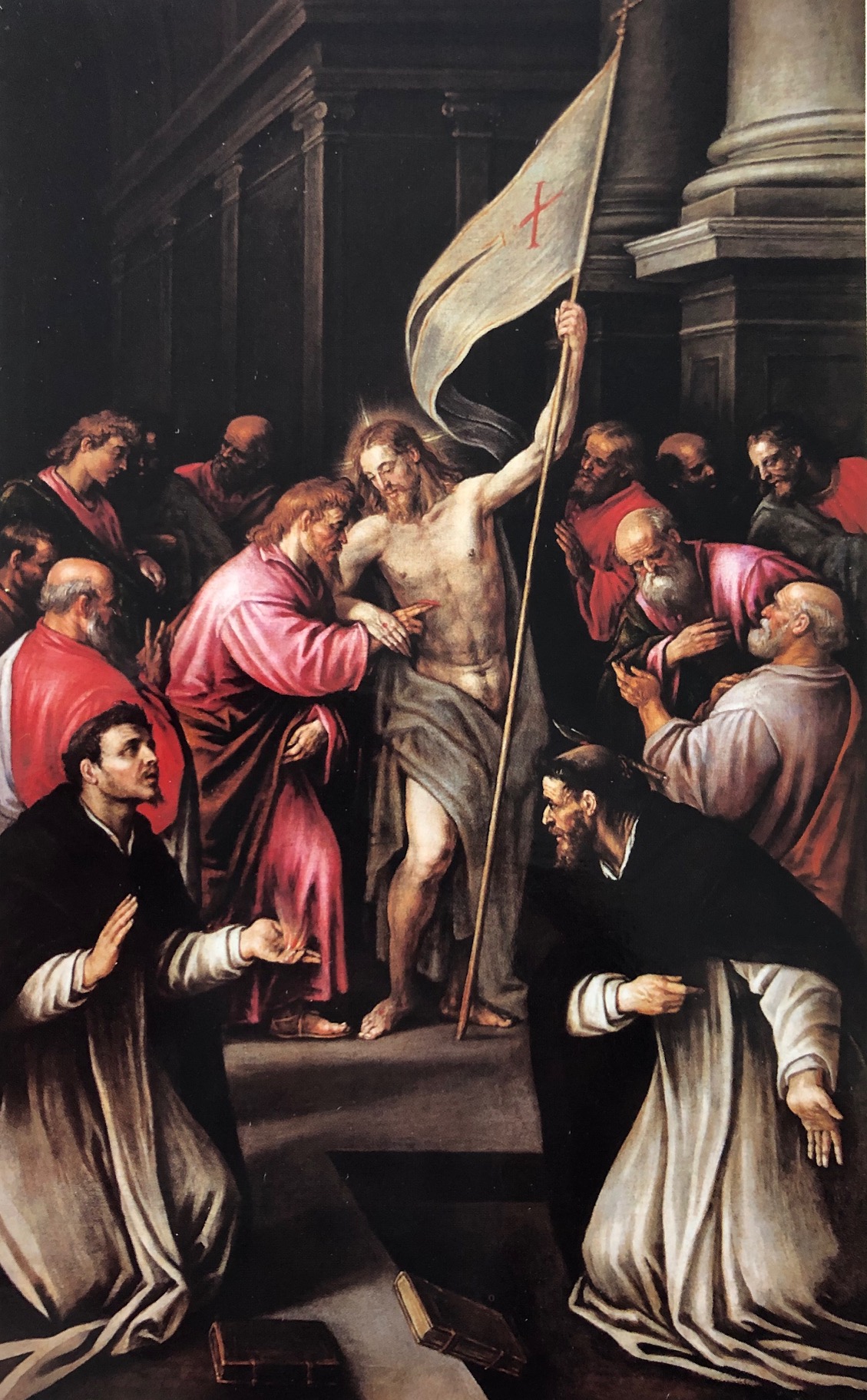
“Here is the Bellini,” he called from the light switch.”You look at this one, then go over to that one”—he pointed further into the nave directing our eyes to the darker painting of Christ with the apostle Thomas by Leandro da Bassano— “and then come back and see this one again. You turn on the light if you need to.”

“We will. Thank you,” I told him.

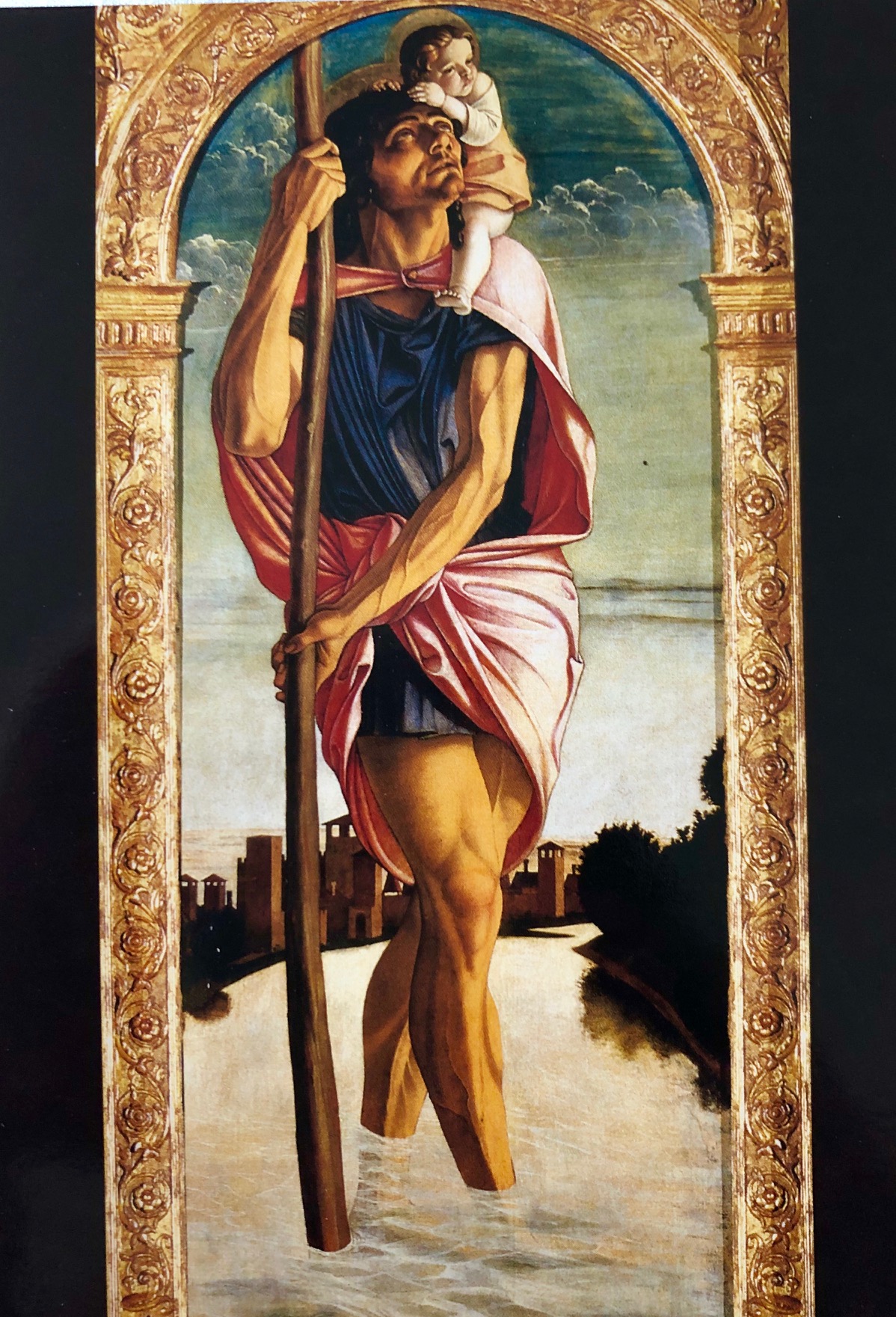
We looked at San Cristoforo and the assemblage of Giovanni Bellini paintings. Each one was large on its own. Framed in gold, the entire altarpiece composition (called the Saint Vincent Ferrer altarpiece, I later learned) spanned nearly nine feet in height.

IMG_9918
San Cristoforo by Giovanni Bellini (1464-1470)

I’m not an art historian, but a little online research revealed these paintings were not made with oils, but tempera paint on wooden panels. This particular one shows the Christ child being carried by Saint Christopher, a 3rd-century church martyr executed by the Roman emperor at the time.  The painting glowed under the light, and reminded me of another glowing Bellini at the Basilica dei Frari. It seems Bellini knew the tempera medium well.

We walked to the other painting we had been permitted to see at no charge.

IMG_9919
L’incredulita di S. Tommasso by Leandro da Bassano | Notice the books falling to the ground along the lower edge… to show the surprise of the onlookers when they realized that they were in the presence of the resurrected Jesus Christ.

This second painting,  L’incredulita di S. Tommasso by Leandro da Bassano was near the front of the church. It was dark and partially obscured by a screen of sorts. It shows Christ showing the doubtful Thomas his crucifixion wounds, proving the resurrection. I later learned that Leandro da Bassano was a famous painter who followed in his artist father’s footsteps and was later knighted by the Doge of Venice. Many of his works are confused with Tintoretto’s and are difficult to date.

We returned to the Bellini and switched on the lights one more time.

“Oh, thank you,” said a tourist staring at the painting who had entered after us.

We decided our visit was over. As we left, my daughter selected another postcard and paid. She offered the guard 5€ to thank him for allowing us in.

“No, no, you keep,” he said. “I just want to show you what you want to see. A postcard isn’t good enough. It’s how I make you… what to say… better tourists,” he said, smiling and shrugging his shoulders. I could tell he meant no offense by his remark.

He continued. “You know… when you’re inside a church here, tell the guard that you want to light a candle and say a prayer and they will let you in.”

Did I hear him correctly? I asked myself.

Still, I’m not Catholic, and using prayer as my ticket inside a church seems disingenuous. However, I did appreciate his candid tip and his enthusiasm for La Serenissima, the traditional name for the Venetian Republic.

We left the church and entered the campo, the large square outside. I knew I wouldn’t forget this brief encounter in a city coming to grips with the effects of mass tourism. Two weeks before, according to the blog La Venessiana, tugboats had allowed an out-of-control cruise ship to strike an occupied river cruise boat instead of Santa Maria della Salute. To compensate for the wear and tear that throngs of summer tourists wreak upon the city, officials are devising new tourism taxes.

In reflection, the guard at Basilica dei Santi Giovanni e Paolo was merely doing his part… politely doing what he could to help visitors he met to “be better tourists” in his city on the sea.

IMG_9718
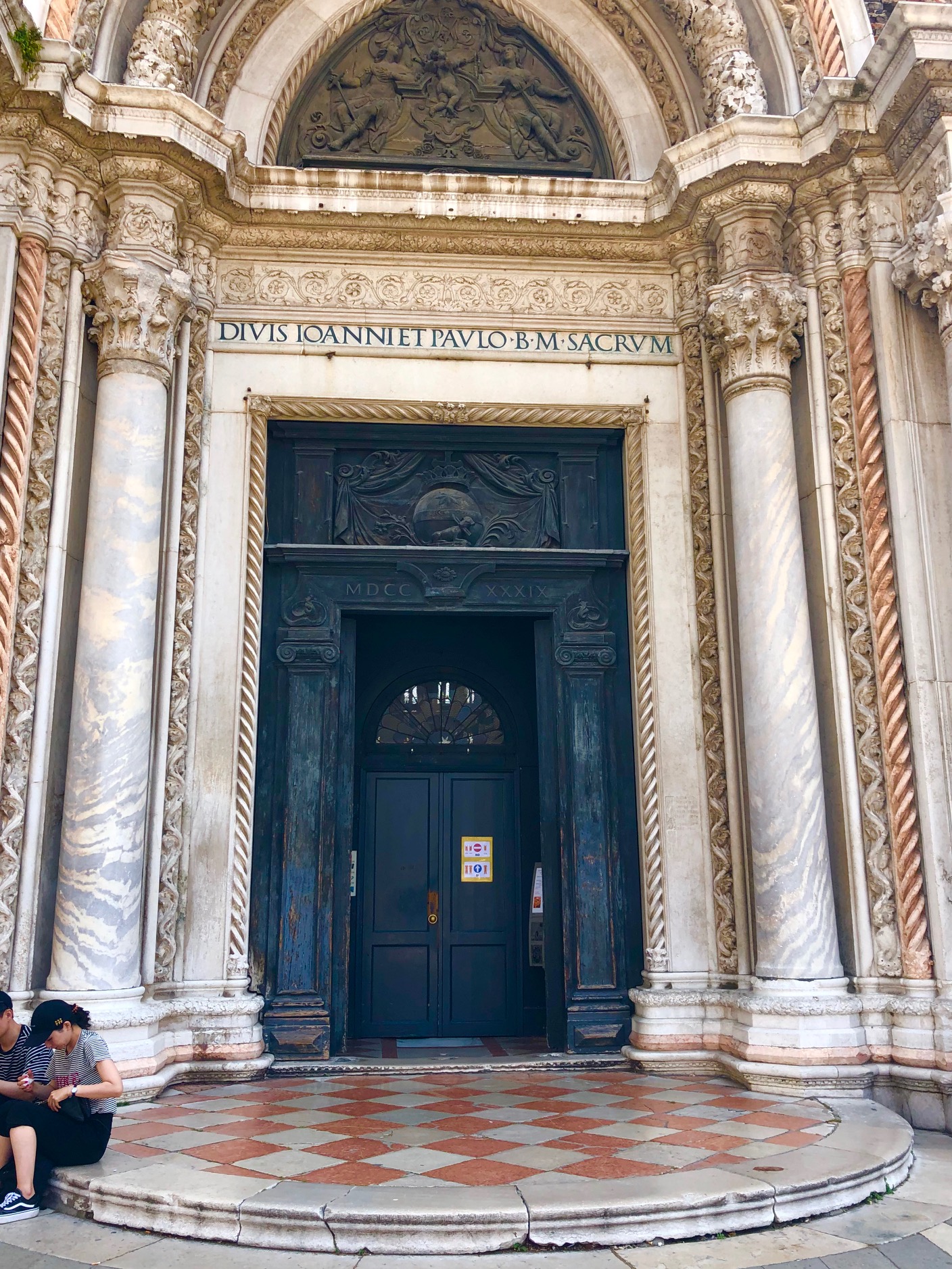
The entrance to Venice’s Basilica dei Santi Giovanni e Paolo | Photo: M. Yung

Featured Image: M. Yung

Categories
Italy (Venice)

Going to the hospital in Venice

H is for Ospedale

I’m betting that the question, “Wonder where the hospital is around here?” passes through the minds of most visitors to Venice… at least those visitors who stay on the island and think about where they would go if they twisted an ankle or suffered whiplash doing a double-take at an especially handsome gondolier.

Last Sunday, my daughter and I wound up at the hospital without really meaning to. We intended to go see the church, Basilica dei Santi Giovanni e Paolo (the Basilica of St. John and Paul). In 2017, I had purchased a little folding picture book of the top ten Venice sights and this church was on that list.

During the week that we visited back then, we simply didn’t get everything accomplished. Back home after our trip, I realized that if I was ever to return to Venice, this church would be on my list of sights to see.

And when one sees this church, one also has the opportunity to see the Venice hospital, the Ospedale SS Giovanni E Paolo Venice. That’s because the church is literally connected to the hospital building. You can enter the hospital from either the black front doors (as seen in the photo above) or you can enter from the backside, which borders the waters of the lagoon.

My daughter and I decided to take the water route around the back of the island. My daughter had never actually ventured on the vaporetto route past her Santa Elena stop, so this was a first-time experience for her, too.

Here’s the sign in the vaporetto bus stop that shows the stop for the Ospedale (Italian for hospital). Note the international symbol for hospital, “H,” below the line.

IMG_9700
Signs like these are posted inside the vaporetto bus stops.
IMG_9702
My daughter has become especially adept at navigating around Venice on water buses, known as vaporetti.

We traveled around the backside of the island to eventually arrive at the church; we didn’t realize it at the time, but the church is joined to the hospital.

castello-map
This map is courtesy of The Venice Insider. The “3” in the picture above marks the hospital’s location. Santa Elena is included in the area inside the green oval.

Here are some more pictures from the vaporetto ride around to the hospital and the basilica.

IMG_9703
The park-like Santa Elena neighborhood of Castello in Venice features lots of bright red wooden park benches.
IMG_9704
This is a view of part of The Arsenale, the area within Castello that was once included shipyards and armories.  The unique “Building Bridges” hands sculpture by Lorenzo Quinn has been installed to commemorate the Venice Biennale.
IMG_9708
Almost there! More of the Arsenale area.

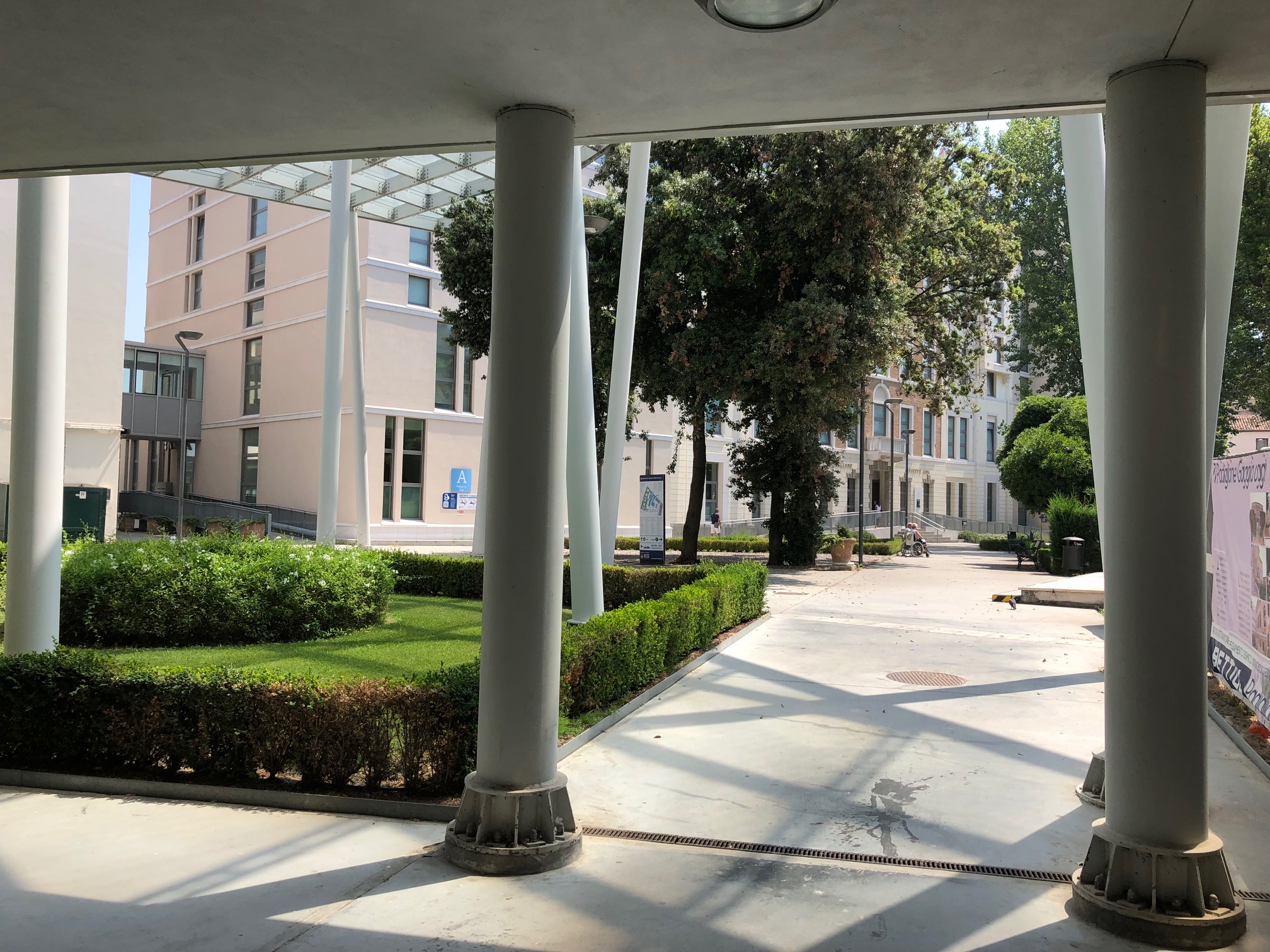
According to The Venice Insider, the hospital grounds are not open for tourists. That being the case, I hesitated to take lots of pictures. However, I did snap a few. Here’s a picture of a modern-looking inner garden area you’ll walk through after leaving the vaporetto and walking through the first doors you come to.

IMG_9711
I took this picture after walking through this inner courtyard.

Katherine’s roommate had told us to look for the gardens with all the cats. We thought that this was the garden she meant. We were wrong, as you will soon see.

Before we would find the garden full of cats, we walked by the Emergency Room doors. Here it is, for all you ankle twisters or gondolier gawkers:

IMG_9712
The E.R.

Keep walking past the ER and you will eventually arrive at a beautiful garden, surrounded by loggia walkways and filled with about a dozen stray cats.

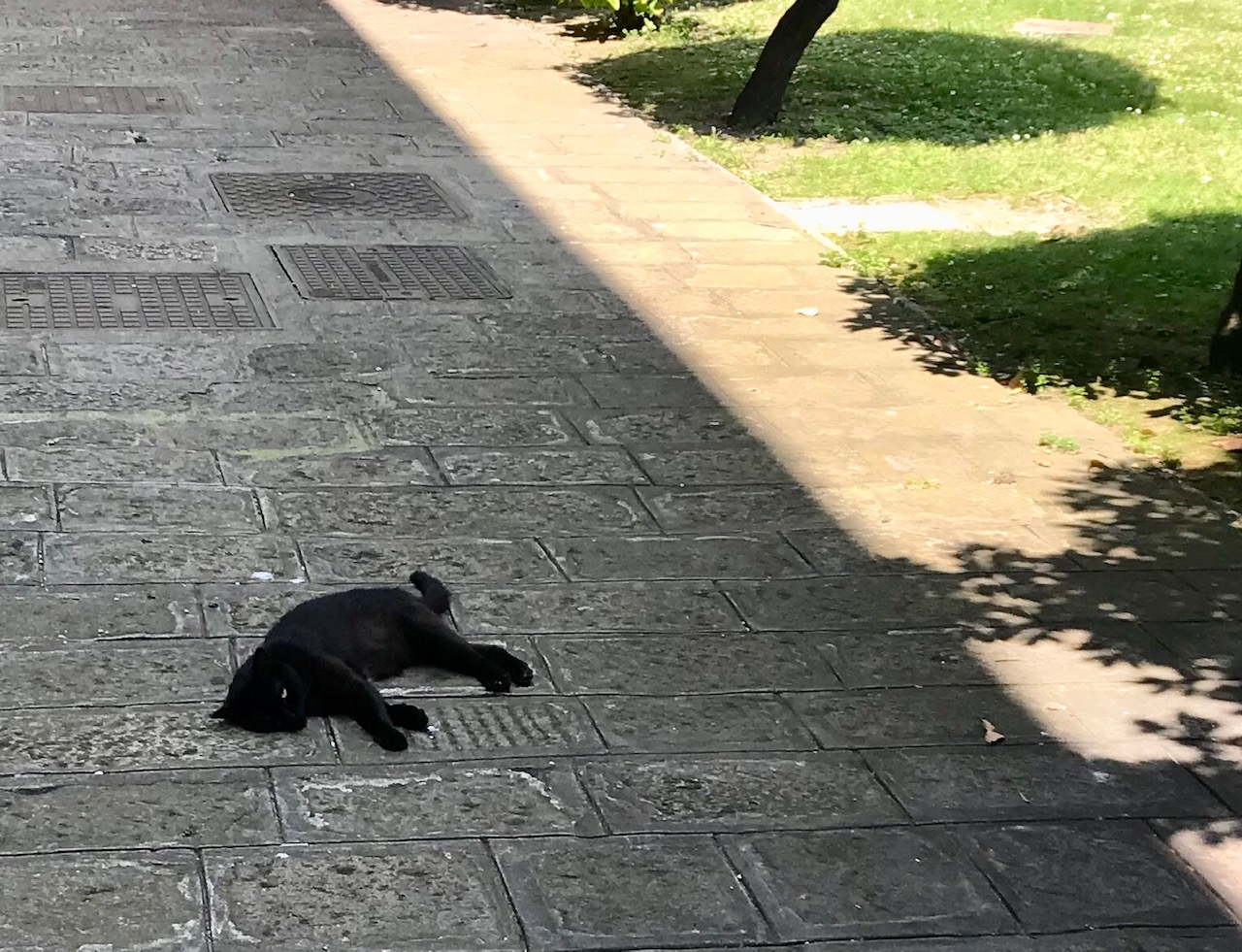
Residents and visitors alike care for Venice’s many feral felines. The kitties are quite comfortable during the warmer months. I’ve read that the cat population can become a problem during cooler temperatures and that there are volunteer groups that help with the problem.

IMG_9714
Notice the black and white cat sleeping under the flower pot in the center of the photo. Photo: Katherine Yung
IMG_9917
Photo: Katherine Yung
IMG_9916
This cat is so relaxed we thought he was sick, or worse. No, just very content. Photo: Katherine Yung

After you exit the cat garden, you’ll pass through an exit where you can continue on to the wards of the hospital or turn left to the Scuole Grande, which leads eventually leads outside to the campo with Basilica dei Santi Giovanni e Paolo.

IMG_9713
This is a photo looking back outside from the hallway leading to the Scuole Grande, religious and social groups that provided charitable services, including hospitals. If you turn to the right outside these doors, you will return to the cat garden.

If you continue down these steps, you will enter this grand entrance hall. There are doors and hallways that lead from this hall. This is the Scuole Grande (see caption above). At the end of this hall, is the front door of the hospital shown in the elaborate facade in the first picture of this article.

IMG_9715
Entrance hall just inside the front facade entrance to the hospital. The cat garden and ER are at the far end of this hallway. Most people needing ER services would, I imagine, enter from the backside along the main waterway.

And this brings us to the front entrance of the hospital on the campo, the large square that is the “city center” of this area of Castello.

IMG_9716

In effect, this post has brought you to the hospital from the backside along the water, to the very front door, which is shown in this photo at the far left (see the oval-topped dark door that blends in with the light post).

And this also brings us to the close of this post. I will continue this post tomorrow with our visit to the basilica where you will meet a die-hard Venetian who gave us some very good and timely advice on how to be “better tourists.”


Thanks for reading! Tune in tomorrow for the continuation of our Sunday morning in Venice. Click like, leave a comment, and be sure to follow my blog for the next installment. 

Categories
Italy

When you finally meet your online Italian language tutor

Desperately seeking Clara in Bologna, Italy

Last Saturday, my daughter and I ventured out of Venice to Bologna. The purpose of our trip was to meet Clara Ori. Clara teaches online lessons in the Italian language and she and my daughter have been working together since last September. Once or twice a week, they meet online via Preply.com.

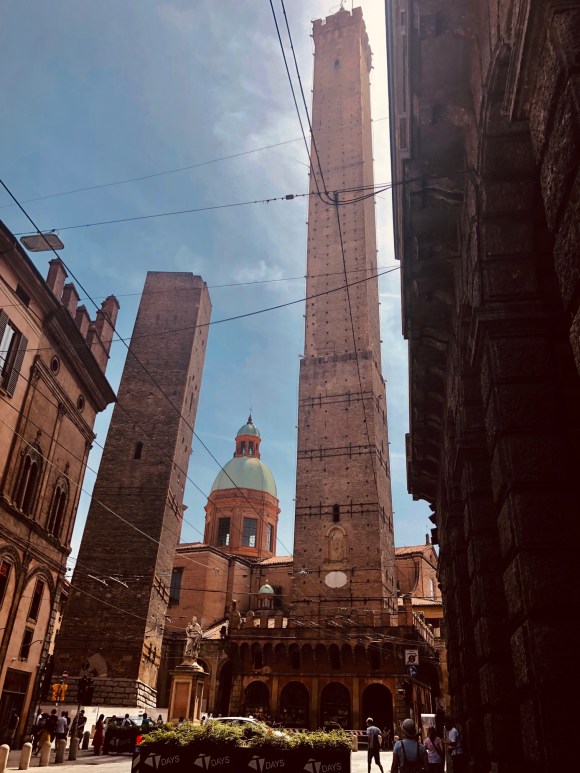
The famous towers of Bologna.

Clara and Katherine hit it off right from the start and found it challenging to remain focused on their lessons because they had so much fun just chatting and becoming friends.

IMG_9591
Leaving Venice at 7 a.m.

So, when Katherine was awarded her internship at the U.S. Pavilion at the Venice Biennale in late April, she knew that a visit to meet Clara would be in order.

The two had decided to arrange to meet for lunch around noon. We had subsequently planned to leave Venice early in the day, do some sightseeing in the morning, have lunch with Clara and her boyfriend, Victor, and then return to Venice in the afternoon.

IMG_9593
The Italian countryside

We left Katherine’s neighborhood of Santa Elena in the Castello sestiere on a vaporetto at about 6 a.m., and arrived at the Ferrovia train station about thirty minutes later. Our Trenitalia train left at 7 a.m.

A mere two hours later, we were dining on cappuccini and croissants near the Piazza Maggiore in Bologna’s city center, and deciding which major sights to see.

IMG_9602
Piazza Maggiore

Sitting close to the major square of the city, the Piazza Maggiore, I considered how I had always thought Venice felt old. After all, it was founded in 421 AD. However, strolling into Bologna, I realized that it feels and looks older and has a more primitive feel. And for good reason: Bologna was founded in 500 BC. That’s quite a difference!

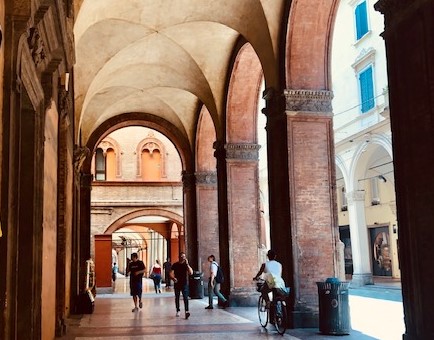
Another difference: compared to quiet Venice, Bologna is raucous with its cars and scooters. Plus, there’s all that beautiful red masonry and all the loggias, those covered archway thoroughfares along the Via Indipendenza that shade pedestrians as they saunter along the timeworn marble-paved and mosaic walkways.

IMG_9659
Loggia along Via Indipendenza

Next to the Piazza Maggiore and its Basilica di Petronius is the Fountain of Neptune within the plaza of the same name. When my daughter last visited Bologna during her first internship in Venice, the Fountain of Neptune was encased in scaffolding for maintenance. She looked forward to seeing it in person this time.

IMG_9599
The Fountain of Neptune

We strolled around the major buildings of the plaza and stopped inside the Palazzo d’Accursio to see the city’s Town Hall. The oldest parts of this building date to the 14th century.

It’s interesting to see where Bolognans go to pay, oh for example, their water bills. Paying a utility bill in a spot such as this would make the bill easier to pay, I would think. This facility also includes art collections, the city libraries, and a museum.

IMG_9605
Palazzo d’Accursio… the city’s administrative buildings

The highlight of the morning was touring inside the enormous, medieval Basilica di Petronius. Inside many churches (whether a cathedral or basilica), signs request that visitors respect “the holy place” and that knees and shoulders be covered. If you don’t have the appropriate clothing, you won’t be allowed in or you may purchase for 1€ a dark blue, gauzy kimono to wear. We saw one or two women wearing these as they milled around the cathedral. Luckily, I had tucked a cardigan inside my bag for the day to wear over my tank-style dress.

In addition, for 2€, you may take pictures, presumably even with flash. So, I paid the man at a lectern-type kiosk, who in turn looped a bright orange band around my wrist. Then we were free to roam and photograph at our leisure. (Surely, the woman walking around boldly wielding her GoPro camera had paid, right?!)

IMG_9611
Basilica di Petronius
IMG_9614
Inside the Basilica di Petronius
IMG_9616
Inside the Basilica di Petronius
IMG_9617
Inside the Basilica di Petronius

You can only take so many pictures inside a beautiful cathedral before it starts to seem pointless. Pictures simply do not suffice. I would dare to say that just admiring the view with your own eyes–and not through a lens–is a much more efficient use of your time.

Even with all its incredible architecture and history, Bologna offers still more. In fact, you can experience Bologna’s charm just walking around. Find a park bench in the shade, and then sit and watch.

IMG_9666
Sitting and people-watching 

While we sat in a shaded square off the plaza, a mother, father, and two daughters were dropped off by taxi a few feet from our park bench.

The oldest teenage daughter’s flowing royal blue chiffon gown swayed in the breeze as she stood with her mother who wore an a olive-burgundy-bronze brocade knee-length chemise. The father, in a white dress shirt and gray plaid fitted trousers, seemed to be searching for someone. The younger daughter, in her awkward middle school years, stood off to the side in a champagne-colored sundress.

IMG_9663
We loved sitting near these storefronts. Notice the hand-painted lettering!

The group discussed directions, peered left and right, walked away down the nearby alleyway, came back, and straightened their clothes. Continually rising on tiptoe to peer into the surrounding clusters of pedestrians, they never seemed to accomplish much other than to exude Italian chic.

IMG_9608
A typical street in Bologna’s city center

After people-watching for about an hour, we started out to meet Clara, who told us she would be arriving via train from Padua with her boyfriend, Victor. (They had been to Padua that morning for Victor’s eye appointment and they had planned to return to Bologna for the afternoon.)

We headed back to the Via Indipendenza, which is closed to automotive traffic on the weekends. Pedestrians filled the brick paved boulevard and sauntered through the loggias on each side of the street. We scanned the oncoming walkers for Clara and Victor.

But here’s the thing: Clara is blind and Victor has very limited eyesight.

Spotting them was our goal; listening for Katherine’s voice would be Clara’s.

Clara had told Katherine that Victor would be very tall and that she would be using, in her words, “my inseparable white cane.”

Within a few minutes, at the very far end of the loggia, just a block from the train station, we spied them. Katherine called out, “Clara!” and that was that. We found each other!

After greetings and hugs, Clara and Victor said they would select a place where we could have paninis and visit. They knew of such a cafe just down the street. We followed the couple, Clara and Katherine chatting the entire way.

After ordering our lunches (and admittedly, following their lead was not as difficult as you might imagine), we sat down at a table outside and talked for more than an hour.

IMG_9675
Talking over paninis

After eating, we had an hour or so of free time, so Clara and Victor told us they would like to take us to the Salaborsa public library in Bologna just a short distance away inside the Palazzo d’Accursio facility. This library was built in 2001 and is the central public library funded by the municipality of Bologna. We followed Clara and Victor into one of the most beautiful libraries I will probably ever see.

IMG_9676
Salaborsa Library
IMG_9678
Salaborsa Library

There wasn’t much time left after going to the library, so we all four headed back to the train station. We took some photos and Clara and Victor made sure to direct Katherine and I to the correct platform area to catch our 4:08 p.m. train back to Venice.

IMG_9691
The four of us: Katherine, Victor, Clara, and me
IMG_9697
Waiting at Bologna departures for the train back to Venice 

The day had gone exactly as planned.

Our goal of meeting Clara and Victor was met and we arrived back in Venice with time to hop off the vaporetto at the Zattere for a grocery run to buy salmon fillets.

Later back in Santa Elena, Katherine made dinner (score one for Mom!)… she served the salmon with Basmati rice and her own chutney salad made with mango, avocado, cucumbers, and bell peppers. It was a delicious end to a perfect day.

IMG_9874
Making our way across the Venetian lagoon at the end of the day

Thanks for reading! It’s becoming more and more challenging to post daily, but I’m using this trip to get in the habit of producing work daily. We’ll see how that continues. Follow my blog to see how and if I keep up.

Click here for yesterday’s post about the Venice Biennale.

I traveled to Venice from Skopelos, Greece, where we are staying before continuing our trip through the Peloponnese. Click here for a post from Skopelos. 

Categories
Italy Italy (Venice)

Dear Venice… We have to talk.

Finally, I’ve found a city I can trust myself with — Ravenna, Italy.

I didn’t mean to fall in love. I wasn’t looking for someone new. I had never even heard of Ravenna until I went to Italy.

But, Venice, I’m torn. In so many ways, Ravenna attracts me.

It’s untouristy. Affordable. Strangely familiar.

And yes, I’ll admit that although our relationship was brief and passionate, it has withstood the test of time, Venice. After all, I still long for your watery passageways and roaring, rushing boulevards. I fantasize over your shimmering lagoon and all those glossy gondolas slicing through the wakes of vaporettos, taxis, delivery boats.

But Ravenna, well… Ravenna is different. It grounds me. Located just three short hour away from you by train, its rugged stability thrills me in a comfortable, predictable way.

Finally, I’ve found a city I can trust myself with.

Ravenna is real. For one thing, there are cars. There are people looking right and left. There are horns blaring instead of gondoliers chanting gondullah gondullah gondullah.

IMG_3731

And Ravenna’s mosaics! That austere 6th-century Byzantine architecture! I can’t deny that jewels such as these drew me in: Sant Apollinare Nuovo, the Basilica of San Vitale, Galla Placidia’s Mausoleum, the Archiepiscopal Museum, and the Neonian Baptistery.

FullSizeRender (3)

In Ravenna, the sights are spectacular, seductive, strong, and silent. And a quick glance in any guidebook shows that my new love interest holds thirty more palazzo and churches from antiquity.

IMG_6531
Photo: Katherine Yung

Frankly, Venice, I never thought I would say this, but I see a future in Ravenna, but not necessarily in you. I fear you’re too exotic for a long-term relationship.

IMG_3757

After all, I’ve stood in St. Mark’s, your gold-drenched basilica. I’ve felt the reflections from the ceilings and walls warm first my cheek, my neck and then my shoulders as the afternoon sun dipped below the Adriatic. In fact, you’re so beautiful it terrifies me.

IMG_3754

Yes, Venice, you have the glitz, the passion, the prestige. You have those opulent icons: St. Mark’s, Santa Maria Della Salute, the Grand Canal. Rialto.

What am I leaving out? Oh, your cruise ships. Your crowds. Your selfie-stick vendors on the Accademia Bridge.

And that’s another reason why I’m torn, Venice. You make me dizzy with love and desperate with doubt at the same time. Have those annoying tourist trappings driven me away?

Four words: Possibly and I’m sorry.

Despite your glamour, Ravenna captivates me. This quiet city has stolen my heart with its own brand of starry-eyed elation. Its warm, steady embrace just feels right.

IMG_3759

Thanks for reading! Have you been to Ravenna, Italy? Have you ever traveled somewhere only to find a hidden gem you weren’t expecting to find? Feel free to leave a comment!

Categories
Art & Architecture Italy

Sins of the Flash in Torcello

When you visit the island of Torcello in the Venetian lagoon, you observe a sign inside the basilica that forbids photography. Ugh, you think. But it’s so beautiful. Inside, the apse—a half-dome of sorts—is encrusted in gold mosaic. The Virgin Mary resides in its center, alone, regal, royal. It’s graphically arresting and elegant in its simplicity; it contrasts with the opposite wall, a riot of colors, shapes, lines… Biblical scenes of the Last Judgment.

The cathedral is exquisite. One simply must have pictures to remember. So you plan to purchase them in the form of postcards from the adjacent gift shop when you leave. Problem solved.

Why then, the click? Why then is that woman over there snapping away? Lost in thought, she roams the chapel, gazing at the art, studying the expressive scenes, recording her visit on her sleek 35mm Canon.

Your immediate thought: she must have special permission. She must be a researcher working on a project. You explain as much to your husband. No, he says, she’s just ignoring the sign. His nonchalance startles you. As if this is just what people do, and in this case, a woman.

Oh, you reply, secretly envying this woman’s quiet rebellion that allows her a certain freedom that you will never claim. Disobey a sign that clearly states no photos? You shake your head. It’s right there in 96-point Times New Roman even. You roll your eyes at her audacity. This disregard for convention and rules astounds you.

You wonder how much inevitable damage each click does to the Byzantine masterpieces. Over the decades, who knows? She could be causing irreparable harm, you think. This should go down on her permanent record, wherever those are.

You ask your husband about the inevitable damage. Probably doesn’t hurt the art at all, he explains, adding something he read reported most cameras have filters that limit or remove UV waves.  Doesn’t damage a thing, he says.

Here I’ve been, you think, following all the rules all this time.

You continue to stare at this renegade designing her destiny, staking her claim with a few flashes that you still cannot bear to sneak on your measly iPhone. It’s true, you think, this woman has shown you to be the fool that you are.

She clicks another shot and checks the tiny screen. It must have been good, you think.

Her crimes finally and fully committed, the woman strides purposefully across the nave, stuffing her camera into a turquoise canvas tote bag. On the side of the bag is a design: two kitschy, feathery angel wings protruding from behind a shield. The design is cliché and you abhor that about things.


Thanks for reading! This is another story generated by a week-long trip to Italy I took in 2017. There are more stories on the way. Feel free to leave a comment and click follow for more.

Categories
Italy Motherhood

A dull ache for a sharp object

When Mom’s pocket knife gets confiscated

When the security employee at the gate asked me to step aside, I remembered. My pocket knife. Oh no, my pocket knife, I thought, realizing I had left it earlier in the little cosmetic bag inside my purse. I had forgotten to check it with my luggage and now I was at the gate and my knife was going away.

The uniformed employee explained in her thick Venetian accent, “We must take this from you. If it’s you really need, you go downstairs, fill out the form, and it be sent to you.”

Standing there, I knew we wouldn’t have time to make those arrangements. And besides, it wasn’t a valuable possession. But then again, it was.

For twenty-five years, I had carried that pocket knife.

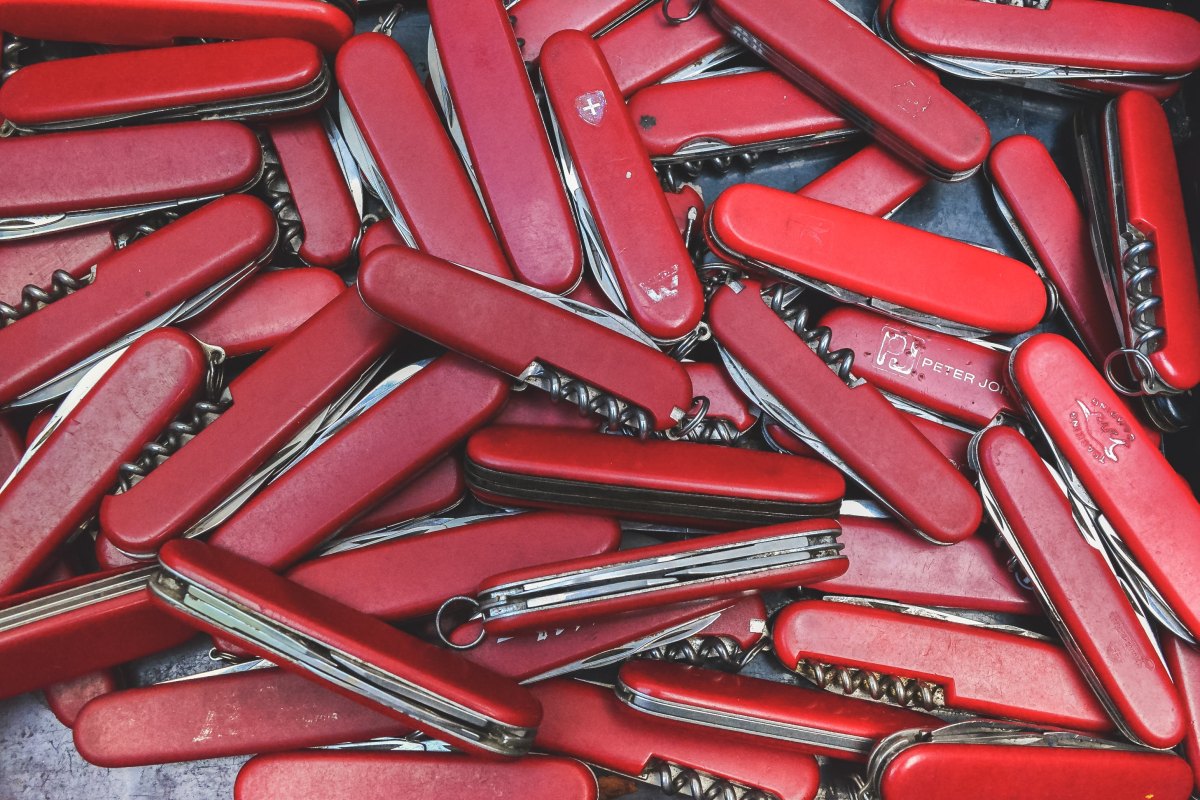
Back in 1990, I had chosen it from a mound of identical ones heaped in a small cardboard box next to a cash register in the sporting goods department at a Kmart in Topeka, Kansas. It had cost my boyfriend (now my husband) an entire dollar. It featured a steel blade, a wooden casing, and bronze hardware that over the years, had polished to a golden shine from being nestled in my purse for so long.

Similar to how candy bars are placed at checkout stands to captivate small children, that box of $1 knives held equal allure for the fishermen and hunters who visited that department. Not that I was one of them. We had gone to the store to use the restrooms tucked away behind the restaurant at the back of the store. As he waited on me, he spotted the knives and bought one for me.

“Keep it in your purse. It’ll come in handy,” he told me. He was right.

That little knife had been many places… all over Missouri and Kansas, Nashville, Asheville, several cities in Maine and Vermont, Columbus, Atlanta, Sarasota, Highland Park, Phoenix and other Arizona locals, multiple sights in the Los Angeles area, Oregon and Washington State, Cape Town and other South African cities, DC, New York City, Taos, Breckenridge, Crested Butte, Dallas, New Orleans. Over the years, we had journeyed across the country to attend annual family reunions, exhibit my husband’s ceramic art at festivals, and accompany him as he served artist residencies.

And now, its final destination would be Venice, Italy, where it would be left behind, a hindrance to a quick departure, discarded inside a gray plastic tub under the counter.

I regret leaving that silly little knife because it wasn’t just a pocket knife. It was a symbol of family life and motherhood and had been more often used for non-cutting tasks. That knife spread peanut butter on sandwiches many more times that it ever cut into a fish or snipped a cord on a tent or tarp. It was this mother’s indispensable tool. As such, it was always easy to locate.

My son and daughter both knew I carried a pocket knife and I passed it back to them at least once or twice on every road trip we took over the years. Need to break open a family-sized plastic bag of M&Ms? Get Mom’s knife. Opening a DVD? Get Mom’s knife. Got a stray thread hanging from your hem? Ask Mom to hand back her pocket knife.

Just prior to leaving Venice, as I buckled up inside the plane, regretting my decision to leave my knife, I recalled how six years earlier, I had flown from Johannesburg to Atlanta with a knife my son had purchased as a souvenir. Despite its massive four-inch blade, he had somehow forgotten to pack it in a checked bag. I offered to stow it inside my purse, warning him it would likely be confiscated at our first departure.

Nope. X-rays and inspections by hand never discovered it. Of course, that would happen to a brand new knife without any peanut butter experience. And of course, that knife has since been long forgotten, I might add.

As for my knife, I have since replaced it, but the blade on my new one is narrower and not quite as functional as the one left in Venice. I mean, you can spread peanut butter on a slice of bread if you really want to, but it’s the not the same as my Kmart special.

I’m one of those people who feels sorry for the last Christmas tree on the lot. So it’s no surprise that I’m still feeling nostalgic for my lost pocket knife… a year and a half later.

Somewhere in Italy, it’s languishing in a gray bin of confiscated sharp objects. Maybe it’s been recycled by now. Maybe it’s been donated to a charity. Hopefully, it’s performing some mother’s mundane tasks, making her life a little easier, and definitely more memorable.


Had an experience similar to mine? Like this post, follow my blog, and feel to leave a comment about any precious object that’s drifted out of your life. Thanks for reading!

Categories
Art & Architecture Italy

How I Found Connection in the Basilica of San Vitale

Here’s a scenario: Your daughter requests sprinkles on the Easter cupcakes you’re baking. However, pretend the shaker needed to sprinkle on the dotted decorations has not been invented yet, and the only way to get the sprinkles perfectly placed and evenly dispersed on the cupcakes is not by scattering them with your fingers, but by applying them one by one… with tweezers perhaps.

sharon-mccutcheon-569839-unsplash
Photo: Unsplash

Adding sprinkles to the cupcakes now will take days, weeks or longer. The task will be one of intense devotion and labor, simply because of the time involved and the perseverance needed to complete it.

Now imagine that each one of those precisely placed sprinkles is similar—I know it’s a stretch, but stay with me—to a shimmering miniature glass tile positioned into a mosaic inside the Basilica of San Vitale in Ravenna, Italy, a city of 160,000 near the Adriatic Sea.

1024px-Meister_von_San_Vitale_in_Ravenna_009
A detail of Empress Theodora, from the mosaic in the apse of San Vitale. | [Public domain], via Wikimedia Commons

One by one, each tile is placed into the scene. One by one, each tile forms a bit more of the image. This will take twenty years at least. It’s a painstaking process and creating the picture would be much faster with brushwork, but glass is the medium and a stunning mosaic is the goal.

Each tiny piece of glass—some are half the size of your pinky nail—symbolizes perseverance and an acute attention to detail and artistry, and—by extension—to Jesus Christ.

Cupcake sprinkles are the comparison that came to mind when I began to write about the mosaics inside the Basilica of San Vitale. My family visited the basilica in March of 2017, during a much too brief daytrip to Ravenna. The church, whose namesake was a Roman soldier martyred during the Christian persecutions, was begun in 526 and consecrated in 548.

The mosaics of San Vitale are so well-known in art history circles that they have earned the basilica the description, “the most glorious example of Byzantine art in the West,” according to Ravenna: City of Art.

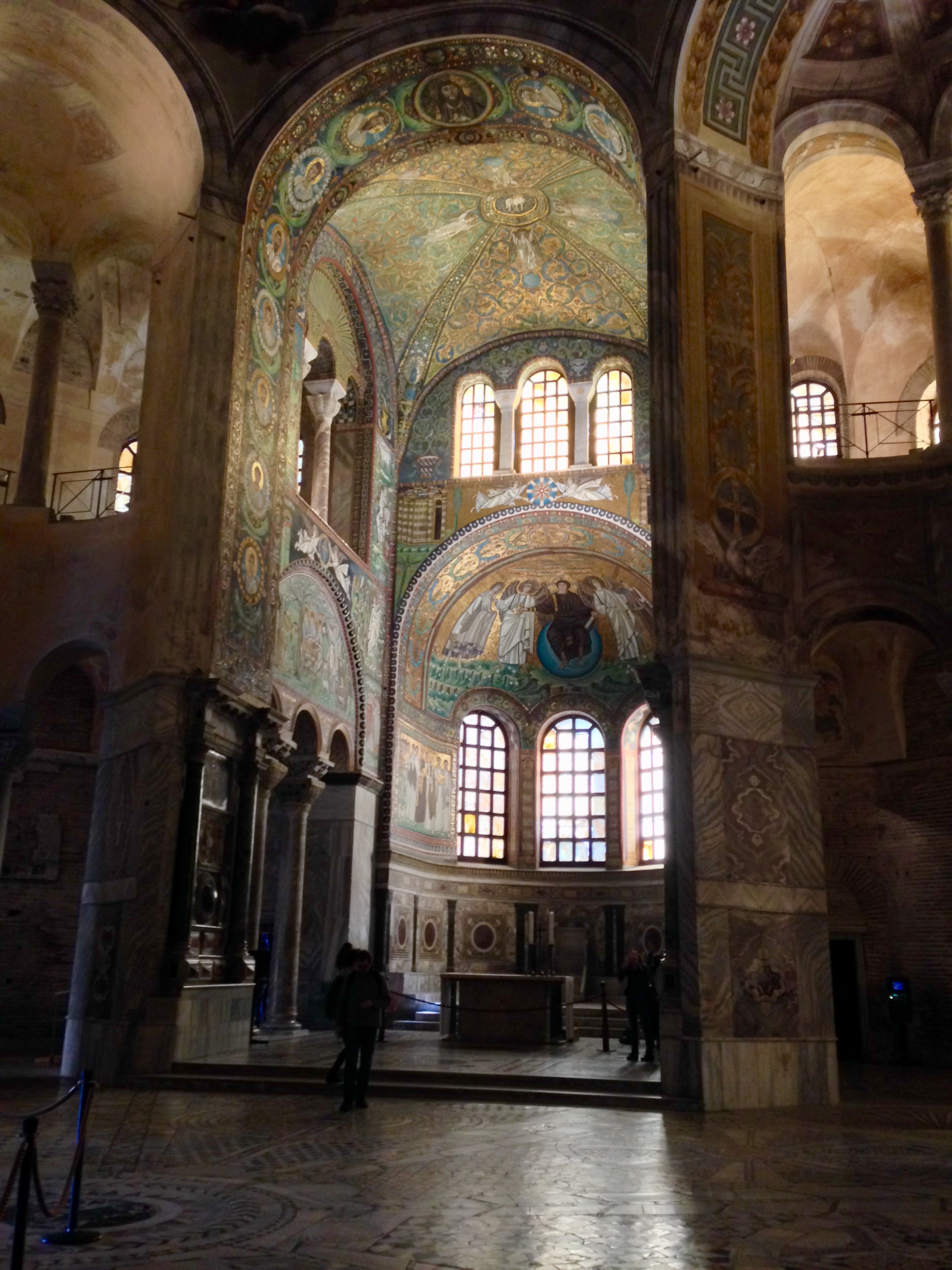
On the morning we visited, the interior of San Vitale glowed in the sunlight that streamed in through the windows of the church.

FullSizeRender (17)
A photo from across the basilica. Notice the intense patterning even in the marble floor. It’s difficult to stand close to the tesserae at San Vitale. Most of the mosaics are positioned above eight feet. The patterns you see below the windows are mostly marble mosaics. | Photo: M. Yung

As I stood in the grandeur of San Vitale, sheer awe at the handiwork overtook me.

Sheer wonderment… 

…at the dedication and tedium.

Sheer astonishment…

…at the skill and collaboration it required to not only conceive the images contained in the mural, but also to source the materials, create the artwork, and execute their application and installation on the high walls of this old, old church.

In the sunlight, the golden tesserae dazzled.

These are actually pieces of gold leaf sandwiched between pieces of clear glass. When they were pressed into place by medieval workmen, the gold tiles were angled to best reflect the sunlight, or the glow of a candle or lantern.

FullSizeRender (1)
A closer photo of the apse and the mosaic that shows Jesus Christ resting on a globe surrounded by angels. The far right figure in brown carries a miniature version of the basilica, offering it to Jesus in service. | Photo: M. Yung

As we took our self-tour, I stared up and pondered the mosaics and felt nearer to those laborers and artists who spent many years of their lives creating these mosaics. I marveled at their tenacity to produce these works without power tools and machinery, electricity, plumbing and other conveniences.

Would this sort of devotion be practiced today?

I don’t think so, but then maybe it was different for these medieval workers.

Even though creating the mosaics may have been their “job,” would the tedium of producing these masterpieces have been more endurable for those to whom the time of Christ was only four hundred years earlier? True, four hundred years is a long time, but wouldn’t the time of  Christ have been within their mental grasp?

To compare, would I find it easier to devote myself to glorifying the Pilgrims who landed at Plymouth Rock? I don’t know of anyone from that era, but I do feel a connection of sorts. I know about their concerns and their motivations. I can identify with them to a degree, while I find it nearly impossible to identify with people of Biblical times. Perhaps medieval workers could.

As I continued in my thoughts, my husband and daughter sought the two mosaics-within-the-mosaics below.

The mosaics of Byzantine Emperor Justinian and Empress Theodora are considered the masterpieces of San Vitale.

The first photo below shows Justinian surrounded by his court, clergy members and soldiers. The emperor holds a bowl that contains bread for the Eucharist. Justinian never visited this basilica, according to Dr. Steven Zucker in this Khan Academy video lesson, but this mosaic was his way of asserting his power and authority from Constantinople, the Byzantine capital.

The figures in both mosaics are highly stylized. Laura Morelli, art historoian and author of The Gondola Maker, explains it this way:

“A more eastern aesthetic characterizes the mosaics completed in Ravenna during this early period. Elegant, slender, flattened figures on a shallow spatial plane stare out with huge, staring eyes.”

The two famous mosaics clearly reveal this style.

IMG_6534
The mosaic that shows Emperor Justinian with his court, clergy, and soldiers at left. Even the borders and frames that surround the central image are mosaic. | Photo: Katherine Yung

The mosaic of Empress Theodora rests on the opposite side of the apse and mirrors Justinian’s mosaic. In this piece, the empress carries a chalice of wine for the Eucharist. Wearing a finely detailed gown, Empress Theodora is surrounded by her imperial court and attendants. She wears elaborate jewelry, and, like Justinian, is surrounded by a halo.

IMG_6532_sRGB
The mosaics of Justinian and Theodora are the “pieces de resistance” of Basilica San Vitale. They are found in art history textbooks as supreme examples of medieval Byzantine art. | Photo: Katherine Yung

Ready to finally move my gaze from the brilliance of the gold, I focused on the frescoes that cover the ceiling of San Vitale.

They were completed much later—in 1780—by artists from Bologna and Venice. While they are beautiful, they cannot compare, in my opinion, with the luster of the mosaics.

FullSizeRender (4)
Frescoes, water-based paintings on plaster, adorn the center dome of San Vitale. Photo: M. Yung
IMG_3733 (1)
My husband and son, at left, gaze up at the frescoes that surround the mosaic-drenched apse. | Photo: M. Yung

I felt our visit was coming to its end, and I noticed that even the floors of San Vitale were intricately decorated. Minuscule marble tiles did their best to distract me from the golden “eye candy” above. Over the centuries, the floor tiles do show some wear, but are amazingly colorful and durable. The most wear is to the floor surface itself, which, in some places within the basilica, contains depressions from heavy traffic patterns from worshipers and tourists.

The detail in the flooring reinforced my thoughts about the devotion of those early medieval artists; they spared nothing—not even the floor—in their pursuit to create a beautiful place to glorify God.

IMG_3747
Photo: M. Yung

As we exited the basilica, we took photos of its rustic appearance and its unusual structure of two stacked octagons. Its unusual shape does not follow cathedrals designed in the typical shape of the Latin cross, but instead evokes eastern influence from Byzantium.

From the outside, one would have no idea of the grandeur within.

FullSizeRender (3)
The contrast between the exterior and the interior of the Basilica of San Vitale is striking. The bricks were repurposed from demolished structures in Rome. Photo: M. Yung

Visiting the Basilica of San Vitale was a lesson in humility, reverence, and connection.

As I walked across the same floors, gazed up at the same artwork, and whispered in the same hushed tones that countless others whispered down through the ages, I knew that my visit was not about sprinkles on Easter cupcakes.

It wasn’t even about the magnificent golden mosaic masterpieces. It was instead about connecting to Jesus Christ and historical Christianity… and in a broader sense, to humanity.


Thanks for reading! Please click “like” so others can find this post more easily. Feel free to leave a comment about what your mind wanders to when you gaze at something truly beautiful.

Categories
Italy

Vicenza, Italy: where the art is the city itself

And other observations made on a daytrip from Venice to the City of Palladio

My daughter spent three months living in Venice in 2017 as an intern at the Peggy Guggenheim Collection, a small, yet world-renowned modern art museum located on the Grand Canal. Her time there was magical, challenging, beautiful, and life-changing. On four occasions, she day-tripped with her friends away from the 124 islands that compose Venice to visit these cities: Bologna, Padua, Verona, and Vicenza. 

Since her return, we’ve enjoyed many conversations about her time in Italy. In this and future posts, I’ll be relaying the details of each of these short excursions. This post is about her daytrip to Vicenza, a city with an approximate population of 113,000 full of architectural gems that was designated a World Heritage Site in 1994.

The interview answers are just the two of us talking; see the photo captions for more detailed notes and facts about her trip.

How far is Vicenza from Venice? It’s only a 45-minute train ride that goes through Mestre, which is near Venice on the mainland and then Padua before arriving in Vicenza.

What did you do first? We first walked from the train a few minutes to the city walls. Then we made our way to the Palladio Museum. It’s a large museum situated within the Palazzo Barbarano. The museum showcases Andrea Palladio, the Italian architect who designed tons of buildings all around the city. Palladio lived in the early 1500s, so he can be considered a High Renaissance artist.

FullSizeRender (13)
The city walls of Vicenza. At this location, pedestrians enter beneath the arch in the darker portion of the wall. Photo: K. Yung

The museum has old and rare sketchbooks and drawings by Palladio. Those were so interesting. It was amazing to see how well-preserved the papers were.

FullSizeRender (14)

The museum is also famous for all of the dioramas they have of Palladio’s designs. These aren’t old, but they are really valuable, so anyone—and especially art historians and architects—can understand more about how the buildings were designed. You can get a sense of the effects that Palladio achieved with his symmetry, like the long views down corridors.

FullSizeRender (15)
Dioramas attract many to the Palladio Museum. Here, architecture and art history scholars can see up close the Palladian features that created this ubiquitous architectural style. Photo: K. Yung
FullSizeRender (16)
Photo: K. Yung

Was symmetry his trademark? Well, one of them, along with columns. He’s why columns are popular in homes and public buildings. Basically, his work was about highlighting classical Roman architecture, and symmetry was one characteristic. His designs influenced architecture around the world. It eventually became called Palladianism. Palladio’s work is easy to recognize because he had a very distinct style that totally revolutionized the architecture game. And lots of people are familiar with Palladianism, even if they don’t realize it. The White House and the U.S. Capitol—and thousands more examples around the world—are good examples. So is Thomas Jefferson’s home, Monticello.

Did you have a tour of the Palladio Museum? Yes, we had a guide who spent 2 ½ – 3 hours showing us the museum, which was our main goal in visiting Vicenza. There was an exhibition being shown there called “The Mysteries of Palladio’s Face.” It was all about portraits of Palladio—or the fact that there aren’t portraits of him. No one really knows for sure what he looked like. Even drawings of him are different. However, there was a drawing we saw where he had actually sketched his hand onto the paper. Kinda cool because at least we know it’s his hand, y’know?

You were there such a short time. Did you miss anything? The Villa Rotonda was closed when we were there and that’s one of Palladio’s most famous and influential works. It’s a square building with four entrances, one on each side. It’s one of the most recognizable structures of the Renaissance.

Villa_Rotonda_front
The Villa Rotonda contains four identical facades, which add balance to the complete design. Photo: Stefan Bauer, http://www.ferras.at [CC BY-SA 2.5 (https://creativecommons.org/licenses/by-sa/2.5)%5D, from Wikimedia Commons

What did you do after the Palladio Museum? After that, we walked around downtown to see some of the other buildings. There’s a whole street in Vicenza called Corso Andrea Palladio… it’s lined with multiple palaces and buildings that were at least designed by Palladio if they were constructed during his lifetime.

IMG_6503
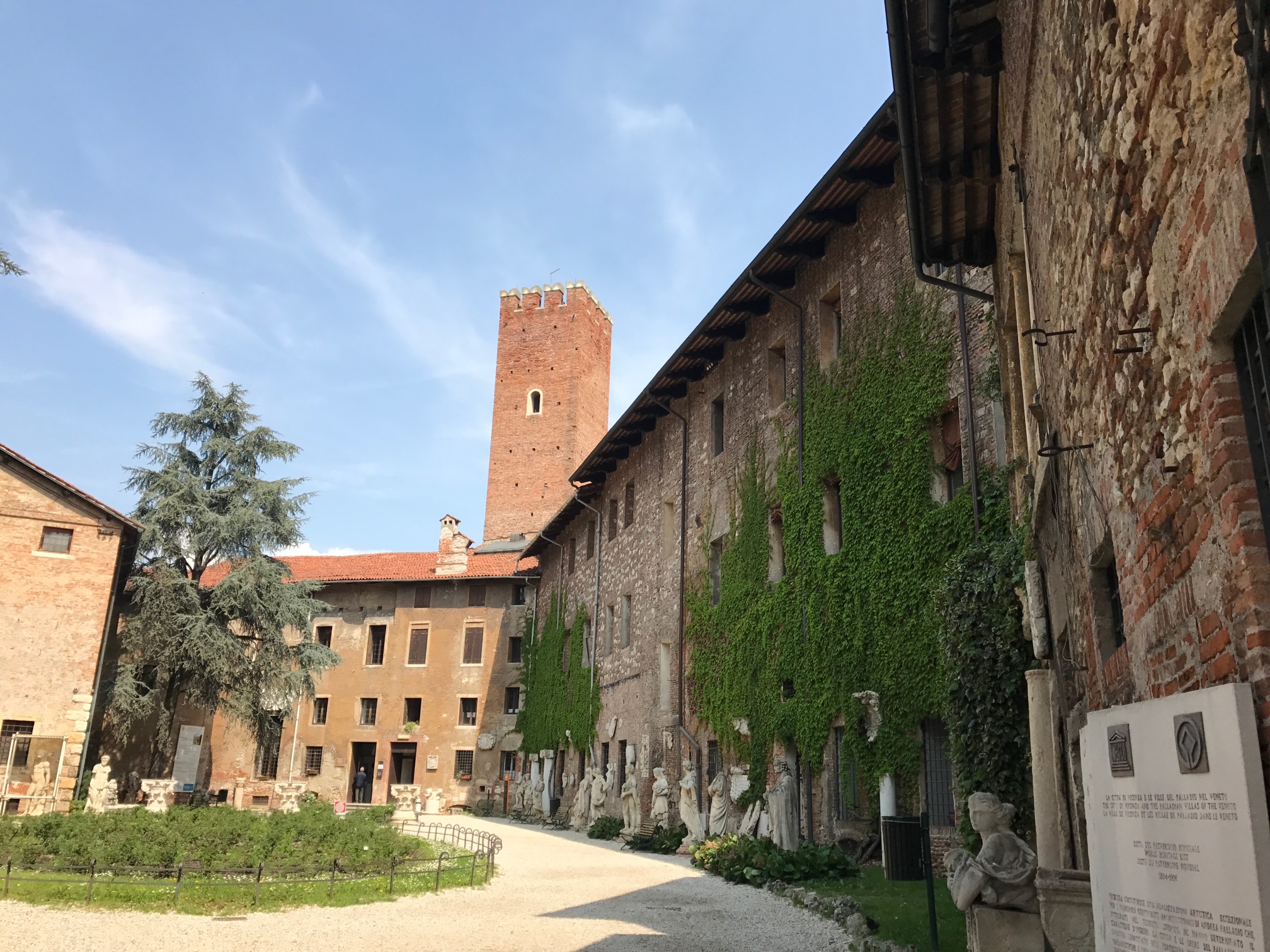
In this photo, you see the Teatro Olimpico on the right. Built from 1580-1585, the theater appears deceptively rustic on the exterior, but on the inside, the design does an “about face” and High Renaissance style takes center stage. The plaque that declares the theater’s designation at a UNESCO World Heritage Site is displayed at right. Photo: K. Yung

Then we went to the Teatro Olimpico. It’s a performing arts theater that Palladio designed. Today, the theater does live theater productions. You can go inside the actual theater and sit and look at the paintings. You can also see the façade that Palladio designed and the illusion of the set itself.

theatre-515655_1920
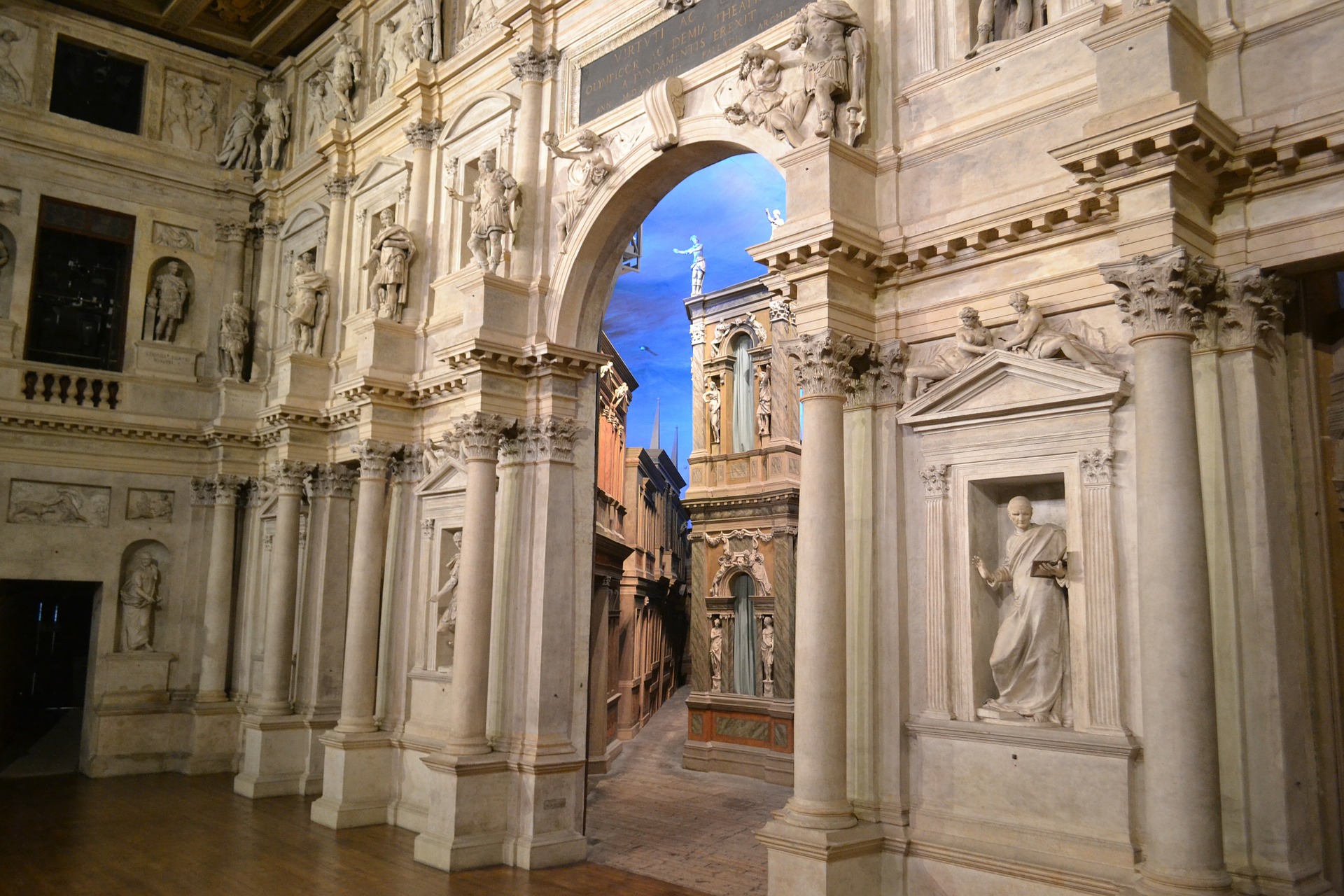
This photo does not show the theater’s majestic interior in its entirety. Visit here for fabulous photos and a full explanation of how optically revolutionary this theater is. Photo: juliacasado1 on Pixabay.

On the interior, parts of it plays tricks on your mind due to optical techniques. For example, it appears that the set is very deep based on the perspective you see through the entrance with the blue sky beyond. The ceiling of the theater is painted like the sky and it’s encircled by large-scale Olympic figures.

IMG_6509
The theater hosts dance and theater productions today. Photo: K. Yung

What else did you see on such a short trip? We went and saw the Basilica Palladiana. It’s a building downtown that you can easily identify because of its copper roof. They issued a contract to Palladio in 1549 to renovate the building because of structural problems that occurred over the years. Today, there are restaurants and shops around it, plus exhibition spaces for art and architecture shows. One thing that makes the basilica significant is that it shows the first example of the Palladian window. Palladian windows have a center window with a semi-circular top and then one rectangular identical window on each side.

vicenza-1683975_1920
Vincenza’s Piazza dei Signori, where the Basilica Palladiana is located to the right of the dark brick tower in the photo above. The distinctive copper roof is visible behind the statues that line the upper edge. Photo: cusarina on Pixabay.

After going to the basilica, we decided we wanted to have lunch outside on the plaza, the Piazza dei Signori. We found a quaint café in the sun and… wait for it… had some pizza that was altogether forgettable. It was more like American pan pizza. I’m sure some people liked it, but I was disappointed. I didn’t even make a note of the name of the place. Oh, well. That was literally the only downside to the whole day. I would love to go back!

How would you sum up Vicenza? It’s a quiet city with an off-the-beaten-path feel to it. It’s very beautiful and important. It’s like a giant art museum, but the art is the city itself.


I make no apologies. As a writer and parent, I feel perfectly entitled to take full advantage of my daughter’s experiences in Italy by wringing every possible story idea from it! Yes, our family did visit her in Venice for a week, and while we saw so much in that time, we envied the luxury of time her three-month internship allowed. Check out my profile on Medium.com and find more stories about my daughter’s other daytrips around northern Italy.

Categories
Italy

Padua, Italy: The bluest blue I’ve ever seen

And other observations my daughter made during a quick morning trip to Padua from Venice

My daughter spent three months living in Venice in 2017 as an intern at the Peggy Guggenheim Collection, a small, yet world-renowned modern art museum located on the Grand Canal. Her time there was magical, challenging, beautiful, and life-changing. On four occasions, she day-tripped with her friends away from the 124 islands that compose Venice to visit these cities: Bologna, Padua, Verona, and Vicenza. One day, she travelled to Ravenna with my husband, our son and me when we visited over spring break.

Since her return, we’ve enjoyed many conversations about her time in Italy. In this and future posts, I’ll be relaying the details of each of these short excursions. This post is about her morning trip to Padua, a city that claims to be the oldest city in northern Italy. It’s a short 26 miles from Venice.

The interview answers are just the two of us talking; see the photo captions for more detailed notes and facts about her trip.

How did you travel to Padua? We left from the Venice train station at 9 a.m. It took barely thirth minutes to get there.

What was the most important thing you saw in Padua? Our goal in going to Padua—of Padova, as the Italians say—was to see the Scrovegni Chapel. It’s covered on the inside with many famous frescoes by Giotto. He was a painter during the Middle Ages. He was known for the expressions he painted on people. The frescoes in the chapel are literally in every art history textbook I’ve ever seen. The chapel is extremely small and floor to ceiling it’s jammed with frescoes.

IMG_6380
Another view of the floor-to-ceiling frescoes painted by Giotto at the Scrovegni Chapel. Giotto is considered pre-Renaissance; his work takes a step away from the Medieval style. Photo: K. Yung

Did the chapel meet your expectations? Yes! It was exactly what I hoped it would be. Giotto was known for using blue and the frescoes there were way more intensely vibrant than I expected them to be. The color was the bluest blue I’ve ever seen.

Before you even enter the chapel, it must be readied by the staff. They adjust the humidity level in order to control the air quality inside and they also regulate your entrance time because the air quality must be adjusted to protect the frescoes. Many of them are fragile. Some are entirely gone. Some are faded and chipping away. They were completed in 1305, so that explains the deterioration.

IMG_6383
This photo shows the most famous fresco (center) in the Scrovegni Chapel entitled “Lamentation of Christ.” The anguish in the facial expressions of the figures is one characteristic that makes this fresco so well-known. Photo: K. Yung
IMG_6378
The gardens and grounds that surrounded the Scrovegni Chapel were lush with the spring season in Padua. Photo: K. Yung

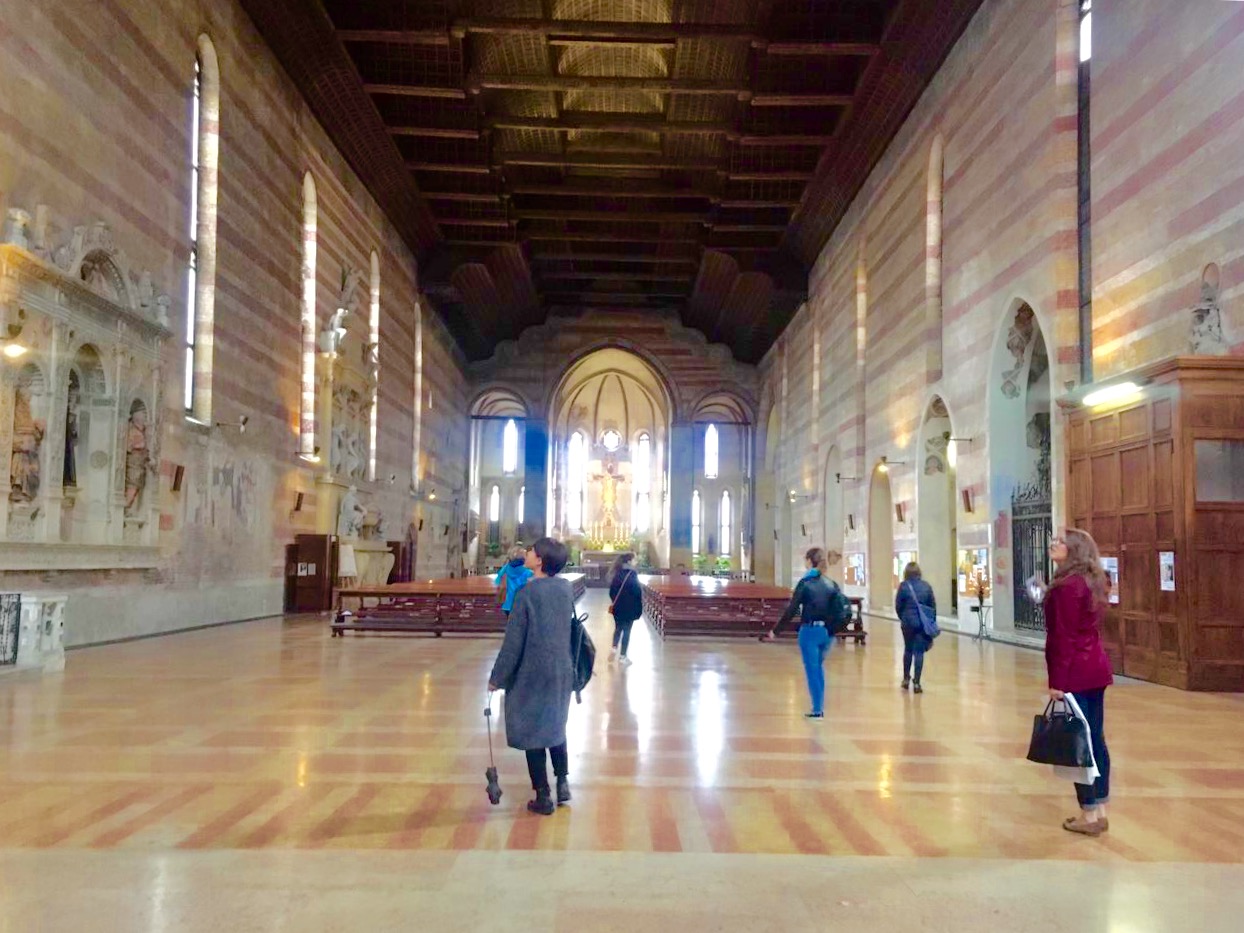
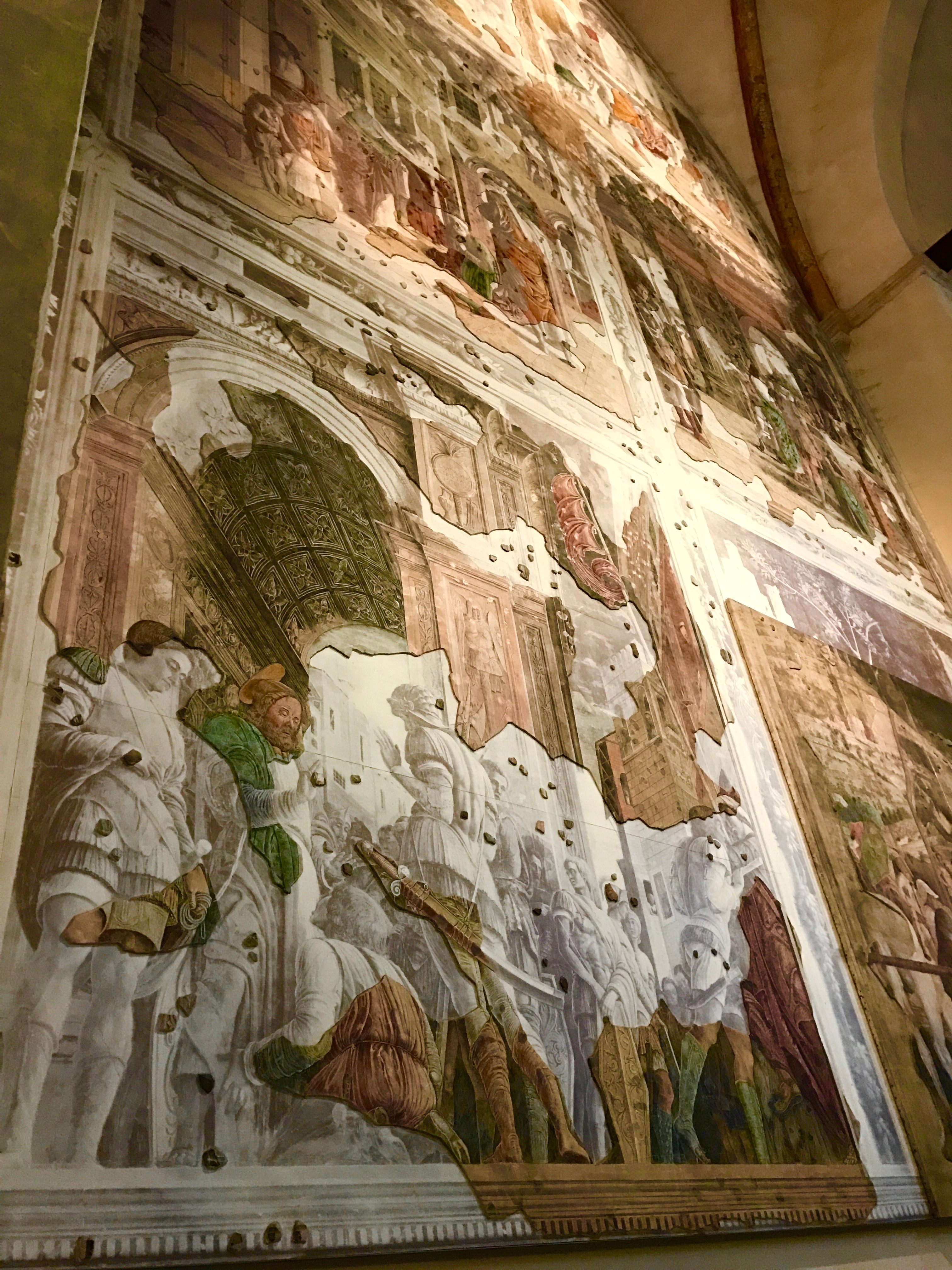
Where did you go after the Scrovegni? We went to Chiesa degli Eremitani, literally the Church of the Hermits, which was a religious order under St. Augustine. It’s a very tall church with a woven, wooded lattice roof. There area frescoed bricks on the wall. At the front where the altar is, there are two or three little chapels. There are interesting frescoes that go up into the domes, but only to a point.

The church was bombed in World War II and they were almost totally destroyed. Over the years, the building has been renovated. There are fragmented frescoes where black paint has been applied showing what the image would have been had it not been bombed.

FullSizeRender (7)
Inside the Chiesa degli Eremitani, the frescoes show scenes from the life of St. Augustine. The damage done to this church is considered by art historians to be Italy’s “greatest artistic wartime loss.” Photo: K. Yung
FullSizeRender (11)
This photo shows the devastation of the bombing from 1944. Fragments from the destroyed frescoes have been found over the years and inserted onto the plaster in the precise spots where they were believed to have been placed originally. Photo: K. Yung

Did you grab a meal while you were there? Yes, after the Chiesa, we ran to get pizza somewhere on the way to the train station. We also managed to find an American coffee shop and I ordered a chai tea latte for the first time while I was in Italy. Chai tea is not a thing in Italy, by the way.

That was also about the time we realized we had bought the wrong returning ticket to Venice. We made our way onto the next train back, but didn’t have time to purchase tickets. It was a confusing ordeal. We planned to pay while we were onboard the train, but no one ever checked our tickets.

We made it back to Venice by 2 in the afternoon, which was around the time we were scheduled to get ready to tour Damien Hirst’s mammoth exhibition, which is totally another story.

Would you like to go back to Padua since you were only there for a few hours? Yes, of course, it would be great to go back. There are so many things I know we just didn’t have time for. One would be the Basilica of Saint Anthony. Someday… someday.


Featured Photo: The Scrovegni Chapel was commissioned by Enrico degli Scrovegni, a Paduan lender. It is considered one of the masterpieces of Western art. Giotto di Bondone, considered the first of the Italian masters, painted the frescoes in the intimate space. Giotto, (1276-1337), is considered the most important Italian painter of the 14th century.“His works point to the innovations of the Renaissance style, which developed a century later,” according to Encyclopedia Britannica. Photo: K. Yung


I make no apologies. As a writer and parent, I feel perfectly entitled to take full advantage of my daughter’s experiences in Italy by wringing every possible story idea from it! Yes, our family did visit her there for a week, and while we saw so much in that time, we envied the luxury of time her three-month internship allowed. Check out my profile on Medium.com and find more stories about my daughter’s daytrips around northern Italy.