Categories
Italy

When you finally meet your online Italian language tutor

Desperately seeking Clara in Bologna, Italy

Last Saturday, my daughter and I ventured out of Venice to Bologna. The purpose of our trip was to meet Clara Ori. Clara teaches online lessons in the Italian language and she and my daughter have been working together since last September. Once or twice a week, they meet online via Preply.com.
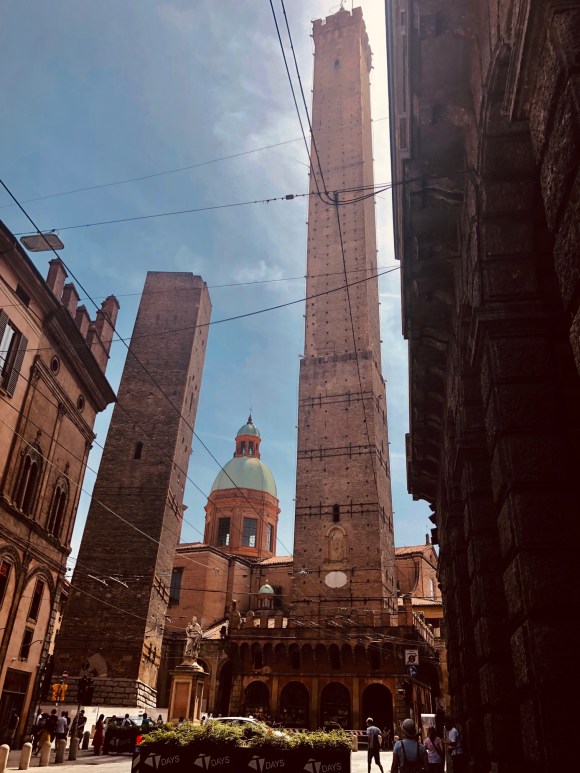
The famous towers of Bologna.

Clara and Katherine hit it off right from the start and found it challenging to remain focused on their lessons because they had so much fun just chatting and becoming friends.

IMG_9591
Leaving Venice at 7 a.m.

So, when Katherine was awarded her internship at the U.S. Pavilion at the Venice Biennale in late April, she knew that a visit to meet Clara would be in order.

The two had decided to arrange to meet for lunch around noon. We had subsequently planned to leave Venice early in the day, do some sightseeing in the morning, have lunch with Clara and her boyfriend, Victor, and then return to Venice in the afternoon.

IMG_9593
The Italian countryside

We left Katherine’s neighborhood of Santa Elena in the Castello sestiere on a vaporetto at about 6 a.m., and arrived at the Ferrovia train station about thirty minutes later. Our Trenitalia train left at 7 a.m.

A mere two hours later, we were dining on cappuccini and croissants near the Piazza Maggiore in Bologna’s city center, and deciding which major sights to see.

IMG_9602
Piazza Maggiore

Sitting close to the major square of the city, the Piazza Maggiore, I considered how I had always thought Venice felt old. After all, it was founded in 421 AD. However, strolling into Bologna, I realized that it feels and looks older and has a more primitive feel. And for good reason: Bologna was founded in 500 BC. That’s quite a difference!

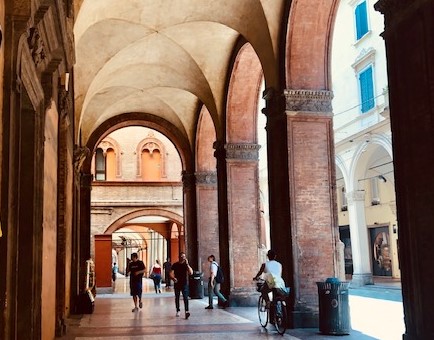
Another difference: compared to quiet Venice, Bologna is raucous with its cars and scooters. Plus, there’s all that beautiful red masonry and all the loggias, those covered archway thoroughfares along the Via Indipendenza that shade pedestrians as they saunter along the timeworn marble-paved and mosaic walkways.

IMG_9659
Loggia along Via Indipendenza

Next to the Piazza Maggiore and its Basilica di Petronius is the Fountain of Neptune within the plaza of the same name. When my daughter last visited Bologna during her first internship in Venice, the Fountain of Neptune was encased in scaffolding for maintenance. She looked forward to seeing it in person this time.

IMG_9599
The Fountain of Neptune

We strolled around the major buildings of the plaza and stopped inside the Palazzo d’Accursio to see the city’s Town Hall. The oldest parts of this building date to the 14th century.

It’s interesting to see where Bolognans go to pay, oh for example, their water bills. Paying a utility bill in a spot such as this would make the bill easier to pay, I would think. This facility also includes art collections, the city libraries, and a museum.

IMG_9605
Palazzo d’Accursio… the city’s administrative buildings

The highlight of the morning was touring inside the enormous, medieval Basilica di Petronius. Inside many churches (whether a cathedral or basilica), signs request that visitors respect “the holy place” and that knees and shoulders be covered. If you don’t have the appropriate clothing, you won’t be allowed in or you may purchase for 1€ a dark blue, gauzy kimono to wear. We saw one or two women wearing these as they milled around the cathedral. Luckily, I had tucked a cardigan inside my bag for the day to wear over my tank-style dress.

In addition, for 2€, you may take pictures, presumably even with flash. So, I paid the man at a lectern-type kiosk, who in turn looped a bright orange band around my wrist. Then we were free to roam and photograph at our leisure. (Surely, the woman walking around boldly wielding her GoPro camera had paid, right?!)

IMG_9611
Basilica di Petronius
IMG_9614
Inside the Basilica di Petronius
IMG_9616
Inside the Basilica di Petronius
IMG_9617
Inside the Basilica di Petronius

You can only take so many pictures inside a beautiful cathedral before it starts to seem pointless. Pictures simply do not suffice. I would dare to say that just admiring the view with your own eyes–and not through a lens–is a much more efficient use of your time.

Even with all its incredible architecture and history, Bologna offers still more. In fact, you can experience Bologna’s charm just walking around. Find a park bench in the shade, and then sit and watch.

IMG_9666
Sitting and people-watching 

While we sat in a shaded square off the plaza, a mother, father, and two daughters were dropped off by taxi a few feet from our park bench.

The oldest teenage daughter’s flowing royal blue chiffon gown swayed in the breeze as she stood with her mother who wore an a olive-burgundy-bronze brocade knee-length chemise. The father, in a white dress shirt and gray plaid fitted trousers, seemed to be searching for someone. The younger daughter, in her awkward middle school years, stood off to the side in a champagne-colored sundress.

IMG_9663
We loved sitting near these storefronts. Notice the hand-painted lettering!

The group discussed directions, peered left and right, walked away down the nearby alleyway, came back, and straightened their clothes. Continually rising on tiptoe to peer into the surrounding clusters of pedestrians, they never seemed to accomplish much other than to exude Italian chic.

IMG_9608
A typical street in Bologna’s city center

After people-watching for about an hour, we started out to meet Clara, who told us she would be arriving via train from Padua with her boyfriend, Victor. (They had been to Padua that morning for Victor’s eye appointment and they had planned to return to Bologna for the afternoon.)

We headed back to the Via Indipendenza, which is closed to automotive traffic on the weekends. Pedestrians filled the brick paved boulevard and sauntered through the loggias on each side of the street. We scanned the oncoming walkers for Clara and Victor.

But here’s the thing: Clara is blind and Victor has very limited eyesight.

Spotting them was our goal; listening for Katherine’s voice would be Clara’s.

Clara had told Katherine that Victor would be very tall and that she would be using, in her words, “my inseparable white cane.”

Within a few minutes, at the very far end of the loggia, just a block from the train station, we spied them. Katherine called out, “Clara!” and that was that. We found each other!

After greetings and hugs, Clara and Victor said they would select a place where we could have paninis and visit. They knew of such a cafe just down the street. We followed the couple, Clara and Katherine chatting the entire way.

After ordering our lunches (and admittedly, following their lead was not as difficult as you might imagine), we sat down at a table outside and talked for more than an hour.

IMG_9675
Talking over paninis

After eating, we had an hour or so of free time, so Clara and Victor told us they would like to take us to the Salaborsa public library in Bologna just a short distance away inside the Palazzo d’Accursio facility. This library was built in 2001 and is the central public library funded by the municipality of Bologna. We followed Clara and Victor into one of the most beautiful libraries I will probably ever see.

IMG_9676
Salaborsa Library
IMG_9678
Salaborsa Library

There wasn’t much time left after going to the library, so we all four headed back to the train station. We took some photos and Clara and Victor made sure to direct Katherine and I to the correct platform area to catch our 4:08 p.m. train back to Venice.

IMG_9691
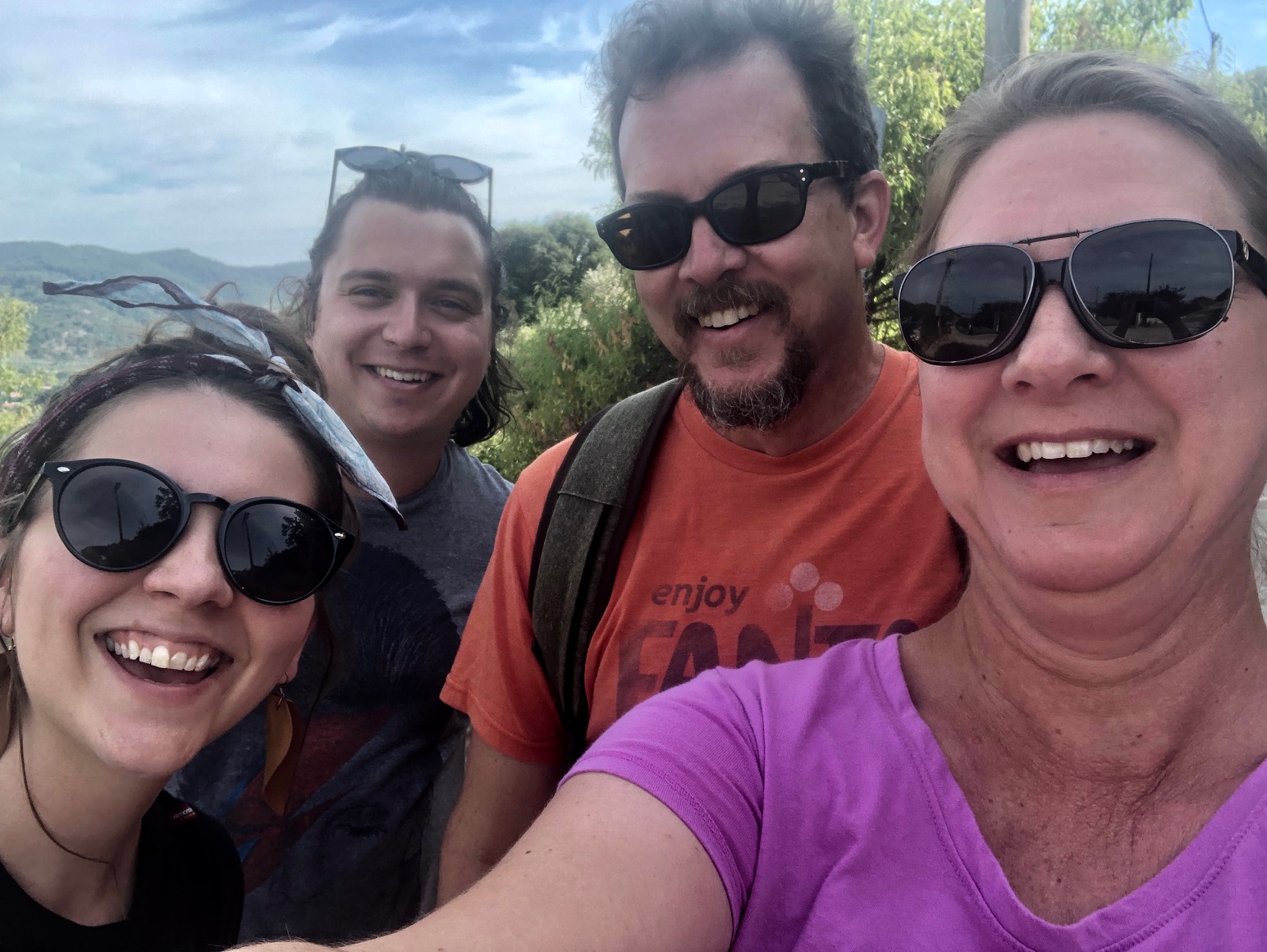
The four of us: Katherine, Victor, Clara, and me
IMG_9697
Waiting at Bologna departures for the train back to Venice 

The day had gone exactly as planned.

Our goal of meeting Clara and Victor was met and we arrived back in Venice with time to hop off the vaporetto at the Zattere for a grocery run to buy salmon fillets.

Later back in Santa Elena, Katherine made dinner (score one for Mom!)… she served the salmon with Basmati rice and her own chutney salad made with mango, avocado, cucumbers, and bell peppers. It was a delicious end to a perfect day.

IMG_9874
Making our way across the Venetian lagoon at the end of the day

Thanks for reading! It’s becoming more and more challenging to post daily, but I’m using this trip to get in the habit of producing work daily. We’ll see how that continues. Follow my blog to see how and if I keep up.

Click here for yesterday’s post about the Venice Biennale.

I traveled to Venice from Skopelos, Greece, where we are staying before continuing our trip through the Peloponnese. Click here for a post from Skopelos. 

Categories
Art & Architecture Italy (Venice)

The Venice Biennale 2019

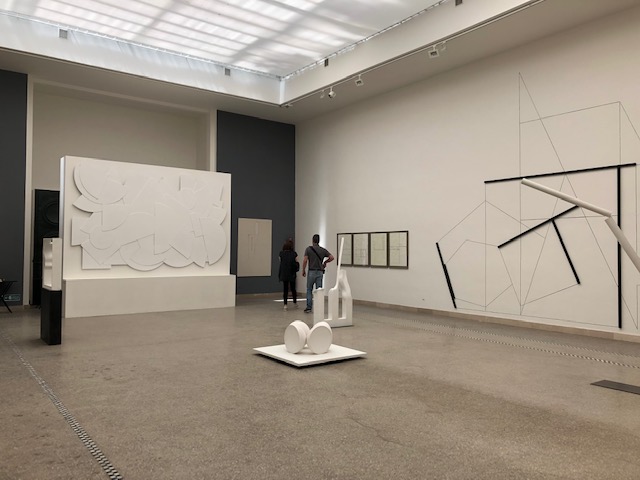
In interesting times, artists create. In uninteresting times, artists still create. Regardless of the global political climate, the Venice Biennale—the Olympics of art where countries each exhibit in their own pavilion or exhibit space—continues. Sure, some countries may decline to participate from year to year or may be late in readying their exhibits (such as tumultuous Venezuela this year); however, for the Biennale… the show must go on.

IMG_9506
A ticket good for entry at the Giardini and Arsenale portions of the Biennale cost 25€. You purchase them at a row of red ticket counters shown at left in this photo.

If you’re unfamiliar with the Venice Biennale, here’s a quick summary from the Biennale website:

The Venice Biennale has been for over 120 years one of the most prestigious cultural institutions in the world. Established in 1895, the Biennale has an attendance today of over 500,000 visitors at the Art Exhibition. The history of the La Biennale di Venezia dates back from 1895, when the first International Art Exhibition was organized. In the 1930s new festivals were born: Music, Cinema, and Theatre (the Venice Film Festival in 1932 was the first film festival in history). In 1980 the first International Architecture Exhibition took place, and in 1999 Dance made its debut at La Biennale.

An over-arching theme characterizes each Biennale. This year’s theme, “May You Live in Interesting Times,” encourages people to avoid the quick judgment, the stereotype, the single-lens viewing of current world events.

IMG_9587
A collection of brochures I collected during our visit. The Biennale brochure reads, “May You Live in Interesting Times.”

According to Biennale President Paolo Baratta, “the expression ‘interesting times’ evokes the idea of challenging or even ‘menacing’ times, but it could also simply be an invitation to always see and consider the course of human events in their complexity, an invitation, thus, that appears to be particularly important in times when, too often, oversimplification seems to prevail, generated by conformism or fear.”

Another way to put it: allow art to show you the many ways of looking at the world.

IMG_9510
Inside the Swiss Pavilion, we watched the video entitled, “Moving Backwards.”

Last Friday (June 14), I visited the Biennale with my daughter, who is an intern in the United States Pavilion. The United States’ participation is primarily a function of the Department of State, which “supports official U.S. participation at select international art exhibitions called biennales. The Department’s support ensures that the excellence, vitality, and diversity of American arts are effectively showcased abroad and provides an opportunity to engage foreign audiences to increase mutual understanding.” In other words, exhibiting at the Biennale is another way to build and maintain positive relationships around the world.

IMG_9525
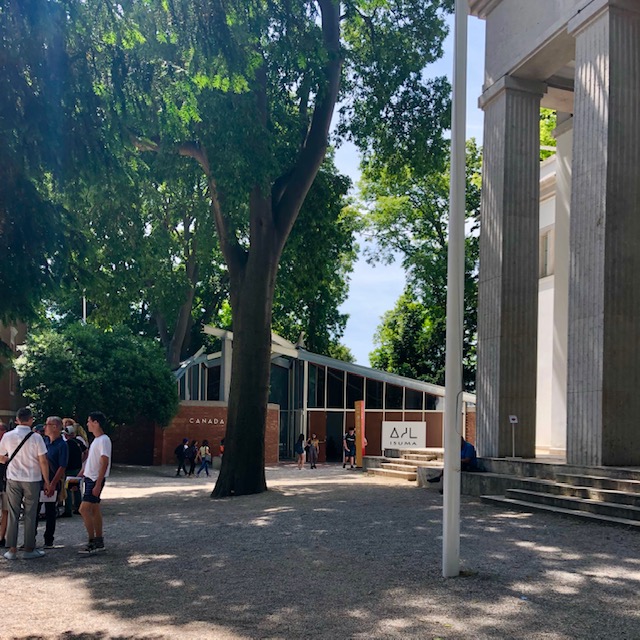
The Canadian Pavilion is shown on the left in photo above. Their media company showcasing inside is called Isuma. The German Pavilion stands on the far right.

As for the U.S. Pavilion’s intern program, the Peggy Guggenheim Collection, a well-known modern art museum in Venice, handles the hiring of the interns who provide guarding of the exhibits, inform visitors about the various works, and generally are the main points-of-contact for visitors touring through the pavilions. (Two years ago, my daughter served an internship at the museum; when they issued a call for former interns interested in returning to work the Biennale, she quickly applied.)

IMG_9526
The German Pavilion exhibit: industrial, cold, and futuristic.

We arrived at the portion of the show held on the ground of Venice’s Giardini (Italian for garden). Visitors can see another section of the show at the adjacent Arsenale. In addition, more pavilions are scattered throughout the city. For example, we walked by the door to the Mongolian exhibit in a dark, narrow street somewhere in the San Marco area of the city.

From the Russian Pavilion. These figures were only one component to the entire Russian offering, which was inspired by Flemish painters.

During our three-hour visit, we saw fourteen exhibits out of the 79 participating in the Biennale this year. That doesn’t sound like that many, does it? Especially when you know there are art lovers who allot several days to see all the exhibits. To them, I say, “Go you!”

However, since I only had four full days in Venice, and one of those was spent in Bologna (see my next post!), we prioritized.

IMG_9527
Waiting in line to the British Pavilion.

Plus, we knew that a visit to the best gelato in town, Suso, was in order for the afternoon. This would require a thirty-minute vaporetto ride down the Grand Canal from the Giardini. Sheesh… the price we pay for good gelato!

IMG_9529
Works by Cathy Wilkes inside the British Pavilion.

Enjoy these photos! I’ve attempted to add some details in the captions and, looking back now, I should have written this post immediately after our visit to better capture the ambiance of our visit. But when one is in one of the most beautiful cities in the world, you want to get out and see it—not stay in and write about it.

IMG_9535
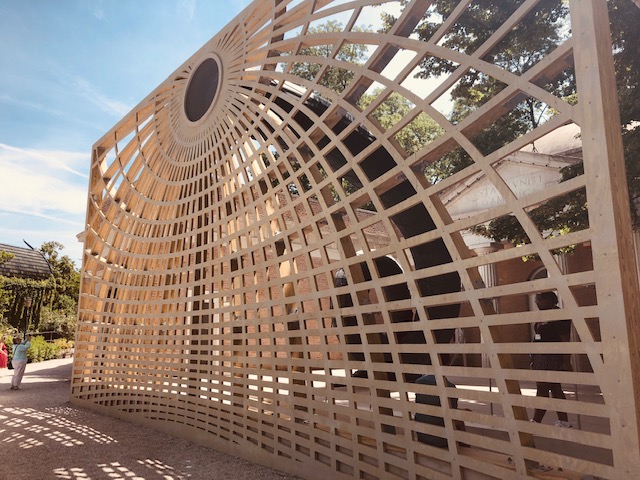
The front of the U.S. Pavilion, which features the work of Martin Puryear.
IMG_9536
And now, the back of the opening piece.
IMG_9551
A red Phrygian cap, also known as a French liberty cap. This is made of wood. My daughter says everyone wants to touch it.

A

IMG_9541
A Confederate Civil War cap. Look in the crosshairs to see yourself.
IMG_9540
IMG_9539
Bronze, but doesn’t look like bronze.
IMG_9537
Detail of the bronze.
IMG_9554
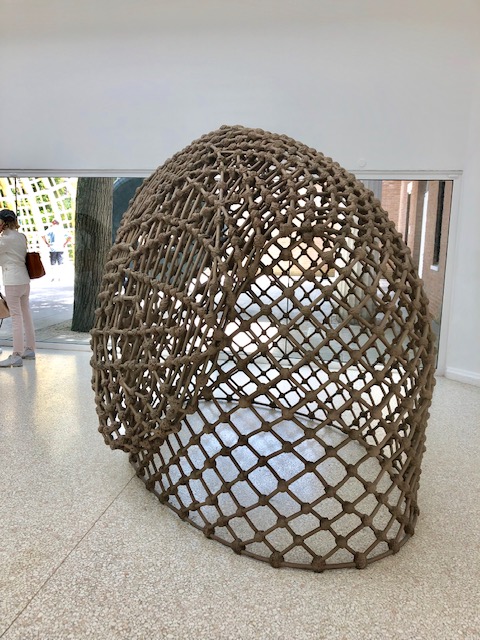
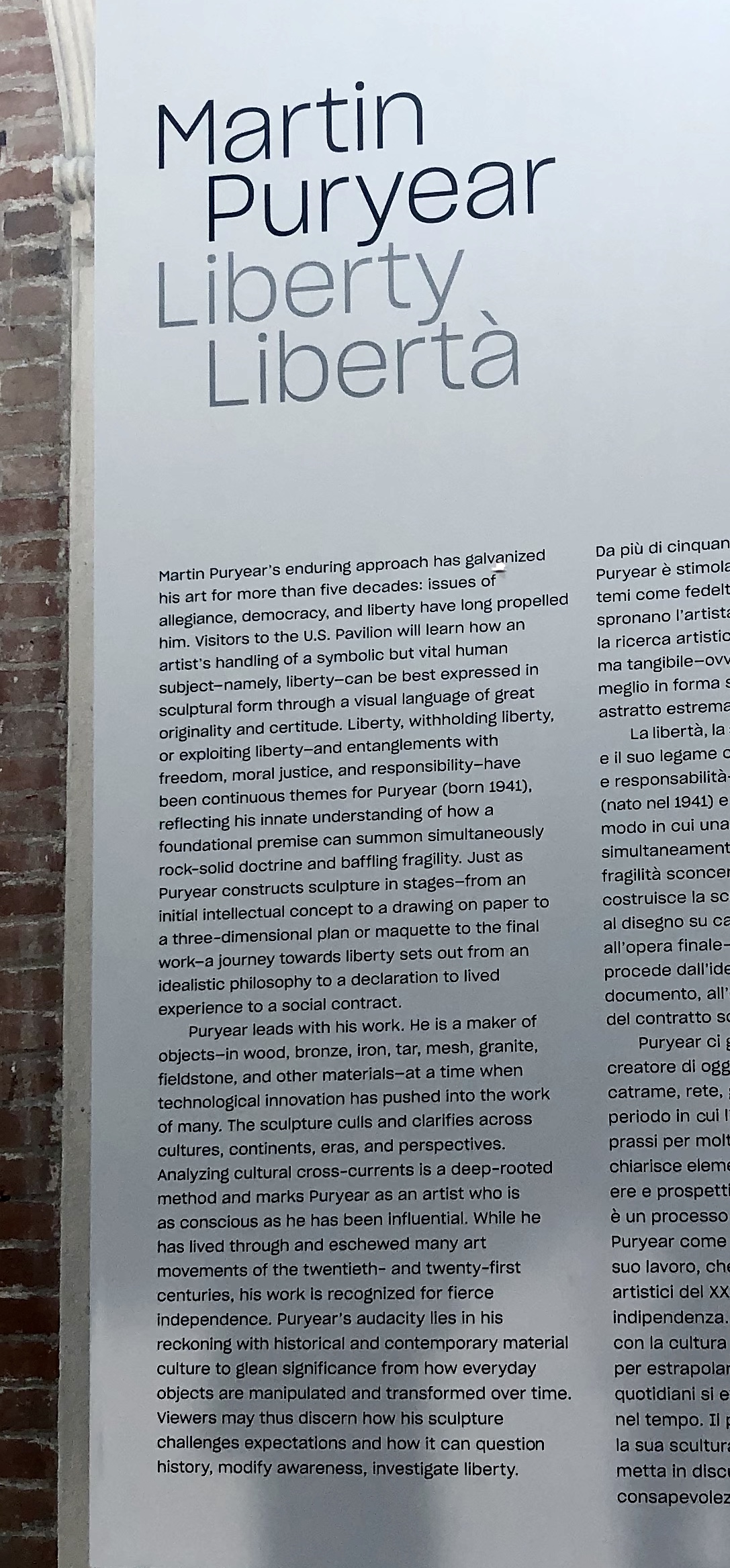
The gallery label for the Martin Puryear exhibition inside the U.S. Pavilion. I do not have photos of every piece in the show. There were several more.
IMG_9564
I figured that if we are visiting Greece this summer, we should probably go see the Greek pavilion.
IMG_9561
Walking on glass cups inside the Greek pavilion.
IMG_9532
Countries from around the world participate. Here’s the Uruguay Pavilion. Not sure why I don’t have a photo from inside. No offense, Uruguay.
IMG_9531
Work inside the Czechoslovakia Pavilion.
IMG_9534
The Nordic countries participate in one exhibition hall. Every Biennale, one of those nations also has its own additional pavilion. This year, it was Finland’s turn, but I did not take pictures of that show. 
IMG_9533
Inside the Nordic Pavilion.
IMG_9557 (1)
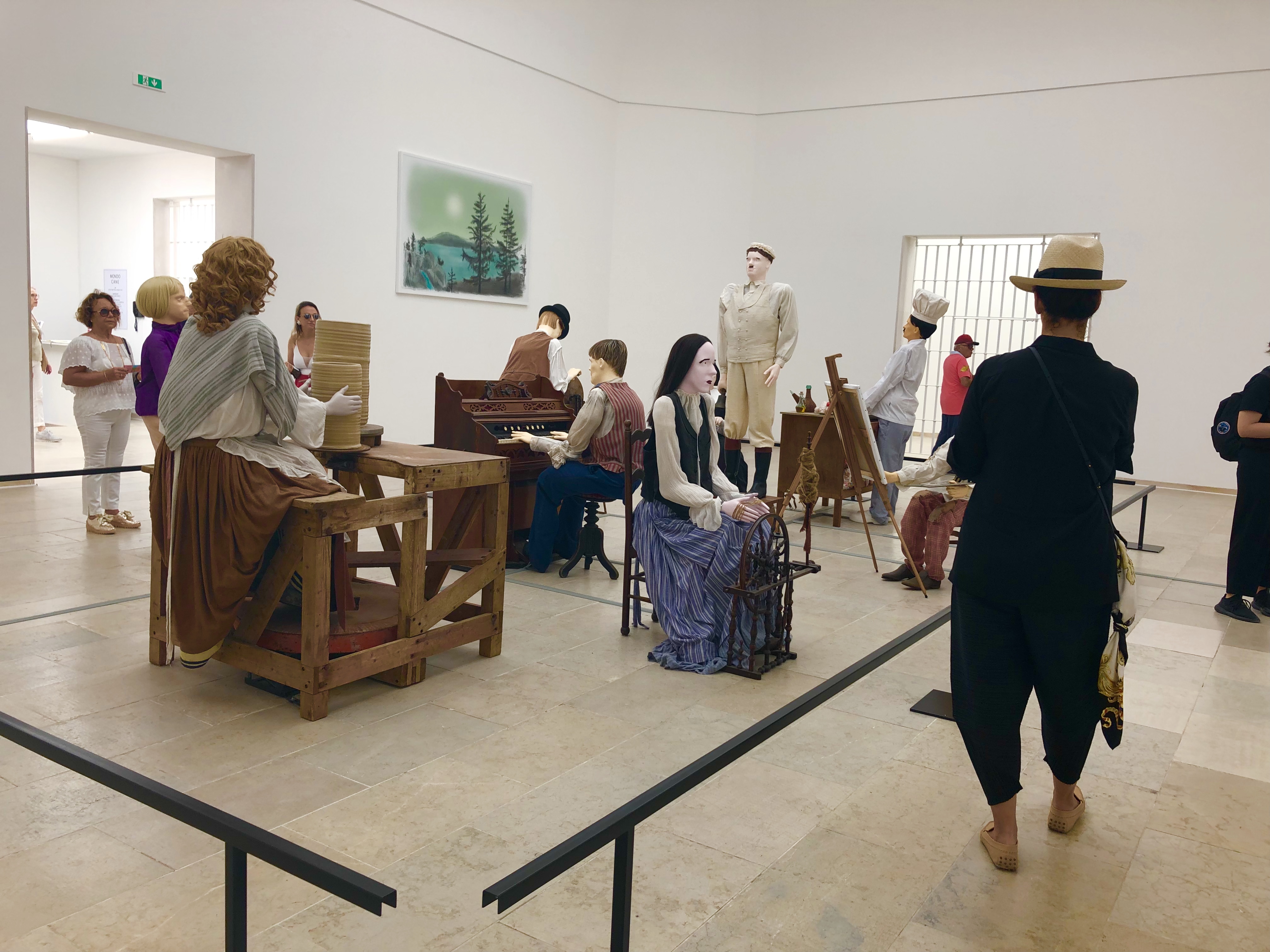
This assemblage inside the Belgium Pavilion was eerily irresistible.
This installation within the Belgium Pavilion was eerily fascinating. Every figure is moving and making something… pottery, bread, cloth, music, a painting. The taskmaster controls it all with the ringing of the bell.
IMG_9555
The Egypt Pavilion
IMG_9521
Japan Pavilion
IMG_9522
A video piece inside the Japan Pavilion.
IMG_9560
We walked over this canal to see the back portion of the Giardini area of the Biennale.

Thanks for reading! As you can see, there is too much to see at the Venice Biennale without spending days there. In addition, to really study the art and understand its motivation and full message deserves much more time than we were able to devote. Still, if you have the desire to see art on a global scale, the Venice Biennale is where you need to go. Click like if you enjoyed this post, and feel free to leave a comment or follow my blog for my next post from Bologna!

Categories
Greece (Skopelos)

Hiking the Coast-to-Coast Trail on Skopelos Island

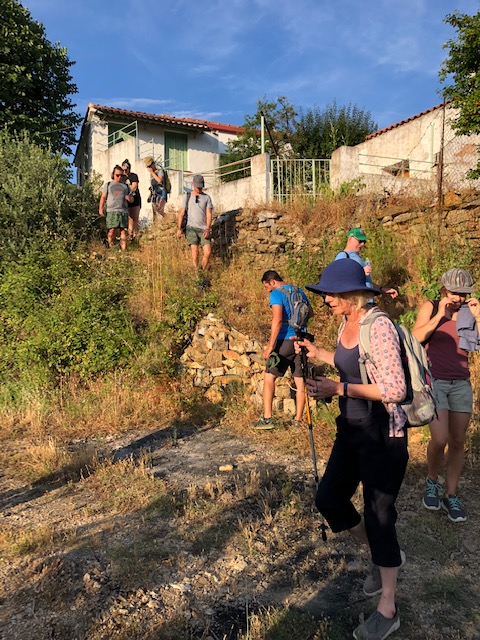
On Wednesday night (June 12), Mitch and I hiked across Skopelos Island from Skopelos Town to the little seaside town of Panormos. The three-hour hike was organized by Heather Parsons, founder of Skopelos Trails.

I had heard of Parsons last fall when I found her in an online search. It seems when you research Skopelos Island, her name will eventually surface. Her organization, Skopelos Trails, is dedicated to restoring, maintaining and improving the ancient stone pathways, called calderimi, that are sprinkled across the island.

IMG_9423
Victoria Rose Phillips, Grayson Phillips, Mitch and I

Parsons has written and published a book as well, called Skopelos Trails. It shows the paths for  the island’s many walking and hiking trails. Parsons has provided detailed—almost step-by-step directions— for finding and following the paths either on your own or with guidance from her or her business partner and our guide, Emmanuel.

According to a post on Facebook just today, the local forestry department recently asked Skopelos Trails to provide them with details of all the closed trails.

IMG_9485

In the post it says that Emmanuel had drawn in by hand 116 km of trails on the department’s terrain map. Clearly, Skopelos Trails knows the land better than most.

Parson’s book also contains hand-drawn illustrated maps that appear alongside the directions and description of the Trails. The illustrations may not be drawn to scale and if a business was used as a landmark on the map, it may have changed, especially if you are using an older edition of the book.

The trails are marked and rated by level of difficulty and the trail we walked Wednesday night, the Coast to Coast Trail, is considered “not strenuous,” or at least that’s how Parsons described it to me in her reply to an email I had sent her as we were making arrangements. (Since I had a 7 a.m. ferry ride to catch the next morning, I wanted to make sure the three-hour Coast to Coast Trail would not wipe me out for the next day’s travel to Venice to see my daughter.)

IMG_9425
Starting off from Skopelos Town below.

With Parsons’ “not strenuous” description, we decided to sign up for the 25€ hike, but we opted to take the bus back later from Panormos to Skopelos Town instead of going to a restaurant with the other hikers. I would have loved to socialize more with the others, since during the hike we were able to visit for only a short while.

IMG_9426

The plan was to meet at 5 pm at Kahili’s Bakery and Cafe down on the harbor front street or at 5:15 further up the hill near our apartment, where the calderimi, which started just down the hill a small distance, passed by.

IMG_9450
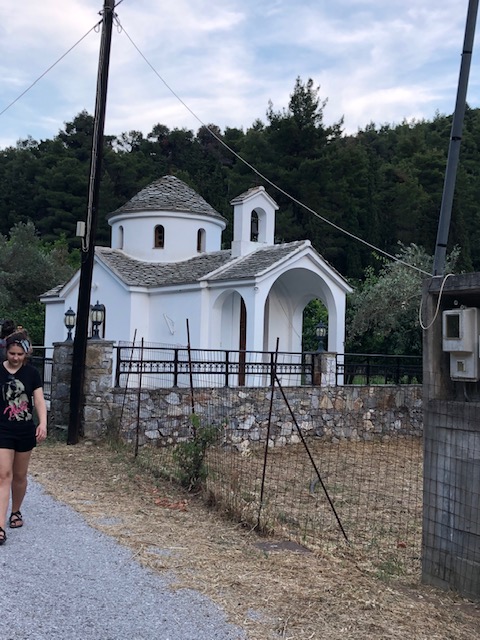
Mitch next to a small family Greek Orthodox church

As we stood near the telephone pole with a Skopelos Trails trail marker (a 3″- diameter white circle with a yellow hiking boot footprint), we began to hear huffing and puffing from an approaching group.

IMG_9443

To our left, trudging up the hill with the entire town of Skopelos spread behind them as a backdrop, proceeded two couples from England; Anna, a young Athens native who lives in Skopelos; a woman from Skopelos who had built a brand new home in the mountains of Skopelos; and our guide, Emmanuel.

Our addition to the group included Mitch and I plus Grayson and Victoria Phillips, who is serving an artist residency at Skopart.

In total, there were eleven of us—quite a good number for an end-of-day stroll (and I use that term loosely) across the island.

IMG_9451 (1)

The previous Thursday, according to the Skopelos Trails’ Facebook page, a group of five hiked the path starting at 9 a.m.

IMG_9457

It would have ended in the heat of the day, so maybe an evening hike, with its cooler temperatures during the latter two-thirds of the hike, makes for a more tempting outing and attracts more participants.

IMG_9459
One of the natural springs we came upon

We did stop occasionally during the hike— about five times. During our stops, we would take a photo, drink water, or refill our water bottles at a  natural spring. There are several of these springs on the island and many islanders use them for their drinking water.

The water was cold and clean, Emmanuel assured us. Our bottles were nearly full, so we didn’t drink from the spring, but I wish I had. Should have tasted natural Greek spring water. How often do you get to do that? I did scoop up some of the icy water and rubbed it on my arms and neck for a cool-down, though.

We arrived right on schedule at 8:15 pm in Panormos, having traversed the island through olive groves, along stone-walked paths, on top of stone-bordered terraces, alongside pastures where goats and an occasional horse roamed.

IMG_9455

The hike took a solid three hours and fifteen minutes. I’m writing this post in Venice; when I return to Skpelos, I’ll look into my copy of Skopelos Trails to see how many kilometers we covered. I’m guessing right now about five.

IMG_9430

We also came upon five tiny and well-maintained Greek Orthodox churches. Our guide told us that many of the churches were built by families so their members would have a central location for burial. In at least one, a single candle glowed in the darkened nave.

I was tired when it was over. I would definitely label the hike “moderately strenuous.” It’s very rocky, and very steep in parts, and in many places we were walking in thigh-high grasses or on steep grades that were covered with a cushion of small, smooth leaves (a eucalyptus variety?) that made a few of us nearly fall.

IMG_9472

Even though it was a challenging three hours, it was very enjoyable literally getting off the beaten path to see the rural Greek countryside and rugged, forested mountains, which are particularly unique to Skopelos.

IMG_9471
IMG_9428

We also enjoyed meeting and visiting with people from around the world. As Judy, an British hiker from Bristol said, “It’s so interesting when people from all different parts of the world with different lives come together to connect in this way.”

IMG_9479

Thanks for reading! This was a fun experience and when I return to Skopelos next week, Mitch and I hope to take another (probably shorter!) hike using the Skopelos Trails book. Follow my blog for more posts from our summer travels and feel free to leave a comment about some interesting hikes you’ve taken recently.

Categories
Greece (Skopelos)

A Big Fat Greek Vocabulary Lesson

Gus Portokalos would be proud

You know in the movie My Big Fat Greek Wedding when the father, Gus, explains how every English word can be traced back to the Greek language? Here’s what Gus says in the movie: Now, give me a word… any word… and I show you, how the root of that word… is Greek. How about “arachnophobia”? “Arachna,” that comes from the Greek word for spider… and “phobia” is a phobia, it means “fear.” So, “fear of spiders.”

Well, he’s right on that point when you look at the name for the group of islands that my husband and I are visiting: the twenty-four Sporades Islands along the east coast of Greece.  (Actually, we’re only visiting one of those islands, Skopelos.)

map
Only four of the twenty-four Sporades Islands are permanently inhabited: Skiathos, Skopelos, Alonnisos, and Skyros.

When you look at the twenty-four islands that make up the Sporades  on a map, they appear to have been scattered into the Aegean Sea. Picture in your mind seeds or spores that have been tossed across a field by a farmer.  Or consider the seemingly random process in which cells scatter and germinate. It’s a very visual and literal way to describe these islands.

Now let’s do what Gus would do.

Ever think about the English word “sporadic”? According to Merriam-Webster, this word “describes the distribution of something across space or time that is not frequent enough to fill an area or period, often in scattered instances or isolated outbursts.”

See? The English word sporadic can be traced directly back to the “Guh-leek,” as Gus would say.

For even deeper backstory, there’s this from Merriam-Webster:

Sporadic “comes from Medieval Latin sporadicus, which is itself derived from Greek sporadēn, meaning “here and there.” It is also related to the Greek verb speirein (“to sow”), the ancestor from which we get our word spore (the reproductive cell of a fungus, microorganism, or some plants), hinting at the seeming scattered nature by which such cells distribute and germinate.”

So when when the islands were created or “sown,” they were scattered like spores. What better name to call these islands other than the Sporades Islands?


I’m a word nerd. I love learning where words come from and how they have changed over time. Click “like” if you enjoyed this post and leave a comment about a word you find interesting.  Follow my blog for more posts as we continue our month in Greece.

Categories
Greece (Skopelos)

A Tour of Our Studio Apartment in Greece

I thought it might be interesting to write a post about our lodging here in Skopelos Town, sometimes called the Chora, on Skopelos Island in Greece.

IMG_9310
Here’s our front door.

We’re staying in a room that sleeps three people at Mayorka Studios, which is located just a three-minute walk down the hill from Skopelos Foundation for the Arts (Skopart). This is the arts center where my husband Mitch is pursuing a three-week artist’s residency.

The studio we’re staying in runs €40-80 night, depending on the time of year. July and August are the most expensive times; it varies greatly after that. In addition, if you come to the island to participate in a Skopart artist residency, your rates may be lower.

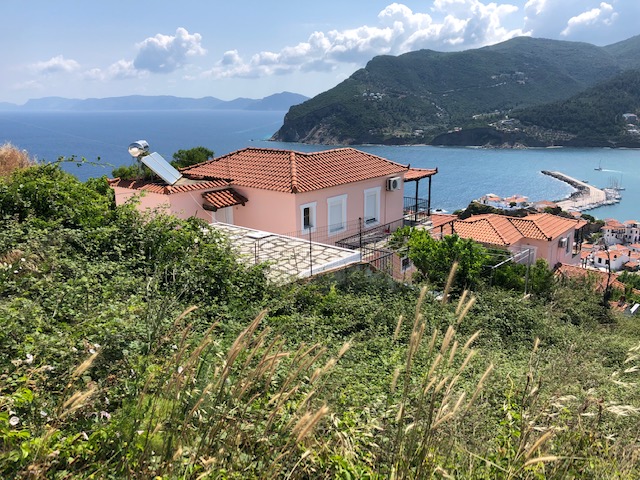
Mayorka Studios comprises twelve units perched high on the hill that overlooks Skopelos Town below. In fact, if you look in the picture below, you can see the apartments in the extreme upper left corner. They are not white, but instead are painted a light coral color and have red tile roofs.

IMG_9094 (2)
You can see Mayorka Studios in the very top left of this picture, right along the edge.

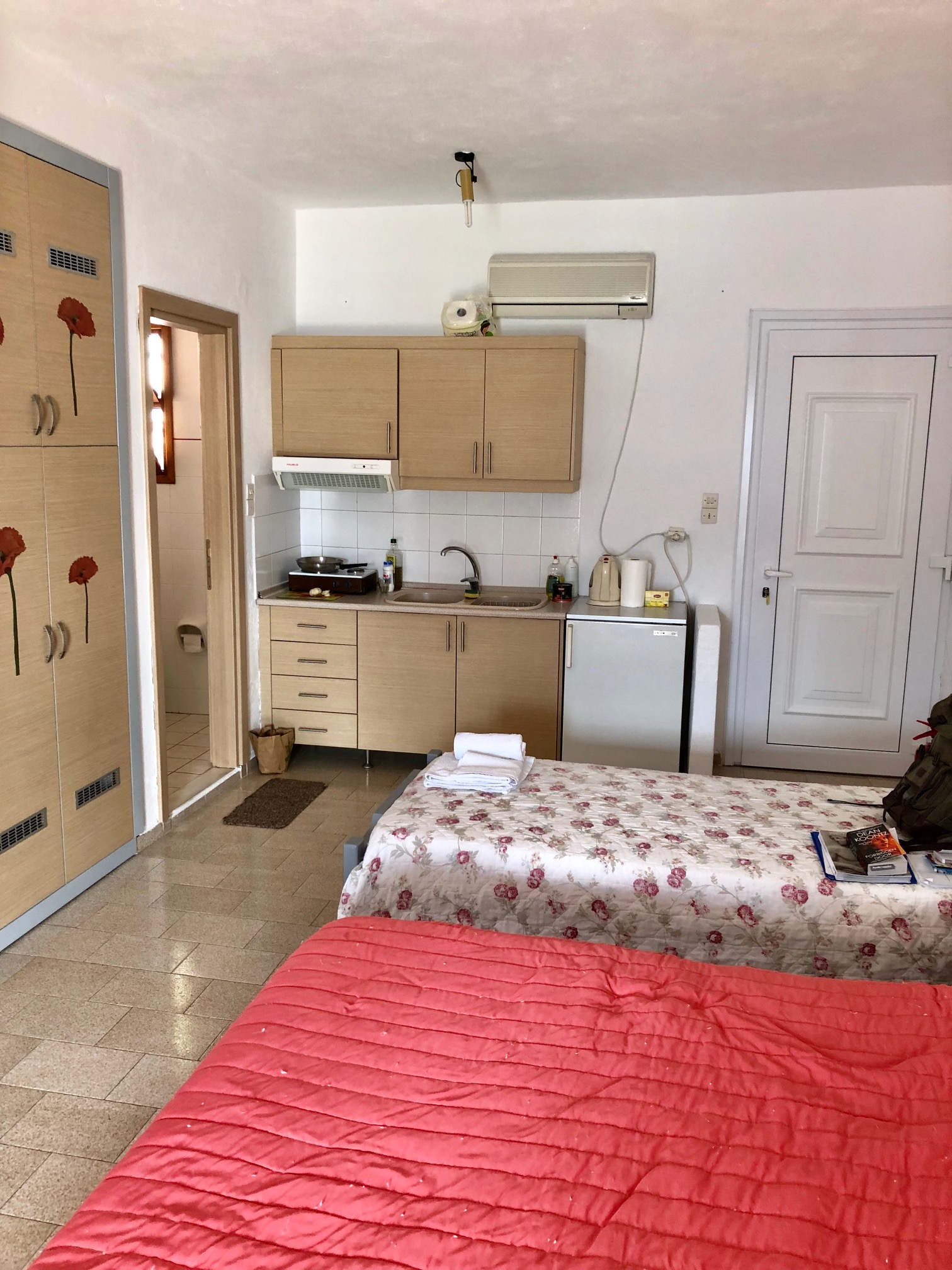
Our room has a king-size bed and a twin. It also has a limited kitchen with a few pots and pans, an ice cold fridge, double sink, a small two-burner stove, …

and a kettle that boils water in no time flat.

IMG_9290
The entrance. You can park on the lot there by the scooter, but no one here right now has a car.

The kitchen has the main appliances we need, but not a microwave or oven; however, I don’t think that microwaves are as popular here as they are in the U.S. As for the oven, yes, I would like to have one of those–even more so than a microwave, actually– but oh, well. My daughter’s apartment during her first internship in Venice didn’t have an “oh-ven” either.

IMG_9339
Rather plain Jane, but perfectly adequate.

The kitchen also contains the basic utensils needed, but we did have to go buy a sharp serrated knife for slicing tomatoes. (We have Greek salads with nearly every meal to make sure we get our daily allowance of feta cheese.)

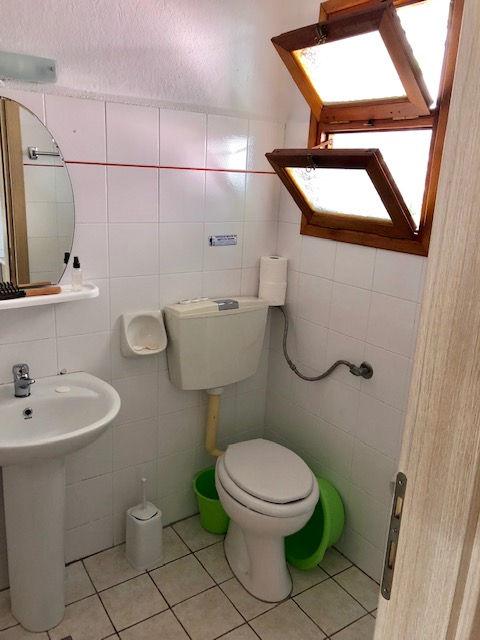
The bathroom has a small shower and a hand-held shower head that hangs over the faucet. The shower at our AirBnb in Athens featured this same type of shower setup, so it must be common here. It’s a little awkward to get used to… you’re never just standing under flowing water. You have to hold the shower head. Kind of a pain. Man, am I a whiner or what?!

IMG_9340
And now for the other angle.

The toilet functions, except for “the rule.”

IMG_9411

That would be the “never flush paper” rule, which was also awkward to get used to. Flush NO paper, not even the dirtiest paper? Nope. Apparently, it clogs up the pipes. So, instead of tossing your paper into the toilet, you just toss it into the lidded trashcan. I noticed this same rule at a hillside restaurant near the Acropolis in Athens. That place had a large lidded basket for the used paper.

Our king-size bed is very comfortable and firm. There are plenty of good pillows also. The place is spotless thanks to the housekeeper who drops in every morning around 10.

IMG_9341
Yep, that’s a bathroom. Notice “washing machine” next to toilet.

The TV (an old tube version) doesn’t seem to work. I suspect that the batteries in one of the remote controls are dead; however, I still can’t seem to get the little black box that sits on top of the TV to be friends with the actual TV.

IMG_9342
Shower with hand-held faucet. This was a new one for me.

But it doesn’t really matter, since the one night I was able to get something to watch, it was a soccer game with a Greek-speaking commentator (duh). So it was no great loss, but still. I get a kick out of watching TV when I’m in another country. I think it’s fun to learn what people in different countries are interested in,  their perspectives and priorities.

As for laundry, we wash it by hand.

Yes, you read that right. In fact, there’s a lime green plastic washtub wedged between the toilet and the wall specifically for the purpose. We take the tub, put it on the floor of the shower, turn on the water, sprinkle in some powdered Tide for handwashing and get to washing.

IMG_9312
The housekeeper dries the sheets in the breeze.

Then we rinse (sometimes in the tub, sometimes just in running water) and hang the wet duds on the clothesline on our balcony just like everyone else.

IMG_9105
Outside our door

It works really pretty well, and yes, saves a lot of energy. I can handle not having a dryer, but a washer really would be nice. Our place in Athens had one, and even though we were there for only two nights, we washed a load of laundry. (And honestly, I do think it might be a little unusual to not have one in our unit.)

So even though we handwash our own clothes, can’t flush toilet paper, and the TV doesn’t work, this place is still the bomb. And that’s because…

it’s all about the balcony.

The view is absolutely incredible. In fact, who needs a TV when you have a front row seat to the best show in town all day and all night?

IMG_9367
View from the balcony

Watching the ferries, tour cruises, and boats of all shapes and sizes sail in, unload, and sail back out will probably be one of my best memories from this entire trip. We can also see people way down there walking up and down the harbor front street. And late at night, when the balcony doors are open (and they usually are, because it’s quiet and safe up here), you can hear live Greek folk music rising on the breeze from the Paganitsa Tower taverna. It’s heavenly.

I guess you could argue that the balcony is our only sitting area, however. You’d be right. There is no indoor dining area, for example, or an easy chair to sit in.

IMG_9308
If you stand along the railing on the balcony, this is the view of the town to the right of the port.

Last Saturday night, during the second night of the music and dance festival, when students were showcasing their modern dance routines, someone must have been performing to “Perfect” by Ed Sheeran. Those crazy-good chords floated up from the performance at the City School down below…

another nice memory.

So, except when we’re in the kitchen fixing meals, if we’re in the apartment, then we’re on the balcony sitting in the two wicker rattan love seats, looking out at the Aegean Sea, and maybe sipping a glass of wine. There’s a glass-topped table there and that’s where we have breakfast, lunch and dinner.

IMG_9302
This just shows the top of the apartments. Notice the solar water heater on the top unit. Each unit has one of these. Hottest water ever!

We’ve dined out only twice in the week and a half that we’ve been here. We head to the grocery store downtown (or catch a ride with friends from Skopart) whenever we need to pick up a few things. I know we’ll eat out a few more times eventually, but I’m perfectly fine with eating in, shopping at the little market, and buying just what we really need for that day.

That seems to be the way they do things here.

IMG_9307
Mitch walking down to our apartment. 
IMG_9311
Right outside our door. Almost to the killer stairs… see next photo.
IMG_9313
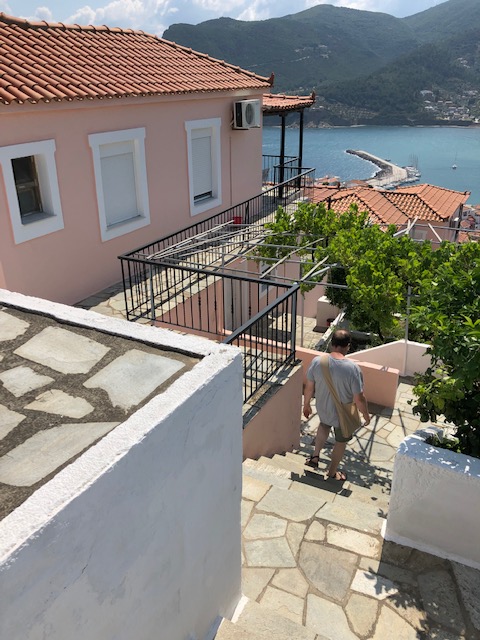
A shot of the studios from down below on the stairs that descend all the way into Skopelos Chora. These stairs are killers. Wear good shoes. Walk slowly so your knees aren’t jarred with every step. You’ll get very fit just walking around Skopelos on a daily basis.

Thanks for reading! I thought it would be interesting to show our digs while we’re on Skopelos Island in Greece. The rates for lodging are highest in July-August; however, Greece is still relatively inexpensive compared to other locales. Click “like” if you found this interesting and feel free to leave a comment.  If you’ve stayed in Greece before, what was your experience like? 

Categories
Art & Architecture Greece (Skopelos)

A Visit to Rodios Pottery in Skopelos

Yes, you can call Nikos Rodios a Greek pottery legend, but you can also call him the juggler of Skopelos. When we arrived at his studio Saturday morning in Skopelos Town, Rodios was waiting for a large bowl to dry on his “extra” potters wheel. (He uses a traditional kickwheel for the majority of his work. ) The bowl was slowly acquiring the malleability needed to remove it from the wheel without collapsing. It wouldn’t be long. The mild Aegean breeze flowing through the open doors of the studio would see to that.
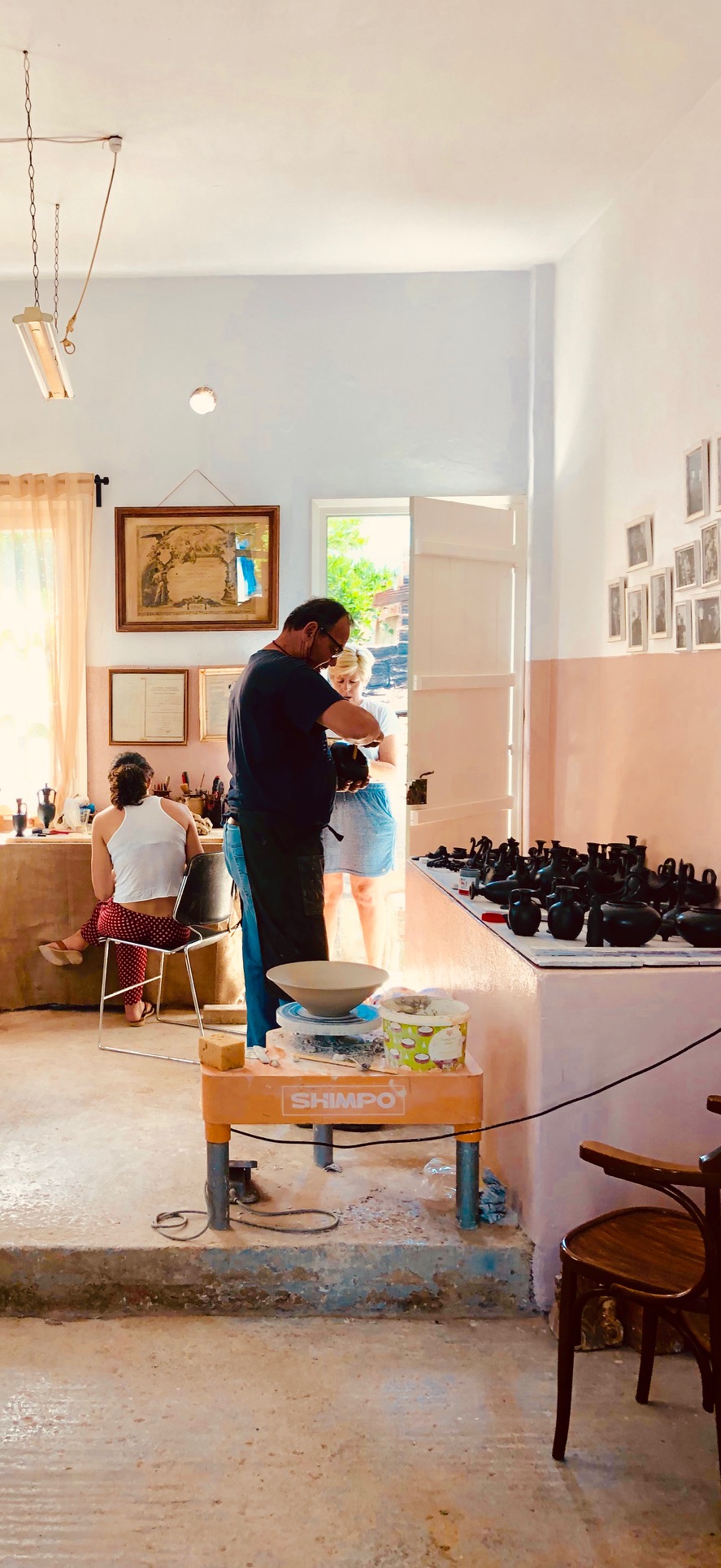
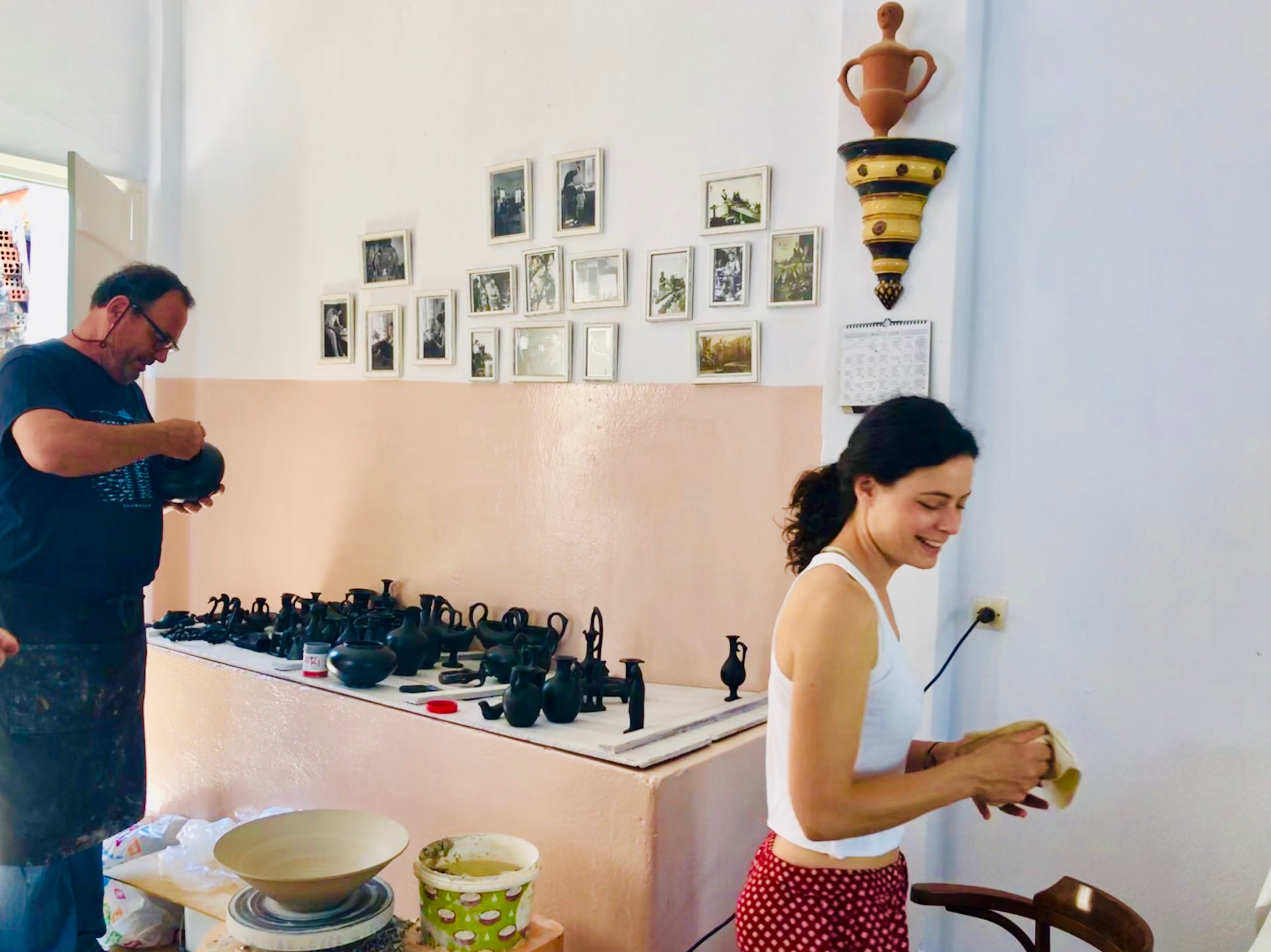
At the same time, Rodios was also polishing and finishing a load of pottery that had been unloaded earlier from his brick kiln (it burns olive tree wood) that stands just outside the door behind his studio. The pieces were arranged on a counter… an assortment of vases, animal figures, and bowls. And then some visitors walked in: us. See what I mean when I use the term juggler?

IMG_9231
Jill Somer, associate director of Skopelos Foundation for the Arts, and Mitch talk with Nikos Rodios about a vase made by his grandfather.

But juggling is the nature of ceramics… it’s a busy, start-and-stop process that requires both flexibility in one’s routine, and a keen eye for scheduling and working a medium that waits for no one and simultaneously takes its own time. The Rodios family knows this routine very well.

Our visit had been arranged by Jill Somer, associate director of the island’s Skopelos Foundation for the Arts, also known as Skopart. Somer interpreted conversations about techniques, clay bodies, and terra sigilattas (slip-like liquids) between Rodios and my husband, Mitch, who is serving an artist’s residency at Skopart.

Rodios and Mitch are each testing the practicability of using terra sigillatas with both Skopart’s red earthenware clay, which Mitch is using during his residency, and Rodios’ proprietary claybody.

IMG_9286
The family has printed this brochure in both Greek and English.

Fans of ceramics in general and contemporary Greek pottery in particular revere Nikos Rodios for carrying on a tradition begun by his grandfather, Nikolaos Rodios. In the early 1900s, Nikolaos focused on producing decorative forms reminiscent of classical Greek pottery.

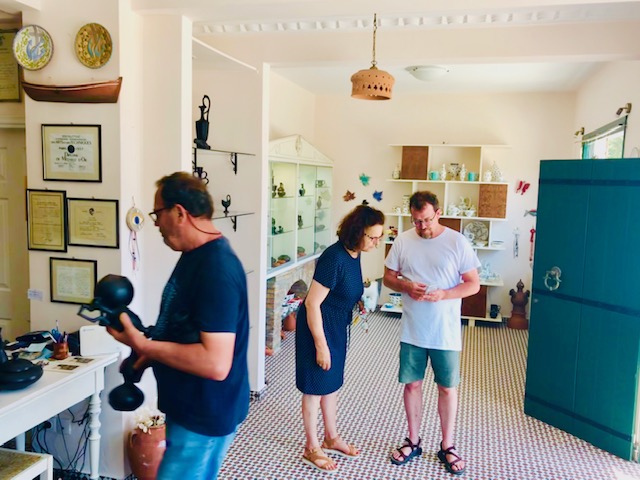
At the same time, he desired that his work feature a permanent, bold black surface. After experimenting to find the precise combination of clay bodies, colorants, and firing temperatures—potters are chemists in disguise, if you didn’t know—Nikolaos was awarded a patent for his technique in 1930. You can view the patent certificate, assigned the number 2981, on display in the workshop.

IMG_9234 (1)
Rodios inspects some pieces from his most recent firing. On the wall near the door, you can see the patent certificate awarded to Nikolaos Rodios in 1930.

As the years continued, Nikolaos passed the family secret to his son, who in turn passed it down to today’s Nikos Rodios.

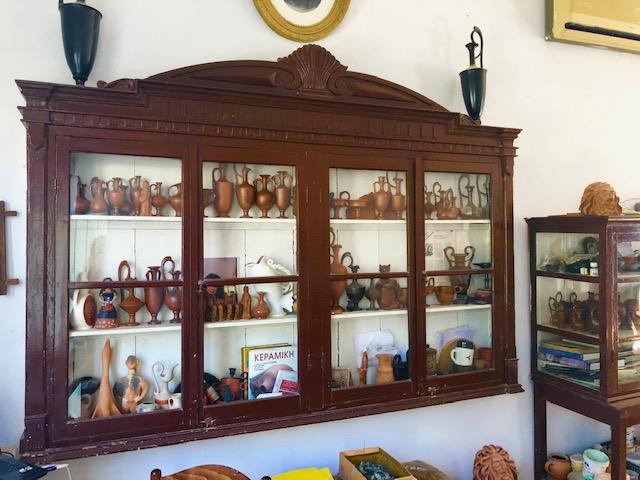
After we spent a short while admiring Rodios’ newly fired pottery, he led us to a large wooden display case hanging on another wall.

IMG_9233
This case contains pottery made by Nikos Rodios’ grandfather and father.

It contains a diverse collection of pottery made by the previous two generations of Rodios. Vases of all heights are on display. Some are short and bulbous, others are elongated and elegant. Each alludes to classical Greek forms.

It’s humbling to witness the current members of a family respect the hard work and innovation accomplished by their ancestors. It’s also gratifying to know that the next generation, Nikos’ daughter Magda, is building on the legacy left to her.

IMG_9235
Magda spends time in the studio alongside her father, Nikos.

At a workbench near the sunny back window, Magda helped her father polish some of the items from the kiln.  She adds her own creative flair to the family business with bright, colorful earthenware mugs, serving pieces, jewelry, and decor items.

IMG_9236
Mitch shares images from his Instagram accouint with Maria, Rodios’ wife.

After greetings us, Magda took a break from her work to retrieve a plastic water bottle that she had filled recently with a mixture of water and a local black clay. She explained that she hopes the mixture will someday soon yield an interesting clay. She brushed a bit of it onto a pottery shard. The watery part of the mixture instantly soaked into the shard and left a gritty residue on the surface.

Who knows? With time and attention, the sludgy, gritty solution may indeed transform itself into a native Skopelos clay.

IMG_9237
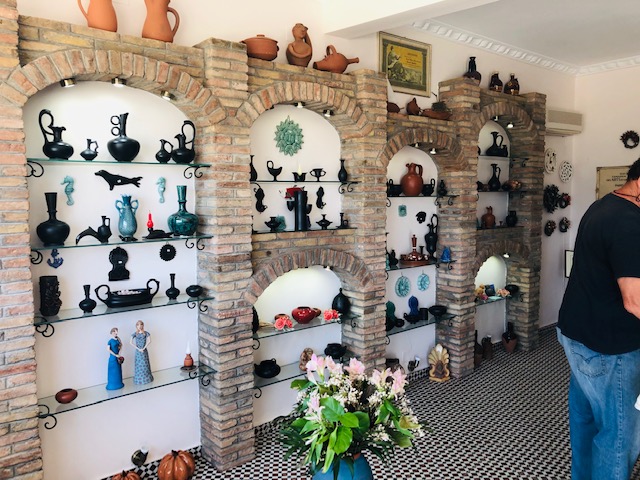
Art enthusiasts will find their own Rodios creation in the gallery.

We then walked across the street to the pottery shop that bears the Rodios name. The shop carries a wide variety of both decorative and functional ware, from wall hangings to coffee mugs and jewelry.

Inside, Maria, Rodios’ wife greeted us and spoke briefly with her husband about the wares he had carried over from his studio. He added a few pieces to the stone-and-glass shelving units, and agreed to motor over to Skopart in a few days for a quick visit with Jill and the artists working there (students from Gulf Coast State College, painter Victoria Phillips from Macon, Georgia, and Mitch).

Then he said his goodbyes and sauntered back to his studio across the street. He had some more juggling to do.

IMG_9238
The Greek letters spell out “Rodios Pottery” on the front of the family-run gallery.

Thanks for reading! Click “like” if you found this interesting and click “follow” for daily posts from our “workation” in Greece. After the residency concludes, we’ll be continuing our visit on the mainland and south to Crete (we think).

Categories
Greece (Skopelos)

A Quick Getaway to Glifoneri Beach

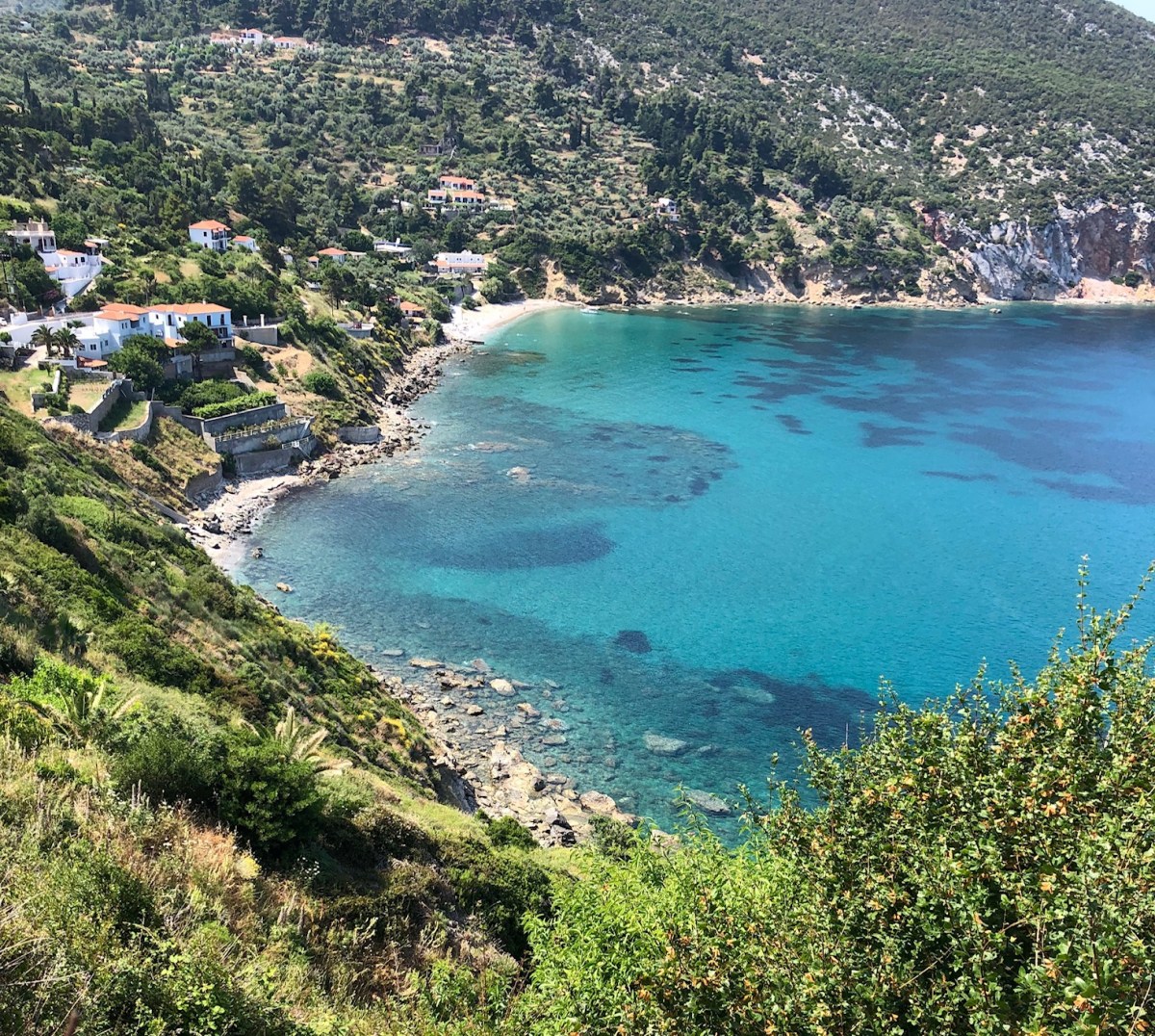
We downsized our Sunday afternoon with a walk to this nearby beach

We had planned to go to Stafylos Beach, about one mile away across Skopelos Island. However, that would require a bus, and we didn’t know if there would be buses running on a Sunday, since Greek Orthodoxy does play a major role here in Sunday activities.

In fact, every Sunday morning, you can hear Greek Orthodox monks chanting via loud  speakers throughout the “bowl” that is Skopelos Chora (the main town).

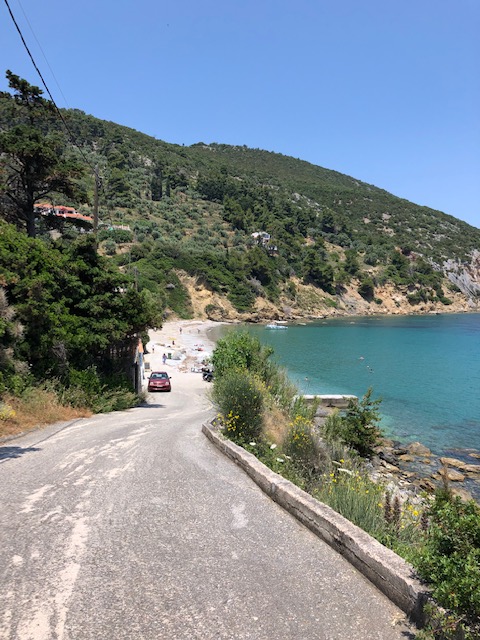
IMG_9257
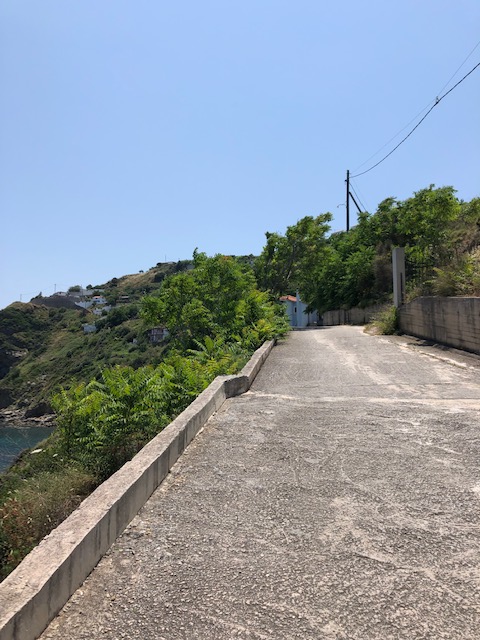
At one point, our walk down to the Glifoneri Beach followed this concrete road. 

From my vantage point high up on the hill overlooking the harbor and town, however, I would say that yes, the buses do run on Sundays, since I don’t see any down below parked at the bus station on the main street. I’m assuming they must be out and about. Oh look, one is pulling in right now, in fact.

IMG_9261

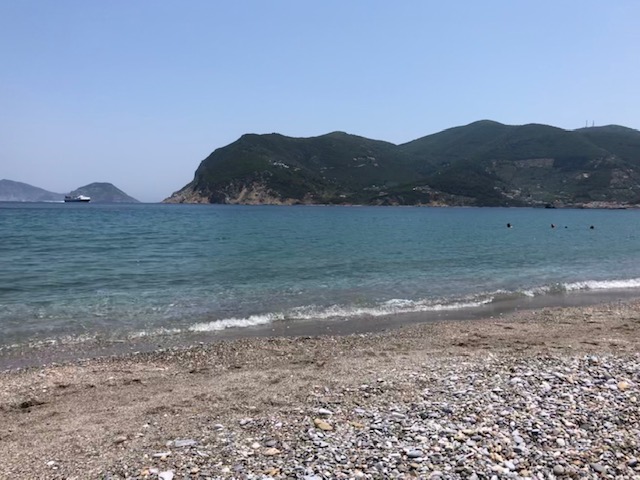
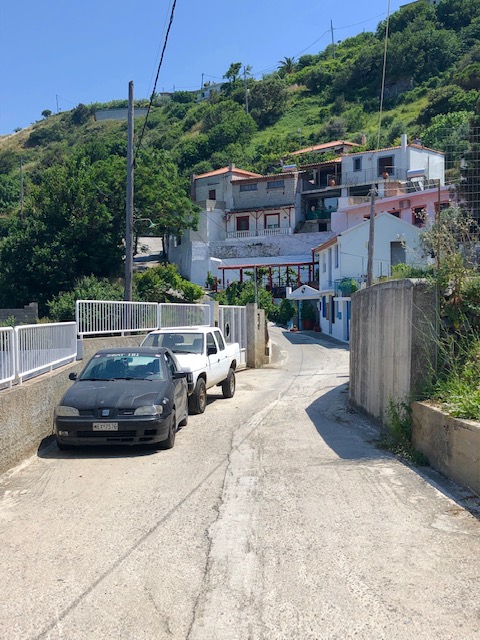
So instead, we walked down to Glifoneri Beach. We passed houses (some beautiful, some ramshackle),  chicken coops, and abandoned stone sheds along our way.

The beach is about a half-mile walk away, all downhill. It’s named after the small “taverna” that operates across the little street from the beach; however, it’s also known as Agios Konstatinos Beach for the church that is on the hillside above. I haven’t seen the church, but there are so many (around 123) on the island of all shapes and sizes that it’s possible I’m just not seeing it.

IMG_9264
On the outcropping on the far right in the photo, you can barely see the white churches that overlook Skopelos Harbor. The most prominent of these is Panagitsa Tower, the Church of the Virgin Mary.

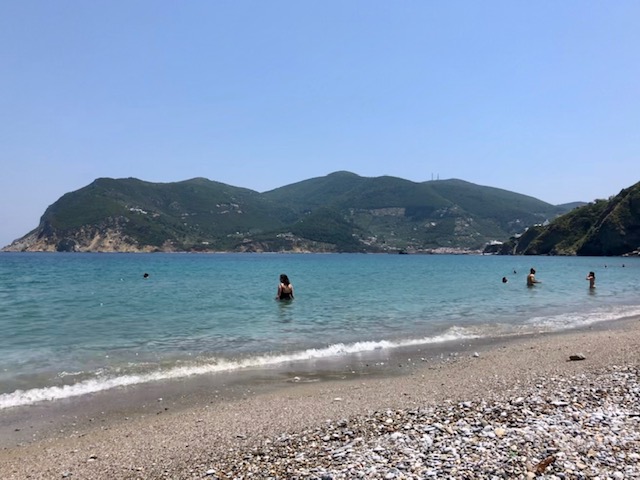
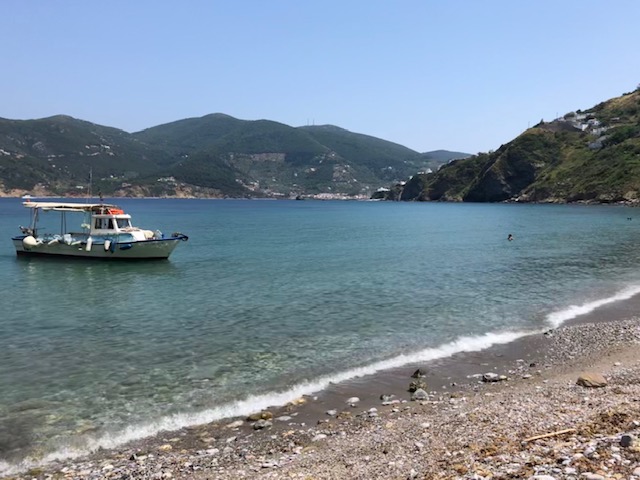
When we arrived, the water was quiet. It was stunningly aqua in color, but quiet and serene. Approximately thirty people were there. Kids played in the waves, middle aged couples lounged and slept in the sand, and young twenty-somethings ventured out further into the waters.

IMG_9259
A Hellenic Seaways ferry makes its way into the Skopelos harbor.

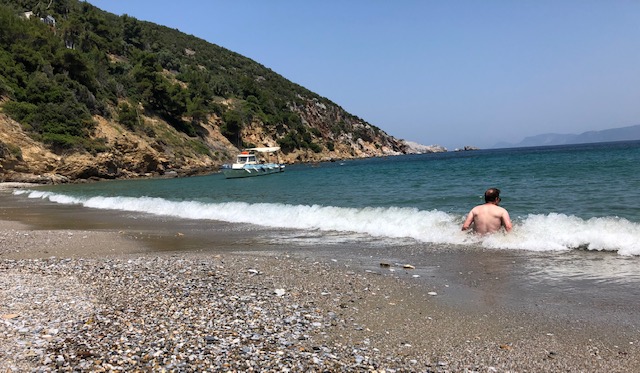
Around 1:30 p.m., however, a procession of waves began rolling in. First, the waves were small, but then they gradually built in size to the point where I turned around to see if the water was reaching our backpack and beach bag.  It wasn’t, but it was only about a foot away.

We sat at the edge and watched the water roll in, bringing with it bits of leaves, sand, tiny stones and sand. Eventually we decided to dog paddle over a narrow band of larger rocks to where Mitch said the bottom was covered with a fine, white sand. He was right. The bottom was soft to walk on and firm.

IMG_9255
And, of course, our return meant we had to do it all again… only going up. This photo shows just a short part of the trip. There were several more escalating hairpin curves to arrive at our studio apartment that overlooks the town and harbor.

We swam out about twenty feet and felt the mixture of currents rolling in from the Aegean. Distinct layers of icy cold waters mingled with warm. We didn’t know whether to relish in the sensation or climb back onto the beach.

IMG_9271
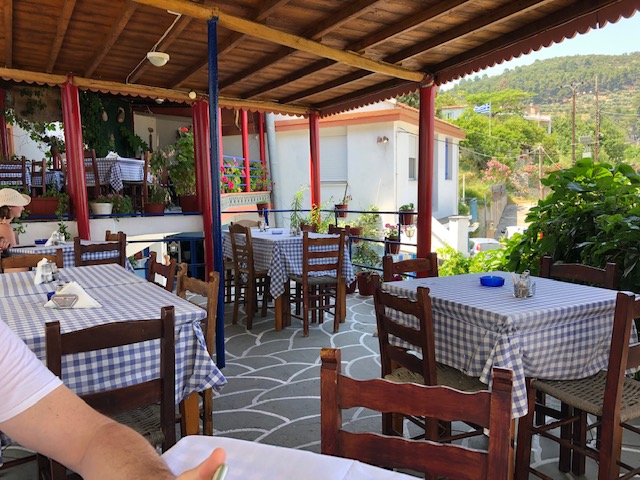
Stella Taverna is in the lower part of the large white house in the photo. It’s a little oasis with incredible views.

We saw a Hellenic Seaways  ferry glided around the island from the south and entered the Skopelos Harbor, disappearing from view around Panagitsa Tower, the Church of the Virgin Mary. As it chugged into town, four bright white streams of seafoam trailed behind it, vivid against the inky blue Aegean waters. Ten minutes later, it emerged again and continued on to its next stop, probably Glossa (the next largest town on the island) or Skiathos Island next door.

IMG_9272
Stella Taverna was quiet in the middle of a Sunday afternoon. Just two more couples were there.

After spending about an hour and a half at Glyfoneri, we began our walk home back up the hill to Mayorca Studios, where we are staying.

IMG_9280
Fresh, fried squid. We usually call it calamari.

On the way, we stopped at Stella Taverna and ordered some fried squid (calamari) and two Cokes.

IMG_9275
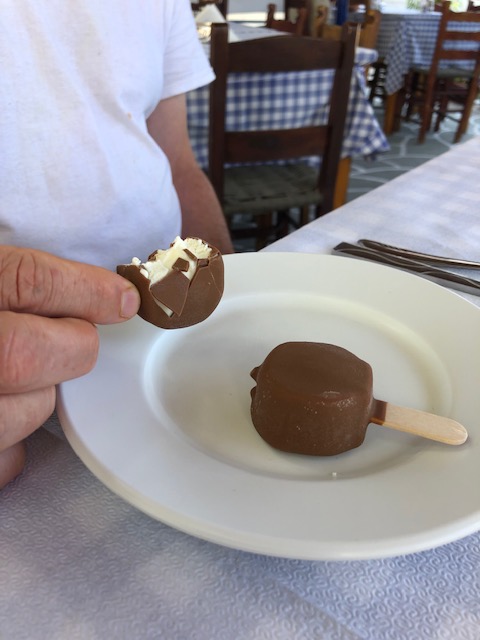
Look at these super cute little ice cream bars. The perfect touch!

Sesame-encrusted bread was served alongside the squid and complimentary miniature chocolate-covered ice cream bars were given to us after we paid our €12 bill.

IMG_9268
And, yes, there was even this picturesque boat anchored nearby.

We interrupted our steep walk back home with several breaks to enjoy the view and rest our aching knees and calves. Skopelos terrain will challenge anyone!

IMG_9267
Alonnisos Island, the third of Greece’s Northern Sporades Islands, sits in the distance. 

Thanks for reading! My husband is serving an artist’s residency at Skopelos Foundation for the Arts on Skopelos Island, Greece. I’m writing as much as I can about our trip and working on some other projects as well. On the agenda for tomorrow: securing ferry tickets for my trip on Thursday to Venice, Italy to see my daughter, who is serving an internship at the Venice Biennale U.S. Pavilion. I have a direct flight out of Skiathos and plan to stay there for five nights.

Categories
Greece (Skopelos)

Greek Dancing in the Dark

Last night, after a dinner down by the harbor at Στου Δημητράκη (by the way, where we dined on giouvetsi, mousaka and ekmek—more on that later), we ventured up the hill to the City School to watch a night of traditional dancing. The show started at 9 p.m. and lasted to midnight and was hosted by the Cultural & Folklore Association of Skopelos.

Jill Somer, assistant director of Skopelos Foundation for the Arts, told me that this is the first night of three end-of-year recitals for a local teacher who currently has 200 Skopelos dancers, including children to adult age groups. Here’s a poster for the festival, which I retrieved from the Skopelos News blog.

dav
The Skopelos News blog has been a real help while we’ve been in town. Check it out for interesting articles.

As you can see from the poster, the festival continues through Sunday night and will feature ballet, modern dance, gymnastics, and musical performances.

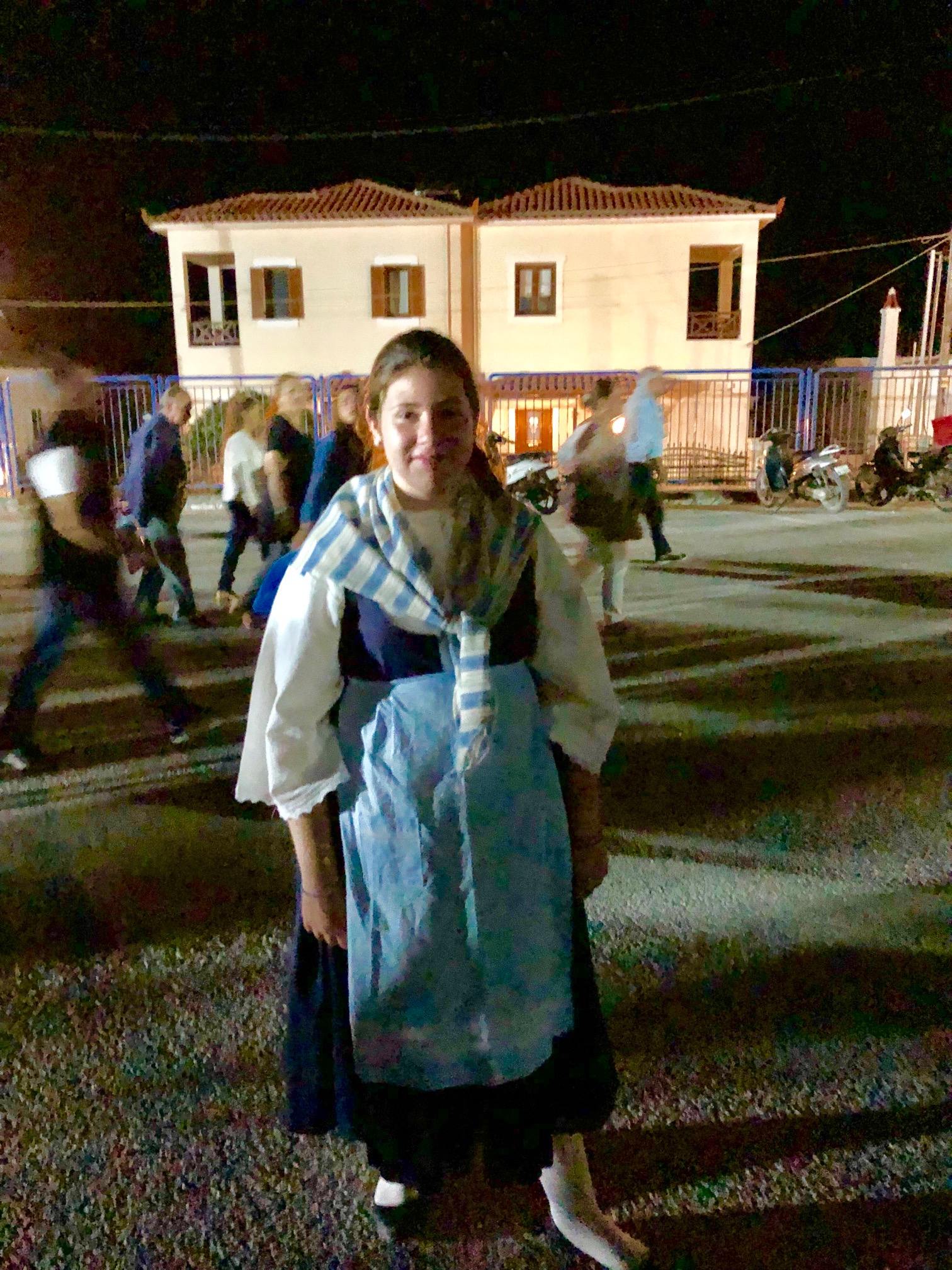
The concert was held in a large concrete amphitheater. Dance teams performed traditional dances from various locales and regions of Greece in the dresses and suits of the respective areas.

When we arrived, many people were there, watching in the stands or chatting on the large plaza behind the dancers. People filtered in and out of the stands all throughout the night. Parents and grandparents scurried to and from the dance floor to take close-up pictures on cell phones and tablets. Some kids played in a large concrete plaza off to the side of the amphitheater.

IMG_9218
The high school dance class

Others practiced their dances while they waited their turn to perform, adjusting their dresses and suits as they prepared. Of course, the occasional cat wandered through.

IMG_9202
This adult dance class wound themselves slowly into a spiral and then released from it gradually.

It seemed to mostly be a local crowd, but there seem to be so many people visiting and re-visiting the island, that the definition of a “local” might be a little blurry here. (And let’s be real, that probably depends on who you ask!)

IMG_9207
These kids make it look easy wearing their traditional Skopelos everyday wear.

At midnight when the concert concluded, we walked back to Mayorca Apartments. It was a long trek, but much of the town was still awake, talking quietly in the streets and tiny walkways. Two or three random scooters with bright headlights zoomed past while we stepped aside.

IMG_9213
The sixth grade dance class also performed in traditional Skopelos everyday clothing.

Google Maps refused to refresh our trek, and we finally gave up, deciding instead to just keep going up and over to where we knew we would eventually find our apartment. At one point as we climbed, the stairway before me continued as far as I could see. Envision Jacob’s Ladder or the Stairway to Heaven and you’ll get the picture! Eventually, we found a landmark (what we call the stone wall), took a left, and knew we only had one final push to the summit.

IMG_9227
Zoey, daughter of Jill Somer, associate director of Skopelos Foundation for the Arts 

The night was breezy and mild. The music was loud. The culture was “full steam ahead.”

IMG_9215
One of the elementary school classes

Footwear varied, as it often does at kids’ dance recitals back in the United States. Some kids opted not to wear traditional dance shoes. Some girls wore black shoes and some wore shimmery pink shoes instead. A few boys wore Nikes and Converse instead of black loafers.

IMG_9219
Another adult dance class lines up to perform.

I was fortunate to be able to see this slice of authentic Skopelos culture. Being a teacher, I had wondered where the school was located and was surprised that it was nestled right in with the hotels, homes, and businesses of this beautiful little town.

IMG_9225
The night concluded with this final number from the adult class.

Thanks for reading! I’m planning to post a story daily on my blog while we’re in Skopelos and on the mainland. Follow my blog to get updates on new posts!

Categories
Greece (Skopelos)

Casual Chaos: A Ferry Tale

Traveling to new places can make you appreciate or at least think differently about the rules and procedures of your own country. And when it comes to safety procedures, sometimes I think the United States tries too hard to keep people safe. We’ve gone so far in the name of safety (and in the name of avoiding lawsuits, too) that Americans no longer need to think for themselves. That wasn’t the case on the Greek island of Skiathos last weekend.

Last Saturday, my husband Mitch and I took a 30-minute flight from Athens over the Aegean Sea to Skiathos Island, the smallest of three isles that compose Greece’s Sporades Islands. After a three-minute taxi ride down dusty, narrow lanes from the Skiathos Airport to the harbor, we confirmed our passage at a ferry ticket office and then made our way across the crowded main street to an assemblage of casual chaos.

IMG_9078
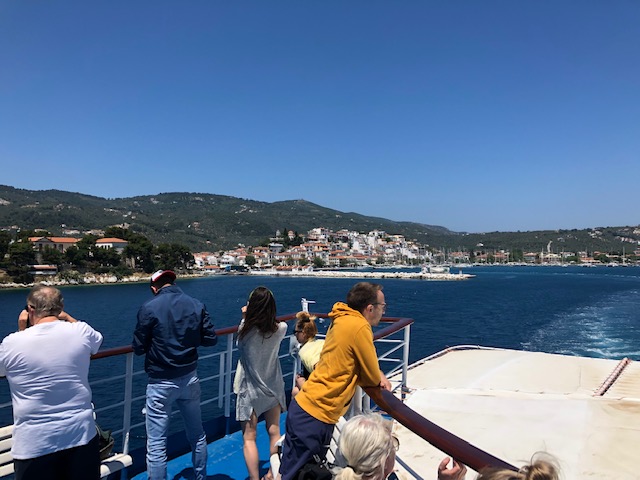
The port of Skiathos as our ferry departed from the harbor.

The noonday sun beat down on the dusty parking lot filled with tourists carrying luggage and others just out for a weekend excursion. Music from the row of restaurants drifted from across the busy street, an incongruous backdrop to the hectic activity of the dock.

As we approached the crowd of waiting passengers, a young man was backing up a semi tractor into the lower hold of the ferry. He craned his neck left and right to peer into his rear view mirrors, guiding the tractor cab in reverse toward the gaping hold of the ferry. He jostled and bumped his way onto the ramp, clearing the opening on both sides and above by less than a foot and then disappeared within the ship.

IMG_9088
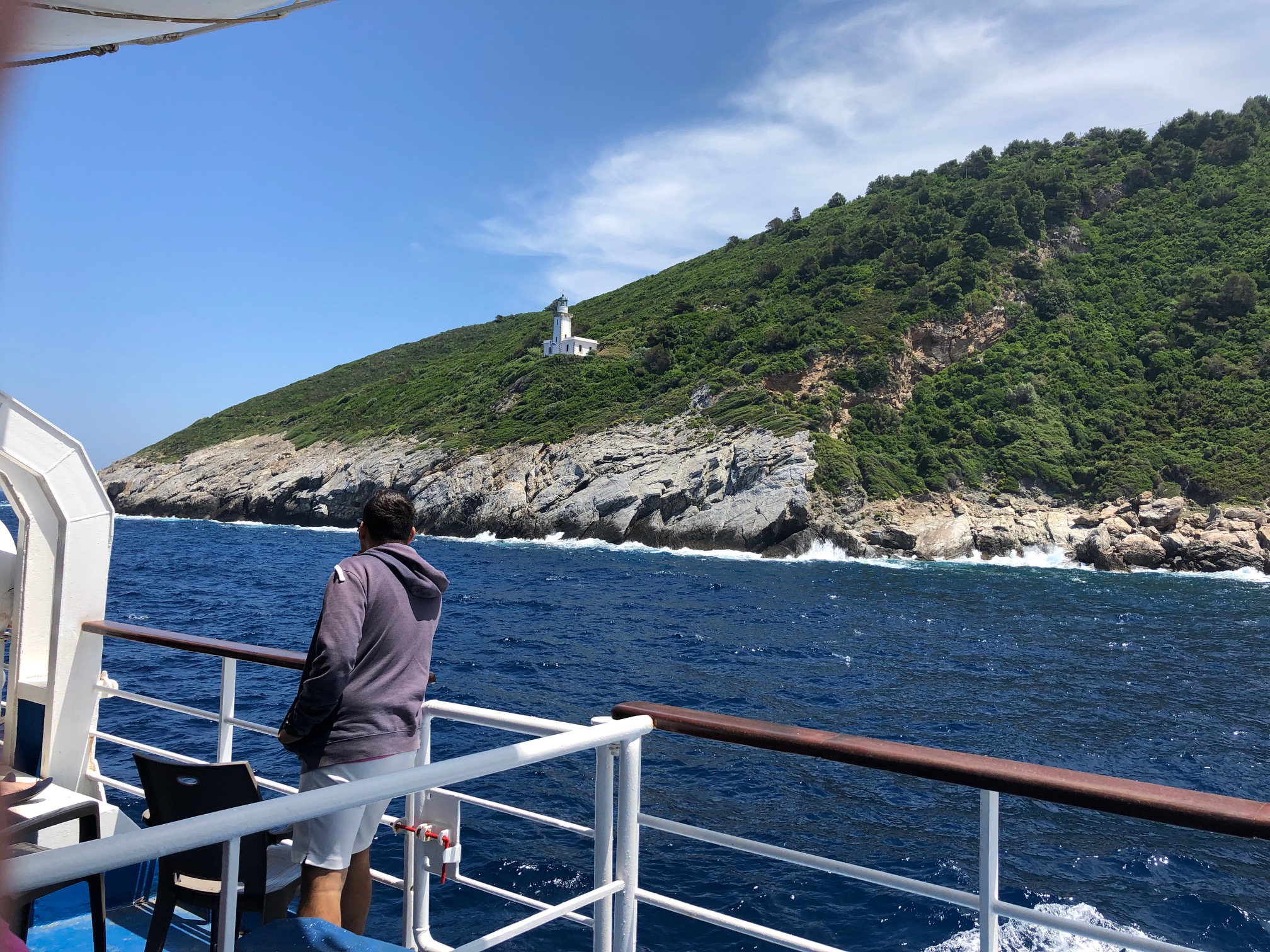
A lighthouse on the southern tip of Skopelos Island.

About two minutes later, he emerged with a fully-loaded trailer of goods. Brushing his sweaty forehead with one hand and steering with the other, he maneuvered the rig, first in drive and then in reverse, to the edge of the parking lot near where we stood. And then he did it all over again, four more times to be exact.
All the while during his performance, a stream of disembarking ferry passengers had been descending the staircases along the side of the hold. A quiet procession of bag-bearing zombies, they inched down the staircase, watching their feet with each step, one step at a time. Once they reached the last stair, they wandered across the tractor’s loading area, where ferry workers, professionally dressed in white shirts, ties and dark trousers, ushered them along, guiding them out of the path of the semi that was soon to emerge from the ship.

IMG_9093
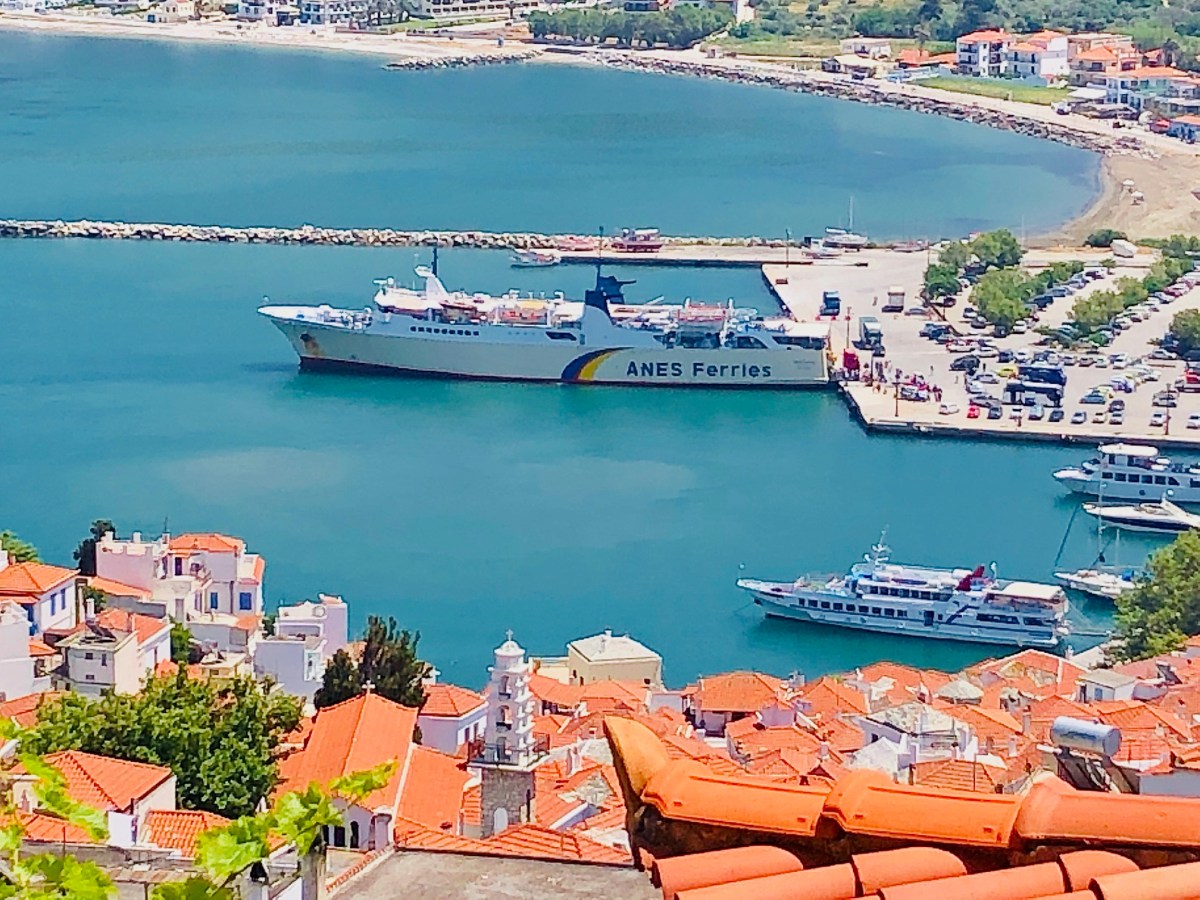
Pulling into Skopelos Town, the largest city on Skopelos Island.

It was very casually run for being so chaotic. There was no yelling. No running back and forth. Just a toot of the semi’s horn when one man stopped in the middle of the path to check his phone. Just an occasional raising of a dockhand’s arm to direct people along and keep them out of harm’s way.

We talked quietly between ourselves about how different this would be in the states. There would be a beep screeching from the semi tractor every time it backed into the hold. There would be traffic cones arranged to keep the area clear.  Passengers would likely be contained in a holding area off to the side. But not here. Here, apparently, you have to pay attention and watch.You have to think.

Finally, with the ship’s hold empty, it was time for passenger boarding. We fell into a line and inched up the yellow-painted staircase where we slung our bags into loosely formed stacks and onto odd-shaped ledges and shelves that lined the stairway. There was no exchange of baggage receipts, no record that we had dropped off a bag at all. It would be our responsibility to retrieve our luggage when we descended upon reaching our destination. When we arrived in Skopelos, we would have to remember and pay attention. We would have to think.

Ascending the stairs, I placed my new, shiny wheeled carry-on onto a wobbly stack of suitcases and thought about how differently this procedure would be handled back home. There would be tags to keep track of or a ticket to scan. Thought would be taken out of the process. Without a doubt, I would get my bags back, but I wouldn’t have to think to make that happen.

“Leave here. Get later,” I heard a Greek ferry worker say to some passengers climbing up behind me.

IMG_9094 (2)
An even closer view of Skopelos as our ferry entered the harbor.

Thank you for reading! My husband is serving a three-week artist residency at Skopelos Foundation for the Arts on Skopelos Island in Greece. I’m along for the ride, writing and posting and otherwise enjoying my summer off from teaching middle school English Language Arts. Follow this blog for more articles and find me on Medium.com under Parenting, Education, and Travel.


Categories
Greece (Skopelos) Life lessons

Skopelos’ Church of Agios Michael Synadon

When you learn (yet again) how much you don’t know

We weren’t inside this little church for more than twenty minutes, but that was long enough to be reminded yet again of my ignorance on… well, so many things. Architecture and Greek Orthodoxy are topics that come to mind, as well as the history of the 100+ public and private churches that exist in Skopelos, the little Greek town we’re residing in while my husband completes an artist residency.

We discovered one of those churches, the Church of Agios Michael Synadon, on our second night on Skopelos Island northeast of mainland Greece. The church is tightly wedged into a small neighborhood and you can easily pass right by it if you’re talking or, like my husband Mitch and me, concentrating on the steep walk down from the top of the hill to the harbor-front shops and restaurants of Skopelos Town.

IMG_9111
It’s easy to overlook Agios Michael Synadon unless you notice the curved apse jutting out into the stone path.

As you walk by, following the well-marked path from the hilltop, you pass the backside of the church. The apse first caught Mitch’s eye and caused us to stop and wander around the corner to the front of the church.

In fact, according to this Skopelos News blog, another detail that makes the church so notable is the stele placed just below the apse window (see the light-colored stone directly below the dark window in the picture above). A stele is a piece from an old Greek grave that dates from the second century B.C. Steles may feature carvings such as flowers and inscribed names, as this one does. 

Another detail worth noting, according to Skopelos News, are five large gray stones, remnants from Roman-era sarcophagi (coffins). There are three on the front side of the church and two on the back. They are the largest stones that you see in the pictures above.

The main front doors of the church were locked, but a door off to the side was not. We knocked and walked inside to meet a woman with shoulder-length brunette hair and dark brown eyes.

“Καλησπέρα,” the woman said, Greek for “good evening.”

“Kali-spera,” we replied and followed her into the nave, the main sanctuary. Inside, it was musty and dark, lit only by a box of candles burning on a table near the front. 

IMG_9108
Agios Michael Synadon was nearly dark until the woman attendant turned on this chandelier.

“You are Greek Orthodox?” the woman asked us quietly, hesitating in her choice of English words.

“No,” I replied, wondering if that would affect our visit.

She continued, “You are from where?”

“United States,” I replied. She nodded and smiled, and walked to the wall to turn on the lights. The chandelier hanging above us glowed brilliantly, illuminating the entire room filled with icons, paintings, frescoes and artwork, carved chairs and other furniture.

We walked to the front to view the icons there. Finely applied oil paints revealed brilliant cheekbones and almond-shaped eyes, typical for post-Byzantine era portraits. Several had pierced silver elements attached to the paintings, in effect creating mixed media icon artworks.

IMG_9109
The fresco in the dome is difficult to discern due to age and years of exposure to candle smoke.

I stood below and to the side of the chandelier and gazed up at the fresco-painted dome and then around me. There was simply too much, too many details to absorb. I didn’t even think to ask when the church was built.

I still haven’t been able to determine how old the church is, but it does resemble another church in style and materials that we stumbled upon in Skopelos known as Panagia Eleftherotria. According to Skopelos News, archaeologist Adamatios Sampson claims Panagia Eleftherotria was originally built in the 16th century.

Wanting a photo, I asked the woman if I might take one. She smiled and sighed and I wondered if I had overstepped. Surely I wasn’t the first tourist wanting to capture the beauty of this small place. But then she nodded and I took two pictures on my iPhone, taking care to silence it to avoid that annoying click.

We then thanked the woman and the three of us walked back to where we had entered. On the white plaster walls of this side room thirty to forty small paintings, miniature icons, hung from two wires. The woman searched for the English words that suggested these paintings were created by her students. She showed us some larger paintings also tucked behind the smaller ones, which I believe she said she had painted. One Virgin Mary rendition measured approximately 24″ x 30″.

I asked her if the artwork was for sale, since the manner in which they were displayed indicated that they might be. She shook her head, and then I remembered that buying and selling wouldn’t be appropriate in a place of worship. She motioned with her hand to her side and said, “Shops,” indicating perhaps that her work was available elsewhere in town.

Finally, we asked where we could leave a donation. She led Mitch back into the sanctuary, where he placed a €5 into a brass offering box near the front of the nave. We then exited the Church of Agios Michael Synadon.

Outside, we took another few minutes to study the exterior, which was covered with a mixture of bricks, marble stones, the large sarcophagi, plus an assortment of porcelain dinner and serving plates inset as accents into the facade.

IMG_9177
Our souvenir from Agios Michael Synadon.

In the short span of twenty minutes at the church, there was just too much to see and honestly, I felt like an intruder… an outsider very ignorant of the traditions and rituals that this little building upholds. Maybe that’s the most valuable lesson that traveling to new places teaches us: how much we don’t know.

As we left, the woman called to my husband from the doorway of the side entrance. He walked back to her and then returned with a souvenir for each of us: a small color printout of her Virgin Mary painting.


Thanks for reading! So far during our time in Greece, we have never been treated like outsiders. On Skopelos Island, the residents seem eager to ask where you are from and always have a “Ya-sis” for you in the day or a “Kali-spera” in the evenings. Even when we visit a church we know very little about, the Greeks seem eager to inform us– if they speak English, which most do– about what we are seeing.

Please click like to show your support for my blog and feel free to follow for more posts about our time on Skopelos.