Categories
Greece (Crete)

Phaistos, Crete

A peek into the past in the hills of southern Crete

Phaistos. Phaestos. Festos. Faistos. And then in Greek, it’s spelled Φαιστός.  No matter how you spell it, each name refers to Phaistos Minoan Palace, the second most important site (after Knossos Palace in Heraklion) of the Minoan civilization on the island of Crete.

We visited Phaistos last summer in late June. After touring the archaeological sites at Athens, Mycenae, Delphi, Olympia, and Knossos, we made a final stop at Phaistos. After a confusing morning journey by public bus from Heraklion, we made it to Phaistos in plenty of time to take a leisurely self-guided tour, eat a small lunch beneath a pine tree, and have a cold drink and ice cream in the small, on-site gift shop before hopping on a bus back to Heraklion. Here’s my post about how to get from Heraklion to Phaistos, click here.

If Minoans are new to you, here are a few facts about the culture from my husband:

  • The Minoans, named for their ruler, the mythical King Minos, are known for their advanced civilization that settled the island of Crete and other surrounding islands.
  • The Minoans were great sea travelers.
  • They built enormously sophisticated palaces for their royalty. The palaces were very “high tech” for the time period and exhibited a distinctive and advanced architectural style.
  • Phaistos was the region that produced Kamares ware, a pottery style dating from the 1800-1700 BC. Kamares ware, named for the nearby cave where it was found, is known for its dark background and white brushwork. Kamares wares were considered luxurious to own and were exported throughout the Mediterranean to Cyprus, Egypt and Palestine.
IMG_0876
Kamares ware, including these vessels, were found at the Minoan palaces at Knossos and Phaistos. | Photo: M. Yung

A self-guided tour of Phaistos is relaxing and quiet. Unlike Knossos, there are no guides-for-hire who approach you as you enter offering to walk you through the site for a fee.

While these guides are likely very helpful for many tourists, we doubted that they were truly needed, considering the large number of detailed placards placed throughout the site. Granted, that assumes one doesn’t mind reading.

phaistos distance
This photo is taken from the opposite side of the palace grounds.   Jerzy Strzelecki [CC BY-SA (https://creativecommons.org/licenses/by-sa/3.0)%5D

When you do stop to read the signs, you can learn a lot. Here are some basic facts taken from a placard found at the entry to the main site:

  • The hill of Phaistos was inhabited as early as 4500-3200 BC in the Final Neolithic Age.
  • The first palace of Phaistos was active from 1900-1700 BC. The palace controlled the plains and valleys found below the palace hilltop.
  • The city of Phaistos — and Minoan culture in general — flourished until  323-367 BC.
  • The Phaistos Palace grounds included a central court, surrounding wings, multi-story buildings (similar to Knossos), gateways and open balconies.
  • More facts follow the next few photos.
IMG_1129
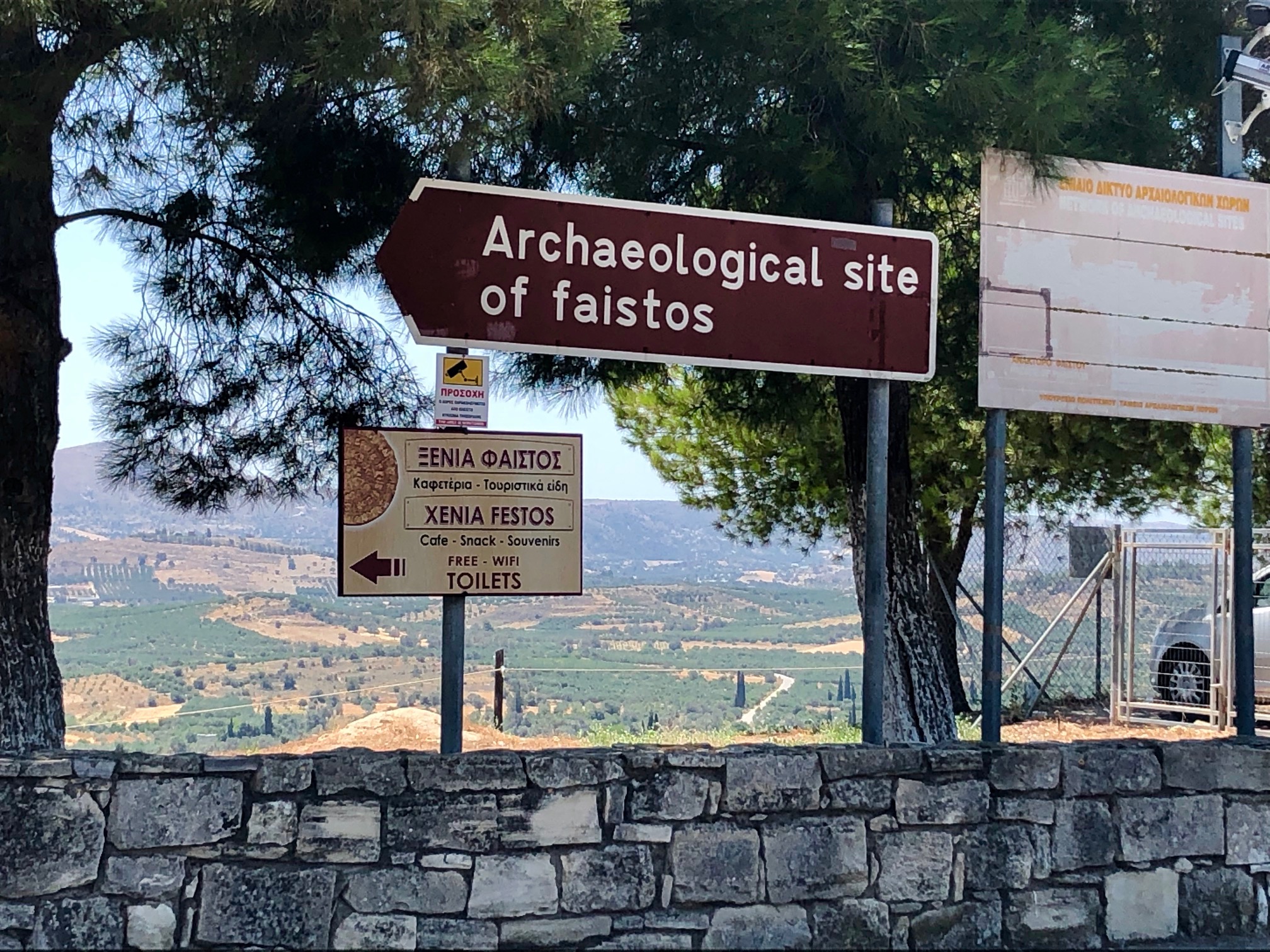
Phaistos is found on a hilltop in southern Crete. The valleys on all sides of the hilltop are blanketed with olive trees, grape vineyards, cypress trees, and farms. There are several caves in the surrounding hills also. Many items, including pottery, have been found in these caves. | Photo: M. Yung
  • The first Phaistos Palace was built around 1900 BC.
  • It covered 8,000 square kilometers over three terraces.
IMG_1077
Tickets to the Phaistos site are 8€ each. Getting there is inexpensive, too, via public bus.
  • The original palace was inhabited for 250 years and destroyed and rebuilt three times.
  • It was destroyed the last time by an earthquake around 1700 BC.

It’s amazing that visitors are allowed to walk on stones laid nearly 3,700 years ago!

IMG_1079
Little at Phaistos seems to have changed since the 1919 photo above. It’s still isolated, quiet, and remote. | Photo: M. Yung
  • After the earthquake, the ruins were covered and a new palace was constructed on that.
  • This last palatial site was smaller, but according to the placard, “more monumental.”
  • This last Phaistos Palace was destroyed in 1450 BC, but not rebuilt.
  • Two more facts follow below.
Phaestos_Vue_générale_Au_fond,_la_plaine_de_la_Messara_-_Baud-bovy_Daniel_Boissonnas_Frédéric_-_1919
It’s amazing how little has changed over the years. This photo from 1919 shows the steps leading to the West Court. The theatral area and diagonal wall appear in the lower half of the picture. | Frederic Boissonnas [Public domain]
  • The city of Phaistos continued to be inhabited and thrived in Hellenistic times from 323-367 BC.
  • In 150 BC, Phaistos was finally destroyed by Gortys. When Rome conquered Crete in 67 BC, Gortys became the capital, replacing Knossos.

But back to our tour…

The main reason we wanted to visit Phaistos: the pithoi.

IMG_1084
Two pithoi appear below a reconstructed walkway. | Photo: M. Yung

These pithoi (the singular word is pithois) are well-known in art history circles and Phaistos is considered the premier site for this particular kind of storage vessel. In fact, my husband hoped the site would have more available to see, as he had seen photos of many more pithoi on display here.

IMG_1088
A room with storage jars known as pithoi. | Photo: M. Yung

Still, it was fun to wander the grounds and find a pithois tucked away here and there. There were more to see in an area of the grounds covered with metal shelters; however, these shelters were in large areas closed off to visitors.

IMG_1090
Mitch walked as far as he could into the Magazine of the Giant Pithoi, a room that contained  several large pithoi jars. | Photo: M. Yung

In fact, this was our main disappointment with Phaistos:

a good portion of the site was closed.

IMG_1096
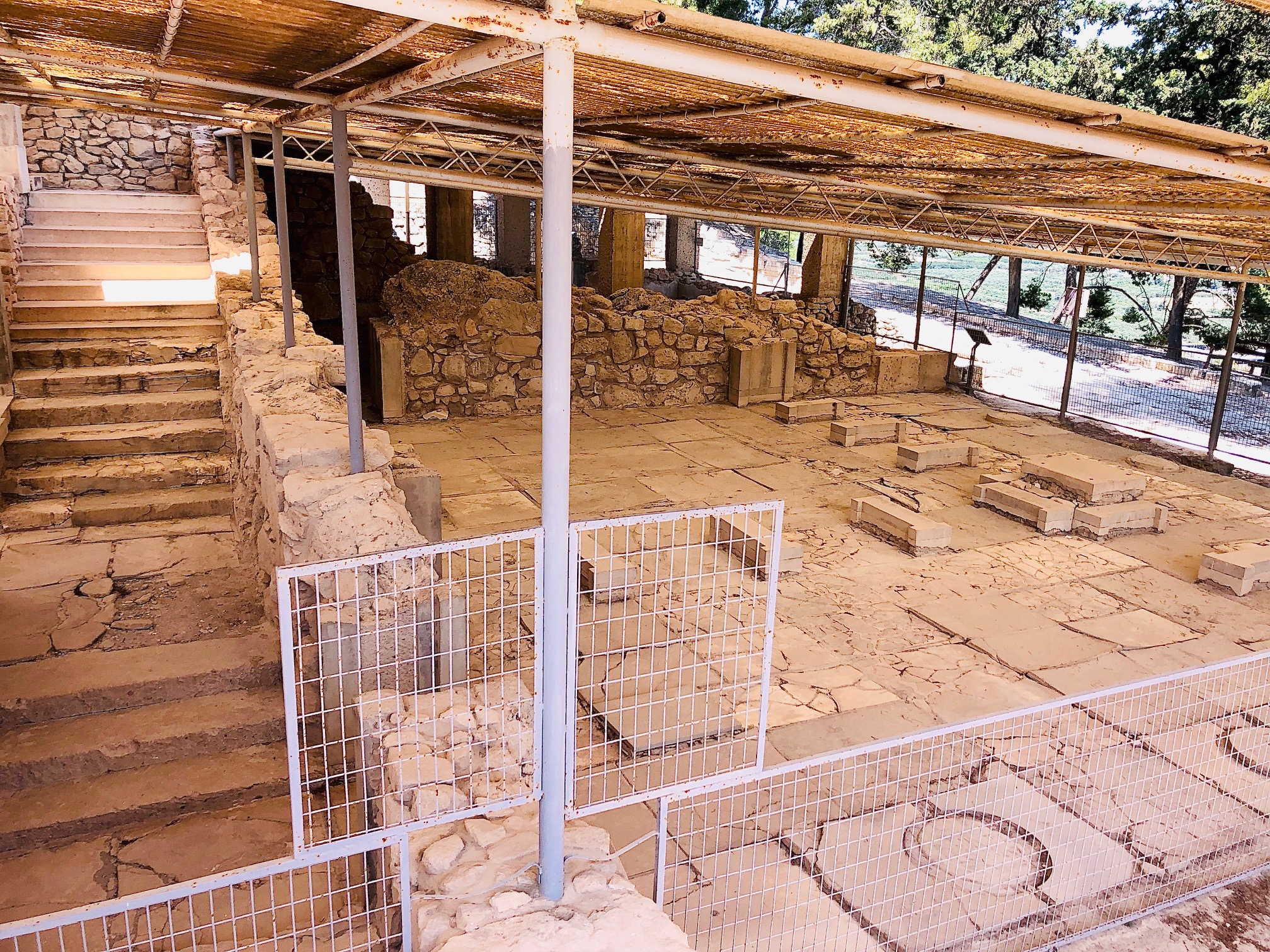
The shrines of the West Wing were predominantly small rectangular rooms that contained benches. According to the placard, inside these rooms excavators found ritual vessels, figurines of deities and other cult objects. | Photo: M. Yung

There was definitely a feeling that Phaistos is overlooked and forgotten.

  • a few signs were missing
  • some barriers were broken
  • a wooden observation deck had missing boards

Generally, Phaistos seemed neglected. And this isn’t really surprising, considering Greece’s other economic priorities.

True, due to its location, Phaistos sees fewer visitors than other more popular Greek archaeological sites. In fact, Phaistos doesn’t even make this Top 20 list of Greek ruins.

IMG_1106
Photo: M. Yung

Still, Phaistos is a valuable peek into the past, and among art historians, it’s well-known and revered.

The Phaistos Minoan Palace reminds us that we shouldn’t underestimate the abilities and ingenuity of ancient cultures. For example, precisely placed stairs and drainage pipes made of solid stone show us the resourcefulness of the Minoans.

IMG_1104
Drainage pipes were used at Phaistos. | M. Yung
IMG_1109
This is the Queen’s Megaron (throne room) found at Phaistos. It is covered by a metal shelter on this side…
IMG_1110
…and this side, too. | Photo: M. Yung
IMG_2460
The Phaistos Disk is on display at the Heraklion Archaeological Museum. The disk represents one of the greatest mysteries of archaeology. No one knows the meaning of the symbols incised into the clay. It was made between 2000-1000 BC. It measures about six inches in diameter. | Photo: M. Yung
IMG_1093
Photo: M. Yung

It was a beautiful sunny day when we visited Phaistos. In fact, by early afternoon, we were ready to hop on an air-conditioned bus and make the trip back to Heraklion.
IMG_1113
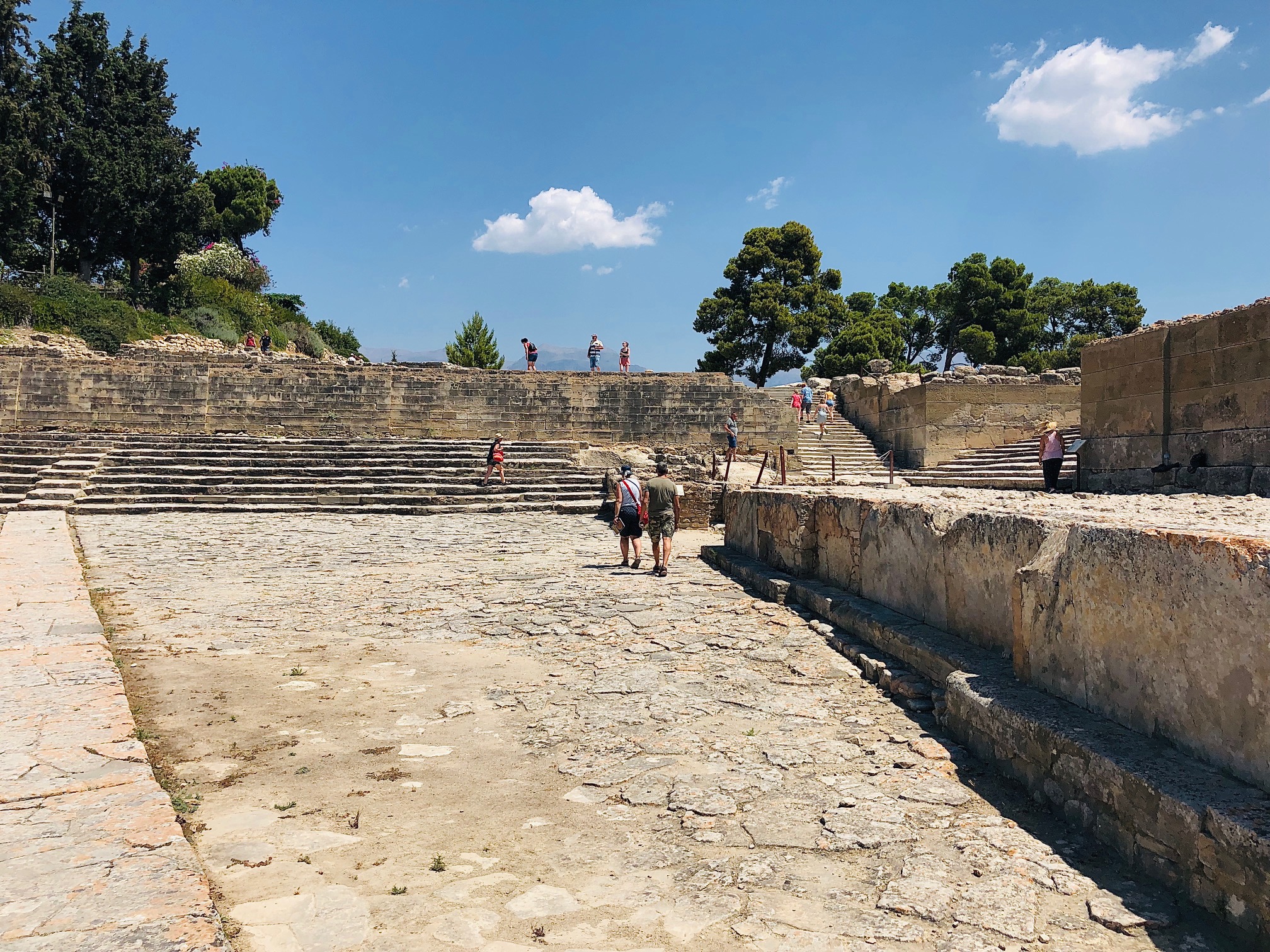
This photo shows the theatral area on the left and stairway to the West Court on the right. | Photo: M. Yung
IMG_1154
Here I am walking near the theatral area in the West Court. The wall to my left can be seen on the left side of the preceding photo.
IMG_1116
Kouloures, large stone-built structures, show time-consuming craftsmanship. | Photo: M. Yung
IMG_1101
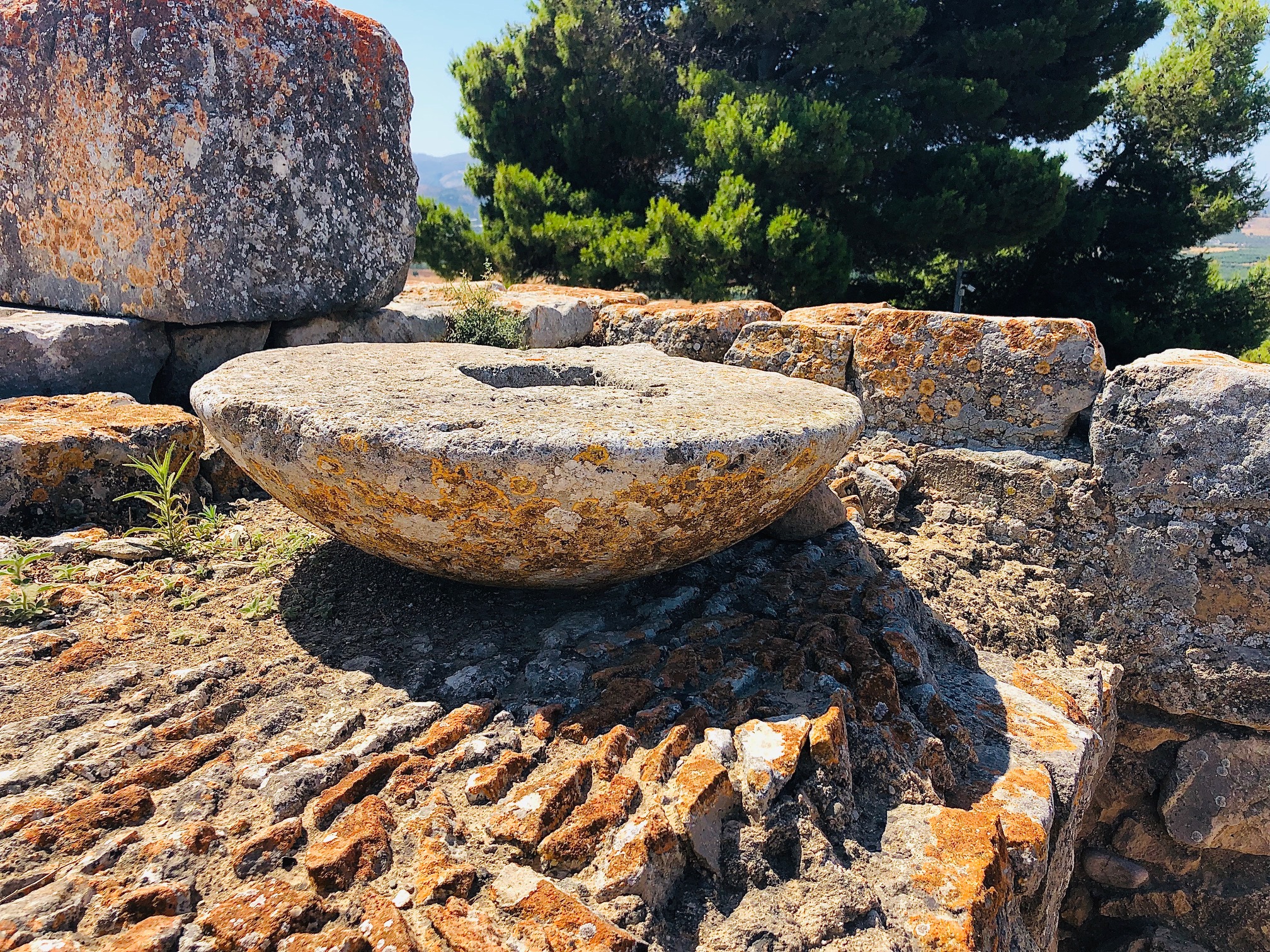
Relics from the past are scattered across the grounds. | Photo: M. Yung
IMG_1112
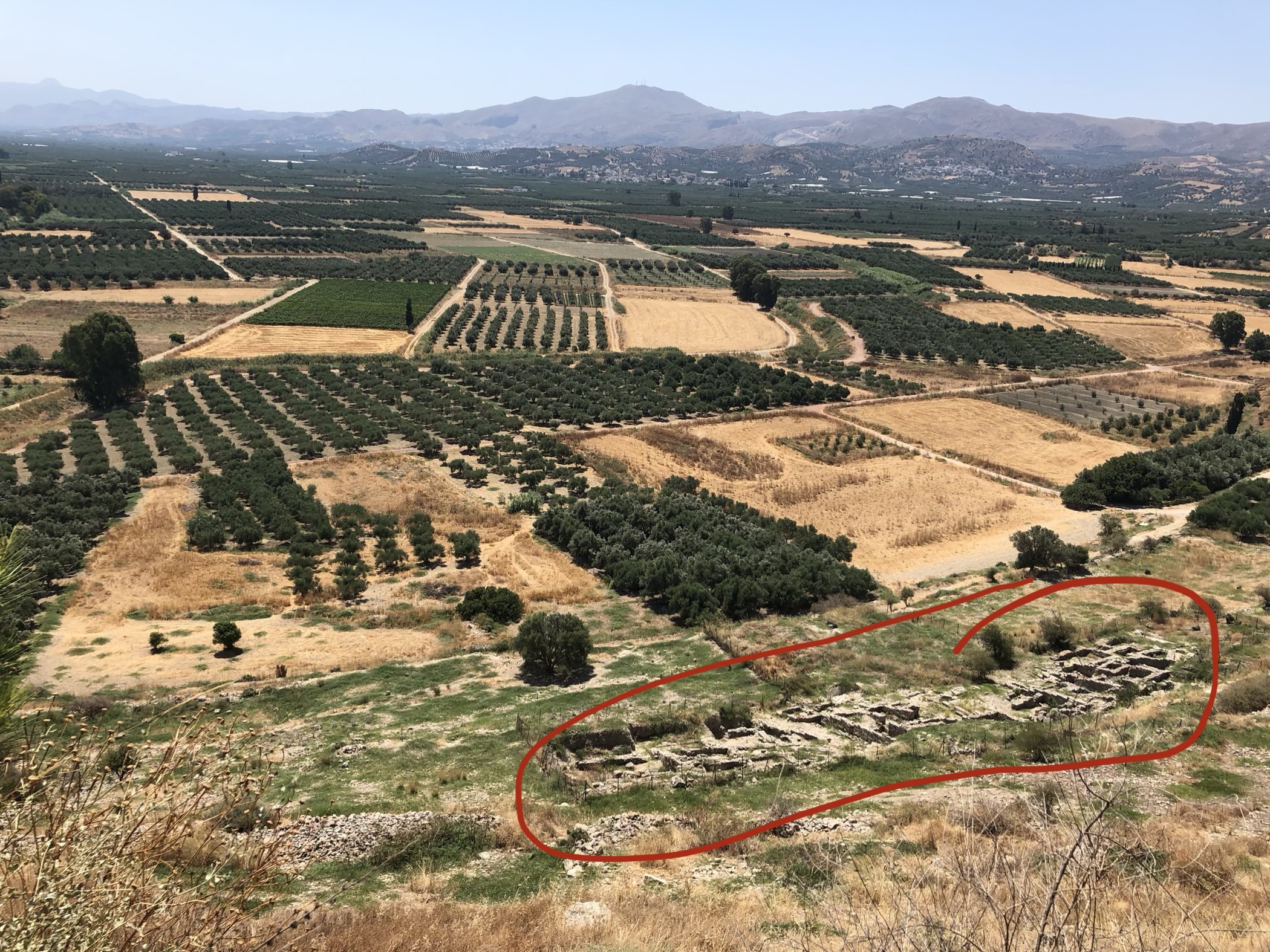
This photos shows the surrounding hillsides. I’ve circled in red additional outlying structures that were subordinate to the palatial hilltop above.  We ate our lunch (that we had packed and brought with us) on benches beneath a pine tree right above this scene. | Photo: M. Yung

Mysteriously, no one knows for sure the reasons for the collapse of Minoan culture, including the civilization at Phaistos.

Perhaps that’s a fitting conclusion for this archaeological site that today is still out-of-the-way, obscure, and famous.


Thanks for reading! This post is another installment from our cross-country Greek odyssey last summer. It’s amazing how many more sights I have yet to write about. Follow my blog for more travel posts, including this one from our final day in Greece when we visited the site of Paul’s To an Unknown God sermon.

Categories
Art Greece (Athens, Delphi)

The Zeus of Greek Museums

From golden goblets to frying pans to perfume

On our next to last day in Greece last summer, we capped off our Greek museum tour with a visit to the National Archaeological Museum in Athens. It was the last museum we would see, having already visited other museums in Athens (The Acropolis Museum), Mycenae, Delphi, Olympia, and Heraklion. You would think that we would have been “museumed out,” but actually each museum is so unique to its location that each one feels quite different from the others.

IMG_1215

So what sets the National Archaeological Museum in Athens apart from the others? In a word, I would say “breadth.” In fact, you will find the widest gamut of Greek artifacts and art. This museum has pieces from all those other areas we had visited across the country, in addition to hundreds (possibly thousands) more.

By the way, here’s a list with links to posts I’ve written about the other museums we visited in Greece:

For example, when we visited the Museum of Mycenae, the golden Mask of Agamemnon that was discovered in a grave circle there, was not held in that museum.

agamemnon
The original Mask of Agamemnon is in Athens; a replica is in Mycenae. Photo: Wikipedia

The mask on exhibit in Mycenae is a replica,  a guard told me. The original could be found in the National Museum in Athens, he added. Upon hearing this, we made a mental note to seek out the mask when we would eventually tour the National.

Watch this video from Khan Academy for more about this mask.

When one visits a museum in Greece, you truly feel that you are in the hub of antiquity. Each museum is an art historian’s dream;  art history students will also be amazed at seeing in person so many famous works commonly found in textbooks.

This description of the National Museum can be found on the museum’s website:

“The National Archaeological Museum is the largest museum in Greece and one of the most important in the world. Originally destined to receive all the 19th century excavations, mainly from Attica and other parts of the country, it gradually took the form of a central National Archaeological Museum and was enriched with finds from all parts of the Greek world. The rich collections, enumerating more than 11,000 exhibits, offer the visitor a panorama of ancient Greek culture from the prehistory to the late antiquity.”

IMG_1224
We saw Cycladic non-stick frying pans that date from 2800-2300 BC.
IMG_1226
These Cycladic frying pans really captured my interest since they resemble modern day frying pans.

Here’s a listing of the various collections within the museum:

  • prehistoric antiquities
  • sculpture
  • metalwork
  • vases and minor arts
  • Egyptian antiquities
  • Cypriot antiquities (those from the island of Cyprus).
IMG_1234
Ancient Greek Cauldrons
IMG_1237 (1)
Fragments of a fresco from Knossos Palace in Heraklion on the island of Crete. This is an image of a “figure 8 shield” covered in animal hide.
IMG_1236
Part of the museum’s collection of gold artifacts. These are from Mycenae’s Grave Circle A, where many tombs of the wealthy were found. The pieces are found in the shapes of cocoons (a symbol of rebirth), pomegranates (a symbol bounty), and butterflies.
IMG_1248
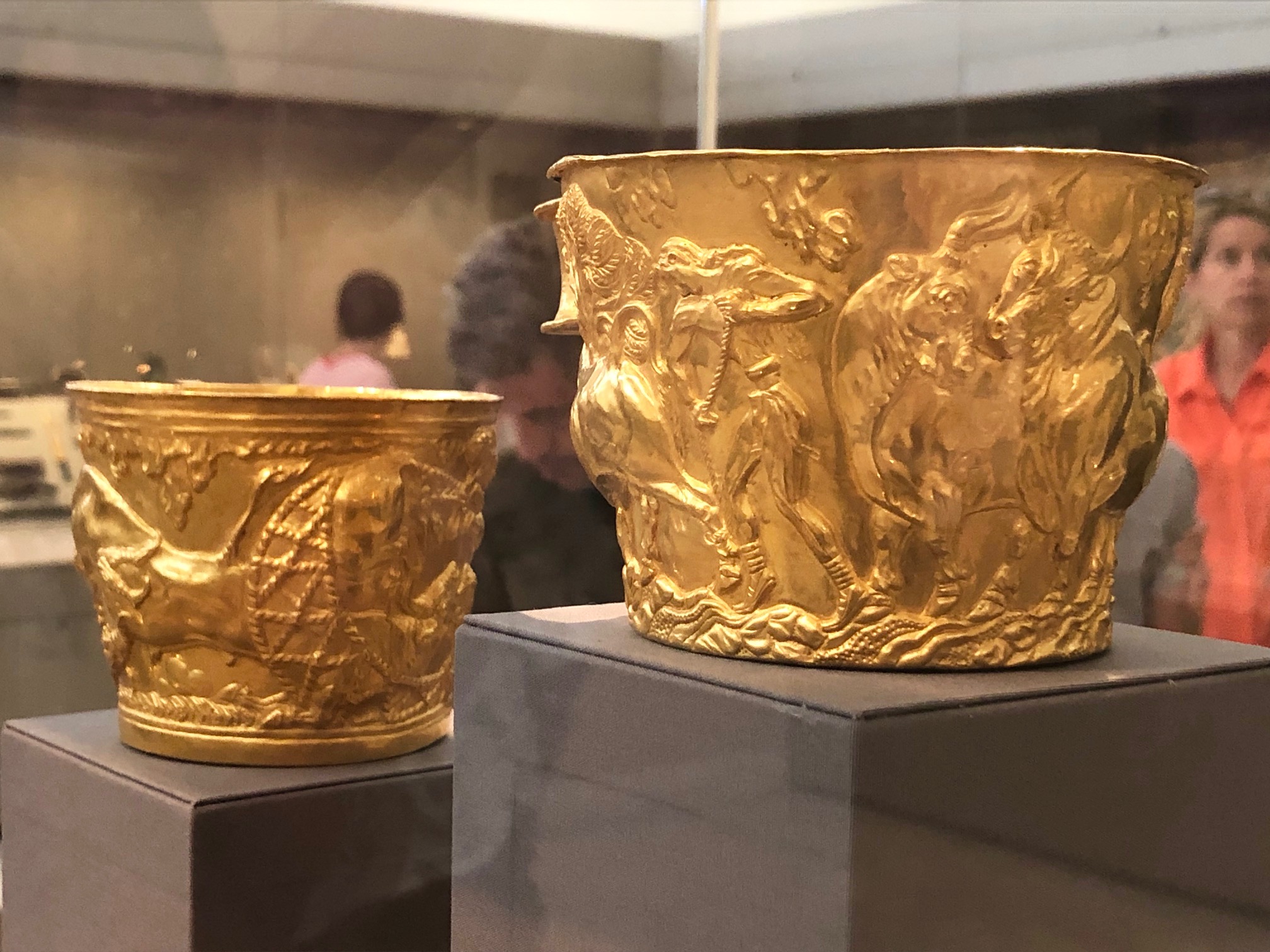
These golden goblets, known as the Vaphio Cups, are finely detailed and depict bulls.
IMG_1263
Egyptian artifacts proves trade between the early Greeks and Egyptians. The Greeks learn some of their quarrying techniques from the Egyptians. In addition, archaic kouros poses were borrowed from the ancient Egyptians.
IMG_1264
Part of a temporary exhibit, “The Countless Aspects of Beauty.”
IMG_1267
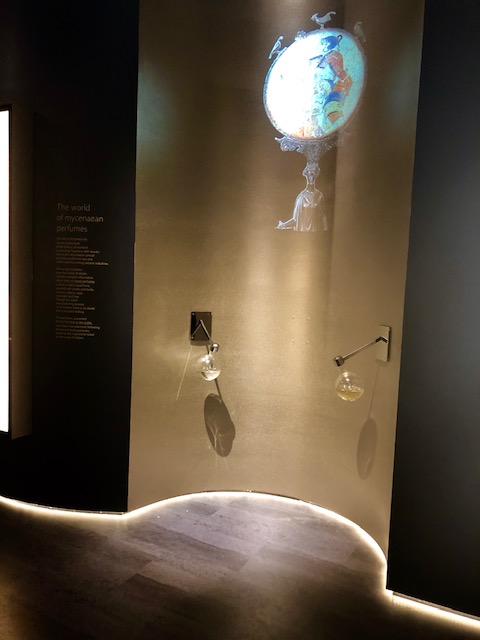
Vials of perfumes to sniff in the “Countless Aspects of Beauty” exhibit.
IMG_1282
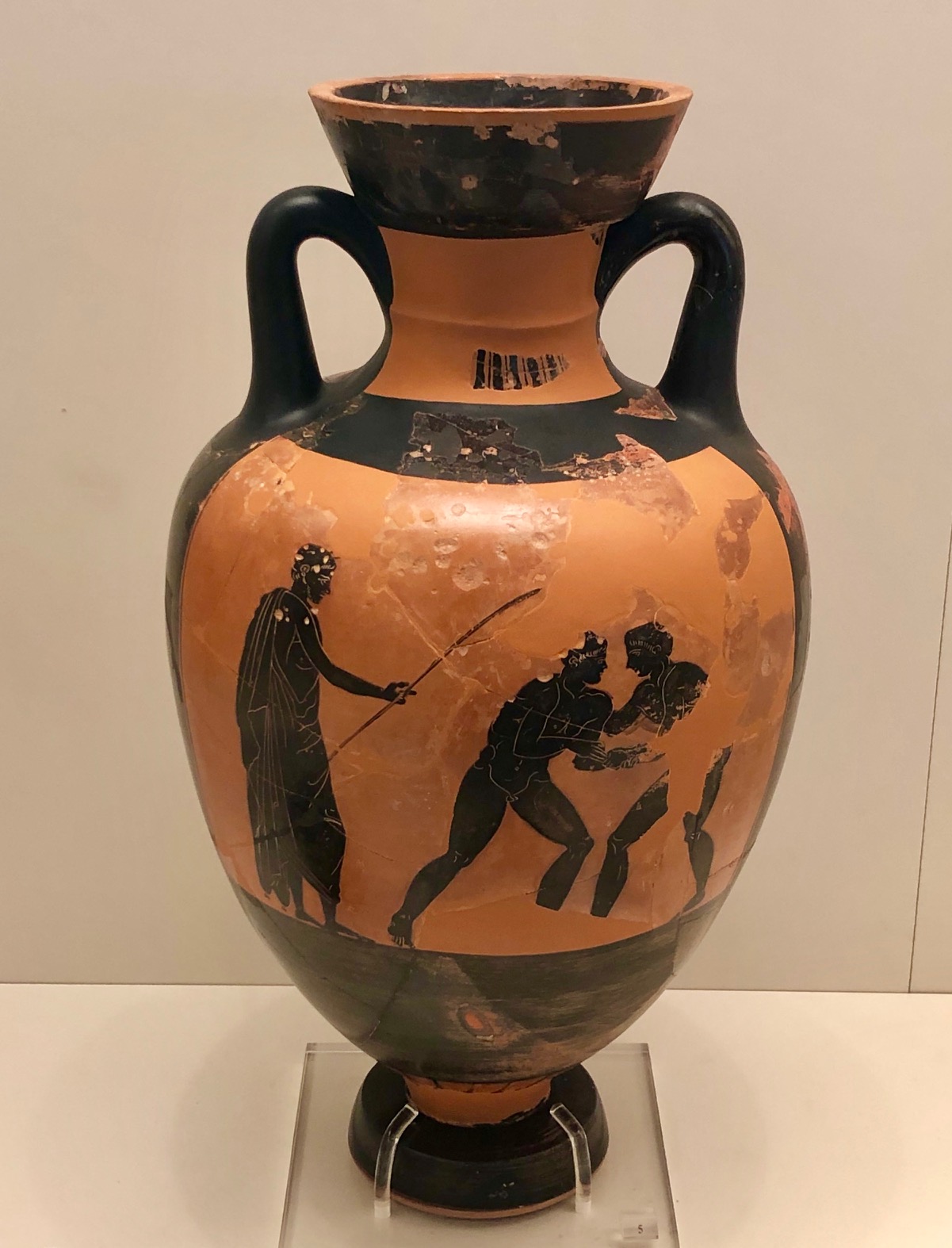
These amphoras (pedestal vases) were awarded at Panathenaia, an important festival held in honor of Athena in Athens.
IMG_1274
Close-up of an amphora.
IMG_1254
Members of the Roman Julio Claudian Dynasty (31 BC-68AD). During this period, Greece was a Roman province.
IMG_1251
IMG_1256
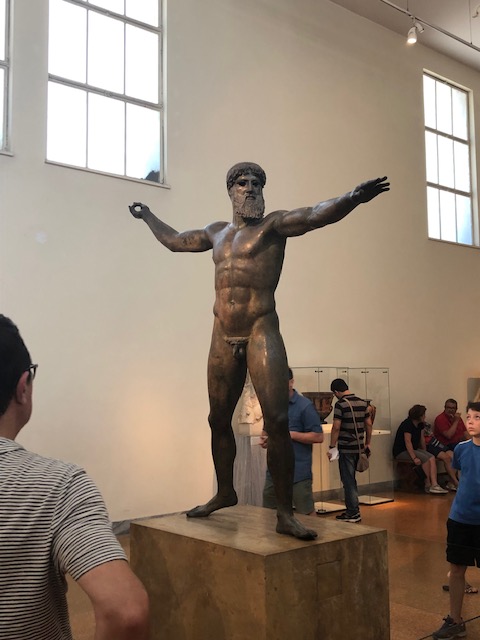
Renowned bronze of Zeus or Poseidon found on the Cape of Artemision, in northern Euboea near Athens.
IMG_1260
This Zeus, in the Severe style, also known as the Early Classical style, “marks the breakdown of the canonical forms of archaic art and the transition to the greatly expanded vocabulary and expression of the classical moment of the late 5th century,” according to this Wikipedia article. Works in the Severe style show a change in drapery of clothing.
IMG_1259
The Severe Style more accurately represents the human body. Also, Severe style works have an “interest in emotion and motion.” As for emotion, figures reveal a more serious character and expression.  As for motion, figures are under strain or in action, but always in motion.
IMG_1217
Here’s an example from the museum of an early Cycladic figure that shows the contrast of earlier artwork to later pieces of the Severe style.
IMG_1271
Close-up of the youth Perseus or Paris. Also of the Severe style, this is a good example of how artists commonly used bronze to produce their sculptures.

Visiting the National Museum in Athens was our final stop of our five-week Greek odyssey. We left Athens at 6 a.m. the next morning, for a short layover in Amsterdam, and then Atlanta, and then finally to our home airport in Springfield, Mo.

Featured Photo Credit: Marilyn Yung | Bronze sculpture (of Zeus or Poseidon) in the Severe style, 460 BC.


Thanks for reading again about our travels in Greece this past summer! Now that we’ve both started new jobs and are in the full swing of new school years, this trip seems like a lifetime ago. However, there are still posts to be written, and I’ll get to those eventually. My next one will likely be about the Jewish Ghetto in Venice, which I was able to see briefly during my week-long stay there in June. 

Now that the year is beginning to wind down, I also hope to write soon about “2019… My Year of Living Changerously” and how I managed to stay buckled up and on the tracks.

Categories
Greece (Peloponnese)

A Great Man is Always Willing to Be Little

His expression compelled me to stop and linger at the display in Mycenae.

Only three to four inches in height, this ivory Mycenaean sculpture does not overwhelm with its size or weight, but with its expression. Made between 1250-1180 B.C. this “Ivory Male Head Figure” was excavated in the ruins of Mycenae (Mykines) in the Peloponnese region of Greece.

We saw a staggering number—thousands?—of artifacts this past summer; however, this little number above is still my favorite.

To realize it was conceived and shaped by human hands so very long ago is a lesson in humility.

Of what use  is our modern technology?

Of what purposes are our conveniences?

Of what skills can we boast in light of this quiet gem?

Featured Photo Credit: Marilyn Yung | This ivory sculpture is in the collection of artifacts at The Archaeological Museum of Mycenae


On May 29, my husband and I journeyed to Greece for about five weeks. Three weeks were spent on Skopelos, one of the three islands in the Sporades east of the mainland. The remaining two were spent venturing from Mycenae to Delphi to Olympia and finally Heraklion on the island of Crete to tour the sites at Knossos and Phaistos. Athens formed the bookends of our Greek odyssey. 

I posted daily for much of the trip, but still have so much more to tell. Follow my blog and stay tuned.

Acknowledgement: “A great man is always willing to be little.” Ralph Waldo Emerson

Categories
Greece (Crete)

Travel on Crete: How to get from Heraklion to Phaistos by bus

IMG_1075

It’s not easy, but it is possible to take the bus from Heraklion to Phaistos

Today, my husband and I visited Phaistos Minoan Palace, arguably the second most important Minoan archaeological site on the island of Crete in Greece. Phaistos has been on our bucket list for our journey through Greece, and because we’ve relied on bus travel for much of our trip, we’ve learned that things can go wrong.

For example, your driver may miss a stop, turn around, and go back. Your driver may make a package delivery you weren’t expecting, adding minutes to your ride and causing you to miss a connection if you have one.

That’s why yesterday we figured out EXACTLY how we would make the trip today. We bought our tickets a day early for not only Phaistos, but also for the bus station from where we would depart. In the end, we had a successful trip, but it wasn’t without a good dose of head scratching, miscommunication, wrong turns, and a frantic last-minute ticket purchase.

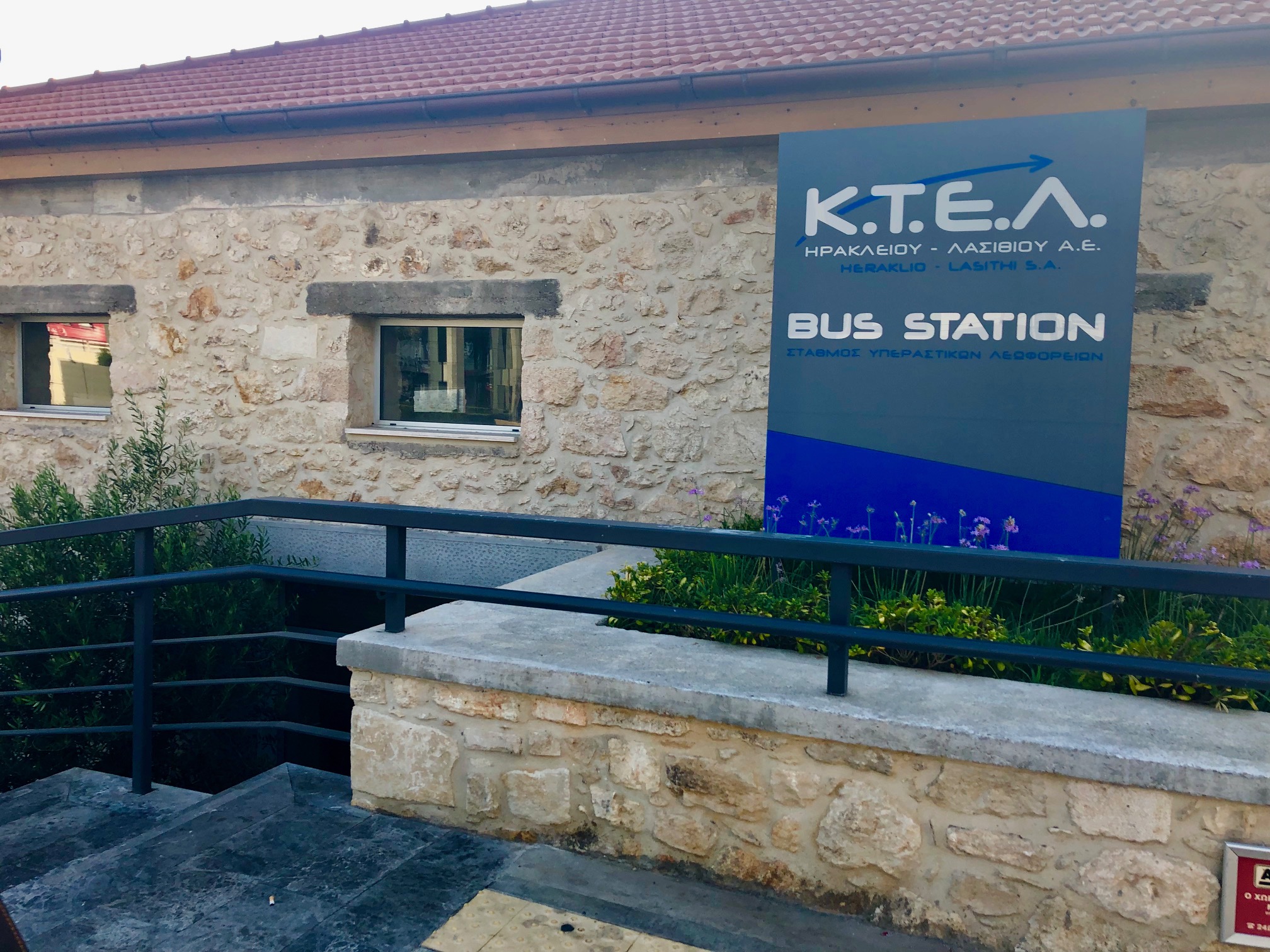
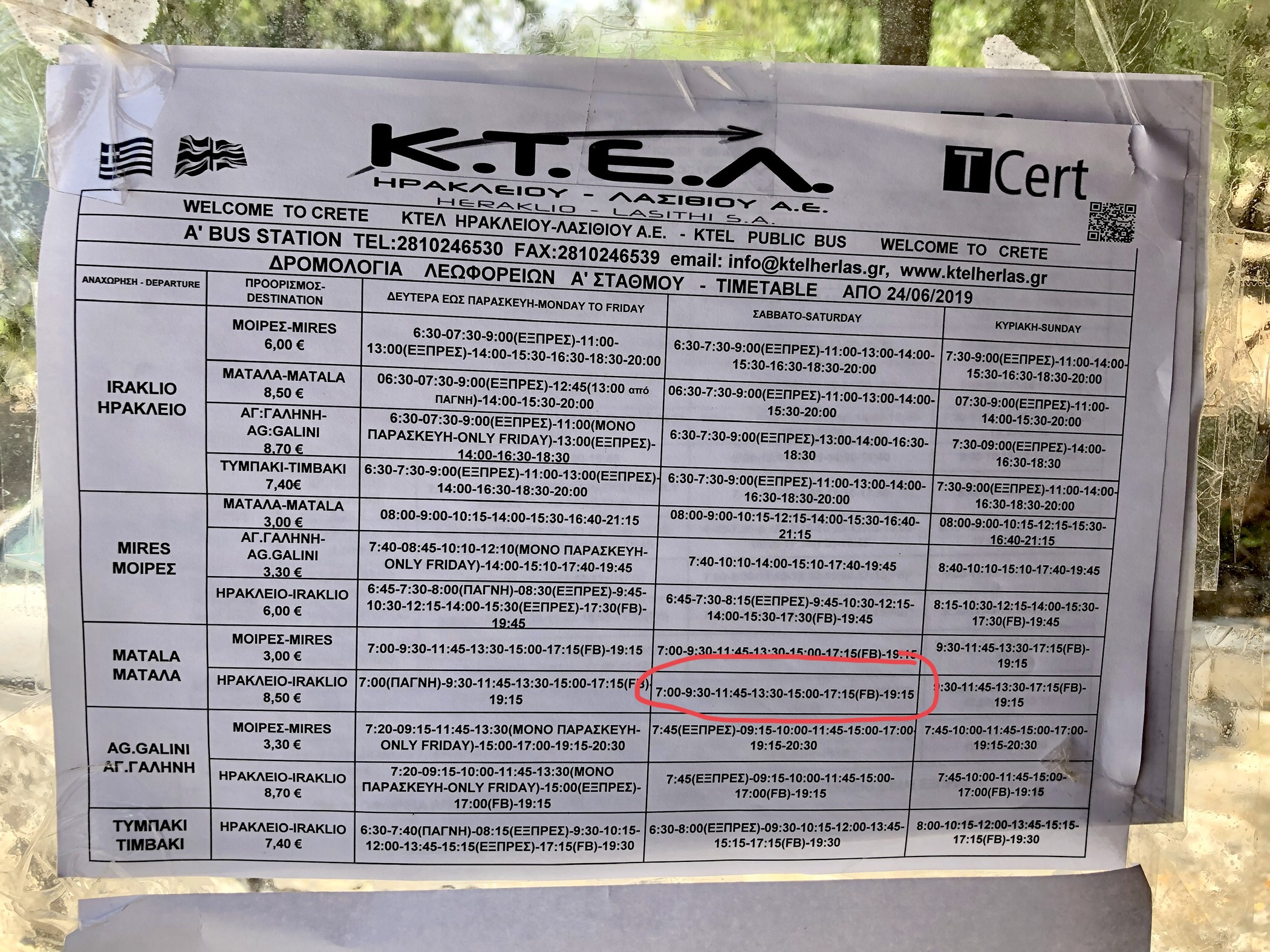
Part of our confusion was due to the scarcity of up-to-date timetables and not knowing the location of Heraklion’s KTEL Central Bus Station (the main bus terminal in Heraklion). The rest of the confusion was due to a general lack of detailed, timely information on how to get to Phaistos in the first place. It’s not listed as a destination on the pull-down destination menu on their website; however, the printed timetable does list Phaistos as a destination. Go figure.

In addition, there simply isn’t much info on websites such as TripAdvisor and Rome2Rio. Instead, what you will mainly find are other people on TripAdvisor looking for the way there, too.

Here’s how to get from Heraklion to Phaistos:

  1. Get a KTEL bus timetable brochure from any KTEL ticket kiosk or at the KTEL Central Bus Station. You will need this timetable to figure out when the buses leave and return from Heraklion and Phaistos.  Read on for how to find KTEL Central Bus Station.

    IMG_1150
    I’ve circled the part of the KTEL timetable brochure that shows the Heraklion to Phaistos and the Phaiston to Heraklion schedules. Side note: There are multiple ways to spell Heraklion and Phaistos. Heraklion is also spelled Iraklio. Phaistos can be spelled Faistos and Festos. Moires is also spelled Mires. Take a look at the Greek spellings, too, so you can recognize them if needed.

    IMG_1151
    Here is the June 2019 KTEL timetable brochure. We used it July 6 and the times were still the same.
  2. Go to KTEL Central Bus Station (the main terminal) and get there well ahead of your bus’ departure time. Get there early (thirty minutes or more) on the day you plan to travel or buy them the day before like we did. Do this in case any unforeseen complications arise and cause you to arrive late and  miss your bus because you didn’t have your tickets purchased.
  3. To find the KTEL Central Bus Station, we asked a ticket seller in the Heraklion Archaeological Museum. (We didn’t see any informational signs to direct travelers to the station from the popular museum where both city buses and KTEL buses drop off and pick up.) The ticket seller told us to walk behind the ticket kiosk on the circle next to the museum, and then take the stairs down the hill. At the bottom of the hill, turn left and follow the street until you come to a large dark gray bank (Pancretan Cooperative Bank) on your left. It has a modern look, with lots of large mirrored windows. When you get to the bank, you will see the KTEL Central Bus Station in front of you at the corner of Efessou and Leof. Ikarou.IMG_1072
  4. Walk down the stairs behind the bus station, go through the waiting area that looks like a large outdoor cafe, and go inside.
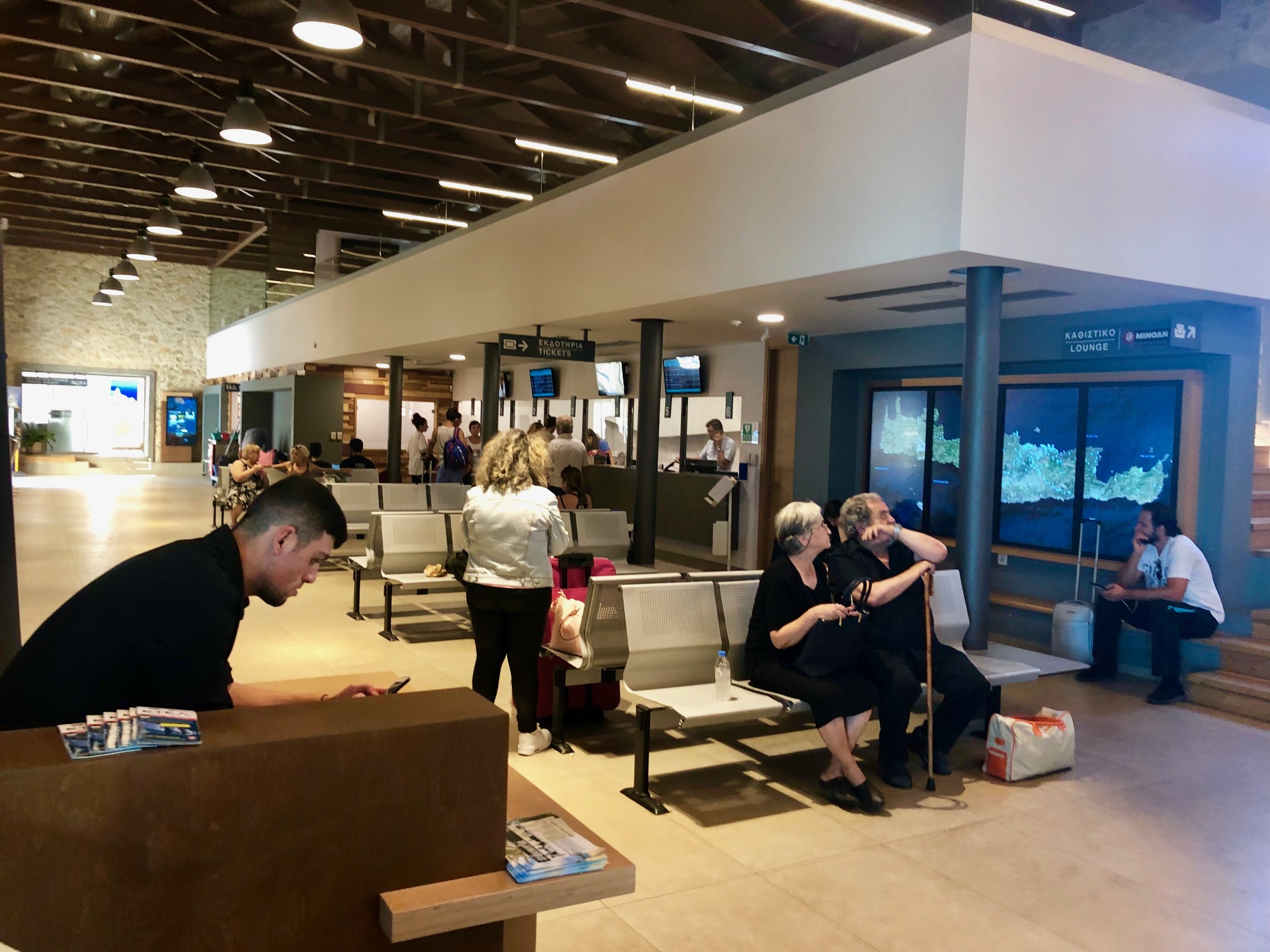
  5. Get in line at one of the six ticket windows and tell the clerk when you want to go to Phaistos based on the times available per the timetable brochure. We purchased only our tickets (7.10€ each) to Phaistos ahead of time. Because we didn’t know how long it would take to see the site, we didn’t know what time to schedule a return bus. IMG_1074
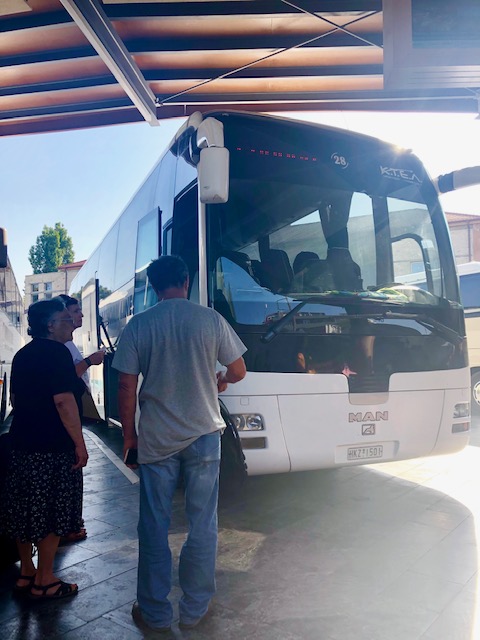
  6. You will take an approximately one-hour bus ride from KTEL Central Bus Station in Heraklion to Moires, where you will change to another bus bound for Matala. Phaistos is on the way to Matala.
  7. When you get to Moires, get off the bus so you can hop onto another bus headed for Matala. To do that, go inside the KTEL ticket office (there’s not a station–just a bus stop and a ticket office with a bunch of boxes scattered on the floor). The ticket office has a small KTEL sign on it and is about one hundred feet from the bus stop. Ask the ticket clerk how long it will be before the Matala bus arrives. In our case, it was about ten minutes away.
  8. Watch for the Matala bus. You will not need another ticket to get on the Matala bus.
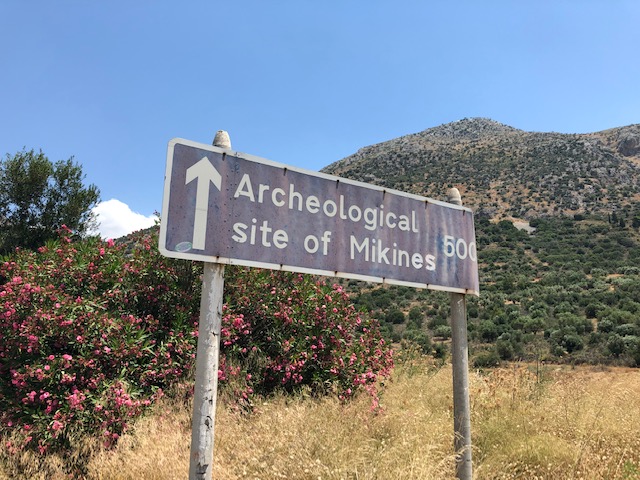
  9. The bus ride to Phaistos from Moires on the Matala bus takes about fifteen minutes. The driver should stop at Phaistos, but he might not if you don’t tell him you need to stop there. Do that when you board or during the ride. Don’t assume other riders are going to Phaistos. (If they’re tourists, they’re probably going to the beach in Matala.) We were the only two people on our bus today headed for Phaistos. Here’s the sign for Phaistos Minoan Palace. Get off here.

    IMG_1129
    Here’s the sign for the archaeological site. Note the spelling variation.

9. Tour Phaistos Minoan Palace. It might be a good idea to buy a guide book and thumb through it before entering the site so you can understand better what you’re seeing. Phaistos doesn’t appear to have the marketing support that other sites such as Knossos does. By the way, tickets to the archaeological site cost 8€ each. It took us about 1-1/2 hours to see the site. It would have taken longer, but some of it was closed for maintenance.

10. Leave Phaistos.  There were bus schedules taped to the windows at the archaeological site ticket booth and inside the bus stop out near where we disembarked. These should coincide with the KTEL timetable brochure. But to double-check, use the chart (see photo below), and find the bus that departs from Matala and arrives in Heraklion. In the photo below, I’ve circled the part of the schedule that contains the route that begins in Matala, stops at Phaistos, and makes the connection in Moires again onto a bus that returns to Heraklion’s KTEL Central Bus Station where you started.

IMG_1131

11. When your bus arrives from Matala to pick you up at Phaistos, board it and buy your tickets from the driver. Our tickets were 1.80€ each. This paid our way back to Moires.

12. At Moires, you will need to disembark, (just like you did earlier), go inside the KTEL ticket office, and buy tickets to take you from Moires back to Heraklion’s KTEL Central Bus Station where you started. For us, these tickets cost 6€ each. We nearly missed our Heraklion-bound bus in Moires because it was fifteen minutes late arriving in Phaistos. As a result, we arrived at Moires at 1:55 for a 2 p.m. ride. If there’s any question that you might not have your tickets before the bus leaves, go ahead and board the bus, and as you board, tell the driver you will be buying tickets directly from him. We saw many riders on both KTEL and city buses buy their tickets directly from bus drivers.

13. Once you’re seated on the bus in Moires, enjoy the approximately one-hour drive back to KTEL Central Bus Station. Our return ride took a different route from what we took in the morning and it followed a windy, mountainous road with vast, breath-taking views of olive groves and vineyards punctuated with oleander and cypress trees.


Thanks for reading! Greece can be tricky to navigate, especially with changing bus schedules, language barriers, and stations that close or change locations. We needed a blog post about this very topic a couple of days ago. We searched quite a bit to find the way to Phaistos. I hope this helps some readers find their way there. By the way, I plan to write a post about our visit to Phaistos in the next few days. 

Click like, leave a comment and follow my blog for my daily travel posts from Greece and Italy, including our AirBnb stays and also to catch that Phaistos post. 

Categories
Greece (Peloponnese)

Carrying a Torch for Olympia, Greece

Olympia, Greece was worth three bus rides and a taxi

Yesterday, we toured the Sanctuary of Olympia, the mammoth archaeological site at Olympia, Greece.  Thanks to the Olympic Games, I would venture to say that most of us have heard of this site. However, I myself didn’t realize that there was virtually a complete city in this location, in addition to the athletic contests.

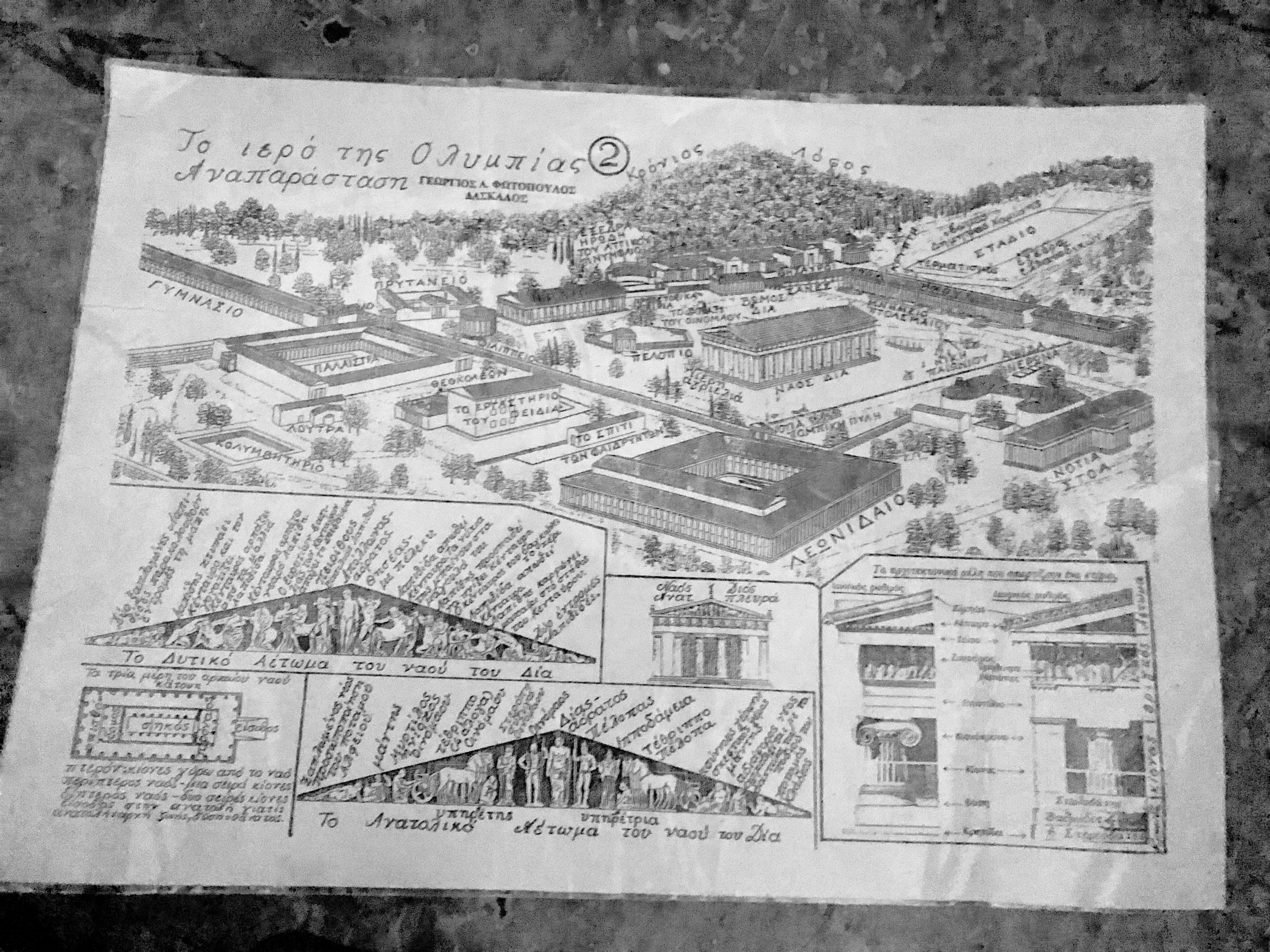
Above is a diagram of the Olympia site that our AirBnb host showed us when we arrived at our apartment. See what I mean by city?!

It’s a good thing the archaeologists and designers placed an ample supply of informational placards around the site so people like me can understand and appreciate more of what they’re seeing.

To summarize, the placards placed at two locations near the front of the site read as follows:

“In this place Zeus, father of the Olympian gods, was worshipped, and splendid athletic contests, the Olympic Games, were celebrated. In the cella of the temple of Zeus was placed the enthroned gold-and-ivory made cult statue of the god, work of the famous Greek sculptor Pheidias, one of the seven wonders of the antiquity. Here too, nowadays the ceremony of lighting the flame for the modern Olympic Games is held.”

After I read those placards, I looked around and here was my first thought:  this place is huge.

IMG_0501
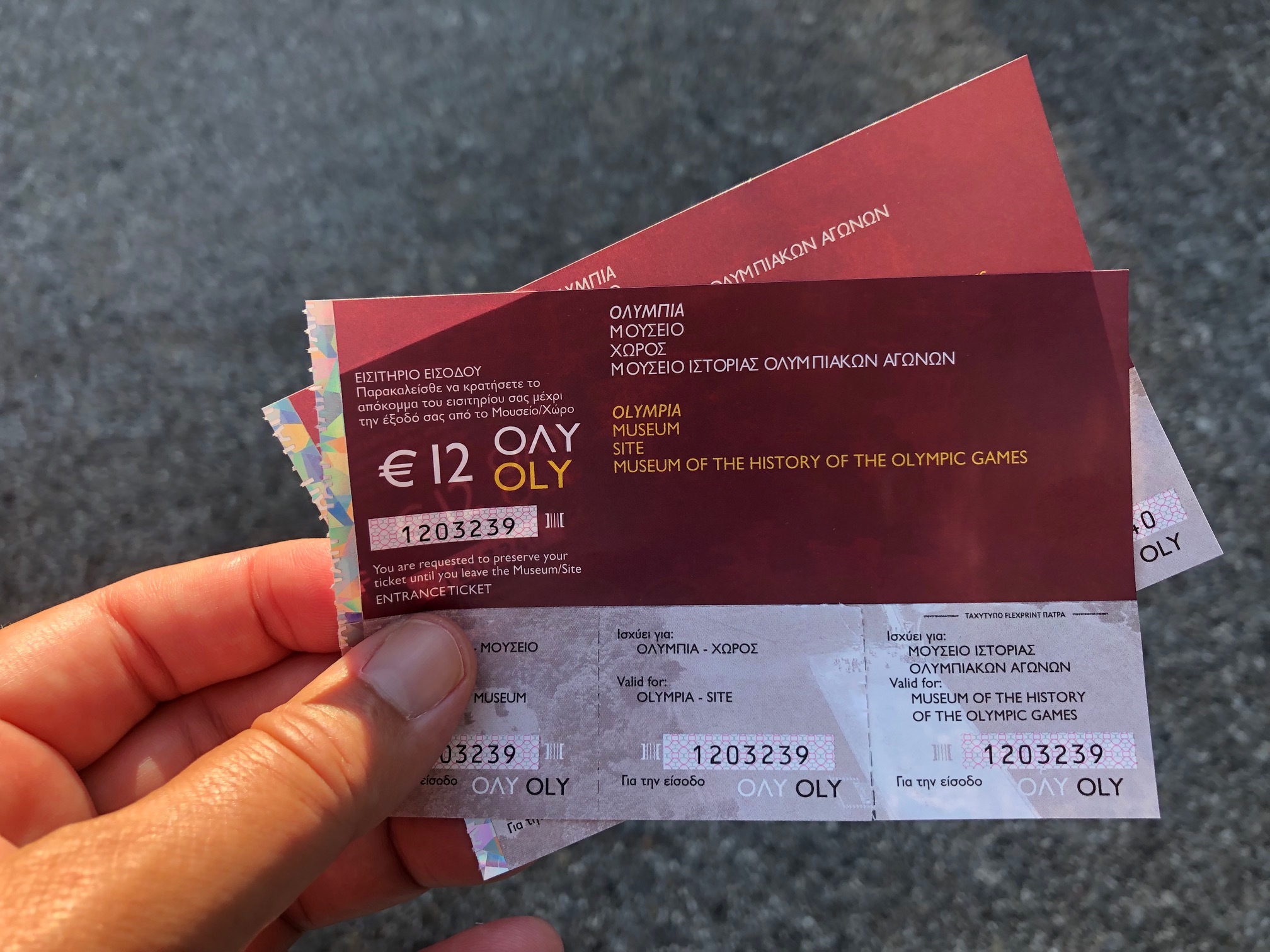
One ticket gets you into the archaeological site, the archaeological museum, and the museum of the history of  the Olympics.The site and museums are open from 8 a.m. to 8 p.m. daily. Adult tickets are 12€ each. You can leave and return later in the day to any of the sites and even return the next day to continue your visit or see more. Note: We did not visit the Museum of the History of the Olympic Games. There was only so much time. If we had had another morning, we could have visited it then.


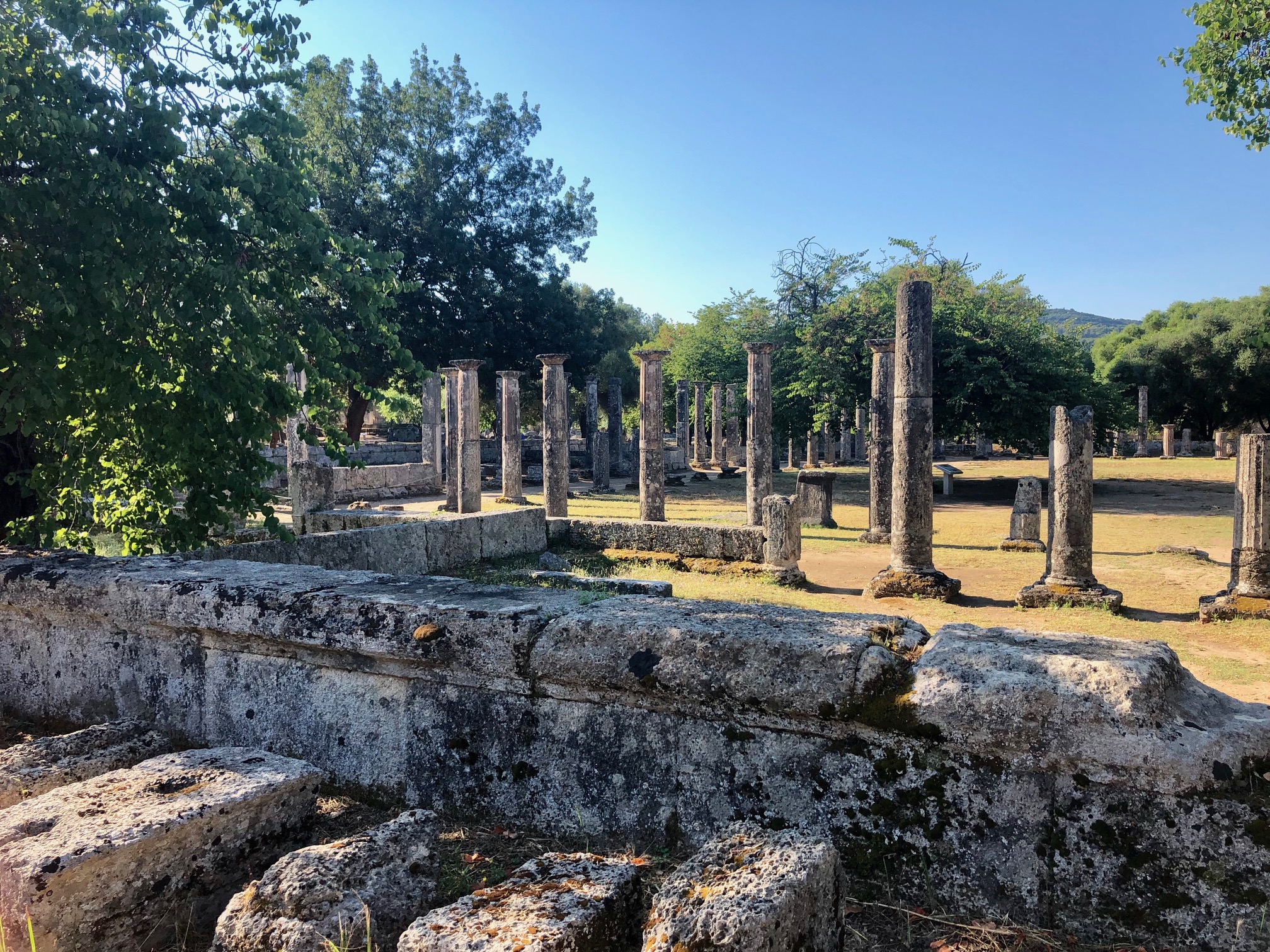
As I gazed across the grounds, as far as I could see were partially reconstructed colonnades, temples, baths, workshops, dwellings, and myriad other structures.

IMG_0506
The colonnade is a popular photo subject. Google “Olympia” and you will see lots of pictures of these columns.

This ability to see layers upon layers of excavations is the one major difference when I compare Olympia to Mycenae and Delphi, two other sites we had just seen during the previous three days.

IMG_0680
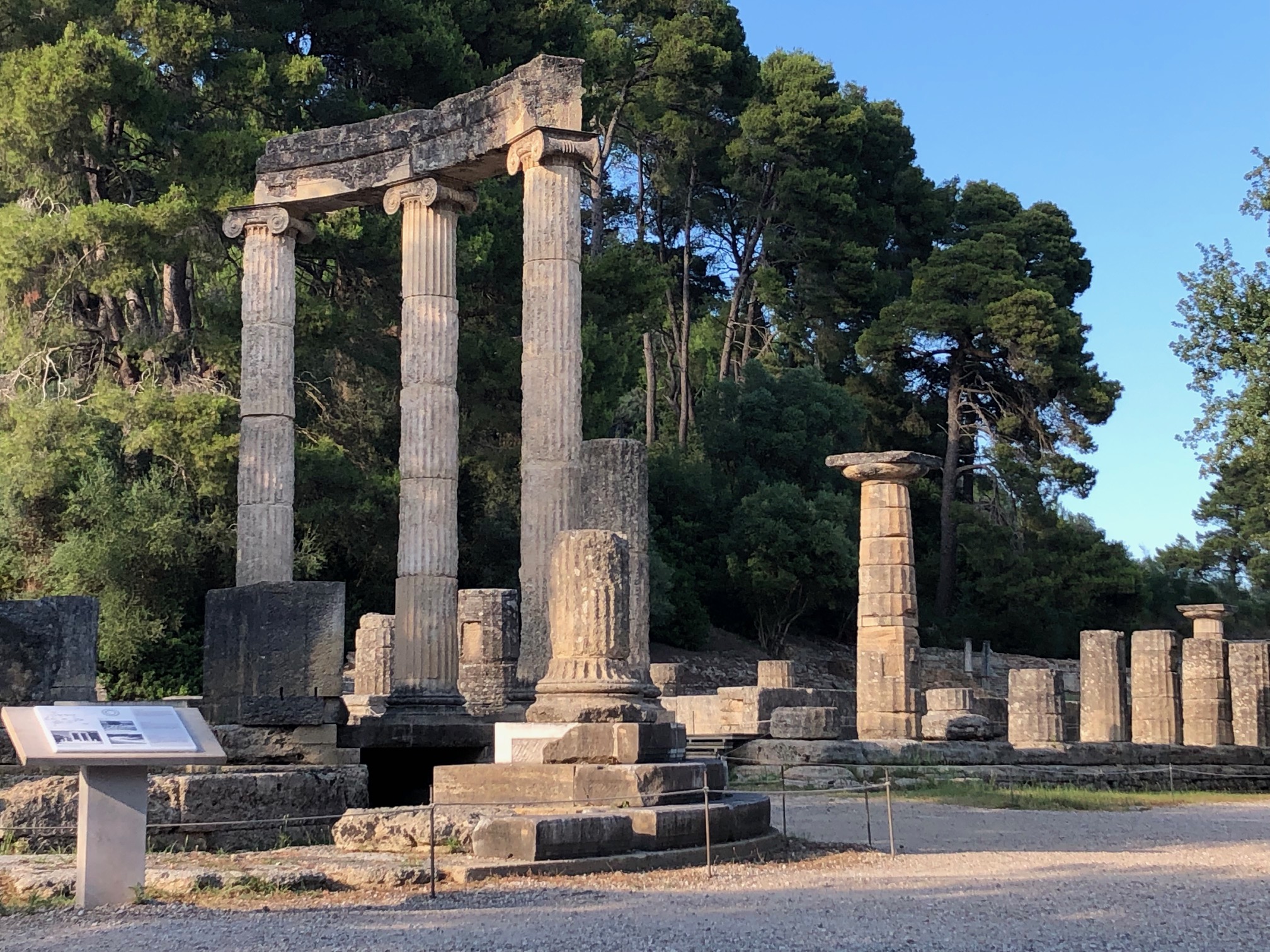
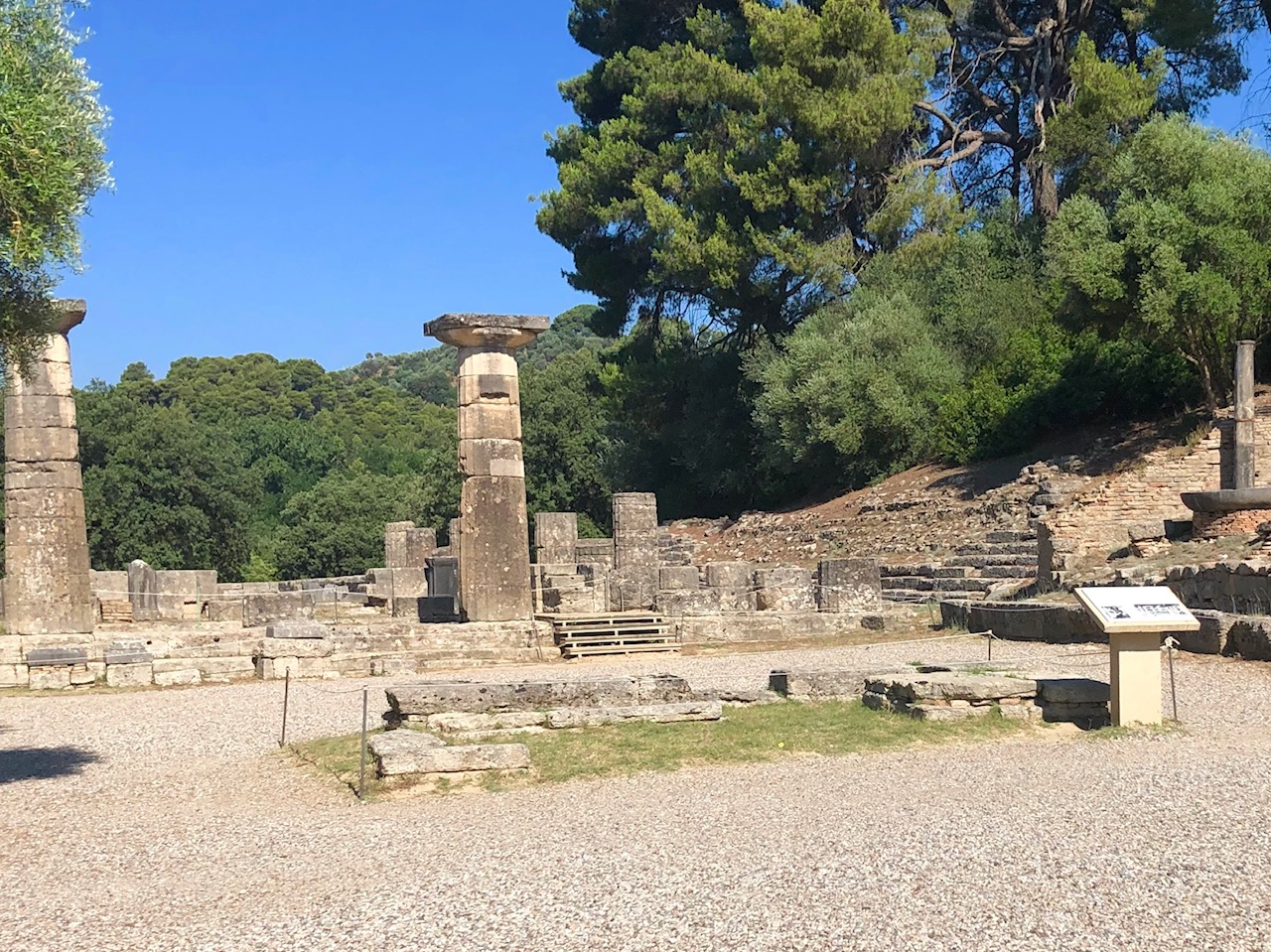
The Philippeion Tholos, a circular temple,  and the Temple of Hera in the background

By the way, we’re on a whirlwind tour of Greece. We’ve spent three weeks on the island of Skopelos and now we’re taking two weeks to see Athens, Mycenae, Delphi, Olympia and Crete. We will return home July 9.

IMG_0563
The Temple of Hera is in the background. In the foreground is the site of the lighting of the Olympic Torch that begins each modern Olympic Games.

At Mycenae and Delphi, you can definitely survey the sites across a hillside or from a high point (The Citadel at Mycenae, the Stadium at Delphi); however, at Olympia, you are looking through the site.

IMG_0519
The Tholos, a circular temple
IMG_0521
I took this picture because I couldn’t believe how sharp the scroll carving still is on these Ionic capitals.

For example, before you stands the colonnade of Palaistra. Beyond that, however, you see the impressive Tholos, and beyond that you see the standing columns of the Temple of Hera, and beyond that you see  the multi-tiered Nymphaion aqueduct fountain, through which you see the arched entrance to the stadium, the site of the first Olympic Games in 776 BC.

IMG_0554
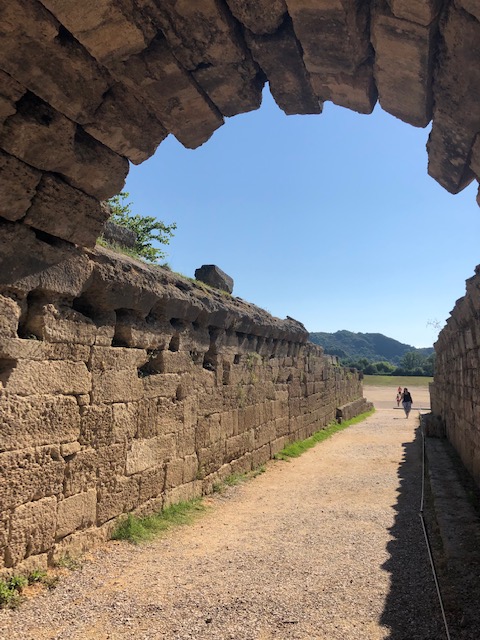
Passing through the arched entry to The Stadium
IMG_0557
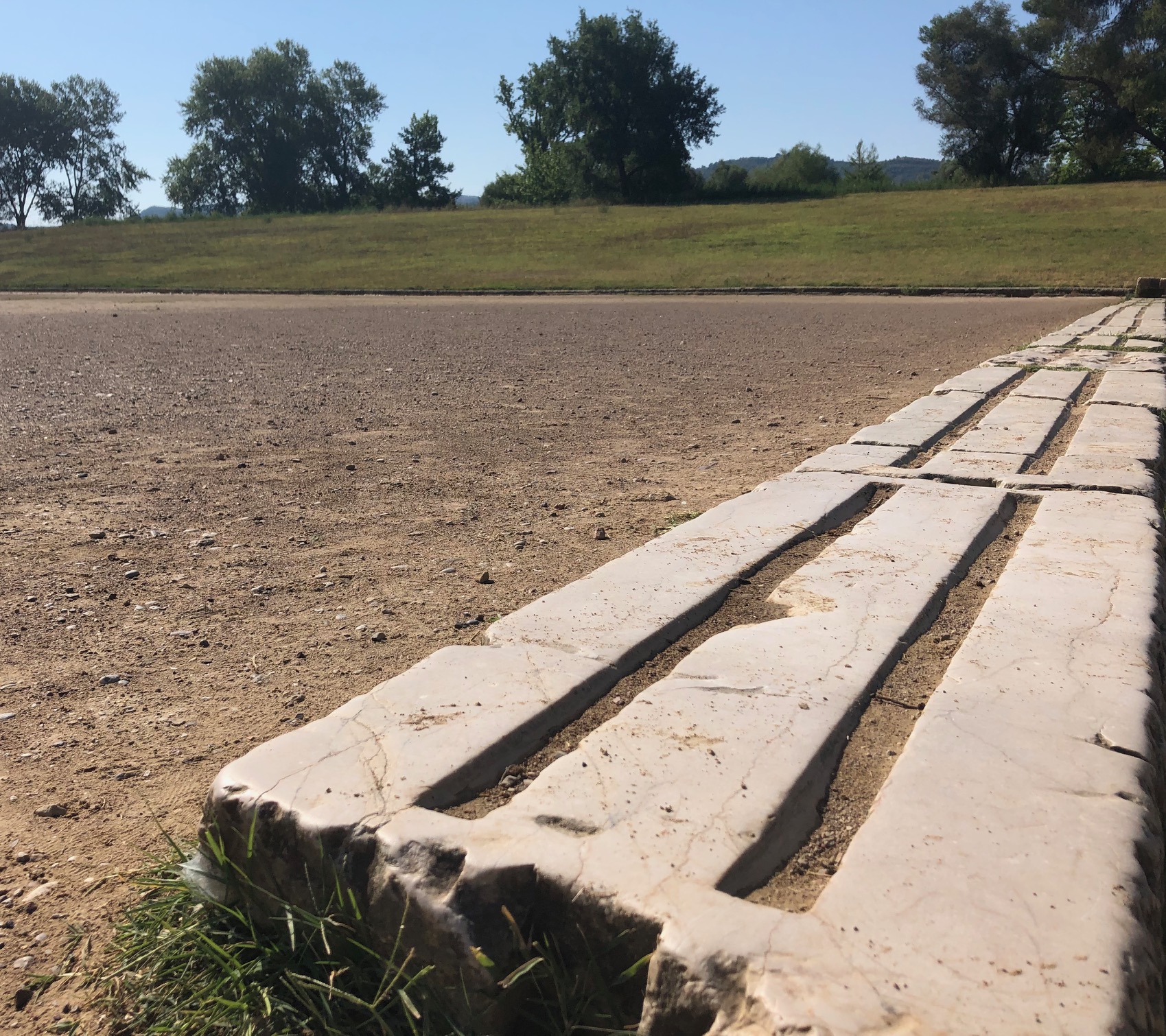
The marble starting blocks for the competing athletes at The Stadium
IMG_0558
The stadium, where foot races (forerunner to today’s 200-meter races) were held in the ancient Olympic Games.
IMG_0569
This is the workshop of Pheidias, the sculptor for the statue of ivory, gold, and bronze status of Zeus housed in the Temple of Zeus, one of the seven wonders of the ancient world.
IMG_0570
This slab of carved marble is in Pheidias’ workshop

In other words, from any spot at Olympia, you will see layer upon layer of ruins in various stages of reconstruction. And then compressed between all those layers are stashes of more pieces.

IMG_0702
An earthquake in 522 AD 551 AD toppled these columns that stood in the Temple of  Zeus, one of the seven wonders of the ancient world. Notice how the drums fell and appear almost like dominoes.

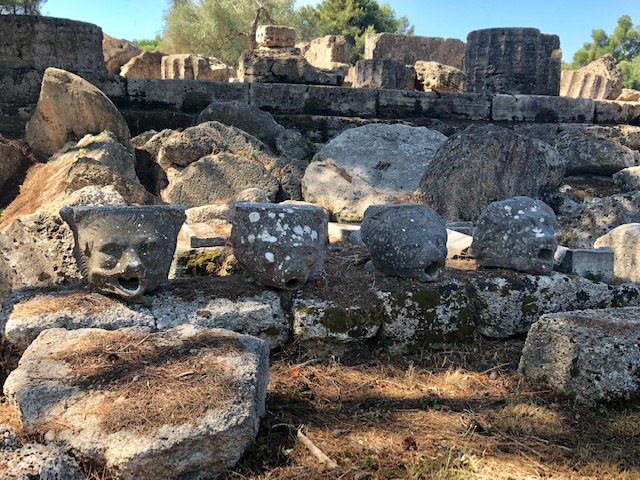
Perhaps a field of column drums, a row of lion head water spouts, a random six-foot-tall triglyph, a plot of Ionic column drums, then a plot of Doric drums, then a composition of more rare Corinthian capitals.

IMG_2232
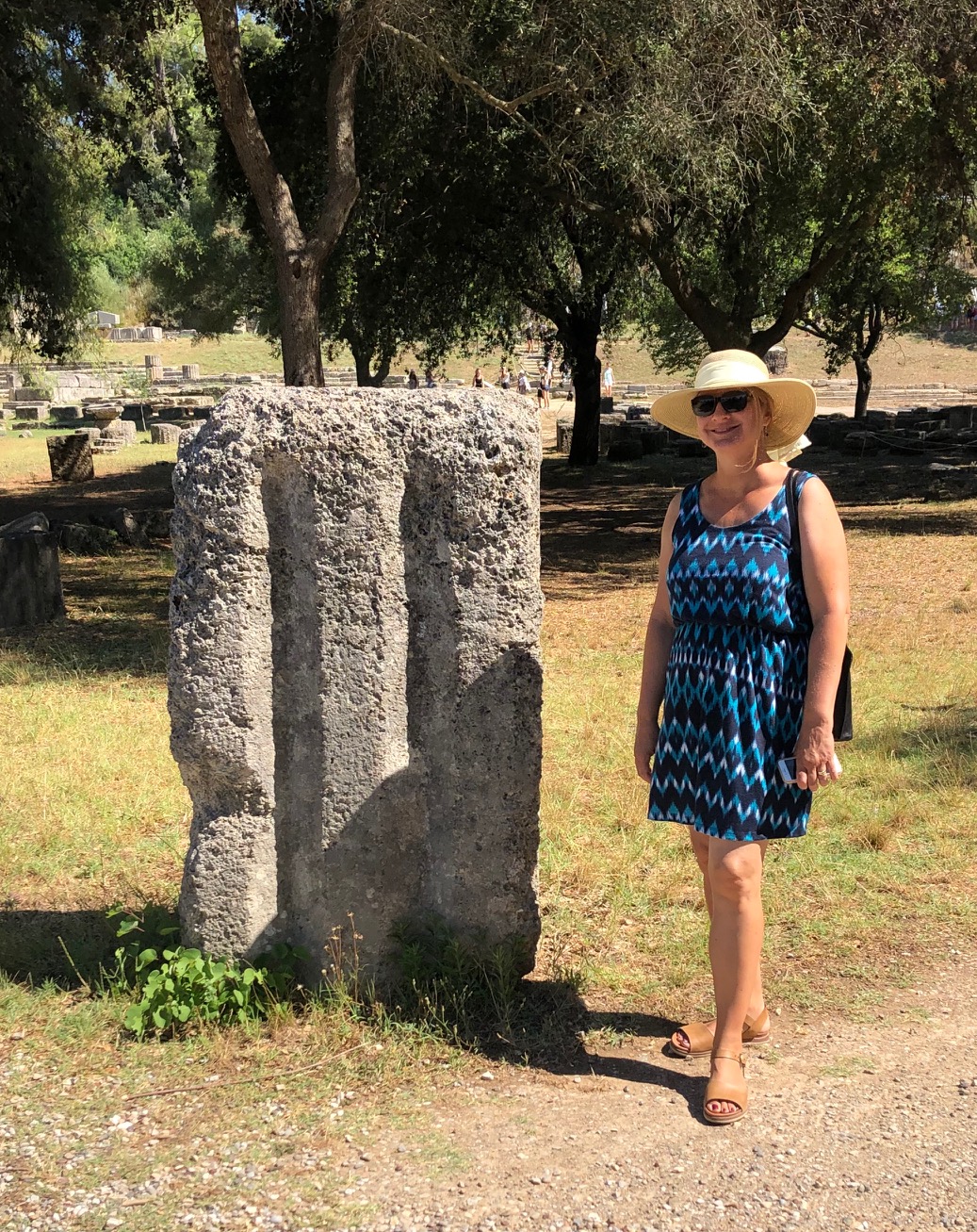
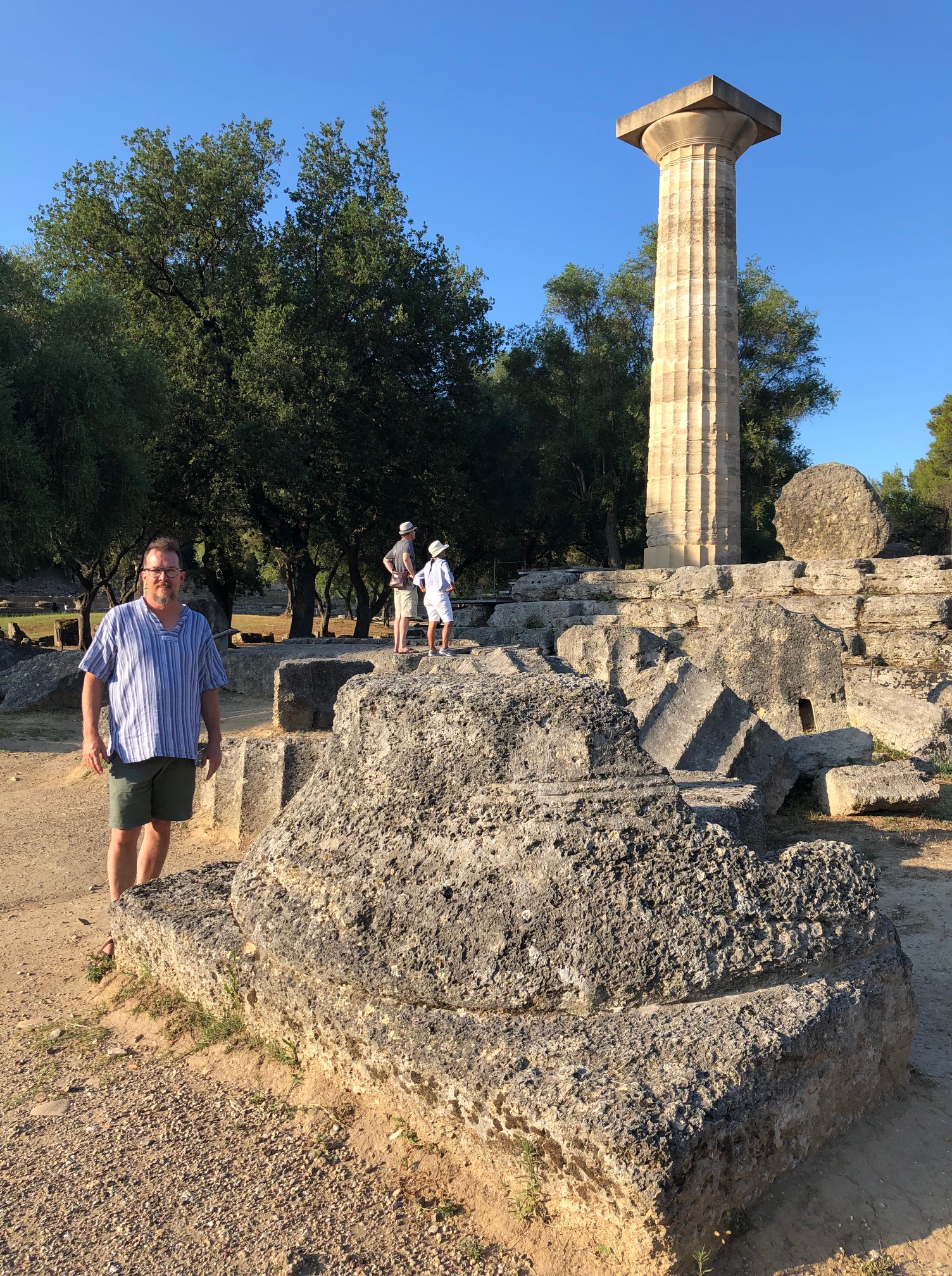
Here I’m standing next to a triglyph, three carved “columns” that were placed between metopes, relief sculptures below the pediment (the triangular-shaped friezes). See caption for next image.
IMG_0752
I’ve circled a triglyph in the image above. I’m standing next to one of these in the preceding picture. I couldn’t believe how large it was.

So many pieces and parts, but if you need a quick list of the top sights within Olympia, I think they would be:

  • The Temple of Zeus
  • The Temple of Hera
  • The Tholos
  • The Stadium
  • Workshop of Pleiades
  • The Palaistra , which includes the Colonnade

What’s more, when you tour the park, you will walk right among most of the artifacts and monuments and stones. You may even walk right on the original marble steps placed in this city of 2,500 years ago.

IMG_0595
Lion water spouts in a row on the ground surrounding the Temple of Zeus.

There are 1/2″-inch ropes that show you where you can and can’t go, and if you stray where you shouldn’t, you’ll hear a park employee sitting on a nearby park bench remind you with a sharp blast on a whistle.

IMG_0578
More columns.
IMG_0583
This was a building for council members. It contained water around the outside of this “curvy” centerpiece and also around the inner section.

Late last night, one couple climbed upon a large “rock” to see the floor of the Temple of Zeus, which was roped off unfortunately. (You can see them in the picture below.) Suddenly, a shrill blast! They didn’t hear or didn’t recognize their offense. Another blast! They looked around, the park employees shouted something in Greek, and down they jumped.

IMG_0692
We couldn’t believe how large this capital (the top of a column) that  once topped a column on the Temple of Zeus. Note the visitors standing on the stone shelf—that’s a major no-no.
IMG_0695
Each capital had these notches carved into them to help them lock onto the column.

Perhaps they didn’t realize they were standing on an architectural relic. After all, there are so many stones EVERYWHERE.

IMG_2585
We returned in the evening to see parts of Olympia again. The light put a different cast on the monuments.

To be safe, when you’re at Olympia, assume that any rock is not actually a rock, but rather an artifact. If you want to sit down for a bit, look for an actual park bench. There are several. That’s the safest bet.

Or head over to the Olympia Archaeological Museum.

IMG_0613
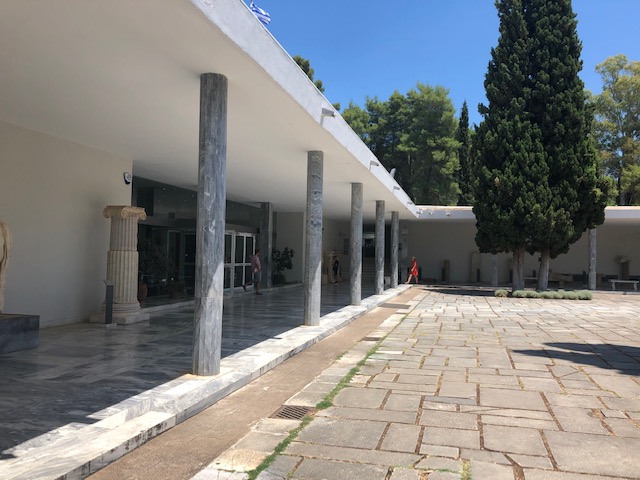
The Olympia Archaeological Museum front entrance
IMG_0617
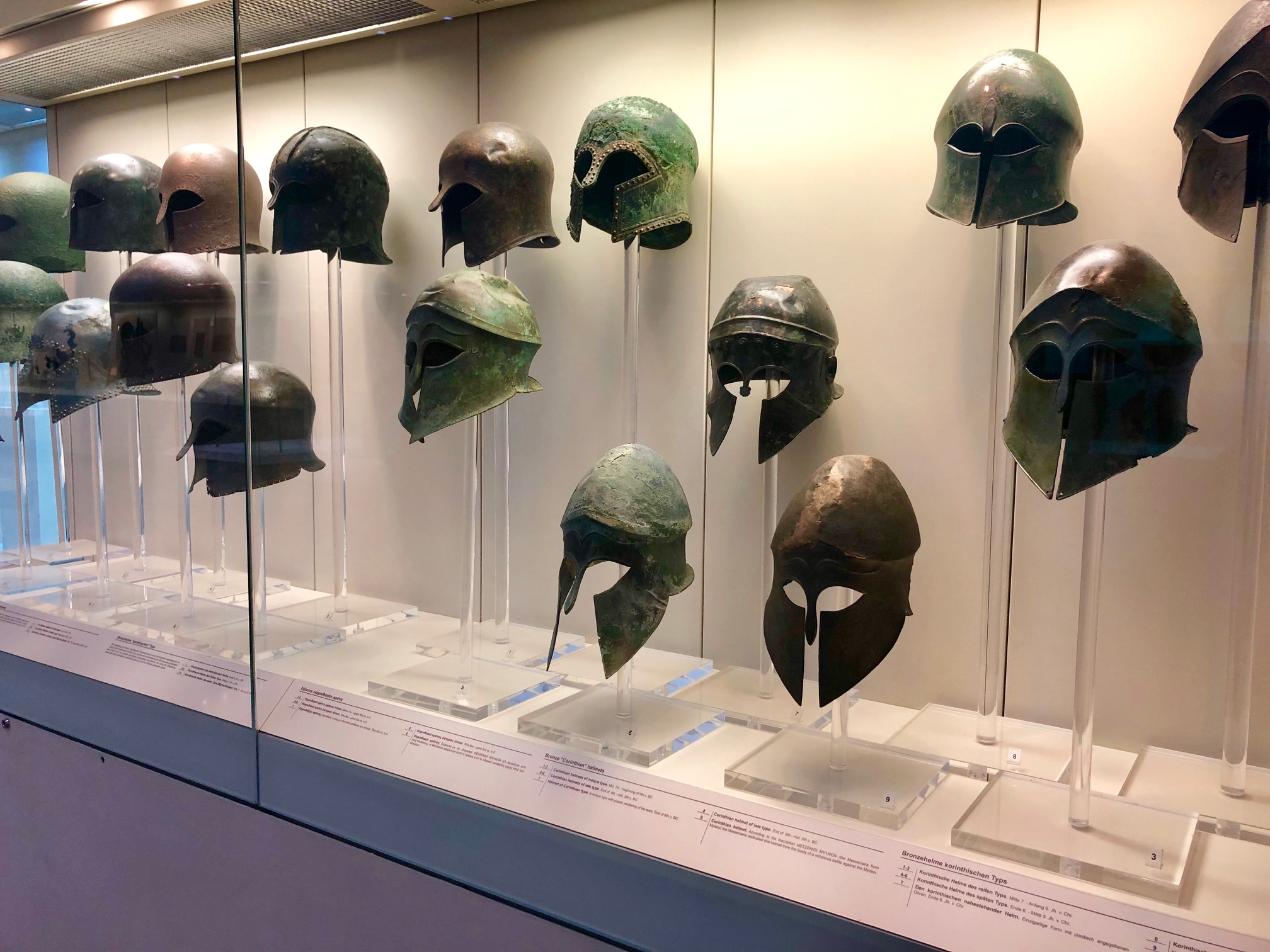
Various helmets excavated at Olympia
IMG_0623
This was a statue of Nike that used to be mounted on the Temple of Zeus.
IMG_0629
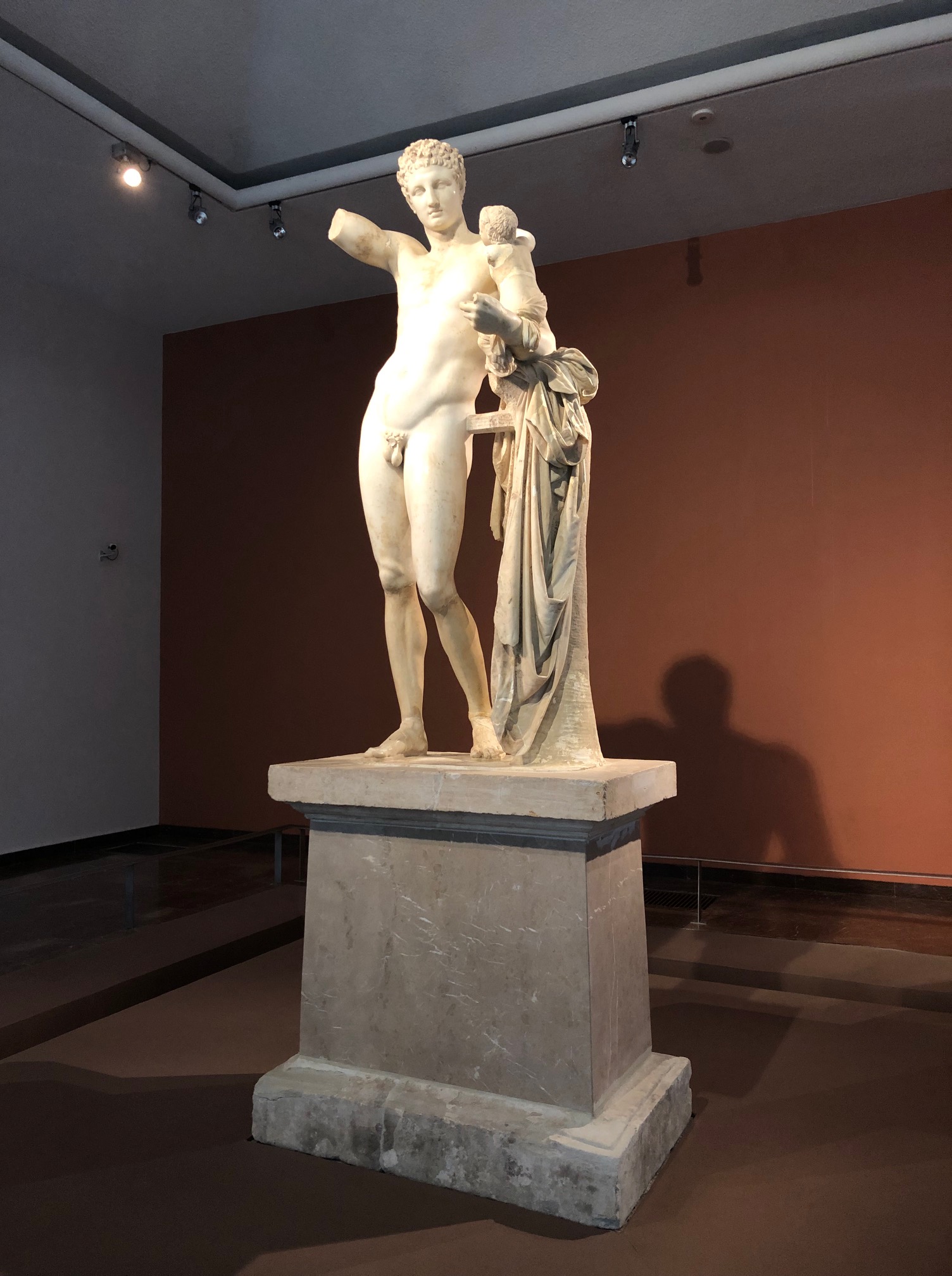
This is a statue of Hermes and was found in the Temple of Hera.
IMG_0648
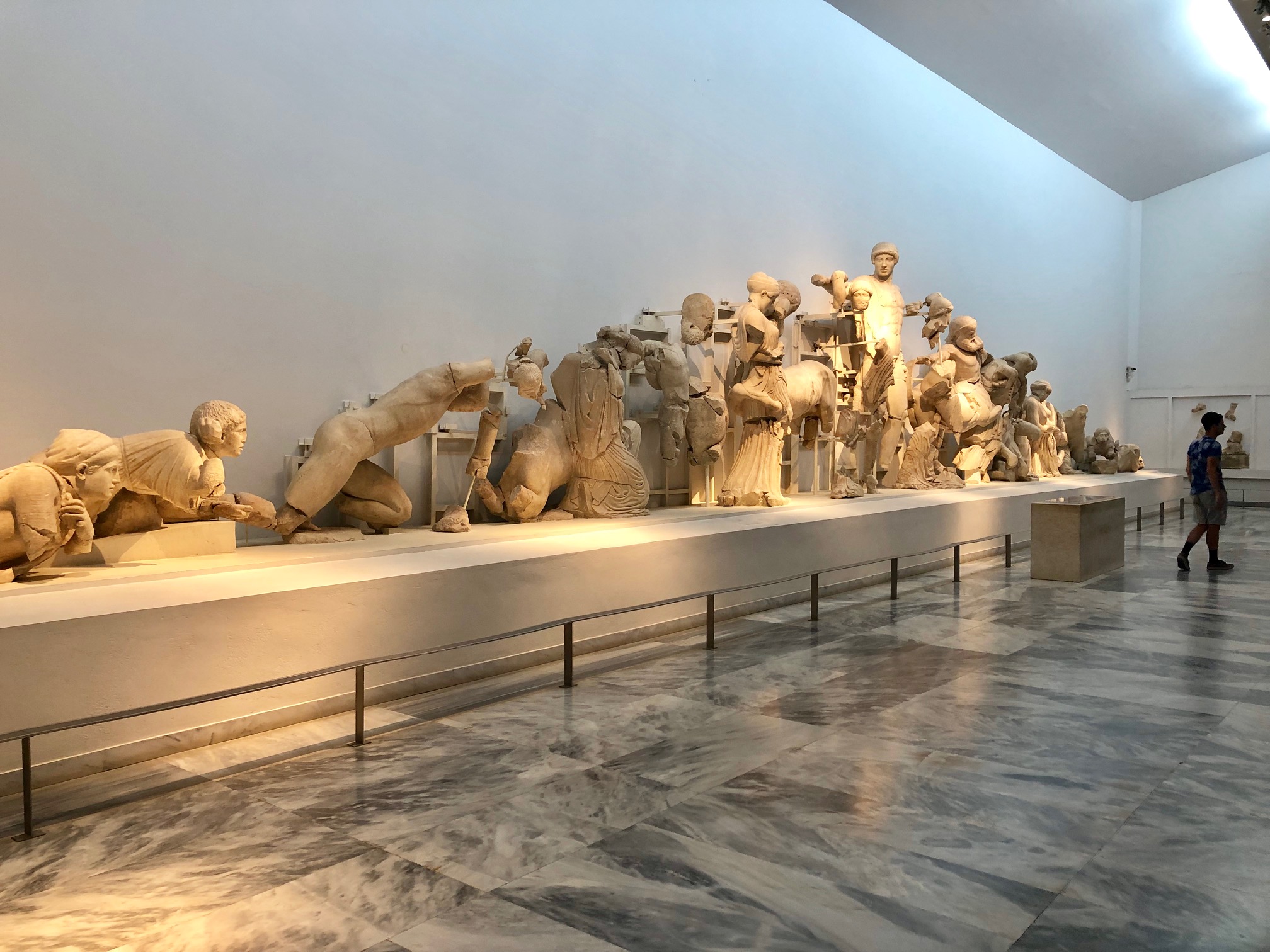
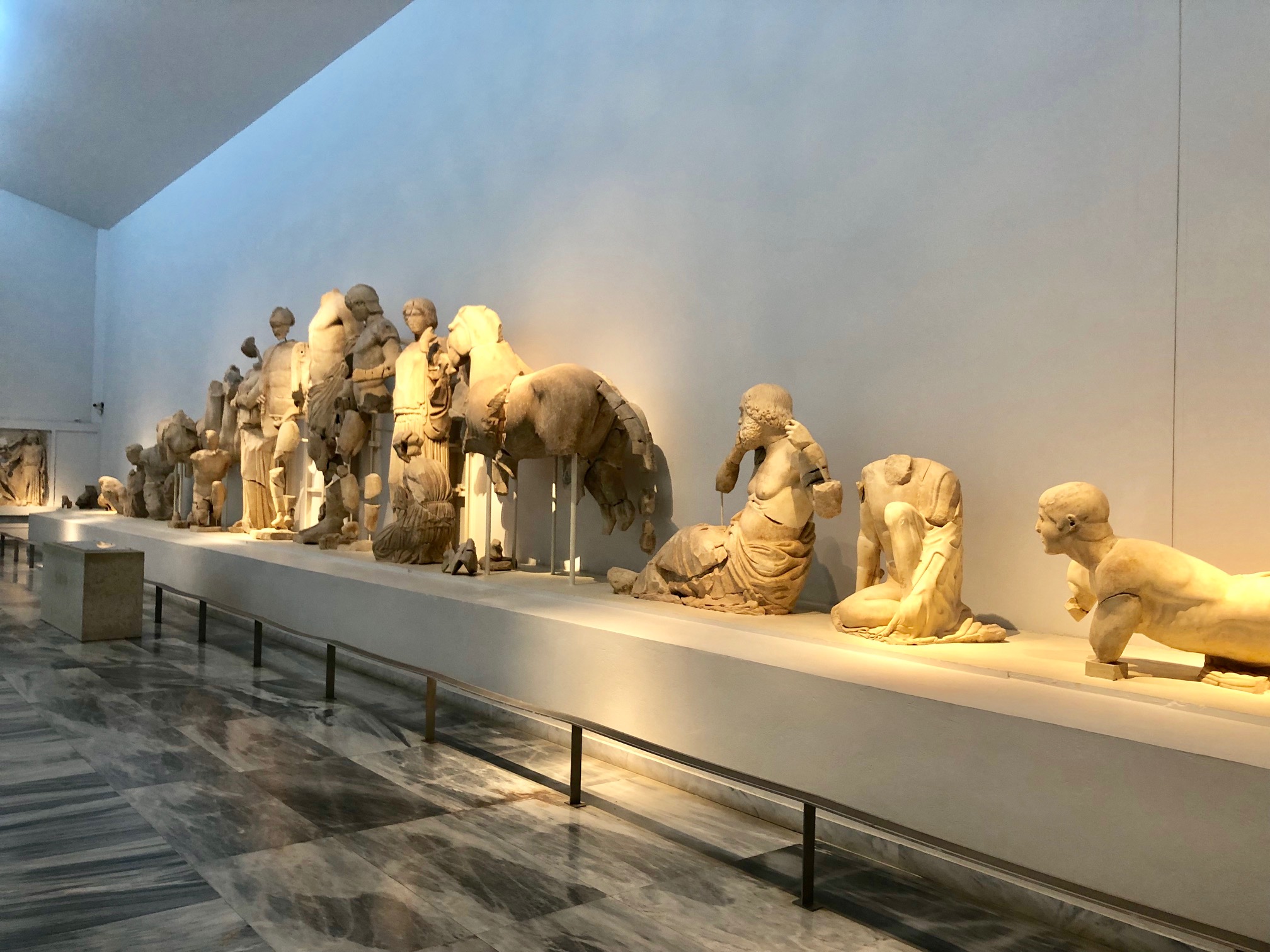
One of two reconstructed friezes from one of the pediments on the Temple of Zeus. This one features Apollo (son of Zeus) in the middle.
IMG_0649
One of two reconstructed friezes from one of the pediments on the Temple of Zeus. This one features Zeus in the middle.
IMG_0653
More lion water spouts and other prominent sculptures are placed around the outside loggia of the museum. You can just walk right up to these. But don’t touch, obviously. There were no guards anywhere around, which surprised us.

Although Olympia takes some planning to reach, it’s definitely worth the visit.

The site and museums are open from 8 a.m. to 8 p.m. Adult tickets are 12€ each. You can leave and return later in the day to any of the sites and even return the next day to continue your visit or see more. We arrived at the archaeological site at 8:30 a.m. and left about two and a half hours later. Tour bus groups arrived around 10.

As it was getting quite hot, we left at 10:40, went out for gyros and a soda, and then returned to the air-conditioned museum for about two hours in the afternoon.

Later that evening, we returned to the archaeological site to see more and take pictures with the sun coming from a different angle.


The modern city of Olympia is a beautiful little city that is literally about two blocks from the archaeological site. I’ll write a short post about the town tomorrow. Our AirBnb host told us the permanent population is only about 700 people! 

Thanks for reading! Click like, leave a comment and follow my blog for more stories about travelling in Greece. 


Categories
Greece (Athens, Delphi)

A Day in Delphi

Delphi: Greece’s Top Divine Destination

Our visit to Delphi was our favorite single day of our six-week Greek odyssey. Once we figured out the Greeks pronounce the divine destination “Delfie, as if to rhyme with selfie, we settled in and fully enjoyed our day.

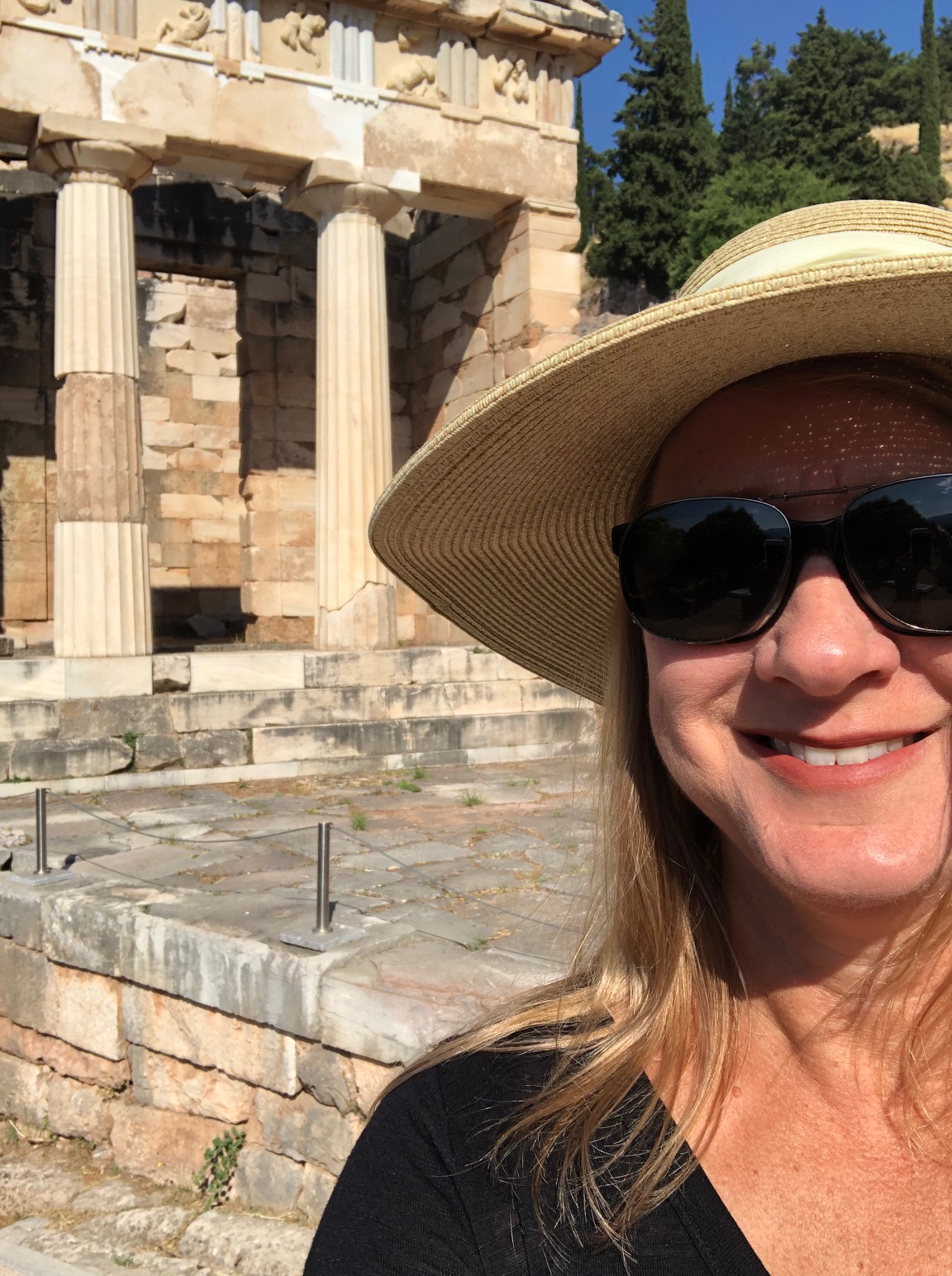
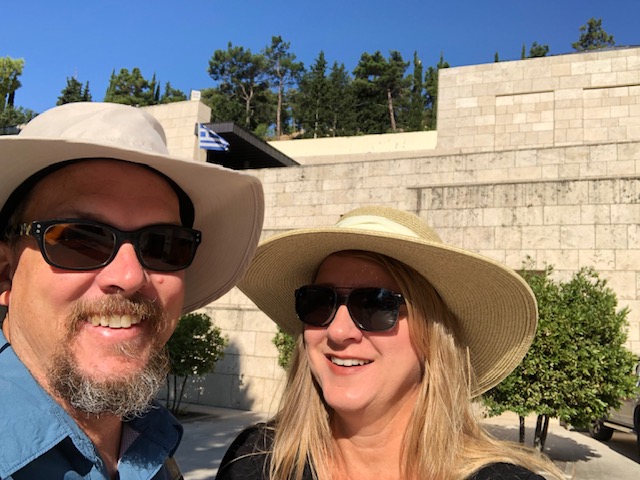
So… I think it made perfect sense to attempt a Delfie selfie today when we visited the archaeological wonder. I don’t take many selfies (and by that I mean as few as possible), but this post includes two or three to take care of the issue for awhile.

IMG_0198
Another selfie in front of the Treasury of the Athenians

When we added Delphi to our list of must-see attractions, I had no idea we would be scouring over a steep mountainside full of pine and cypress trees. In fact, this is snow skiing country. The next town over, Arachova, offers skiing during the winter months. I guess I just didn’t realize how “Alpine” the Delphi would feel.

IMG_0199
Treasury of the Athenians

In a sentence or two, “Delphi could be described as a religious complex centered around the Oracle of Delphi that was located in the Temple Apollo,” according to a book we bought, Delphi and Its Museum, by Panos Valavanis. Delphi flourished during the Archaic and Classical period of Ancient Greece, roughly from the 6th – 4th centuries BC.

On the UNESCO World Heritage site placard near the entrance to the grounds, it reads:

“The archaeological site of Delphi is Panhellenic sanctuary with an international fame. Its remnants represent some of the foremost events of art and architecture. The sanctuary, which combines in a unique manner the natural and historical environment, is related to numerous, key events of Greek history that have an impact on the progress of civilization.”

It continues: “Inscription on this List confirms the outstanding universal value of a cultural or natural property which deserves protection for the benefit of all humanity.”

IMG_0423
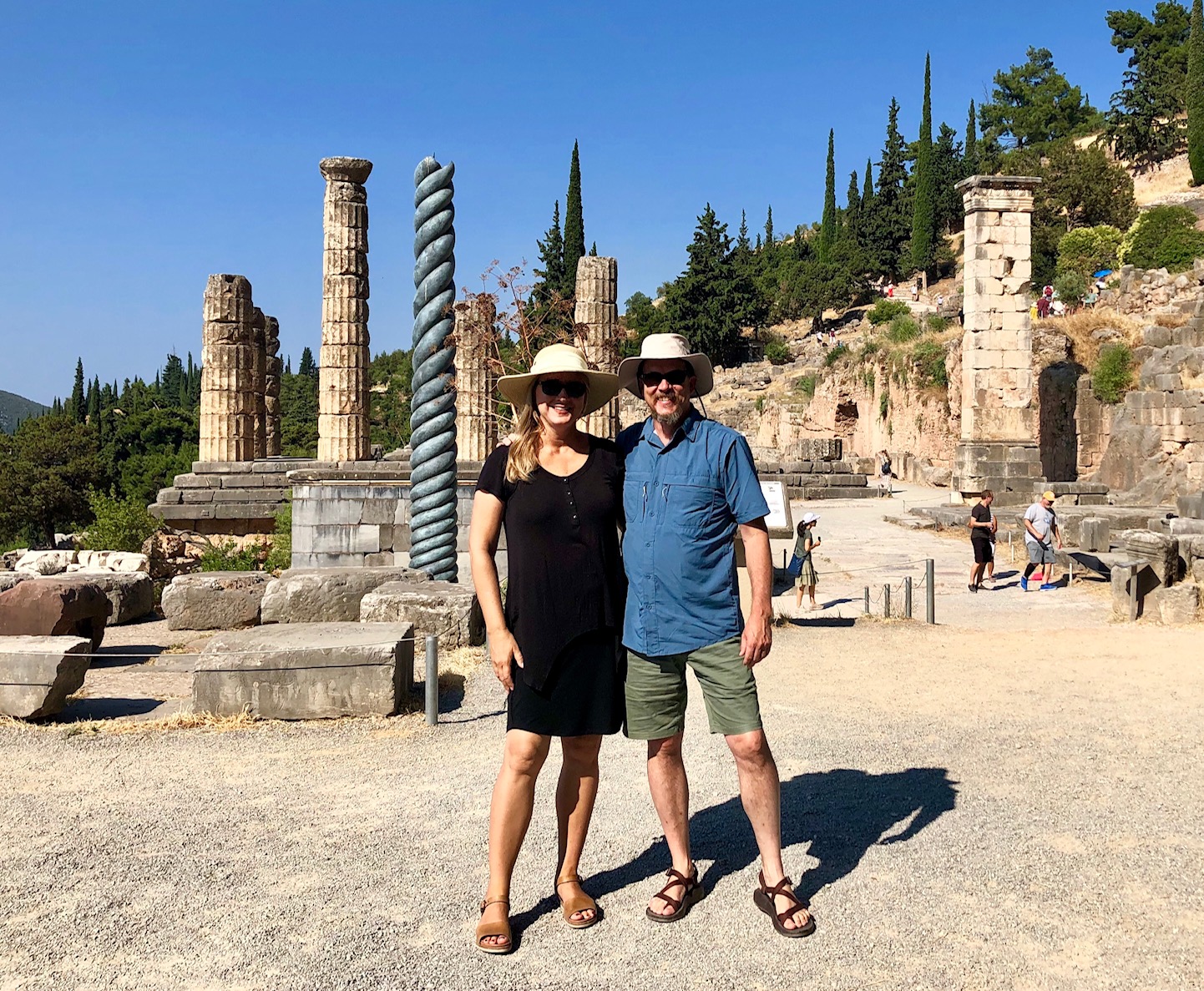
Okay, not exactly a selfie, but a nice lady from Australia took this for us. We’re standing in front of the Temple to Apollo and the Serpentine Column.

Here are some major sites within the Delphi archaeological site:

  • The Treasury of the Athenians
  • Temple to Apollo
  • Theater
  • Stadium
  • Tholos at Delphi
  • The Sanctuary of Athena Pronaia

However, besides all these major sites, there are numerous other objects, foundations, walls, and monuments to distract and fascinate you. And don’t forget the magnificent natural beauty of the place.

IMG_0230
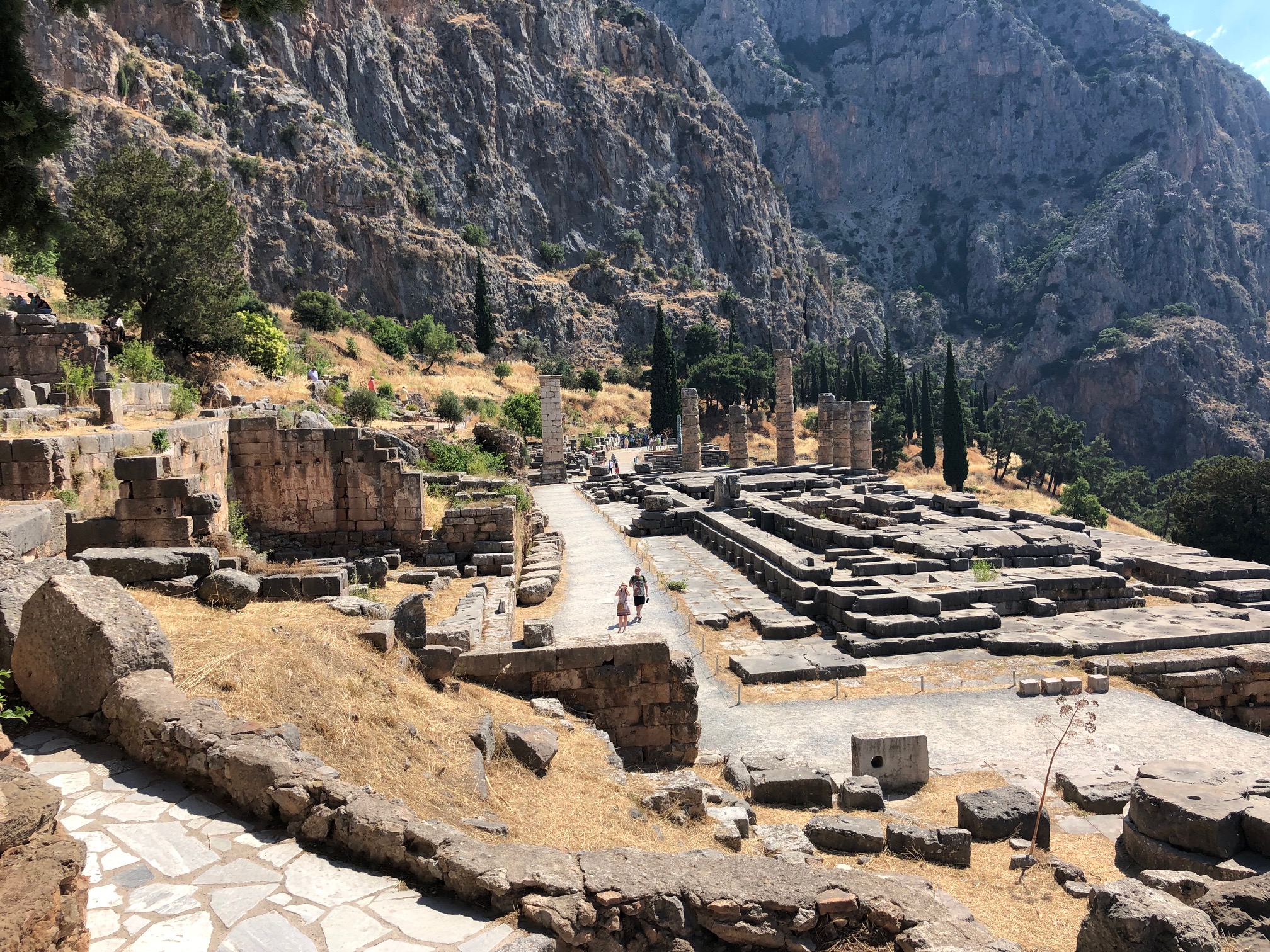
Theater on the left. Temple to Apollo is on the right. Clear down the hill you can see more ruins. This was taken on our way to the stadium all the way at the top of the site.

We took so many pictures at Delphi today that there’s NO WAY I could post them all. Here are a fraction of the photos we took at both the archaeological site and at the museum.

IMG_0249
Temple to Apollo is on the right. Other buildings (there are so many we couldn’t keep track of them all) are on the left.
IMG_0213
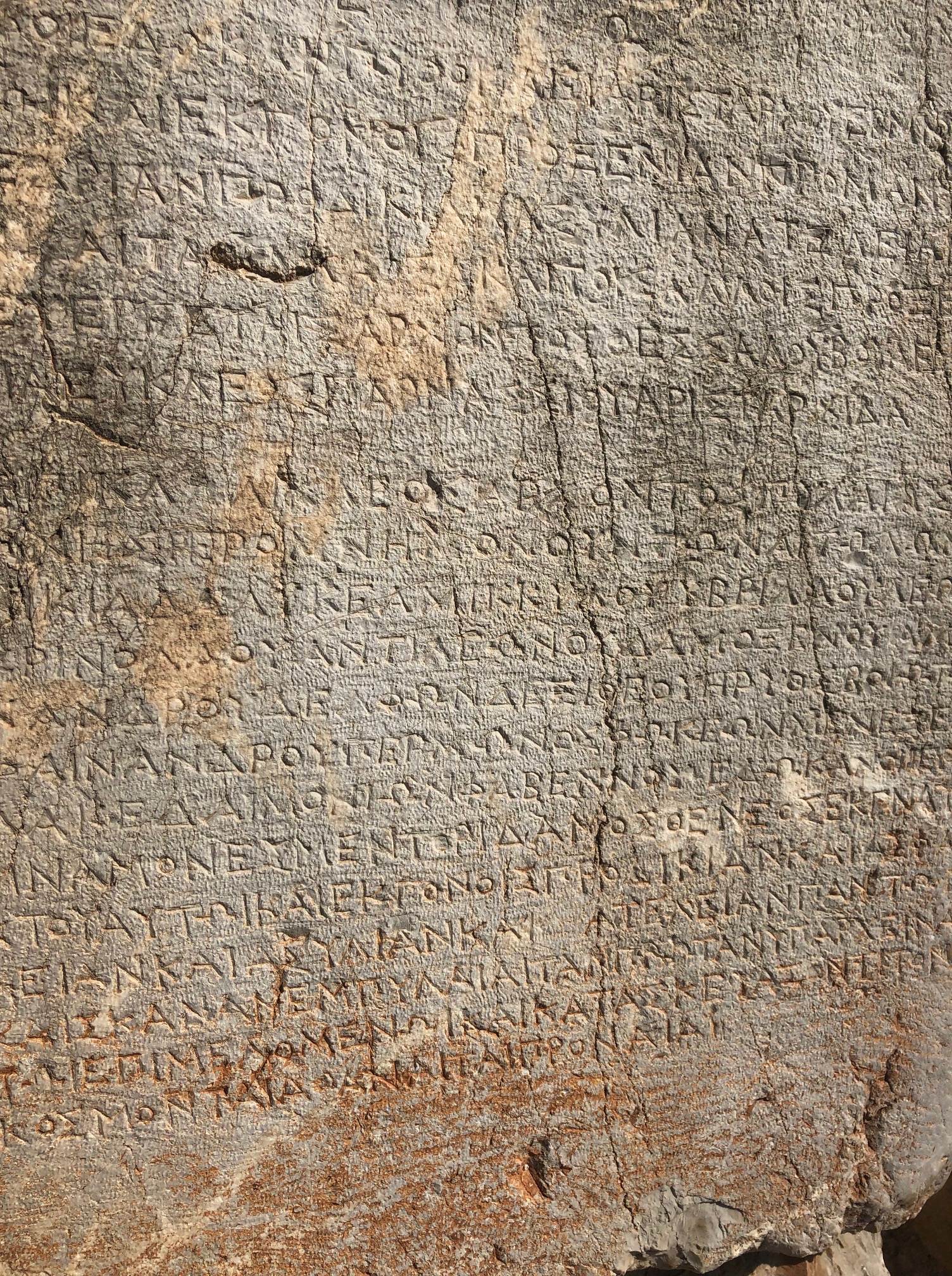
Carved inscriptions are on practically every surface.  Most of these were written by slaves who were guaranteed their freedom by Apollo, according to a book we bought in the museum.
IMG_0214
A closer view of the carved inscriptions.
IMG_0215
The long view of the wall. Most stones had inscriptions on them.
IMG_0259
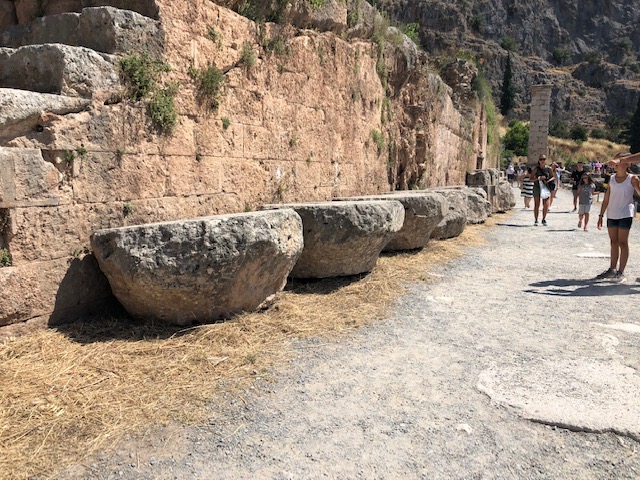
Capitals that would have topped columns. They’re just here, there and everywhere.
IMG_0360
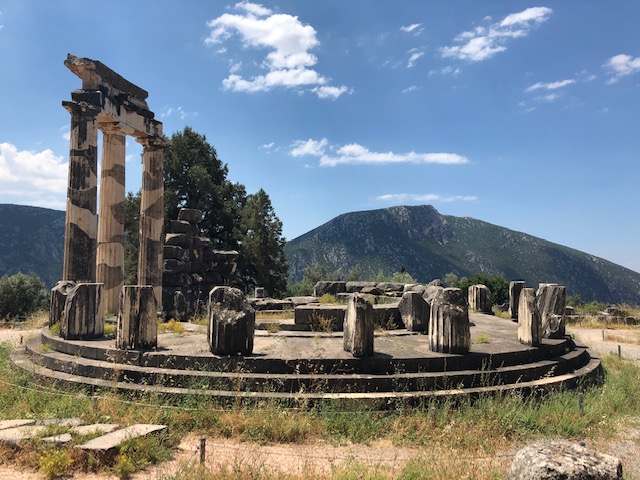
The Tholos, a round temple. This is the structure I’m standing in front of in the selfie at the top of this story.
IMG_0369
I took this to show the detail of the underside of the Tholos.
IMG_0236
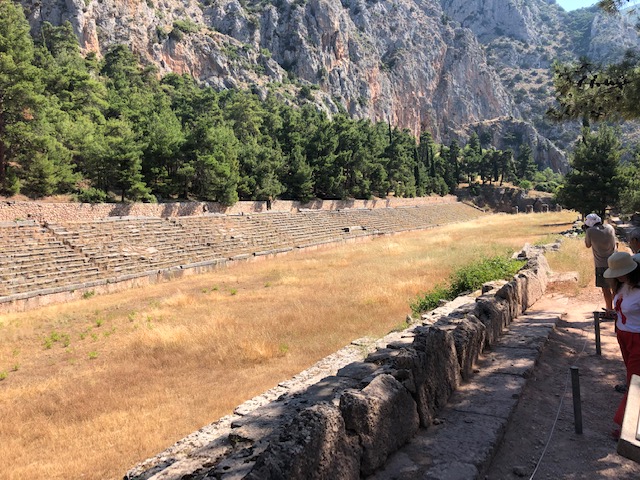
The stadium clear up at the top of the site. Panhellenic Pythian Games were held here.
IMG_0239
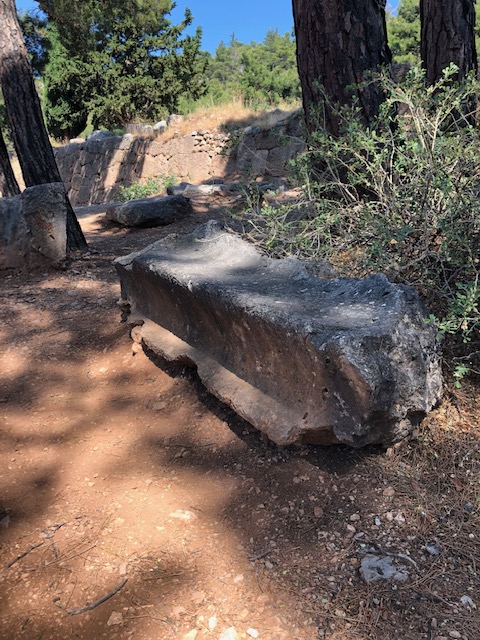
We snacked on this stone bench over by the stadium. I think it could actually be a bench from the stadium itself. There are stone pieces everywhere. They had to fall there from something.
IMG_0258
Column drums that were stacked to form tall columns. That’s my purse next to one to show scale. In the background by the person in the pink shirt, is a base that these columns may have been stacked on.
IMG_0268
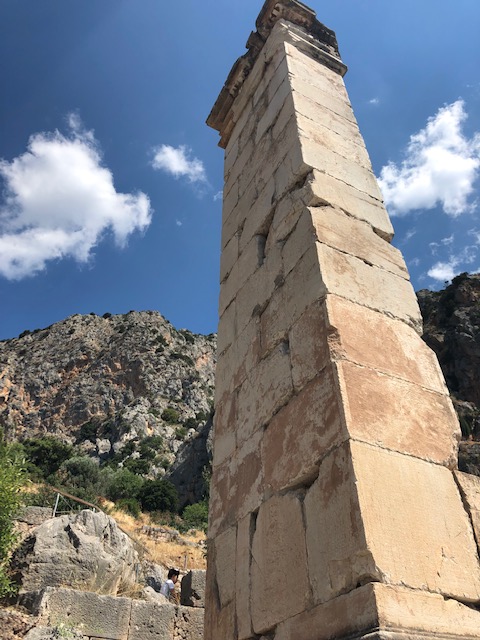
I thought this column was interesting because of its sharp edges. If you look closely, you’ll see carved inscriptions on the stones.
IMG_0245
A trough for carrying waters from the natural fountains on the mountain.
IMG_0184
It’s interesting. Right alongside some fire extinguishers and a storage chest, you’ll find ancient Greek columns. No big deal.
IMG_1643
And then we went to the museum.
IMG_0378
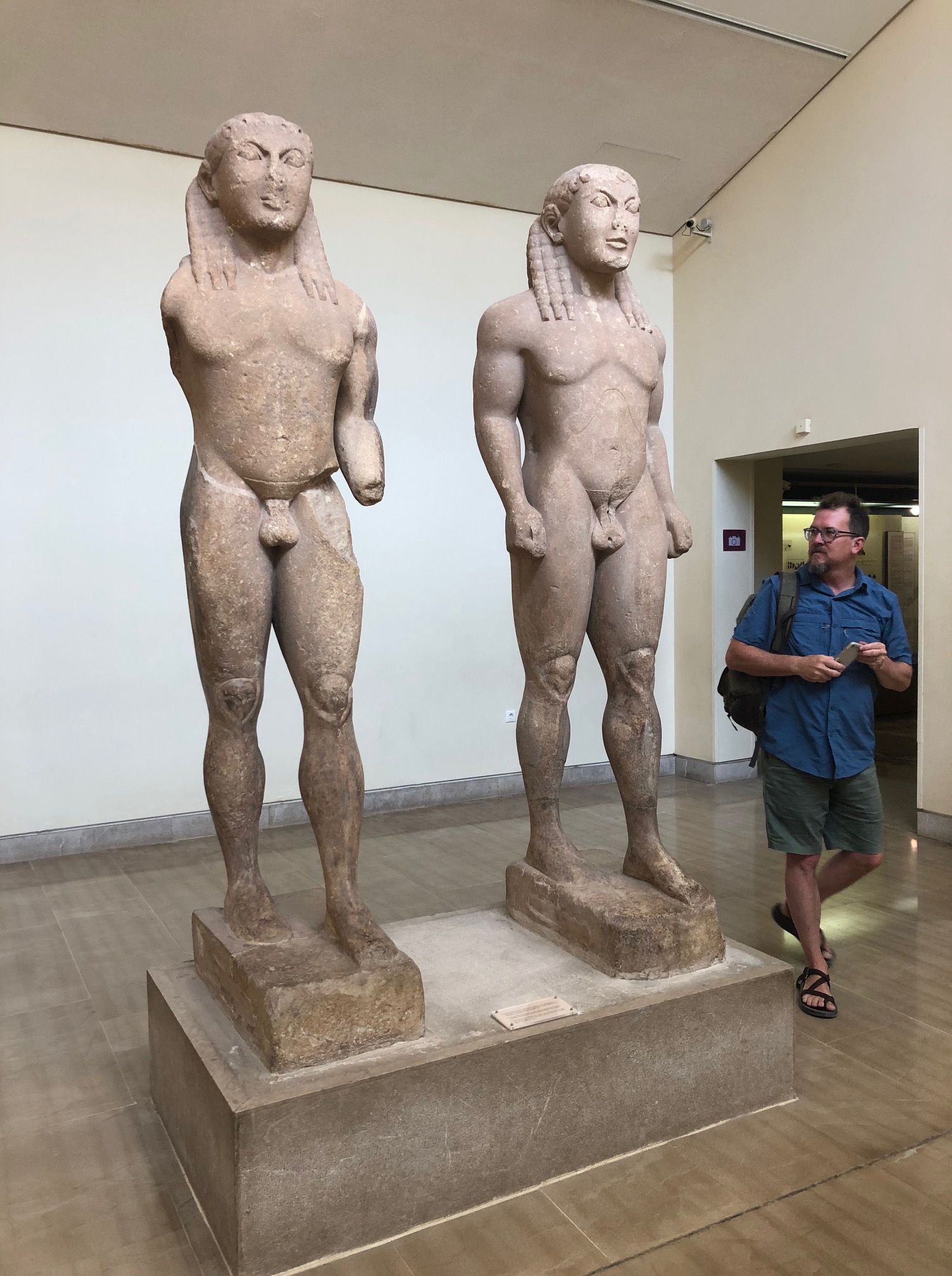
The Argos Twins, Cleobis and  Biton… Careful what you wish for. These were the boys whose mother asked the gods to bless them for carrying her to the temple of Hera. As a result, they were given the greatest gift… death at their finest moment.
IMG_0385
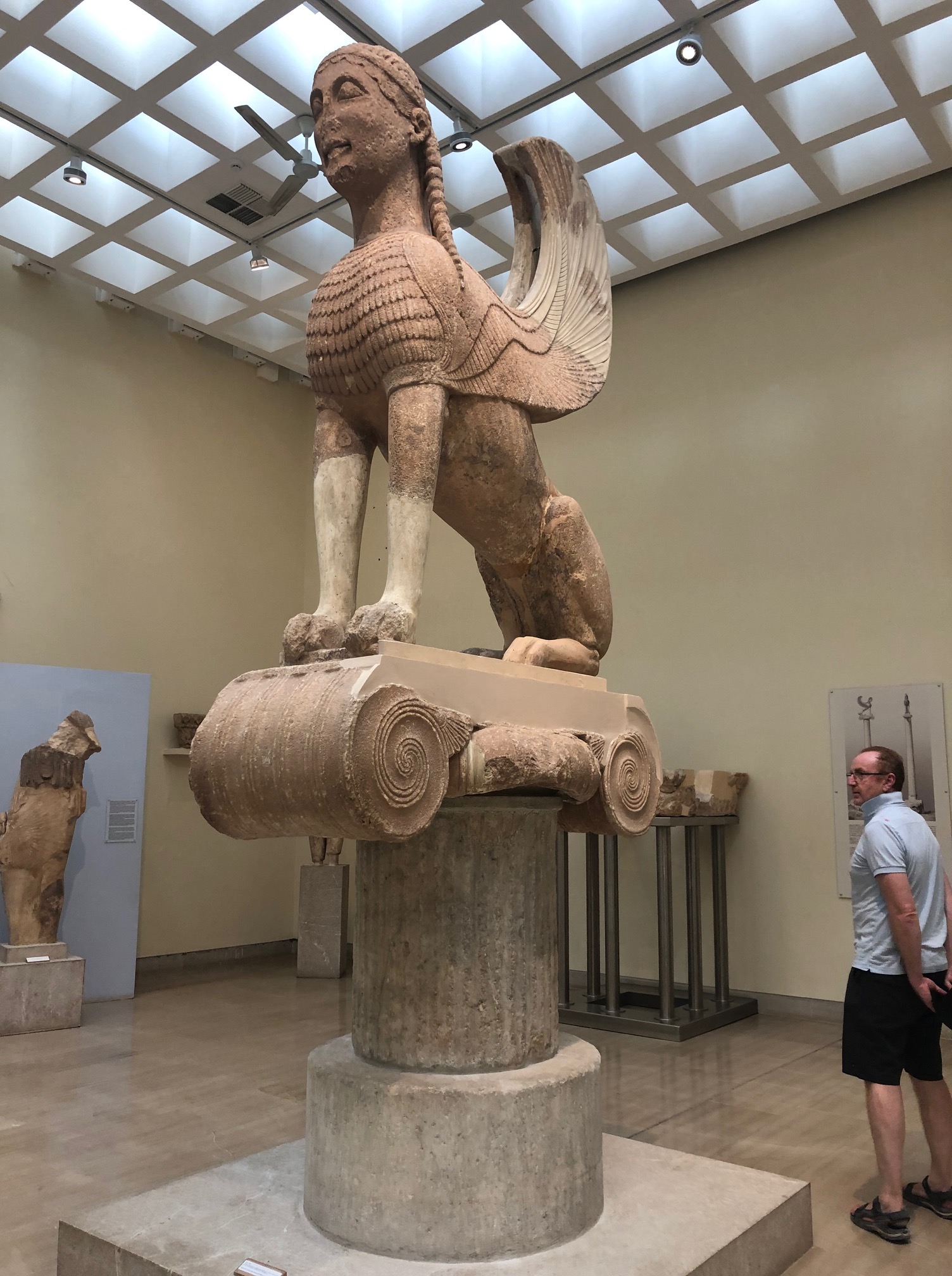
The Sphinx, a gift from the island of Naxos, given to Apollo Delphi to gain the gods’ favor.
IMG_0410
Aghias, son of Aknonis. An athlete (that’s why he’s nude) and shows how the ancient Greeks used contrapposto, which is an assymetrical arrangement of the body. Contrapposto allows a more natural stance.
IMG_1987
The bronze Charioteer is the grand finale of the museum.

We spent about four-plus hours total touring the archaeological sites and the museum. We started in about 9 a.m. and finished up around 1:30 p.m. The weather was very warm, but very nice in the shade.

We had about an hour before the tour buses arrived, so the sites really weren’t that crowded. And because many if not most people don’t go down to the Tholos of Delphi and the Sanctuary of Athena (which are located down the hill and separate from the main complex), we felt like we had a very thorough visit.

Tomorrow… on to Olympia!


Thanks for reading! Leave a comment if you’ve been to Delphi! What was your favorite part of your time there? Follow my blog for more stories from our 2019 Greece trip.

Categories
Greece (Peloponnese)

Marry an Artist and Then Go to Mycenae

A few days ago, I posted on Instagram about how one of the perks of being married to an artist is that you can tag along with them when they serve an artist residency in Greece.

Image-1

Well, if you need another reason to marry an artist, here it is:

You have a built-in tour guide for all things artistic: museums, historical sights, and exhibitions. 

Today, I fully realized the benefits of being married to an artist while walking the grounds of Mycenae. Not having studied these incredible ruins for a degree in journalism and teaching, I really didn’t understand much of what I was seeing.

However, walking around with my husband, I gained a glimmer of understanding about the culture that preceded classical Greece and influenced western art, architecture, and philosophy.

Mitch was able to tell me that: the Lion Gate that leads to the Citadel at Mycenae is important because it shows a monumental post and lintel entry point. Another reason: those lions throughout history never became buried or destroyed. Always visible down through the ages, they created a landmark for historical study that continues in current times.

IMG_0068
A closer shot of the Lion Gate.

The Lion Gate structure, like all of Mycenae, was built  from 1600-1300 BC. When you wrap your head around that date, these ancient ruins— some of them today merely stubs of stone outcroppings and faint traces of walls and foundations–are indeed spectacular.

Many times today, I found myself asking things like:

  • “How in the world were they able to hoist that huge stone all the way up there?” 
  • “And why did they need that large of a stone in the first place?”

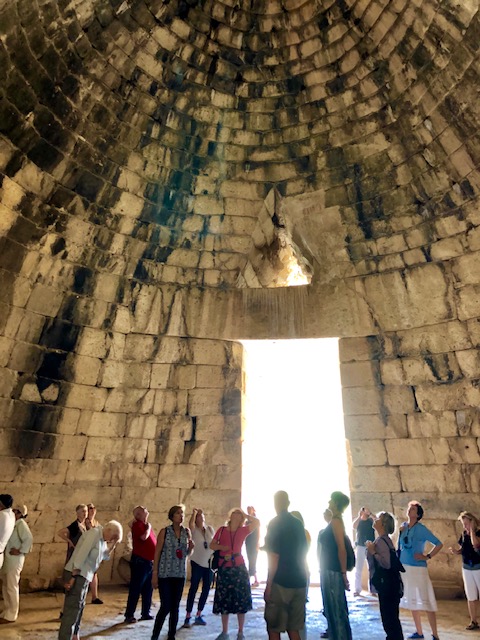
My husband Mitch is also able to tell me about the triangular openings above many entries. These triangular openings displaced the weight from above so the weight didn’t rest directly on the lintel. We saw several of these triangular openings on beehive-shaped tombs. Imagine how many failures were experienced over the years in order for the Mycenaens to learn and then apply this engineering principle in the surviving structures we admire today.

This was taken inside the Treasury of Atreus or the Tomb of Agamemnon. It’s mammoth. In fact, it’s the largest of the nine similar tombs at Mycenae.

IMG_0131
That’s one BIG stone above the doorway. See how it curves?
IMG_0139
See how that curved stone is actually bigger than it looks? You walk under it a good bit when you enter the tomb.

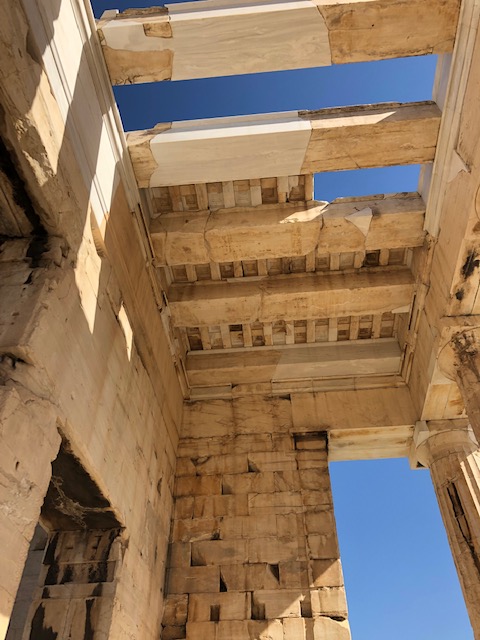
Another example of my husband’s knowledge that comes in handy when you go to places like Greece: Back in Athens, inside the Propylaea, the entrance to the Acropolis, one could easily walk under the ornate “ceiling,” never pausing to consider the enormous stones above.

In the next photo of the Propylaea in Athens, see the large horizontal pieces, some of which have new and whiter marble replacement pieces? Now see those stones in between those horizontal pieces? Those are separate stones placed over the horizontal beams.  Stone on stone on stone. Truly incredible.

IMG_8997
Ceiling of the Propylea at the Acropolis in Athens a few weeks ago.

But let’s return to today’s Mycenae visit.

Here’s I am again walking under a lintel that spans the posts, transferring the weight to the posts. Maybe this is common knowledge to you, but it’s new to me and fun to hear about from my husband.

IMG_1615
Post and lintel doorway at the Citadel

Another spot I saw today: the House of Columns at the Citadel at Mycenae. Notice the large stone in the front of the picture? Now see how there are four more behind it spaced regularly? Those used to be columns. Amazing.

IMG_0094
The House of Columns at Mycenae
IMG_0035
Quick summary of the importance of Mycenae

We walked the mile or so up the road to Mycenae from our AirBnB. It was a breezy, sunny day and warm, but not too warm. It was actually a nice walk full of oleander and olive trees.

IMG_0142

We started out here at our AirBnb. Yesterday was a long day. We arrived here last night after leaving Skopelos, ferrying to Skiathos, flying to Athens, and taking a bus to Fichti, where our host met us at the bus stop before driving us to Mycenae (spelled Mikines in Greece using English alphabet).

IMG_0143
Our AirBnb in Mycenae

Tomorrow, we head to Delphi, where Mitch will get to play tour guide again. What a perk for me!


Thanks for reading! Catch tomorrow’s post by following my blog. Ever been to the Peloponnese? Leave a comment about your experience.

Categories
Art & Architecture Italy (Venice)

Venice Doesn’t Need Another Tourist Like Me

It just wasn’t as elaborate as I thought it would be, I thought as I surveyed the interior of Venice’s Basilica dei Santi Giovanni e Paolo. Yes, it was beautiful, just not as beautiful as I expected for a “Top 10” ranking in the little book about Venice I had at home.

A sign at the door had notified us of a 3.50€ entrance fee to enter. My daughter and I both agreed that this view from the doorway would suffice. After all, we had been in many other Venetian cathedrals or basilicas.

Just two days before, we had ventured inside the Chiesa di Santo Stefano in the San Marco sestiere.  The previous day, we had taken loads of photos inside Basilica di San Petronio in Bologna. The next day, a second tour inside Saint Mark’s Basilica was on the agenda. And then, two years earlier we had made time not only for Saint Mark’s, but also the Basilica dei Frari, Chiesa di San Zaccaria, and of course, the iconic Basilica di Santa Maria della Salute. In short, we had seen many.

However, I liked the idea of at least a souvenir from Basilica dei Santi Giovanni e Paolo. The rotating stand at the edge of the entry steps might have one I could purchase. I spun the stand, picked out a couple of cards and stepped over to an ornate kiosk. From the back, a man entered the darkened kiosk.

He had just finished setting up for the day—repositioning the “No Photos” sign, stacking up the 1€ kimonos available for purchase by bare-shouldered women, arranging a selection of votive candles.

I slid the two postcards under the slot in the kiosk’s Plexiglass shield. The man looked intently at each one and then met my eyes.

“Did you see the originals?” he asked.

“No.” How could I explain in my non-existent Italian that we had already seen so many churches in this great city? He straightened the cards in his palms with a tap on the marble counter.

“Okay, you must see the originals.” He stepped out from the kiosk and stepped around to meet us. Grabbing the velvet partition rope, he said, “Come with me.”

He handed me the postcards, and we followed him into the cool darkness of the basilica. He strode purposefully to a mammoth collection of oil paintings on the large wall to the right.

As he walked, he spoke over his shoulder, “It’s a crime to come to Venice and buy a postcard and not see the original because you don’t want to pay three-fifty Euro.”

Ouch, I thought.

Here was a Venice enthusiast if I had ever met one. Flashing his dark eyes from beneath even darker curls, he continued: “I will show you the two paintings on your cards.”  He stepped over to the wall behind the oil paintings and tapped a small plastic rectangle. Click. Light saturated the paintings.

My daughter reached for my postcards for a closer look. “This is a Bellini—those are why this church is on the list. These are special,” she whispered.

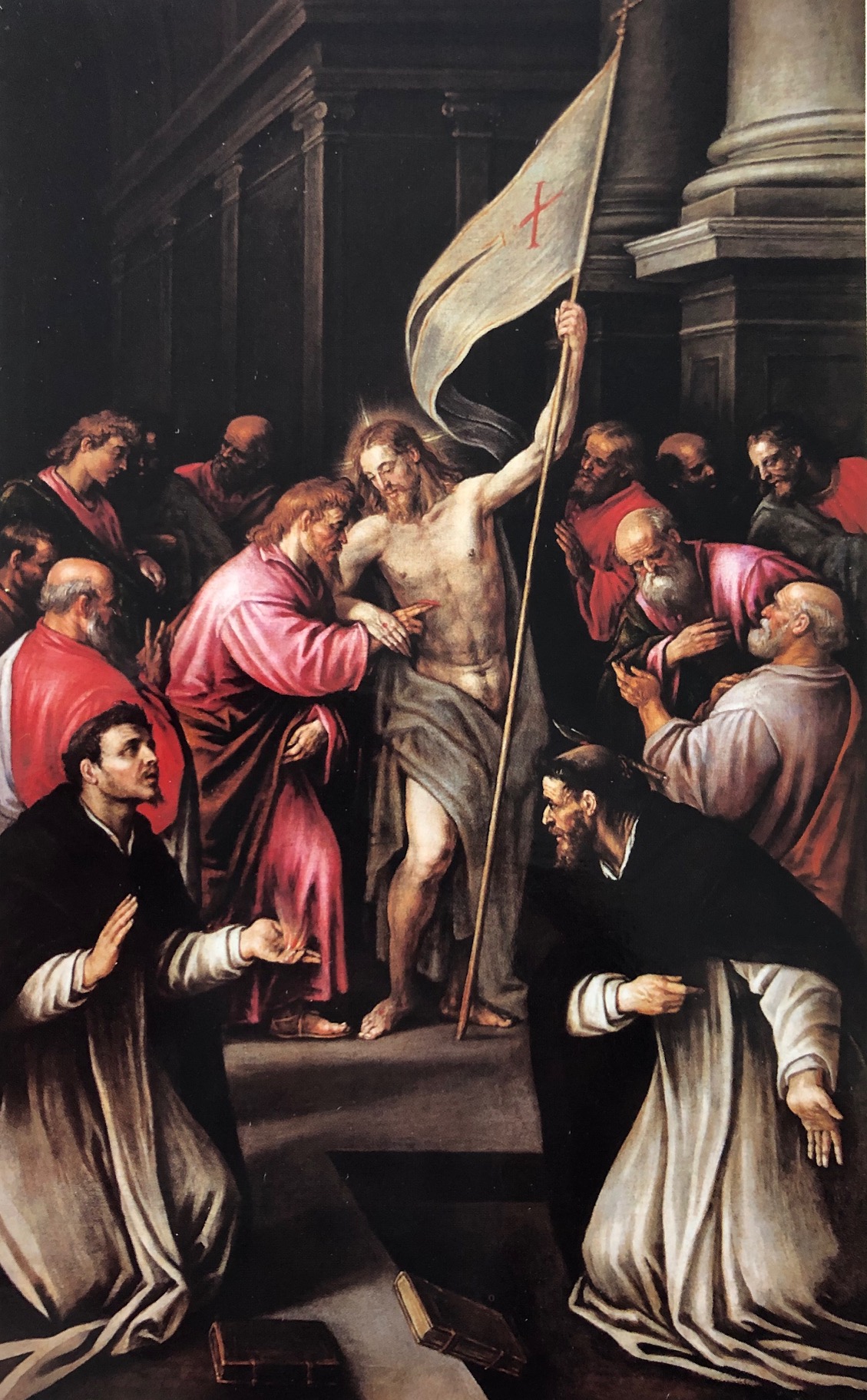
“Here is the Bellini,” he called from the light switch.”You look at this one, then go over to that one”—he pointed further into the nave directing our eyes to the darker painting of Christ with the apostle Thomas by Leandro da Bassano— “and then come back and see this one again. You turn on the light if you need to.”

“We will. Thank you,” I told him.

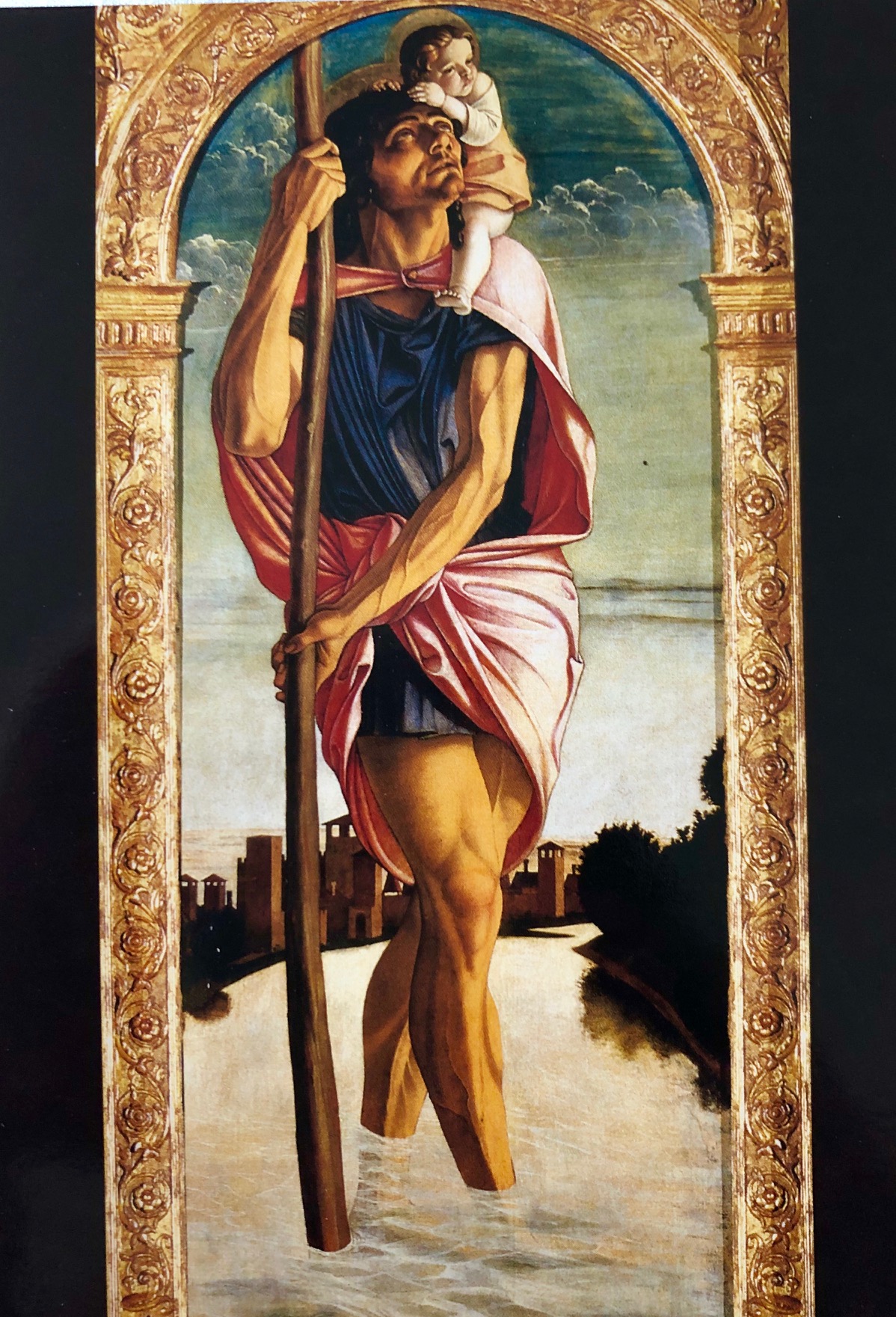
We looked at San Cristoforo and the assemblage of Giovanni Bellini paintings. Each one was large on its own. Framed in gold, the entire altarpiece composition (called the Saint Vincent Ferrer altarpiece, I later learned) spanned nearly nine feet in height.

IMG_9918
San Cristoforo by Giovanni Bellini (1464-1470)

I’m not an art historian, but a little online research revealed these paintings were not made with oils, but tempera paint on wooden panels. This particular one shows the Christ child being carried by Saint Christopher, a 3rd-century church martyr executed by the Roman emperor at the time.  The painting glowed under the light, and reminded me of another glowing Bellini at the Basilica dei Frari. It seems Bellini knew the tempera medium well.

We walked to the other painting we had been permitted to see at no charge.

IMG_9919
L’incredulita di S. Tommasso by Leandro da Bassano | Notice the books falling to the ground along the lower edge… to show the surprise of the onlookers when they realized that they were in the presence of the resurrected Jesus Christ.

This second painting,  L’incredulita di S. Tommasso by Leandro da Bassano was near the front of the church. It was dark and partially obscured by a screen of sorts. It shows Christ showing the doubtful Thomas his crucifixion wounds, proving the resurrection. I later learned that Leandro da Bassano was a famous painter who followed in his artist father’s footsteps and was later knighted by the Doge of Venice. Many of his works are confused with Tintoretto’s and are difficult to date.

We returned to the Bellini and switched on the lights one more time.

“Oh, thank you,” said a tourist staring at the painting who had entered after us.

We decided our visit was over. As we left, my daughter selected another postcard and paid. She offered the guard 5€ to thank him for allowing us in.

“No, no, you keep,” he said. “I just want to show you what you want to see. A postcard isn’t good enough. It’s how I make you… what to say… better tourists,” he said, smiling and shrugging his shoulders. I could tell he meant no offense by his remark.

He continued. “You know… when you’re inside a church here, tell the guard that you want to light a candle and say a prayer and they will let you in.”

Did I hear him correctly? I asked myself.

Still, I’m not Catholic, and using prayer as my ticket inside a church seems disingenuous. However, I did appreciate his candid tip and his enthusiasm for La Serenissima, the traditional name for the Venetian Republic.
We left the church and entered the campo, the large square outside. I knew I wouldn’t forget this brief encounter in a city coming to grips with the effects of mass tourism. Two weeks before, according to the blog La Venessiana, tugboats had allowed an out-of-control cruise ship to strike an occupied river cruise boat instead of Santa Maria della Salute. To compensate for the wear and tear that throngs of summer tourists wreak upon the city, officials are devising new tourism taxes.

In reflection, the guard at Basilica dei Santi Giovanni e Paolo was merely doing his part… politely doing what he could to help visitors he met to “be better tourists” in his city on the sea.

IMG_9718
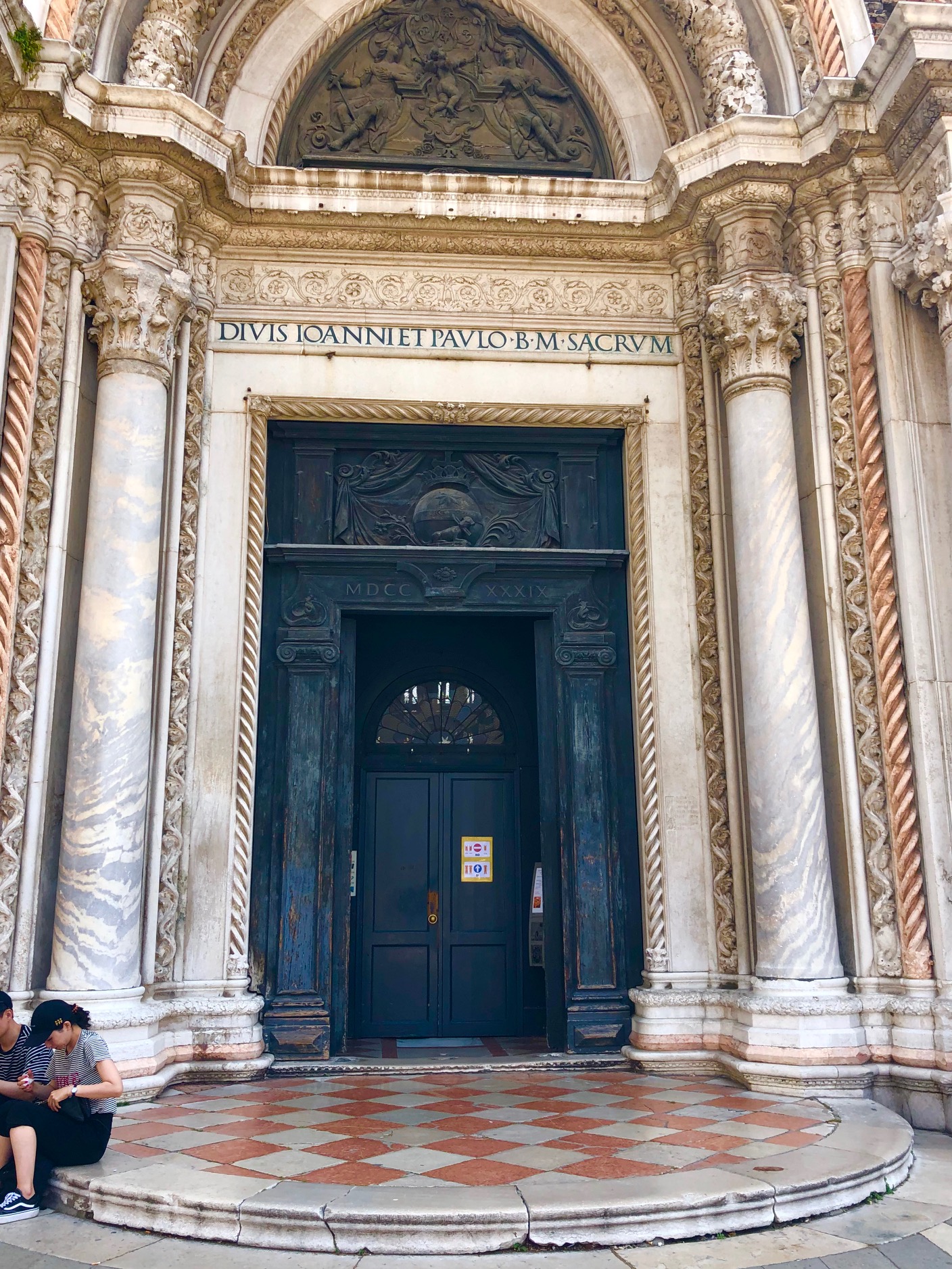
The entrance to Venice’s Basilica dei Santi Giovanni e Paolo | Photo: M. Yung

Featured Image: M. Yung

Categories
Art & Architecture Italy (Venice)

The Venice Biennale 2019

In interesting times, artists create. In uninteresting times, artists still create. Regardless of the global political climate, the Venice Biennale—the Olympics of art where countries each exhibit in their own pavilion or exhibit space—continues. Sure, some countries may decline to participate from year to year or may be late in readying their exhibits (such as tumultuous Venezuela this year); however, for the Biennale… the show must go on.

IMG_9506
A ticket good for entry at the Giardini and Arsenale portions of the Biennale cost 25€. You purchase them at a row of red ticket counters shown at left in this photo.

If you’re unfamiliar with the Venice Biennale, here’s a quick summary from the Biennale website:

The Venice Biennale has been for over 120 years one of the most prestigious cultural institutions in the world. Established in 1895, the Biennale has an attendance today of over 500,000 visitors at the Art Exhibition. The history of the La Biennale di Venezia dates back from 1895, when the first International Art Exhibition was organized. In the 1930s new festivals were born: Music, Cinema, and Theatre (the Venice Film Festival in 1932 was the first film festival in history). In 1980 the first International Architecture Exhibition took place, and in 1999 Dance made its debut at La Biennale.

An over-arching theme characterizes each Biennale. This year’s theme, “May You Live in Interesting Times,” encourages people to avoid the quick judgment, the stereotype, the single-lens viewing of current world events.

IMG_9587
A collection of brochures I collected during our visit. The Biennale brochure reads, “May You Live in Interesting Times.”

According to Biennale President Paolo Baratta, “the expression ‘interesting times’ evokes the idea of challenging or even ‘menacing’ times, but it could also simply be an invitation to always see and consider the course of human events in their complexity, an invitation, thus, that appears to be particularly important in times when, too often, oversimplification seems to prevail, generated by conformism or fear.”

Another way to put it: allow art to show you the many ways of looking at the world.

IMG_9510
Inside the Swiss Pavilion, we watched the video entitled, “Moving Backwards.”

Last Friday (June 14), I visited the Biennale with my daughter, who is an intern in the United States Pavilion. The United States’ participation is primarily a function of the Department of State, which “supports official U.S. participation at select international art exhibitions called biennales. The Department’s support ensures that the excellence, vitality, and diversity of American arts are effectively showcased abroad and provides an opportunity to engage foreign audiences to increase mutual understanding.” In other words, exhibiting at the Biennale is another way to build and maintain positive relationships around the world.

IMG_9525
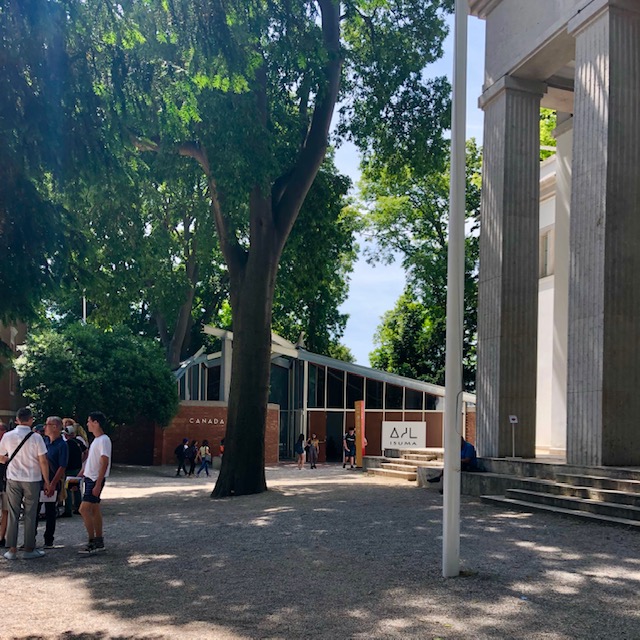
The Canadian Pavilion is shown on the left in photo above. Their media company showcasing inside is called Isuma. The German Pavilion stands on the far right.

As for the U.S. Pavilion’s intern program, the Peggy Guggenheim Collection, a well-known modern art museum in Venice, handles the hiring of the interns who provide guarding of the exhibits, inform visitors about the various works, and generally are the main points-of-contact for visitors touring through the pavilions. (Two years ago, my daughter served an internship at the museum; when they issued a call for former interns interested in returning to work the Biennale, she quickly applied.)

IMG_9526
The German Pavilion exhibit: industrial, cold, and futuristic.

We arrived at the portion of the show held on the ground of Venice’s Giardini (Italian for garden). Visitors can see another section of the show at the adjacent Arsenale. In addition, more pavilions are scattered throughout the city. For example, we walked by the door to the Mongolian exhibit in a dark, narrow street somewhere in the San Marco area of the city.

From the Russian Pavilion. These figures were only one component to the entire Russian offering, which was inspired by Flemish painters.

During our three-hour visit, we saw fourteen exhibits out of the 79 participating in the Biennale this year. That doesn’t sound like that many, does it? Especially when you know there are art lovers who allot several days to see all the exhibits. To them, I say, “Go you!”

However, since I only had four full days in Venice, and one of those was spent in Bologna (see my next post!), we prioritized.

IMG_9527
Waiting in line to the British Pavilion.

Plus, we knew that a visit to the best gelato in town, Suso, was in order for the afternoon. This would require a thirty-minute vaporetto ride down the Grand Canal from the Giardini. Sheesh… the price we pay for good gelato!

IMG_9529
Works by Cathy Wilkes inside the British Pavilion.

Enjoy these photos! I’ve attempted to add some details in the captions and, looking back now, I should have written this post immediately after our visit to better capture the ambiance of our visit. But when one is in one of the most beautiful cities in the world, you want to get out and see it—not stay in and write about it.

IMG_9535
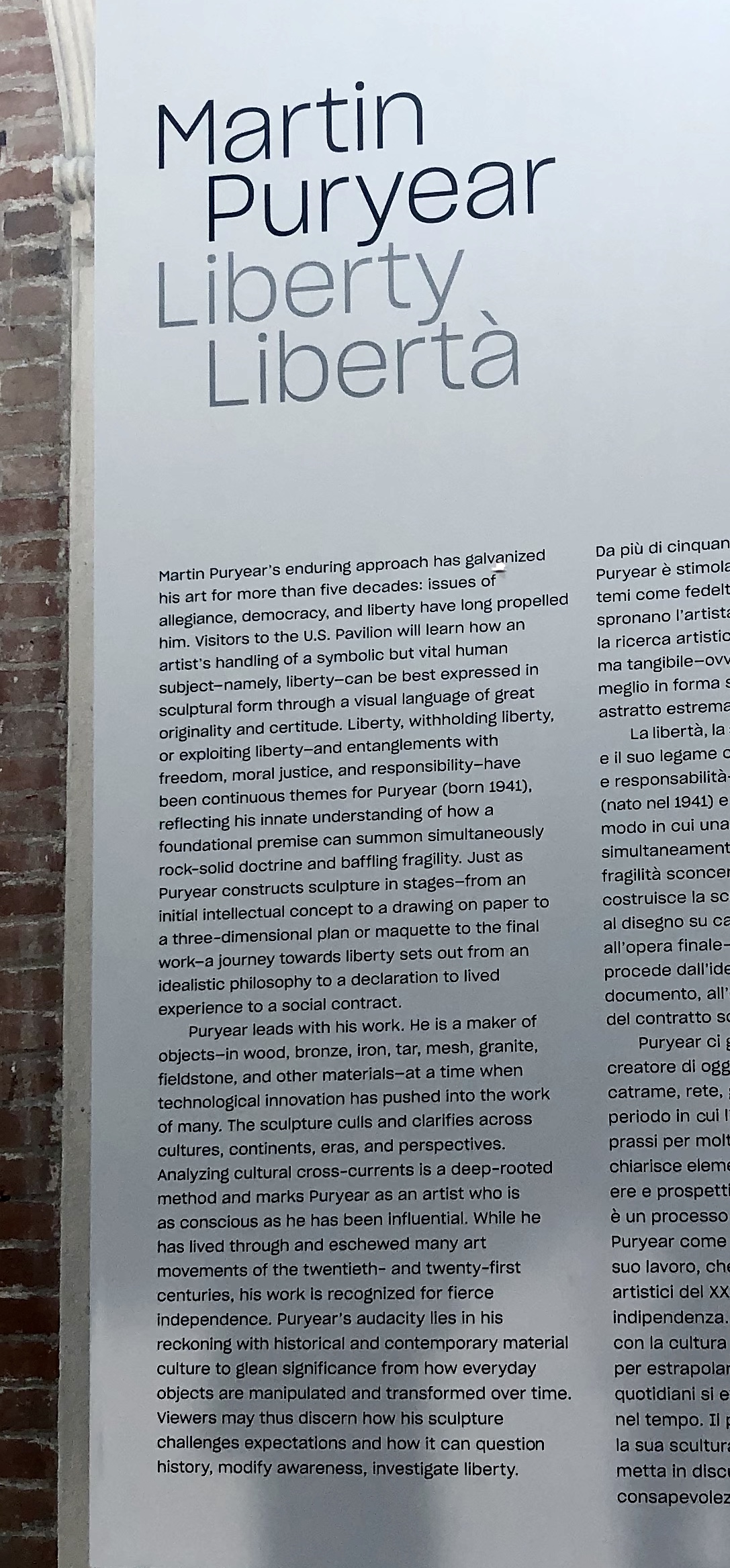
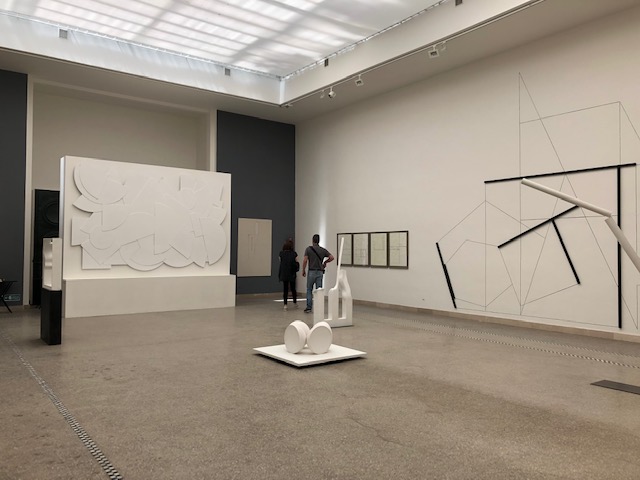
The front of the U.S. Pavilion, which features the work of Martin Puryear.
IMG_9536
And now, the back of the opening piece.
IMG_9551
A red Phrygian cap, also known as a French liberty cap. This is made of wood. My daughter says everyone wants to touch it.

A

IMG_9541
A Confederate Civil War cap. Look in the crosshairs to see yourself.
IMG_9540
IMG_9539
Bronze, but doesn’t look like bronze.
IMG_9537
Detail of the bronze.
IMG_9554
The gallery label for the Martin Puryear exhibition inside the U.S. Pavilion. I do not have photos of every piece in the show. There were several more.
IMG_9564
I figured that if we are visiting Greece this summer, we should probably go see the Greek pavilion.
IMG_9561
Walking on glass cups inside the Greek pavilion.
IMG_9532
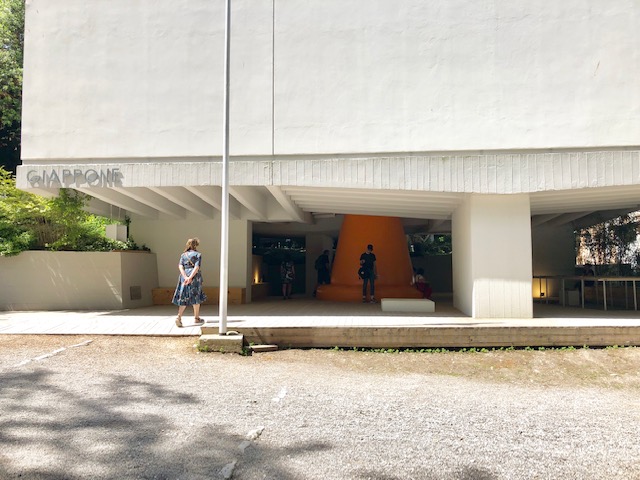
Countries from around the world participate. Here’s the Uruguay Pavilion. Not sure why I don’t have a photo from inside. No offense, Uruguay.
IMG_9531
Work inside the Czechoslovakia Pavilion.
IMG_9534
The Nordic countries participate in one exhibition hall. Every Biennale, one of those nations also has its own additional pavilion. This year, it was Finland’s turn, but I did not take pictures of that show. 
IMG_9533
Inside the Nordic Pavilion.
IMG_9557 (1)
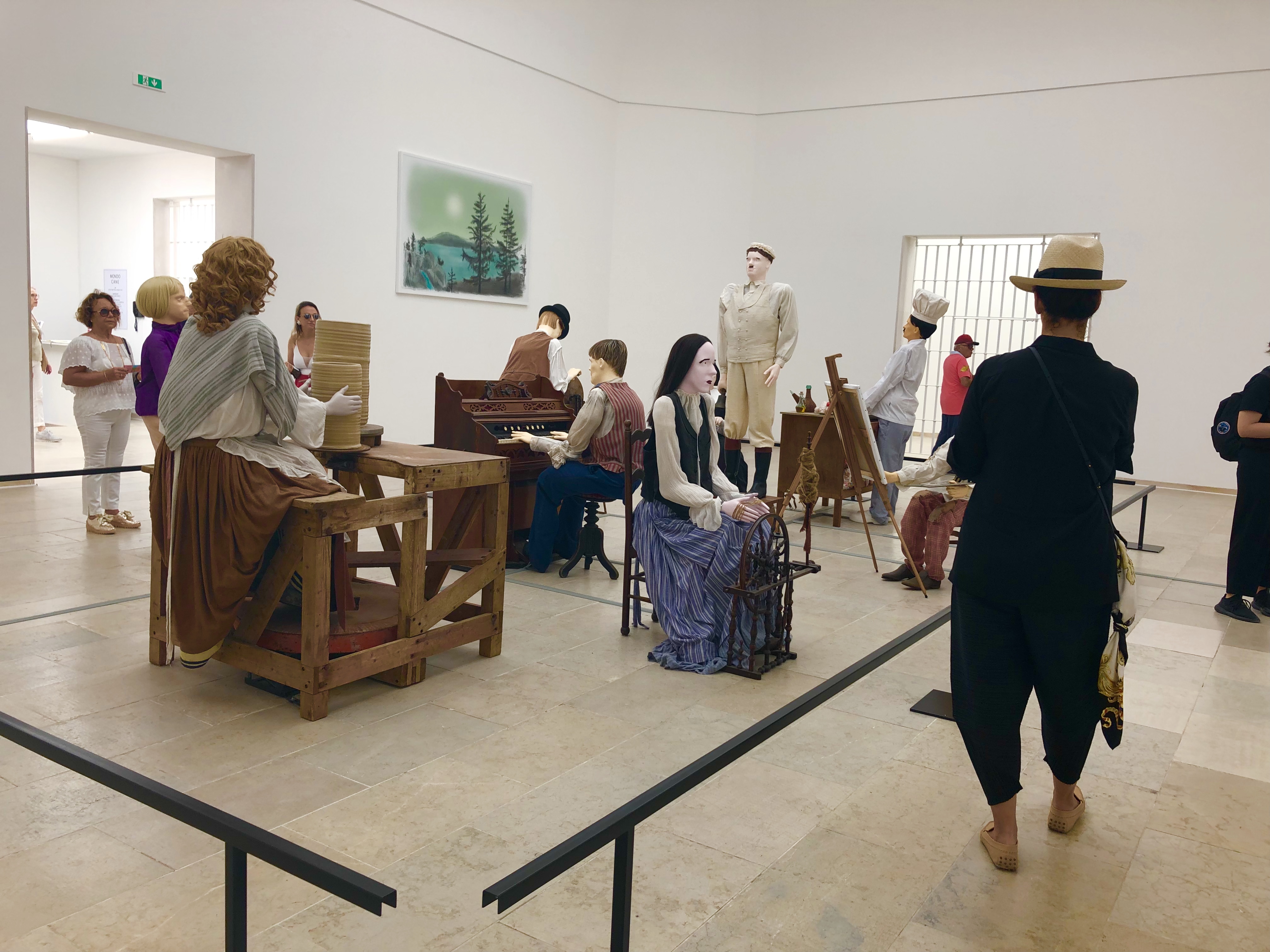
This assemblage inside the Belgium Pavilion was eerily irresistible.
This installation within the Belgium Pavilion was eerily fascinating. Every figure is moving and making something… pottery, bread, cloth, music, a painting. The taskmaster controls it all with the ringing of the bell.
IMG_9555
The Egypt Pavilion
IMG_9521
Japan Pavilion
IMG_9522
A video piece inside the Japan Pavilion.
IMG_9560
We walked over this canal to see the back portion of the Giardini area of the Biennale.

Thanks for reading! As you can see, there is too much to see at the Venice Biennale without spending days there. In addition, to really study the art and understand its motivation and full message deserves much more time than we were able to devote. Still, if you have the desire to see art on a global scale, the Venice Biennale is where you need to go. Click like if you enjoyed this post, and feel free to leave a comment or follow my blog for my next post from Bologna!

Categories
Art & Architecture Greece (Skopelos)

A Visit to Rodios Pottery in Skopelos

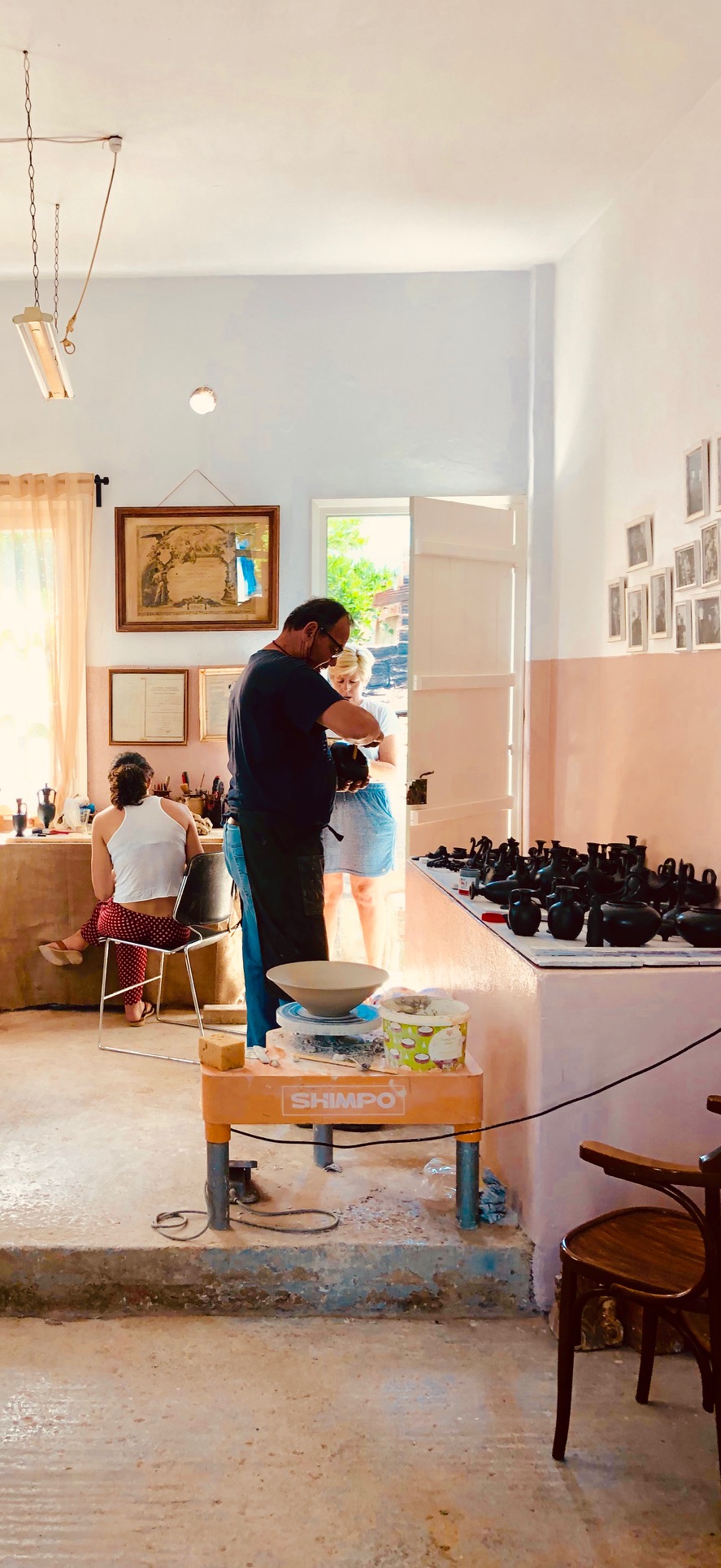
Yes, you can call Nikos Rodios a Greek pottery legend, but you can also call him the juggler of Skopelos. When we arrived at his studio Saturday morning in Skopelos Town, Rodios was waiting for a large bowl to dry on his “extra” potters wheel. (He uses a traditional kickwheel for the majority of his work. ) The bowl was slowly acquiring the malleability needed to remove it from the wheel without collapsing. It wouldn’t be long. The mild Aegean breeze flowing through the open doors of the studio would see to that.

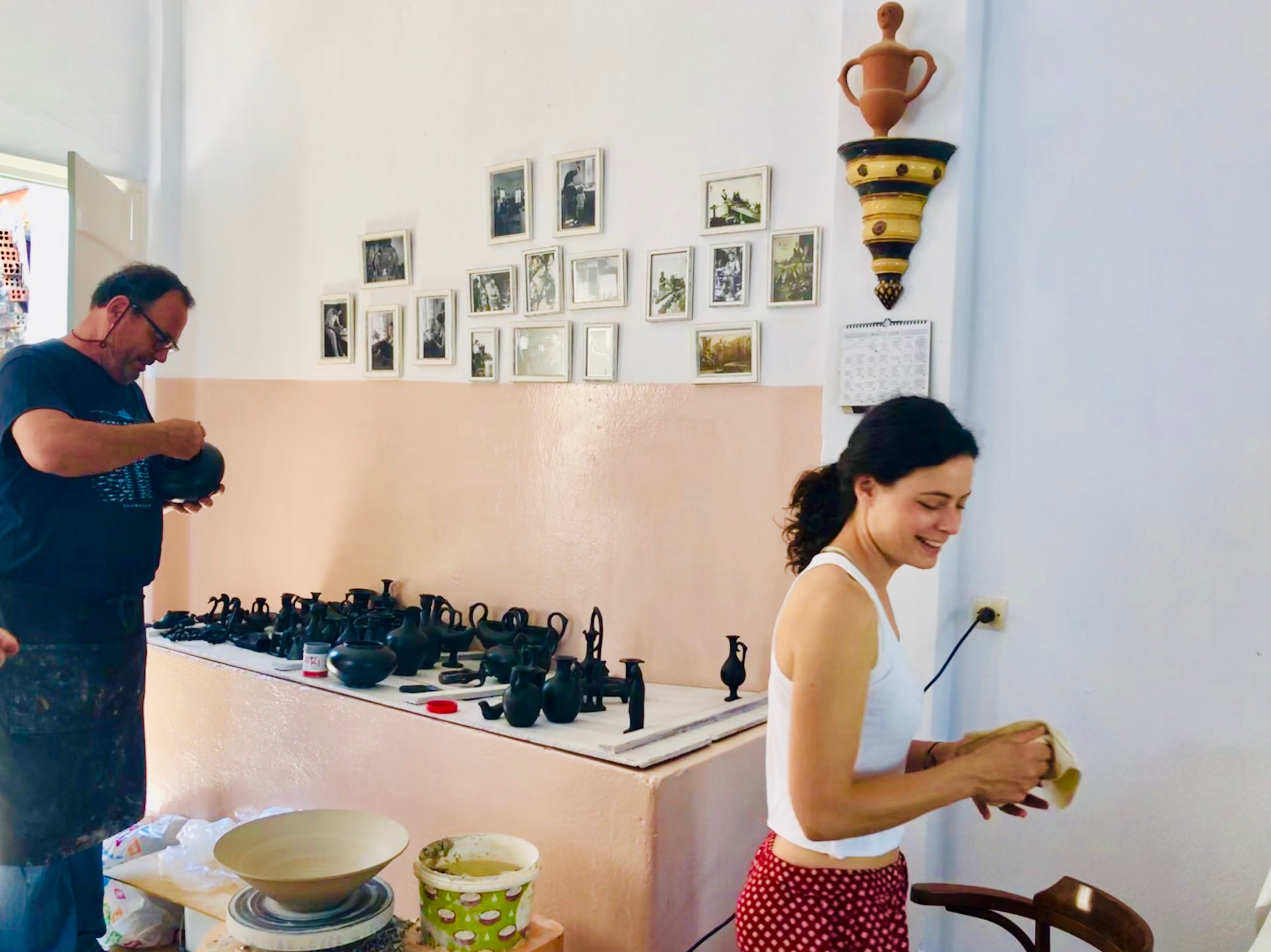
At the same time, Rodios was also polishing and finishing a load of pottery that had been unloaded earlier from his brick kiln (it burns olive tree wood) that stands just outside the door behind his studio. The pieces were arranged on a counter… an assortment of vases, animal figures, and bowls. And then some visitors walked in: us. See what I mean when I use the term juggler?
IMG_9231
Jill Somer, associate director of Skopelos Foundation for the Arts, and Mitch talk with Nikos Rodios about a vase made by his grandfather.

But juggling is the nature of ceramics… it’s a busy, start-and-stop process that requires both flexibility in one’s routine, and a keen eye for scheduling and working a medium that waits for no one and simultaneously takes its own time. The Rodios family knows this routine very well.

Our visit had been arranged by Jill Somer, associate director of the island’s Skopelos Foundation for the Arts, also known as Skopart. Somer interpreted conversations about techniques, clay bodies, and terra sigilattas (slip-like liquids) between Rodios and my husband, Mitch, who is serving an artist’s residency at Skopart.

Rodios and Mitch are each testing the practicability of using terra sigillatas with both Skopart’s red earthenware clay, which Mitch is using during his residency, and Rodios’ proprietary claybody.

IMG_9286
The family has printed this brochure in both Greek and English.

Fans of ceramics in general and contemporary Greek pottery in particular revere Nikos Rodios for carrying on a tradition begun by his grandfather, Nikolaos Rodios. In the early 1900s, Nikolaos focused on producing decorative forms reminiscent of classical Greek pottery.

At the same time, he desired that his work feature a permanent, bold black surface. After experimenting to find the precise combination of clay bodies, colorants, and firing temperatures—potters are chemists in disguise, if you didn’t know—Nikolaos was awarded a patent for his technique in 1930. You can view the patent certificate, assigned the number 2981, on display in the workshop.

IMG_9234 (1)
Rodios inspects some pieces from his most recent firing. On the wall near the door, you can see the patent certificate awarded to Nikolaos Rodios in 1930.

As the years continued, Nikolaos passed the family secret to his son, who in turn passed it down to today’s Nikos Rodios.
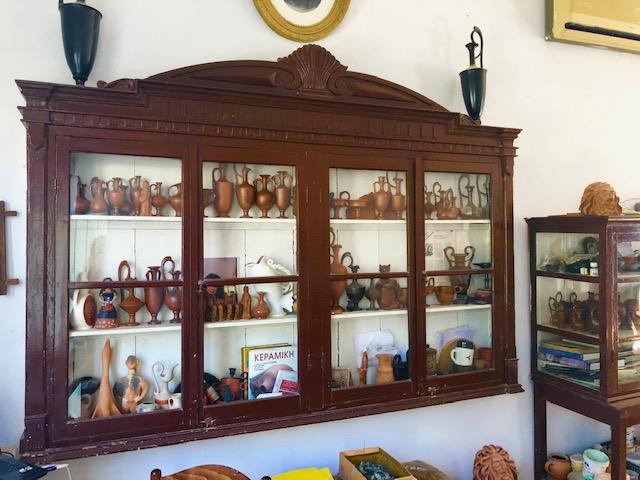
After we spent a short while admiring Rodios’ newly fired pottery, he led us to a large wooden display case hanging on another wall.

IMG_9233
This case contains pottery made by Nikos Rodios’ grandfather and father.

It contains a diverse collection of pottery made by the previous two generations of Rodios. Vases of all heights are on display. Some are short and bulbous, others are elongated and elegant. Each alludes to classical Greek forms.

It’s humbling to witness the current members of a family respect the hard work and innovation accomplished by their ancestors. It’s also gratifying to know that the next generation, Nikos’ daughter Magda, is building on the legacy left to her.

IMG_9235
Magda spends time in the studio alongside her father, Nikos.

At a workbench near the sunny back window, Magda helped her father polish some of the items from the kiln.  She adds her own creative flair to the family business with bright, colorful earthenware mugs, serving pieces, jewelry, and decor items.

IMG_9236
Mitch shares images from his Instagram accouint with Maria, Rodios’ wife.

After greetings us, Magda took a break from her work to retrieve a plastic water bottle that she had filled recently with a mixture of water and a local black clay. She explained that she hopes the mixture will someday soon yield an interesting clay. She brushed a bit of it onto a pottery shard. The watery part of the mixture instantly soaked into the shard and left a gritty residue on the surface.

Who knows? With time and attention, the sludgy, gritty solution may indeed transform itself into a native Skopelos clay.

IMG_9237
Art enthusiasts will find their own Rodios creation in the gallery.

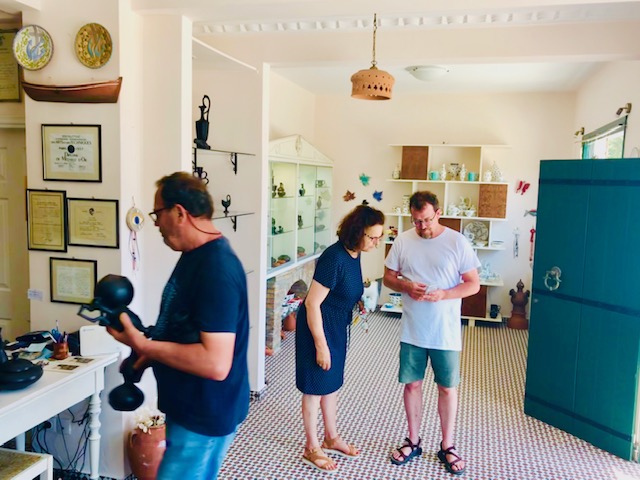
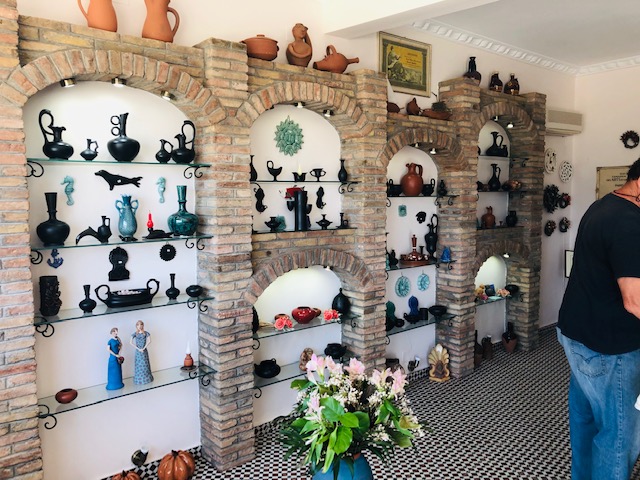
We then walked across the street to the pottery shop that bears the Rodios name. The shop carries a wide variety of both decorative and functional ware, from wall hangings to coffee mugs and jewelry.

Inside, Maria, Rodios’ wife greeted us and spoke briefly with her husband about the wares he had carried over from his studio. He added a few pieces to the stone-and-glass shelving units, and agreed to motor over to Skopart in a few days for a quick visit with Jill and the artists working there (students from Gulf Coast State College, painter Victoria Phillips from Macon, Georgia, and Mitch).

Then he said his goodbyes and sauntered back to his studio across the street. He had some more juggling to do.

IMG_9238
The Greek letters spell out “Rodios Pottery” on the front of the family-run gallery.

Thanks for reading! Click “like” if you found this interesting and click “follow” for daily posts from our “workation” in Greece. After the residency concludes, we’ll be continuing our visit on the mainland and south to Crete (we think).