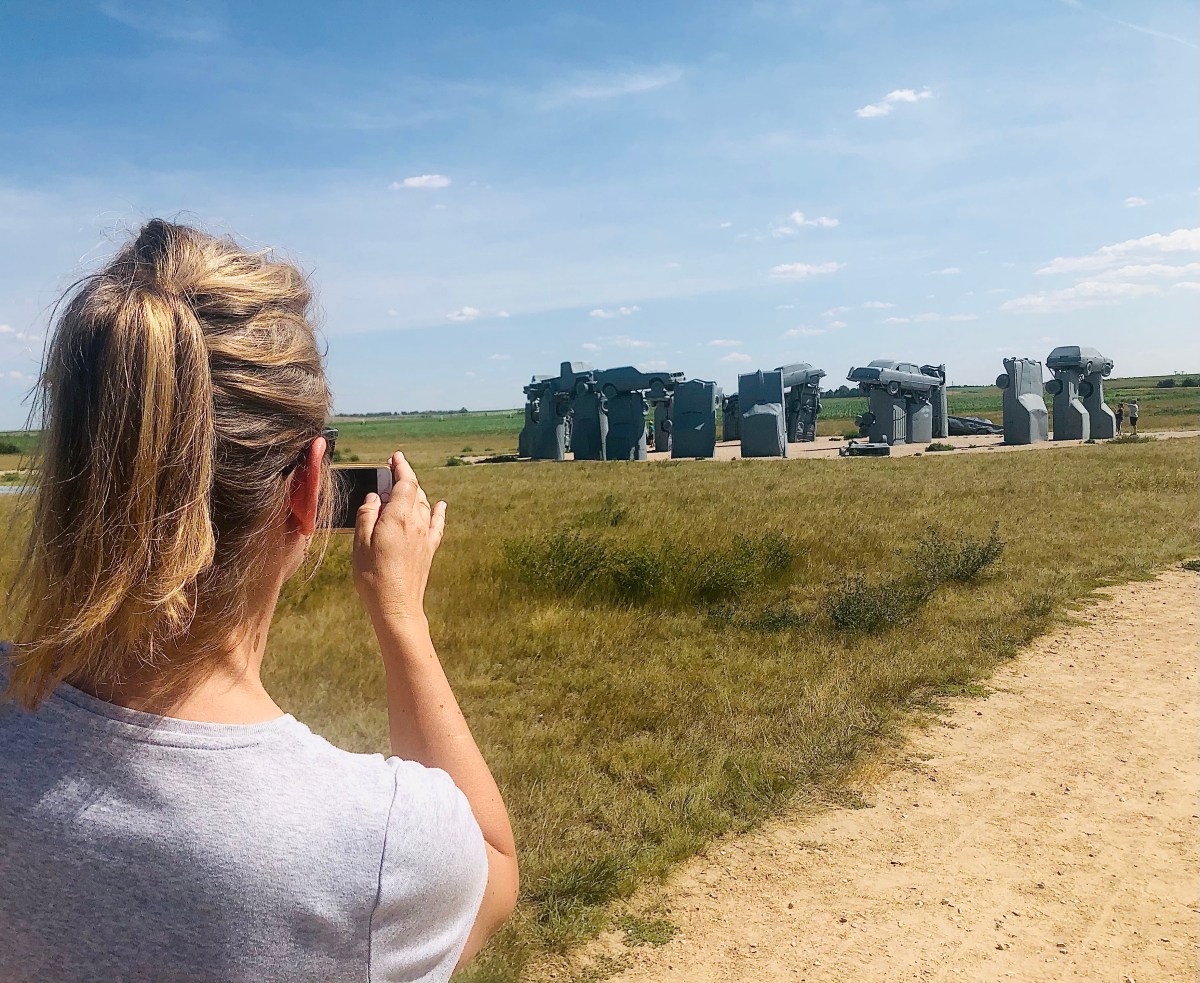
Last week, my husband and I took a three-day trip to Mount Rushmore from southwest Missouri. On the way to and from, we ventured off the beaten path to see some less-visited sites. One of those was Carhenge.
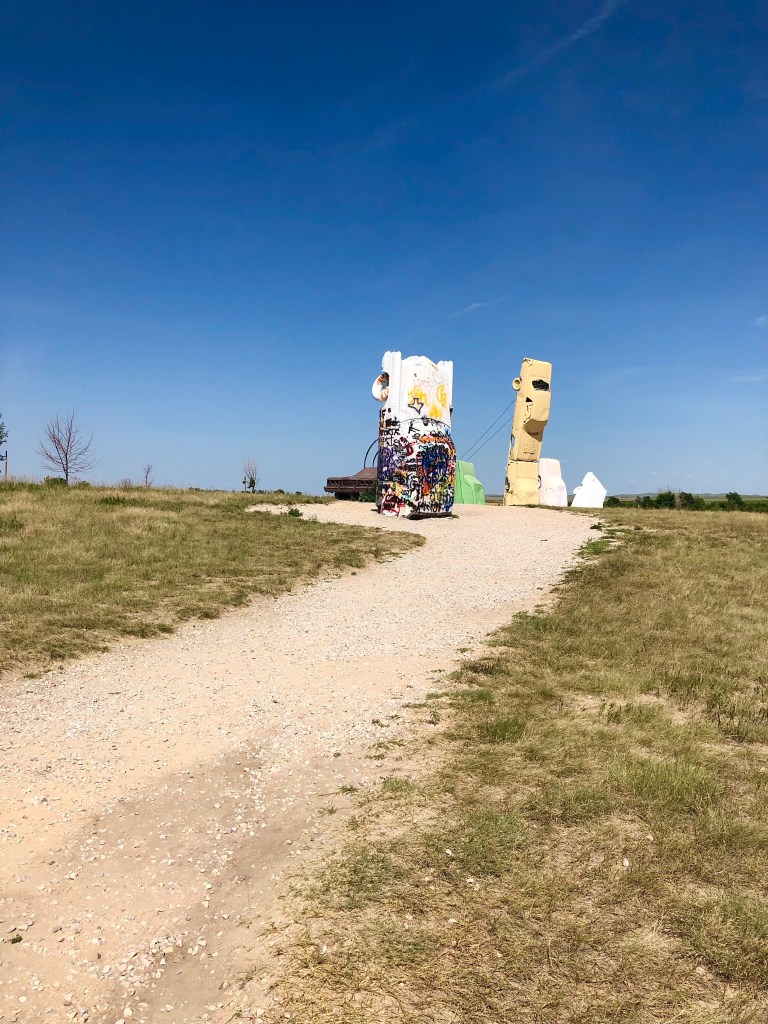
Can you guess what it is? Yep, you’re right. It’s a Stonehenge made of cars.
At left, the UNESCO World Heritage Site of Stonehenge in England and at right, Carhenge in Alliance, Nebraska.
And believe it or not, it’s been on the back-burner of our mental bucket list of places to see for several years now. So you can imagine our delight last Thursday when we learned (thanks to Google Maps) that we would be within a few miles of Carhenge when we passed through Alliance, Nebraska (pop. 8,500) later that afternoon.
Another shot
I first heard of Carhenge right around the time I graduated from the University of Kansas in 1988. The project’s completion in 1987 made the news back then in the Midwest for a little while. Then gradually, the news died down, and it became another one of those odd-ball sights the Great Plains is known for.
Let’s get to it. Here’s a quick video of me simply rotating the camera around the central site:
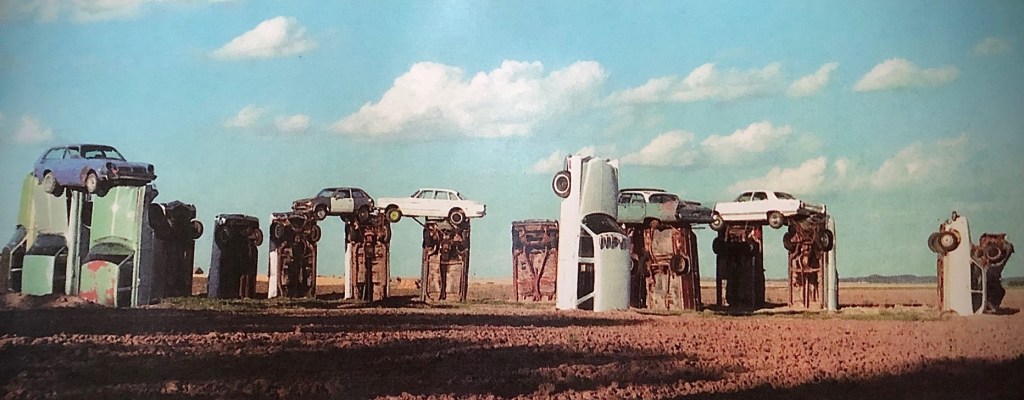
The cars were at one time left in their original paint colors. But I would imagine that over time, the paint began to wear and/or the metal finishes began to rust, so a “Stonehenge gray” color was eventually applied to all. Works for me.
Here’s a photo of the site before the cars were painted gray.
You can buy this postcard in a very sparse information center/gift shop for 79 cents. That’s cool.
Some of the pits that hold the upright cars are five feet deep.
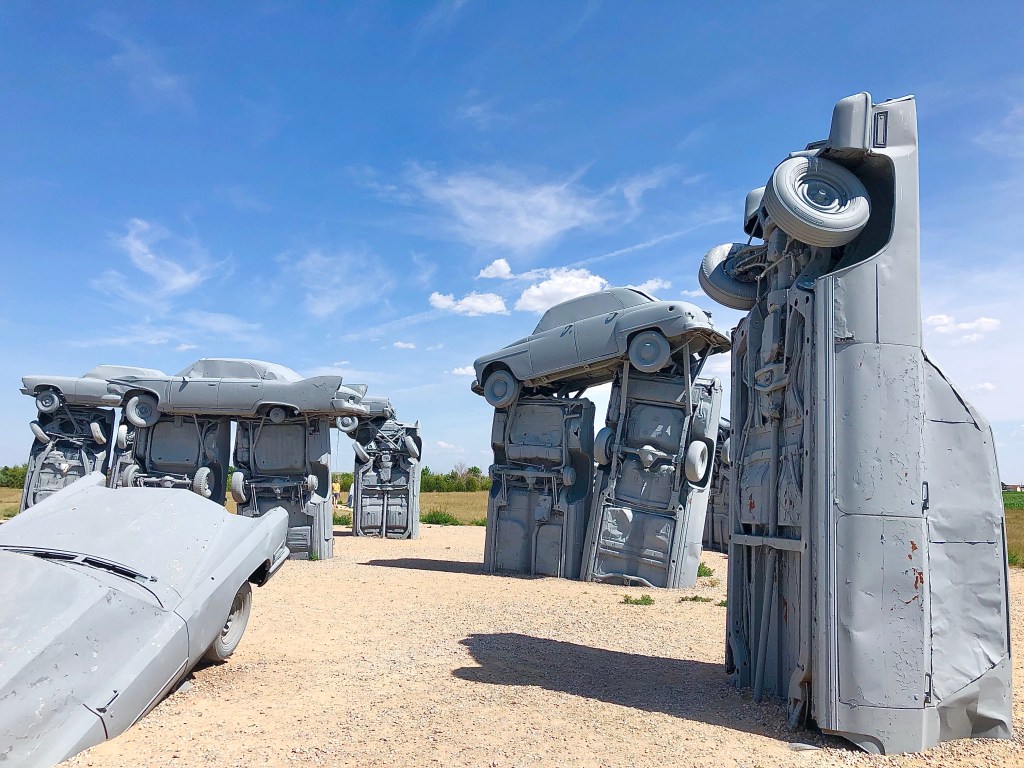
The cars that form the arches are welded to form a complete structure.
Reinders built Carhenge as a memorial to his father and while living in England studied Stonehenge to learn its size and proportions.
During the solar eclipse of August 2017, the path of totality (the path that would experience a total eclipse) passed right over Carhenge. Four thousand people, including the governor, viewed the eclipse from the site.
Another shotTrucks were also used to form the monumental sculpture.Needless to say, Carhenge is an unusual experience.
The information sign below tells about the main Carhenge circle and some outlying sculptures made of found objects, farm implements, and auto parts.
The sign
Sign here, please.
While you can walk right up to the main sculpture, don’t write anything on the cars. If you feel the need to leave your mark, do it on this white car placed here specifically for that purpose.
Sign here, please. To the right of the autograph car is an assemblage also made by Jim Reinders called “The Fourd Seasons,” inspired by Vivaldi’s Four Seasons. The sculpture includes all Ford automobiles and represents the four seasons of Nebraska.
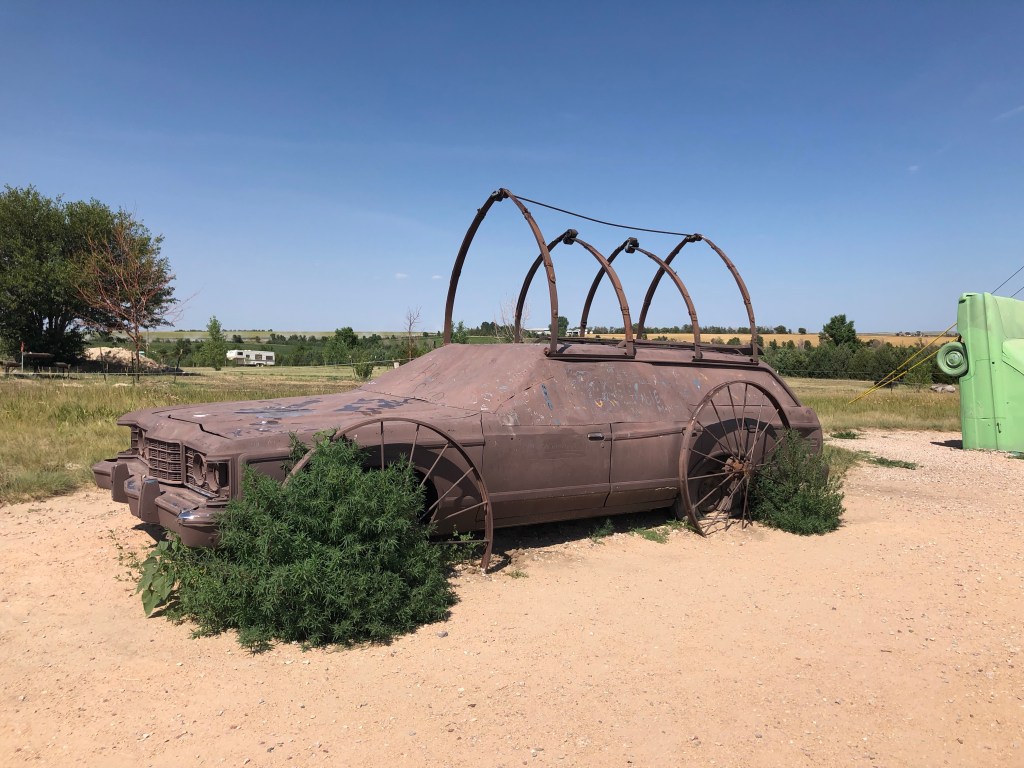
Here’s another example of some of the outlying pieces around Carhenge. This is called Carnestoga after the old Conestoga wagons that at one time were the High Plains vehicle of choice.
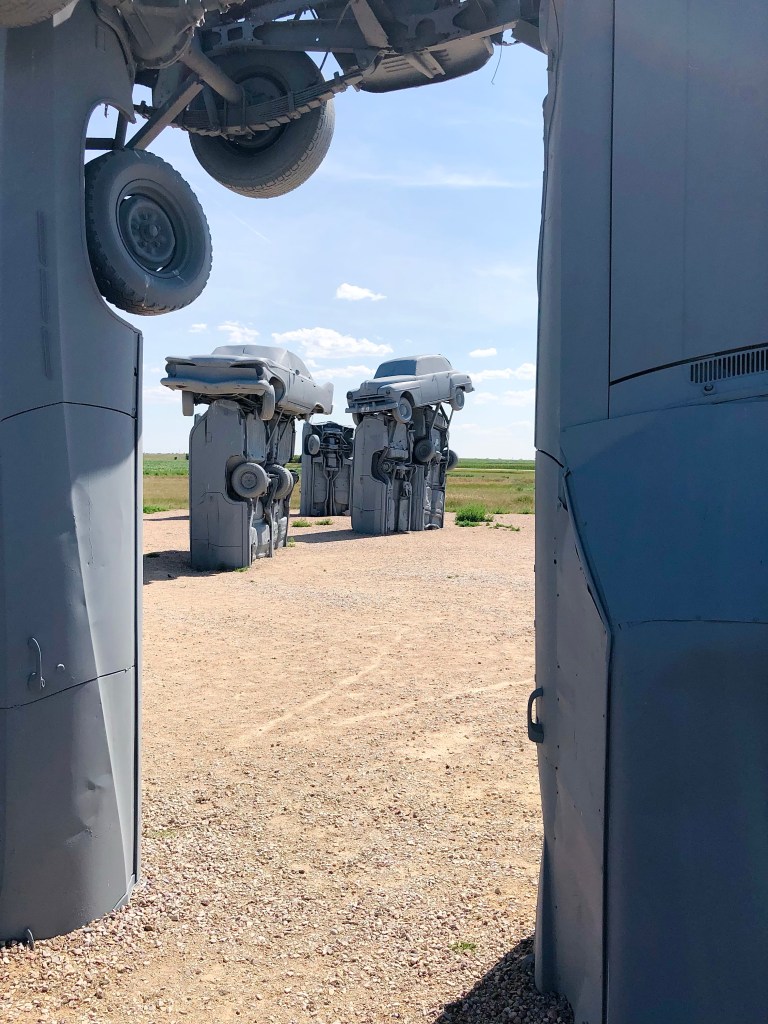
CarnestogaHere’s one final shot as we left Carhenge.
Don’t forget to visit the small information center/gift shop at the site to drop in a donation and buy a souvenir. They have t-shirts, postcards, key rings, cold drinks, and a few snacks et al to make your Carhenge visit complete.
The bucket list
I can now cross Carhenge off my bucket list. If Carhenge isn’t on your bucket list, add it pronto. And then get thee to Alliance, Nebraska to see this funky testament to creativity and cars.
On our way to Mount Rushmore, we also took a quick two-hour tour of De Smet, South Dakota to see the Laura Ingalls Wilder Historic Homes. I’ll do a short post about that soon. Thanks for reading!
While you’re here, check out another post that celebrates the culture and art of the Midwest.
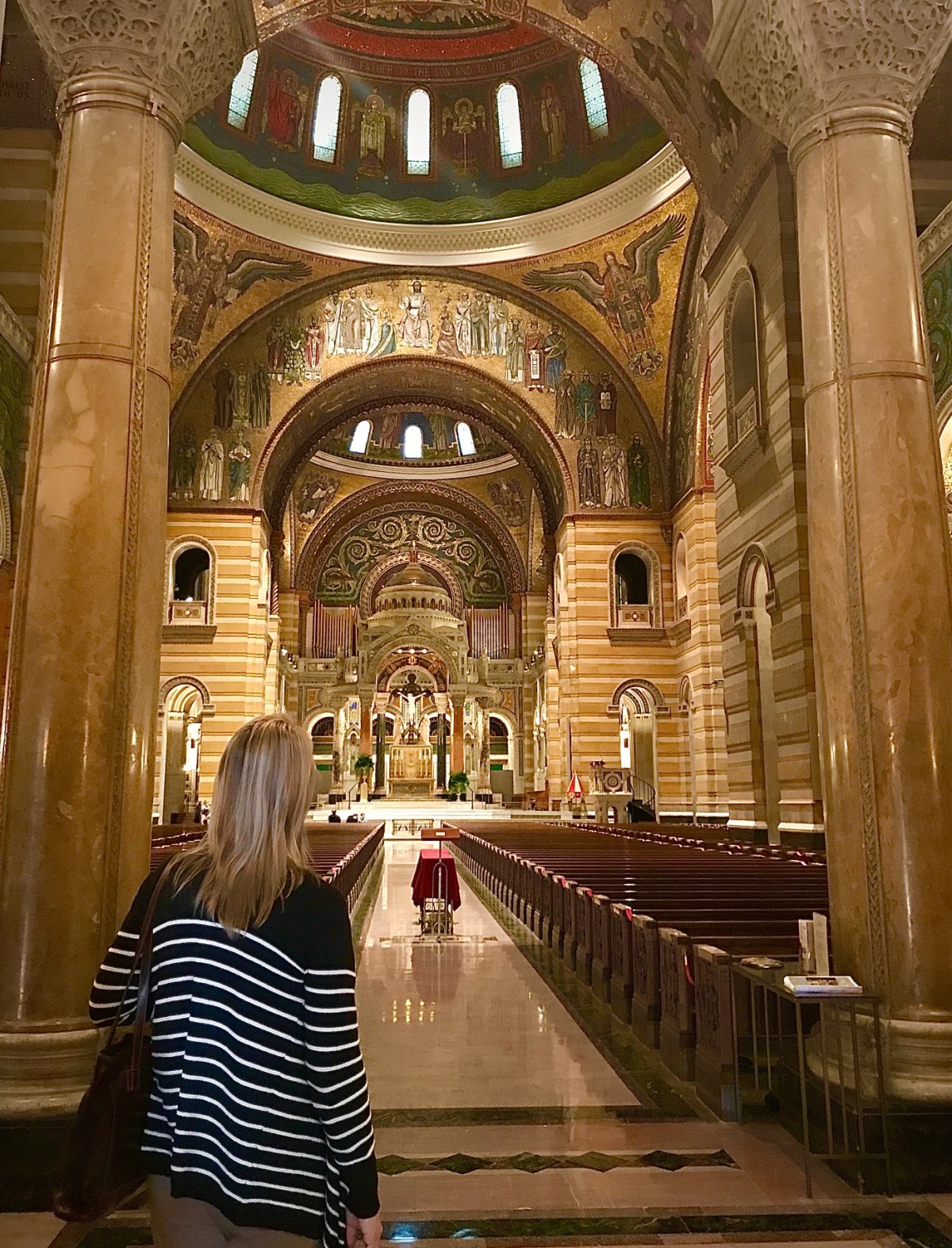
In March, I had the opportunity to visit The Cathedral Basilica of St. Louis, Missouri. Named for the city’s patron, Saint Louis IX of France, the structure, according to a tourist guide, “combines architecture of Romanesque style on the exterior with a wondrous Byzantine style interior.”
In other words, WOW.
Yes, I could bore you with a long list of overused adjectives that can’t possibly describe the grandeur of this unexpected delight. Instead, I’ll just get down to brass tacks and provide you with some details so you can surmise for yourself that Cathedral Basilica of St. Louis, located in a bustling urban setting at 4431 Lindell Boulevard, is probably one of the Midwest’s best kept historical architectural secrets.
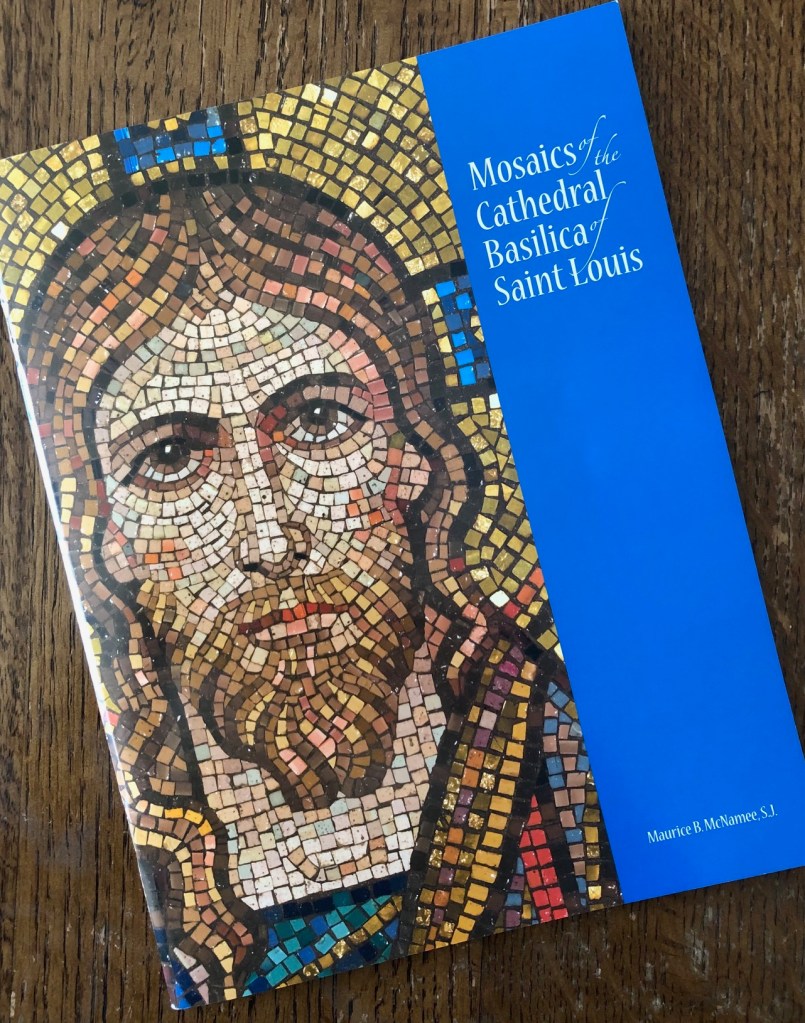
Our tour guide provided a very informative half-hour private tour. Between his knowledge and information gleaned from the beautiful guidebooks shown above, we learned that…
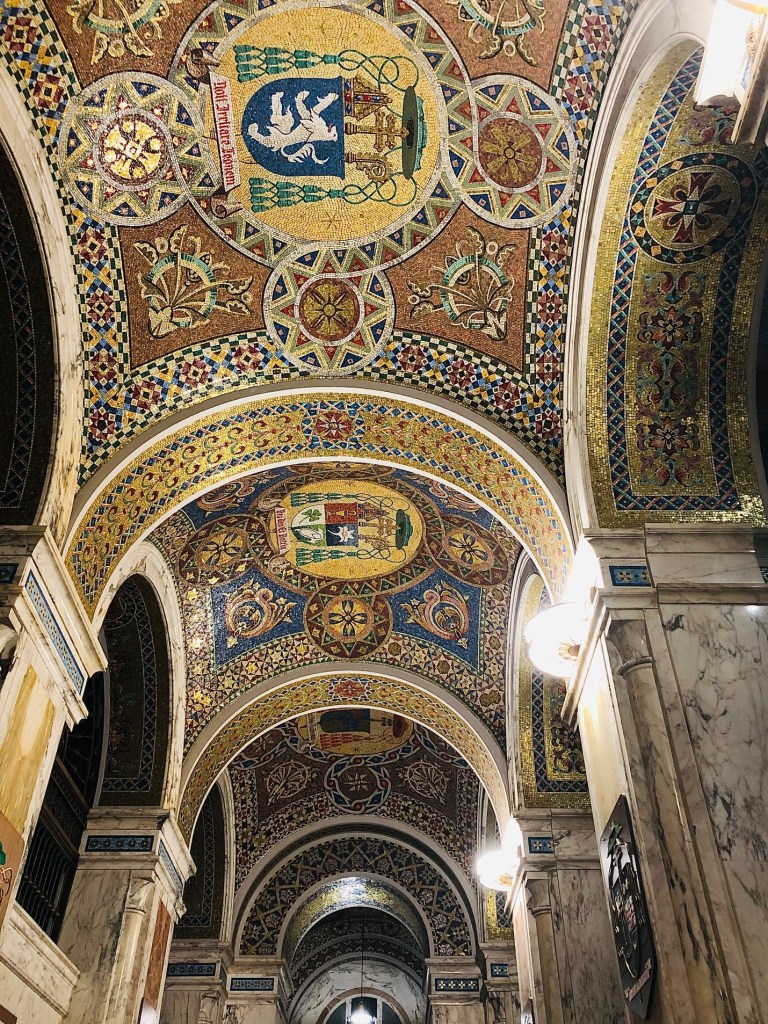
The mosaics that adorn the cathedral were designed, produced, and installed from 1912-1988.
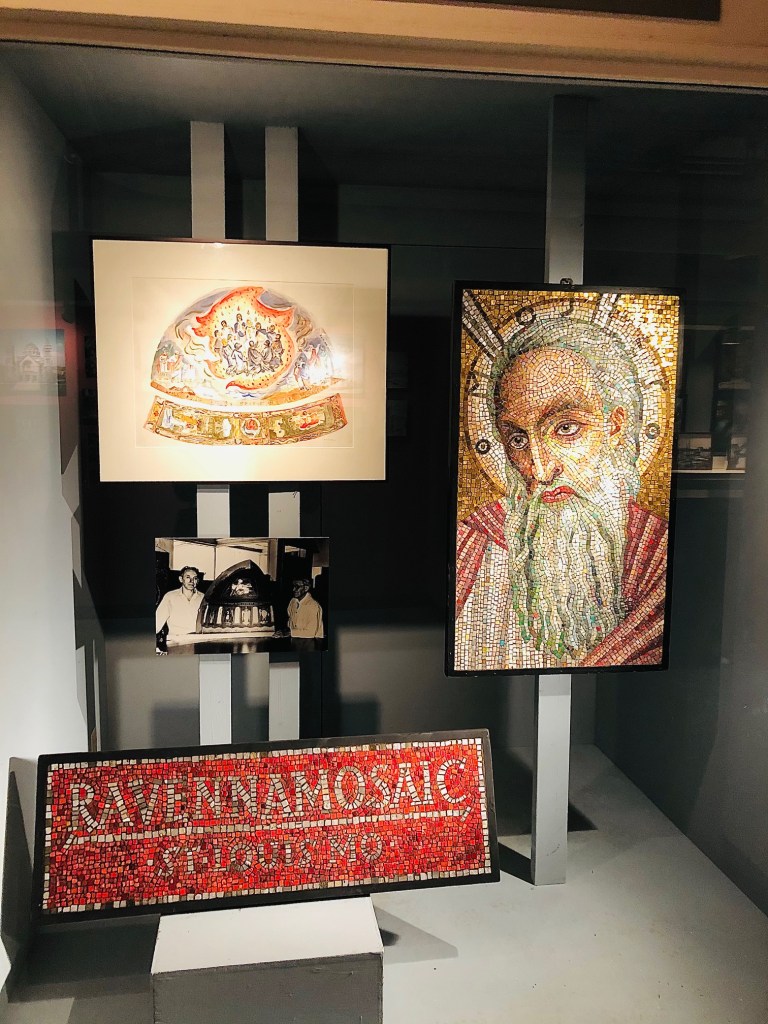
The mosaics were made by the Ravenna Mosaic Co. of St. Louis, a company founded by German father-and-son team Paul and Arno Heuduck primarily to create the Byzantine mosaics for the cathedral.
The cathedral, according to my guidebook published by the Friends of the Cathedral Basilica of Saint Louis, “combines the best of Byzantine, the style of the eastern half of the Roman Empire in the early Christian centuries, and of Romanesque — a combination used, among others, by the architects of the Basilica of Saint Mark Cathedral Church of Venice.”
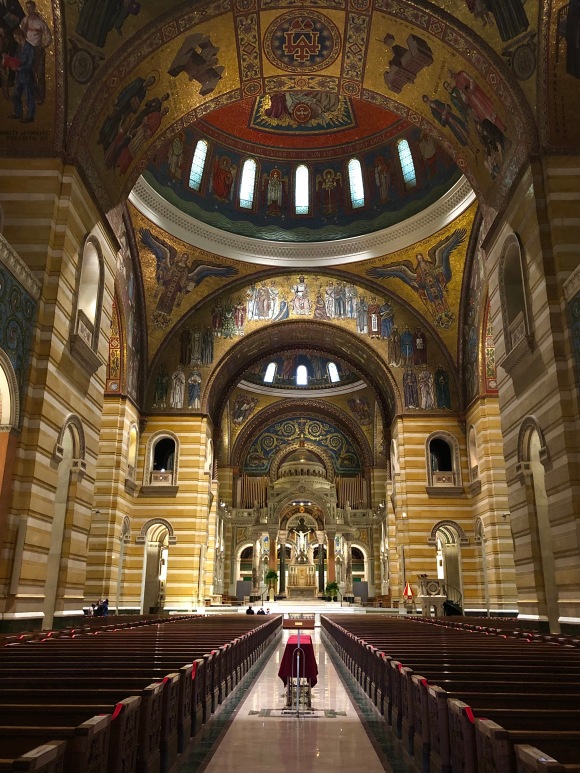
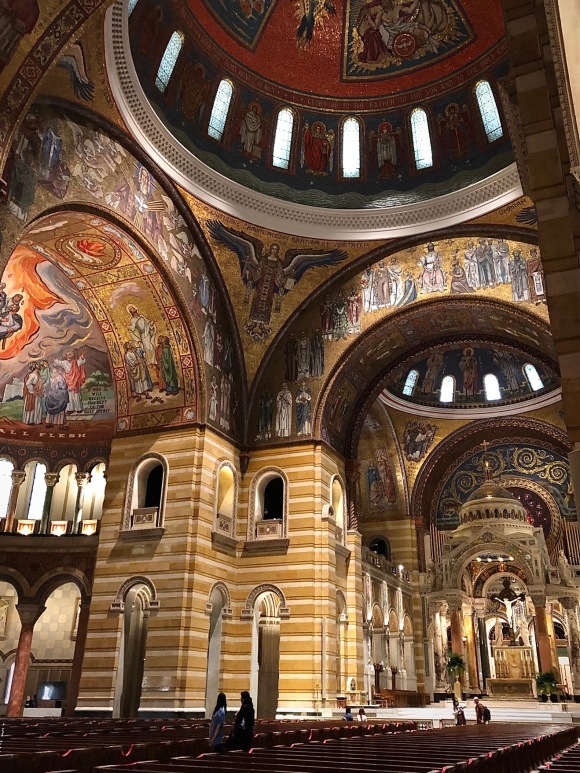
The central dome soars 217 feet.
The dazzling mosaics are unmatched in the Western hemisphere and this one structure contains one of the largest collections in the world.
In 1997, Pope John Paul II designated the Cathedral of St. Louis as a Basilica in order to recognize its beauty and significance; since then, the structure has been known as The Cathedral Basilica of St. Louis. In 1999, Pope John Paul II presided over an evening prayer service at the basilica to conclude his trip to North America.
A view of the Central Dome
The central dome features brilliant red tesserae.
About those mosaics
41.5 million pieces of glass were used to decorate the hundreds of mosaic artworks that cover nearly every interior surface within the basilica.
Seven thousand different colors of tesserae were used.
Thirty-eight different shades of gold mosaic were used.
There are 83,000 square feet of mosaics within the structure.
Twenty-five miles of scaffolding were erected to complete the mosaics.
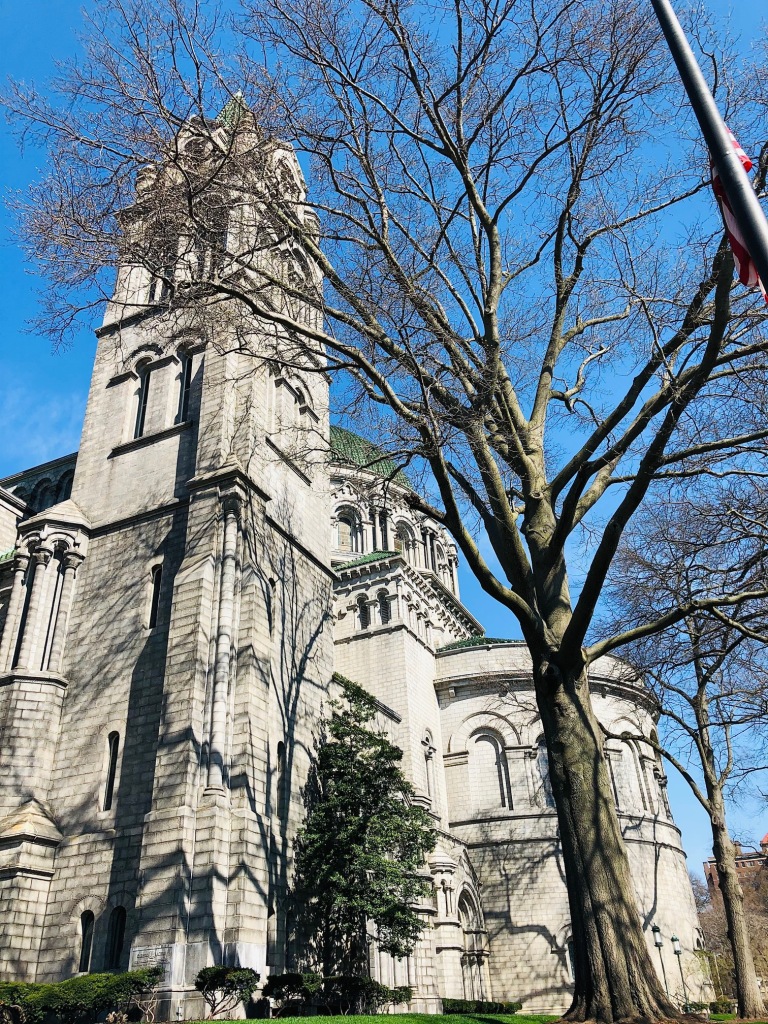
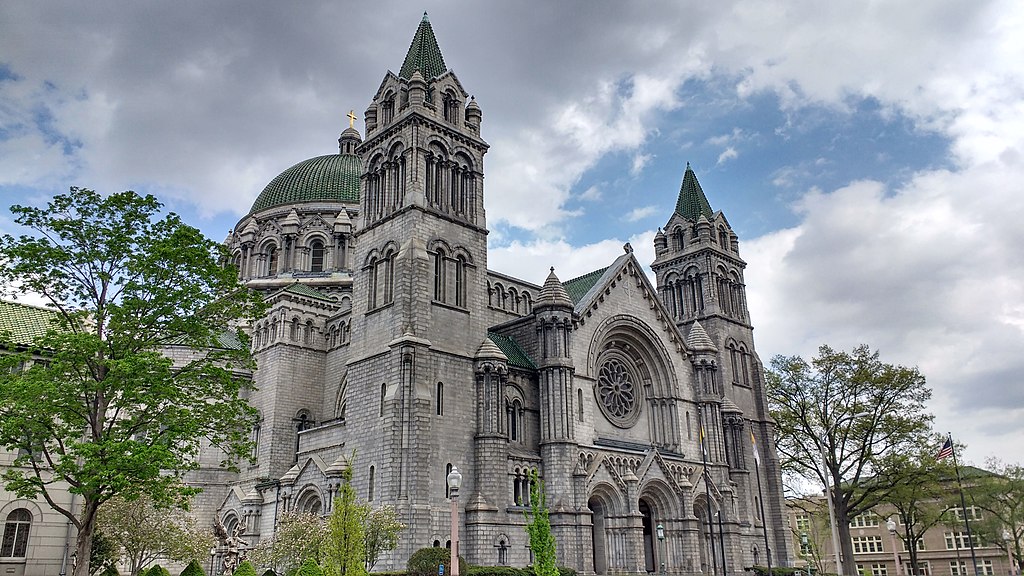
The exterior of the building was simply too massive to photograph on my iPhone. Here’s a better shot courtesy of <a href=”http://A.reyestena, CC BY-SA 4.0 Wikimedia Commons:
When we visited, the trees were still bare. This photo from Wikimedia Commons shows how the green of the trees picks up the green of the dome’s tile roof.
And now for the Narthex
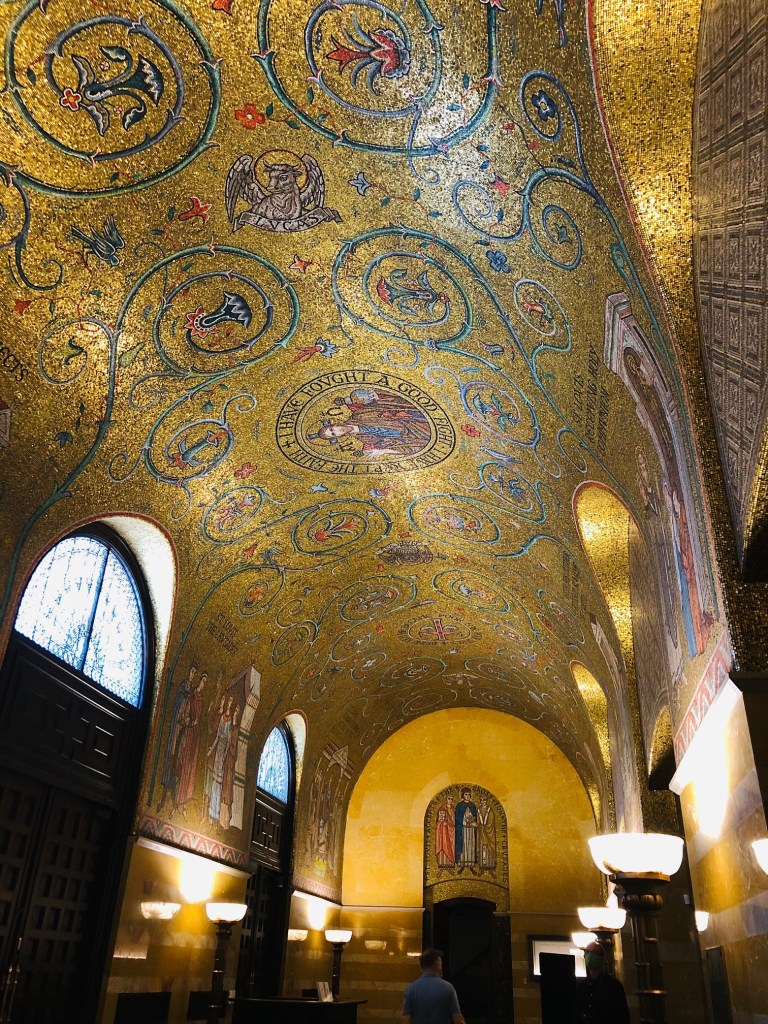
The narthex, similar to an entry hall for gathering together before or after a service, features a barrel-vaulted ceiling and dazzling gold mosaics.
A view toward The Historic Bay and Dome
The historic dome features blue tesserae. The mosaics in this dome and bay feature the history of the Archdiocese of St. Louis, including important milestones of the establishment of the Catholic Church in St. Louis, and works of charity and services performed by area Catholic groups, such as parochial schools and Jesuit missionaries.
The Sanctuary Dome and Baldochino
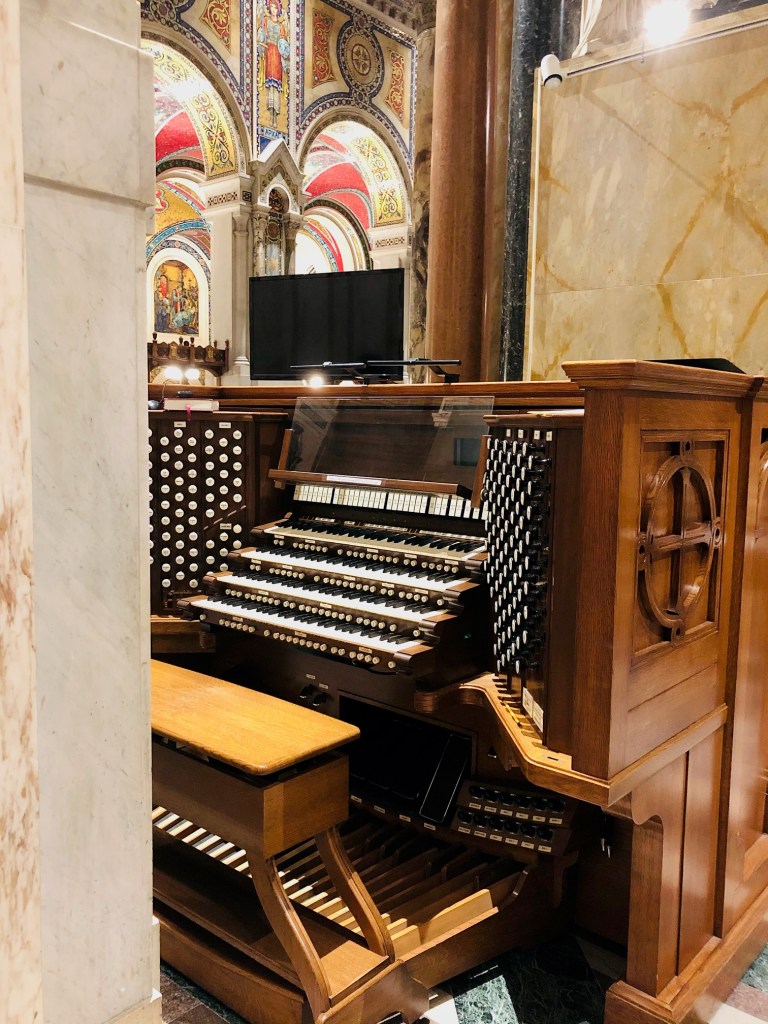
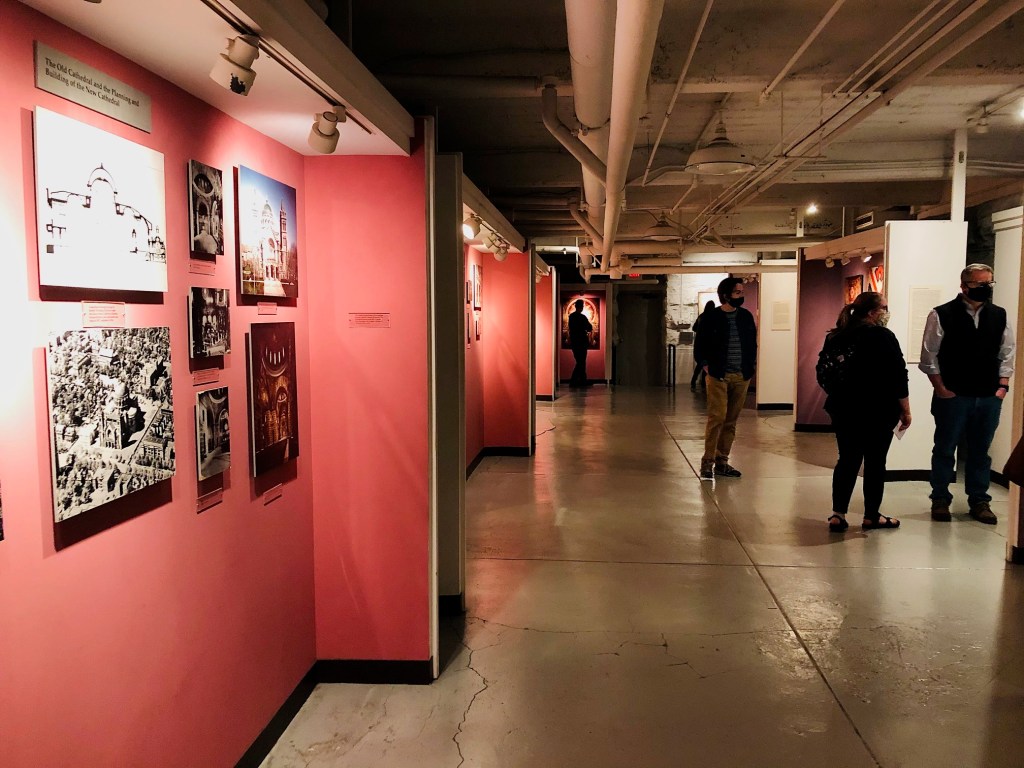
The baldochino, shown at left above, hovers over the main altar.A detail from a hallway near The Blessed Virgin’s ChapelThe West TranseptThe organ near The Bishops HallThe Mosaics Museum is downstairs below the narthex.Sample works from Ravenna Mosaic Co., St. Louis
More sights within
The Bishops Hall
Our visit lasted about an hour and a half. Due to our schedule, we didn’t have enough time to tour the Mosaic Museum located below the narthex. I did snap a few photos (see above).
The cathedral is located at 4431 Lindell Boulevard, St. Louis, Missouri 63108.
The cathedral’s visiting hours are 7 a.m. to 5 p.m. daily. The Mosaic Museum’s hours are 10 a.m. to 4 p.m. daily.
Tours can be arranged for any size group. Tours are given Sundays at 1 p.m. and anytime Monday through Friday from 10 a.m. to 3 p.m.
After our tour concluded, I snapped this quick picture of my daughter and son (center) walking with their significant others.
If you’re ever in the area, definitely carve out an hour or so to see this marvel for yourself. It’s an awe-inspiring place of worship that’s worthy of your time when visiting St. Louis.
Got a thing for cathedrals?
Here’s a post from northern Italy about another one.
Thanks for reading! Click like, become a follower, and leave a comment.
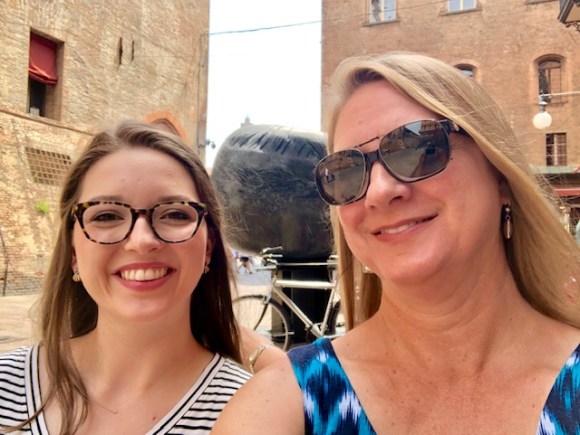
This is a photo of my daughter and I in Bologna, Italy in 2019. Now that school’s out for the summer (and all the pandemic travel restrictions are lifting–YAY!), I can get back to posting more regularly on this blog. Jump over to my teaching blog to read about my extremely full and rewarding teaching life.
On my second trip, I took a bus from Marco Polo to the bustling Piazzale Roma where I met my daughter who was there serving an internship at the 2019 Venice Biennale.
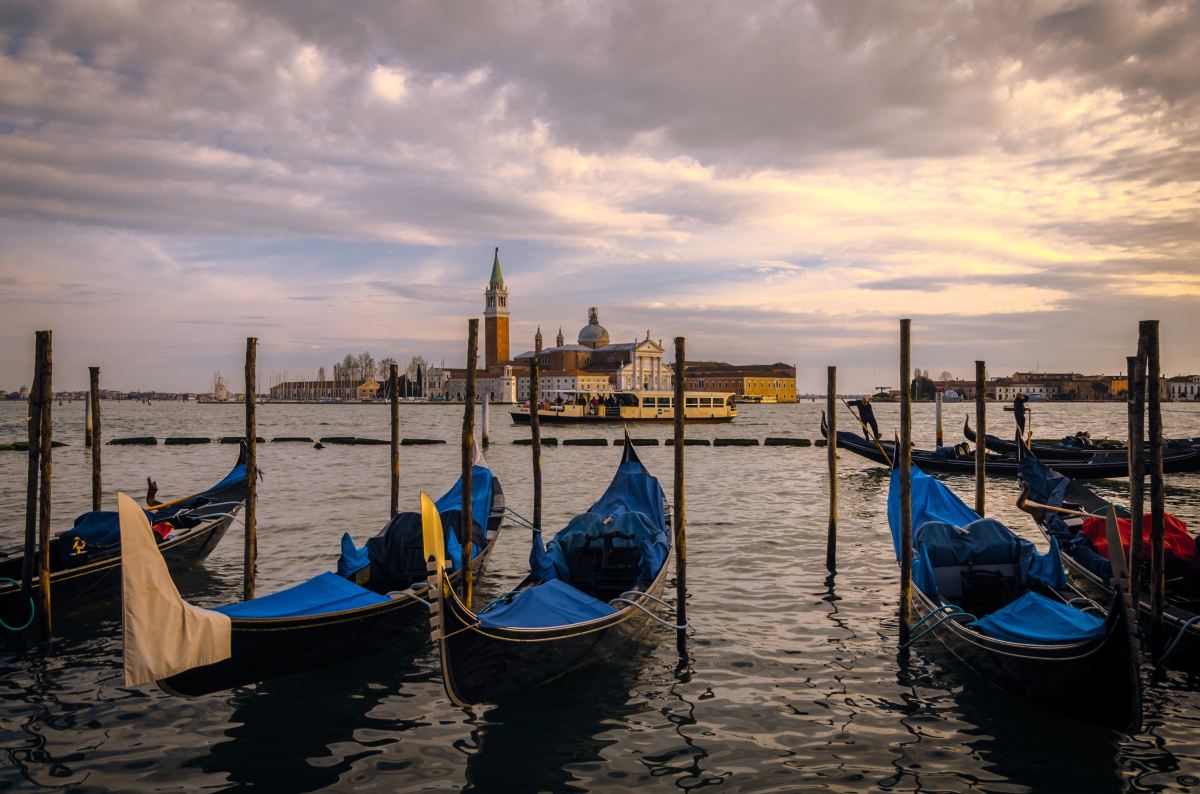
So although I still have not ridden a gondola, they continue to fascinate me…
…as they snake through the labyrinthine canals, glossy and black.
It’s possible, as one walks alongside a canal, to glance up from your thoughts and be surprised by one gliding by, silent and serene, mere footsteps away.
It is also possible to be flabbergasted by the gargantuan size of a cruise ship as it lumbers through the lagoon.
These behemoths seem strangely alien in such a delicate cityscape.
Thanks for reading! Check out my Italy (Venice) category for several more posts (Jewish Ghetto, the hospital, Calatrava Bridge, etc.) about Venice… a city I hope to visit a third time when travel opportunities return. I have a list of sights I still want to experience. Feel free to leave a like, make a comment and become a follower for more travel posts.
My next post: How to get from Delphi to Itea, Greece by bus
That morning, after arriving by train from Venice, we had savored cappuccini and croissants and then toured the main attraction in Bologna, the Basilica de San Petronio. We spent about an hour there marvelling at the centuries-old church with the unusual brick and stone facade. Plan to read a future post on that experience soon, but here’s a taste.
Basilica de San Petronio | Photo: M. Yung
We had also explored the Piazza Maggiore with its beautiful Fountain of Neptune and saw the city “square” rigged and ready with row upon row of temporary seating for hundreds plus a huge movie screen. Among other movies, Gone with the Wind was on the menu at some time during the summer season. How fun would that be?!
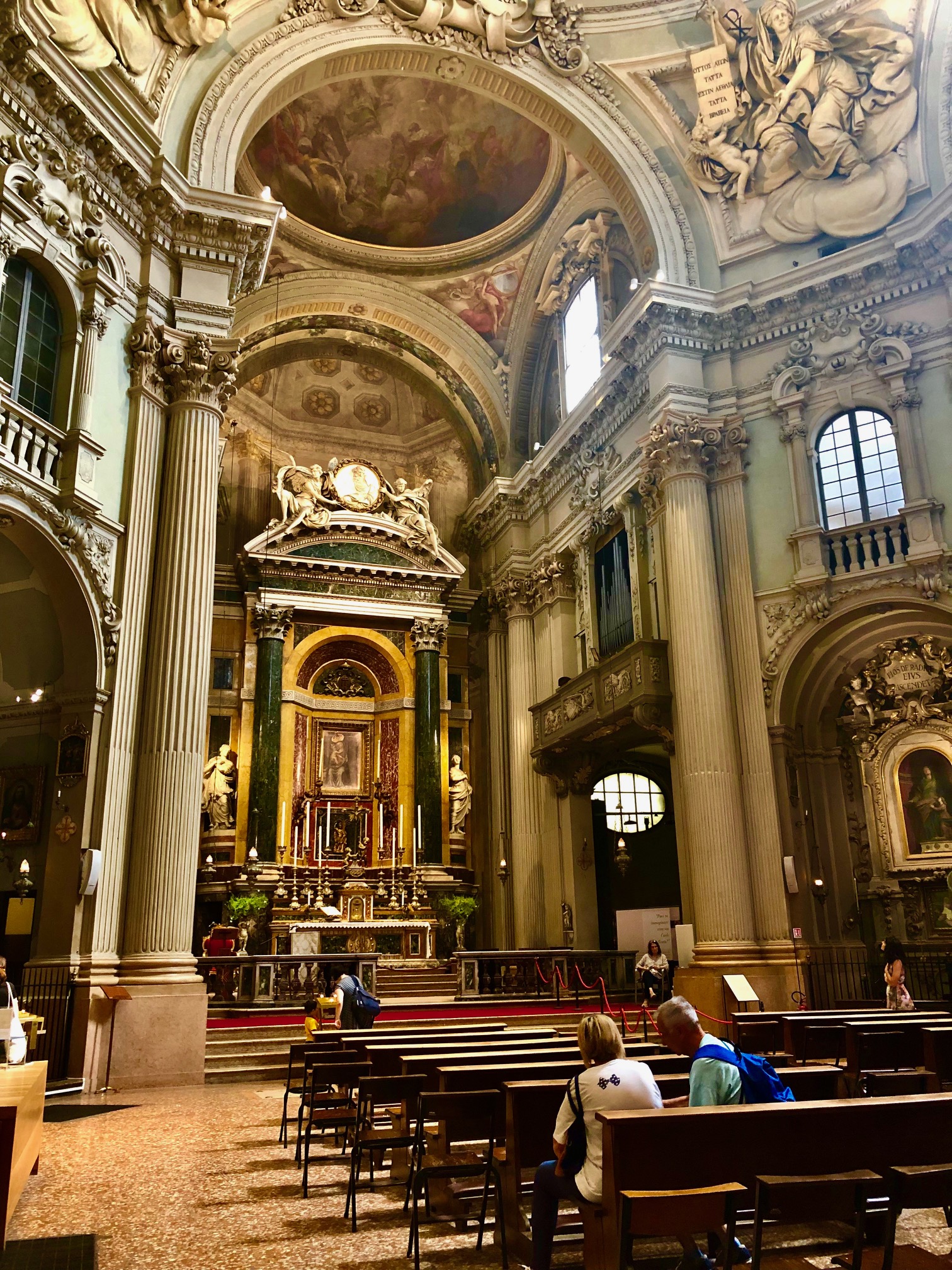
In our hour or two of free time, we also strolled down beautiful loggia-lined avenues. Eventually, we happened upon a church, the Santuario di Santa Maria della Vita.
It’s the copper-domed church in the large photo at the top of this post. While it’s quite a standout in a Bologna skyline photo, at street level it’s easy to miss. Tall buildings and narrow streets together conceal your vision of things in the upper reaches.
Bologna, Italy | Photo: M. Yung
It was a warm and achingly brilliant sunny day. Taking a short break in a quiet place of worship enticed us to escape the Italian noonday rays.
Inside, sounds of the street faded to a cavernous quiet. The majesty and somber tone of the interior both cooled and stunned me.
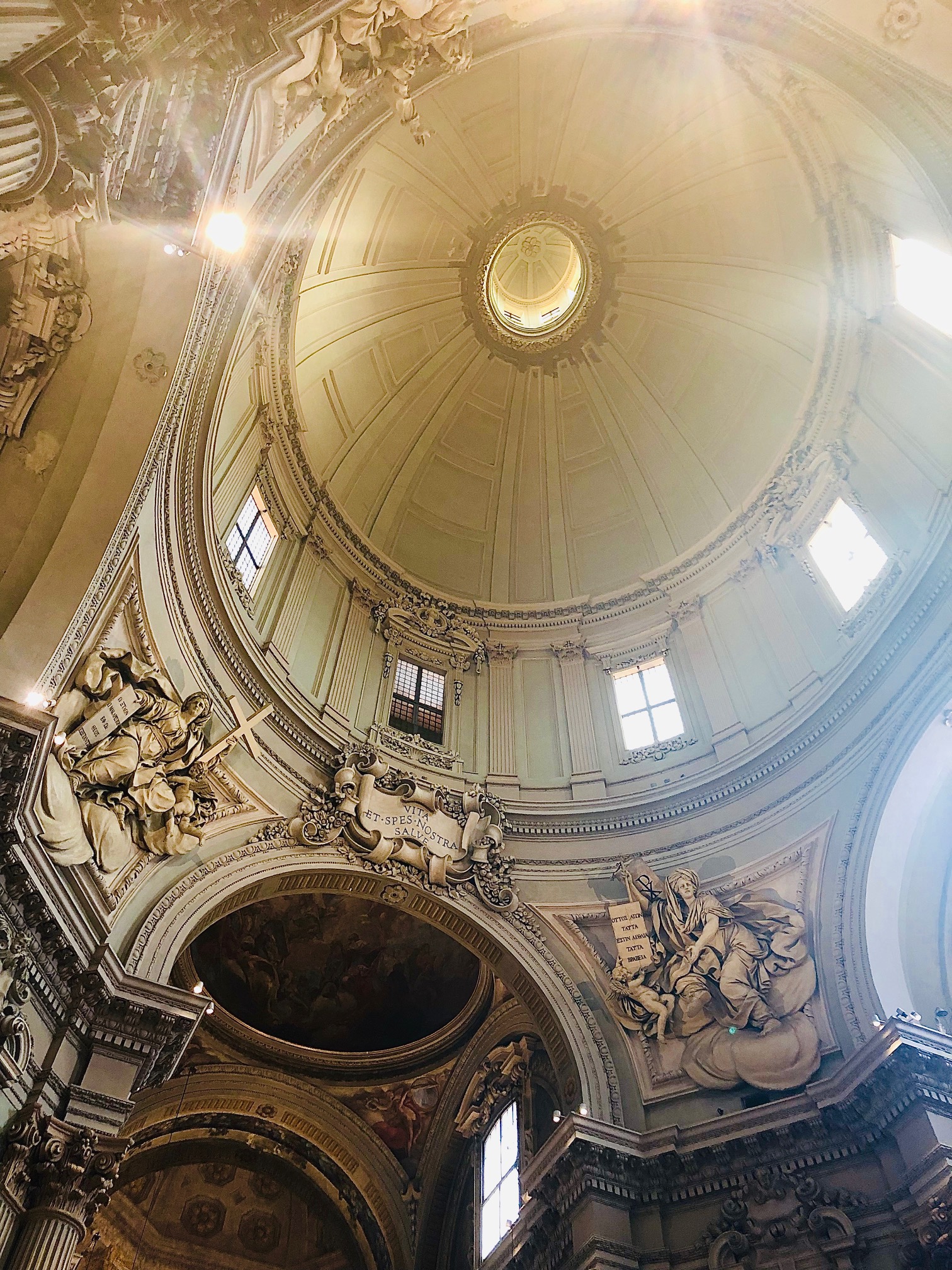
The soothing soft green interior wall colors caught our attentions first. The ornate Baroque stylings caught our attentions second. The dome, completed in 1787 and designed by architect Giuseppe Tubertini, was beautiful as well.
But if only I had Googled to see what more this structure had to reveal.
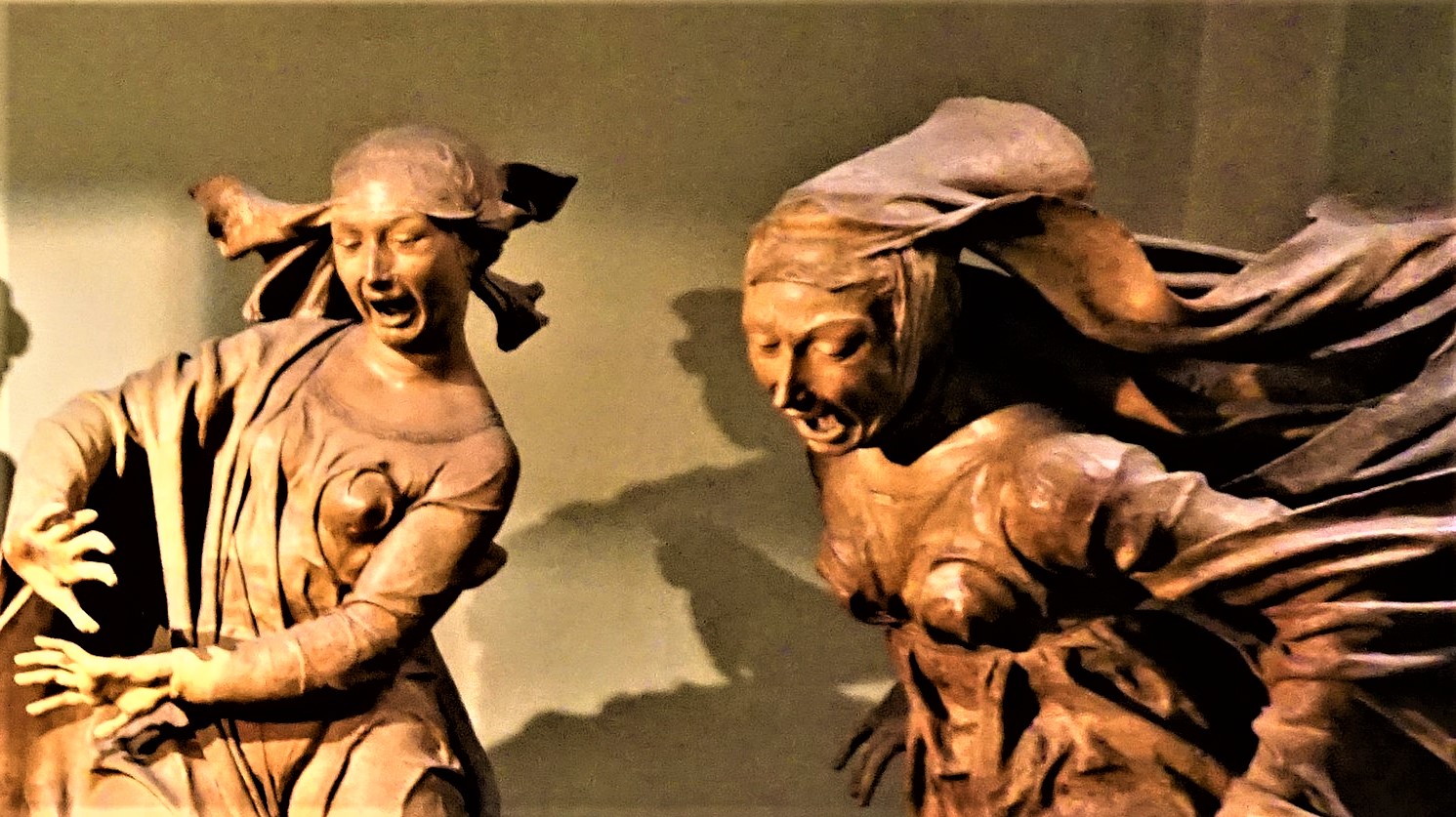
I stumbled upon this sculpture as I was researching the church and I still can’t believe that I was in this very building and missed this very powerful example of Renaissance art.
I can’t get over the expressions on the faces.
Terror. Despair. Uncontrollable grief.
Truth be told, I often feel detached from historical art. The expressions are often glum and sullen, especially in depictions of Jesus Christ and the suffering he endured on the cross. That goes, too, for the the emotional suffering of those nearby who loved him. Sometimes it’s just hard to identify.
With Arca’s work, however, the emotions of the figures are real and painfully so. I understand that kind of hurt and sorrow and panic. We see humans in painful grief daily on the news and in our modern media. To think that an Italian Renaissance artist was able to capture it accurately — in terra cotta — six hundred years ago — baffles my small mind.
Words are not needed in the picture below. The emotion is palpable and horrible.
And on that note, I’ll close this post with this final thought: When travelling, it’s a good thing to have time to spare. However, once you arrive home, it’s heart-breaking to discover something wonderful that you missed.
Lesson learned: Next time, slow down, google it, and learn what more there is right in front of you.
Thanks for reading! Follow my blog for more posts about the details in travel far and wide.
A peek into the past in the hills of southern Crete
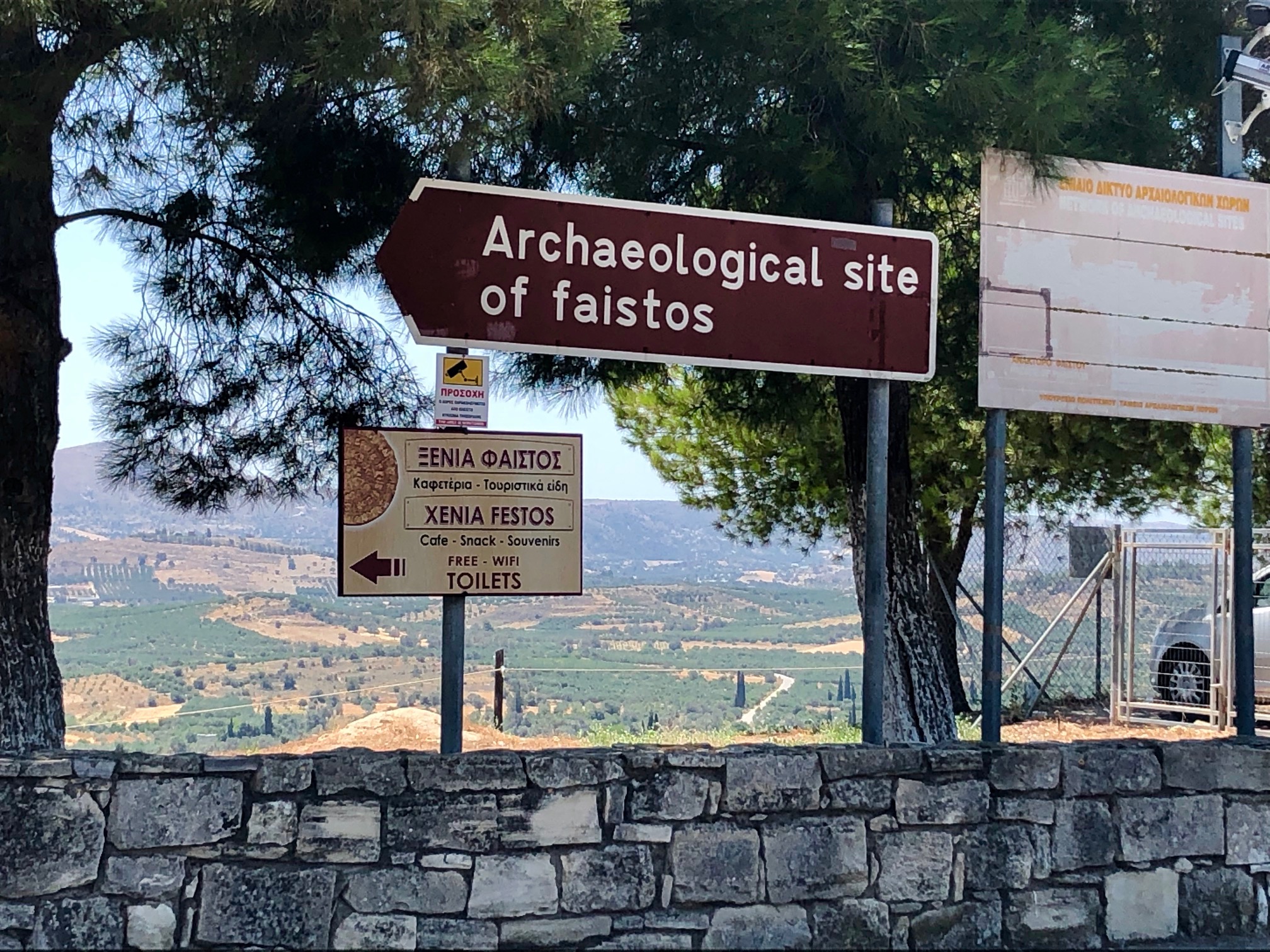
Phaistos. Phaestos. Festos. Faistos. And then in Greek, it’s spelled Φαιστός. No matter how you spell it, each name refers to Phaistos Minoan Palace, the second most important site (after Knossos Palace in Heraklion) of the Minoan civilization on the island of Crete.
We visited Phaistos last summer in late June. After touring the archaeological sites at Athens, Mycenae, Delphi, Olympia, and Knossos, we made a final stop at Phaistos. After a confusing morning journey by public bus from Heraklion, we made it to Phaistos in plenty of time to take a leisurely self-guided tour, eat a small lunch beneath a pine tree, and have a cold drink and ice cream in the small, on-site gift shop before hopping on a bus back to Heraklion. Here’s my post about how to get from Heraklion to Phaistos, click here.
If Minoans are new to you, here are a few facts about the culture from my husband:
The Minoans, named for their ruler, the mythical King Minos, are known for their advanced civilization that settled the island of Crete and other surrounding islands.
The Minoans were great sea travelers.
They built enormously sophisticated palaces for their royalty. The palaces were very “high tech” for the time period and exhibited a distinctive and advanced architectural style.
Phaistos was the region that produced Kamares ware, a pottery style dating from the 1800-1700 BC. Kamares ware, named for the nearby cave where it was found, is known for its dark background and white brushwork. Kamares wares were considered luxurious to own and were exported throughout the Mediterranean to Cyprus, Egypt and Palestine.
Kamares ware, including these vessels, were found at the Minoan palaces at Knossos and Phaistos. | Photo: M. Yung
A self-guided tour of Phaistos is relaxing and quiet. Unlike Knossos, there are no guides-for-hire who approach you as you enter offering to walk you through the site for a fee.
While these guides are likely very helpful for many tourists, we doubted that they were truly needed, considering the large number of detailed placards placed throughout the site. Granted, that assumes one doesn’t mind reading.
When you do stop to read the signs, you can learn a lot. Here are some basic facts taken from a placard found at the entry to the main site:
The hill of Phaistos was inhabited as early as 4500-3200 BC in the Final Neolithic Age.
The first palace of Phaistos was active from 1900-1700 BC. The palace controlled the plains and valleys found below the palace hilltop.
The city of Phaistos — and Minoan culture in general — flourished until 323-367 BC.
The Phaistos Palace grounds included a central court, surrounding wings, multi-story buildings (similar to Knossos), gateways and open balconies.
More facts follow the next few photos.
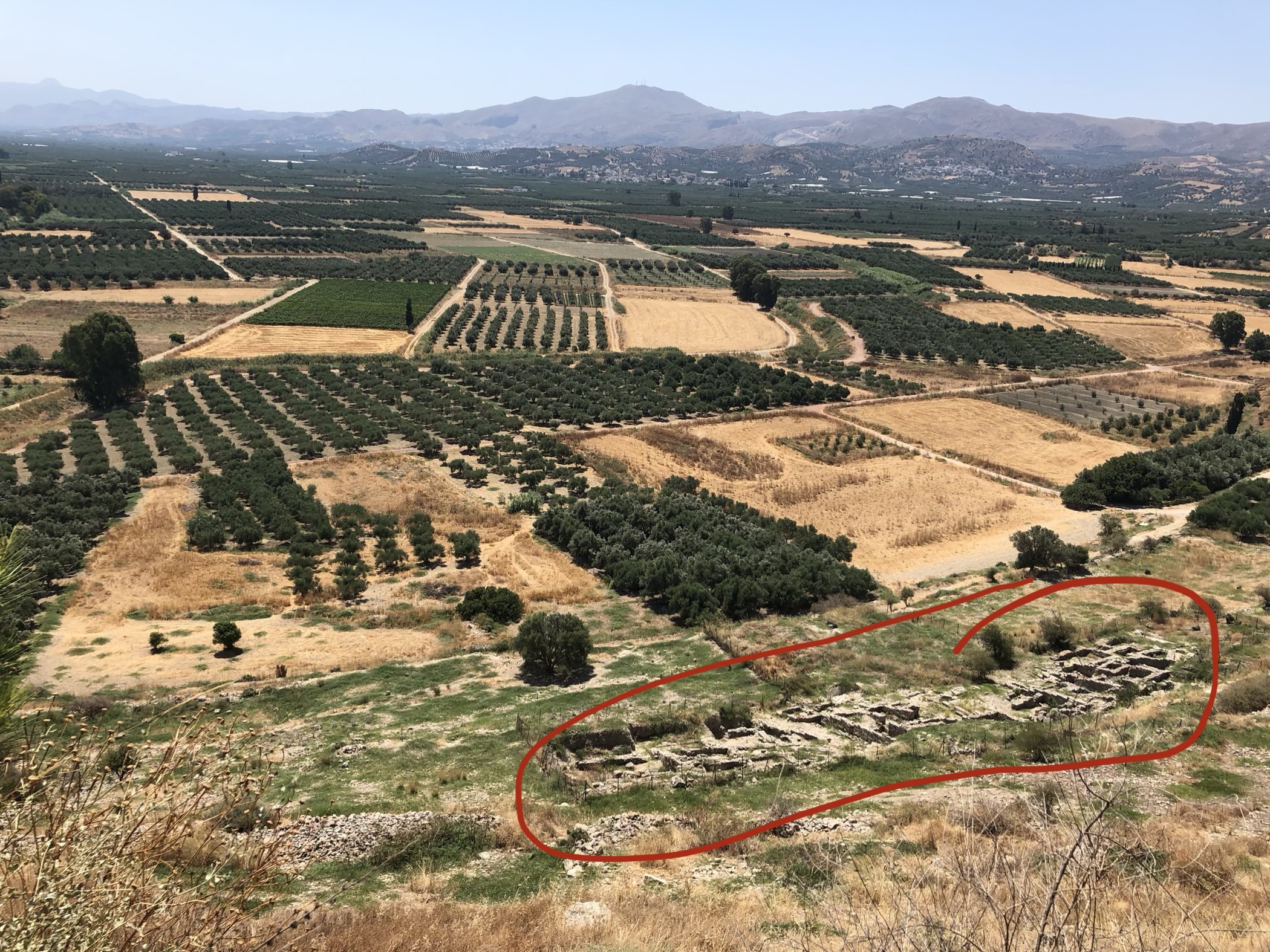
Phaistos is found on a hilltop in southern Crete. The valleys on all sides of the hilltop are blanketed with olive trees, grape vineyards, cypress trees, and farms. There are several caves in the surrounding hills also. Many items, including pottery, have been found in these caves. | Photo: M. Yung
The first Phaistos Palace was built around 1900 BC.
It covered 8,000 square kilometers over three terraces.
Tickets to the Phaistos site are 8€ each. Getting there is inexpensive, too, via public bus.
The original palace was inhabited for 250 years and destroyed and rebuilt three times.
It was destroyed the last time by an earthquake around 1700 BC.
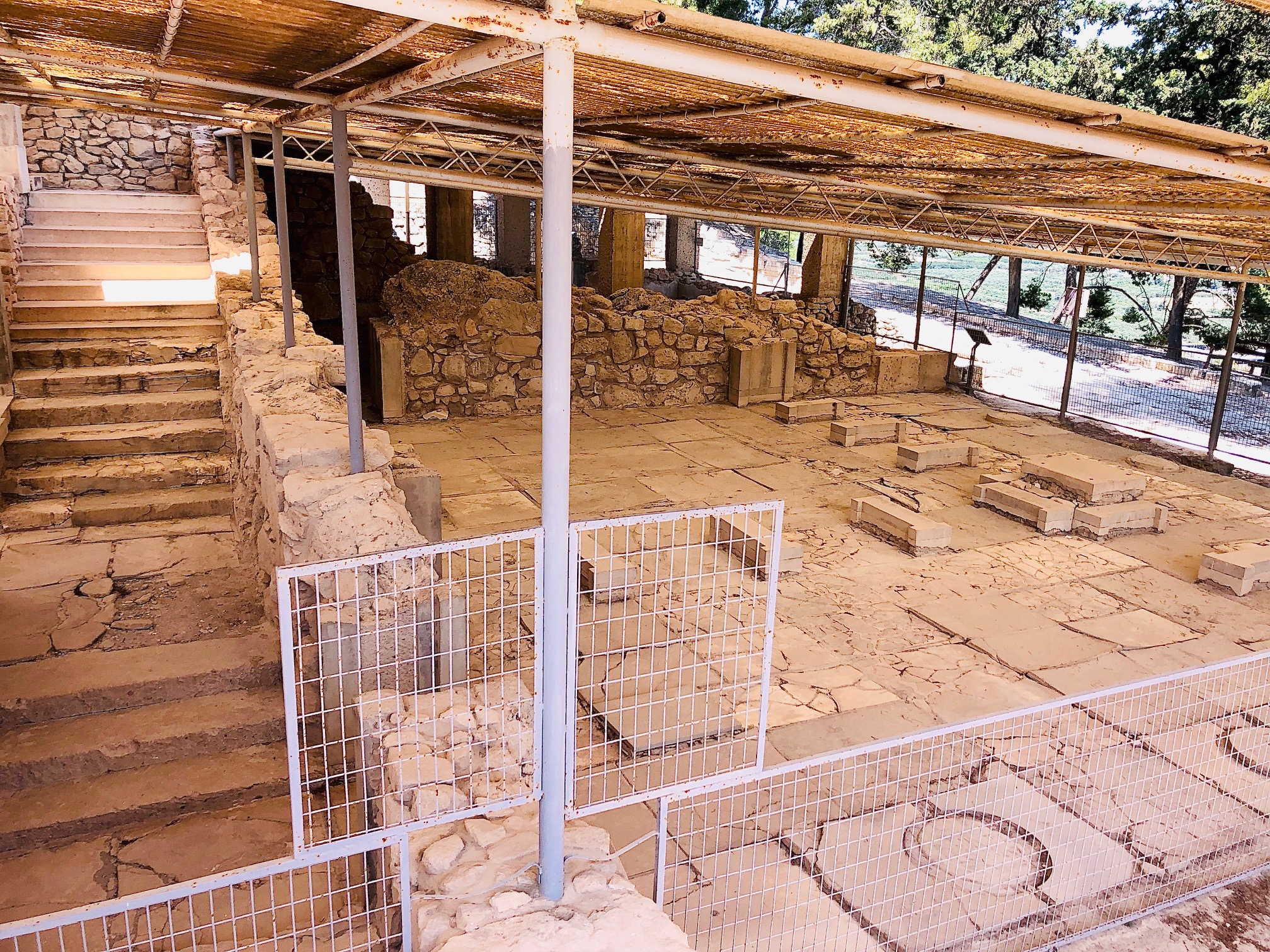
It’s amazing that visitors are allowed to walk on stones laid nearly 3,700 years ago!
Little at Phaistos seems to have changed since the 1919 photo above. It’s still isolated, quiet, and remote. | Photo: M. Yung
After the earthquake, the ruins were covered and a new palace was constructed on that.
This last palatial site was smaller, but according to the placard, “more monumental.”
This last Phaistos Palace was destroyed in 1450 BC, but not rebuilt.
Two more facts follow below.
It’s amazing how little has changed over the years. This photo from 1919 shows the steps leading to the West Court. The theatral area and diagonal wall appear in the lower half of the picture. | Frederic Boissonnas [Public domain]
The city of Phaistos continued to be inhabited and thrived in Hellenistic times from 323-367 BC.
In 150 BC, Phaistos was finally destroyed by Gortys. When Rome conquered Crete in 67 BC, Gortys became the capital, replacing Knossos.
But back to our tour…
The main reason we wanted to visit Phaistos: the pithoi.
Two pithoi appear below a reconstructed walkway. | Photo: M. Yung
These pithoi (the singular word is pithois) are well-known in art history circles and Phaistos is considered the premier site for this particular kind of storage vessel. In fact, my husband hoped the site would have more available to see, as he had seen photos of many more pithoi on display here.
A room with storage jars known as pithoi. | Photo: M. Yung
Still, it was fun to wander the grounds and find a pithois tucked away here and there. There were more to see in an area of the grounds covered with metal shelters; however, these shelters were in large areas closed off to visitors.
Mitch walked as far as he could into the Magazine of the Giant Pithoi, a room that contained several large pithoi jars. | Photo: M. Yung
In fact, this was our main disappointment with Phaistos:
a good portion of the site was closed.
The shrines of the West Wing were predominantly small rectangular rooms that contained benches. According to the placard, inside these rooms excavators found ritual vessels, figurines of deities and other cult objects. | Photo: M. Yung
There was definitely a feeling that Phaistos is overlooked and forgotten.
a few signs were missing
some barriers were broken
a wooden observation deck had missing boards
Generally, Phaistos seemed neglected. And this isn’t really surprising, considering Greece’s other economic priorities.
True, due to its location, Phaistos sees fewer visitors than other more popular Greek archaeological sites. In fact, Phaistos doesn’t even make this Top 20 list of Greek ruins.
Photo: M. Yung
Still, Phaistos is a valuable peek into the past, and among art historians, it’s well-known and revered.
The Phaistos Minoan Palace reminds us that we shouldn’t underestimate the abilities and ingenuity of ancient cultures. For example, precisely placed stairs and drainage pipes made of solid stone show us the resourcefulness of the Minoans.
Drainage pipes were used at Phaistos. | M. YungThis is the Queen’s Megaron (throne room) found at Phaistos. It is covered by a metal shelter on this side……and this side, too. | Photo: M. YungThe Phaistos Disk is on display at the Heraklion Archaeological Museum. The disk represents one of the greatest mysteries of archaeology. No one knows the meaning of the symbols incised into the clay. It was made between 2000-1000 BC. It measures about six inches in diameter. | Photo: M. YungPhoto: M. Yung
It was a beautiful sunny day when we visited Phaistos. In fact, by early afternoon, we were ready to hop on an air-conditioned bus and make the trip back to Heraklion.
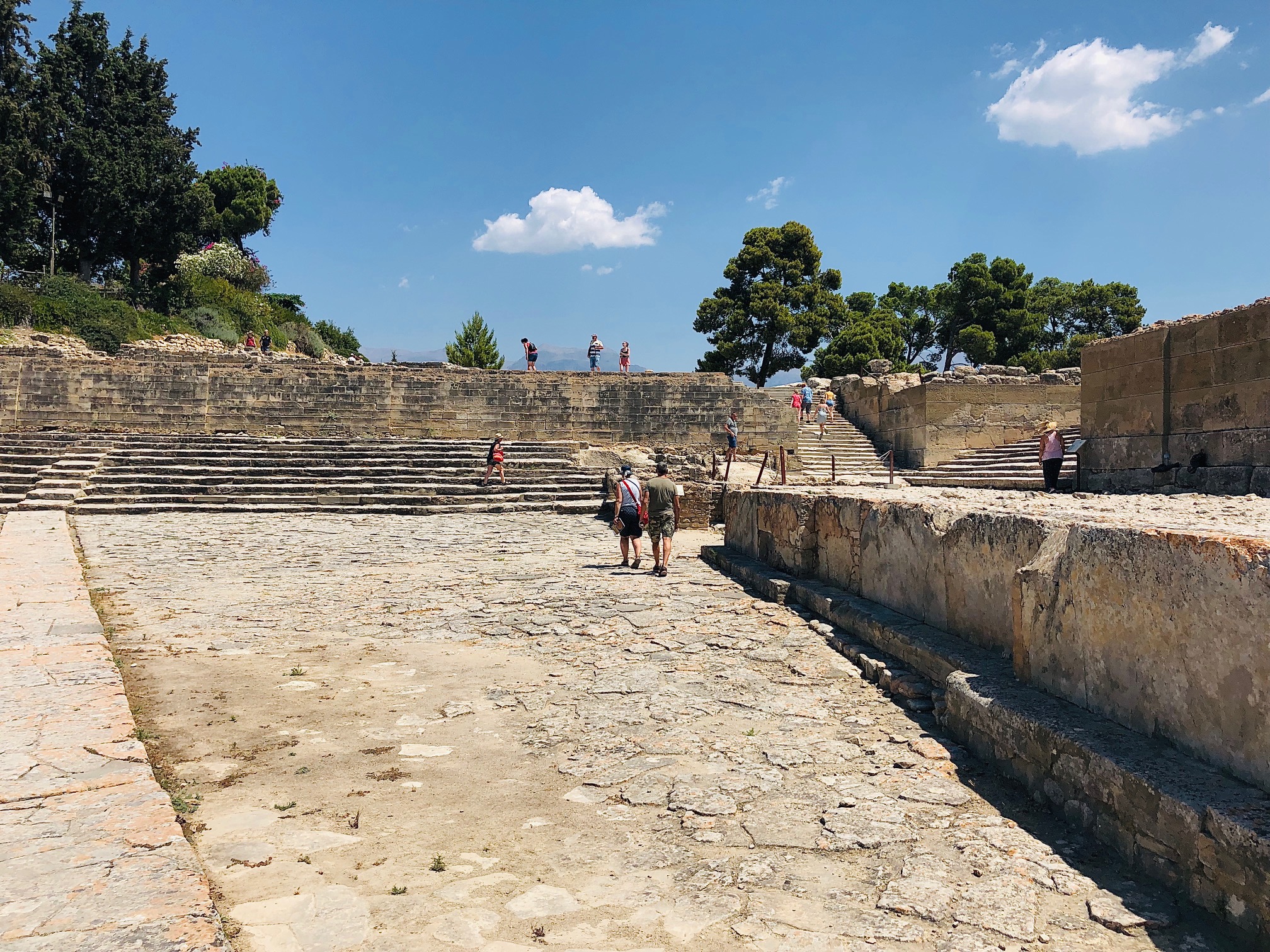
This photo shows the theatral area on the left and stairway to the West Court on the right. | Photo: M. Yung
Here I am walking near the theatral area in the West Court. The wall to my left can be seen on the left side of the preceding photo.
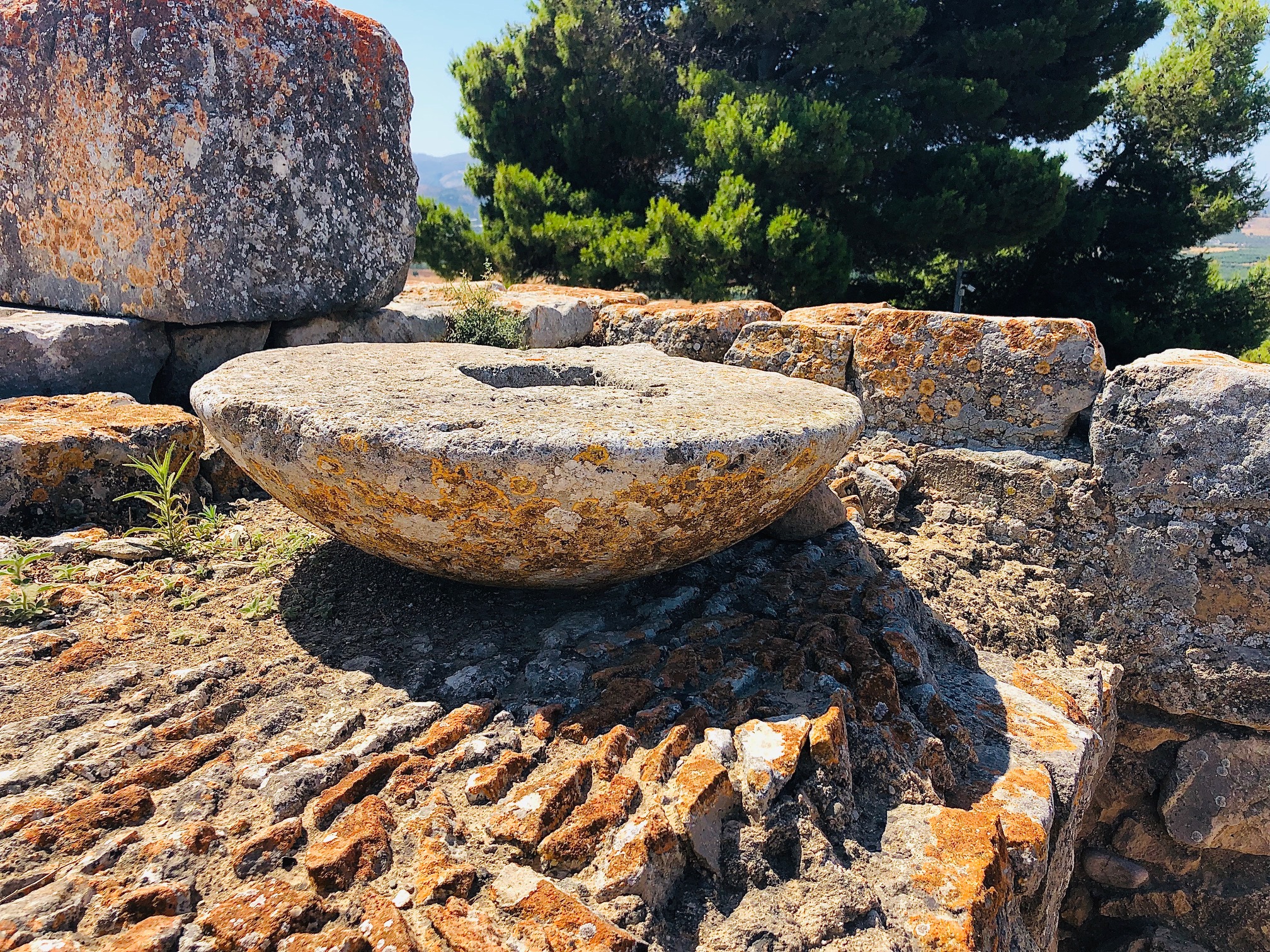
Kouloures, large stone-built structures, show time-consuming craftsmanship. | Photo: M. YungRelics from the past are scattered across the grounds. | Photo: M. YungThis photos shows the surrounding hillsides. I’ve circled in red additional outlying structures that were subordinate to the palatial hilltop above. We ate our lunch (that we had packed and brought with us) on benches beneath a pine tree right above this scene. | Photo: M. Yung
Mysteriously, no one knows for sure the reasons for the collapse of Minoan culture, including the civilization at Phaistos.
Perhaps that’s a fitting conclusion for this archaeological site that today is still out-of-the-way, obscure, and famous.
Thanks for reading! This post is another installment from our cross-country Greek odyssey last summer. It’s amazing how many more sights I have yet to write about. Follow my blog for more travel posts, including this one from our final day in Greece when we visited the site of Paul’s To an Unknown God sermon.
A haircut, Iron Brew, and biltong in Port Elizabeth
It was raining still. Watery pellets pounded the windshield of our rental Volkswagen minivan as Pieter, our tour guide and professional hunter, searched the streets of Port Elizabeth for a barber shop.
“I need a haircut,” he had told us that morning when we left our lodge in Storms River. He rubbed his stubby fingers across his already short crew. “Yes, I need a haircut.”
After driving for an hour and a half, we had arrived in Port Elizabeth, a city of 312, 000 smack in the center of the South African coast. Back then in 2012, using GPS on a cellphone wasn’t as sophisticated as it is today, and driving up and down the streets of Port Elizabeth’s central business district was the more efficient way, apparently, of locating a barber.
Pieter peered left then right from the driver’s seat, pivoting his huge hunched shoulders back and forth. “I know there’s one here somewhere,” he muttered, careening around another corner. With each turn, my right knee pressed painfully again a white-and-blue striped plastic cooler wedged between the driver’s and front passenger seats. An empty can of Iron Brew soda rolled behind my ankle and into the well alongside the van’s sliding door.
“There she is,” Pieter purred seductively. “At last.” He pulled up to a dimly lit blonde-brick salon. A simple white sign hung squarely above the front door. A black curvy font in capital letters read: The Hairline. “At last we meet,” he shouted. The sudden burst of energy shocked my mother- and father-in-law, husband, daughter, son, and me to attention. It had been a long morning of driving in the mists of a typical South African winter, and we needed to get out.
An establishment called The Hairline was sure to offer a basic haircut, Pieter assured us, as he tossed my father-in-law the keys to the van. “Back in thirty minutes,” he called.
Through the foggy windows of the van, my husband noticed a drugstore five doors down.
“They’ll have a Sudafed equivalent, don’t ya’ think?” my daughter asked. There was only one way to find out, so we left my in-laws behind and ventured into the icy, blowing mist.
After purchasing our “Sudafed,” we lingered in the drugstore to peruse the variety of non-drug products: sunglasses, Cadbury chocolate, umbrellas, magazines, souvenir key chains, magnets. We analyzed a minuscule selection of locally-made biltong, a jerky-like snack, arranged in a red wicker basket on the cashier’s counter. The biltong seemed as out of place in a pharmacy as I felt on the side streets of a South African industrial port city, I thought.
I checked my watch. “It’s been thirty minutes,” I said, motioning that it was time to head for the van. Sure enough, Pieter and about three thousand very short hairs were waiting on us.
That was the last time I would see Port Elizabeth, perched along the very southern edge of the African continent. It was not an eventful visit, but it was memorable. After all, we should not underestimate the power of details, no matter how small or seemingly insignificant.
I’m sure many will scoff at our scant, all-too-brief encounter with the city now known as Nelson Mandela City. To be sure, there are many deserving and fascinating sights to see there.
As we left the city in the dim, rainy morning of middle June, I watched the ships, barges, and freighters skim over the whitecaps of the distant bay. The vessels resembled tiny dashes and dots. A bright white Morse Code against the waves, the vessels sailed steadily to their next destination.
This post was originally published last spring on Medium.com. Somehow, I never cross-posted it to this blog. Our trip to South Africa happened in 2012; it’s just now that I’m documenting some of our memories—both the memorable and the more forgettable ones—on my blog. Check out my South Africa category for more stories from this trip.
It was a warm, sunny day when we visited the Campo di Ghetto Nuovo, the square that anchors the Jewish Ghetto in Venice’s Cannaregio in the northwest part of the city.
Five facts and photos from our brief visit to this less traveled Venetian sight
In June, my daughter and I took an afternoon in Venice to see the Jewish Ghetto located in the Cannaregio sestiere, in the north of the city. Two years earlier, on a previous week-long trip to Venice, I had wanted to see the ghetto, but ran out of time. Therefore, in June, it was still on my return trip bucket list.
My daughter and I on our way to Cannaregio to take a walk through the Jewish Ghetto.
Honestly, we didn’t plan this little jaunt well. We just took off for Cannaregio shortly after lunch on the last day of my visit. (She had the day off from her two-month internship at the U.S. Pavilion of the Biennale del Arte and wouldn’t be leaving for another month.)
So while I wish I had taken a guided tour offered by the Jewish Museum of Venice and was able to tell you more about Venice’s Jewish Ghetto—the first of its kind in the world—I’m still grateful that we spent the hour or so there.
Even so, with the recent flooding in Venice, the ghetto has suffered. Fortunately, the synagogues are located on top or upper floors. According to this article in The Jerusalem Post, a storage facility and kosher restaurant were damaged.
To find the ghetto, we used Google Maps, rode a vaporetto to the train station (the Ferrovia stop), and then wound our way through Cannaregio. We crossed a bridge, made a left alongside a row of shops bordering the canal, and walked right past an easy-to-overlook brick tunnel.
Following Google Maps, we turned around eventually, and wandered through that brick doorway. We followed the maze. Within a minute or two, we walked by a shop full of art prints and originals, a jewelry store, a book seller, a bakery.
It was quiet in the darkened corridors.
We heard the rumbles of the vaporetti (water buses) in the distance, layered behind the sounds of our own footsteps.
This sign was posted within the front windows of an art shop down a corridor just off the the main campo of the ghetto.
After browsing through some lithographs and snapping a picture of the detailed sign above summarizing the history of the ghetto, we entered the Campiello de le Scuole, the “little square of the synagogues.” A seven-story building stood plainly before us. I have read since that this building demonstrates the tight quarters the Jewish people were contained in. Judging by the windows, these units couldn’t have contained standard 8-foot ceilings. In fact, these buildings were “the tallest buildings with the lowest-ceilinged apartments” in Venice, wrote David Laskin in this New York Times article.
This building in the Campiello de le Scuole shows how concentrated the floors were.
We continued past this small square. Not more than one minute further into the labyrinth, we found ourselves in the main campo of the Jewish Ghetto, the Campo de Ghetto Nuovo. In the square, a dozen people mingled and conversed quietly. A small tour group gathered at the base of the Jewish Museum of Venice.
A boy wearing a yarmulke, who looked to be about twelve years old, kicked a ball in the cool shade under a covered overhang on one of the many multi-story buildings that lined the campo.
The afternoon was clear and sunny. And hot. It was the perfect day to tour cool and darkened museums and synagogues. But alas, we hadn’t planned well enough to do that. Perhaps on my next visit to Venice (I can’t imagine there’s not another one in my future!), I’ll plan better. In the meantime…
Here are five facts I have learned since about Venice’s Jewish Ghetto:
2. The English word “ghetto” is derived from the Jewish Ghetto in Venice, originating from the Venetian word ghèto and the Italian word ghetto, according to Chabad.org. The word “geto” in the Venetian dialect referred to a foundry, which was located nearby. Eventually, the word was used to refer to the area that contained the Jewish people.
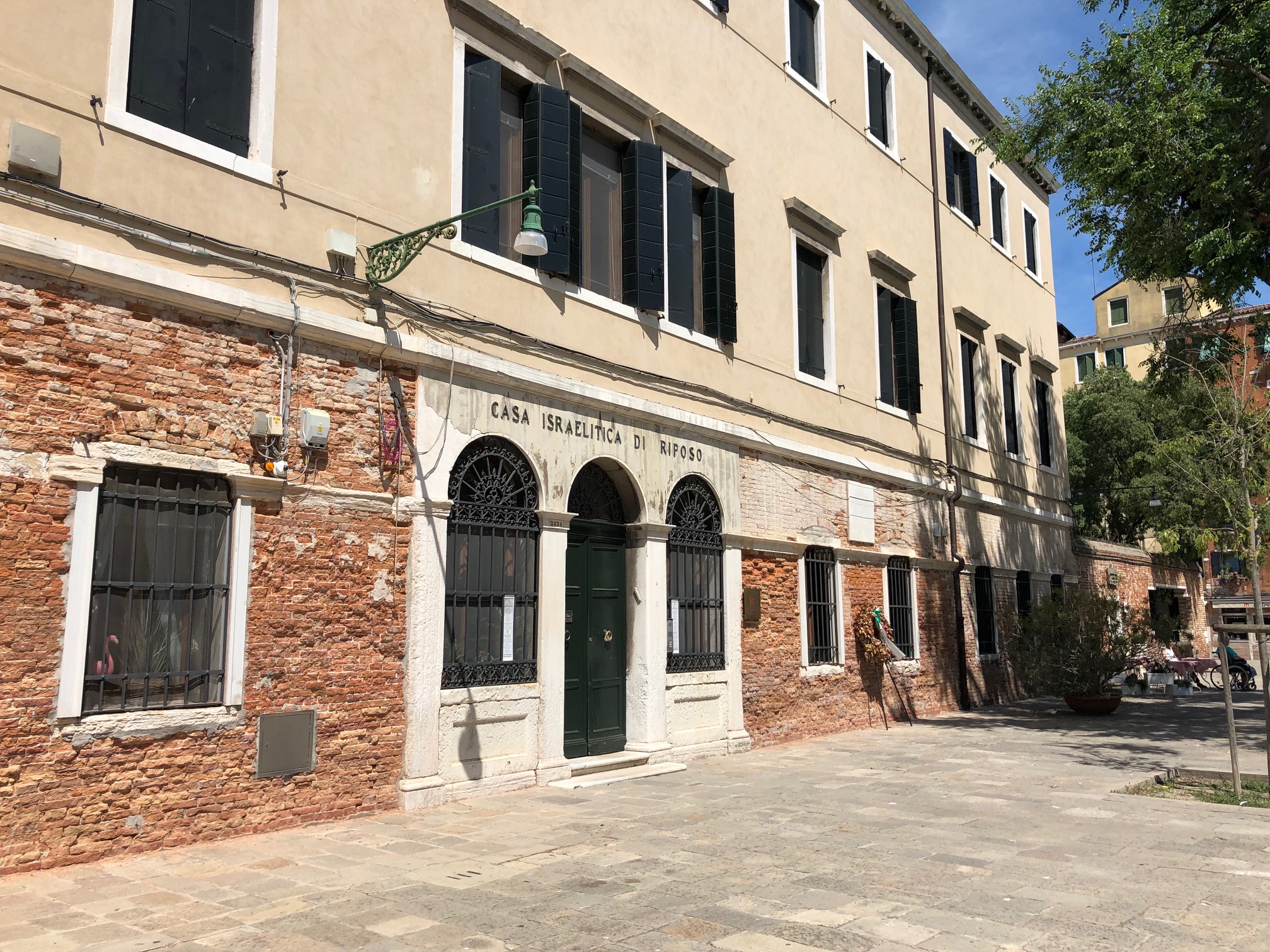
This is a nursing home that forms one side of the campo.
Today, about 450-500 Jews live in Venice. A small number still live in the ghetto.
4. During the ghetto’s early years, its residents were limited as to where they could travel and work. They also had to pay for their own watchmen and security. In addition, their clothing was used to mark them: men wore yellow circles sewn to their left shoulders of their clothing; women wore yellow scarves.
Photo courtesy of The Jewish Museum of Venice
5. There are five active synagogues in the Jewish Ghetto today. To see the synagogues, one must sign up for public guided tours conducted by the Jewish Museum of Venice. Tours are scheduled every half hour starting at 10:30 and ending at 17:30. Tickets are 12 Euro each. Visit this website for more information.
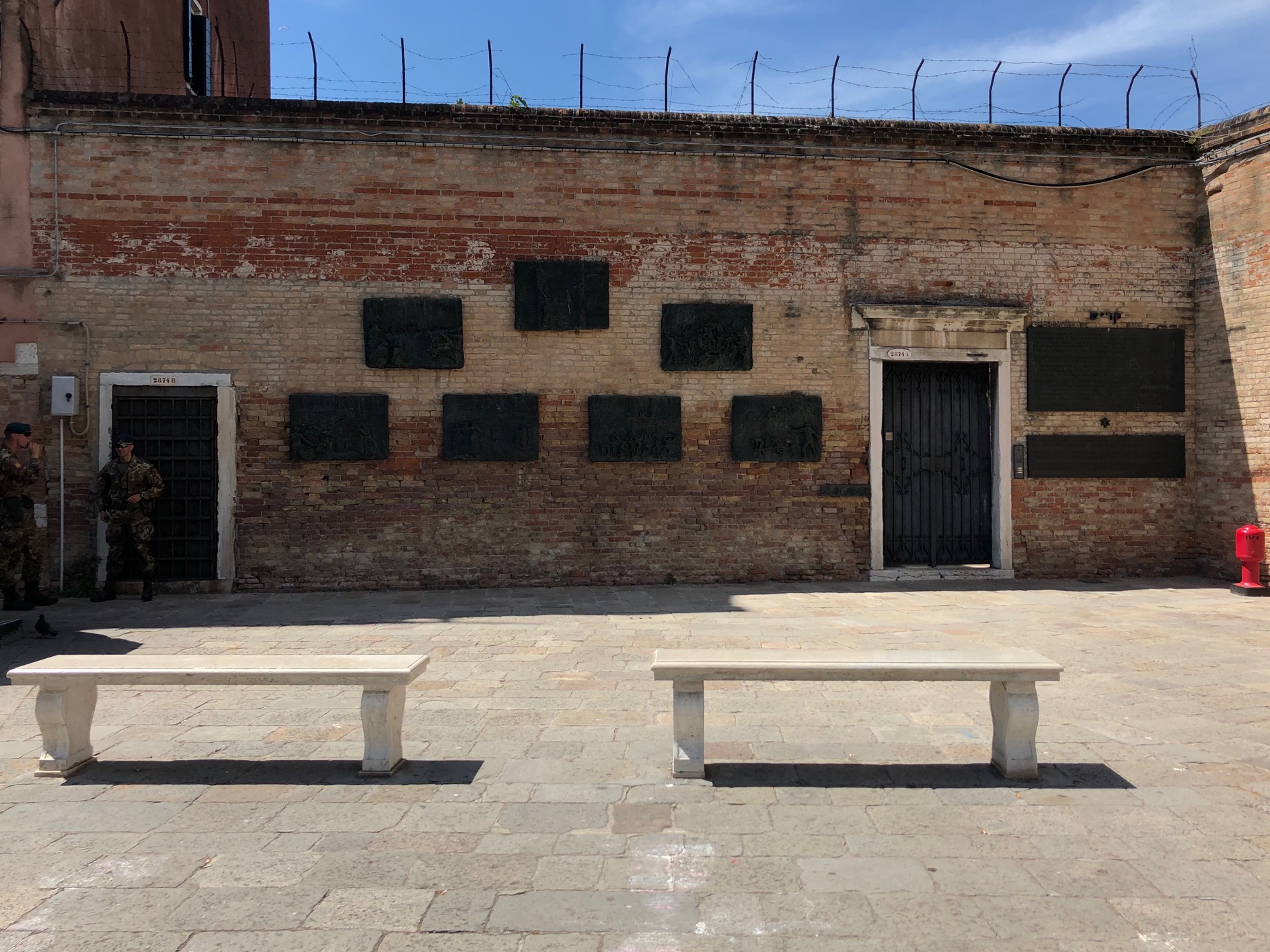
The plaque below describes the above sculpture, titled The Last Train, created by sculptor and Lithuanian-Jew Arbit Blatas. The sculpture shows Jews being loaded onto cattle cars. I believe the top line on the plaque is a dedication of the sculpture by the Jewish community of Venice to those deported to concentration camps of Nazi Germany.
A composition of seven bronze sculptures depicts the atrocities inflicted upon the Jewish people during World War II. Close-up photos of three of these sculptures and the inscription plaques at far right are below.
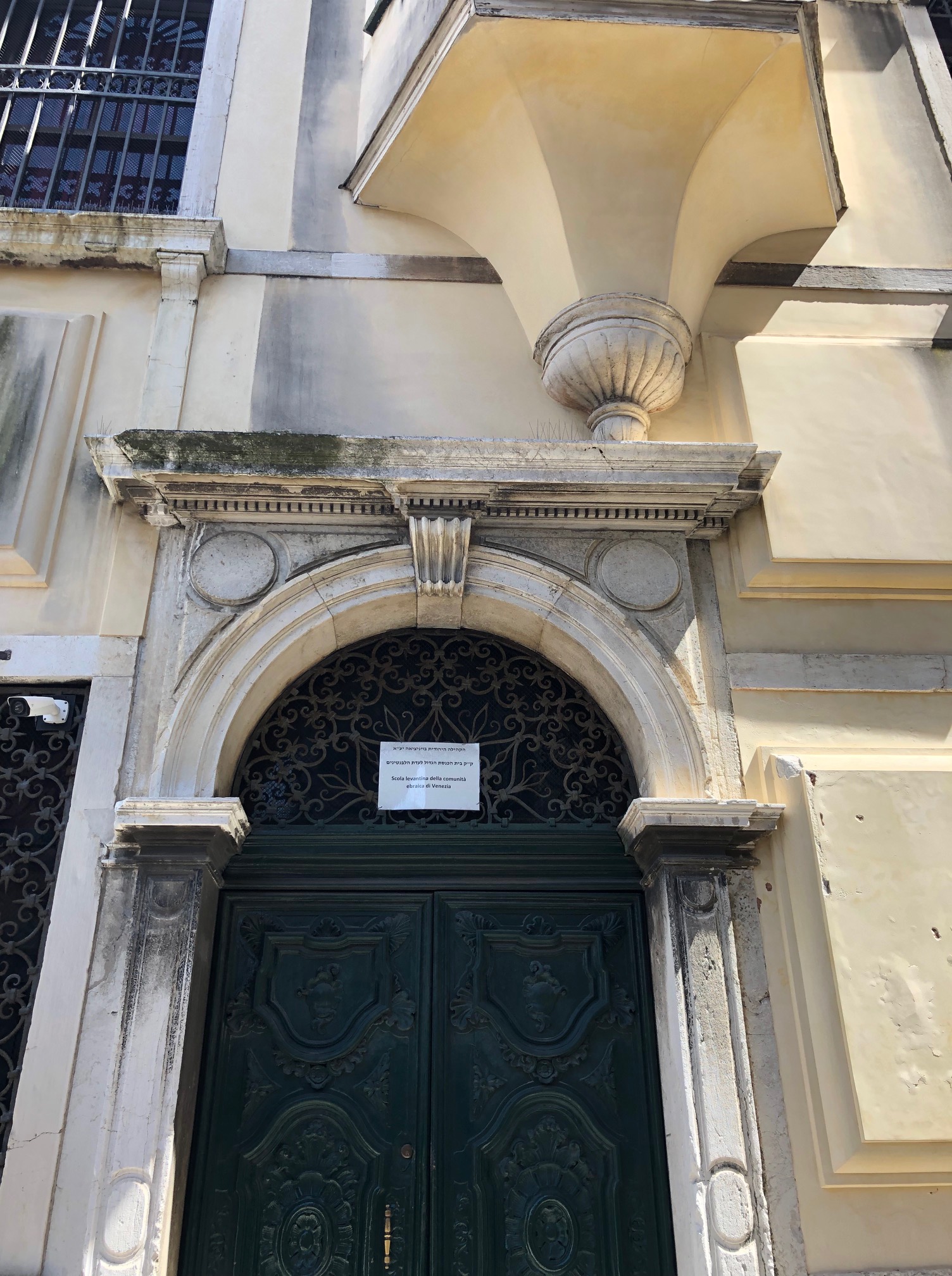
The top plaque reads: “Men, women, children, masses for the gas chambers advancing toward horror beneath the whip of the executioner. Your sad Holocaust is engraved in history, And nothing shall purge your deaths from our memories, For our memories are your only grave.” The bottom plaque reads: “The City of Venice remembers the Venetian Jews who were deported to the Nazi concentration camps on December 5, 1943 and August 17, 1944.”This is the door to the Scola Levantina, a synagogue just off the main campo of the ghetto. It was built between 1538-1561. The distinctive cupola above the door makes it stand out from others in the area.This is another shot of the campo taken as we left the Jewish Ghetto.
Thanks for reading! This stop during my stay in Venice last summer was followed by a warm walk back through Cannaregio. On our way back to Santa Elena, we stopped along the Zattere at a Conad Supermarket for groceries we would need later that night for dinner. Follow my blog for more stories from my trip last summer to Skopelos, the Peloponnese, Crete, and, of course, Venice.
The submission guidelines warn that publication may take up to a few weeks. It also warned that notification of publishing might not be sent. Oh, well, I thought. I’ll just submit it and forget it.
Which I did. And then I “googled” myself over the weekend. About ten listings down, there it was: Dave’s Travel Corner.
As a neophyte travel blogger, it’s nice to get more exposure for my writing. I spent quite a bit of time (three to four hours, I would guess) on this particular article. Even though there isn’t any any compensation for pieces like this, I still appreciate seeing my writing qualifying for publication on a reputable, well-known travel site like Dave’s Travel Corner.
This is the lead photo for the article published on Dave’s Travel Corner.
Thanks for reading! I’ve been really busy lately (I’m also a FT teacher) and it’s been especially hard to find extra time to publish posts to this blog. Hopefully, the upcoming holiday weekend will allow me a few hours to add a post about my visit to the Jewish Ghetto in Venice this past June.
The linoleum flooring in my kitchen is really old. In fact, it’s no longer white. It’s now off-white with an uneven pattern of nicks and dings that has, over the past twenty-four years, resulted in a floor that looks ugly, dirty, and tired. The linoleum, with its four-inch gray grid, was patterned to resemble white ceramic tile. And it did resemble that for the first five years, which was as long as we had originally planned for the flooring to last.
But, if you’re a homeowner, you know how that goes. Often, those initial fixtures outlast their welcome. And for us, that has especially been the case because we’ve never been in a financial position to update our flooring AND pay our bills.
Owning a ceramic studio, freelance writing, college adjunct positions, public school teaching, and an array of part-time retail stints have always managed to pay our basic expenses, but rarely anything additional. Hence, the ugly and outdated off-white linoleum.
So what does one do when one has a dream but also needs new kitchen flooring? My answer: go for the dream.
Yes, in our case, the practical solution would be to update the floor… to build value in the largest investment my husband and I have ever made. But we also know that paying for a new floor will only defer our creative goals. In other words, practicality has its limits and we have quite a dream: one month in Greece next summer.
My husband and I are travelling to Skopelos, a Greek island in the Sporades archipelago east of the mainland. Here, my husband will work a three-week residency at The Skopelos Foundation for the Arts. I, on the other hand, plan to experiment with a new writing genre (travel writing) while lingering on the island for an extended time.
Photo: Dimitris Vetsikas on Pixabay
Staying anywhere for an extended time requires money, and no, we don’t have the funds right now to go, but we are saving. We have ceased eating out on Friday evenings, for example. We are putting away what we can, and plan to have the majority of our trip paid for before our departure date.
Of course, that departure will lead to a return date. Once home, when I step into our kitchen, flip the light switch, and see the same old linoleum, what thoughts will cross my mind? Will I be glad I still have that flooring because keeping it allowed me to write in a new environment and experience new cultures and people? Or will I scowl at the floor, its ugliness reminding me of what I will still have in my life: uncertainty, bills to pay, the meager income that results when both spouses teach?
Will I be grateful for the dream that we chose to chase? Yes, I think so.
In the end, I believe that one can afford what one wants to afford. And when it comes right down to it, I would rather marvel at a Greek monastery than new hardwood flooring. If I can’t have both, I’ll take the dream.
Many things have happened since I originally published this post last fall on Medium.com. My husband was offered a full-time position at a nearby university, and we are moving from our home (with its aging linoleum) later this summer after our stay in Greece. Since we’re moving into a new home, we’ll take a pass on the upgrade to new hardwood flooring.



































 Marilyn Yung
