Categories
Greece (Peloponnese)

Visit Mycenae


What you can expect to see at Mycenae

Ask an art historian about Mycenae and they will likely mention the Lion Gate, the monumental sculptures carved at the entrance to the citadel at the Mycenaean acropolis.  While the Mycenaean civilization they guarded through the millennia was buried and ravaged by time and destruction, the lions remained quietly standing, sentinels that protected the inhabitants within.

Today, Mycenae is still a protected site. Mycenae and the nearby Tyrins were inscribed upon the UNESCO World Heritage Liston December 4, 1999.

IMG_0064

According to a placard at the entrance to the site, “Inscription on this list confirms the outstanding universal value of a cultural or natural property which deserves protection for the benefit of all humanity. The two most important centers of the Mycenaean culture dominated the Eastern Mediterranean from the 15th to the 12th centuries B.C. and played a vital role in the development of the culture of Classical Greece.  The two citadels are indissolubly linked with the Homeric epics, the Iliad and the Odyssey, that affected European art and literature for more than three millennia.”

This isn’t the first post I’ve written about Mycenae. My first post was written on the road during  the middle of our cross-country six-week Greek odyssey last summer. That post was much more concise; it included a handful of photos, but nowhere near the number of photos in this post.

Enjoy these photos and if you have a visit to Mycenae in your future or if you’ve been there already, please leave a comment and share your thoughts.

IMG_0034
Tickets are 12€ each and include entrance to the archaeological site, the museum and the Treasury of Atreus.

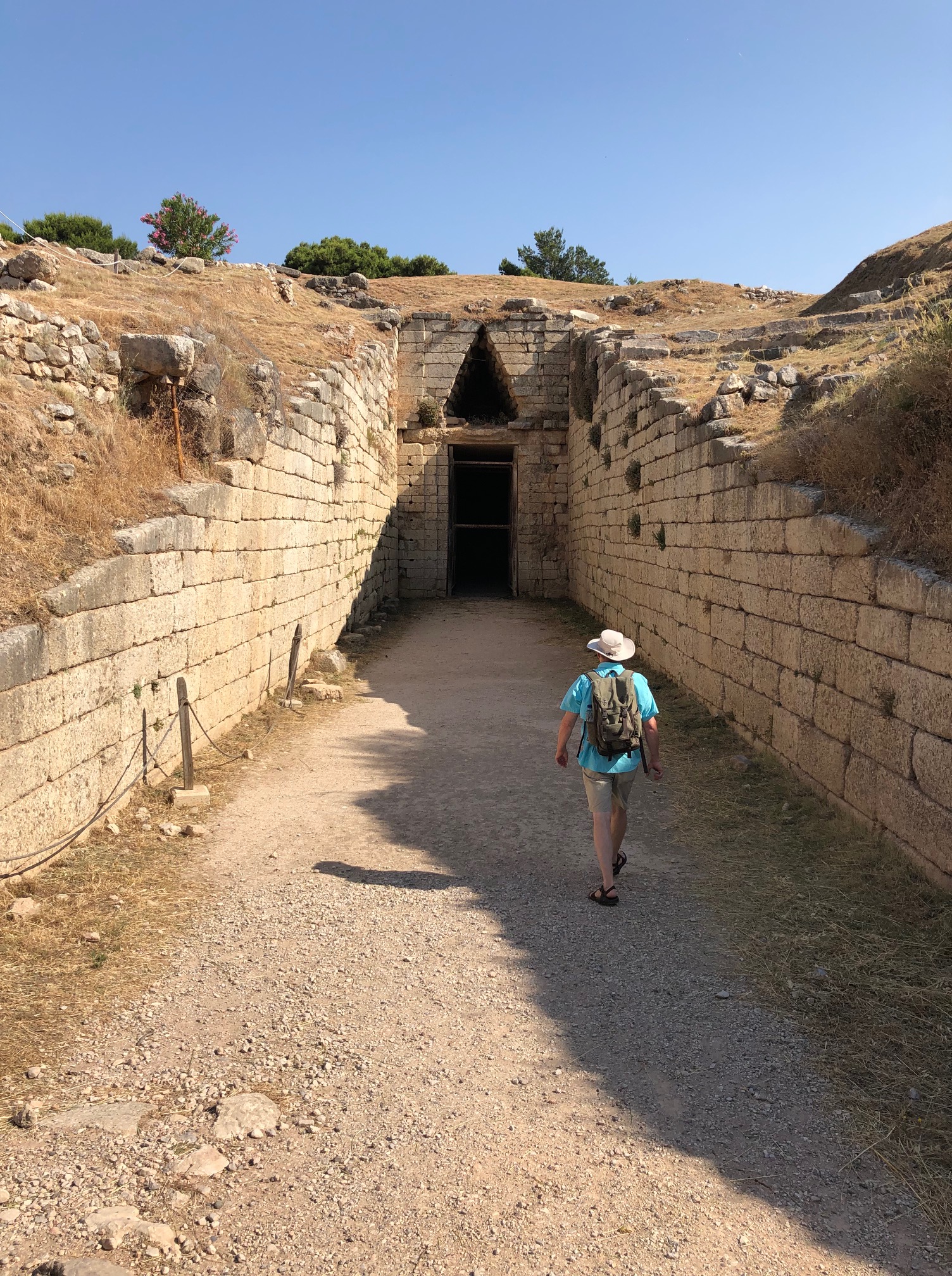
After purchasing your ticket, you’ll walk on grounds that surround the hillside below the citadel on the acropolis, the uppermost part of the site. Beehive tombs and other city structures can be seen around you.
IMG_0048
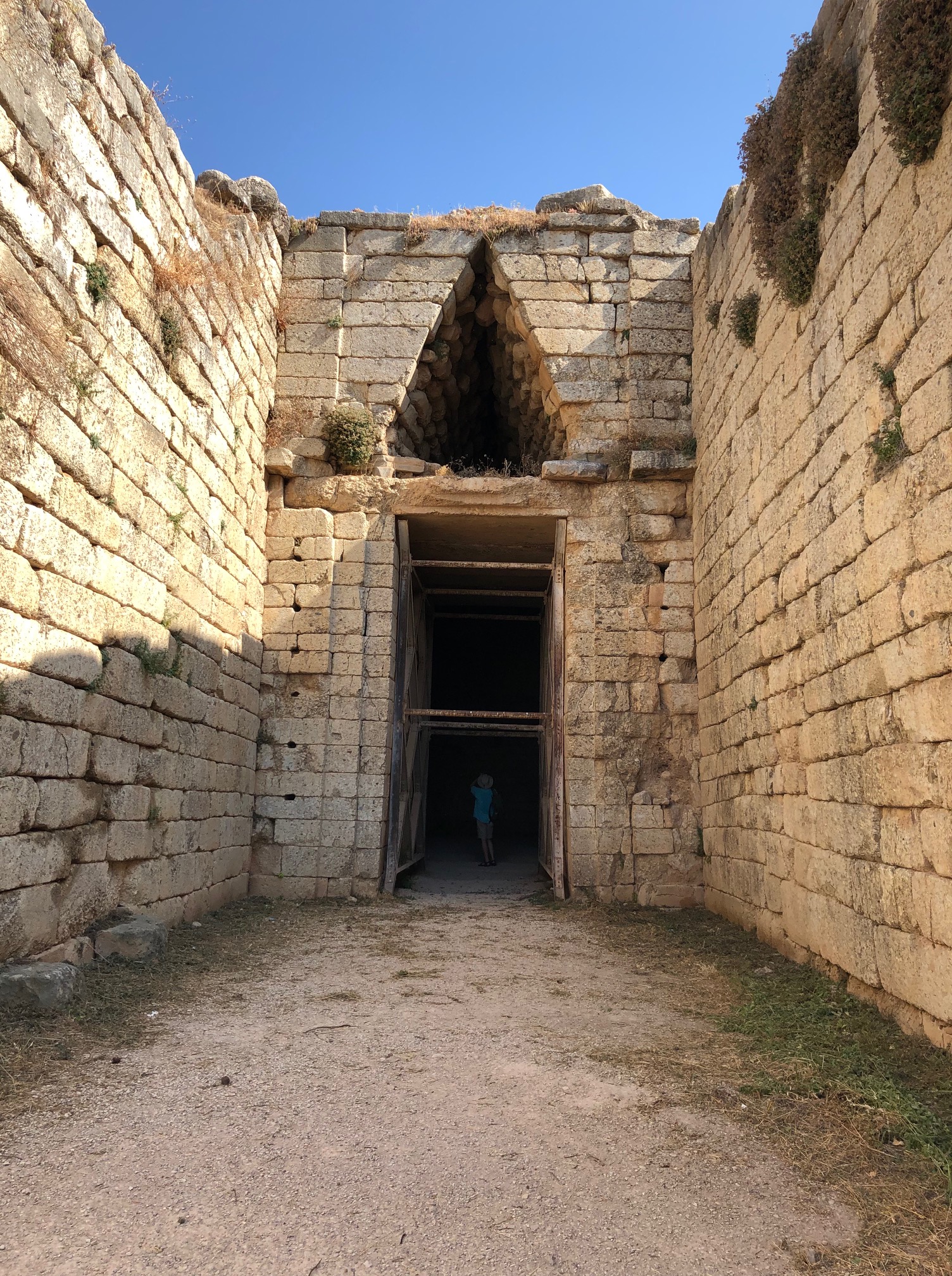
The latest “funerary monument” beehive tomb is on the hillside below the acropolis. It was discovered by chance by villagers during the time of Ottoman rule.
IMG_0050
The same tomb… just a little closer.
IMG_0054
And closer still. Here, I’m standing in the doorway where apparently some scaffolding is used to bolster the heavy stones. My husband, Mitch, is standing along the far wall, to show the size of the tomb.
IMG_0057
And… looking up at the ceiling of the beehive tomb.
IMG_0061
Outside the tomb, you can see theater seating (circled above in red) put in place by Greeks in Hellenistic times.

And another tomb…

IMG_0038
Another beehive tomb we encountered on our way up to the acropolis.
IMG_0042
I took this shot inside the tomb. The stonework is unbelievable.
IMG_0045
Get a load of those lintels above!
IMG_0041
Here’s a shot looking straight up at the underside of those mammoth lintel stones.
IMG_0126
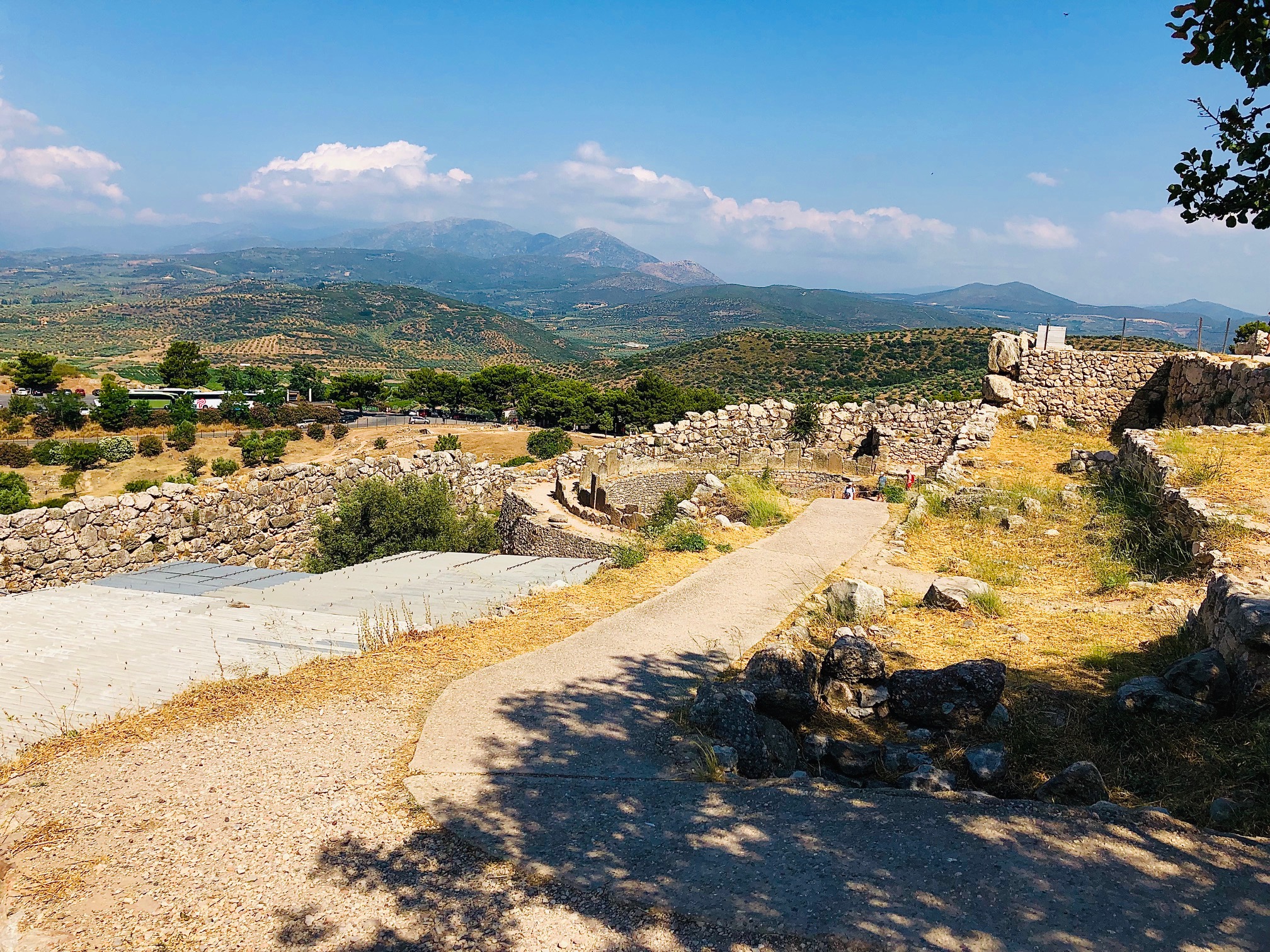
There’s more than one acropolis in Greece. This is the acropolis –the highest place — at Mycenae. It is also referred to as the citadel and was the home of the palace, House of Columns, grave circles, and other structures. If you tap the photo and zoom in you can see tiny figures walking along the very uppermost edge. The walking tour takes you from the edge of this parking lot up to the various sights on the acropolis and the surrounding hillsides.
IMG_0073
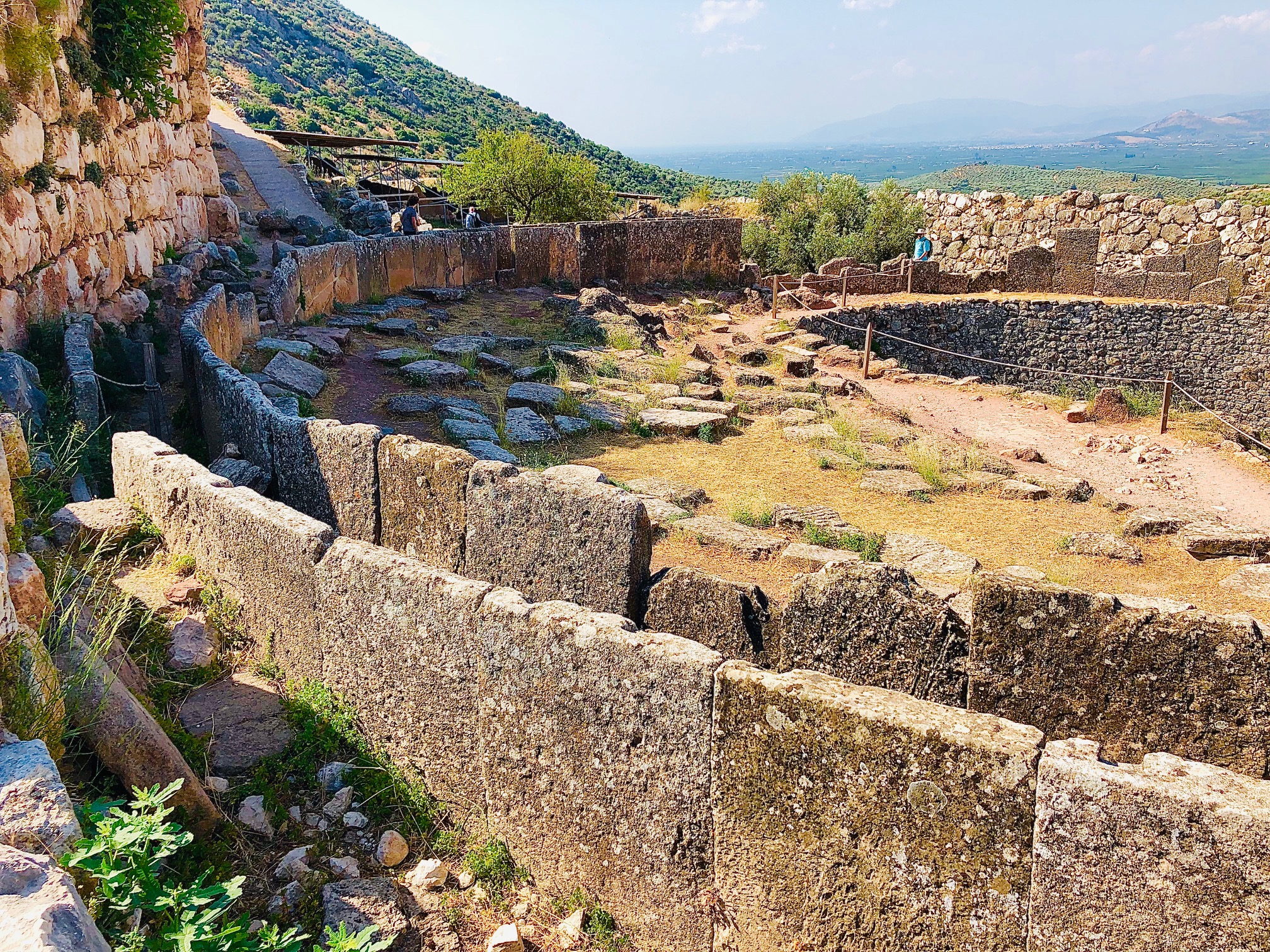
This is Grave Circle A, part of “an extensive cemetery” at Mycenae, according to a placard at the spot. “It was used exclusively for royal burials during the 1500s BC. The shafts, which you can walk down (see below), were near graves that held the bodies of royal family members and grave goods. Those goods can be found at the National Archaeological Museum in Athens. Here’s my post on that museum.
IMG_0075
This circular enclosure was an updated feature added to enhance the royal burial ground. When was the updating done? 1250 BC.
IMG_0080
A view from the citadel at the acropolis. The hillside is filled with myriad structures, foundations, and remains.  According to a nearby placard, most of the ruins visible today date to the 13th century B.C., but there is evidence that use of the site began in the Early Helladic period (3000-2000 BC.) 
IMG_0074
This is another photo from the citadel. Some of the structures on the acropolis include a large court complete with porticoes and antechamber, and the megaron, a political hub with administrative and military functions.
IMG_1615
We marveled at the size of this lintel piece on the citadel. 

There’s much more on the acropolis at Mycenae. Click here to see my other post about Mycenae that includes more photos from the top, including the House of Columns.

But for now, on to the museum…

IMG_0108
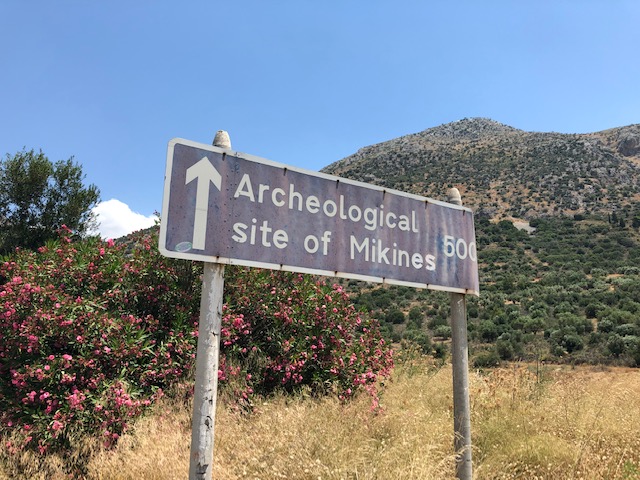
The sign at the entrance  to the museum reads in Greek “Archaeological Museum Mykines,” which English speakers say Mycenae.
IMG_0115
The cup looks very contemporary; however, it was made from 1350-1300 BC. The deep bowl in the back was made 1250-1150 BC.
IMG_0122
This ivory Mycenaean sculpture was made between 1250-1180 BC. It stands between only 3-4″ h. Read this post for more information about this little number.
IMG_0118
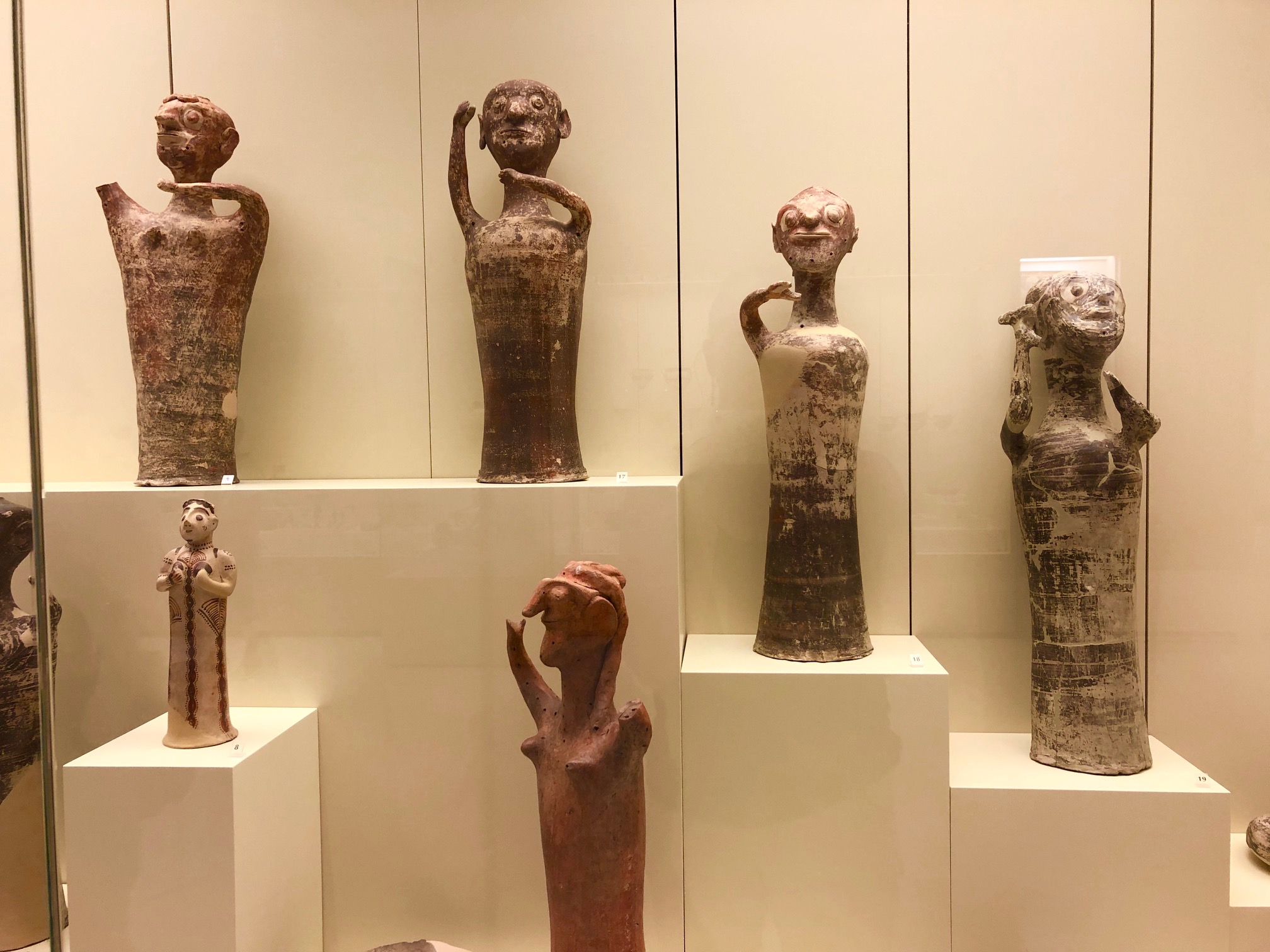
These “anthropomorphic figure” sculptures captivated me. I still am surprised at how contemporary the expressions and poses appear. These were made about 3,200 years ago… 1250-1180 BC! Simply stunning. 
IMG_0119
This anthropomorphic figure appears at the far right in the photo above.
IMG_0117
The spiral motif is timeless. This stairstep was decorated with a repeating pattern. 1450-1350 BC.
IMG_0124
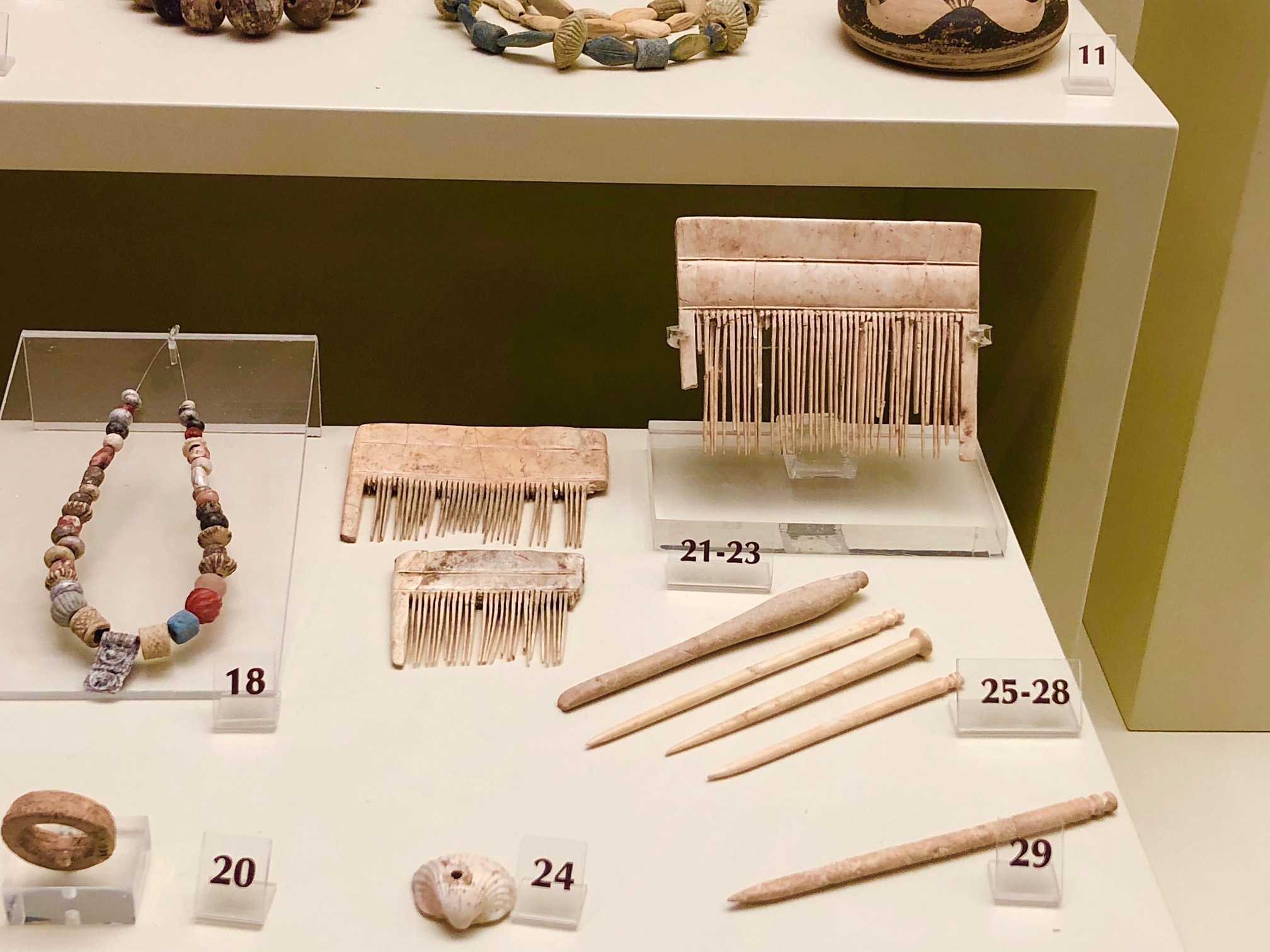
A variety of personal items were excavated from the sites at Mycenae. These combs are dated 1300-1180 BC. The colorful faience and glass necklace at left? 1400-1040 BC.
IMG_0121
This large storage jar is overwhelming in its size. 
Archaeological_Museum_of_Mycenae
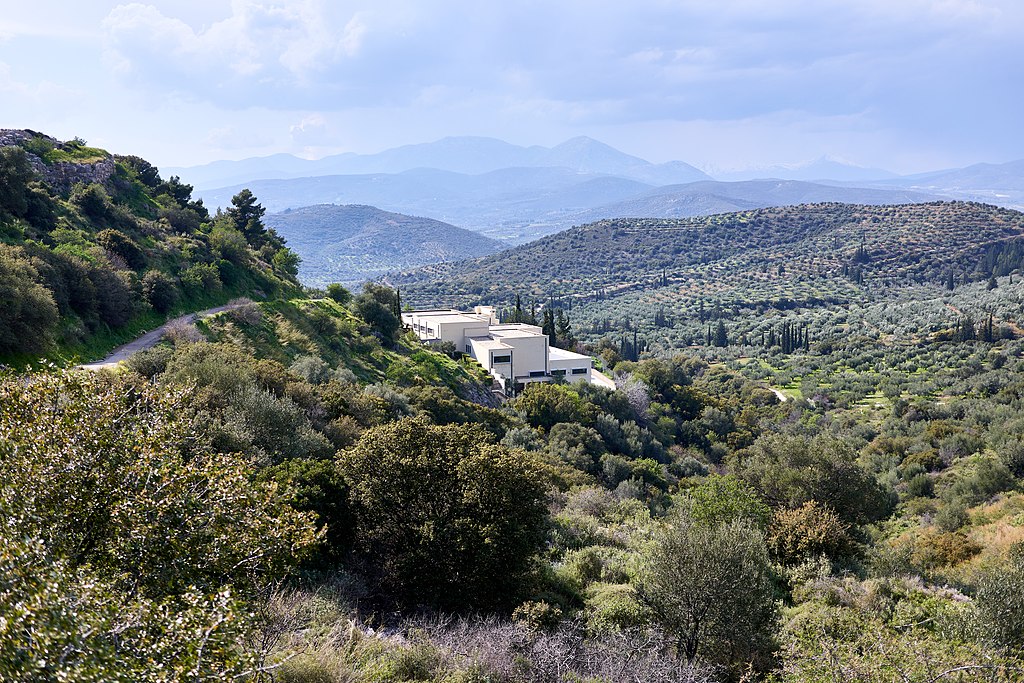
This photo, found on Creative Commons, shows the back side of the museum. When you visit the museum, you enter on the opposite side and and unable to see the various levels of the museum that descend down the mountain slope. Photo Credit: George E. Koronaios [CC BY-SA (https://creativecommons.org/licenses/by-sa/4.0)%5D

After touring the museum, we decided to leave the main site and walk back down the highway to bring our Mycenaean odyssey to a close. The sun was out in full force and we felt the pull of a mid-afternoon nap in our comfortable AirBnB. Here’s a post about our wonderful hosts.

IMG_0106
By the time we left, the crowds were increasing. Even so, the park wasn’t especially crowded. No lines. No waiting. No hassle.

But before that, we knew we wanted to check out the Treasury of Atreus, also known as the  Tomb of Agamemnon. One arrives at it when you head back down the highway toward the town of Mycenae. We had noticed it on our way up earlier that morning.

The Treasury of Atreus isn’t an afterthought… it’s a must-see.

IMG_1610
Just outside the main site, your ticket will allow you into the Treasury of Atreus. Here, you’ll find a guard station, a park bench or two under some pine trees, and, if I remember correctly, a vending machine. There are no facilities. 

But why is it called a treasury?

It’s called a treasury — and not a tomb — because treasures were placed inside to commemorate the ruler buried within.

IMG_0127
This is the Treasury of Atreus, also known as the Tomb of Agamemnon. It’s a large “tholos,” or beehive tomb on Panagitsa Hill at Mycenae. It was built in 1250 BC.

Just so you know…

The Treasury of Atreus has no real connection to Agamemnon. The Mycenae archaeologist Heinrich Schliemann named it thus and the popular name persisted. According to this article, the royal buried here would have ruled at an earlier date than Agamemnon.

IMG_0140
I took this picture looking back from the entrance to the Treasury of Atreus.
IMG_0134
That lintel above the entrance to the tomb weighs 120 tons!
IMG_0135
This is a more accurate picture of the inside of the Treasury of Atreus. It’s dark inside… and nice and cool, too.
IMG_0142
We walked along an asphalt highway up to the Mycenae Archaeological Site. It was a sunny and breezy day. 

I hope you enjoyed this photo essay about Mycenae. It’s a lonely yet so important archaeological site.

Greece, including the Peloponnese region (that part of Greece connected to the mainland by the land bridge at Corinth), offers a plethora of ancient sites. It’s truly difficult to visit them all. In fact, we already are making a list for sites to see when we return someday.

But in the meantime, if Greece is in your future, make time for Mycenae.


Thanks for reading! Make sure to leave a comment or share a thought about this post or to share news about your own visit to Greece. I’m looking forward to hearing from you. 

Featured Photo Credit: Marilyn Yung | Walking in the Grave Circle at Mycenae

Categories
Reviews of Books/Music/Films Travel Tips & Gear

A good carry-on for Volotea Airlines’ baggage policy

This bag is sized right and counts as one of your two free carry-ons

Last spring, I bought this little bag specifically because I knew it would qualify as a carry-on for an upcoming flight I would be taking on Volotea Airlines.

Later in June and July, we traveled on Volotea for one round-trip from (Skiathos, Greece to Venice) and a one-way trip from Athens to Heraklion, Crete.

Volotea requires the following measurements for the two carry-on bags each passenger is allowed. According to this page on their website, carry-on bags must be no larger than 55 cm high (21.65″), 40 cm wide (15.75″), and 20 cm deep (7.9″).  Also, each bag cannot weigh more than ten kg (22 lbs.).

In case you’re unfamiliar with Volotea Airlines (as I was a year ago), it’s a regional carrier based in Barcelona that connects eighty small- and medium-sized cities in Europe from thirteen hubs. For a listing of the cities Volotea serves, click here.

Volotea is a low-cost carrier; your ticket gets you to your destination. Period.

Extras—and there are plenty, wink-wink—add to your ticket price.

For example, make sure you get the right bag. If you attempt to check in with an over-sized bag, it will be placed in the hold and cost you 60€ (approx. $67) PER BAG. Ouch.

I plan to write another post about other ways to keep your Volotea ticket price low, so follow this blog to get that post.

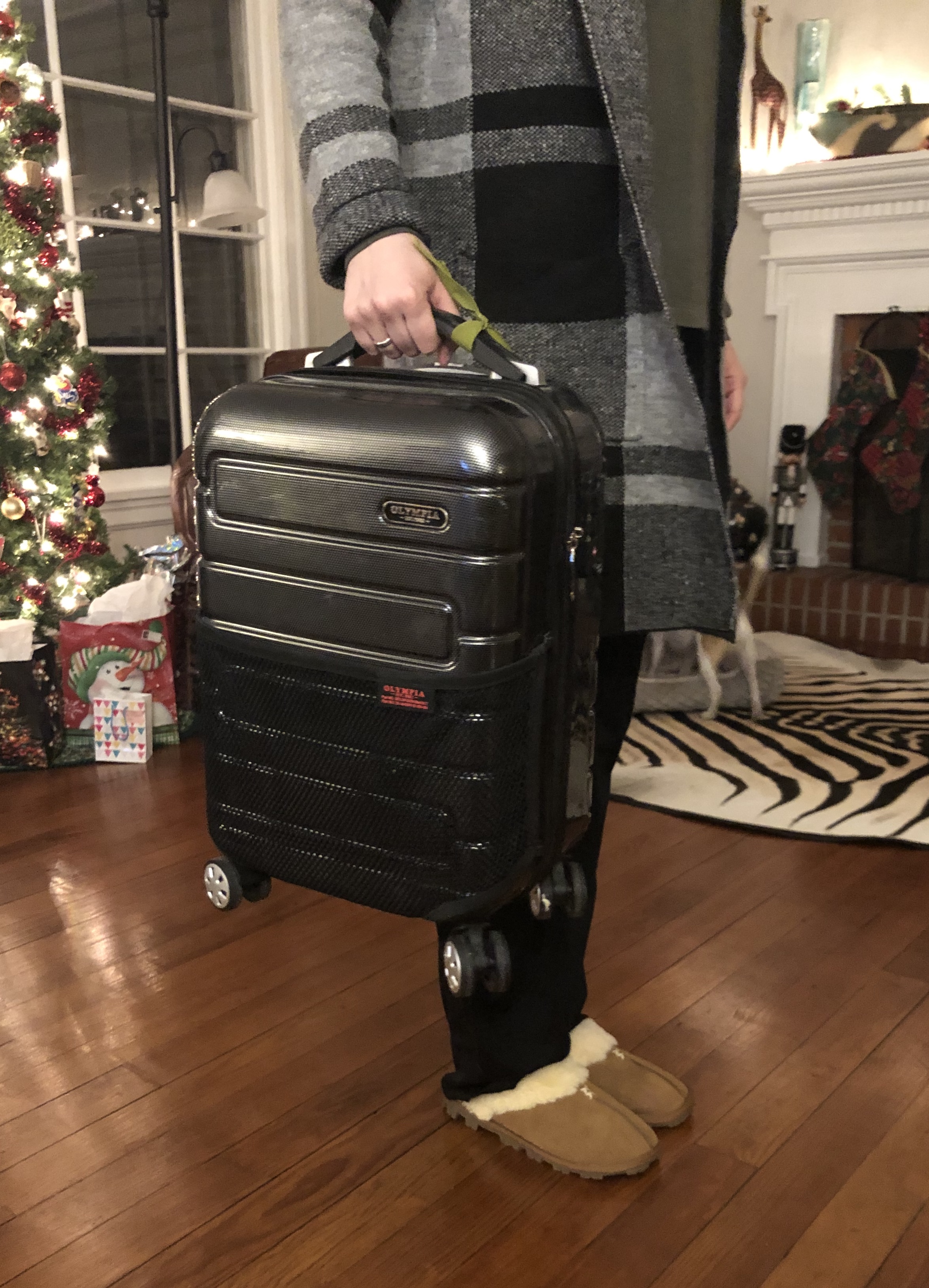
This little bag worked perfectly for me. It’s made by OlympiaUSA, and is called the Nema 18″ Under the Seat Carry-on. It measures 18″ high, 12″ wide, and 8″ deep. Clearly, it has plenty of room to spare. Last summer, this particular bag, which I bought at a local TJMaxx store for $50 (suggested retail $200), easily fit into the overhead bins on Volotea’s aircraft, which includes Boeing 717s and Airbus A319s. This bag gave me the option of placing it in the overhead bin or under the seat in front of me.

IMG_2220

A bag like this one worked perfectly for me then and now. I continue to carry it on short weekend trips, for example, when a canvas tote or small duffel would work as well. It’s so easy to pack and roll around.

Its hard sides provide better protection to your belongings, and allows, in my opinion, for better, more efficient packing. Soft-side luggage just doesn’t travel as well.

Yes, you’re able to jam-pack lots of stuff inside, but it becomes just that… a jam-packed, lumped together mass of clothing, toiletries, souvenirs, and whatnot.

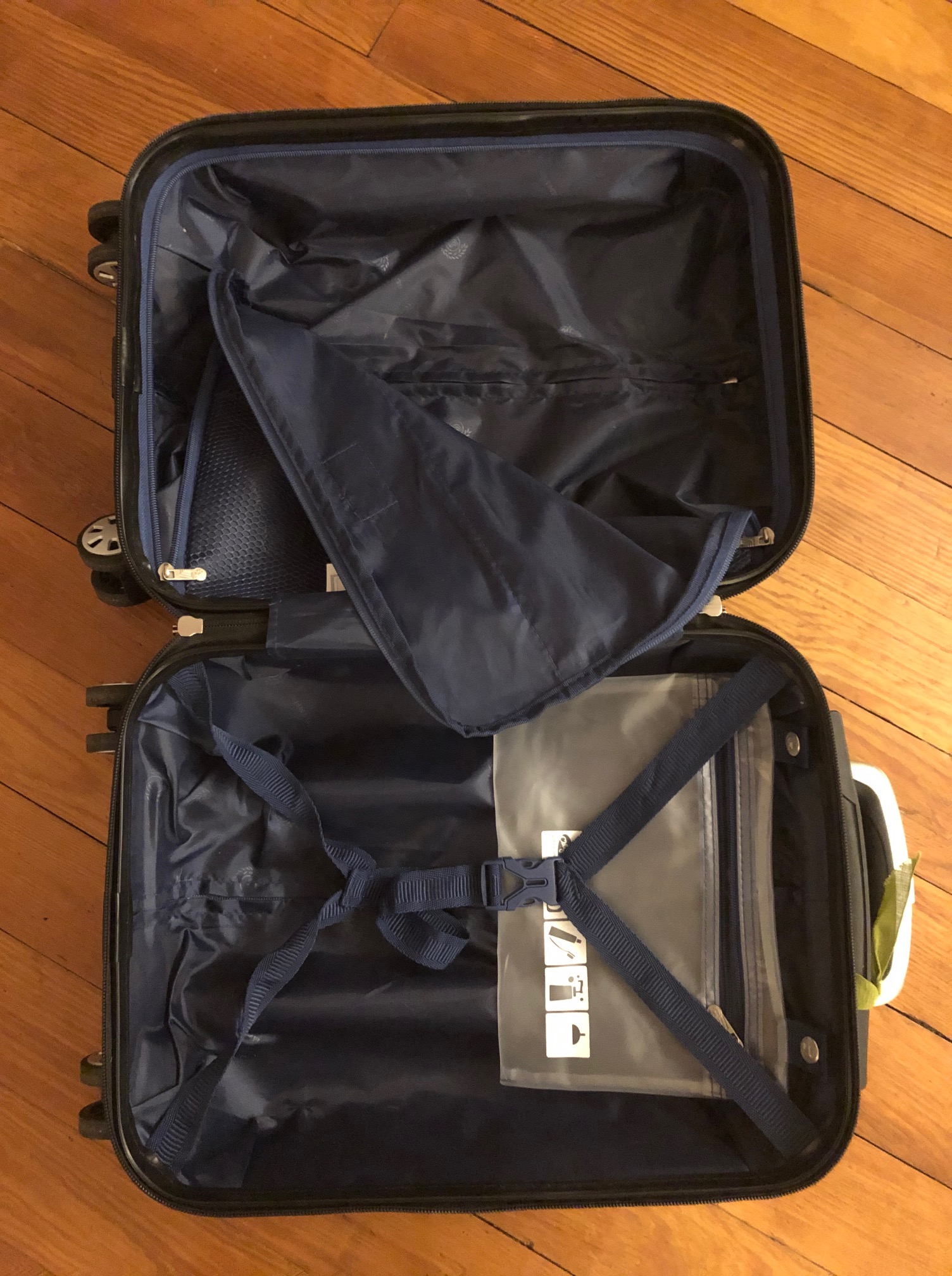
Here’s an inside view of the bag below. There’s a plastic bag with zipper for wet articles or things that need to be kept separate. It’s amazing how much stuff I jammed into this little case. I took it, along with my purse, on a five-day excursion to Venice and it held more than I actually needed.

IMG_2217

Other benefits to this bag:

  • It’s light, weighing only 5.7 pounds.
  • It’s sturdy.
  • It is deceptively roomy.
  • The handle is aluminum and always felt sturdy and strong.
  • The wheels roll smoothly.  The only time I didn’t roll this bag was when I needed to carry it over a gap in the walkway or over cobblestones.
  • It contains a TSA-enabled three-dial lock. You can lock it, but TSA personnel can still open it for an inspection. But honestly, I never locked it. I took this bag so I wouldn’t have to check it for storage under the plane; as such, I was present whenever the bag was looked through.
IMG_2219
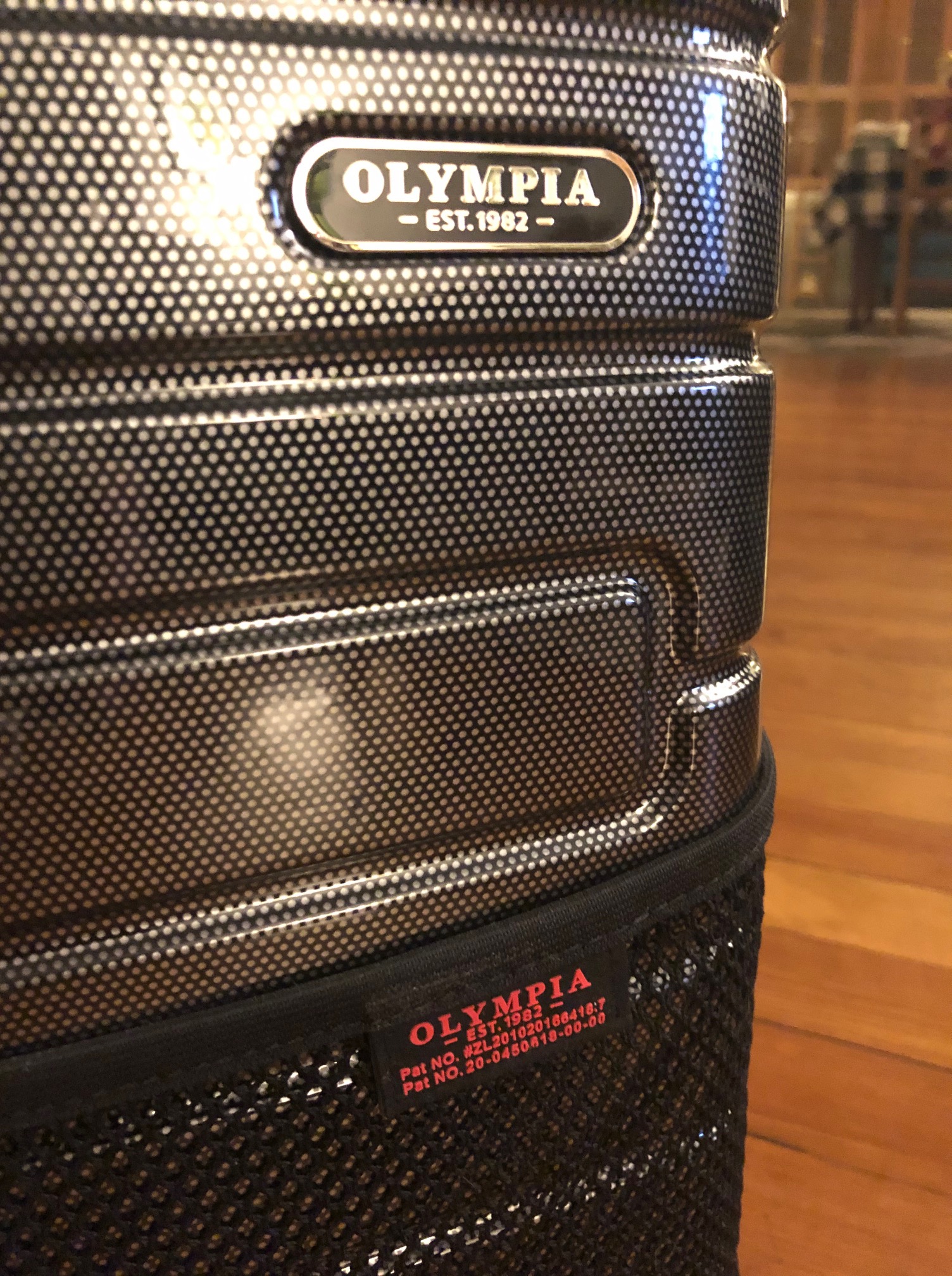
Look for the Olympia label if you want to find this exact suitcase; however, there are many manufacturers that make this size and similar others now.

I plan to use this bag—and only this bag—on my next overseas trip. Yes, that might be a challenge, but based on my experience, I think I can do it. After all, it’s roomy enough, yet small enough, to take on any airline… even other regional carriers similar to Volotea. It will also save so much time and hassle at baggage claim.

IMG_2218

And just think, because I won’t have to check any bags, lost luggage will be an impossibility! Won’t that be great?!


Thanks for reading! Follow  my blog for another post about how to keep your Volotea Airlines ticket prices low. The company is a stickler for printed boarding passes.  Here’s are some links about my trip to Venice and also Heraklion.

Categories
US (Missouri) US Travel

La Petite Gemme Prairie: like none other in Missouri

A short afternoon outing west of Bolivar, Missouri


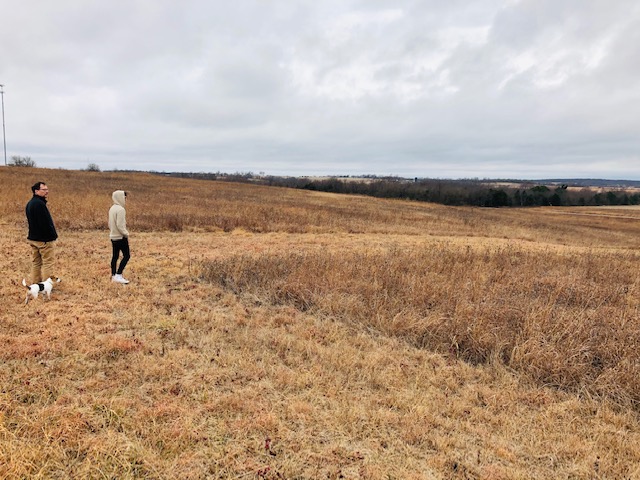
Today after lunch, my husband, daughter, son and I ventured out to La Petite Gemme Prairie just a mile or so west of Bolivar. My son told me recently about this nature preserve, but we hadn’t taken time to go see it until today. We decided to take a short jaunt out to see what we could.

And honestly, this is likely NOT the prime time of year to see this sight.

It takes a keen eye, an ability to notice subtle colors and textures, and an open mind as to what exactly constitutes beauty.

Must a landscape always contain exotic foliage, flaming sunsets, and towering mountains to be considered beautiful? Can the somber, drab colors of deep December reveal their own beauty?

I’ll let you decide as you peruse the shots I took as we walked the 37-acre preserve.

IMG_2273
There’s a gravel parking lot sized for about four vehicles just in front of this sign. We parked here and then took out walking.
IMG_2274
Unspoiled prairie land…

For more background on the preserve, here are some details from the yellow informational sign that appears near the end of this post:

“The 37-acre area was purchased by the non-profit Missouri Prairie Foundation in 1977. It is owned by the MPF, and co-managed by the MPF and the Missouri Department of Conservation. A botanically diverse and scenic upland prairie on soils derived from shale and limestone, La Petite Gemme is a beautiful spot in which to relax and wander. The name is French for “the little gem” and recognizes the French influence on Missouri as well as the gemlike quality of the prairie wildflowers.”

IMG_2237
First, you walk up this mowed path to the top of the hill.
IMG_2239
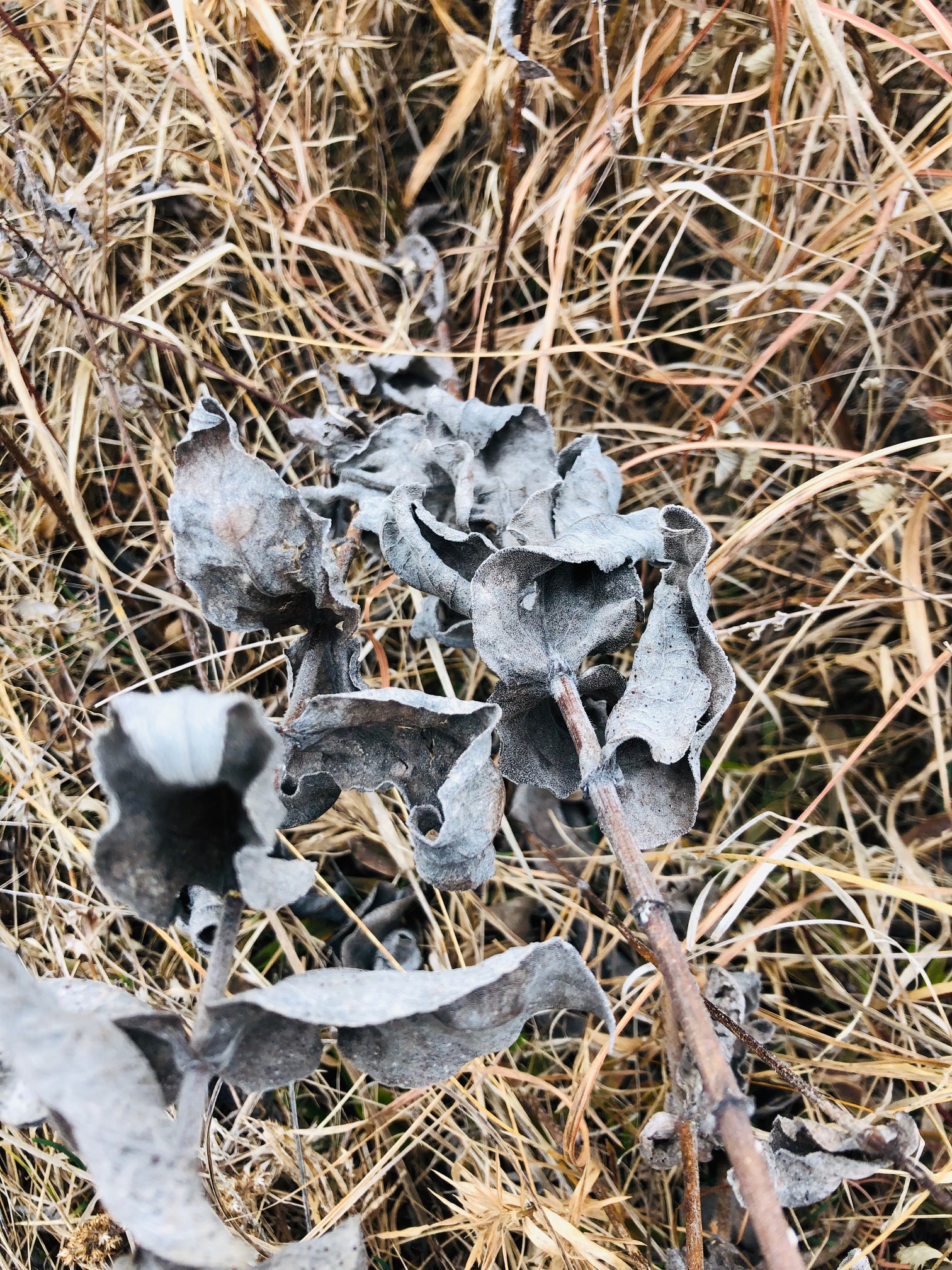
The curly lines of these silver-hued leaves caught my eye.
IMG_2277
Francie, our Jack Russell-Rat Terrier, burned off some energy this afternoon.
IMG_2236
The dark dots positioned against the golden vertical lines of the grasses is a nice contrast.
IMG_2240
The color of these delicate leaves!

Here’s an impressive list of flowers and creatures that make this preserve their home. All of these are listed on the yellow sign that appears at the bottom of this post.

IMG_2241
Here is the view of the countryside further west of Bolivar.
IMG_2243
Once you’re at the top of the hill, the mowed path takes you back down to the other side.
IMG_2246
These unspoiled prairie grasses grow off to the side of the path.
IMG_2252
I love these roller coaster blades of grass that careen over, under, and around the tufts of native grasses.
IMG_2247
Wild rosehips dot the walking trail.
IMG_2251
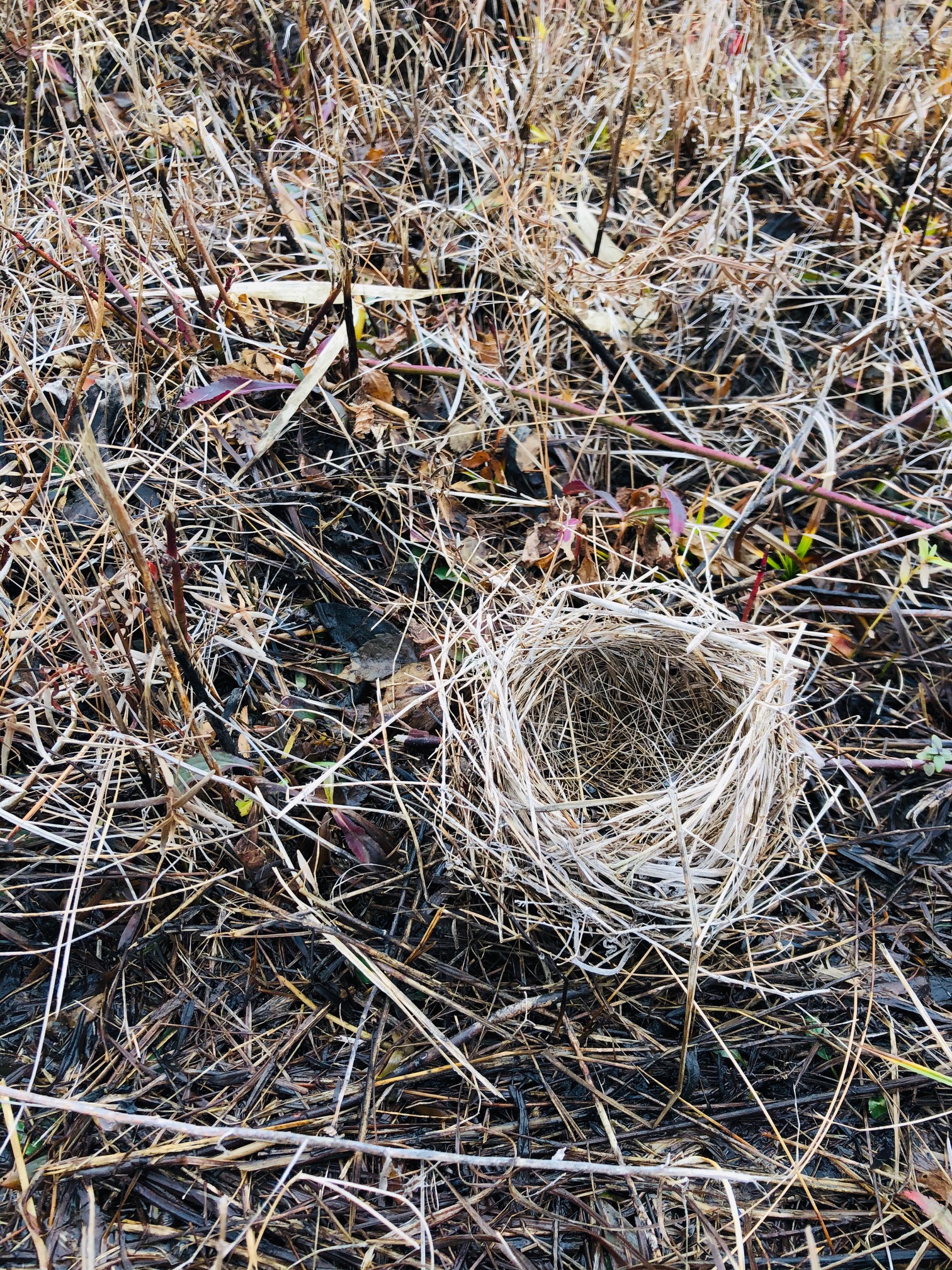
This nest appears to have been built in the middle of the path. Either it blew onto the path from a breeze, or this place sees little traffic this time of year. Either explanation sounds reasonable.
IMG_2257
My daughter noticed this deer trail veering off from the walking path.
IMG_2258
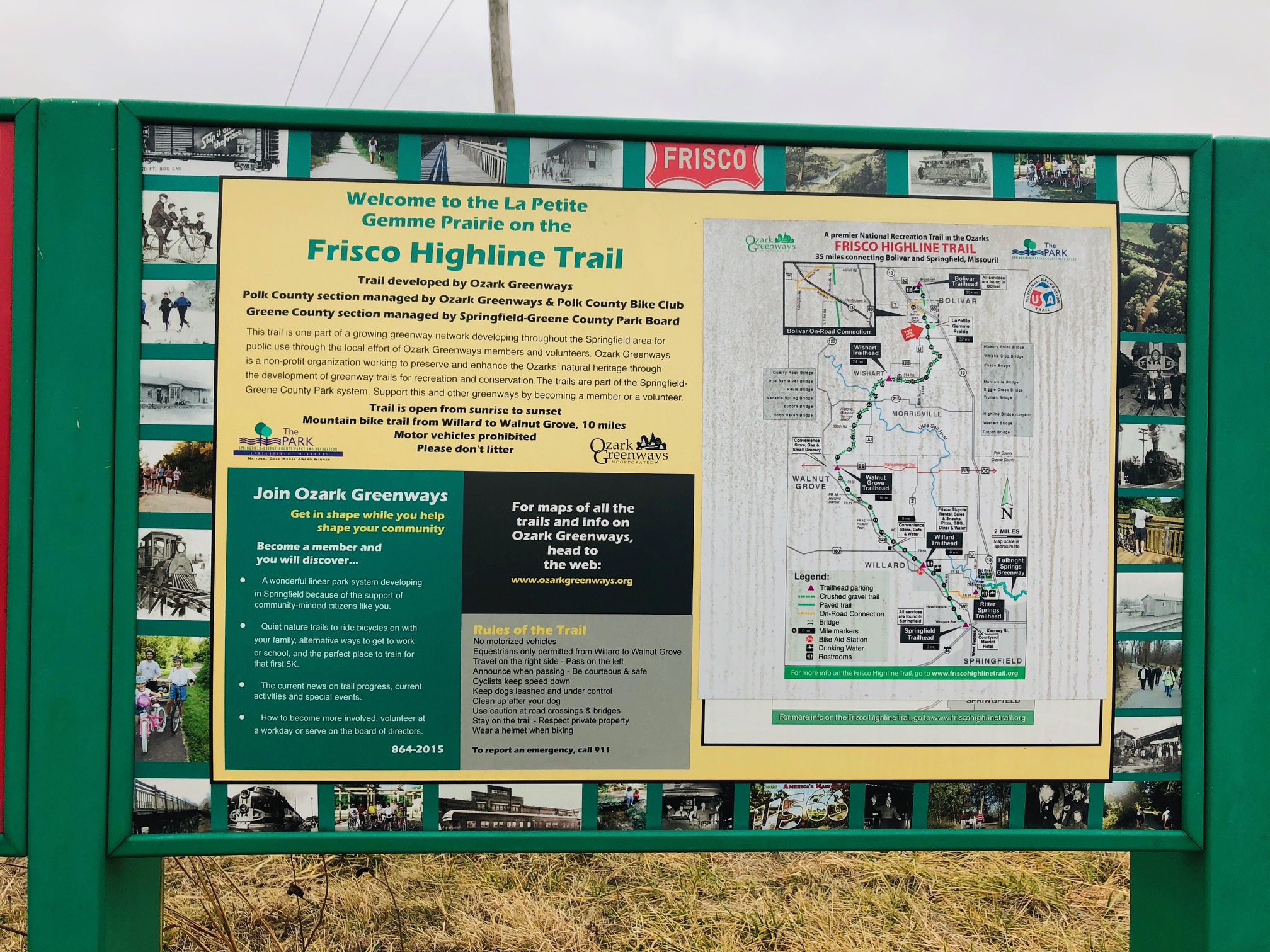
At the bottom of the hill, you’ll meet an asphalt path that travels north and south. It’s the Frisco Highline Trail, a “national recreation trail that connects Bolivar and Springfield, Missouri,” according to an informational sign along the trail. The trail is 35 miles long and follows the former Springfield and Northern Railroad tracks. The trail is managed by Ozark Greenways, a non-profit organization working to preserve and enhance the Ozarks’ natural heritage. Open from sunrise to sunset, no motor vehicles are allowed on the trail. 
IMG_2260
Ahhh, siblings!
IMG_2262
Here’s a trail marker along the asphalt trail heading north. 
IMG_2264
These signs can be read as you approach the prairie from the north. Some close-up shots of the signs are below.
IMG_2265
Signs provide information about the flora and fauna… 
IMG_2267
…of the native prairie.
IMG_2271
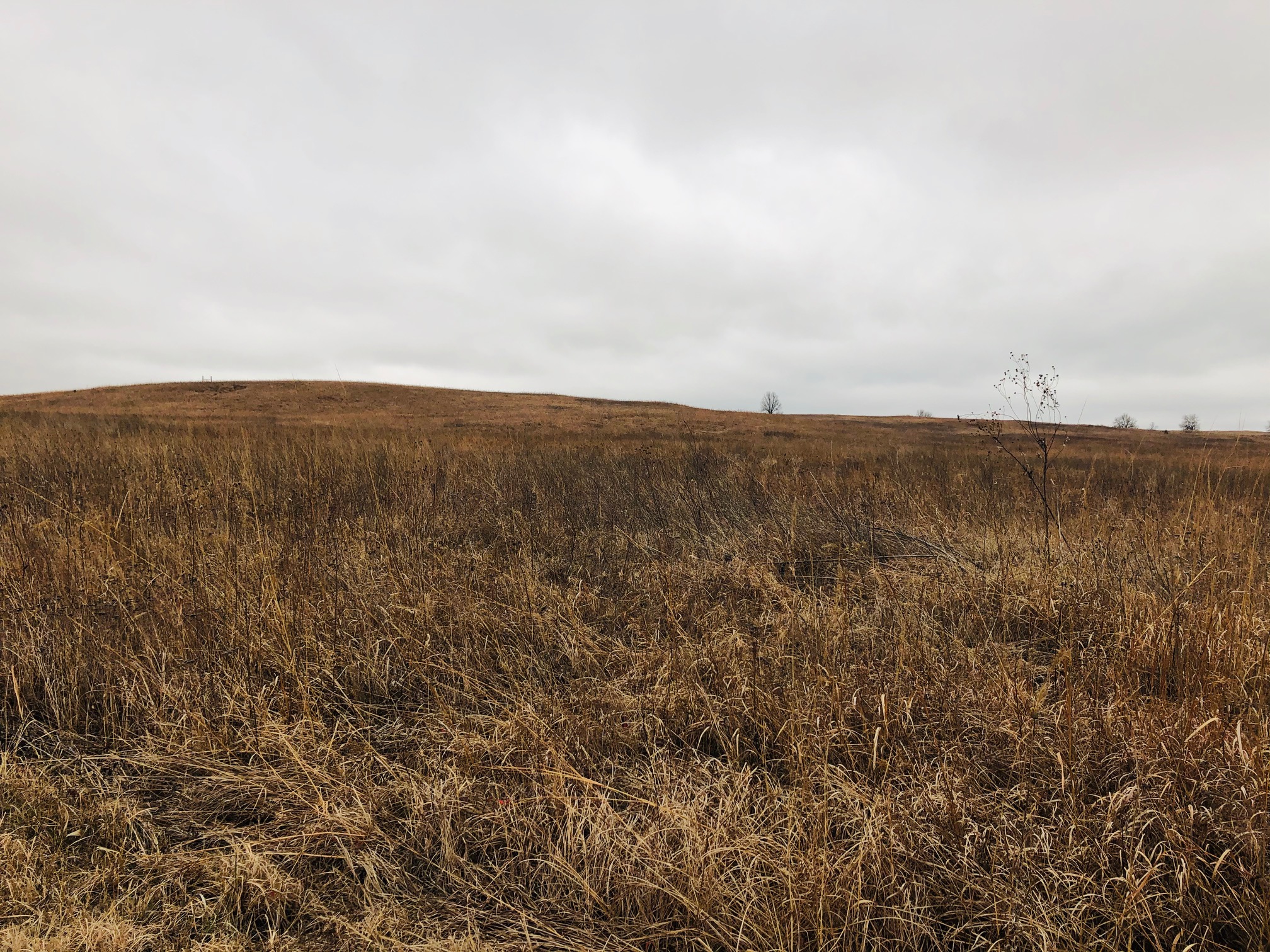
I took this one final view after taking our walk through Le Petite Gemme Prairie.

Thanks for reading! It was a mild 65 degrees F when we started out for the prairie, but as we walked, the temperature cooled, the wind picked up, and as we loaded into the car, a misty rain settled in. Back home now, I can still hear the rain gently falling outside. 


Categories
South Africa

Port Elizabeth, South Africa: The travel is in the details

A haircut, Iron Brew, and biltong in Port Elizabeth

It was raining still. Watery pellets pounded the windshield of our rental Volkswagen minivan as Pieter, our tour guide and professional hunter, searched the streets of Port Elizabeth for a barber shop.

“I need a haircut,” he had told us that morning when we left our lodge in Storms River. He rubbed his stubby fingers across his already short crew. “Yes, I need a haircut.”

After driving for an hour and a half, we had arrived in Port Elizabeth, a city of 312, 000 smack in the center of the South African coast. Back then in 2012, using GPS on a cellphone wasn’t as sophisticated as it is today, and driving up and down the streets of Port Elizabeth’s central business district was the more efficient way, apparently, of locating a barber.

Pieter peered left then right from the driver’s seat, pivoting his huge hunched shoulders back and forth. “I know there’s one here somewhere,” he muttered, careening around another corner. With each turn, my right knee pressed painfully again a white-and-blue striped plastic cooler wedged between the driver’s and front passenger seats. An empty can of Iron Brew soda rolled behind my ankle and into the well alongside the van’s sliding door.

“There she is,” Pieter purred seductively. “At last.” He pulled up to a dimly lit blonde-brick salon. A simple white sign hung squarely above the front door. A black curvy font in capital letters read: The Hairline. “At last we meet,” he shouted. The sudden burst of energy shocked my mother- and father-in-law, husband, daughter, son, and me to attention. It had been a long morning of driving in the mists of a typical South African winter, and we needed to get out.

An establishment called The Hairline was sure to offer a basic haircut, Pieter assured us, as he tossed my father-in-law the keys to the van. “Back in thirty minutes,” he called.

Through the foggy windows of the van, my husband noticed a drugstore five doors down.

“They’ll have a Sudafed equivalent, don’t ya’ think?” my daughter asked. There was only one way to find out, so we left my in-laws behind and ventured into the icy, blowing mist.

After purchasing our “Sudafed,” we lingered in the drugstore to peruse the variety of non-drug products: sunglasses, Cadbury chocolate, umbrellas, magazines, souvenir key chains, magnets. We analyzed a minuscule selection of locally-made biltong, a jerky-like snack, arranged in a red wicker basket on the cashier’s counter. The biltong seemed as out of place in a pharmacy as I felt on the side streets of a South African industrial port city, I thought.

I checked my watch. “It’s been thirty minutes,” I said, motioning that it was time to head for the van. Sure enough, Pieter and about three thousand very short hairs were waiting on us.

That was the last time I would see Port Elizabeth, perched along the very southern edge of the African continent. It was not an eventful visit, but it was memorable. After all, we should not underestimate the power of details, no matter how small or seemingly insignificant.

I’m sure many will scoff at our scant, all-too-brief encounter with the city now known as Nelson Mandela City. To be sure, there are many deserving and fascinating sights to see there.

As we left the city in the dim, rainy morning of middle June, I watched the ships, barges, and freighters skim over the whitecaps of the distant bay. The vessels resembled tiny dashes and dots. A bright white Morse Code against the waves, the vessels sailed steadily to their next destination.


This post was originally published last spring on Medium.com. Somehow, I never cross-posted it to this blog. Our trip to South Africa happened in 2012; it’s just now that I’m documenting some of our memories—both the memorable and the more forgettable ones—on my blog. Check out my South Africa category for more stories from this trip.

Categories
Italy (Venice)

The Jewish Ghetto of Venice: A Walking Tour

IMG_9798
It was a warm, sunny day when we visited the Campo di Ghetto Nuovo, the square that anchors  the Jewish Ghetto in Venice’s Cannaregio in the northwest part of the city.

Five facts and photos from our brief visit to this less traveled Venetian sight

In June, my daughter and I took an afternoon in Venice to see the Jewish Ghetto located in the Cannaregio sestiere, in the north of the city. Two years earlier, on a previous week-long trip to Venice, I had wanted to see the ghetto, but ran out of time. Therefore, in June, it was still on my return trip bucket list.

58213627208__C41ACE90-D037-4DDC-A02F-CF12DF811372
My daughter and I on our way to Cannaregio to take a walk through the Jewish Ghetto.

Honestly, we didn’t plan this little jaunt well. We just took off for Cannaregio shortly after lunch on the last day of my visit. (She had the day off from her two-month internship at the U.S. Pavilion of the Biennale del Arte and wouldn’t be leaving for another month.)

So while I wish I had taken a guided tour offered by the Jewish Museum of Venice and was able to tell you more about Venice’s Jewish Ghetto—the first of its kind in the world—I’m still grateful that we spent the hour or so there.

Even so, with the recent flooding in Venice, the ghetto has suffered. Fortunately, the synagogues are located on top or upper floors. According to this article in The Jerusalem Post, a storage facility and kosher restaurant were damaged. 

To find the ghetto, we used Google Maps, rode a vaporetto to the train station (the Ferrovia stop), and then wound our way through Cannaregio. We crossed a bridge, made a left alongside a row of shops bordering the canal, and walked right past an easy-to-overlook brick tunnel.

Following Google Maps, we turned around eventually, and wandered through that brick doorway. We followed the maze. Within a minute or two, we walked by a shop full of art prints and originals, a jewelry store, a book seller, a bakery.


It was quiet in the darkened corridors.

We heard the rumbles of the vaporetti (water buses) in the distance, layered behind the sounds of our own footsteps.

IMG_9794
This sign was posted within the front windows of an art shop down a corridor just off the the main campo of the ghetto.

After browsing through some lithographs and snapping a picture of the detailed sign above summarizing the history of the ghetto, we entered the Campiello de le Scuole, the “little square of the synagogues.” A seven-story building stood plainly before us. I have read since that this building demonstrates the tight quarters the Jewish people were contained in. Judging by the windows, these units couldn’t have contained standard 8-foot ceilings. In fact, these buildings were “the tallest buildings with the lowest-ceilinged apartments” in Venice, wrote David Laskin in this New York Times article.

IMG_9795
This building in the Campiello de le Scuole shows how concentrated the floors were.

We continued past this small square. Not more than one minute further into the labyrinth, we found ourselves in the main campo of the Jewish Ghetto, the Campo de Ghetto Nuovo.  In the square, a dozen people mingled and conversed quietly. A small tour group gathered at the base of the Jewish Museum of Venice.

A boy wearing a yarmulke, who looked to be about twelve years old, kicked a ball in the cool shade under a covered overhang on one of the many multi-story buildings that lined the campo. 

The afternoon was clear and sunny. And hot. It was the perfect day to tour cool and darkened museums and synagogues. But alas, we hadn’t planned well enough to do that. Perhaps on my next visit to Venice (I can’t imagine there’s not another one in my future!), I’ll plan better. In the meantime…

Here are five facts I have learned since about Venice’s Jewish Ghetto:

  1. It was established by the Doge Leonardo Loredan in 1516, according to this website. The ghetto in Venice was one of the world’s first places where people were forcibly segregated because of their religion. An observance of the 500-year anniversary of the establishment of the ghetto was held in 2016. A major art exhibition at the Doge’s Palace, special performances at the Fenice Opera House, and other events around the city were held to mark the milestone.

2. The English word “ghetto” is derived from the Jewish Ghetto in Venice, originating from the Venetian word ghèto and the Italian word ghetto, according to Chabad.org. The word “geto” in the Venetian dialect referred to a foundry, which was located nearby. Eventually, the word was used to refer to the area that contained the Jewish people.

IMG_9809
This is a nursing home that forms one side of the campo.

3. At its height, around 1650, the Ghetto housed 4,000 to 5,000 people in a space roughly equivalent to 2-1/2 city blocks. Later, in the years prior to World War II, about 1,300 Jews lived in the Ghetto.  During the war, 289 were deported by the Nazis to Auschwitz and Trieste; only seven returned.

Today, about 450-500 Jews live in Venice. A small number still live in the ghetto.

4. During the ghetto’s early years, its residents were limited as to where they could travel and work. They also had to pay for their own watchmen and security. In addition, their clothing was used to mark them: men wore yellow circles sewn to their left shoulders of their clothing; women wore yellow scarves.

Image result for venice jewish museum
Photo courtesy of The Jewish Museum of Venice

5.  There are five active synagogues in the Jewish Ghetto today. To see the synagogues, one must sign up for public guided tours conducted by the Jewish Museum of Venice. Tours are scheduled every half hour starting at 10:30 and ending at 17:30. Tickets are 12 Euro each. Visit this website for more information.

IMG_9799

The plaque below describes the above sculpture, titled The Last Train, created by sculptor and Lithuanian-Jew Arbit Blatas. The sculpture shows Jews being loaded onto cattle cars. I believe the top line on the plaque is a dedication of the sculpture by the Jewish community of Venice to those deported to concentration camps of Nazi Germany.

IMG_9800

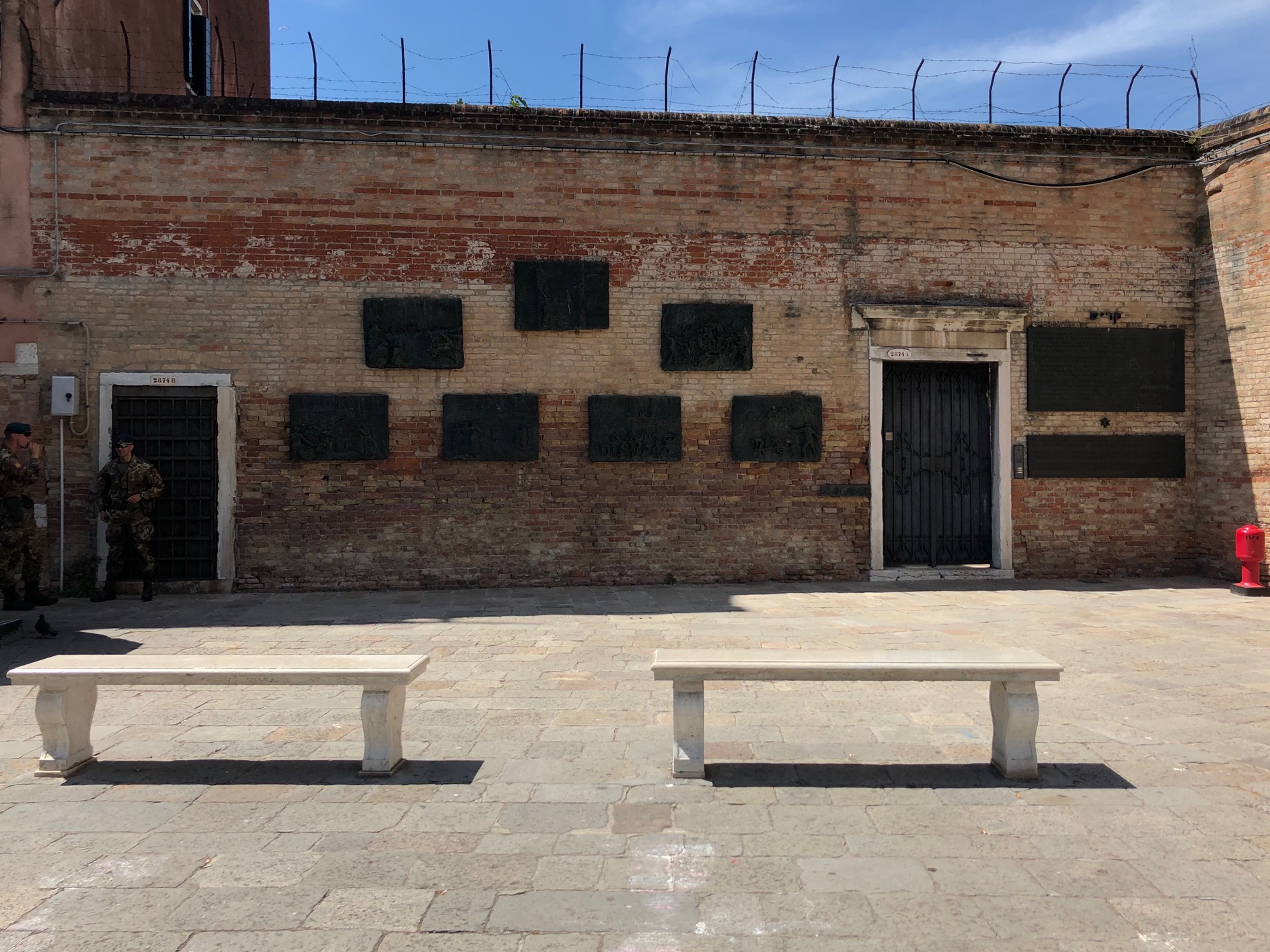
A composition of seven bronze sculptures depicts the atrocities inflicted upon the Jewish people during World War II. Close-up photos of three of these sculptures and the inscription plaques at far right are below.

IMG_9802
IMG_9807
IMG_9806
IMG_9805
IMG_9808
The top plaque reads: “Men, women, children, masses for the gas chambers advancing toward horror beneath the whip of the executioner. Your sad Holocaust is engraved in history, And nothing shall purge your deaths from our memories, For our memories are your only grave.”  The bottom plaque reads: “The City of Venice remembers the Venetian Jews who were deported to the Nazi concentration camps on December 5, 1943 and August 17, 1944.”
IMG_9811
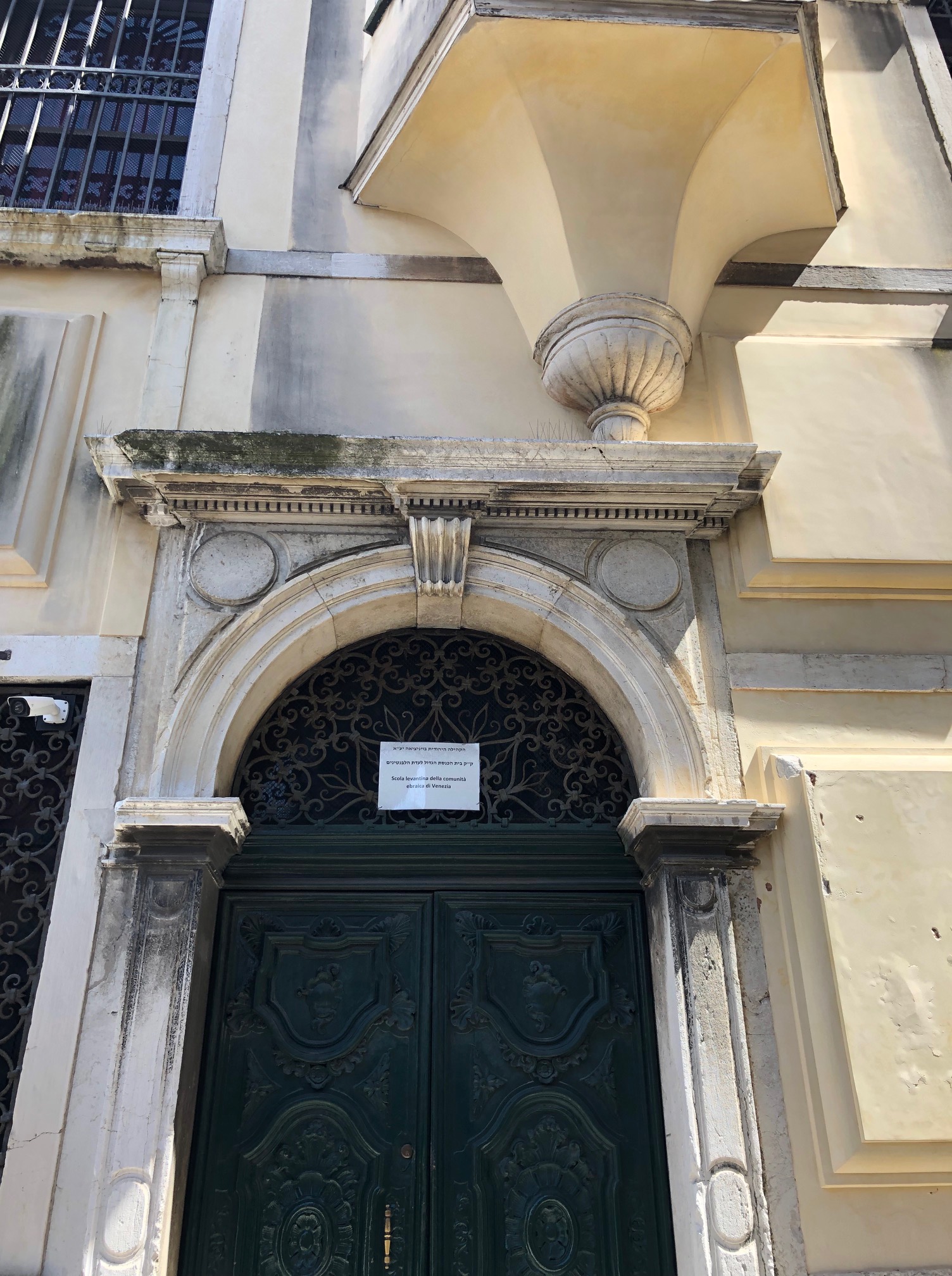
This is the door to the Scola Levantina, a synagogue just off the main campo of the ghetto.  It was built between 1538-1561. The distinctive cupola above the door makes it stand out from others in the area.
IMG_9801
This is another shot of the campo taken as we left the Jewish Ghetto.

Thanks for reading! This stop during my stay in Venice last summer was followed by a warm walk back through Cannaregio. On our way back to Santa Elena, we stopped along the Zattere at a Conad Supermarket for groceries we would need later that night for dinner. Follow my blog for more stories from my trip last summer to Skopelos, the Peloponnese, Crete, and, of course, Venice.

Categories
Uncategorized

Breaking into Dave’s Travel Corner

IMG_2029
This article was published on Dave’s Travel Corner. 

This huge travel blogging site published one of my recent articles

It’s nice to know that Dave’s Travel Corner, a leading and independent travel and lifestyle blogging platform with 500,000 followers across the major social media services, published one of the articles I wrote while in Greece in June. Actually, the post ran on Dave’s Travel Corner in July. I remember uploading it to the site’s “journals” page, a place for visitor-submitted travel stories.

The submission guidelines warn that publication may take up to a few weeks. It also warned that notification of publishing might not be sent.  Oh, well, I thought. I’ll just submit it and forget it.

Which I did. And then I “googled” myself over the weekend. About ten listings down, there it was: Dave’s Travel Corner.

IMG_2030

As a neophyte travel blogger, it’s nice to get more exposure for my writing. I spent quite a bit of time (three to four hours, I would guess) on this particular article.  Even though there isn’t any any compensation for pieces like this, I still appreciate seeing my writing qualifying for publication on a reputable, well-known travel site like Dave’s Travel Corner.

IMG_9110
This is the lead photo for the article published on Dave’s Travel Corner.

Thanks for reading! I’ve been really busy lately (I’m also a FT teacher) and it’s been especially hard to find extra time to publish posts to this blog. Hopefully, the upcoming holiday weekend will allow me a few hours to add a post about my visit to the Jewish Ghetto in Venice this past June.

Categories
Art Greece (Athens, Delphi)

The Zeus of Greek Museums

From golden goblets to frying pans to perfume

On our next to last day in Greece last summer, we capped off our Greek museum tour with a visit to the National Archaeological Museum in Athens. It was the last museum we would see, having already visited other museums in Athens (The Acropolis Museum), Mycenae, Delphi, Olympia, and Heraklion. You would think that we would have been “museumed out,” but actually each museum is so unique to its location that each one feels quite different from the others.

IMG_1215

So what sets the National Archaeological Museum in Athens apart from the others? In a word, I would say “breadth.” In fact, you will find the widest gamut of Greek artifacts and art. This museum has pieces from all those other areas we had visited across the country, in addition to hundreds (possibly thousands) more.

By the way, here’s a list with links to posts I’ve written about the other museums we visited in Greece:

For example, when we visited the Museum of Mycenae, the golden Mask of Agamemnon that was discovered in a grave circle there, was not held in that museum.

agamemnon
The original Mask of Agamemnon is in Athens; a replica is in Mycenae. Photo: Wikipedia

The mask on exhibit in Mycenae is a replica,  a guard told me. The original could be found in the National Museum in Athens, he added. Upon hearing this, we made a mental note to seek out the mask when we would eventually tour the National.

Watch this video from Khan Academy for more about this mask.

When one visits a museum in Greece, you truly feel that you are in the hub of antiquity. Each museum is an art historian’s dream;  art history students will also be amazed at seeing in person so many famous works commonly found in textbooks.

This description of the National Museum can be found on the museum’s website:

“The National Archaeological Museum is the largest museum in Greece and one of the most important in the world. Originally destined to receive all the 19th century excavations, mainly from Attica and other parts of the country, it gradually took the form of a central National Archaeological Museum and was enriched with finds from all parts of the Greek world. The rich collections, enumerating more than 11,000 exhibits, offer the visitor a panorama of ancient Greek culture from the prehistory to the late antiquity.”

IMG_1224
We saw Cycladic non-stick frying pans that date from 2800-2300 BC.
IMG_1226
These Cycladic frying pans really captured my interest since they resemble modern day frying pans.

Here’s a listing of the various collections within the museum:

  • prehistoric antiquities
  • sculpture
  • metalwork
  • vases and minor arts
  • Egyptian antiquities
  • Cypriot antiquities (those from the island of Cyprus).
IMG_1234
Ancient Greek Cauldrons
IMG_1237 (1)
Fragments of a fresco from Knossos Palace in Heraklion on the island of Crete. This is an image of a “figure 8 shield” covered in animal hide.
IMG_1236
Part of the museum’s collection of gold artifacts. These are from Mycenae’s Grave Circle A, where many tombs of the wealthy were found. The pieces are found in the shapes of cocoons (a symbol of rebirth), pomegranates (a symbol bounty), and butterflies.
IMG_1248
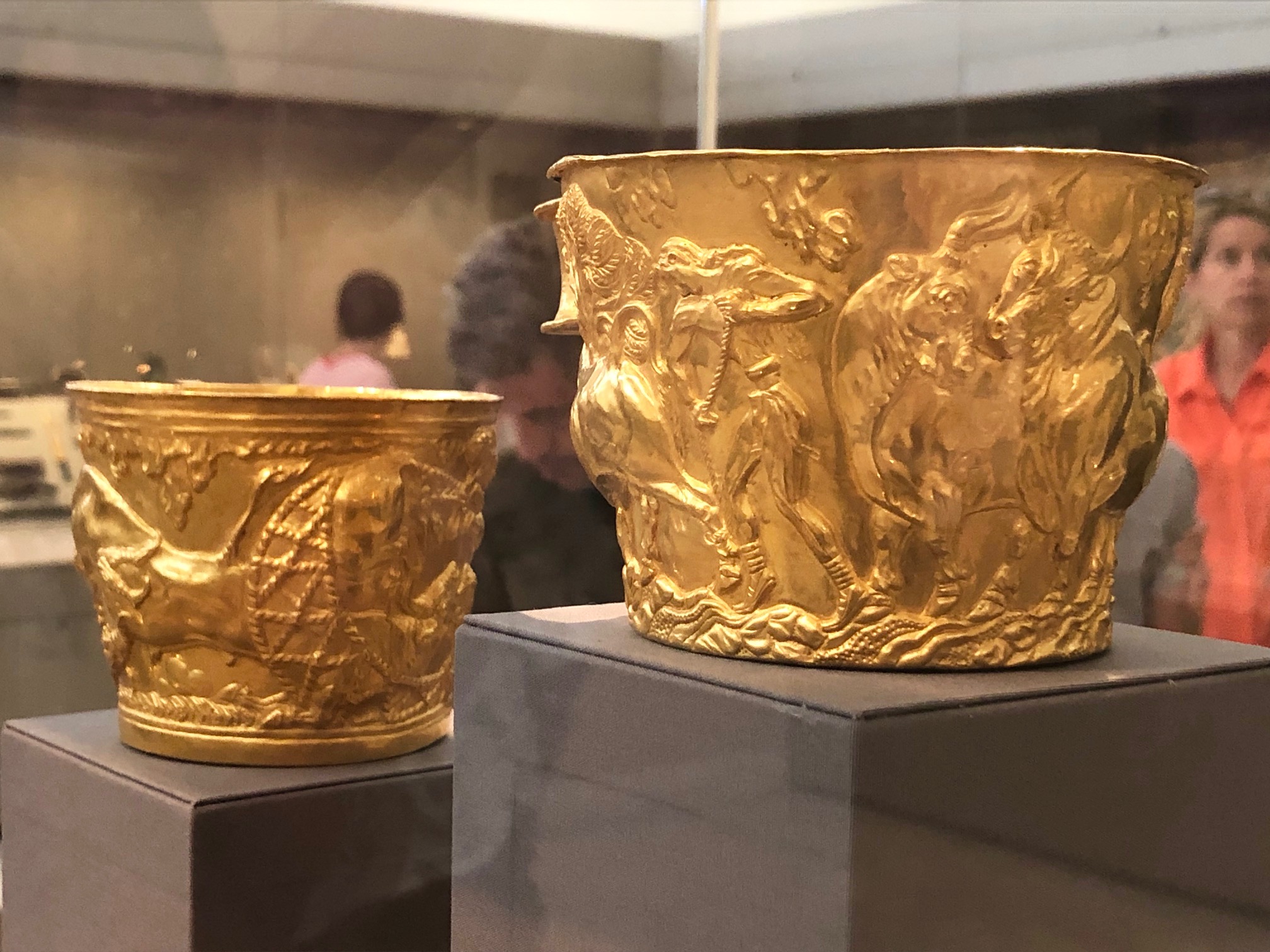
These golden goblets, known as the Vaphio Cups, are finely detailed and depict bulls.
IMG_1263
Egyptian artifacts proves trade between the early Greeks and Egyptians. The Greeks learn some of their quarrying techniques from the Egyptians. In addition, archaic kouros poses were borrowed from the ancient Egyptians.
IMG_1264
Part of a temporary exhibit, “The Countless Aspects of Beauty.”
IMG_1267
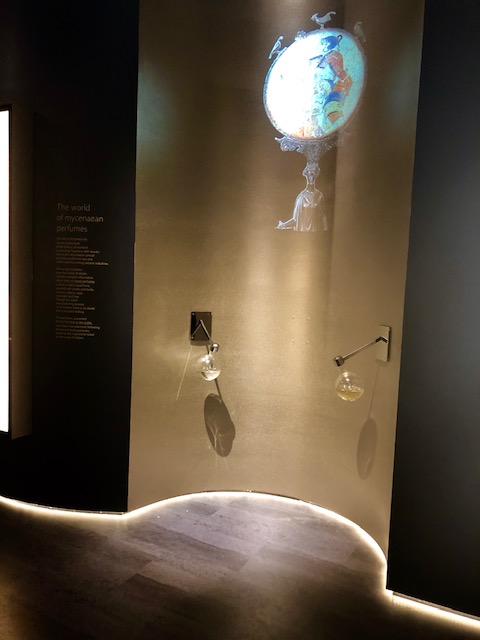
Vials of perfumes to sniff in the “Countless Aspects of Beauty” exhibit.
IMG_1282
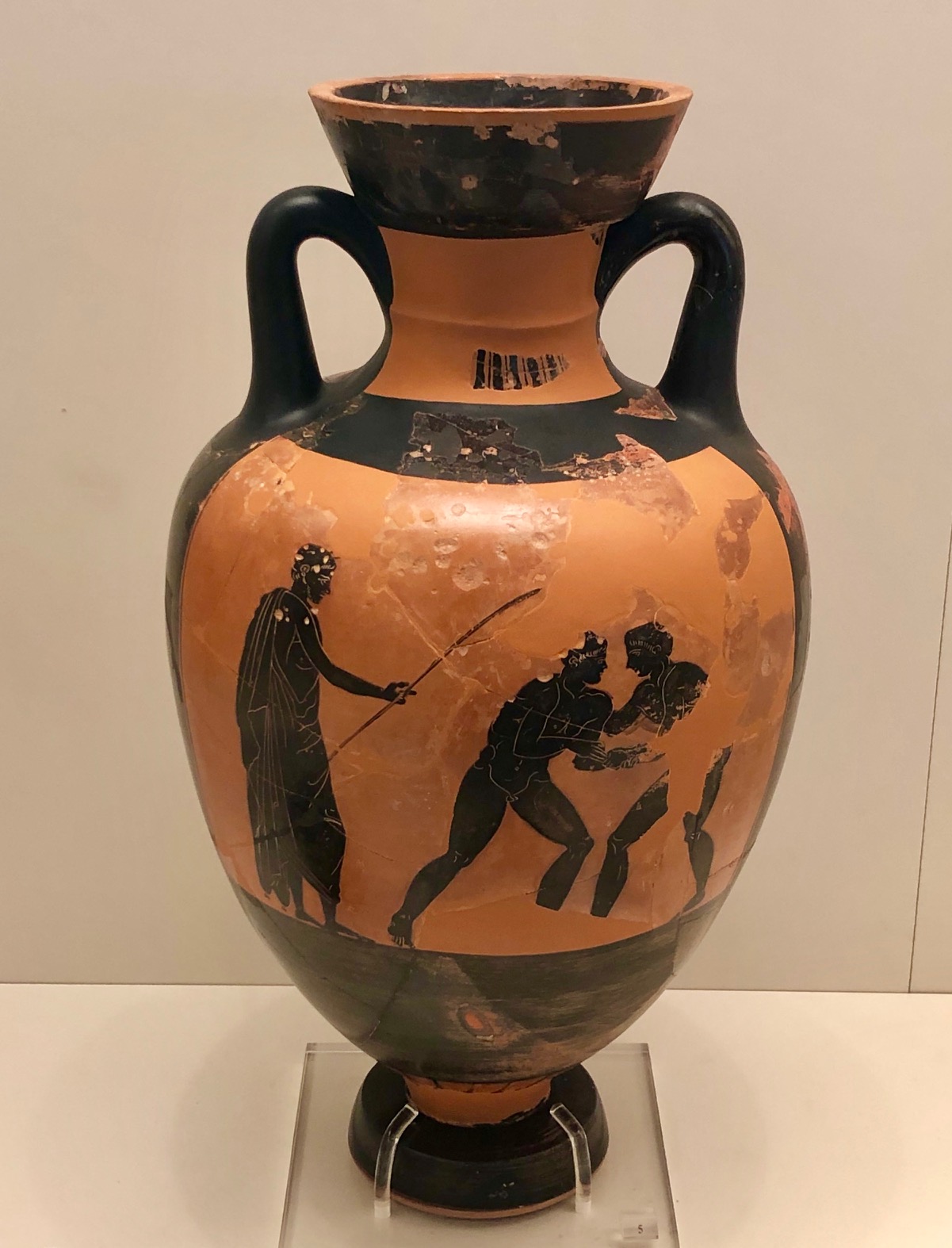
These amphoras (pedestal vases) were awarded at Panathenaia, an important festival held in honor of Athena in Athens.
IMG_1274
Close-up of an amphora.
IMG_1254
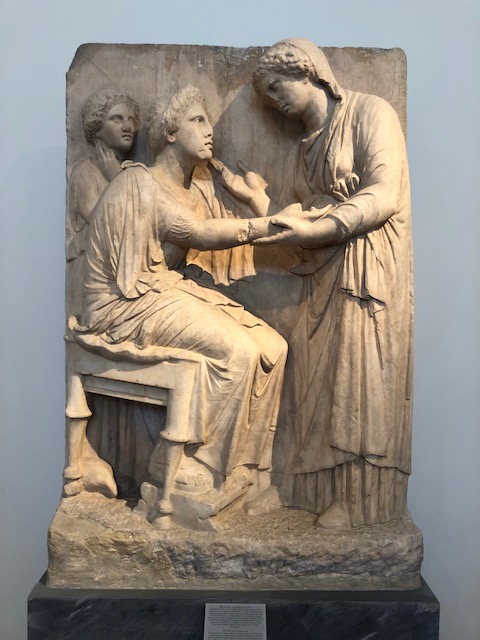
Members of the Roman Julio Claudian Dynasty (31 BC-68AD). During this period, Greece was a Roman province.
IMG_1251
IMG_1256
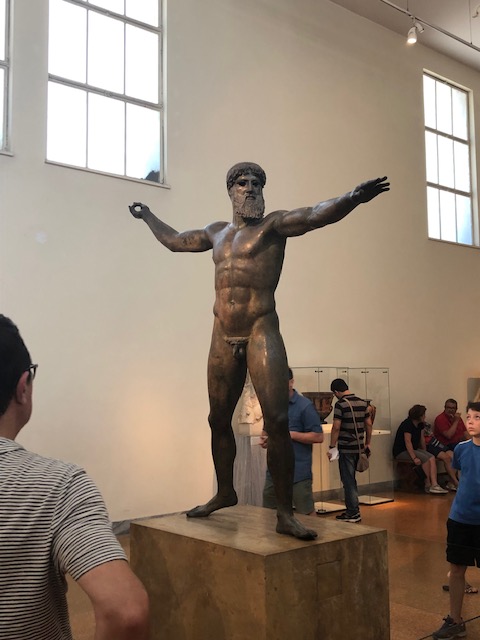
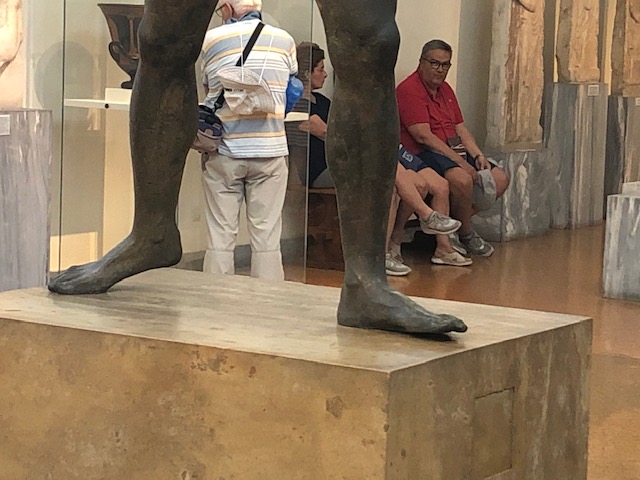
Renowned bronze of Zeus or Poseidon found on the Cape of Artemision, in northern Euboea near Athens.
IMG_1260
This Zeus, in the Severe style, also known as the Early Classical style, “marks the breakdown of the canonical forms of archaic art and the transition to the greatly expanded vocabulary and expression of the classical moment of the late 5th century,” according to this Wikipedia article. Works in the Severe style show a change in drapery of clothing.
IMG_1259
The Severe Style more accurately represents the human body. Also, Severe style works have an “interest in emotion and motion.” As for emotion, figures reveal a more serious character and expression.  As for motion, figures are under strain or in action, but always in motion.
IMG_1217
Here’s an example from the museum of an early Cycladic figure that shows the contrast of earlier artwork to later pieces of the Severe style.
IMG_1271
Close-up of the youth Perseus or Paris. Also of the Severe style, this is a good example of how artists commonly used bronze to produce their sculptures.

Visiting the National Museum in Athens was our final stop of our five-week Greek odyssey. We left Athens at 6 a.m. the next morning, for a short layover in Amsterdam, and then Atlanta, and then finally to our home airport in Springfield, Mo.

Featured Photo Credit: Marilyn Yung | Bronze sculpture (of Zeus or Poseidon) in the Severe style, 460 BC.


Thanks for reading again about our travels in Greece this past summer! Now that we’ve both started new jobs and are in the full swing of new school years, this trip seems like a lifetime ago. However, there are still posts to be written, and I’ll get to those eventually. My next one will likely be about the Jewish Ghetto in Venice, which I was able to see briefly during my week-long stay there in June. 

Now that the year is beginning to wind down, I also hope to write soon about “2019… My Year of Living Changerously” and how I managed to stay buckled up and on the tracks.

Categories
Art & Architecture Italy (Venice)

Stepping Across a Controversy in Venice

This past June, I returned to Venice, Italy for five days to visit my daughter who was serving an internship at the U.S. Pavilion of the 2019 Art Biennale. While there, my goal was to experience a few sights I had missed in 2017 when we visited while she served another internship at the Peggy Guggenheim Collection, a small modern art museum on the Grand Canal. (By the way, I plan to write a future post about her overall experience with the PGC internship. If you, your child, or your grandchild are interested in a career in art museum operations or administration, this paid internship is worth looking into.)

There were three Venice sights I missed seeing in 2017: 1) The Basilica of St. John and St. Paul (known in Italian as the Basilica dei Santi Giovanni y Paolo); 2) The Venetian Ghetto (where Jews were compelled to live starting in 1516 and the origin of the English word ghetto); and 3) The Constitution Bridge (known in Italian as the Ponte della Costituzione).

On the last full day of my visit in June, my daughter and I took a vaporetto to Cannaregio, the part of Venice where the Jewish Ghetto and the Ponte della Costituzione are located.

IMG_9812
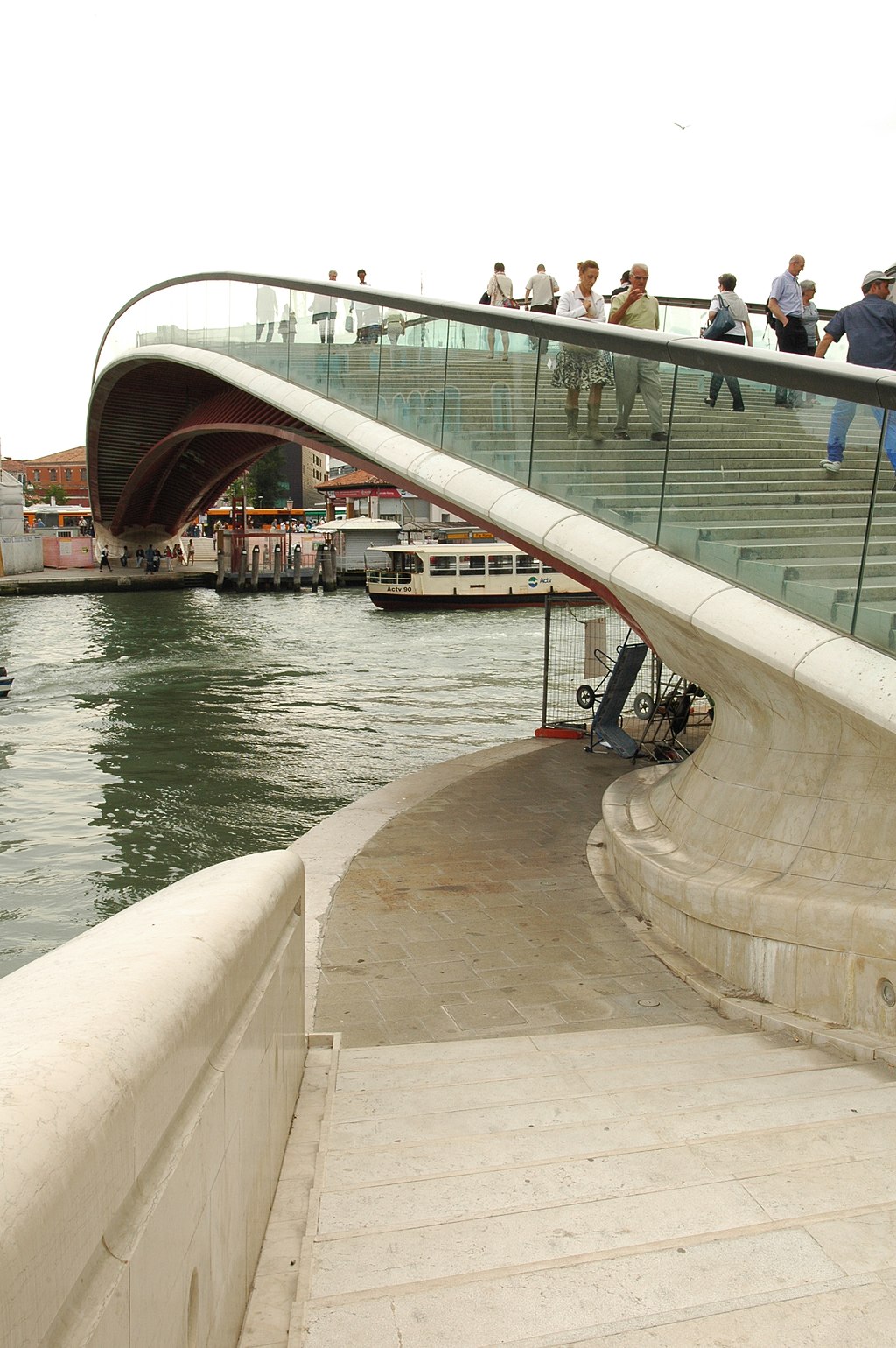
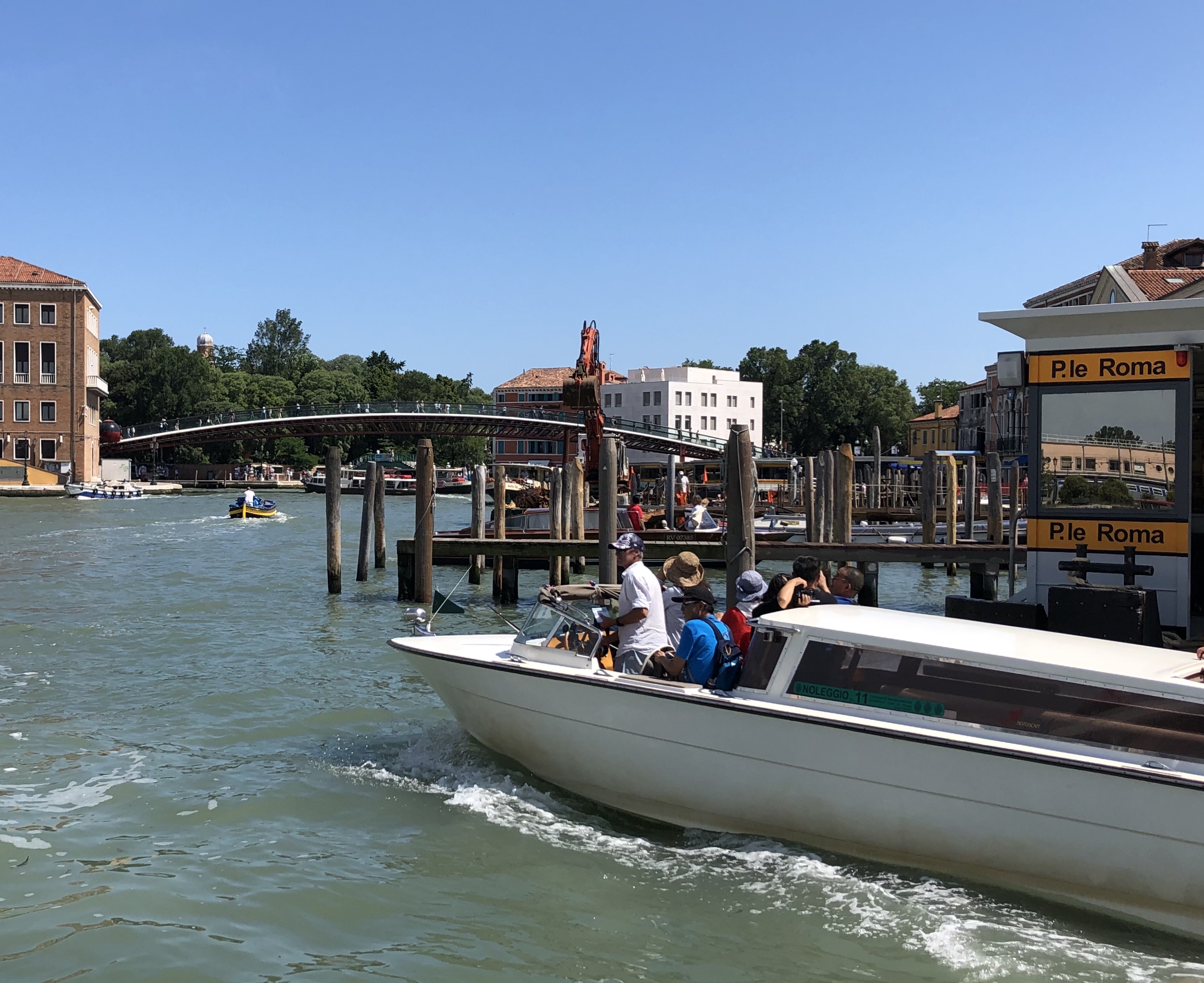
The Constitution Bridge is located at the busy bus terminal known as Piazzale Roma. | Photo: M. Yung

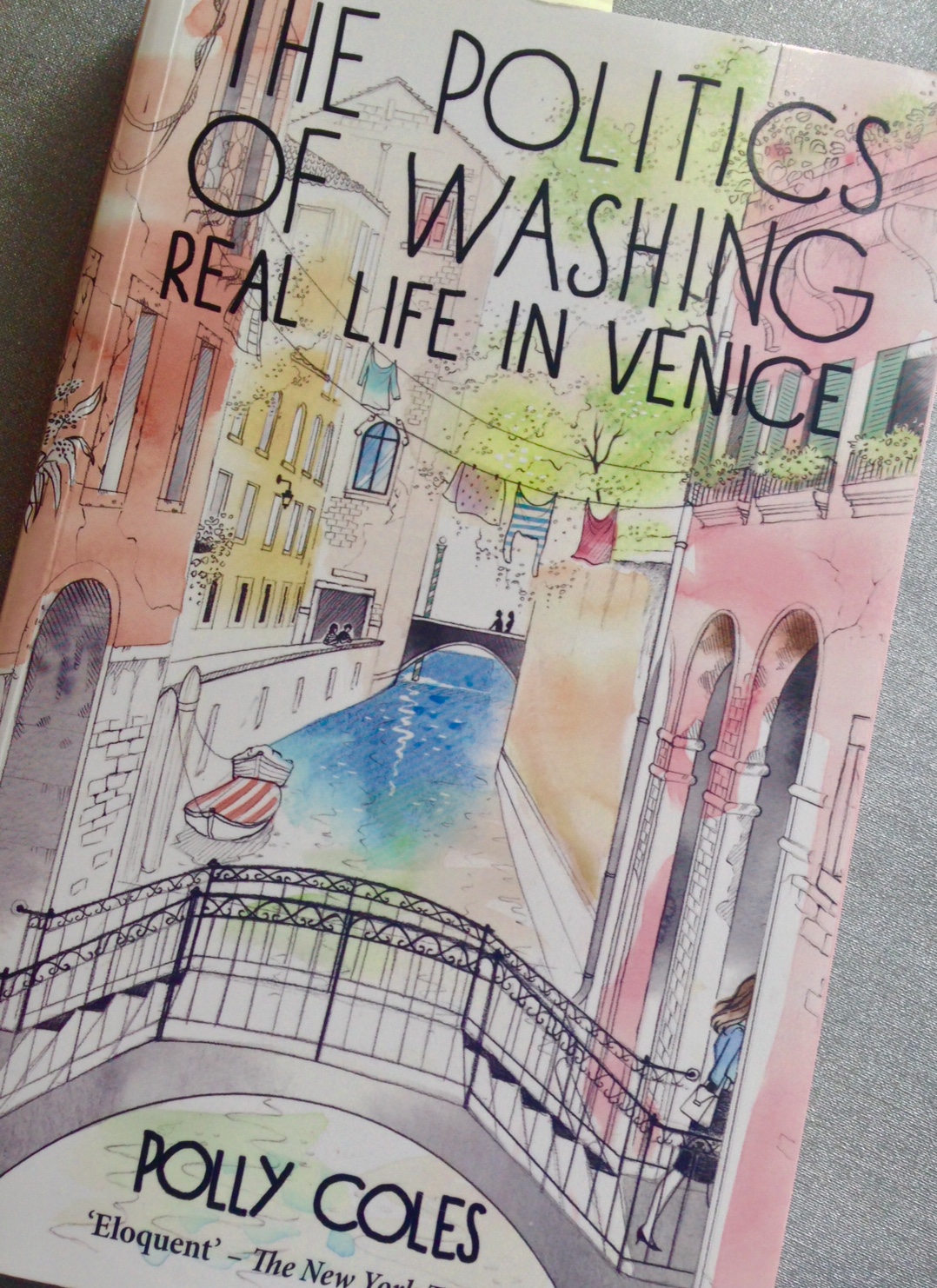
I had first learned of the famous bridge, one of four pedestrian bridges that cross from one side of the Grand Canal to the other, when I read The Politics of Washing: Real Life in Venice. This book, written by Venetian transplant Polly Coles, reveals the daily routines of ordinary Venetians who have made the lagoon city their home. (What’s it like to live in one of the most heavily touristed cities in the world? Read this book. Where are the schools, the hospital, the post office? Read this book.)

Within one chapter of her book, Coles tells of her own experience with the infamous pedestrian bridge designed by Spanish architect Santiago Calatrava.

FullSizeRender (14)

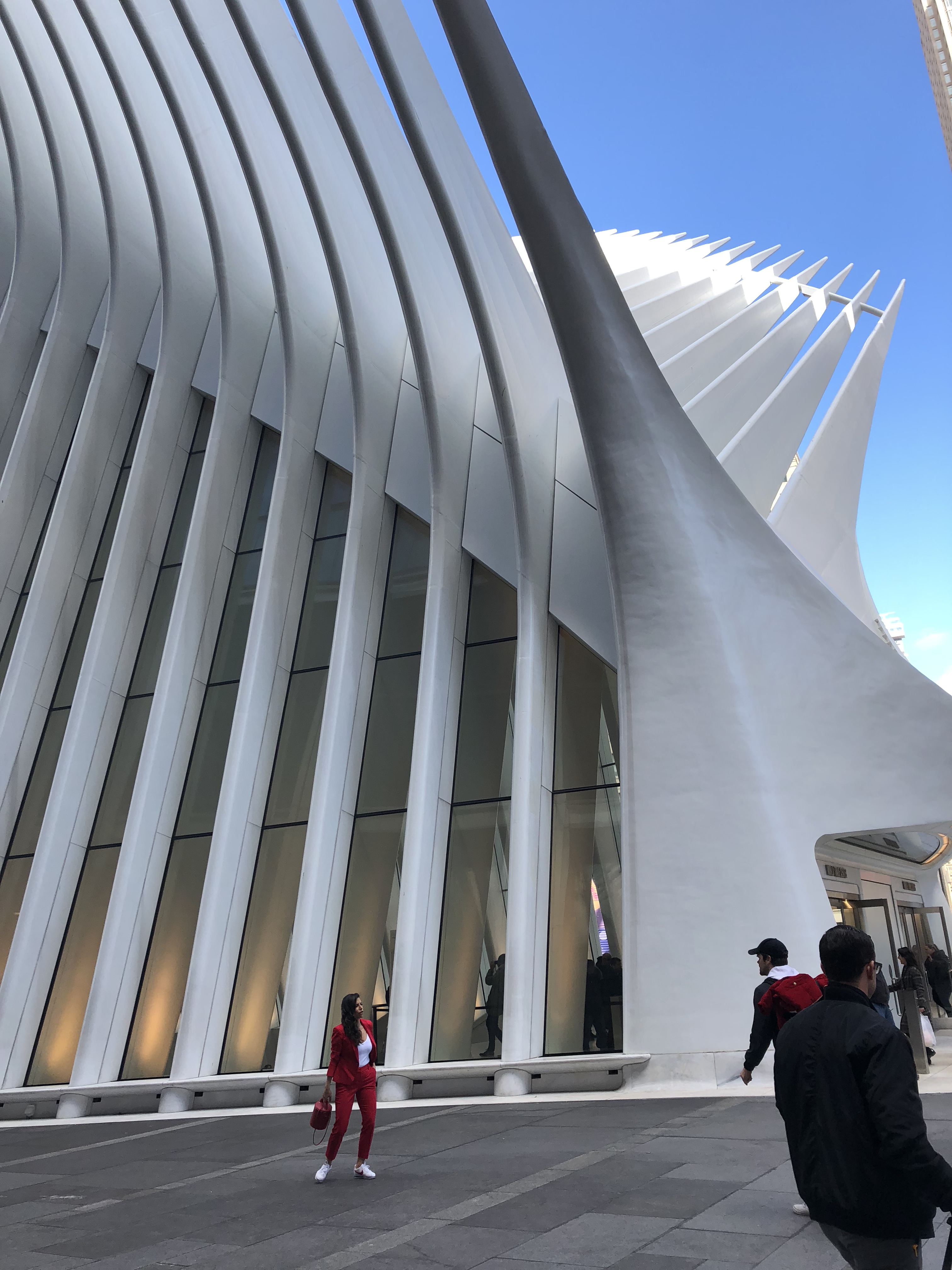
I first learned of Calatrava when we visited “Sculpture into Architecture,” a 2005 exhibition of the artist’s work at the Metropolitan Museum of Modern Art in New York City. The architect’s unusual skeletal forms intrigued me and still do today. For example, the Oculus transit hub near NYC’s One World Trade and the 9/11 Memorial & Museum is one of Calatrava’s more recent U.S. designs. The Oculus’ soaring bird-like structure is a fitting symbol of recovery and growth for the formerly devastated Ground Zero area.

IMG_8345
The Oculus at Ground Zero, New York | Photo: M. Yung

However in Venice, Calatrava’s bridge is a controversial piece of architecture that continues to gain attention today even though it was completed in 2008. Indeed, its troubles started long before the current ones. For example, during its construction, the bridge was budgeted to cost 7 million Euro, but wound up costing 11.6 million Euro. In addition, several delays were required during its construction.

Moreover, other problems have come to light since its construction and subsequent use. These have added to the bridge’s notoriety. Some of these problems include:

  • Limited accessibility for the disabled
  • Its modern design that conflicted stylistically with the city’s historic architecture
  • Its relative close proximity to other bridges that cross the canal, of which there are four in total
  • Glass panels that pedestrians walk on, which become very slippery in rain and even fog
IMG_9771
As you can see, the bridge’s upper surface is more like a glass arch. On dry days, it’s no problem, but on rainy days, it would be difficult to cross.  | Photo: M. Yung

In addition to the slippery surface, because so many tourists (and residents, alike) carry wheeled luggage over the bridge, the glass panels have worn down, which has caused damage to the panels and to pedestrians alike, if they should fall.

So how was my walk across Calatrava’s Constitution Bridge?

Let’s just say that I was glad it was dry the day we ventured across… it was slick even then. (But let me tell you… the marble steps on nearly every other Venetian bridge are slick, too. On these bridges –and there are hundreds across the city– I had to take care to avoid the worn-down, curved edge of each step where I had nearly fallen more than once.)

On Calatrava’s bridge, there is a narrow walkway of another material (stone? concrete?) you can step across on. And truth be told, that optional surface was more comfortable to use even though it was only a strip the width of a narrow sidewalk positioned in the middle of the walkway, far from a handrail.

But still, I will say this about the Constitution Bridge: it. is. elegant.

Its long arch gracefully extends across the canal. If you have the chance to take the lengthy stroll across it, do. Despite its controversy, the bridge is beautiful, simplistic, and a refreshing contemporary note amidst Venice’s historic facades.

It is also officially crossed off my bucket list.  Been there. Done that.


After traversing the infamous bridge, we then ventured on to find the Jewish Ghetto. I’ll write about this district, which provides the actual origin of the Italian word “ghetto,” as well as the museum title. Stay tuned for that upcoming post, as well as the post about the Peggy Guggenheim Collection internship.

Click like and feel free to leave a comment!

Categories
Greece (Peloponnese)

A Great Man is Always Willing to Be Little

His expression compelled me to stop and linger at the display in Mycenae.

Only three to four inches in height, this ivory Mycenaean sculpture does not overwhelm with its size or weight, but with its expression. Made between 1250-1180 B.C. this “Ivory Male Head Figure” was excavated in the ruins of Mycenae (Mykines) in the Peloponnese region of Greece.

We saw a staggering number—thousands?—of artifacts this past summer; however, this little number above is still my favorite.

To realize it was conceived and shaped by human hands so very long ago is a lesson in humility.

Of what use  is our modern technology?

Of what purposes are our conveniences?

Of what skills can we boast in light of this quiet gem?

Featured Photo Credit: Marilyn Yung | This ivory sculpture is in the collection of artifacts at The Archaeological Museum of Mycenae

On May 29, my husband and I journeyed to Greece for about five weeks. Three weeks were spent on Skopelos, one of the three islands in the Sporades east of the mainland. The remaining two were spent venturing from Mycenae to Delphi to Olympia and finally Heraklion on the island of Crete to tour the sites at Knossos and Phaistos. Athens formed the bookends of our Greek odyssey. 

I posted daily for much of the trip, but still have so much more to tell. Follow my blog and stay tuned.

Acknowledgement: “A great man is always willing to be little.” Ralph Waldo Emerson

Categories
Greece (Crete)

A Week in Heraklion, Crete

At first, Crete’s largest city threw us for a loop

The arrivals terminals at Crete’s airport may disappoint you.

First, it’s curiously dim. I remember telling my husband it felt like a Walmart store. Its cold LED lighting cast a cool glow on the blue and gray interior.

Second, the ladies bathroom was a mess. Forget toilet seats. Apparently, they were deemed unnecessary. And the hand dryers seemed pointless also. That’s because they blew a softer gale than the one outside. Shaking the excess water from my hands, I left the bathroom and joined my husband to explore our ground transportation options.

As we walked, I asked myself, This is Heraklion? My preconceived ideas of a sunny, bright and sparkling Crete had quickly evaporated and we weren’t even outside yet.

IMG_0781
We flew to Crete on Volotea Airlines, a regional carrier based in Madrid.

But that would change soon enough. After fielding a taxi to our AirBnb, checking in with our host, picking up some groceries at the small corner market, things improved.

Yes, Heraklion, the largest city on Crete with a population of 174,000 and Greece’s fourth largest city threw us for a loop at first. However, it took just overnight for us to become more accustomed to our corner of Greek life in Heraklion’s Fortetsa neighborhood.

Over the next five days, we explored much of Heraklion’s major attractions, navigated its bus lines, and took a daytrip into the countryside south of Heraklion to the Phaistos archaeological site.

IMG_0783
We sat down and surveyed the ground transportation options before deciding to take a taxi to the Fortetsa neighborhood. Our driver had a difficult time finding it. Apparently, the neighborhood is not a regular stop for tourists.
IMG_0811
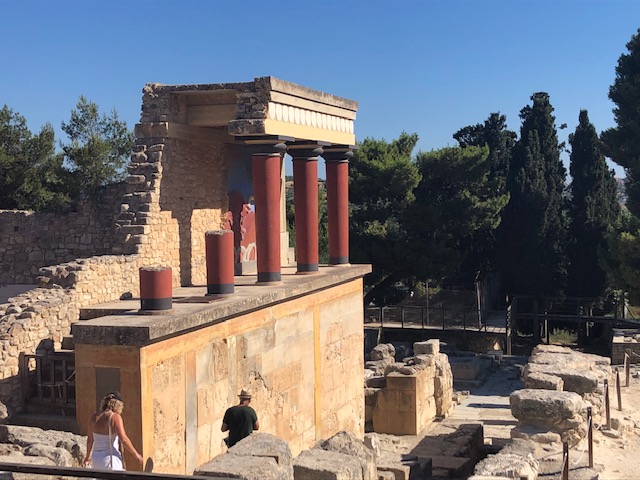
At the top of Crete’s historical attractions is the Knossos Palace, the center of Minoan culture; read my post for more information. This is the oldest city in Europe and dates from 1380-1100 BC.
IMG_0913
This strolling Greek band was loud and persuasive. The man on the left approached out table and held out his tambourine for a 2 Euro donation.
IMG_0915
If you look deep into this photo, you can see several tavernas and restaurants ready to snag tourists with cappuccinos and gyros.
IMG_0936
This is part of the Venetian shipyards, erected during the Venetian occupation of the port and the island in general, which in those days was known as Candia.
IMG_0937
This sign will fill you in on basic Heraklion history, including a history of Crete in general.
IMG_0998
This portion of the Venetian wall extends into Heraklion.
IMG_1071
This fountain is another relic of the Venetian period.
IMG_1144
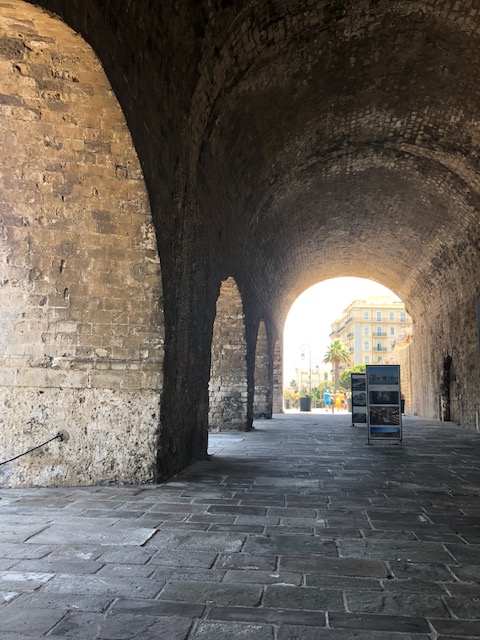
Pedestrians pass under and through the Venetian wall on foot or in vehicles. They can walk up the stairs beyond the tree on the right-hand side of the photo and walk on top of the wall.
IMG_0952
This portion of the Venetian fortress extends into the harbor. It protected the city from invaders. Notice the symbol of Venice, the lion, in the relief sculpture at left. For scale, also notice people between the crenellations along the top of the wall.
IMG_0970
I just couldn’t get over the blue-green waters of the Sea of Crete north of Heraklion.
IMG_0967
We walked inside the Venetian Fortress Museum. It was well worth the 2 Euro ticket price to learn a little history along the way.
IMG_1005
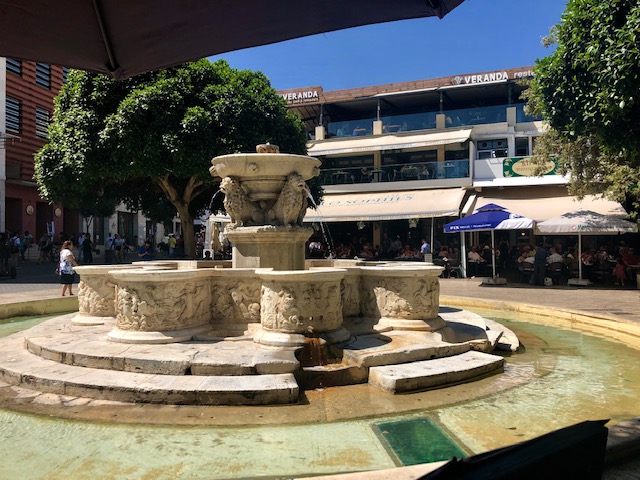
This is Morosini Fountain in city center Heraklion. It’s a remnant of the city’s glory days under Venetian influence and rule.
IMG_1004
IMG_1022
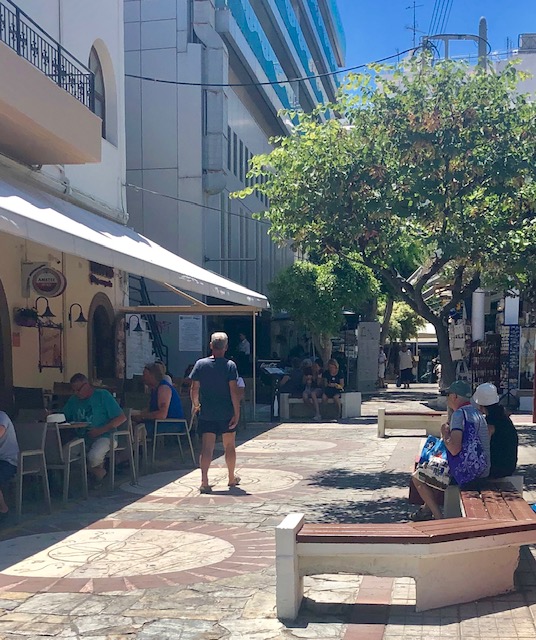
This is the sunny plaza at noontime just outside the Church of San Minas.
IMG_1143
The front entrance to the Heraklion Archaeological Museum in the center of the city.
IMG_1017
The interior of the Church of Saint Minas
IMG_1033
Adjacent to the Church of Saint Minas is the Church of Saint Katherine Museum of Christian Art. It showcases a collection of Greek Orthodox artwork, including murals, tapestries, metallurgy, and, of course, incredible icons.
IMG_1036
A detail from a painting inside the Museum of Christian Art. This painting is called
IMG_1059
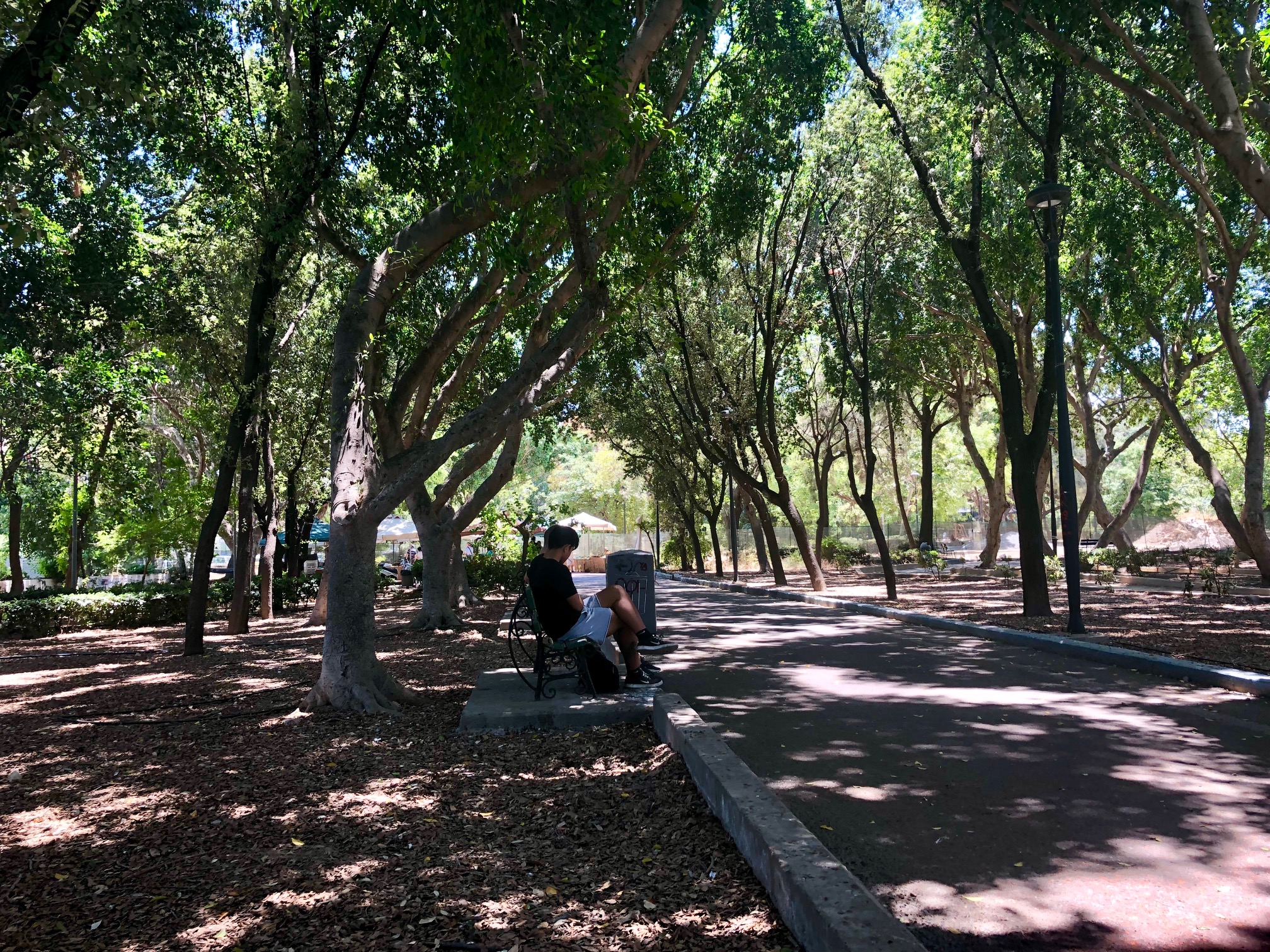
We rested inside this shady park situated next to a portion of the Venetian wall.
IMG_1136
This outdoor mural in inspired by the “Ladies in Blue,” a fresco originally found at Knossos. The original fragments are displayed inside the Heraklion Archaeological Museum.
IMG_1046
Scooters everywhere!
IMG_1056
Snack kiosks such as this one are ubiquitous in Heraklion. Some of these also sell city bus tickets.
IMG_1138
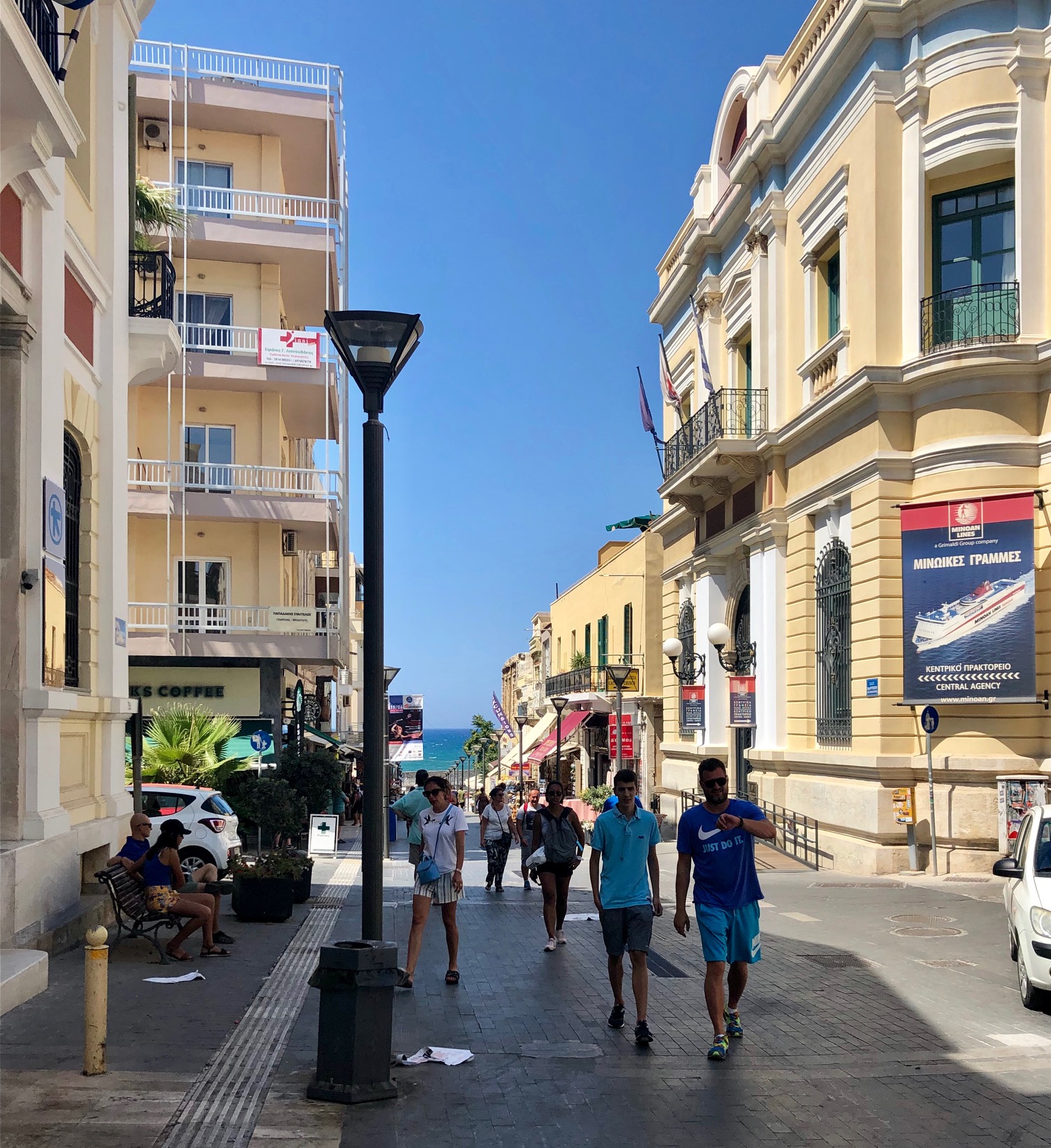
This is a popular retail district in Heraklion. Notice the brilliant blue of the ocean in the distance.
IMG_0987
IMG_0942
The harbor at Heraklion with the Venetian fortress on the left.
IMG_1089
Pottery found at Phaistos, which we visited one day when we took a daytrip south. A post on this daytrip is forthcoming. Stay tuned! Check out this post for how to get to Phaistos by bus.
IMG_1148
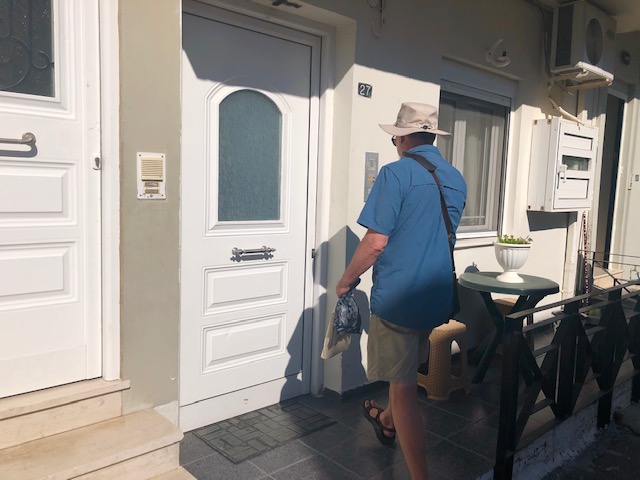
The front door of our AirBnb in the Fortetsa neighborhood of Heraklion.
IMG_1063
The street outside our AirBnb. Our taxi driver seemed a little surprised that we were staying here. I guess it’s not the expected tourist neighborhood; however, it was safe and quiet. We felt like we were getting to see the real Heraklion that many tourists may not be privy to.
IMG_1147
We stayed in Fortetsa. Notice the Greek spelling above the Roman or Latin letters.
IMG_1146
Greece held elections on July 7. All 300 seats in the Hellenic Parliament were in play, including president. Posters were plastered in bus stops and in other public areas throughout the city.
IMG_1070
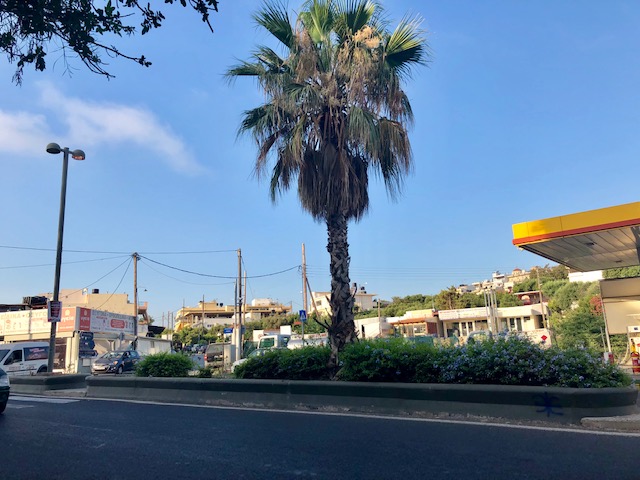
I took this photo while sitting in the bus stop looking up into our Fortetsa neighborhood. We were getting ready to board a bus downtown.
IMG_0992
We stopped in at this market a few times during our stay in Heraklion. The melons were perfectly sweet.
IMG_1064
The living room of our AirBnb in Heraklion.
IMG_1067
Another photo of our AirBnB.
IMG_1160
The ceiling in the departures terminal of the Heraklion airport (above) is quite a dramatic difference from the arrivals terminal. The arrivals area was stark and uninviting  in comparison.

Featured Photo Credit: Marilyn Yung | Central Heraklion from the top of the Venetian fortress in the harbor.


Thanks for reading! My husband and I are in the process of moving out of the house we’ve lived in for 25 years. It’s been a job accomplishing the move and writing more about our trip this summer to Greece. I plan to add several more posts over the end of summer and fall. That’s my plan; however, with a new teaching job starting in a little over a week, it will be a challenge.