The Areopagus in Athens puts Ancient Greece in its proper perspective
This morning, we walked through Athens to the Areopagus, the location of a judicial court, where Paul made his “To an Unknown God” sermon to the Athenians with—wait for it— the Acropolis in the background with its temples to Athena, Poseidon, Erechtheus and other mythological deities of Ancient Greece.
The Acropolis is right there! Paul was pretty daring in his speech to those gathered. Notice the procession of tourists creeping up the steps of the Propylaea, the entry staircase to the Acropolis and its monuments. And yes, that is graffiti on the rock in the picture. There is graffiti everywhere. Some of it is artful, but much of it is mere vandalism.
How fitting that we saw this on our last day in Greece. Walking on the rocky (and extremely slippery) outcropping where Paul would have stood is a highlight of our trip. This spot puts all the pagan monuments and temples that we’ve seen in their proper perspective. Yes, they are beautiful works made by man, but they are worthless in the eyes of God.
The rocky outcropping is expansive with incredible views of Athens below. I would tell you to wear good shoes, but even good shoes will slip on the time-worn marble. Everyone was sliding around, grabbing onto each other, scooting down on their rear ends. There are metal stairs, but even those are slick.
Acts 17:22-31
22 Paul then stood up in the meeting of the Areopagus and said: “People of Athens! I see that in every way you are very religious. 23 For as I walked around and looked carefully at your objects of worship, I even found an altar with this inscription: to an unknown god. So you are ignorant of the very thing you worship—and this is what I am going to proclaim to you.
24 “The God who made the world and everything in it is the Lord of heaven and earth and does not live in temples built by human hands. 25 And he is not served by human hands, as if he needed anything. Rather, he himself gives everyone life and breath and everything else. 26 From one man he made all the nations, that they should inhabit the whole earth; and he marked out their appointed times in history and the boundaries of their lands.27 God did this so that they would seek him and perhaps reach out for him and find him, though he is not far from any one of us. 28 ‘For in him we live and move and have our being.’[a]As some of your own poets have said, ‘We are his offspring.’[b]
29 “Therefore since we are God’s offspring, we should not think that the divine being is like gold or silver or stone—an image made by human design and skill. 30 In the past God overlooked such ignorance, but now he commands all people everywhere to repent.31 For he has set a day when he will judge the world with justice by the man he has appointed. He has given proof of this to everyone by raising him from the dead.
Our last day in Greece! Our plane leaves at 6 a.m. tomorrow!
Thanks for reading and for joining me on our trip to Greece! I have only missed a handful of daily postings during the time we’ve been here. Writing and posting daily was one of my goals, and I feel positive about my progress. Follow my blog for more stories and travel memoirs that I will be writing in the coming weeks. I have so much more to share!
Are you traveling anywhere over the summer months? Leave a comment with your plans or a link to your blog!
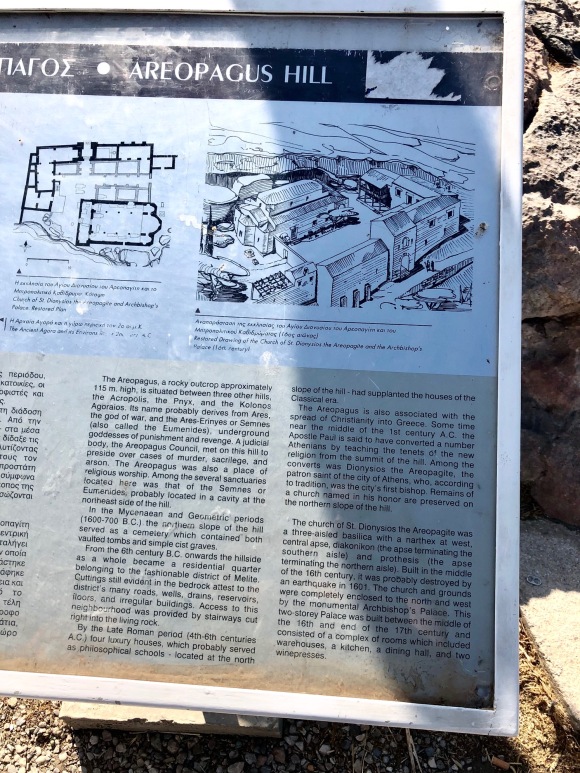
Featured Photo Credit: Marilyn Yung | This plaque has Acts 17:22-31 inscribed in Greek. The scripture appears later in this post.
It’s not easy, but it is possible to take the bus from Heraklion to Phaistos
Today, my husband and I visited Phaistos Minoan Palace, arguably the second most important Minoan archaeological site on the island of Crete in Greece. Phaistos has been on our bucket list for our journey through Greece, and because we’ve relied on bus travel for much of our trip, we’ve learned that things can go wrong.
For example, your driver may miss a stop, turn around, and go back. Your driver may make a package delivery you weren’t expecting, adding minutes to your ride and causing you to miss a connection if you have one.
That’s why yesterday we figured out EXACTLY how we would make the trip today. We bought our tickets a day early for not only Phaistos, but also for the bus station from where we would depart. In the end, we had a successful trip, but it wasn’t without a good dose of head scratching, miscommunication, wrong turns, and a frantic last-minute ticket purchase.
Part of our confusion was due to the scarcity of up-to-date timetables and not knowing the location of Heraklion’s KTEL Central Bus Station (the main bus terminal in Heraklion). The rest of the confusion was due to a general lack of detailed, timely information on how to get to Phaistos in the first place. It’s not listed as a destination on the pull-down destination menu on their website; however, the printed timetable does list Phaistos as a destination. Go figure.
In addition, there simply isn’t much info on websites such as TripAdvisor and Rome2Rio. Instead, what you will mainly find are other people on TripAdvisor looking for the way there, too.
Here’s how to get from Heraklion to Phaistos:
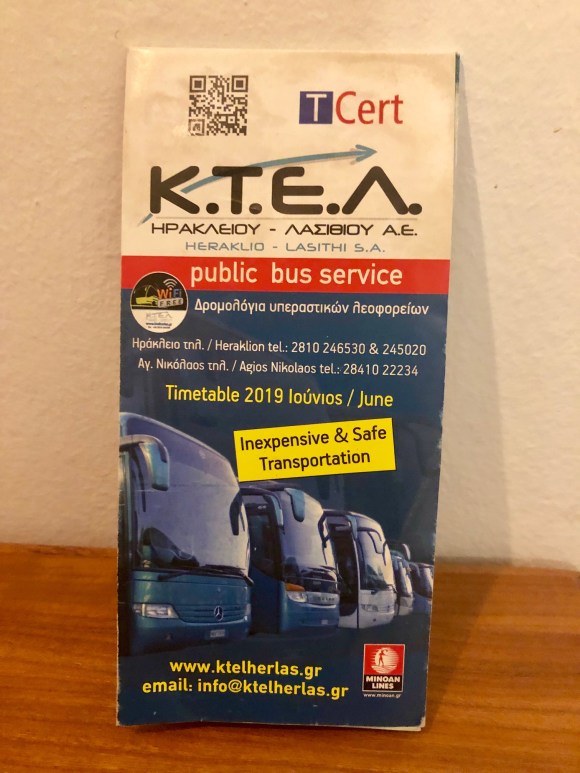
Get a KTEL bus timetable brochure from any KTEL ticket kiosk or at the KTEL Central Bus Station. You will need this timetable to figure out when the buses leave and return from Heraklion and Phaistos. Read on for how to find KTEL Central Bus Station.
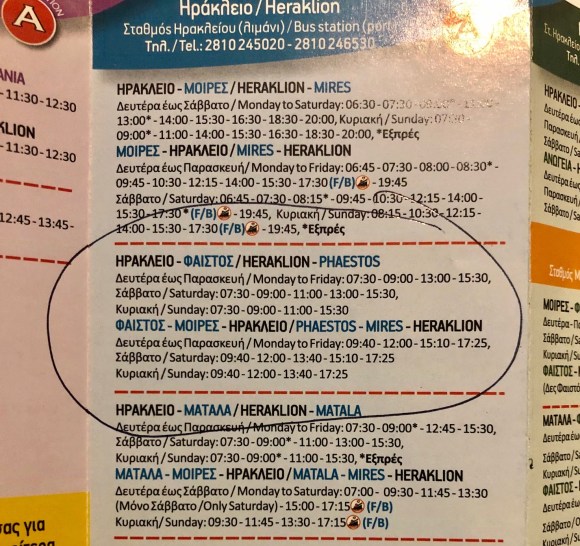
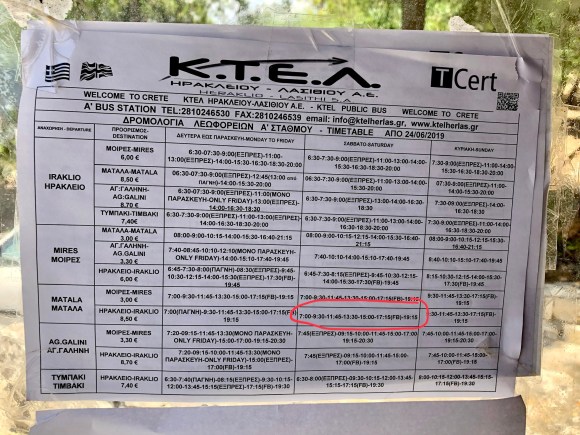
I’ve circled the part of the KTEL timetable brochure that shows the Heraklion to Phaistos and the Phaiston to Heraklion schedules. Side note: There are multiple ways to spell Heraklion and Phaistos. Heraklion is also spelled Iraklio. Phaistos can be spelled Faistos and Festos. Moires is also spelled Mires. Take a look at the Greek spellings, too, so you can recognize them if needed.
Here is the June 2019 KTEL timetable brochure. We used it July 6 and the times were still the same.
Go to KTEL Central Bus Station (the main terminal) and get there well ahead of your bus’ departure time. Get there early (thirty minutes or more) on the day you plan to travel or buy them the day before like we did. Do this in case any unforeseen complications arise and cause you to arrive late and miss your bus because you didn’t have your tickets purchased.
To find the KTEL Central Bus Station, we asked a ticket seller in the Heraklion Archaeological Museum. (We didn’t see any informational signs to direct travelers to the station from the popular museum where both city buses and KTEL buses drop off and pick up.) The ticket seller told us to walk behind the ticket kiosk on the circle next to the museum, and then take the stairs down the hill. At the bottom of the hill, turn left and follow the street until you come to a large dark gray bank (Pancretan Cooperative Bank) on your left. It has a modern look, with lots of large mirrored windows. When you get to the bank, you will see the KTEL Central Bus Station in front of you at the corner of Efessou and Leof. Ikarou.
Walk down the stairs behind the bus station, go through the waiting area that looks like a large outdoor cafe, and go inside.
Get in line at one of the six ticket windows and tell the clerk when you want to go to Phaistos based on the times available per the timetable brochure. We purchased only our tickets (7.10€ each) to Phaistos ahead of time. Because we didn’t know how long it would take to see the site, we didn’t know what time to schedule a return bus.
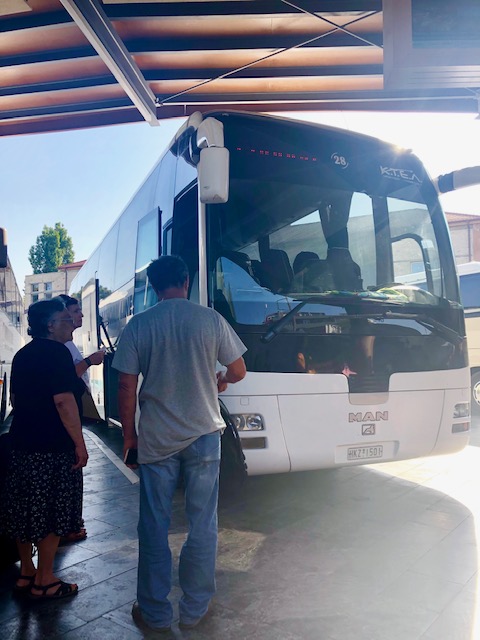
You will take an approximately one-hour bus ride from KTEL Central Bus Station in Heraklion to Moires, where you will change to another bus bound for Matala. Phaistos is on the way to Matala.
When you get to Moires, get off the bus so you can hop onto another bus headed for Matala. To do that, go inside the KTEL ticket office (there’s not a station–just a bus stop and a ticket office with a bunch of boxes scattered on the floor). The ticket office has a small KTEL sign on it and is about one hundred feet from the bus stop. Ask the ticket clerk how long it will be before the Matala bus arrives. In our case, it was about ten minutes away.
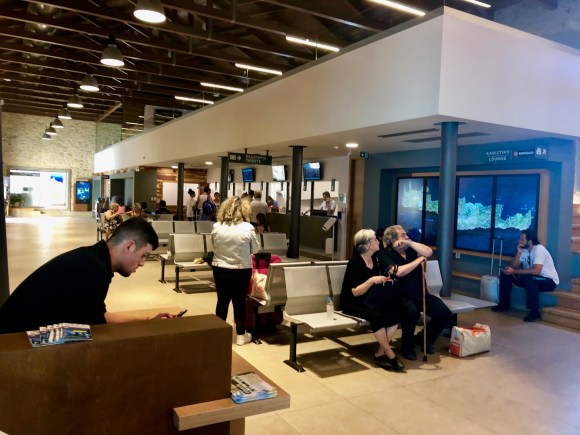
Watch for the Matala bus. You will not need another ticket to get on the Matala bus.
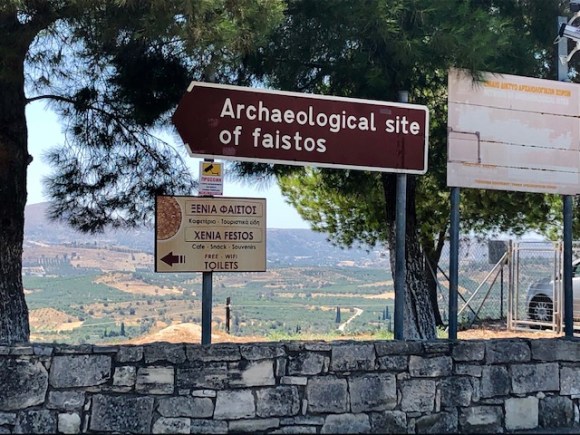
The bus ride to Phaistos from Moires on the Matala bus takes about fifteen minutes. The driver should stop at Phaistos, but he might not if you don’t tell him you need to stop there. Do that when you board or during the ride. Don’t assume other riders are going to Phaistos. (If they’re tourists, they’re probably going to the beach in Matala.) We were the only two people on our bus today headed for Phaistos. Here’s the sign for Phaistos Minoan Palace. Get off here.
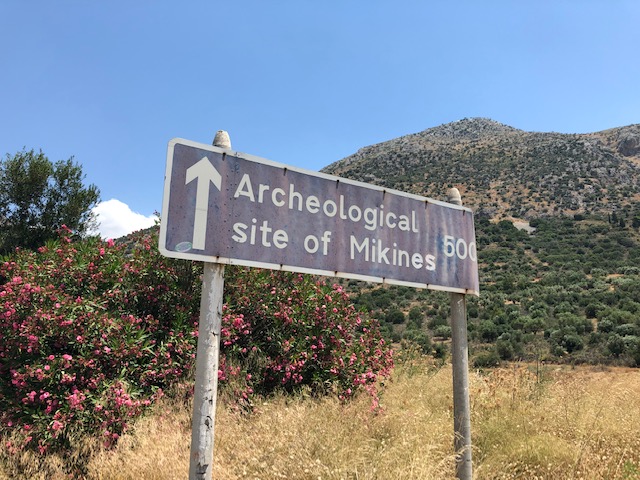
Here’s the sign for the archaeological site. Note the spelling variation.
9. Tour Phaistos Minoan Palace. It might be a good idea to buy a guide book and thumb through it before entering the site so you can understand better what you’re seeing. Phaistos doesn’t appear to have the marketing support that other sites such as Knossos does. By the way, tickets to the archaeological site cost 8€ each. It took us about 1-1/2 hours to see the site. It would have taken longer, but some of it was closed for maintenance.
10. Leave Phaistos. There were bus schedules taped to the windows at the archaeological site ticket booth and inside the bus stop out near where we disembarked. These should coincide with the KTEL timetable brochure. But to double-check, use the chart (see photo below), and find the bus that departs from Matala and arrives in Heraklion. In the photo below, I’ve circled the part of the schedule that contains the route that begins in Matala, stops at Phaistos, and makes the connection in Moires again onto a bus that returns to Heraklion’s KTEL Central Bus Station where you started.
11. When your bus arrives from Matala to pick you up at Phaistos, board it and buy your tickets from the driver. Our tickets were 1.80€ each. This paid our way back to Moires.
12. At Moires, you will need to disembark, (just like you did earlier), go inside the KTEL ticket office, and buy tickets to take you from Moires back to Heraklion’s KTEL Central Bus Station where you started. For us, these tickets cost 6€ each. We nearly missed our Heraklion-bound bus in Moires because it was fifteen minutes late arriving in Phaistos. As a result, we arrived at Moires at 1:55 for a 2 p.m. ride. If there’s any question that you might not have your tickets before the bus leaves, go ahead and board the bus, and as you board, tell the driver you will be buying tickets directly from him. We saw many riders on both KTEL and city buses buy their tickets directly from bus drivers.
13. Once you’re seated on the bus in Moires, enjoy the approximately one-hour drive back to KTEL Central Bus Station. Our return ride took a different route from what we took in the morning and it followed a windy, mountainous road with vast, breath-taking views of olive groves and vineyards punctuated with oleander and cypress trees.
Thanks for reading! Greece can be tricky to navigate, especially with changing bus schedules, language barriers, and stations that close or change locations. We needed a blog post about this very topic a couple of days ago. We searched quite a bit to find the way to Phaistos. I hope this helps some readers find their way there. By the way, I plan to write a post about our visit to Phaistos in the next few days.
An unsettling episode on our otherwise comfortable journey through Greece
I guess nothing came of the strange situation I saw two days ago in Athens. Here’s what happened somewhere between the Omonoia and Ministiraki stations.
So, okay. I’m sitting on this gray metal bench waiting for a train to whisk my husband and I to our AirBnB in Paiania. As I stared at the departure sign’s red digital numbers, I noticed two security guards casually saunter up, talking between themselves. One, pale and tall, walked with his hands in his pockets, eyes on the ground as he spoke to his partner who, with his salt and pepper hair, appeared to be nearing retirement age.
I took note: two security guards. Together.
Now I come from a small town in Kansas and have lived in rural Missouri for thirty years. I know next to nothing about public transit, let alone public transit in downtown Athens. Do security guards often travel in twos? Or just when a situation warrants it?
Whatever, I thought, my eyes moving from the guards back to the digital sign. It indicated our airport-bound train should arrive in about six minutes.
To the right, toward my bench on the platform, a man approached.
Here’s what I noticed:
He was wearing a straw hat, a wide-brimmed style,
and a too-small faded blue suit jacket,
and black sunglasses,
and a canvas hat under the straw one (yes, two hats),
and long, wavy black hair stuffed under the neck flap of the canvas hat,
plus, a drab white-and-blue plaid shirt under the ill-fitting suit jacket.
Here’s what I wish I had noticed: his shoes. They say shoes can say a lot about a person, but I didn’t look at his shoes. I couldn’t get past the straw hat.
Neither could the security guards. Once Straw Hat walked up, they took note. They had been standing silently, but when Straw Hat entered the scene, the taller guard whispered to the other.
The two guards passed by me and walked to the platform edge. They watched the man approach my bench, stop two feet short next to a garbage can, and stand quietly.
I turned away from Straw Hat to my husband sitting to my left. “Do you see this guy?” I whispered.
“If he gets on the train, we’re staying behind for the next one,” he mumbled quietly.
I watched the security guards. The taller one occasionally glanced over at Straw Hat. He made eye contact with the strange dresser. It reassured me to see that the guard wanted Straw Hat to know that he was being watched.
Good, I thought. They’re on to him. And Straw Hat knows it.
I shifted back on the bench and returned my gaze to the digital sign.
Five minutes.
More passengers wandered to the platform. One camera-toting man, a tourist obviously, noticed Straw Hat. His eyes snagged on the hat, and then dropped to scan the rest of the ensemble. He turned away.
Three girls wearing summer tans and sundresses walked up, chatting away, oblivious to Straw Hat. A mother pushing a stroller rolled onto the scene, her eyes never raising from her precious cargo. Two more men walked up. Both glanced at the hat, one’s eyes resting for an uncomfortable three seconds on the costume.
Photo: Marilyn Yung
Four minutes.
The taller guard glanced again at the costumed man and made a call on his cell phone. The other tugged on his belt, straightening his gray shirt that read “Private Security” in all capitals.
Three minutes.
The crowd had grown. The sounds had changed: wheeled luggage rumbled by, shoes and flip flops shuffled through.
Several old men gathered. Two were in a heated conversation. One repeatedly pressed and raised his index finger up and down into his palm, counting off some reasons he was fired up about. At one point, his eyes caught the Straw Hat. He stopped for a split-second, wrinkled his brow in curiosity, and turned away to continue his reasoning.
Two minutes.
I turned to my husband. “Still watching him?”
“Just hang back when the train gets here,” he said, looking straight ahead, keeping the man in his peripheral vision.
In the corner of my eye, I watched, too. Straw Hat gingerly tugged at the cuffs of his sleeves to lower them. They already hung too low, I thought, nearly an inch beyond the hem of his jacket. He then inspected his fingertips. Pale hands, I noticed. Dirty nails. The few tendrils of black hair that I could see were so black they shone blue under the overhead LED lighting. He spent time tucking his hair under the neck flap.
One minute.
From down the tunnel, we heard a dull, deep roar of an oncoming train. Its front sign showed that it was bound for another central Athens station… not the airport. It slowed to a stop at the platform and the doors slid open.
A rush of passengers disembarked, displacing the chatting girls, the camera-toting tourist, the old men, the doting mother. As the train emptied, those waiting flowed toward it, including Straw Hat.
Suddenly, another man appeared wearing a sophisticated, double-breasted gray suit and carrying a clear plastic bag. Two packages were inside wrapped in white paper. He approached Straw Hat, paused, and turned to face the train.
Straw Hat leaned forward and muttered words into the space between them. Then he turned toward the second train car and boarded. Gray Suit boarded the first car. So did the security guards. The taller one kept his eye on Straw Hat in the next car. Had they seen the comment exchanged with Gray Suit? Were they aware that they needed to watch him, too?
More passengers boarded. A few last-minute riders scurried to the platform, scooting inside the train at the final second before the doors slid shut. A bell sounded and the train sped away.
We wondered.
What was about to happen? Anything? Why would anyone dress so conspicuously? Was Straw Hat planning to peel off the layers of his costume as his crime progressed? Was he the distraction to entice watchful eyes off Gray Suit, the truly dangerous one?
We still wonder. What exactly did we witness? We heard nothing about the incident, but then again we probably wouldn’t. Beyond the most basic phrases, we don’t speak Greek, so asking someone or watching the TV for news is futile.
Our Athens transit experience is one of those curious travel stories. A peculiar memory. A shared inexplicable moment that we trust resulted in nothing more than an eyebrow-raising incident to retell over the years. This one story is thankfully the only unsettling episode on our otherwise comfortable journey through Greece.
Photo: Marilyn Yung
Featured Photo Credit: Marilyn Yung
Thanks for reading! This happened two days ago in downtown Athens. It was very unnerving at the time. The two men could have merely been out pick-pocketing. About ten minutes prior to this story, a station employee had warned my husband to wear his backpack on his chest. “The pickpockets are out today,” he had said. Maybe that’s all it was.
Leave a comment if you’ve had a similar puzzling encounter. Feel free to follow my blog for more travel stories.
“The Minoans. Very smart people,” the guard told me, tapping her index finger on her temple. She had just explained to me (without my asking, by the way… she was that enthusiastic and had walked over on her own to explain) the purpose of a raised ridge near the lip of a large pithoi storage jar at the Heraklion Archaeological Museum. The ridge was wide enough to hold a small bit of liquid. Why? To keep ants and other insects from reaching the grain, wine, olives, olive oil, or whatever else was stored inside. Yes, that’s innovative. But that’s the Minoans.
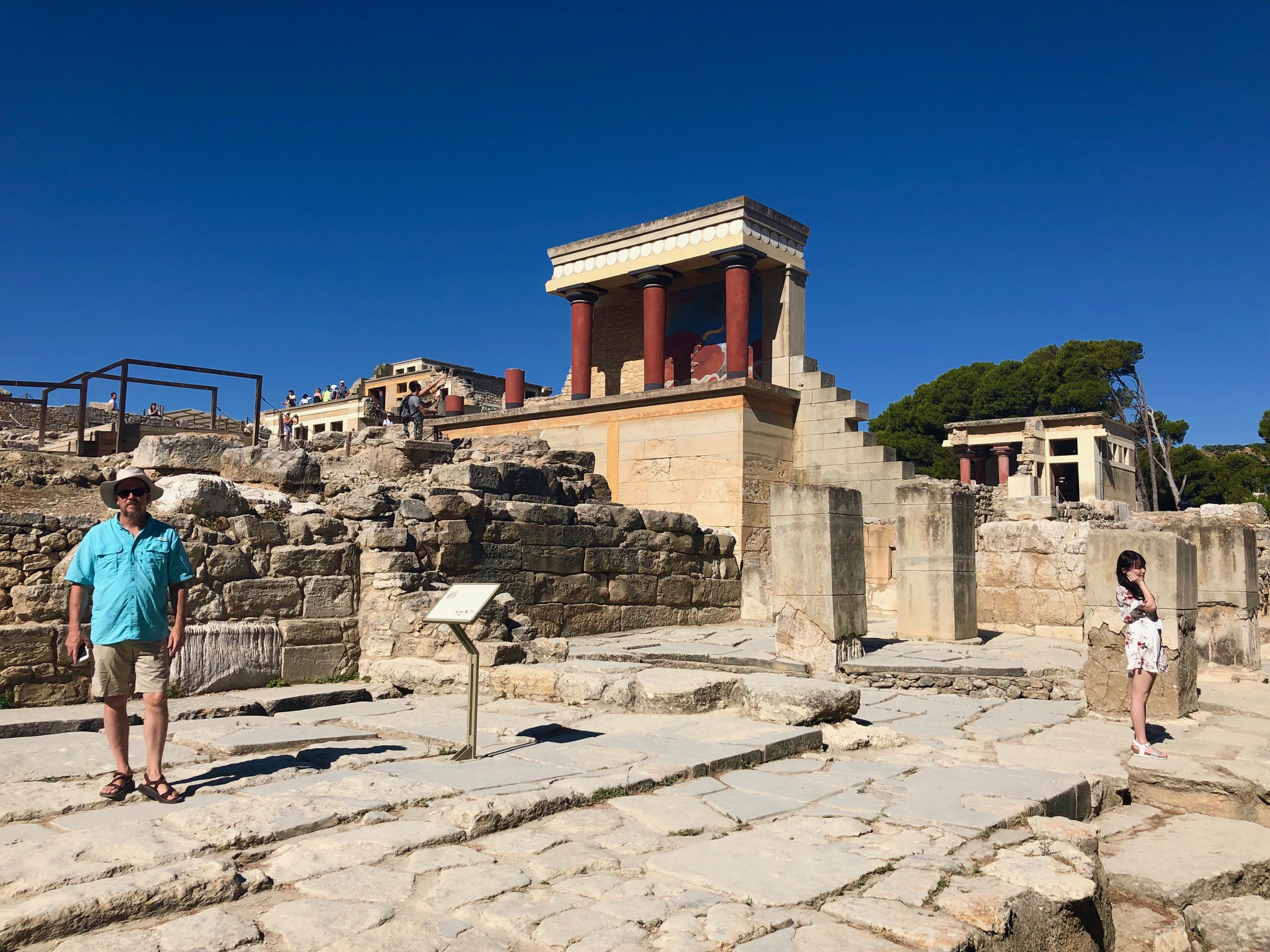
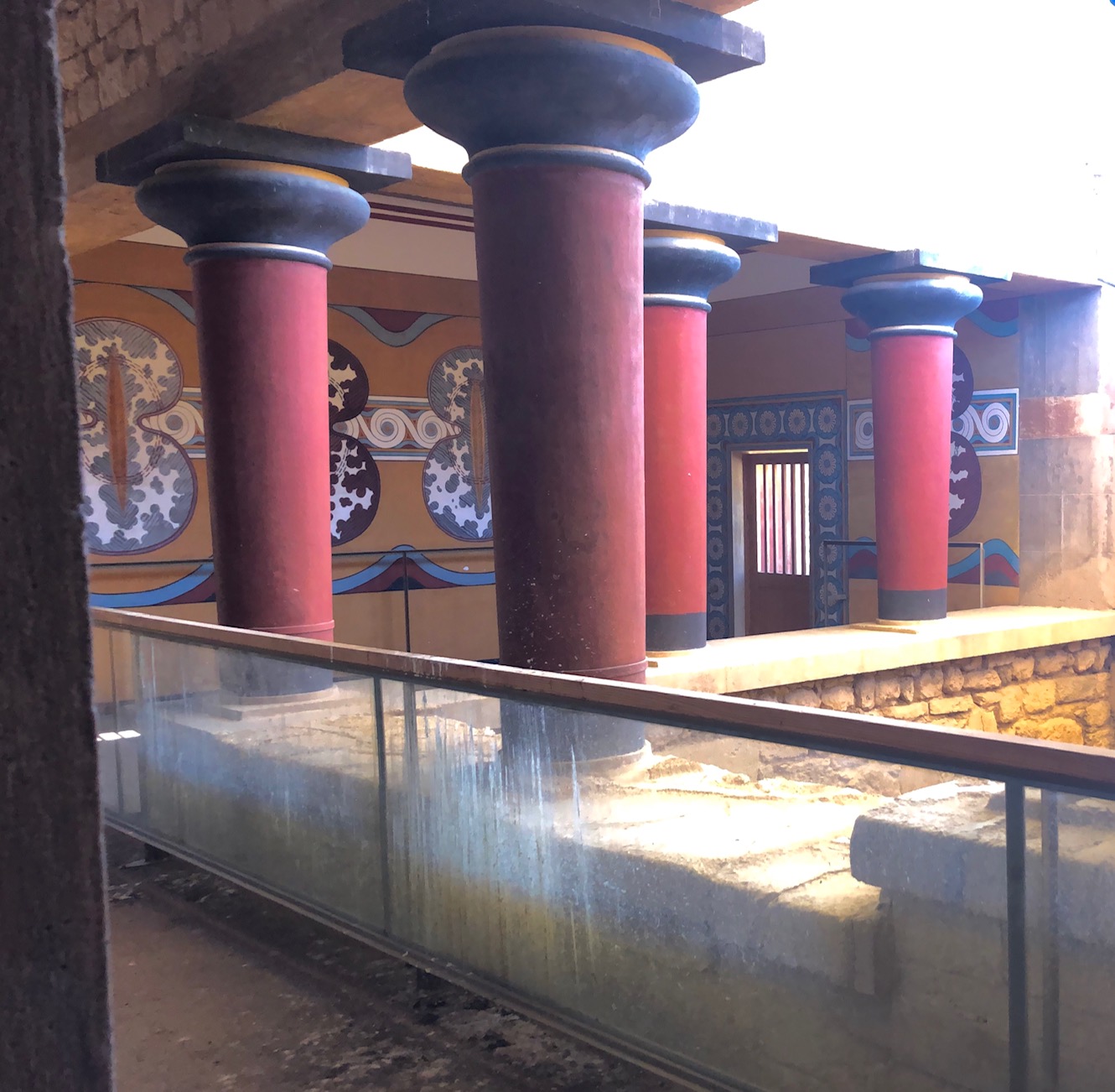
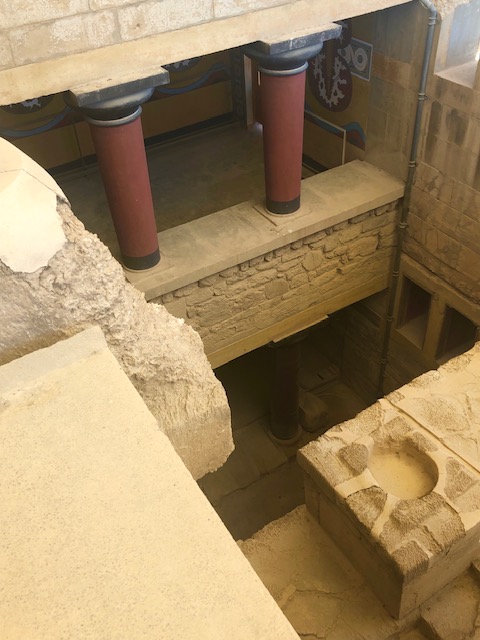
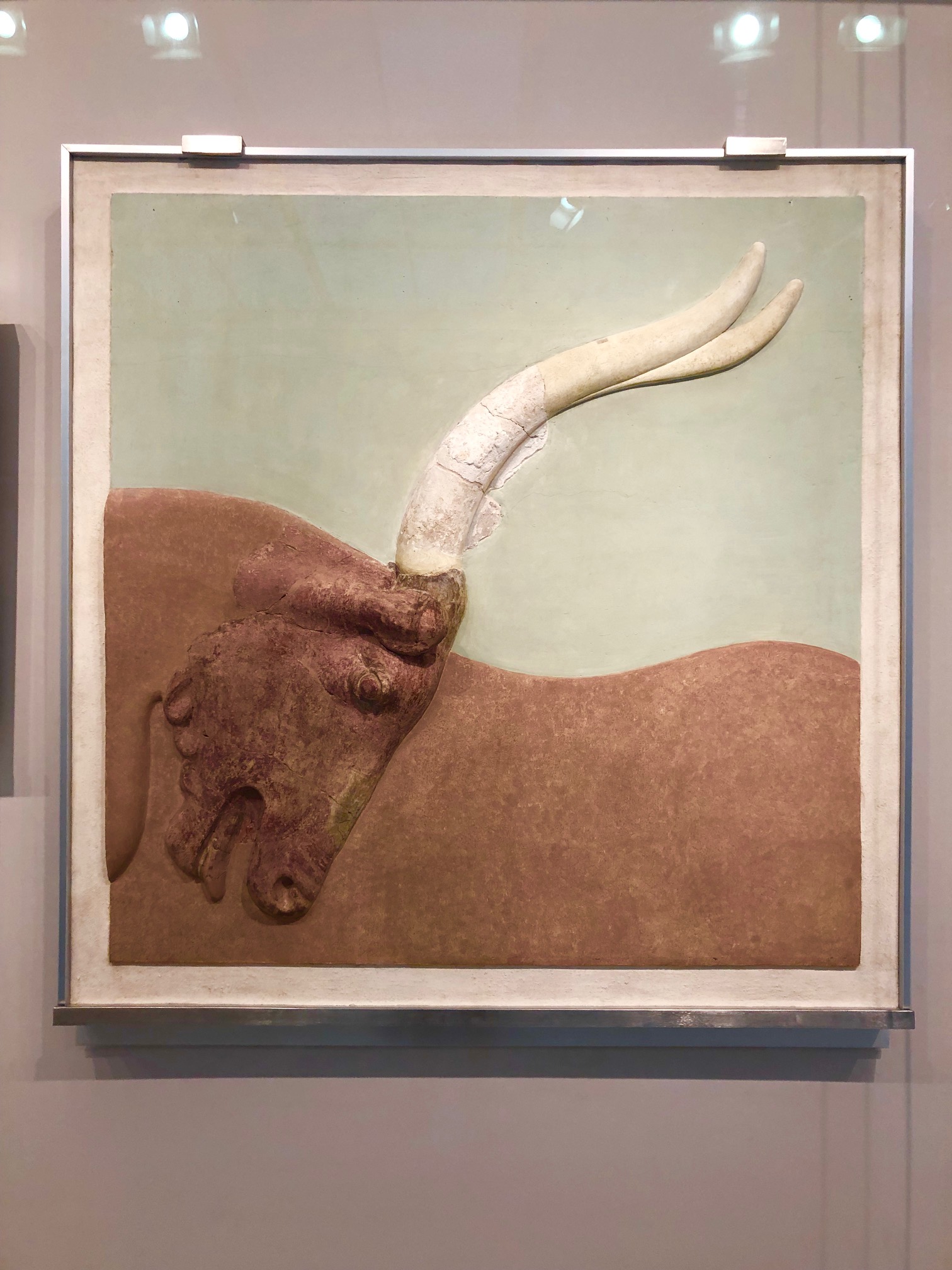
Classic photo of the Palace of Knossos. Behind the red columns, you can see the famous Bull Relief Fresco that is shown in the last photo of this article.
So even though we’ve been amazed at the age of the monuments and temples at Mycenae,Delphi,Athens, and Olympia, none of these are as ancient as Knossos and the greater Minoan culture.
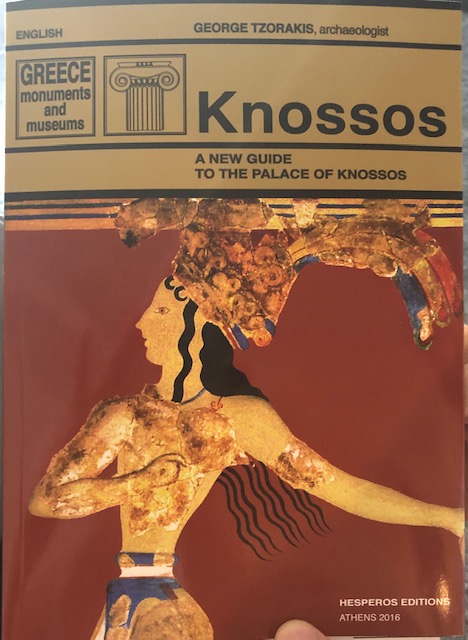
If you’re unfamiliar with Minoan history or culture, here’s a short blurb from the foreword of a book we purchased in the museum’s gift shop. The book is called Knossos: A New Guide to the Palace of Knossos.
“Knossos, the capital city of the Minoan world, is the most important site in Crete and second only to the Acropolis at Athens in all of Greece. It stands as the symbol of the Minoan Civilization, the earliest to evolve in Greece and Europe. “– Dr. Antonis Vasilakis
The introduction continues:
“Knossos is five kilometers southeast of Heraklion, on the hill of Kephala, and west of the river Kairatos. This advantageous location, which controlled one of the most fertile regions in Crete, was to become the heart of the Minoan civilization, considered to be the first in Europe. The hill of Kephala, inhabited continuously since 7000 BC, was the site of the first Neolithic settlement in Crete and over the millennia it grew into the powerful city and palace of Minoan Knossos.” — George Tzorakis, archaeologist
If you’re like me, the Minoan culture has always been a familiar term, but I’ve never really understood it or been able to recognize its art. Sure, my husband has always admired the Minoans, and has even used Minoan art and pottery to inspire his work, but I’ve never been able on my own to intelligently discuss the Minoans.
But after touring Knossos, I know a little more. Spending two and-a-half hours at the site and another two hours in the Heraklion Archaeological Museum yesterday has given me a better understanding about not only this culture, but others that either occurred later or were influenced by it.
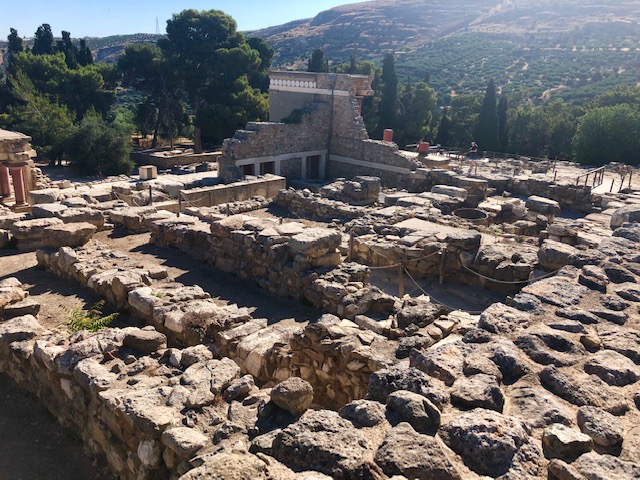
A photo taken across one area of the grounds.
An area adjacent to the grand staircase with the distinctive red columns and frescoes in the back.
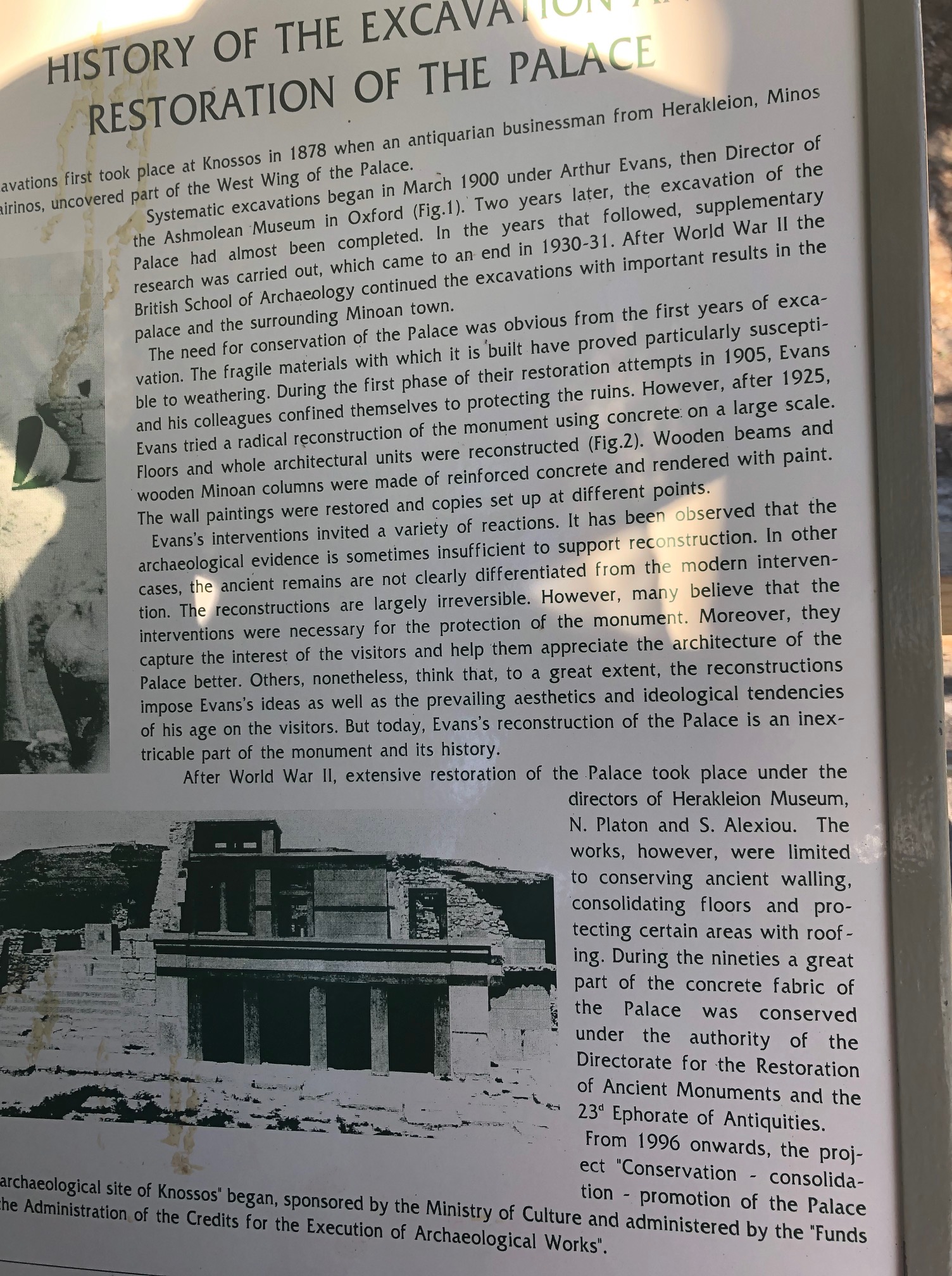
But Knossos has its controversy. The site’s reconstruction is largely the work of Sir Arthur Evans, who began a radical reconstruction program in 1925. Many of the excavations are based on Evans’ research for how Knossos would have appeared. The sign in the photo above explains the controversy very well and in an unbiased way; while some people think Evans’ team went too far in recreating the site, other people believe that without Evans’ reconstructive work, there would be little to show at the site.
The Grand Staircase
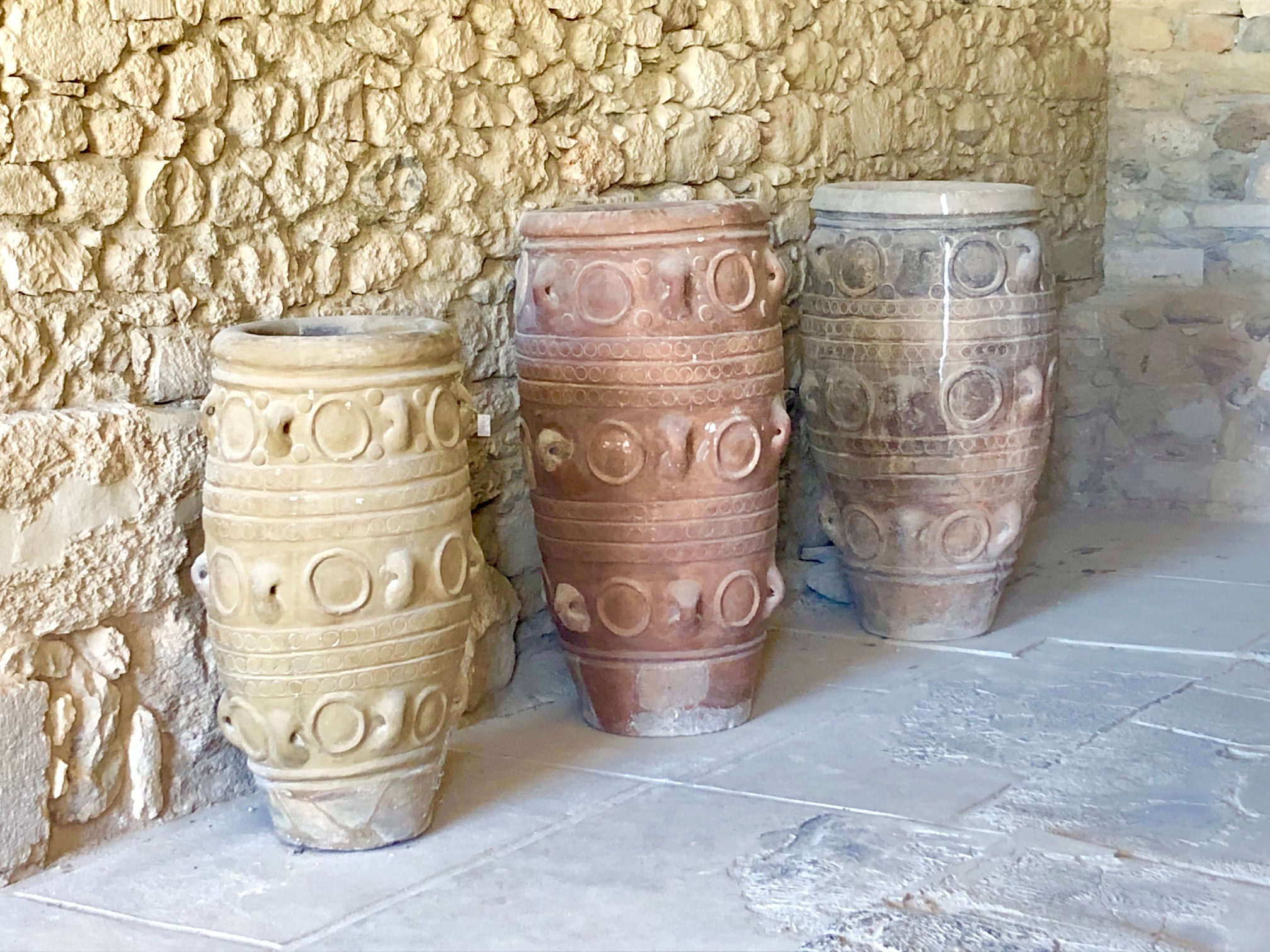
Large pithoi storage jars for holding wine, olive oil, olives, grains.
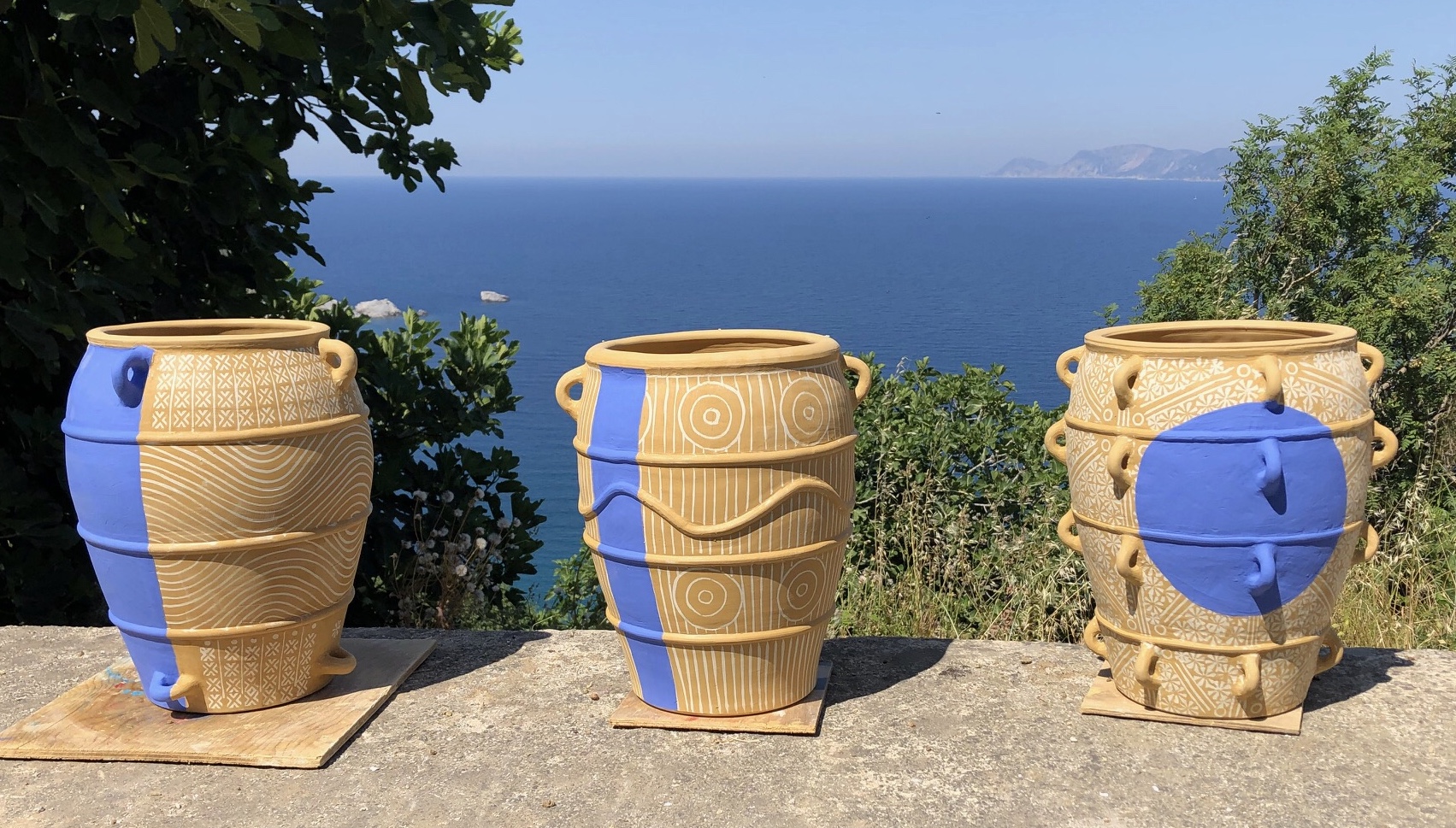
Large pithoi jars made by my husband and inspired by the Minoan pithoi. These were made during his three-week art residency at Skopelos Foundation for the Arts on Skopelos Island. The residency ended June 25.
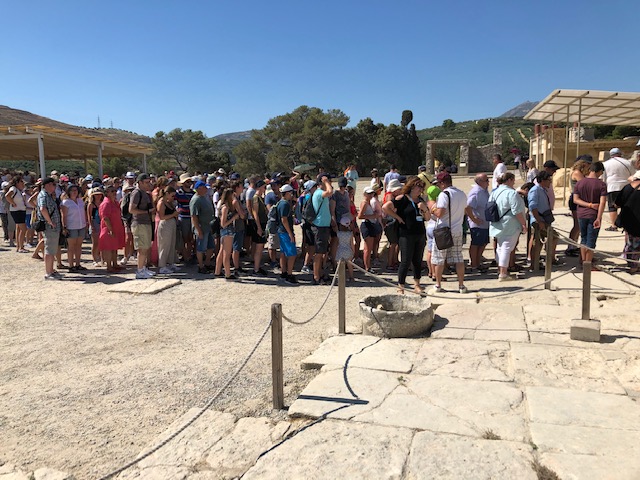
We arrived at the archaeological site at about 8:30 a.m. Tour bus groups (above) arrived between 10-10:30. We walked right into this particular site (The Throne Room, below) at the grounds; these people will have to wait thirty minutes or more under a cloudless sky.
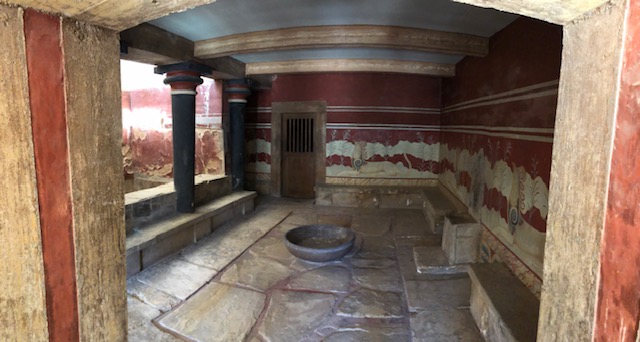
Panoramic shot of The Throne Room, a room used by the king.
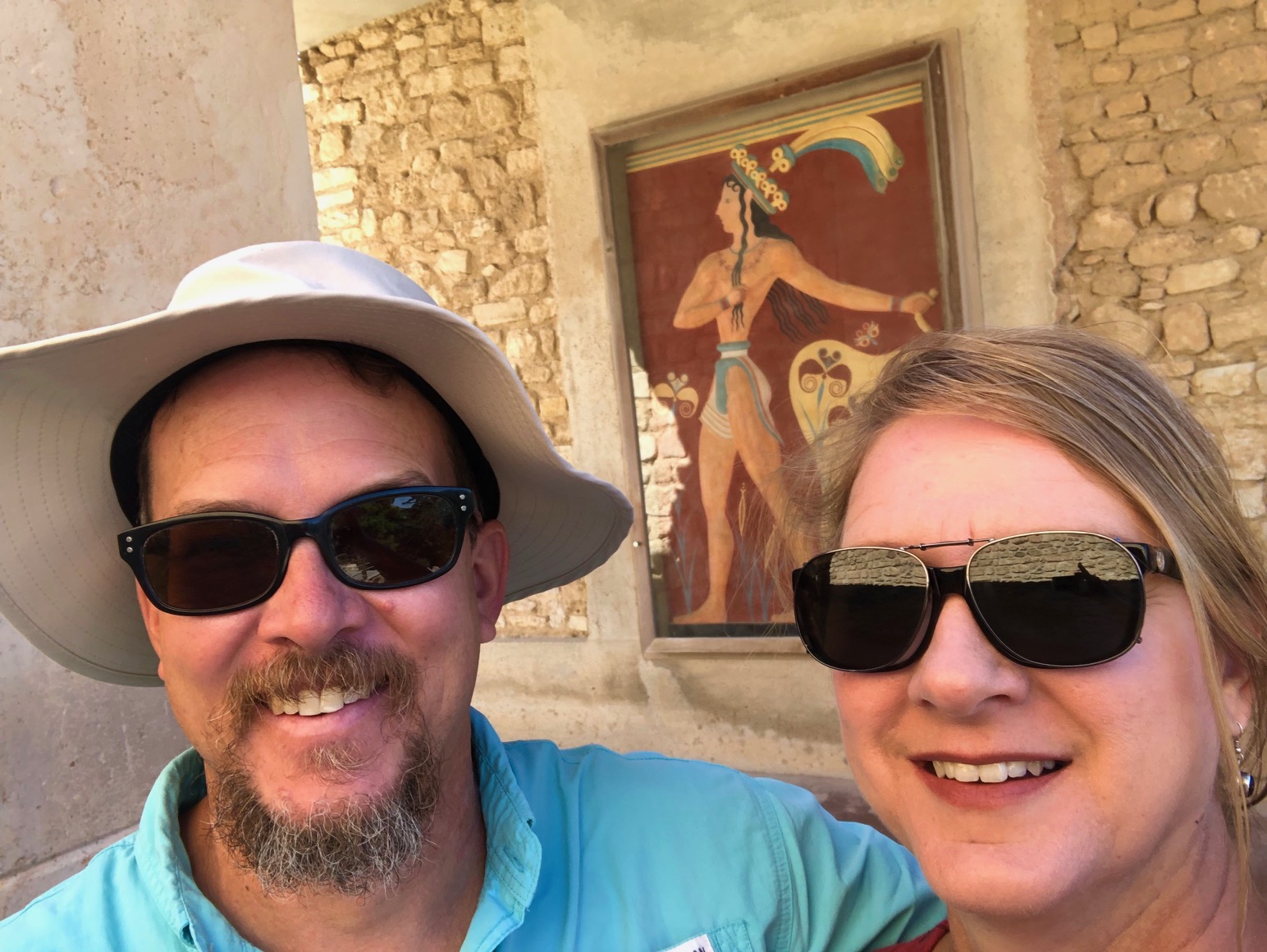
Mitch and I standing in front of a fresco reproduction on the grounds. The original is on display at the Heraklion Archaeological Museum near the harbor in downtown Heraklion.
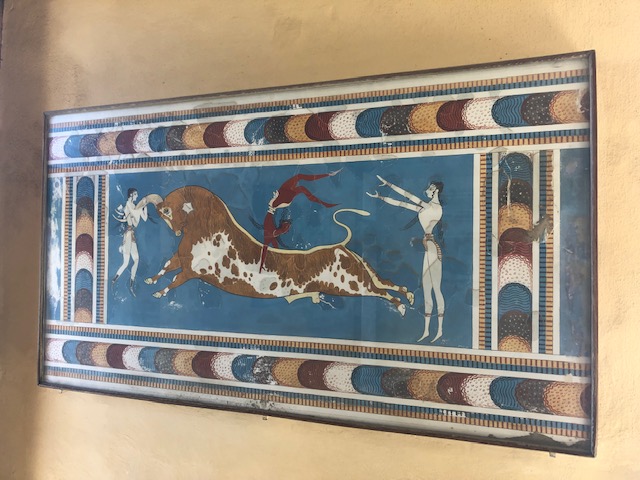
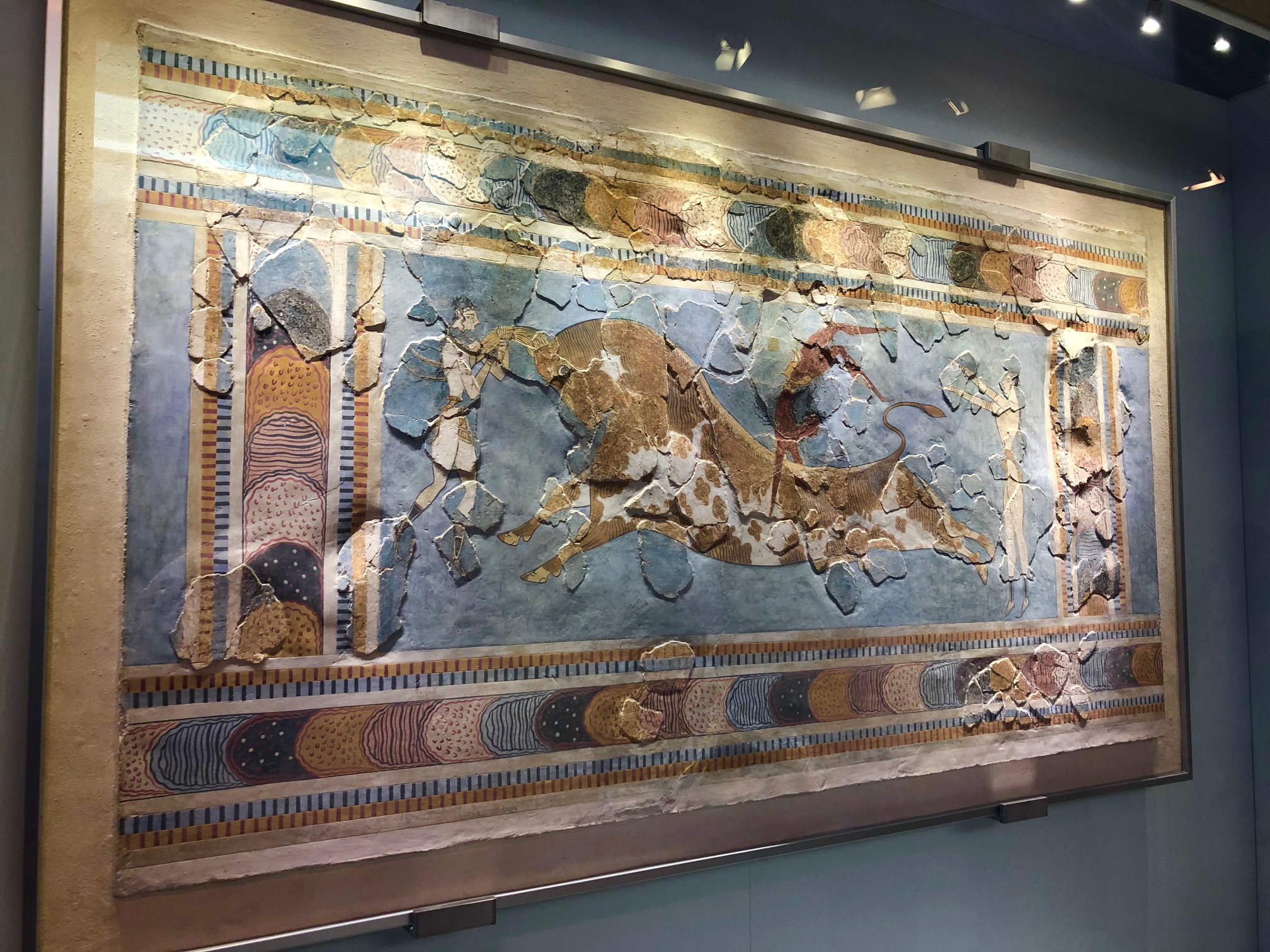
This Bull-Leaping Fresco (1449 BC) is the most intact fresco from the palace. It’s also one of the most recognizable. It depicts a popular sport in Minoan culture, bull leaping. Contestants (male and female, according to the placard at the site) would leap and flip over bulls to compete.
The original of the Bull-Leaping Fresco hangs in the museum. Notice that only some of the original excavated pieces have been found. Archaeologists must research to make assumptions to recreate the larger artwork based on the found pieces.
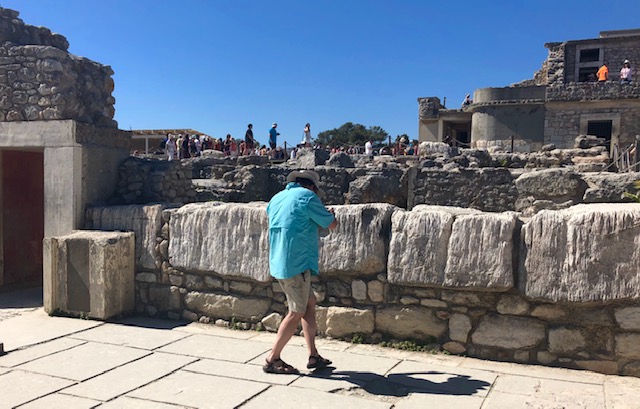
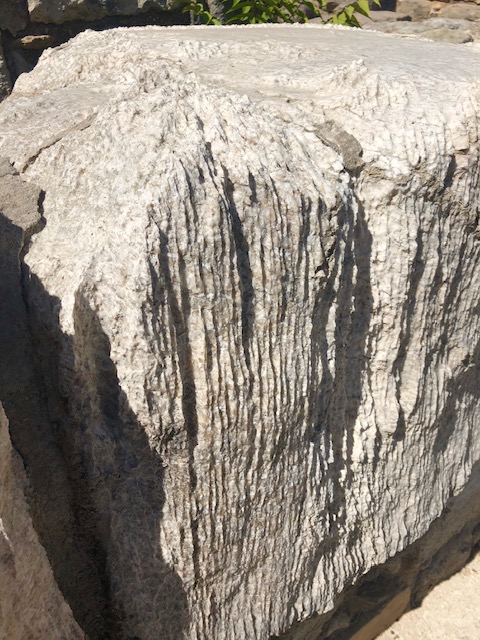
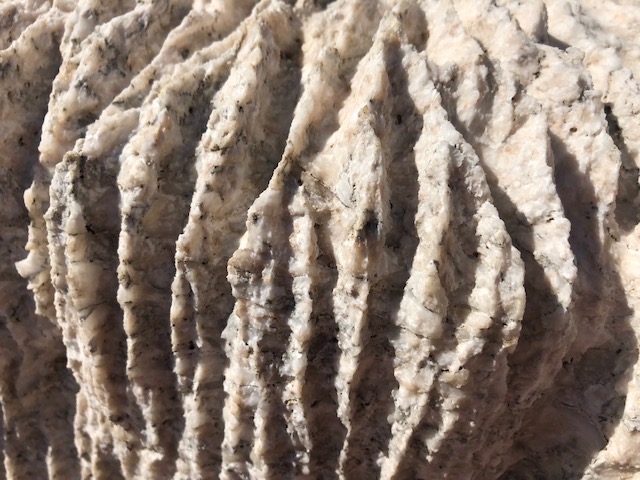
Mitch photographing large blocks of gypsum, a popular building material used at Knossos. It was popular due to its ease of use and beautiful appearance when polished. These pieces are rough and have sharp edges due to being exposed to weather.
A closer look.
And still closer.
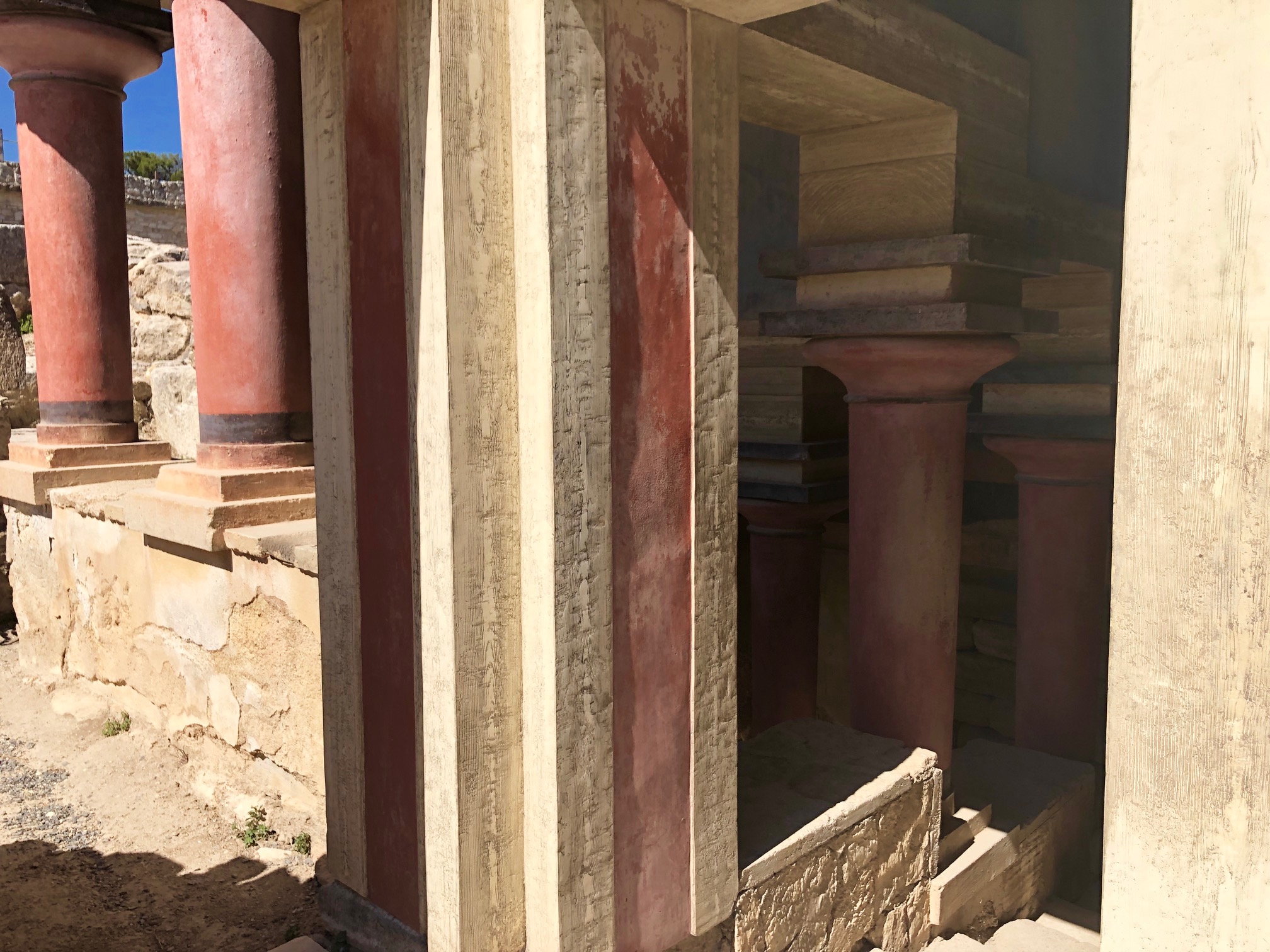
In addition to using gypsum, the Minoans also used wood. The off-white trim work you see alongside the red is wood, probably cypress. Minoans understood wood’s plasticity that would support and complement stone and stucco.
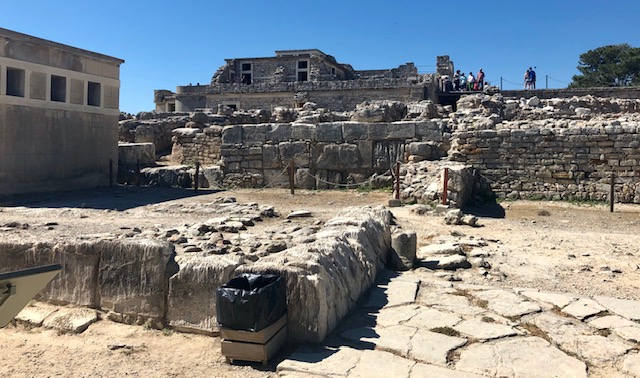
More gypsum walls and foundations.
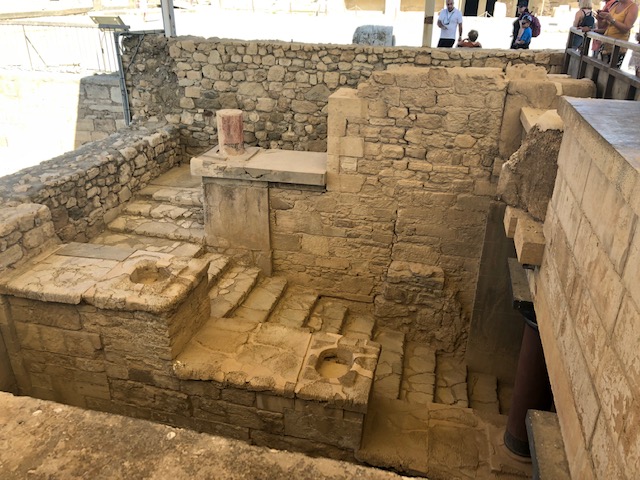
The Palace at Knossos was complex in that it included many layers of floors.
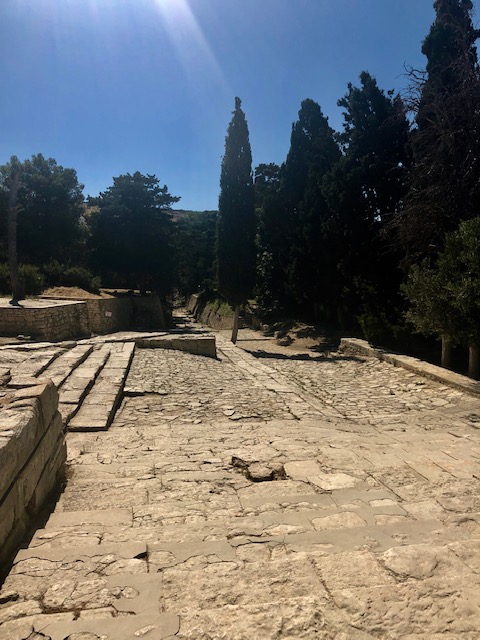
The theater and River Road that visitors to the site use to exit the palace grounds.
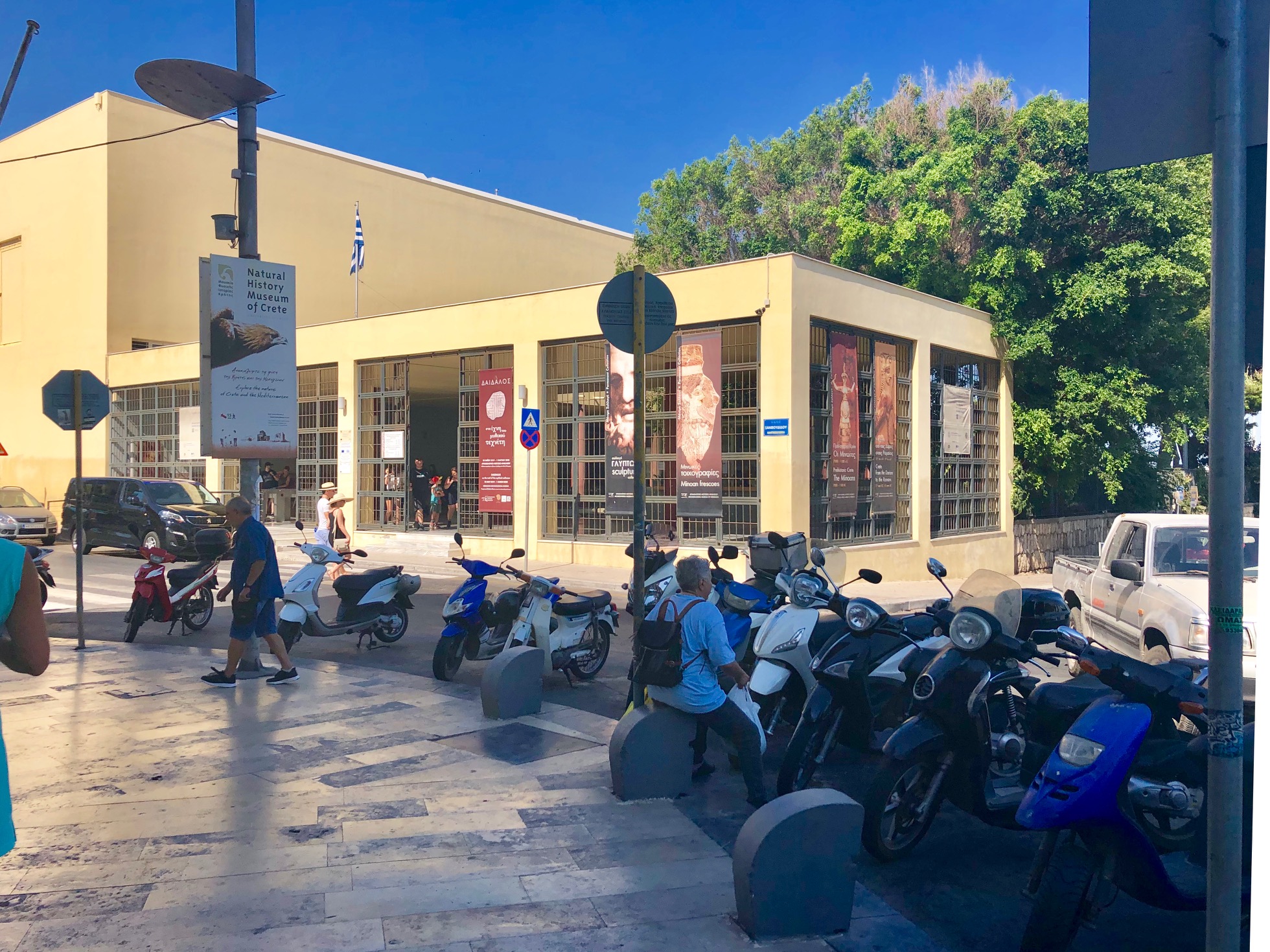
The Heraklion Archaeological Museum near the harbor in downtown Heraklion. Don’t let the museum’s plain exterior conceals the fact that inside is an incredible collection of Minoan art from not only Knossos Palace but other Minoan centers.
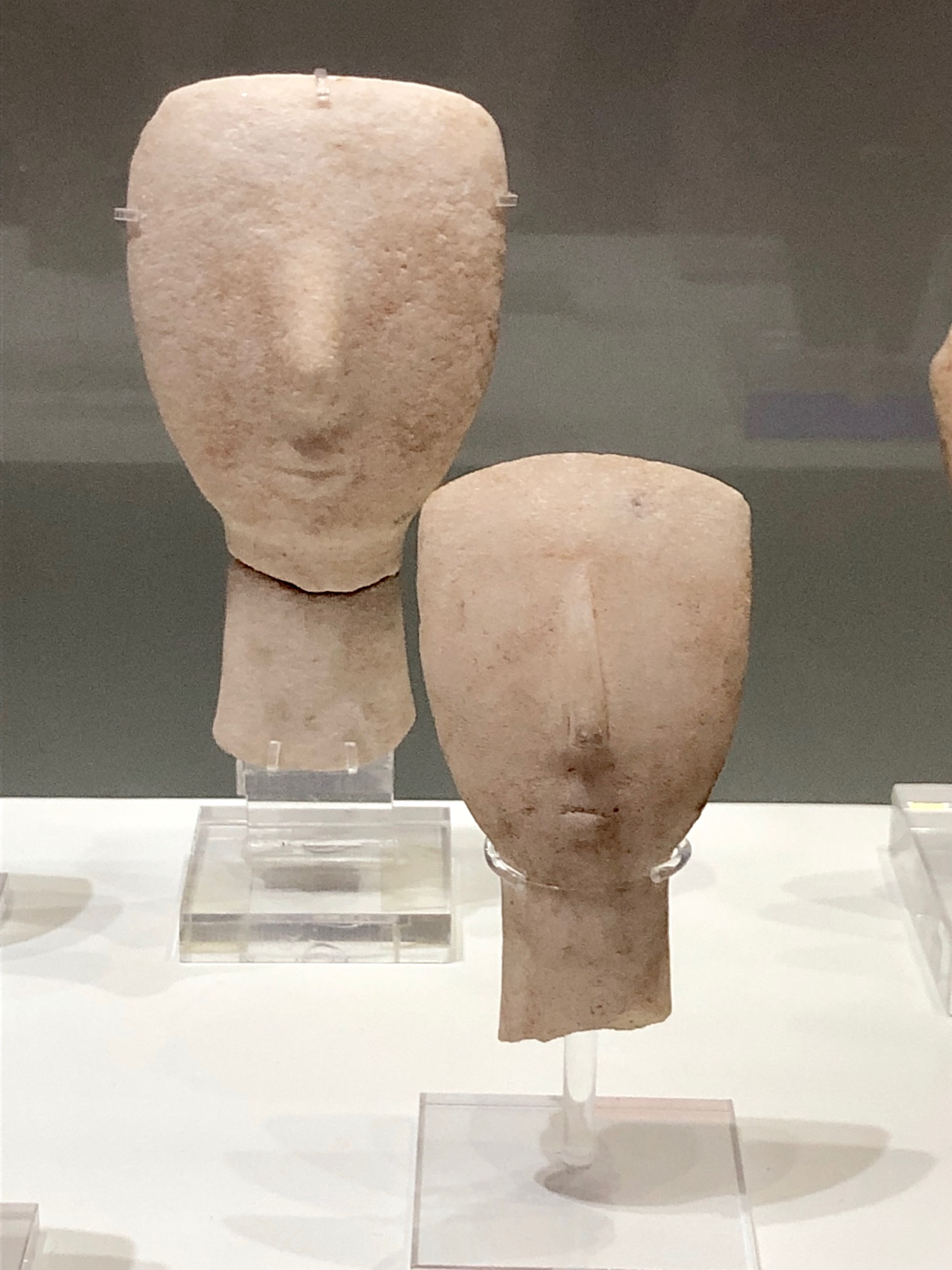
I was captivated by these Cycladic figures, small sculptures made by artists of the islands known as the Cyclades. These were made from 2300-1700 BC.
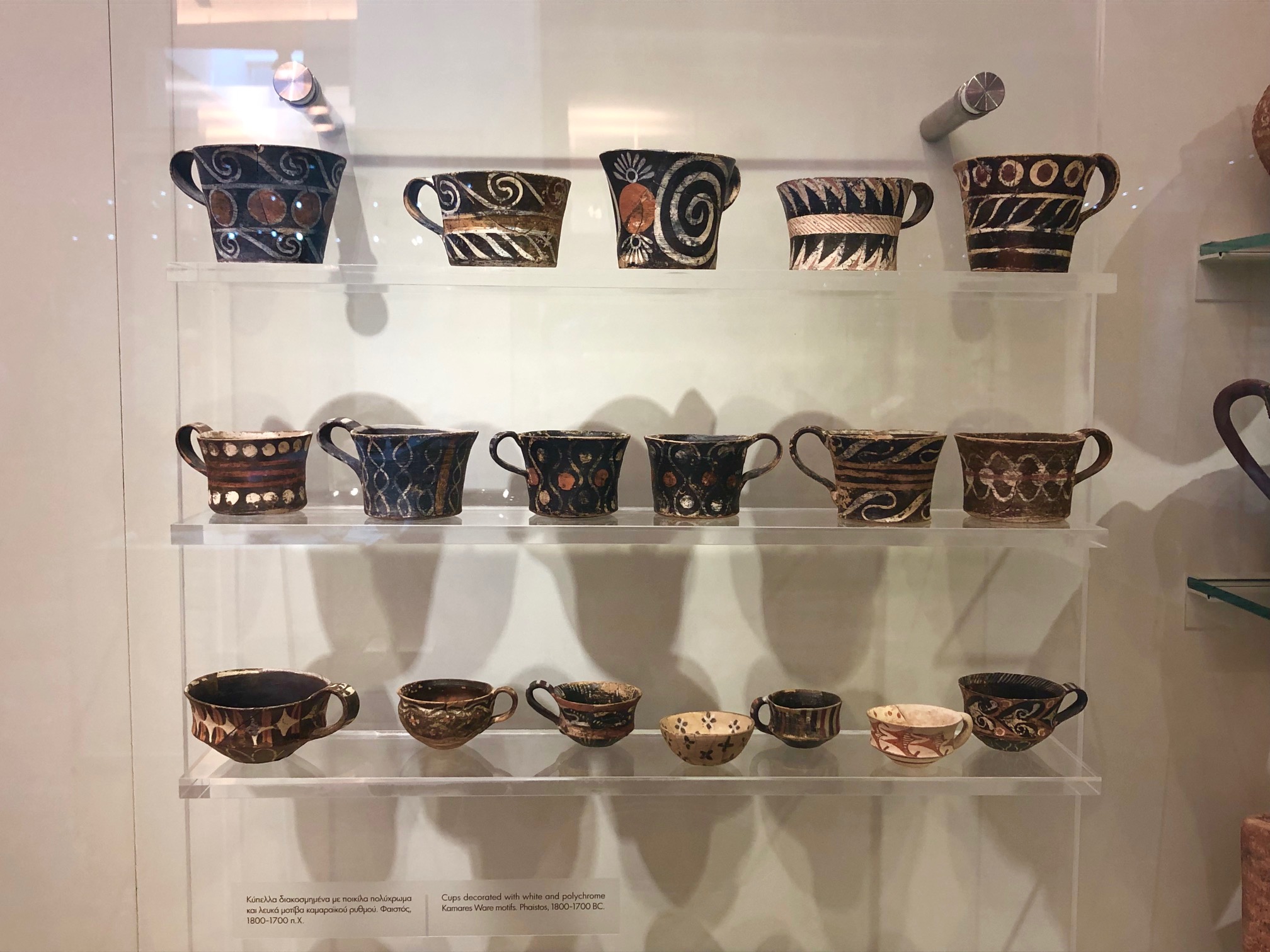
These cups look so similar to ones we use today, but they were made between 1800-1700 BC.
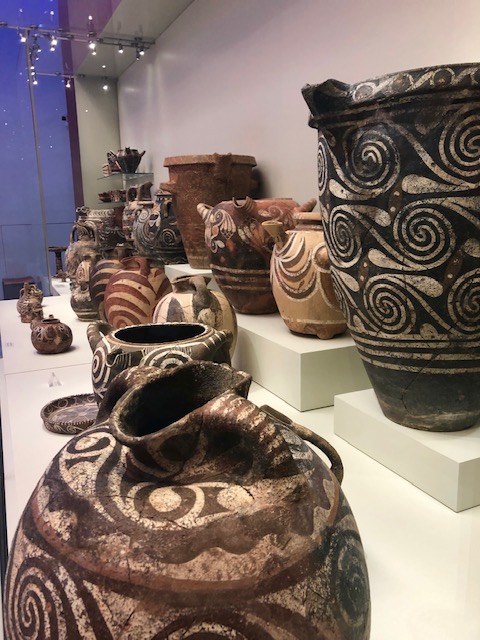
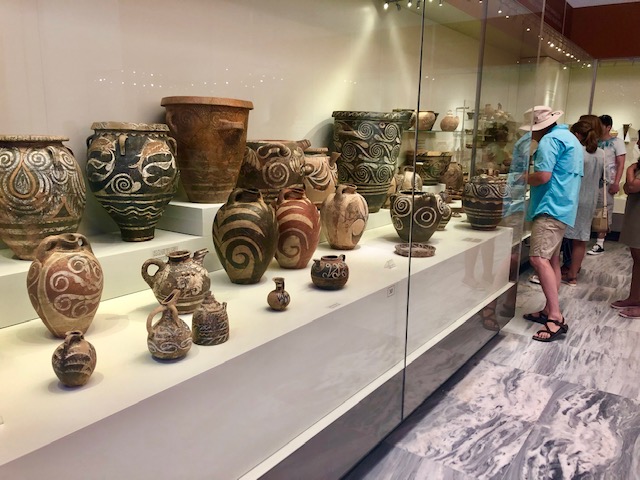
An incredible collection of jars. Seriously beautiful.
This is my husband’s version of Disney World.
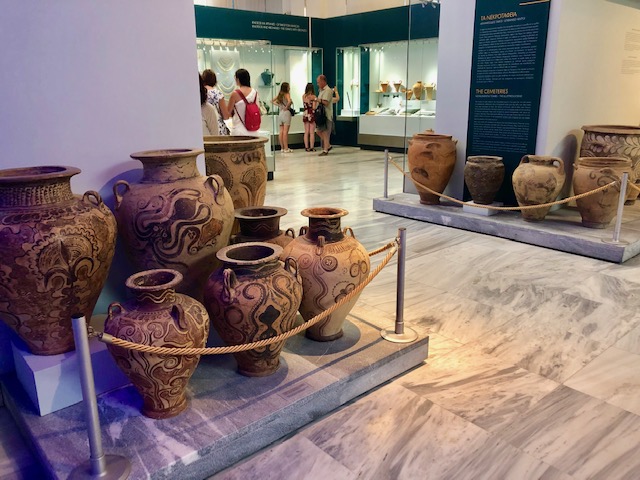
And more jars around every corner. Truly incredible.
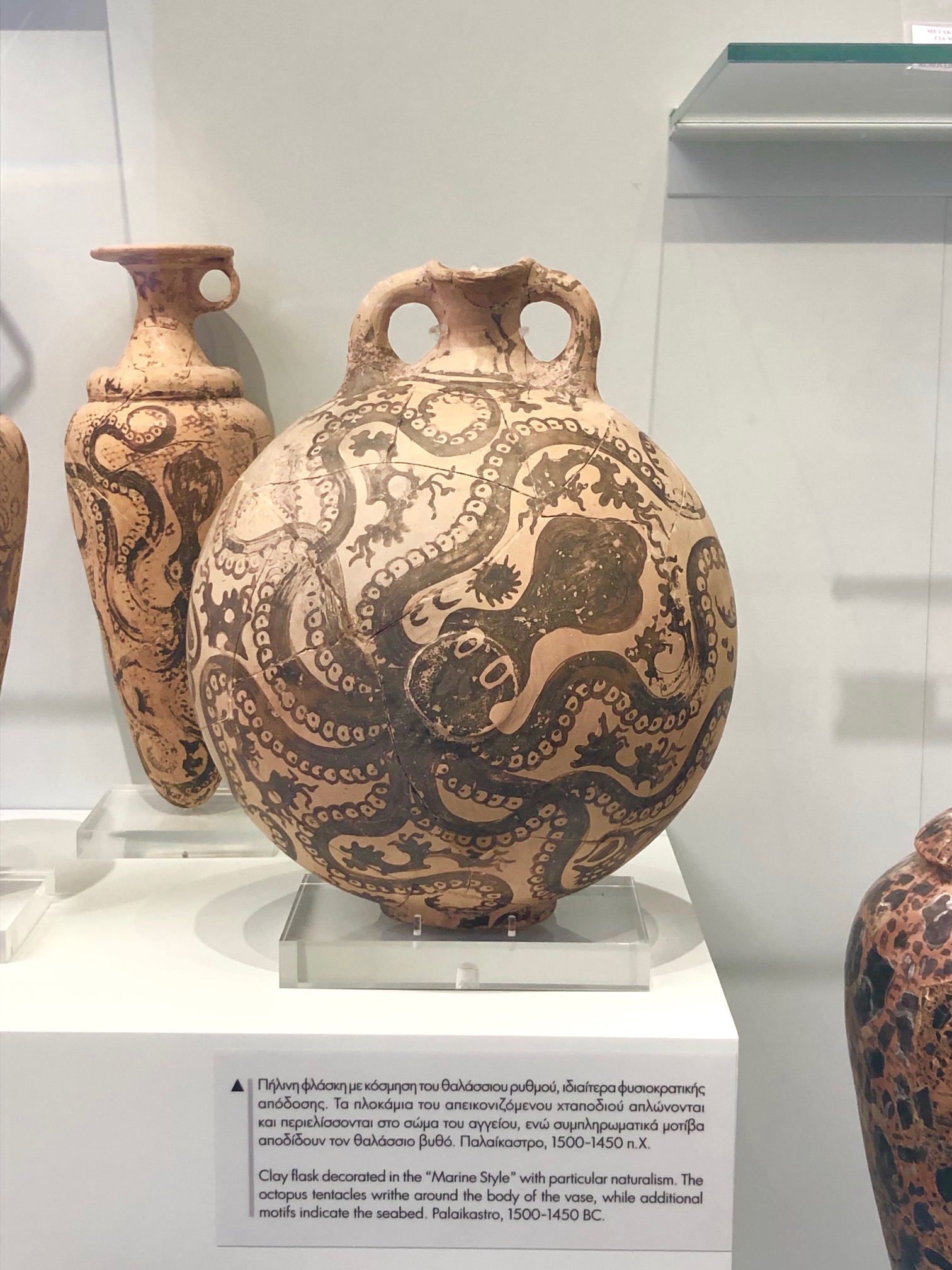
Can’t get over this octopus motif, an example of the “Marine Style” common to Minoan art.
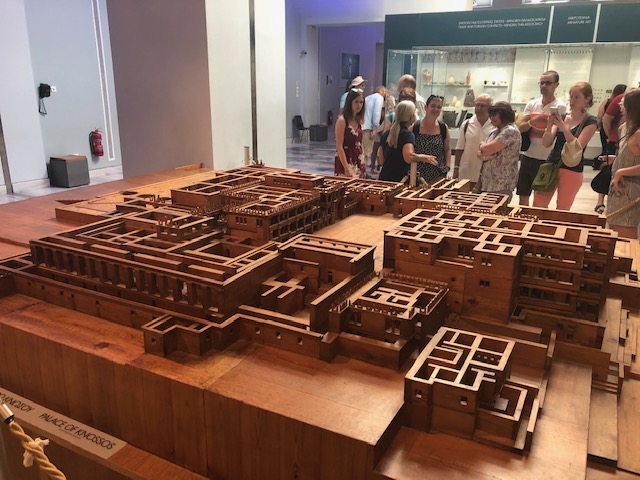
Knossos Palace. By the way, banish our modern notion of what a “palace” is. Back in the Minoan era, a palace was more of a center of a community or kingdom. The Knossos Palace included administrative buildings and other functional structures, in addition to royal quarters and the like.
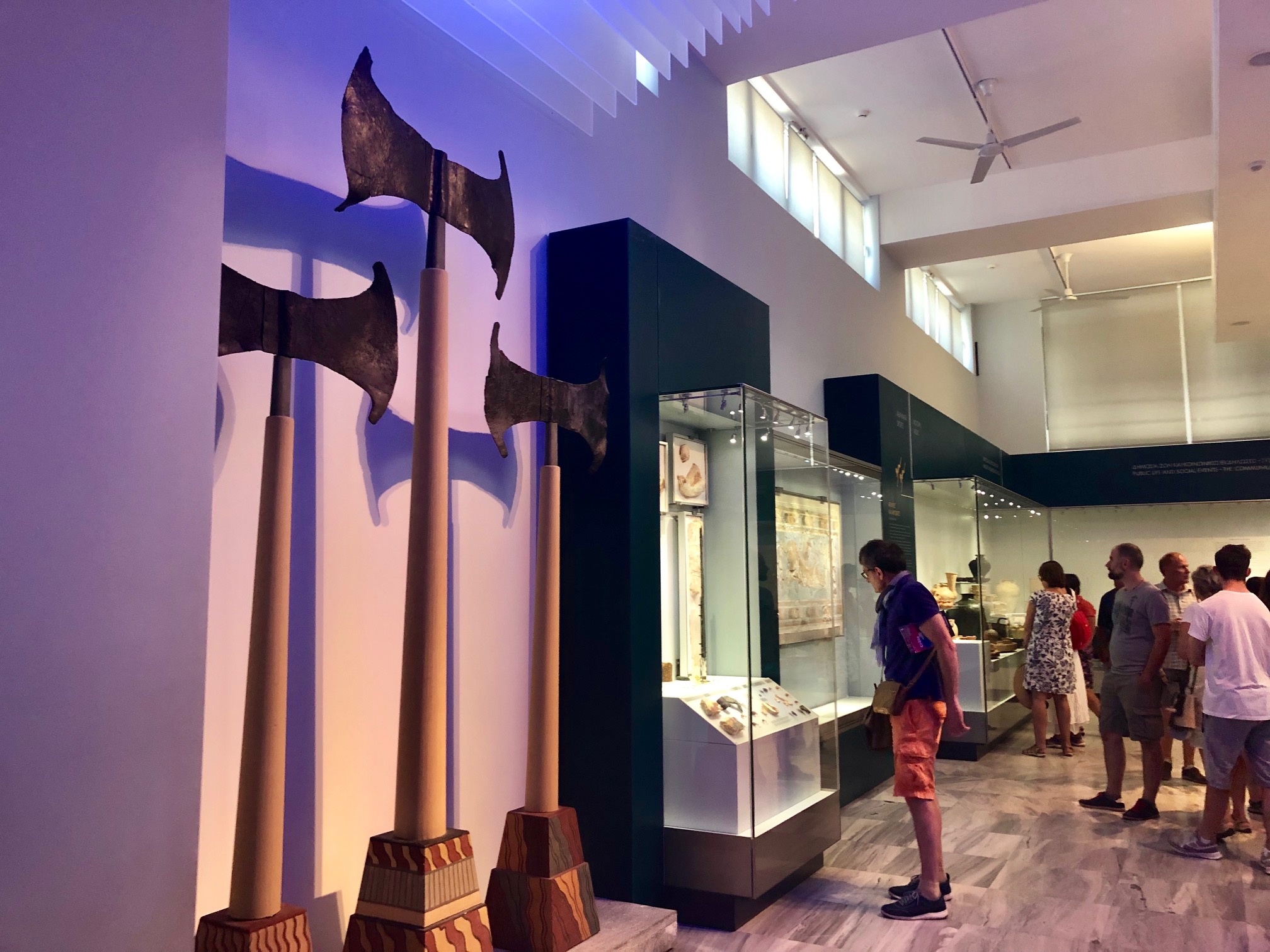
Double axes of monumental size. The Minoan culture spanned the Stone Age and into the Bronze.
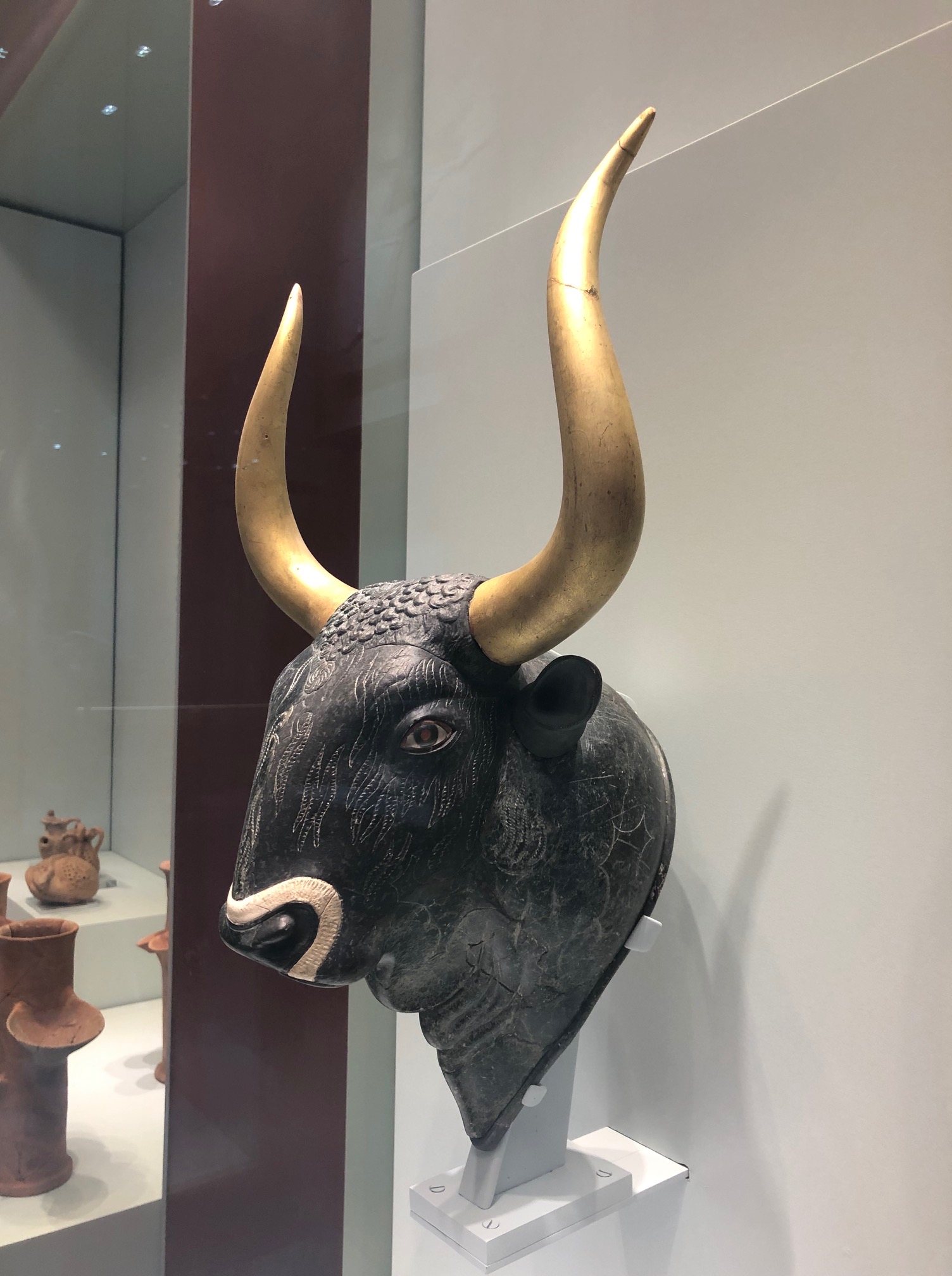
Can you believe this carved stone bull was made from 1600-1450 BC? It was actually used to hold liquids. There was a hole in the back for filling and then the liquid would pour out from the bull’s snout.
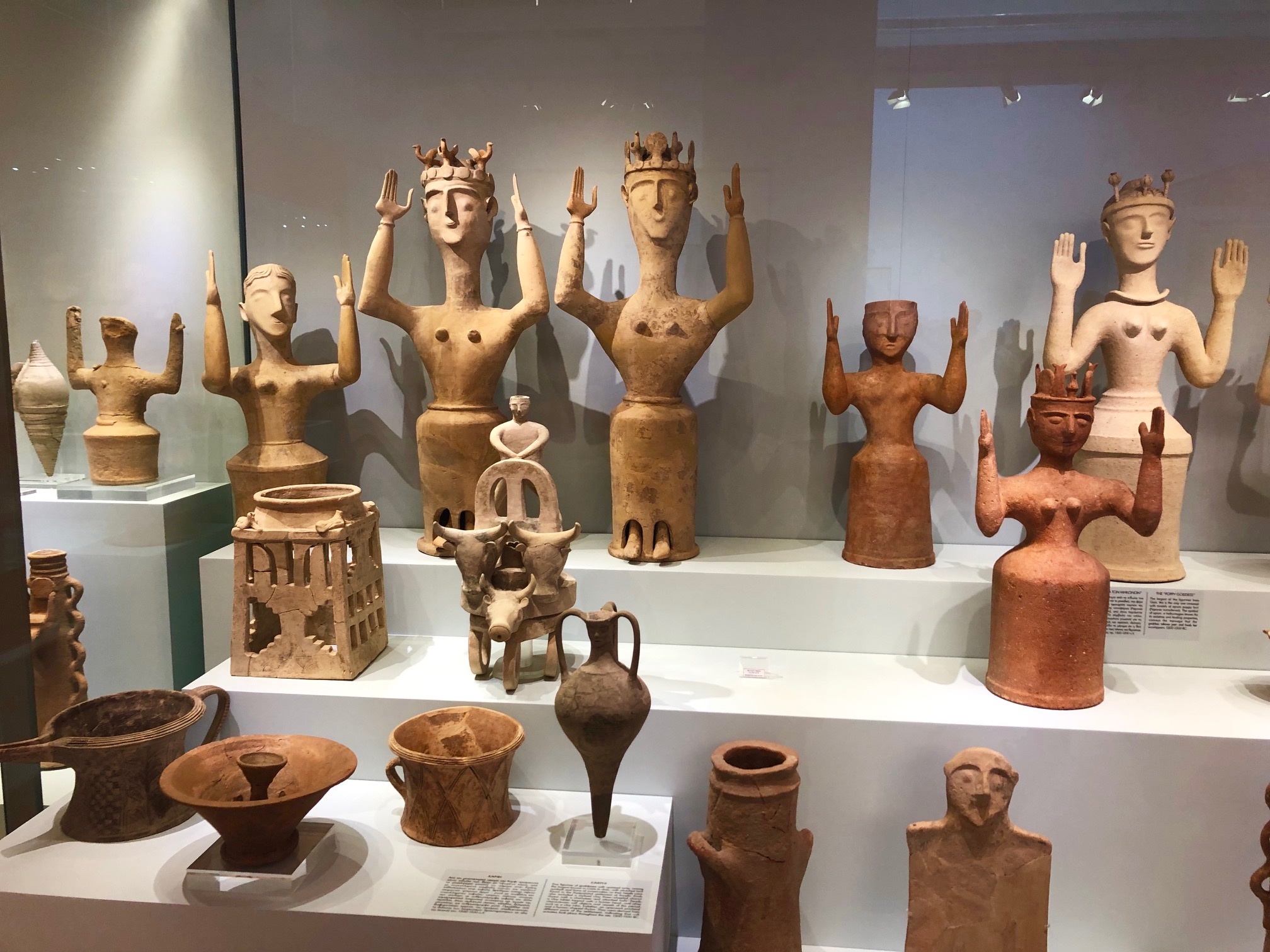
A collection of figurative pieces. So expressive!
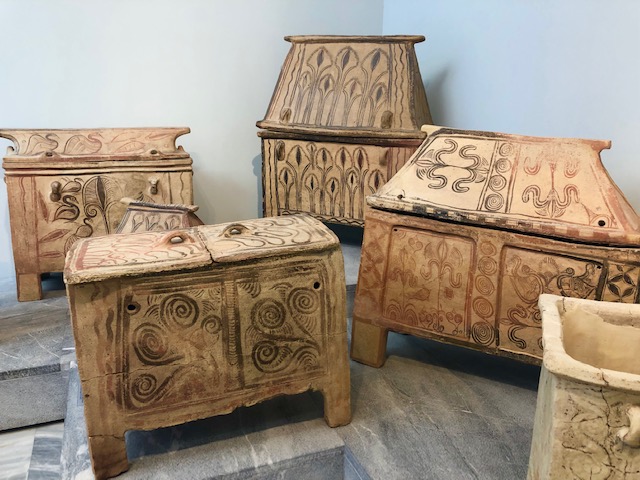
A collection of burial coffins known as larnakes. One actually still had a skeleton inside.
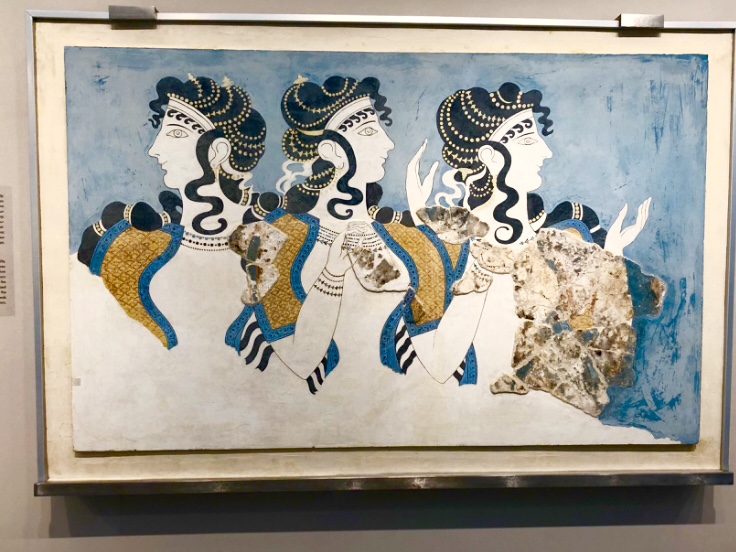
A fresco known as “Ladies in Blue.” This is the original. A reproduction is found at the archaeological site. 1525-1400 BC
Famous Bull Relief Fresco. Its reproduction at the palace is shown behind the columns in the first photo in the article.
Like other Greek archaeological sites, tickets for Knossos were 16€ and included both the site and the museum. The tickets were valid for two days. That means you have all the time you need to tour.
Featured Photo Credit: Marilyn Yung | Knossos
Thanks for reading! This is the fifth archaeological site we’ve visited during our Greek travels this summer. Follow my blog for more stories from our trip.
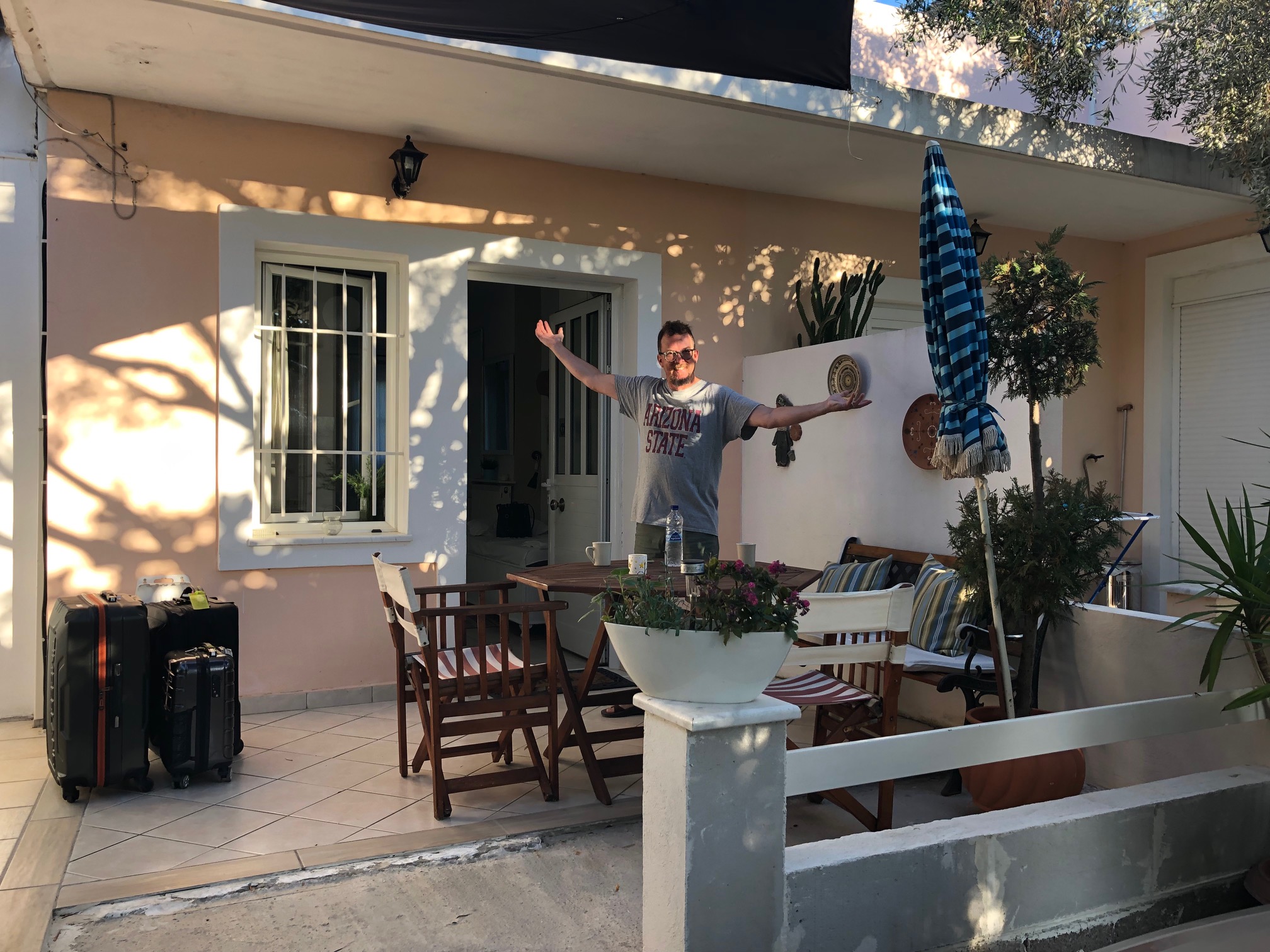
Tania’s house is called “Sunny House” and it’s ten minutes from the airport, which was perfect for our needs since we were flying out of Athens the next day for five days in Crete.
Despite some communication problems between Tania and me during the day about exactly when and how we would arrive at her house, we finally met up around 4 p.m.
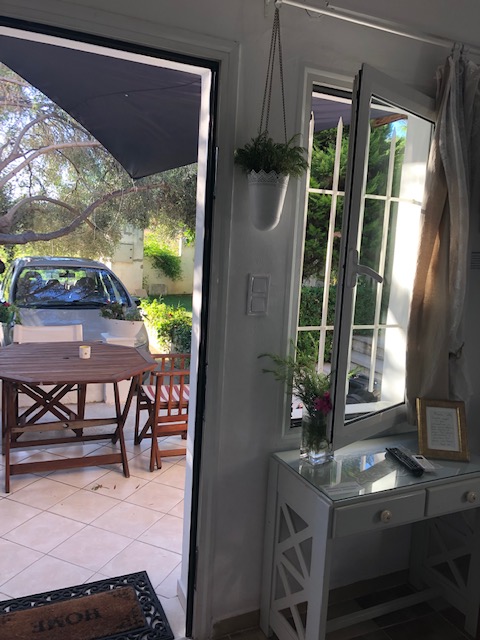
The tile patio
It had been a hectic day! We had taken a three-hour bus ride from Olympia (along the southern coast of the Gulf of Corinth), a subway transfer, and a ride on the suburbs-bound metro train. Tania could tell we were exhausted. After showing us the house, she said, “You look tired,” and she left us to rest.
However, before leaving, Tania’s son Kostas offered to handle ordering dinner for us later. We could look through the menus on the table in the apartment to make our choice, he said. After resting, we took him up on his offer and asked him to order two pork gyros from a local restaurant. In about fifteen minutes, a man on a scooter drove to our door with hot gyros in hand. Awesome!
Mitch and I ate our gyros on the sun-dappled patio table in front of our flat. It was a very warm day (some would call it hot), but with the breeze, it felt cool in the shade.
I wish I had taken pictures right when we arrived. It was a great little place!
As we ate, Kostas was installing some tile around a concrete seating area on his mother’s patio. He came over and asked us if it would be all right if he cut some tile, as it would make quite a loud noise. Of course, that would be fine, we said. We didn’t want to get in the way of his project, obviously.
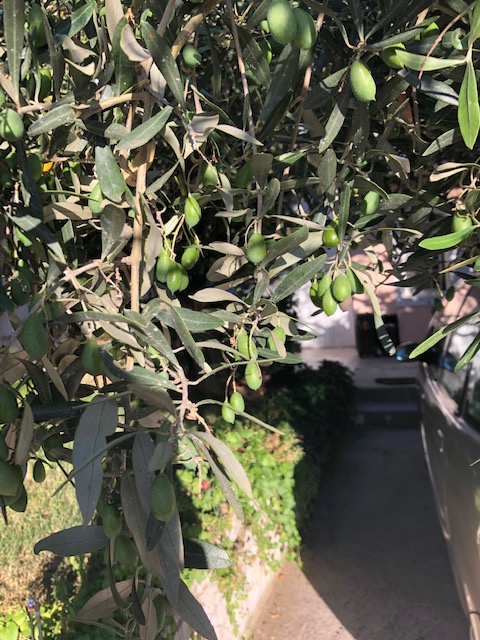
As Kostas worked, Tania swept leaves from her patio that joined ours. In front of her home, four trees provide lemons, oranges, apricots, and olives. She told us to help ourselves to all the apricots we wanted as there were simply too many to pick. We picked about six and carried them back to our place. Lucky for us that we’ve visited Greece during apricot season. (I never buy them at home because they’re rarely allowed to ripen on the tree.)
Apricots fresh off the tree
After eating and resting some more, we both wandered outside to see Kostas’ tile project up close. As we spoke with him, Tania came out from her home.
“Sit, sit,” she said. Taking her cue, the three of us joined her around her wooden picnic table.
As the breeze stirred, we got to know each other a bit.
We visited about politics (Greece has elections in about a week; the United States’ 2020 election is already in the news).
We also talked about opportunities for young people in Greece, which seems to be a complex subject. For example, Kostas, a mechanical engineer completing a master’s degree in Romania, told us that engineers earn less pay than hair stylists. We relayed that teacher salaries in the U.S. also can reflect that disparity.
We met their dog, Bruno. Kostas told us Bruno was a stray that they had adopted. Apparently, Bruno likes to chase cars. The road beyond the house, a gravel one that feels like a country road, did occasionally have a car speeding by.
As we visited, a neighbor hollered in Greek over the courtyard wall. Tania spoke back and apparently invited the woman in. She greeted us with a smile, looked at Kostas’ tile project, indicated that it was coming along well, and went on her way.
Kostas gave us tips for visiting Crete, recommending that we check out Chania while we’re there.
Gradually, the clear night sky darkened. The sound of a flight taking off or landing could be heard in the distance and Tania rose from the table. About five minutes later, she returned with forks and plates of watermelon wedges.
Olives are on the way!
We continued to talk and it occurred to me what a generous mother and son we had met. Both were eager to share about their lives and learn about ours. We told them about our daughter, who was returning to the U.S. from an internship in Italy, and our son, a college student studying photography and video production.
They were curious about Mitch’s familiarity with farming, raising livestock, and chickens. They were especially intrigued when they learned that Mitch even raises specific chickens for their feathers, which he uses to tie flies for fishing.
We also relayed to her details about some of our other AirBnB stays from the previous few days. One of those stays was actually a room in a small hotel. While it was a pleasant stay, it wasn’t quite the traditional AirBnB experience. People who choose AirBnb don’t want a hotel, Tania said. They want the experience of meeting local people.
The next morning right before we left
Eventually, the conversation waned and a few yawns were heard. We all decided to call it a night, but before doing that, we went over our morning plans: Tania would taxi us to the airport at 7:30 in the morning so we could make our 9:15 flight to Heraklion, Crete.
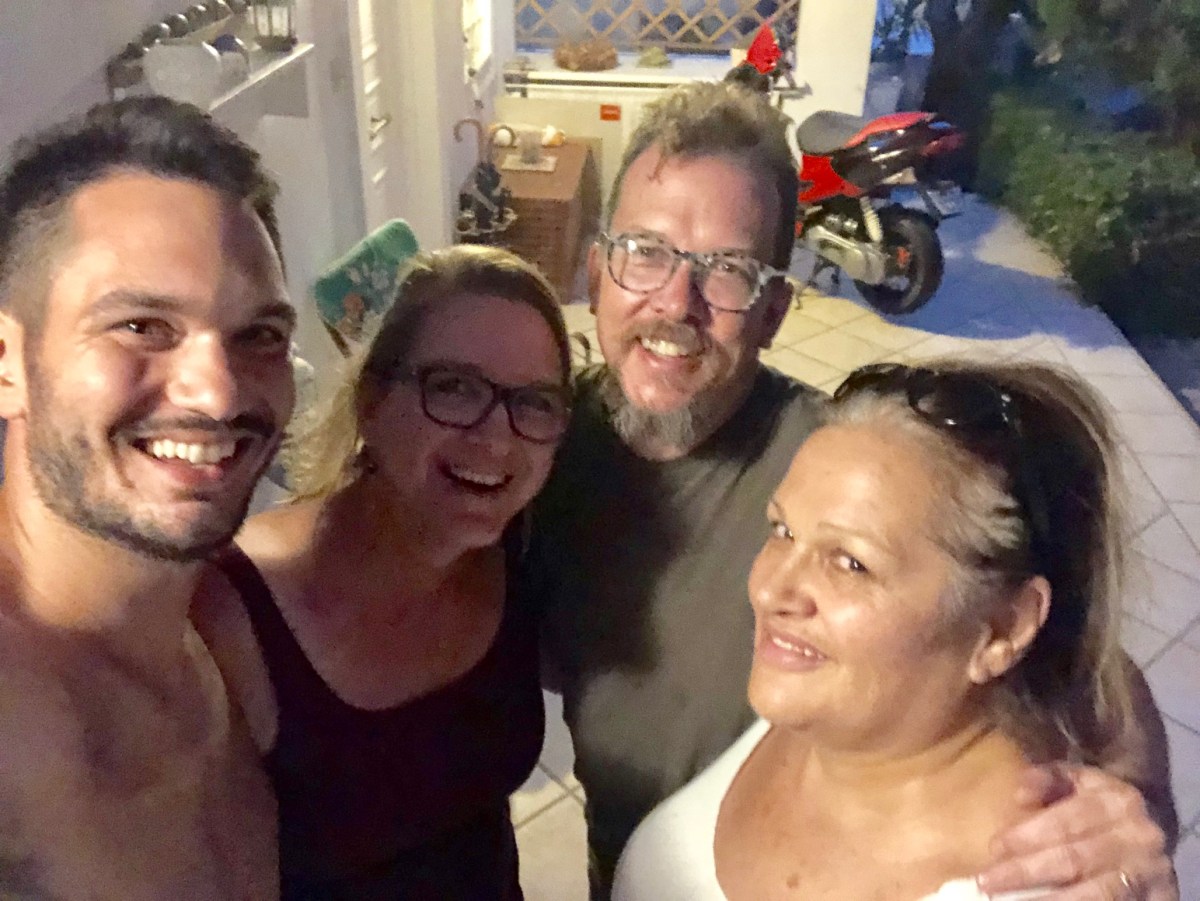
With that confirmed, I asked if I could take a picture for my blog and, of course, they agreed. Kostas offered to take the picture. His long arms are good for that, he told us.
We thanked Tania again for the watermelon and wished Kostas well with his studies. And with that, we turned in for the night.
Photo: Pixabay
Featured Photo Credit: Marilyn Yung
Thanks for reading! Click like if you enjoyed this post. What’s your experience with AirBnb? Follow this blog for more travel stories from Greece.
As with all three of the towns we have visited so far in Greece since we left Skopelos Island, there is more to the towns than just the historical sites. For example, Delphi is a quaint Alpine-style village full of shops and establishments that cater to the tourist market that is always in town, at least in the summer months.
Mycenae is also a sleepy little village just down the mountain from its own historical site. There are a few tavernas, a mini-market, a bus stop, and a few other businesses that keep the town humming along.
Olympia is much the same.
When we arrived there a few nights ago in a taxi, we saw from a distance our AirBnB host, Kostas (another Kostas, not the one from Mycenae) standing in the middle of the street in front of our flat waving his arms at us. We pulled up, paid the driver, and lifted our bags from the trunk. Once we all shook hands, Kostas showed us our small studio apartment and gave us an impromptu history lesson about Olympia.
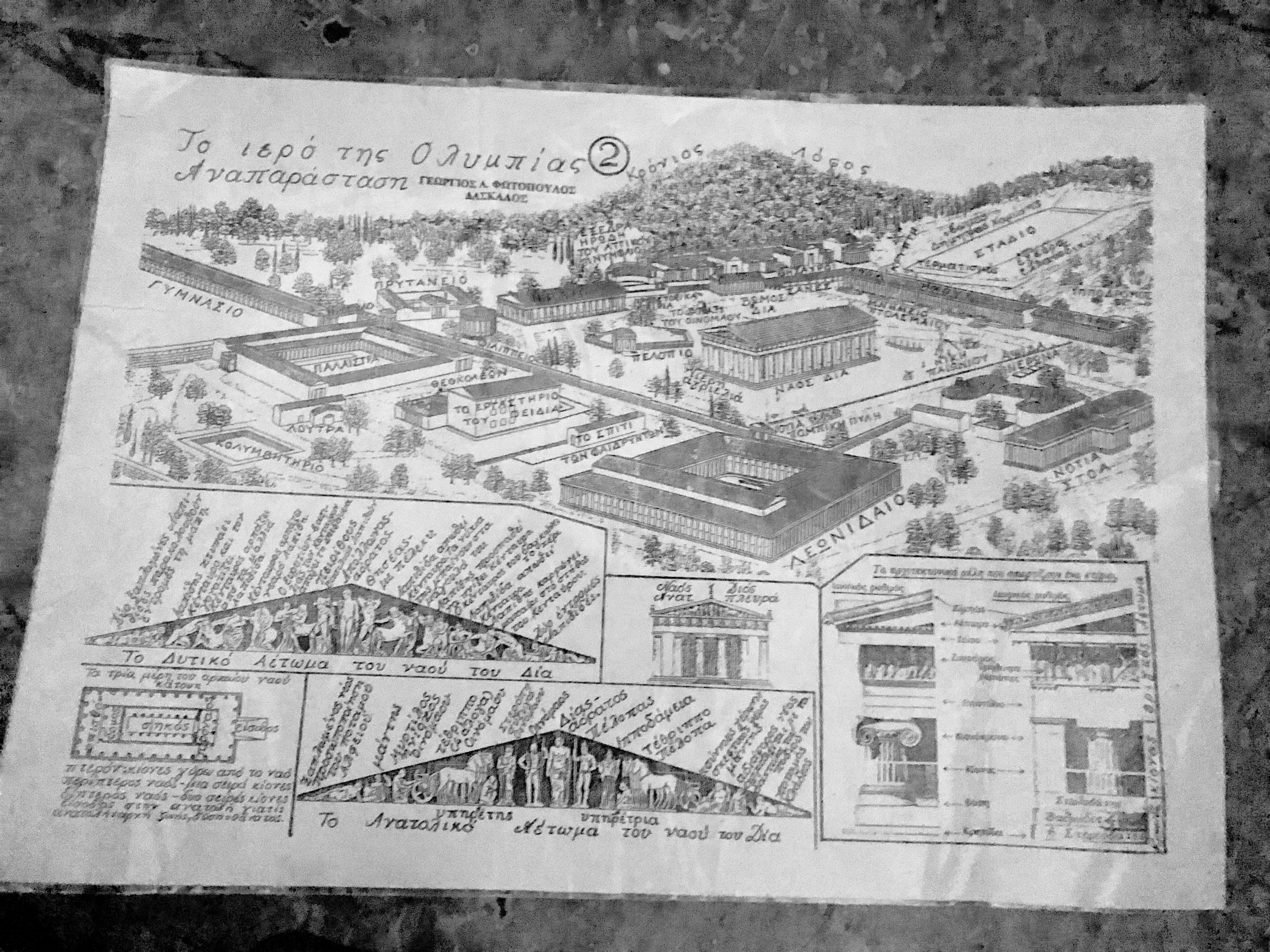
Standing inside our apartment, he showed us the laminated map below. He proudly explained several things to us in a deep, warm voice: how the ancient Greeks counted years by the Olympic games, details about the sculptures found at the site, and how the games were used by the Greeks to unite people and solve differences.
A history buff, it’s obvious that Kostas loves his town and its prominent place in world history. In fact, he reminds me of the enthusiastic Venetian tour guide I met a couple of weeks ago.
And then Kostas walked us downtown and over to the archaeological site so we would know exactly how to get there the next morning. When I say walked us downtown, I really mean that we walked down a series of steps from our studio to the main retail street that connects the modern town to the historical site.
The door to our apartment is on the far right. The main street is right at the bottom of these stairs.
The main retail street, as one would expect, is full of tourist shops, clothing stores, jewelry shops, restaurants, tavernas, a grocery store, The Archimedes Museum (a free museum dedicated to the inventions and discoveries of Archimedes) and the town hall.
The three of us did make one stop along the way to the site. Kostas asked us to wait outside the little super market so he could go inside and buy a can of dog food. He wanted to feed a dog that lived inside the Olympia site.
Kostas told us that several dogs live around town that the locals look after. Once we crossed the bridge and neared the edge of the park, Kostas let out a distinctive whistle. Suddenly, we saw a white and black-spotted border collie mix bound out from the monument grounds. It sprinted for Kostas, who peeled off the lid of the can and flung the food out on the road for the dog to lap up.
Wow, I remember thinking, this is a nice guy.
A jewelry shop owner snagged us inside with a tale of his brother who carried the Olympic torch during the 2004 games. He wanted to take this picture of us. I wish I had taken one of him!
After our history lesson and our tour about town, Kostas bade us farewell, asked us to contact him if we needed anything over the next two days, and took off back to his home.
At that point, we went back to our apartment and collapsed. It had been a long afternoon of bus riding from Delphi, through Itea and then along the edge of the Gulf of Corinth to Patras, and down to Pyrgos, where we missed our connecting bus by about ten minutes.
Once we made it to Patras, Greece’s third largest city, we barely made it on this connecting bus to Pyrgos. For some reason, the ride took longer than it was supposed to and we had to taxi to Olympia. Still don’t know what happened.
In a few hours, however, hunger called and we walked across the street to Kostas’ recommended taverna, Taverna Orestis. He told us it was where the locals ate since it was off the main street. He was right. By 11 o’clock p.m., the outside seating area was chock full of people.
On our first night in town, I took this picture from our balcony right after we got back from Taverna Orestis, located across the street from our flat. Kostas recommended it as a non-touristy choice since it wasn’t on the main tourist street. We ordered grilled sardines, dolmades, Greek salad, and tzatziki with bread. It was excellent and fun to see the locals socializing.
There were two large groups of about twenty each, several couples, and a family or two with children. I was surprised by how busy they were and so late at night! Our sleeping and eating schedules are so vastly different from those of the Europeans.
We found this taverna right in the center of the main district. It was so quaint and also had the misters running in the afternoon, so we decided to enjoy the place with some cappuccini.
Mitch had a freddo cappucino (iced) and I had a regular hot one.
After a morning of sightseeing at the Sanctuary of Olympia, we took a break for gyros and sodas at another local taverna. Then we headed back during the hot afternoon to the air-conditioned museum. See this post for more about the archaeological site.
During our second night in Olympia, we opted to eat in with food from the market on the main street. We bought some toasts, gouda cheese, a freshly-picked orange from a tree, some salami, and Greek olives.
Another view from our balcony.
The morning after our visit to the archaeological site, we asked Kostas to confirm for us the time of the first express bus back to Athens. It’s very difficult to find current bus schedules and to know that they’re right.
At left is a screenshot that Kostas sent us via the AirBnB app so we would have a current schedule. We took the 9:30 express along the southern edge of the Gulf of Corinth and made it back to Athens by 1:30 p.m.
Olympia is small and comfortable. It’s busy when loads of buses drop off tourists, but after they leave for the day, it’s a very quiet town. In fact, there are several unoccupied hotel buildings scattered about town. I’m not sure if that’s an after-effect of the 2004 Olympic Games building boom or not. Regardless, the town is a winner and was definitely worth the three bus rides and a taxi to get there.
Featured Photo Credit: Marilyn Yung | Kostas, our AirBnb host in Olympia, Greece. The town has a permanent population of 700 residents, he told us.
Thanks for reading! Click “like,” leave a comment and follow my blog for more stories from Greece.
Olympia, Greece was worth three bus rides and a taxi
Yesterday, we toured the Sanctuary of Olympia, the mammoth archaeological site at Olympia, Greece. Thanks to the Olympic Games, I would venture to say that most of us have heard of this site. However, I myself didn’t realize that there was virtually a complete city in this location, in addition to the athletic contests.
Above is a diagram of the Olympia site that our AirBnb host showed us when we arrived at our apartment. See what I mean by city?!
It’s a good thing the archaeologists and designers placed an ample supply of informational placards around the site so people like me can understand and appreciate more of what they’re seeing.
To summarize, the placards placed at two locations near the front of the site read as follows:
“In this place Zeus, father of the Olympian gods, was worshipped, and splendid athletic contests, the Olympic Games, were celebrated. In the cella of the temple of Zeus was placed the enthroned gold-and-ivory made cult statue of the god, work of the famous Greek sculptor Pheidias, one of the seven wonders of the antiquity. Here too, nowadays the ceremony of lighting the flame for the modern Olympic Games is held.”
After I read those placards, I looked around and here was my first thought: this place is huge.
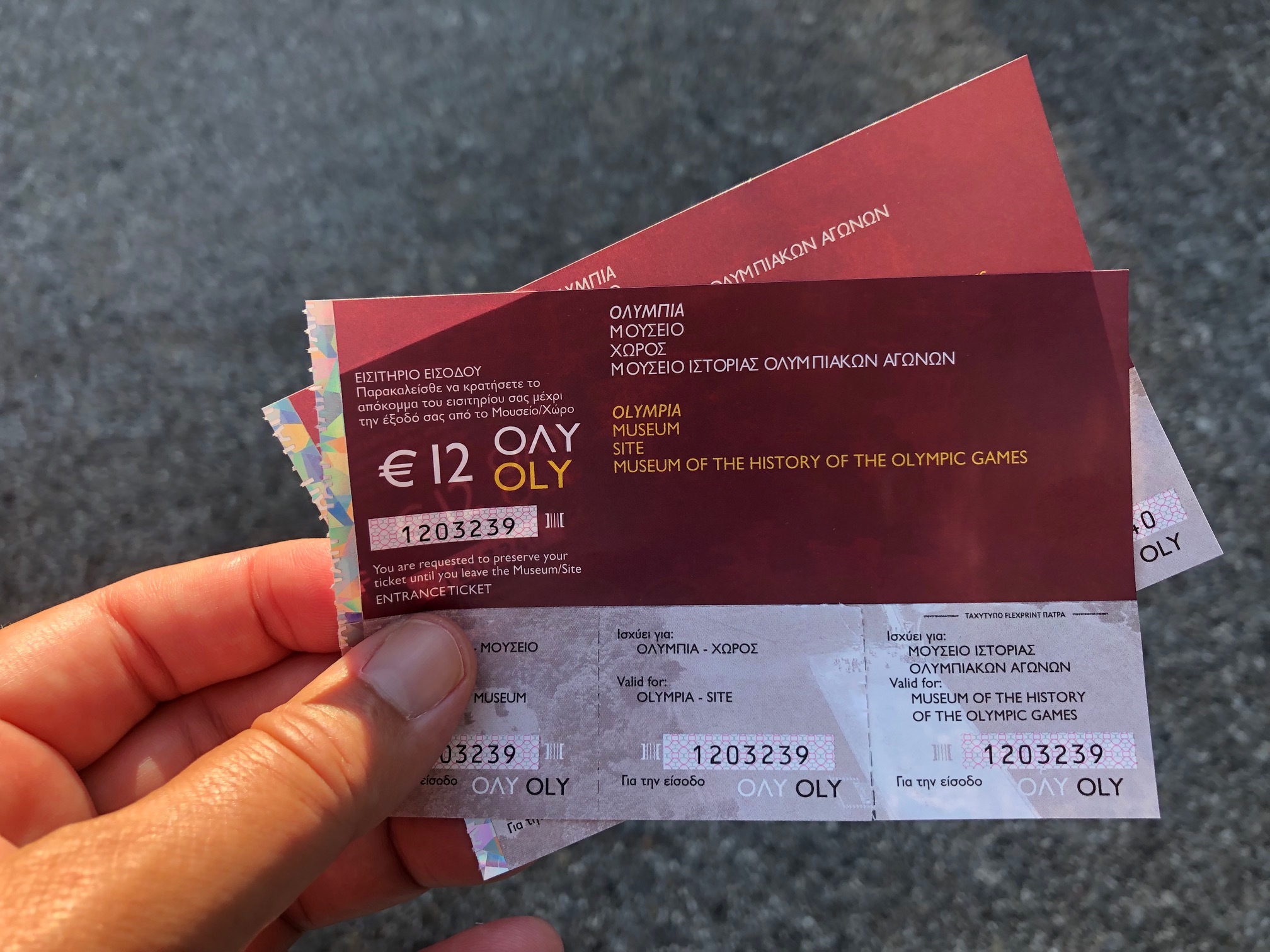
One ticket gets you into the archaeological site, the archaeological museum, and the museum of the history of the Olympics.The site and museums are open from 8 a.m. to 8 p.m. daily. Adult tickets are 12€ each. You can leave and return later in the day to any of the sites and even return the next day to continue your visit or see more. Note: We did not visit the Museum of the History of the Olympic Games. There was only so much time. If we had had another morning, we could have visited it then.
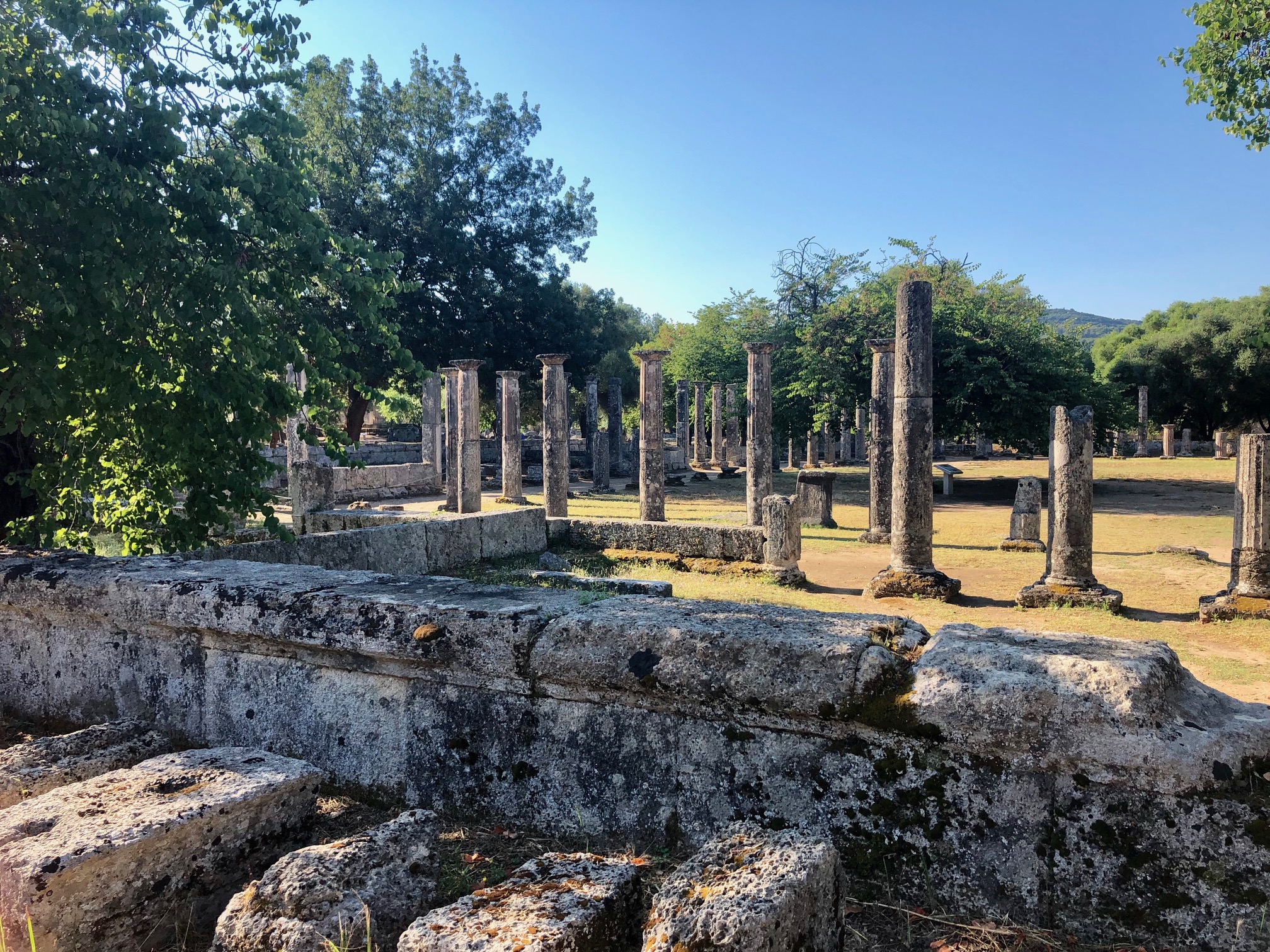
As I gazed across the grounds, as far as I could see were partially reconstructed colonnades, temples, baths, workshops, dwellings, and myriad other structures.
The colonnade is a popular photo subject. Google “Olympia” and you will see lots of pictures of these columns.
This ability to see layers upon layers of excavations is the one major difference when I compare Olympia to Mycenae and Delphi, two other sites we had just seen during the previous three days.
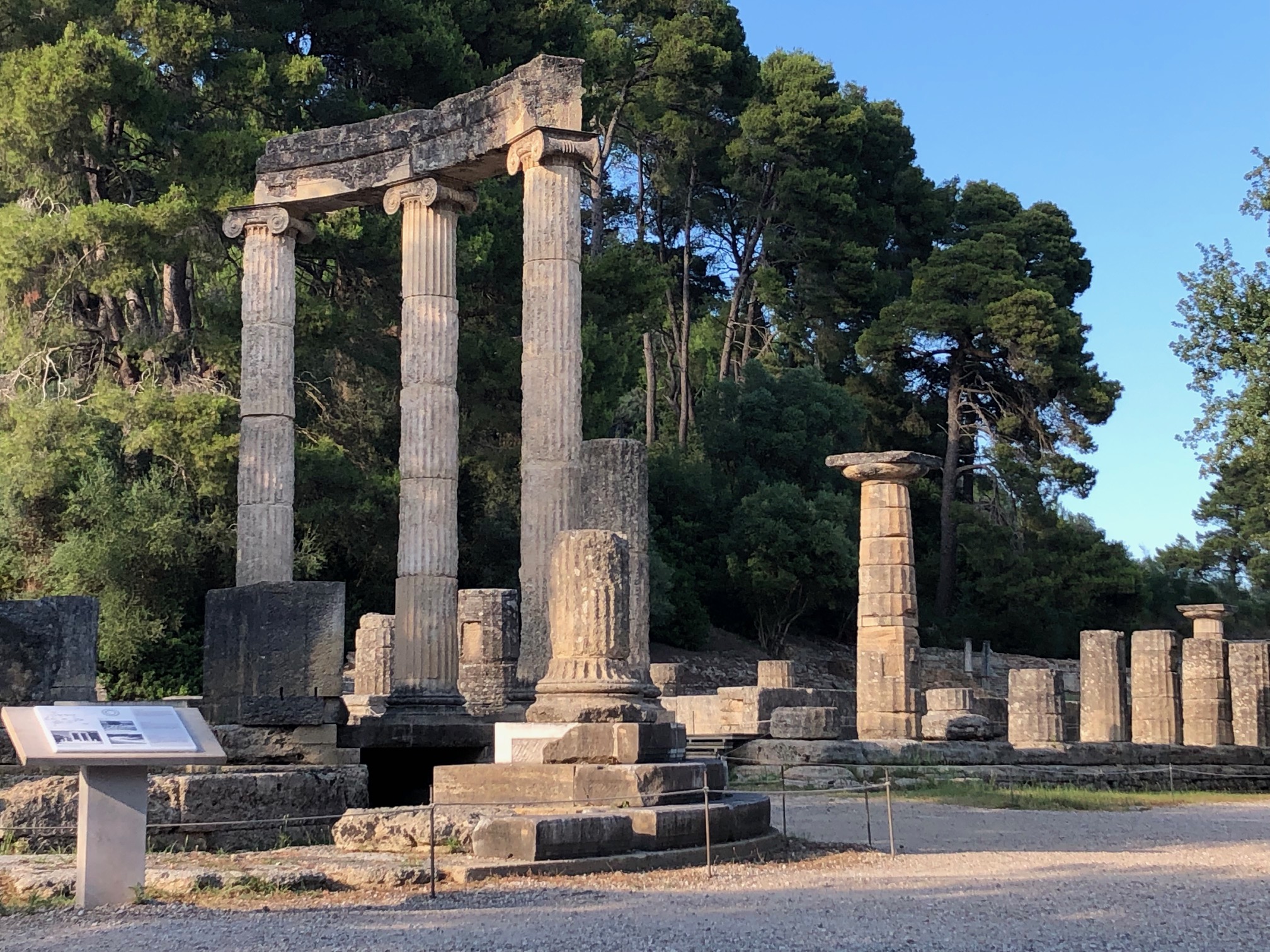
The Philippeion Tholos, a circular temple, and the Temple of Hera in the background
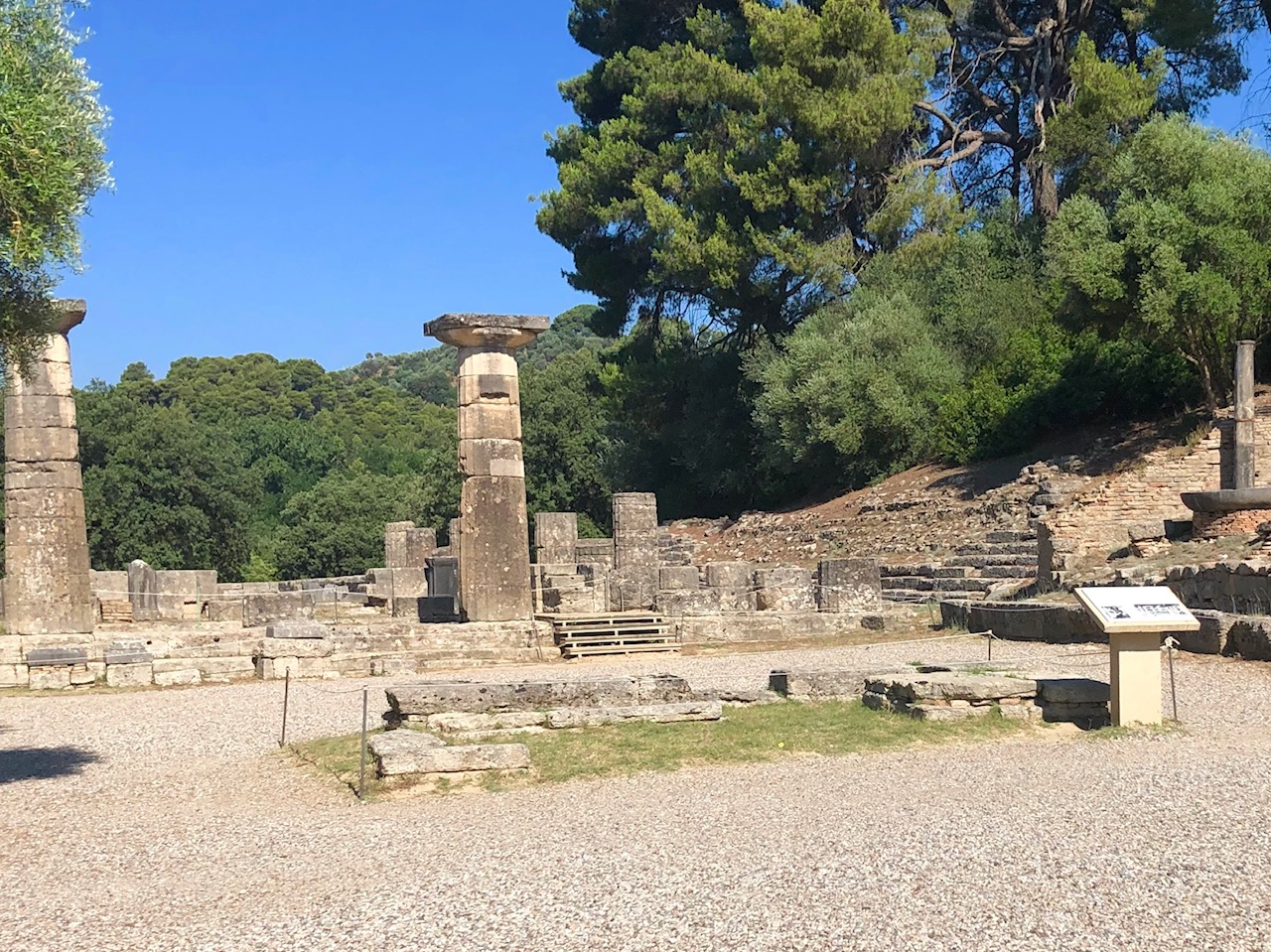
The Temple of Hera is in the background. In the foreground is the site of the lighting of the Olympic Torch that begins each modern Olympic Games.
At Mycenae and Delphi, you can definitely survey the sites across a hillside or from a high point (The Citadel at Mycenae, the Stadium at Delphi); however, at Olympia, you are looking through the site.
The Tholos, a circular temple
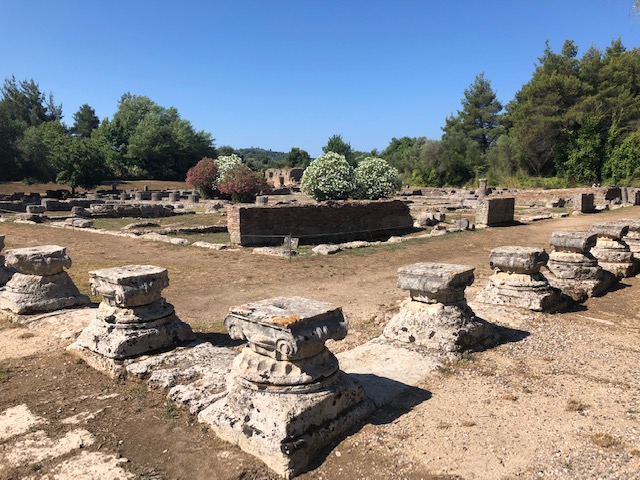
I took this picture because I couldn’t believe how sharp the scroll carving still is on these Ionic capitals.
For example, before you stands the colonnade of Palaistra. Beyond that, however, you see the impressive Tholos, and beyond that you see the standing columns of the Temple of Hera, and beyond that you see the multi-tiered Nymphaion aqueduct fountain, through which you see the arched entrance to the stadium, the site of the first Olympic Games in 776 BC.
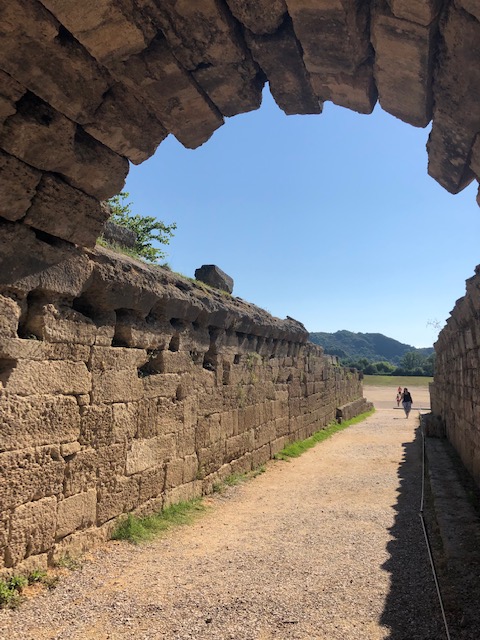
Passing through the arched entry to The Stadium
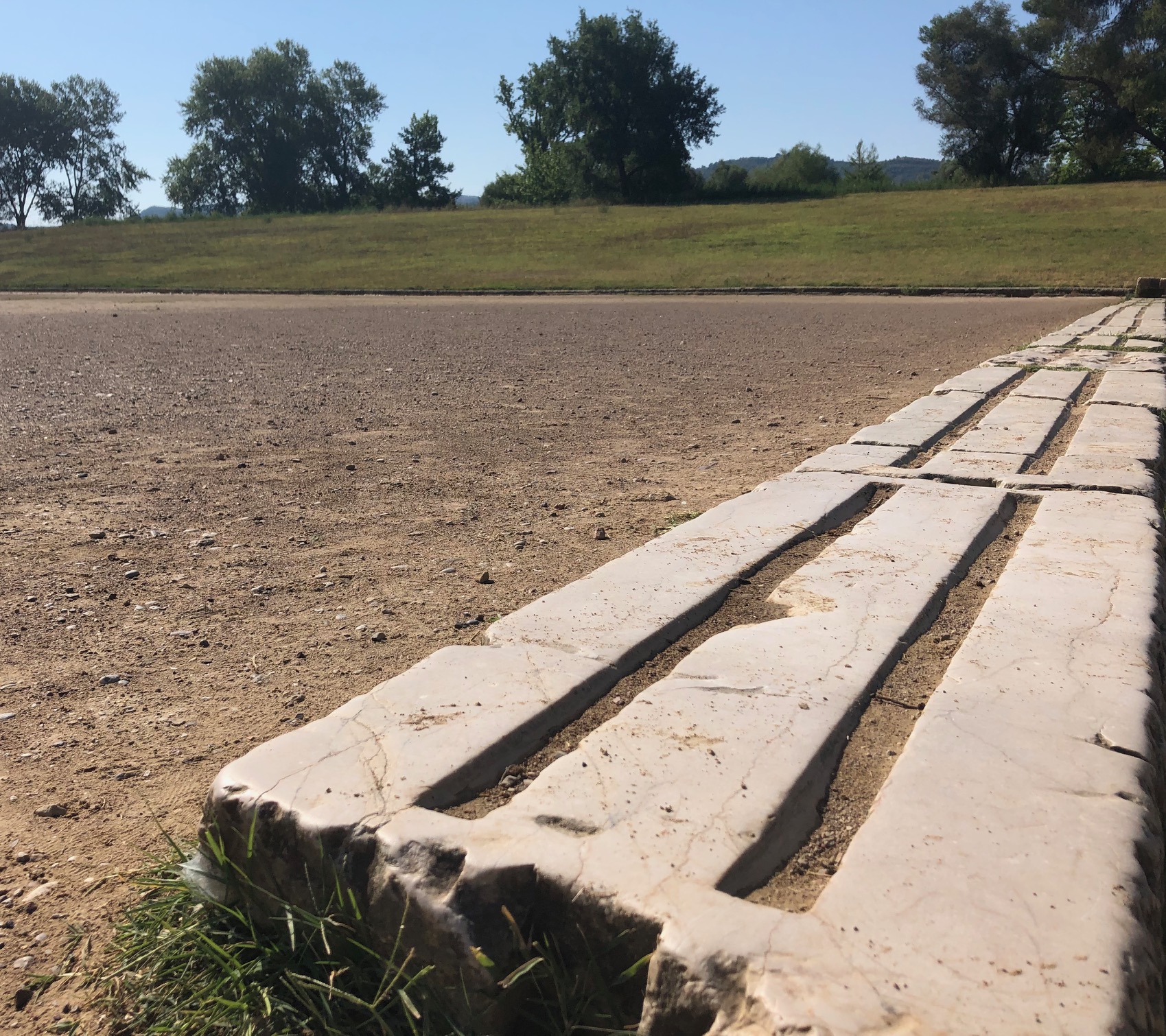
The marble starting blocks for the competing athletes at The Stadium
The stadium, where foot races (forerunner to today’s 200-meter races) were held in the ancient Olympic Games.
This is the workshop of Pheidias, the sculptor for the statue of ivory, gold, and bronze status of Zeus housed in the Temple of Zeus, one of the seven wonders of the ancient world.
This slab of carved marble is in Pheidias’ workshop
In other words, from any spot at Olympia, you will see layer upon layer of ruins in various stages of reconstruction. And then compressed between all those layers are stashes of more pieces.
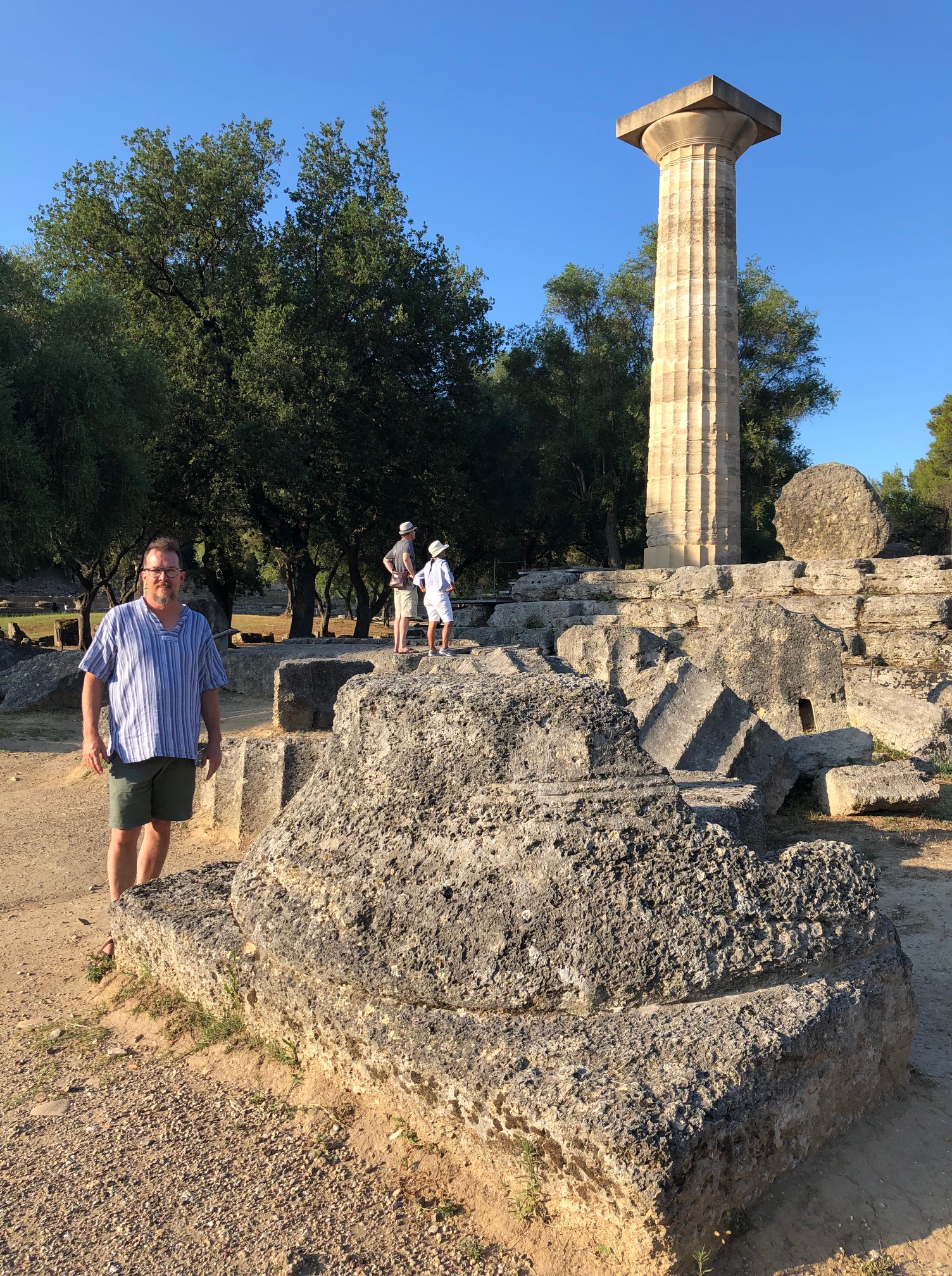
An earthquake in 522 AD 551 AD toppled these columns that stood in the Temple of Zeus, one of the seven wonders of the ancient world. Notice how the drums fell and appear almost like dominoes.
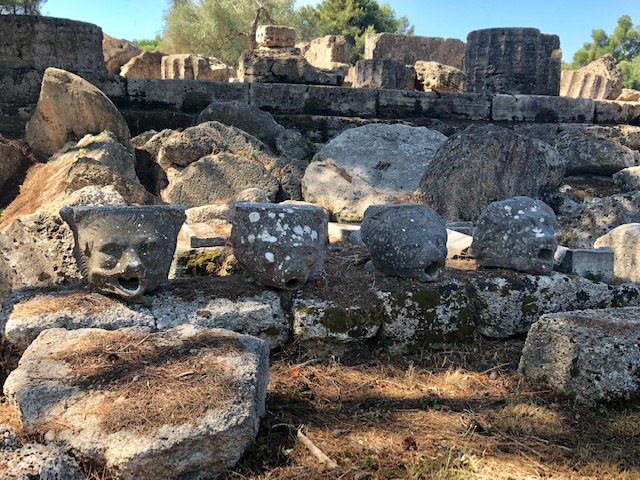
Perhaps a field of column drums, a row of lion head water spouts, a random six-foot-tall triglyph, a plot of Ionic column drums, then a plot of Doric drums, then a composition of more rare Corinthian capitals.
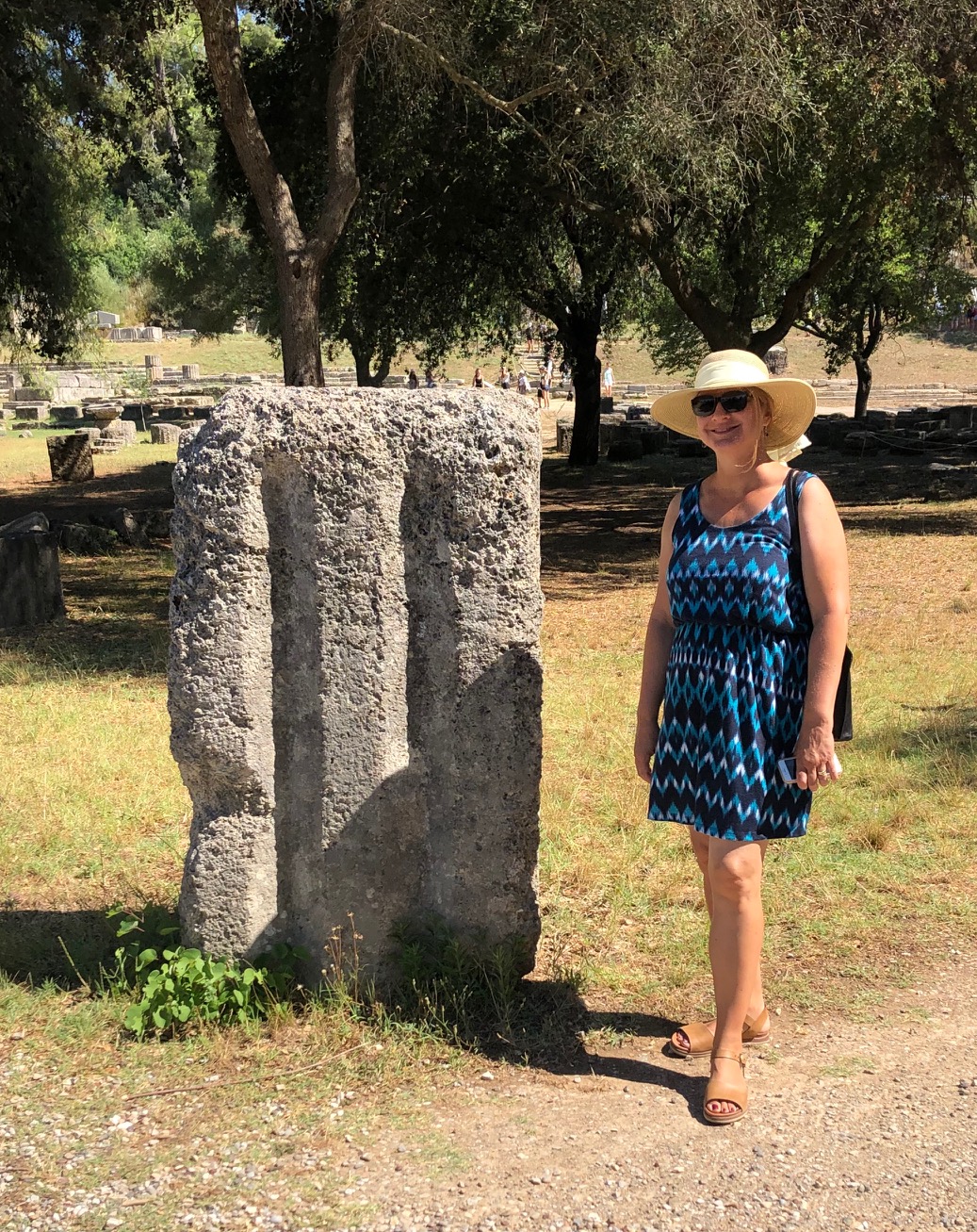
Here I’m standing next to a triglyph, three carved “columns” that were placed between metopes, relief sculptures below the pediment (the triangular-shaped friezes). See caption for next image.
I’ve circled a triglyph in the image above. I’m standing next to one of these in the preceding picture. I couldn’t believe how large it was.
So many pieces and parts, but if you need a quick list of the top sights within Olympia, I think they would be:
The Temple of Zeus
The Temple of Hera
The Tholos
The Stadium
Workshop of Pleiades
The Palaistra , which includes the Colonnade
What’s more, when you tour the park, you will walk right among most of the artifacts and monuments and stones. You may even walk right on the original marble steps placed in this city of 2,500 years ago.
Lion water spouts in a row on the ground surrounding the Temple of Zeus.
There are 1/2″-inch ropes that show you where you can and can’t go, and if you stray where you shouldn’t, you’ll hear a park employee sitting on a nearby park bench remind you with a sharp blast on a whistle.
More columns.
This was a building for council members. It contained water around the outside of this “curvy” centerpiece and also around the inner section.
Late last night, one couple climbed upon a large “rock” to see the floor of the Temple of Zeus, which was roped off unfortunately. (You can see them in the picture below.) Suddenly, a shrill blast! They didn’t hear or didn’t recognize their offense. Another blast! They looked around, the park employees shouted something in Greek, and down they jumped.
We couldn’t believe how large this capital (the top of a column) that once topped a column on the Temple of Zeus. Note the visitors standing on the stone shelf—that’s a major no-no.
Each capital had these notches carved into them to help them lock onto the column.
Perhaps they didn’t realize they were standing on an architectural relic. After all, there are so many stones EVERYWHERE.
We returned in the evening to see parts of Olympia again. The light put a different cast on the monuments.
To be safe, when you’re at Olympia, assume that any rock is not actually a rock, but rather an artifact. If you want to sit down for a bit, look for an actual park bench. There are several. That’s the safest bet.
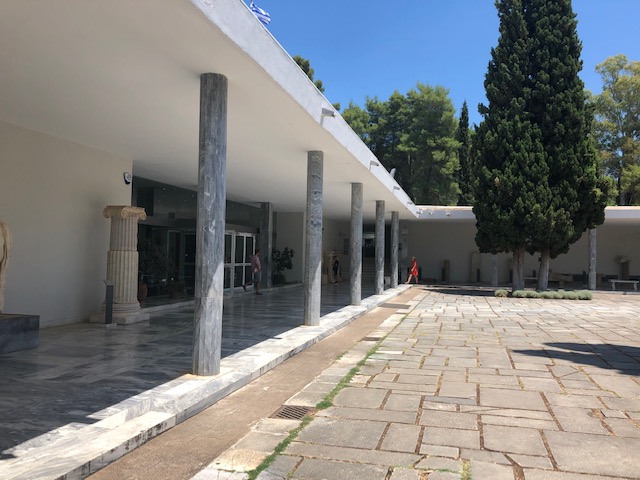
Or head over to the Olympia Archaeological Museum.
The Olympia Archaeological Museum front entrance
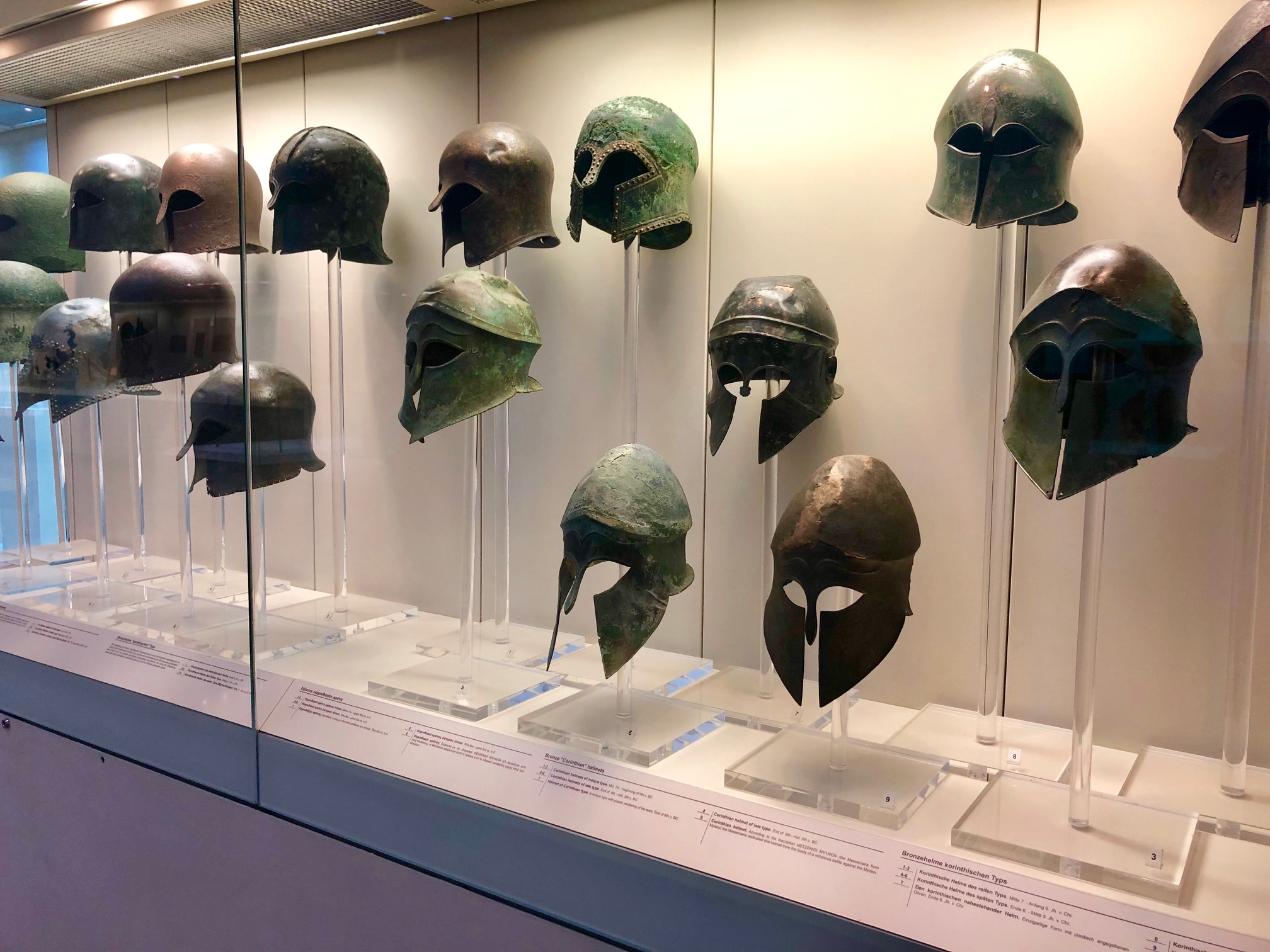
Various helmets excavated at Olympia
This was a statue of Nike that used to be mounted on the Temple of Zeus.
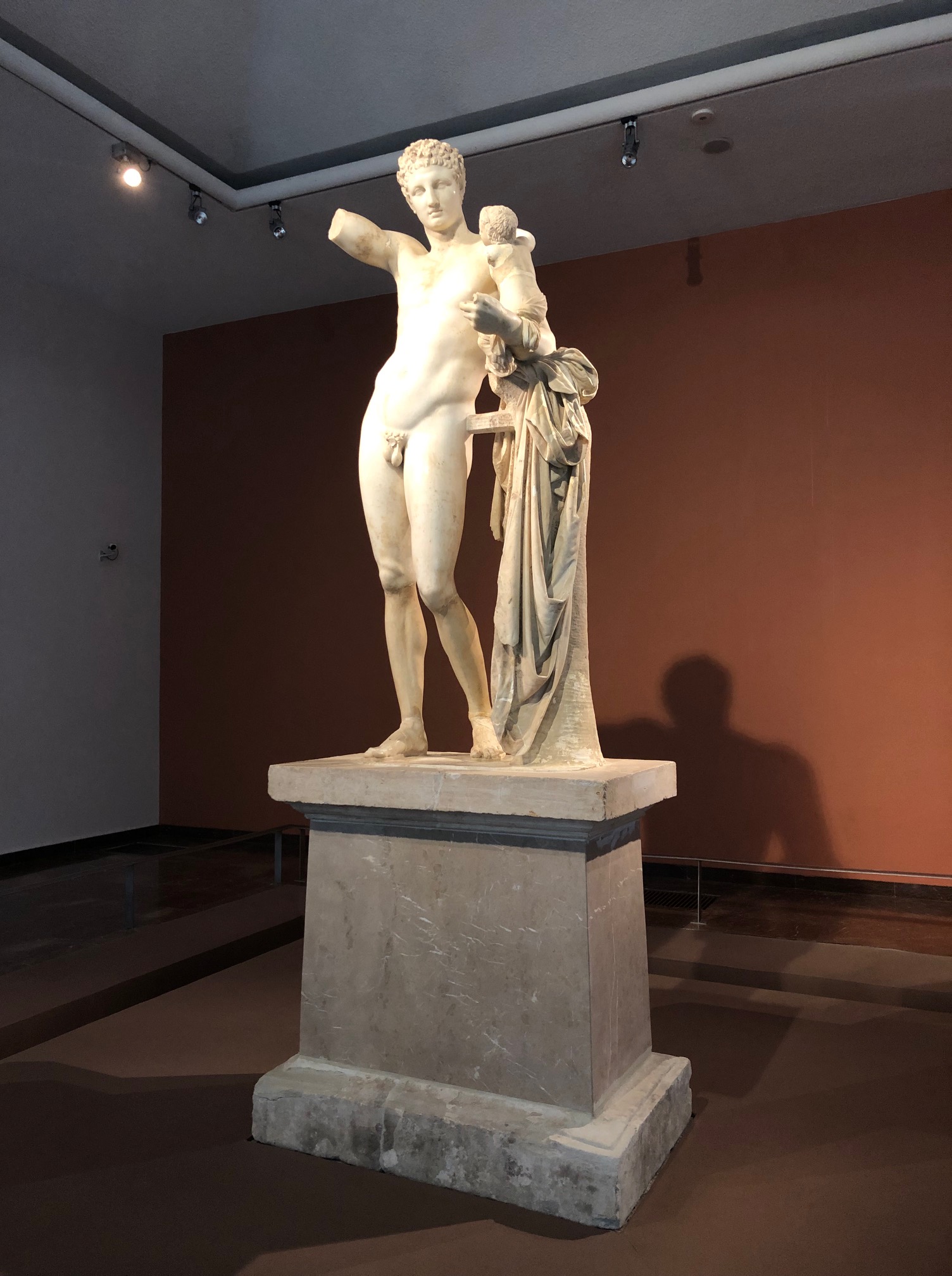
This is a statue of Hermes and was found in the Temple of Hera.
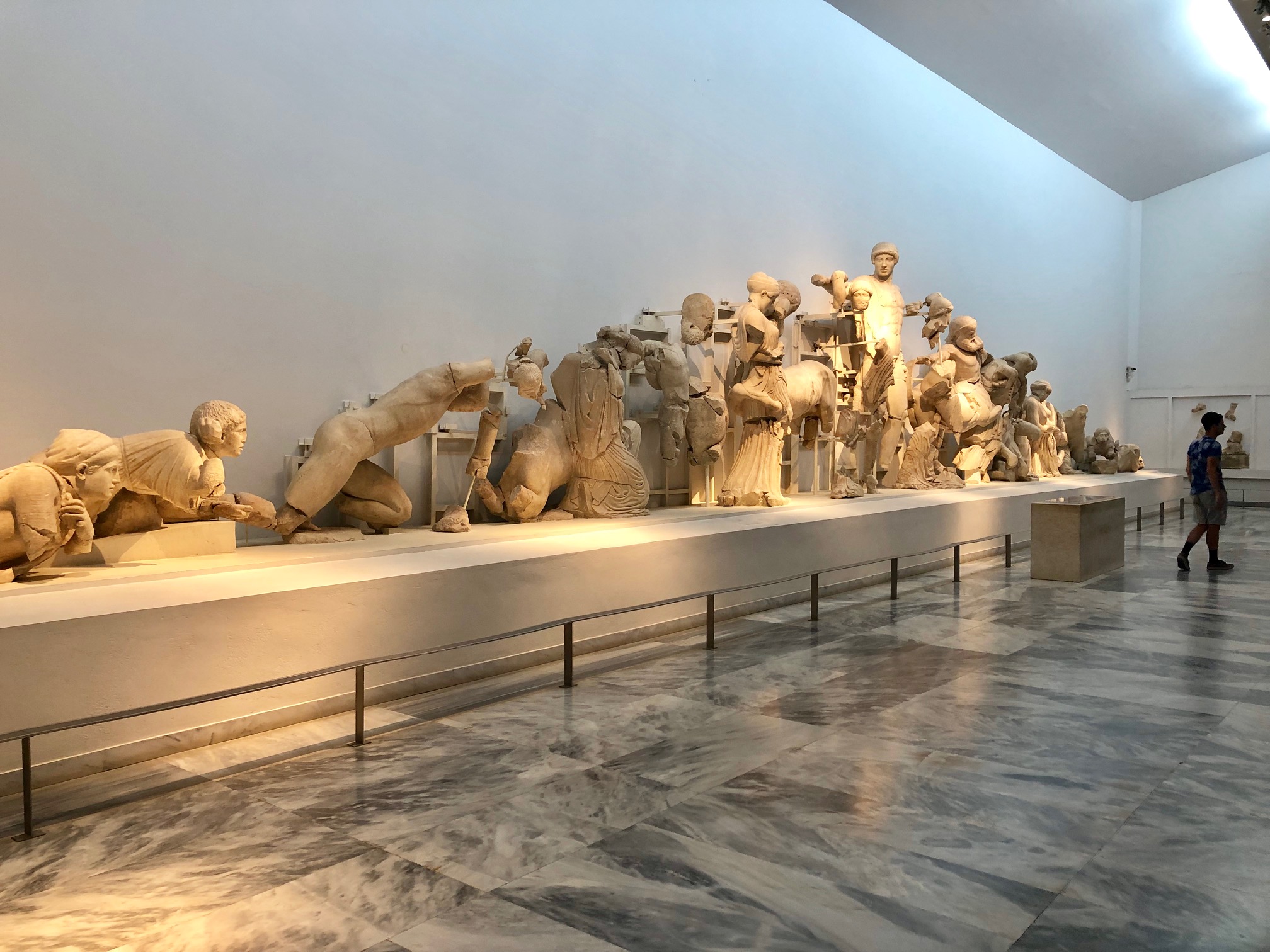
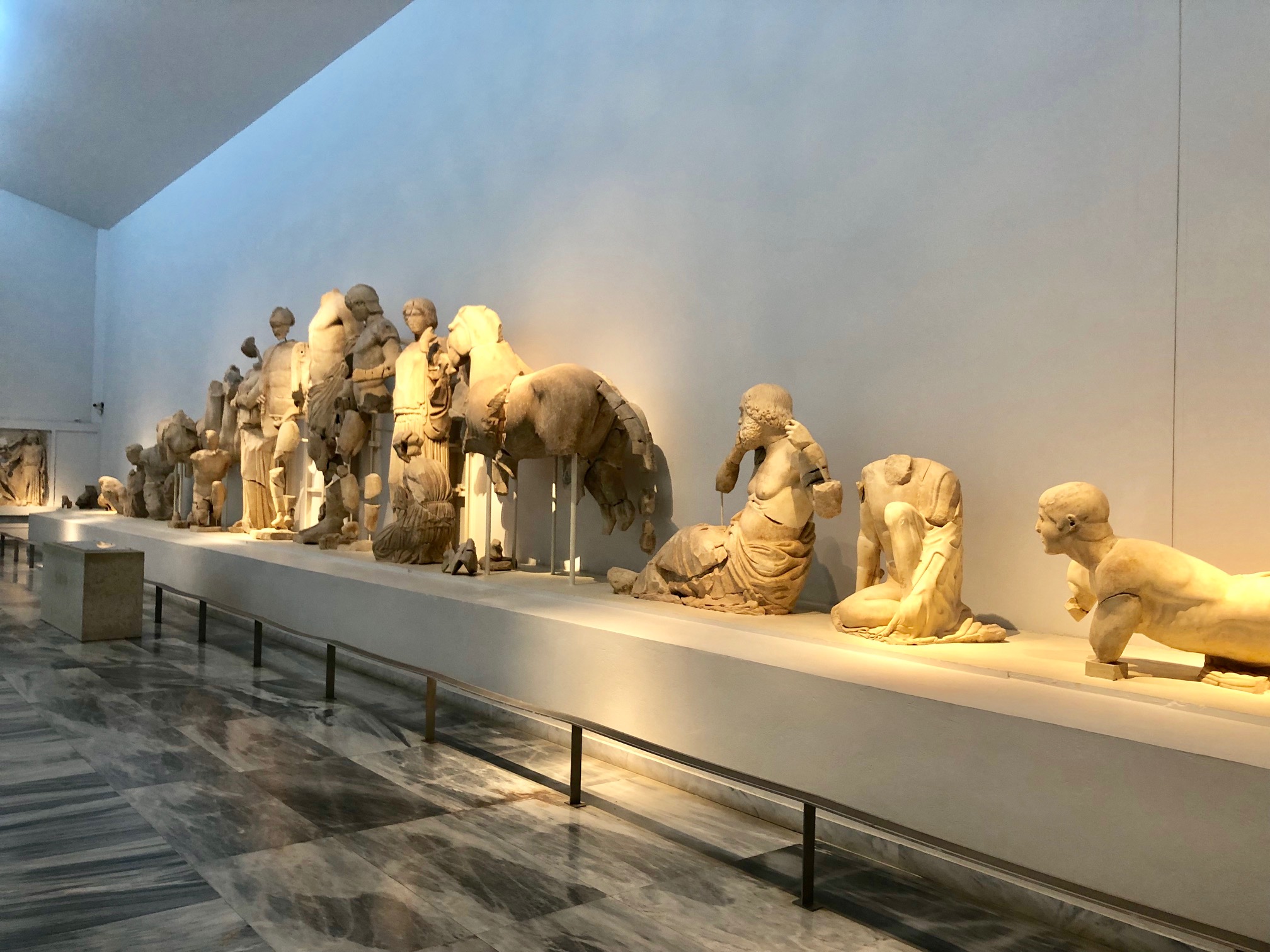
One of two reconstructed friezes from one of the pediments on the Temple of Zeus. This one features Apollo (son of Zeus) in the middle.
One of two reconstructed friezes from one of the pediments on the Temple of Zeus. This one features Zeus in the middle.
More lion water spouts and other prominent sculptures are placed around the outside loggia of the museum. You can just walk right up to these. But don’t touch, obviously. There were no guards anywhere around, which surprised us.
Although Olympia takes some planning to reach, it’s definitely worth the visit.
The site and museums are open from 8 a.m. to 8 p.m. Adult tickets are 12€ each. You can leave and return later in the day to any of the sites and even return the next day to continue your visit or see more. We arrived at the archaeological site at 8:30 a.m. and left about two and a half hours later. Tour bus groups arrived around 10.
As it was getting quite hot, we left at 10:40, went out for gyros and a soda, and then returned to the air-conditioned museum for about two hours in the afternoon.
Later that evening, we returned to the archaeological site to see more and take pictures with the sun coming from a different angle.
The modern city of Olympia is a beautiful little city that is literally about two blocks from the archaeological site. I’ll write a short post about the town tomorrow. Our AirBnb host told us the permanent population is only about 700 people!
Thanks for reading! Click like, leave a comment and follow my blog for more stories about travelling in Greece.
AirBnb offers something that a traditional hotel doesn’t: contact with local residents. We met Kostas and Toula on our first night in Mycenae after three weeks on Skopelos Island.
That day, we had ferried to Skiathos Island, flown for 25 minutes to Athens, then taken a bus to Athens’ KTEL terminal, and finally taken a 1.5-hour bus ride to Fichti, which is just down the road from Mycenae.
Kostas was waiting for us under an olive tree in Fichti. When the bus stopped, the driver made no announcement and there were no signs indicating we were at our destination. Mitch decided to ask the driver where exactly we were and when the driver replied, “Fichti,” Mitch scurried to get our luggage from the hold. At that point, I realized that Mitch was not coming back. (He told me later he thought iI was right behind him.)
So I quickly grabbed my purse and hurried off the bus.
Our AirBnb at Kostas’. We climbed up that spiral staircase to our door.
Kostas was expecting us to be arriving on this particular bus. I had been in contact as our plans unfolded throughout the day with his daughter Sophia, and she had kept him in the loop.
However, since we had booked our Airbnb under my name, when Mitch climbed down from the bus first, Kostas asked him, “Marilyn?”
But then Kostas saw me climb down, realized that Mitch was not Marilyn and we made our introductions.
Kostas was so friendly. He talked the whole drive back to our apartment. He told us about his daughter and son, who currently lives in Canada. In fact, Kostas lived in Canada at one time for several years, which explains why we were able to communicate so well. He struggled with finding words at times, but overall his English is excellent considering he is a native Greek and nearing retirement age.
The sign on the outskirts of town showing the way to the ruins.
When we reached the little town of Mycenae, where our apartment was located, Kostas pointed out the mini-market and two or three tavernas, which we visited the next day.
Inside our apartment, Kostas and Toula showed us around the one-bedroom apartment. It had a nice living room, large eat-in kitchen, full bath, and plenty of seating with an extra couch tucked here and there. There was WiFi, air conditioning, a washer, and a large tile front balcony with clothesline.
They also took great pride to show us the fridge, which they had stocked with six eggs, a small carton of milk, local honey, a loaf of bread and toasts, apples, oranges and apricots. Kostas also showed us a bottle of olive oil fresh from his groves. (He farms olives and oranges, he told us.) We used the olive oil to cook eggs for breakfast the next two mornings. They also provided instant and Greek coffee, which we made on a single-burner stove.
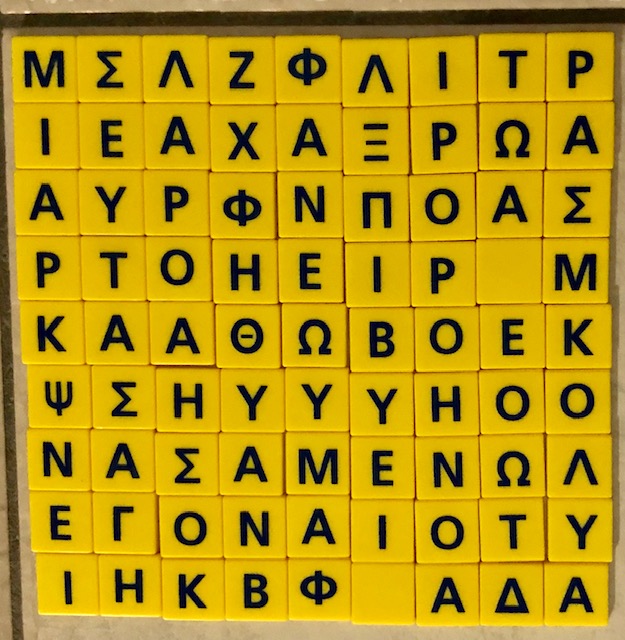
Kostas and Toula kept lots of games in the apartment. Here are Greek Scrabble pieces.
Their generosity and hospitality were incredible… above and beyond! They have definitely mastered the art of what AirBnB calls “the extra touches.”
The view off the side of our front porch balcony. Those are apricots in that truck. Olive trees in the distance… and right by the truck also.
The next evening, we visited with the couple again when we inquired about how to get a taxi back to Fichti. We visited inside their apartment, which was located on the ground level of their three-story building. Over small porcelain cups of Greek coffee, water, and fresh apricots, Kostas offered to drive us back the next morning, as he and Toula were making a trip to “the big city” of Argos.
The view off one side of our front porch balcony.
We also met their sweet little Chihuahua-mix dog, Kirra, who sat on my lap and stared deep into my eyes. She is very old, Kostas said, which you could tell from her fully gray nose and jowls. She rolled over on her back in my lap as we talked.
Toula, who speaks as much English as I speak Greek, multi-tasked all the while. (Several times, Kostas would stop the conversation and translate to Toulah.) She kept her eyes on a TV program, and occasionally listened in our conversation about Kostas’ and our kids, job prospects in Greece for young people (there aren’t many, he said), the cycle of world superpowers, and how Greece needs the help of larger countries to succeed.
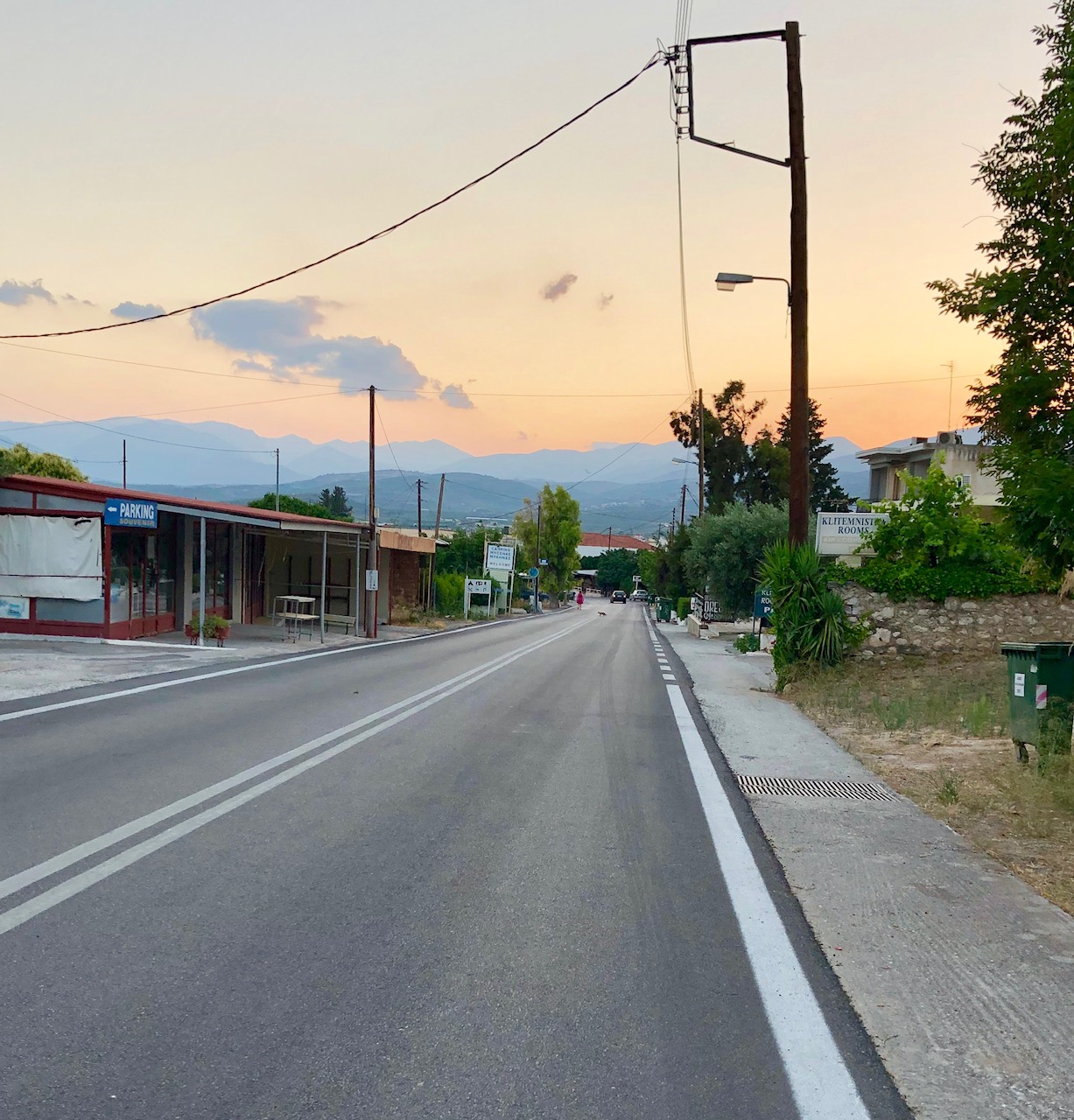
The highway between Fichti and Mycenae was quiet at night. Earlier in the day, tour buses from Argos drive through. It seems that maybe Argos gets most of the tourist business.
Kostas also told us that it had been several years since he had been up the hill to the Mycenaean ruins. In fact, when he had been there before, he had been working there. “They charge too much to see it,” he said. “They think they are the United States and charge a lot for it.”
We explained that the 12€ tickets didn’t seem that high to us, but then again the culture of Ancient and Classical Greece is revered perhaps more when you don’t grow up around it. To us, it’s an amazing site. Perhaps to Kostas, it’s just a bunch of old rocks.
I had chicken souvlaki and Mitch had pork souvlaki. Both were served with french fries. We also had tzatziki as an appetizer. The weather was beautiful. Taverna owners and/or waiters walk right up to you on the sidewalk asking you to dine at their establishment.
We then made arrangements to meet outside the apartment at 9:30 the next morning for the drive back to the Fichti bus station. Kostas also said he would help us buy our bus tickets back to Athens.
As promised, we all met the next morning… fifteen minutes ahead of schedule.
The four of us made the ten-minute drive back to Fichti. We unloaded our luggage, then I sat with it under a tree while Mitch and Kostas walked across the street to get the tickets. Toula waited in the car. After a few minutes, she emerged from the car, and we hugged, kissed cheeks European style, and said, “Thank you,” to each other. Soon, Kostas and Mitch emerged from the bus station with tickets in hand.
The Fichti (say “Fith-ya”) bus station, about ten minutes north of Mycenae
Of course, Kostas absolutely would not accept the 20€ Mitch tried to hand him, waving his arms and stepping back when it was offered. So, while Kostas and I hugged, Mitch tossed the bill onto his car seat. With her limited English, Toula couldn’t refuse it.
We took our seats under the tree, and turned to wave goodbye to our hosts. Kostas, now finding the bill, shook his head. “I don’t want it,” he said.
“Goodbye!” we shouted. He continued to shake his head.
“We would have spent it anyway for a taxi. You take it,” Mitch explained.
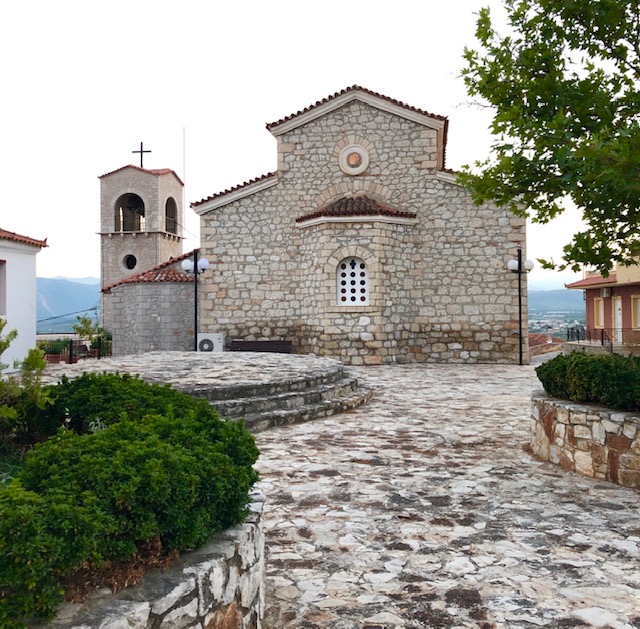
This Greek Orthodox church is right around the corner from Kostas’ and Toula’s place.
Kostas finally conceded, smiled, and pulled away. “It’s been good to meet you,” he said.
“It was good to meet you, too,” we replied.
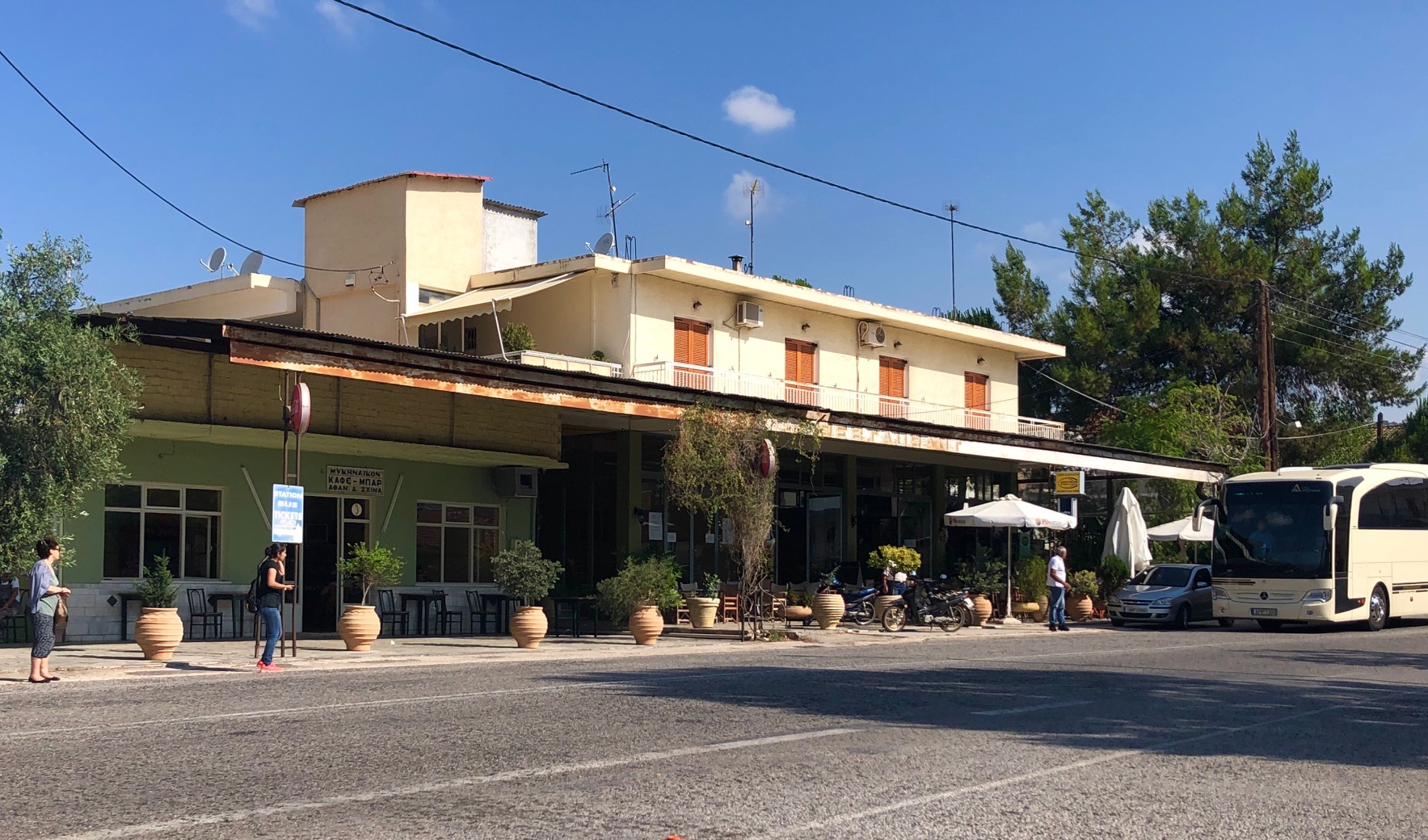
Thanks for reading! We’re on our way to Olympia today from Delphi. At least two bus station transfers, we think, but we’ll have to confirm with the driver. The bus station in Delphi is actually inside a restaurant. You just ask one of the waiters and he instantly turns into a ticket clerk.
Click like, leave a comment and follow my blog for more stories from our trip to Greece.
Our visit to Delphi was our favorite single day of our six-week Greek odyssey. Once we figured out the Greeks pronounce the divine destination “Delfie, as if to rhyme with selfie, we settled in and fully enjoyed our day.
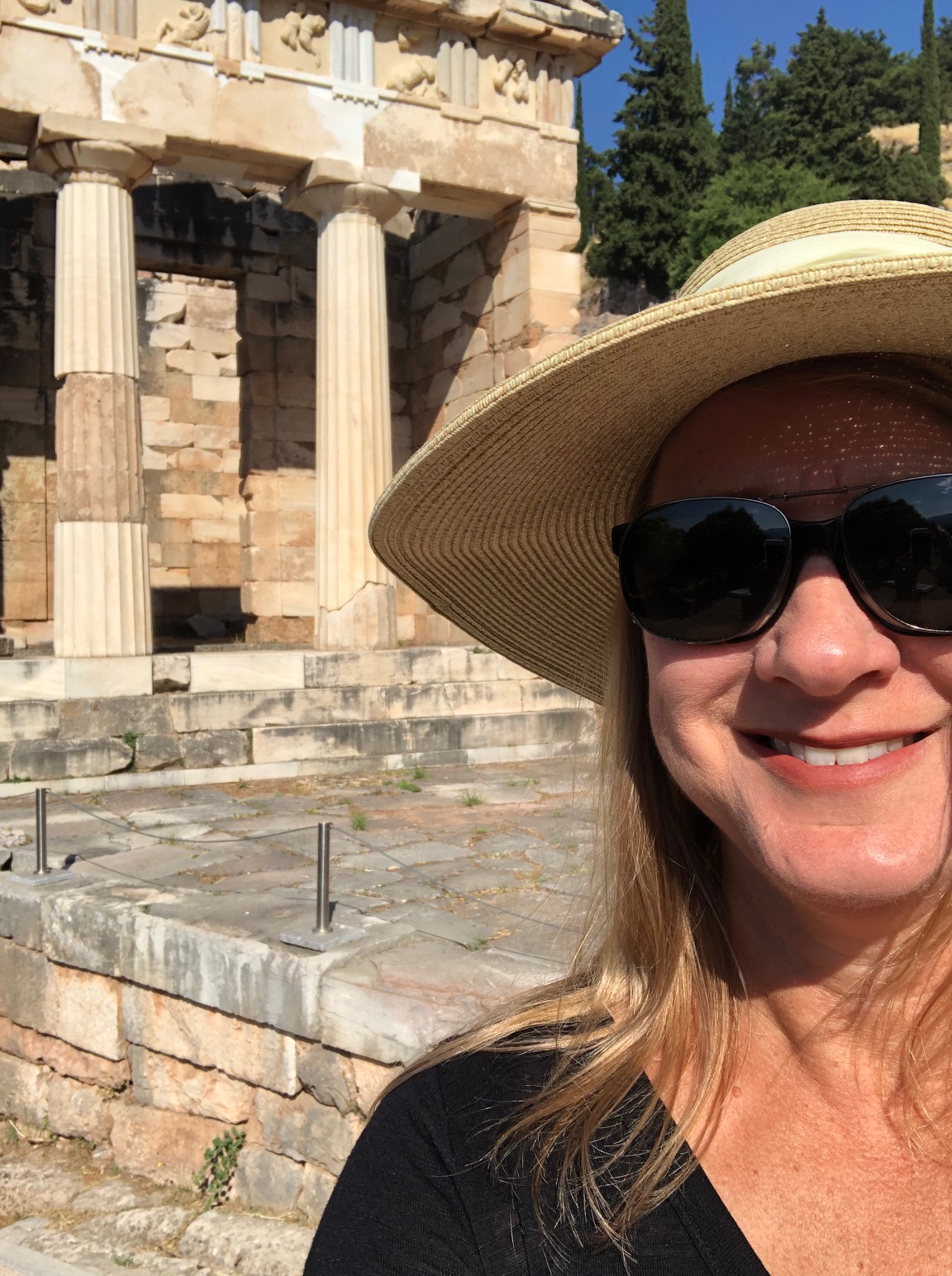
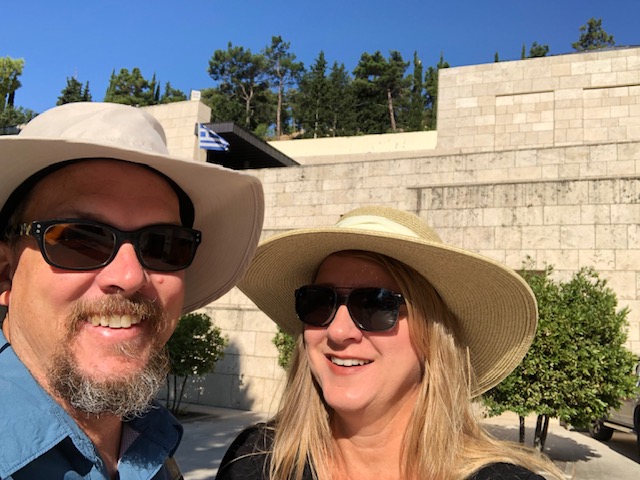
So… I think it made perfect sense to attempt a Delfie selfie today when we visited the archaeological wonder. I don’t take many selfies (and by that I mean as few as possible), but this post includes two or three to take care of the issue for awhile.
Another selfie in front of the Treasury of the Athenians
When we added Delphi to our list of must-see attractions, I had no idea we would be scouring over a steep mountainside full of pine and cypress trees. In fact, this is snow skiing country. The next town over, Arachova, offers skiing during the winter months. I guess I just didn’t realize how “Alpine” the Delphi would feel.
Treasury of the Athenians
In a sentence or two, “Delphi could be described as a religious complex centered around the Oracle of Delphi that was located in the Temple Apollo,” according to a book we bought, Delphi and Its Museum, by Panos Valavanis. Delphi flourished during the Archaic and Classical period of Ancient Greece, roughly from the 6th – 4th centuries BC.
On the UNESCO World Heritage site placard near the entrance to the grounds, it reads:
“The archaeological site of Delphi is Panhellenic sanctuary with an international fame. Its remnants represent some of the foremost events of art and architecture. The sanctuary, which combines in a unique manner the natural and historical environment, is related to numerous, key events of Greek history that have an impact on the progress of civilization.”
It continues: “Inscription on this List confirms the outstanding universal value of a cultural or natural property which deserves protection for the benefit of all humanity.”
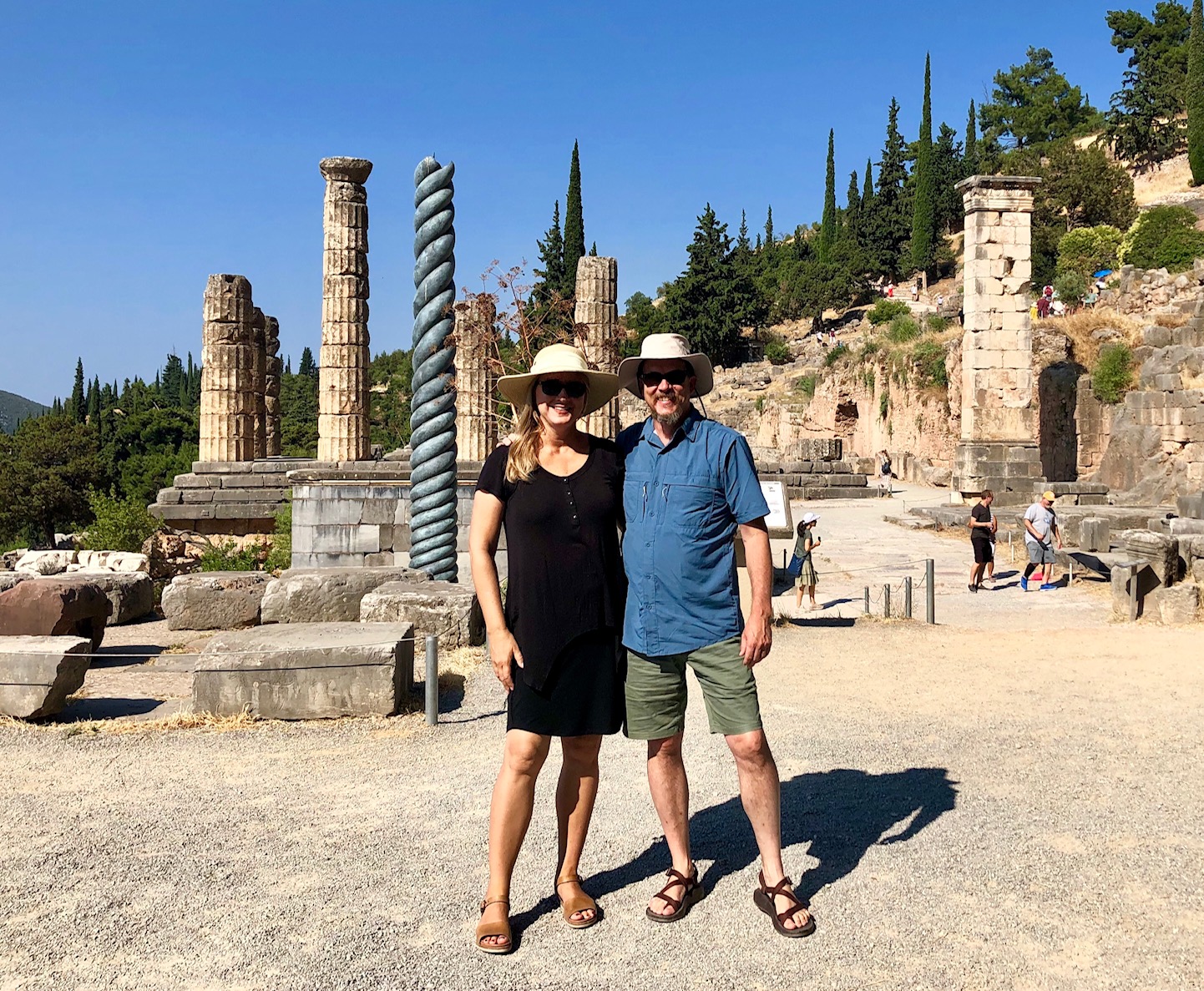
Okay, not exactly a selfie, but a nice lady from Australia took this for us. We’re standing in front of the Temple to Apollo and the Serpentine Column.
Here are some major sites within the Delphi archaeological site:
The Treasury of the Athenians
Temple to Apollo
Theater
Stadium
Tholos at Delphi
The Sanctuary of Athena Pronaia
However, besides all these major sites, there are numerous other objects, foundations, walls, and monuments to distract and fascinate you. And don’t forget the magnificent natural beauty of the place.
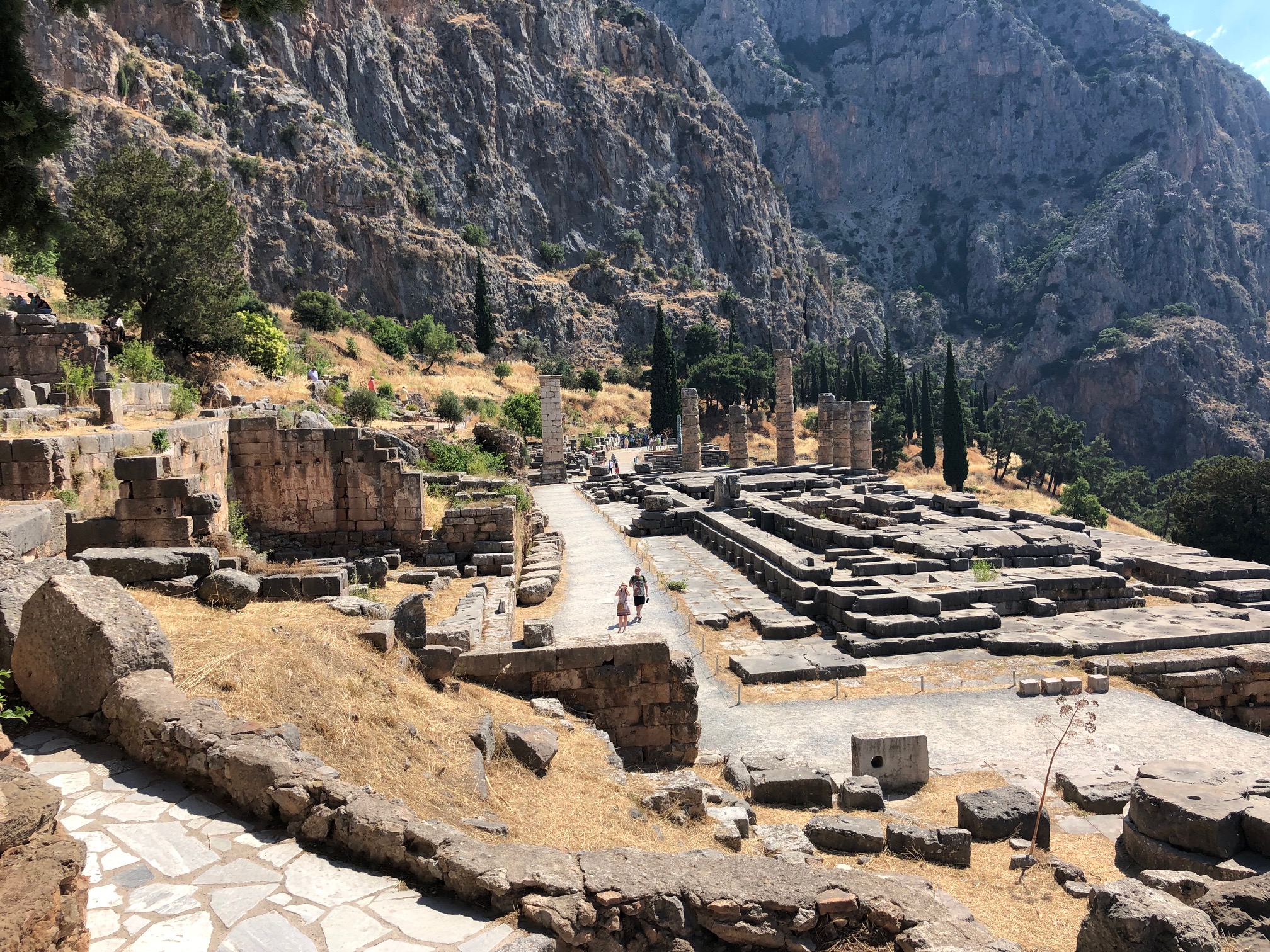
Theater on the left. Temple to Apollo is on the right. Clear down the hill you can see more ruins. This was taken on our way to the stadium all the way at the top of the site.
We took so many pictures at Delphi today that there’s NO WAY I could post them all. Here are a fraction of the photos we took at both the archaeological site and at the museum.
Temple to Apollo is on the right. Other buildings (there are so many we couldn’t keep track of them all) are on the left.
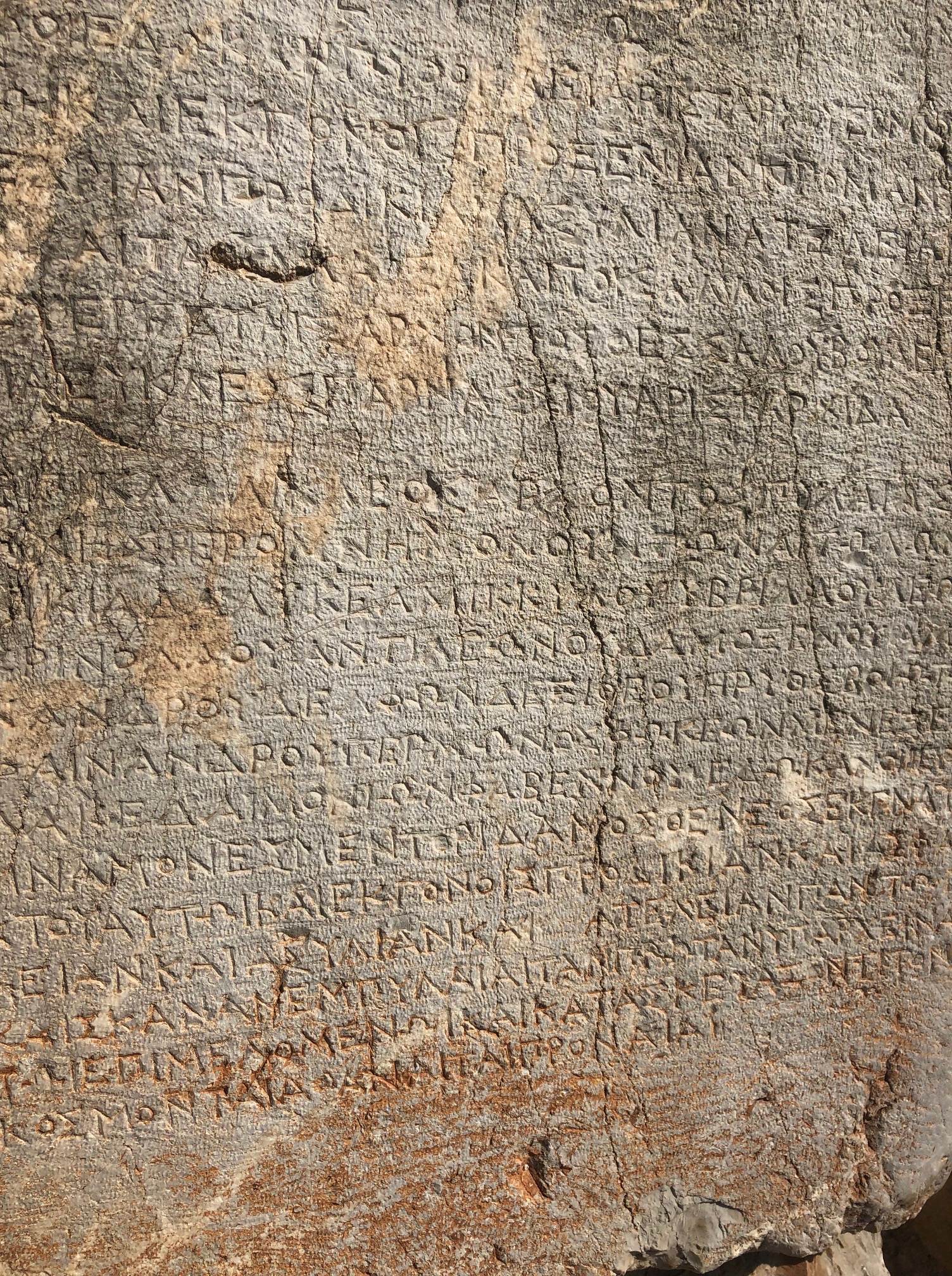
Carved inscriptions are on practically every surface. Most of these were written by slaves who were guaranteed their freedom by Apollo, according to a book we bought in the museum.
A closer view of the carved inscriptions.
The long view of the wall. Most stones had inscriptions on them.
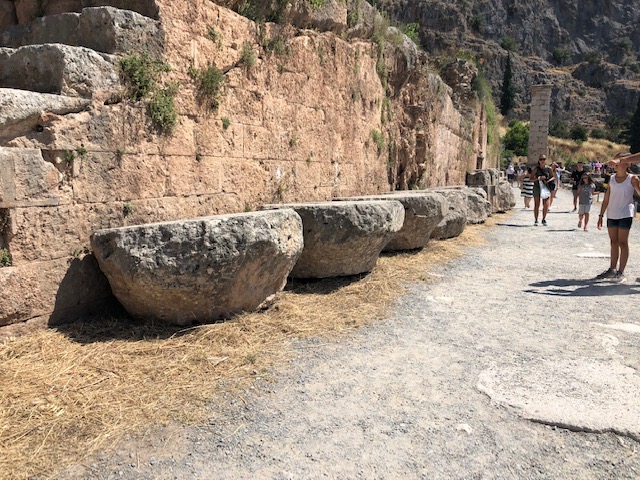
Capitals that would have topped columns. They’re just here, there and everywhere.
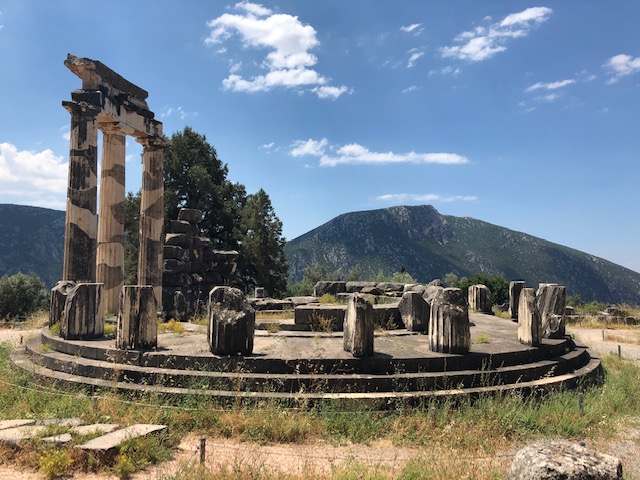
The Tholos, a round temple. This is the structure I’m standing in front of in the selfie at the top of this story.
I took this to show the detail of the underside of the Tholos.
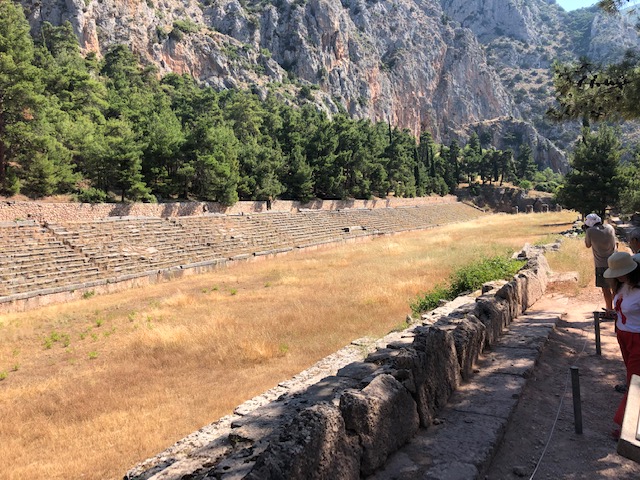
The stadium clear up at the top of the site. Panhellenic Pythian Games were held here.
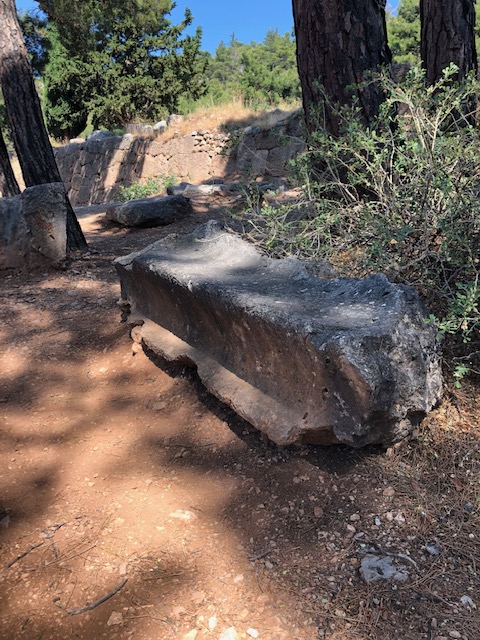
We snacked on this stone bench over by the stadium. I think it could actually be a bench from the stadium itself. There are stone pieces everywhere. They had to fall there from something.
Column drums that were stacked to form tall columns. That’s my purse next to one to show scale. In the background by the person in the pink shirt, is a base that these columns may have been stacked on.
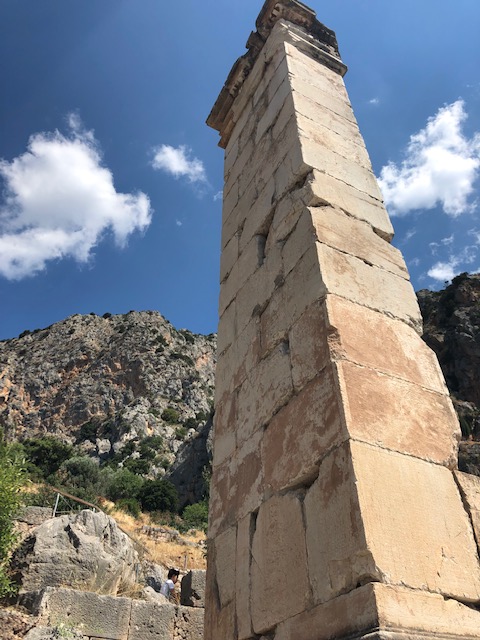
I thought this column was interesting because of its sharp edges. If you look closely, you’ll see carved inscriptions on the stones.
A trough for carrying waters from the natural fountains on the mountain.
It’s interesting. Right alongside some fire extinguishers and a storage chest, you’ll find ancient Greek columns. No big deal.
And then we went to the museum.
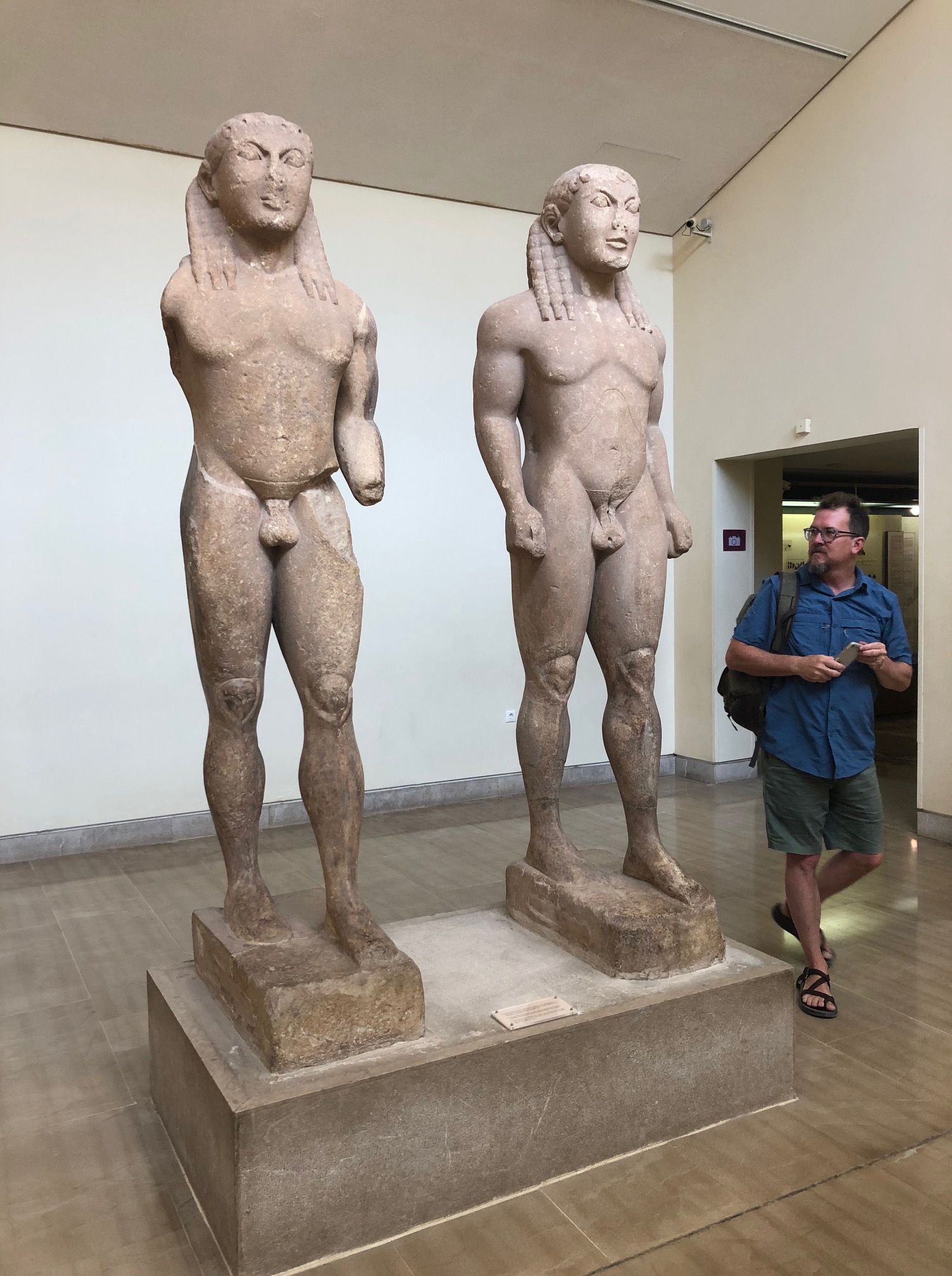
The Argos Twins, Cleobis and Biton… Careful what you wish for. These were the boys whose mother asked the gods to bless them for carrying her to the temple of Hera. As a result, they were given the greatest gift… death at their finest moment.
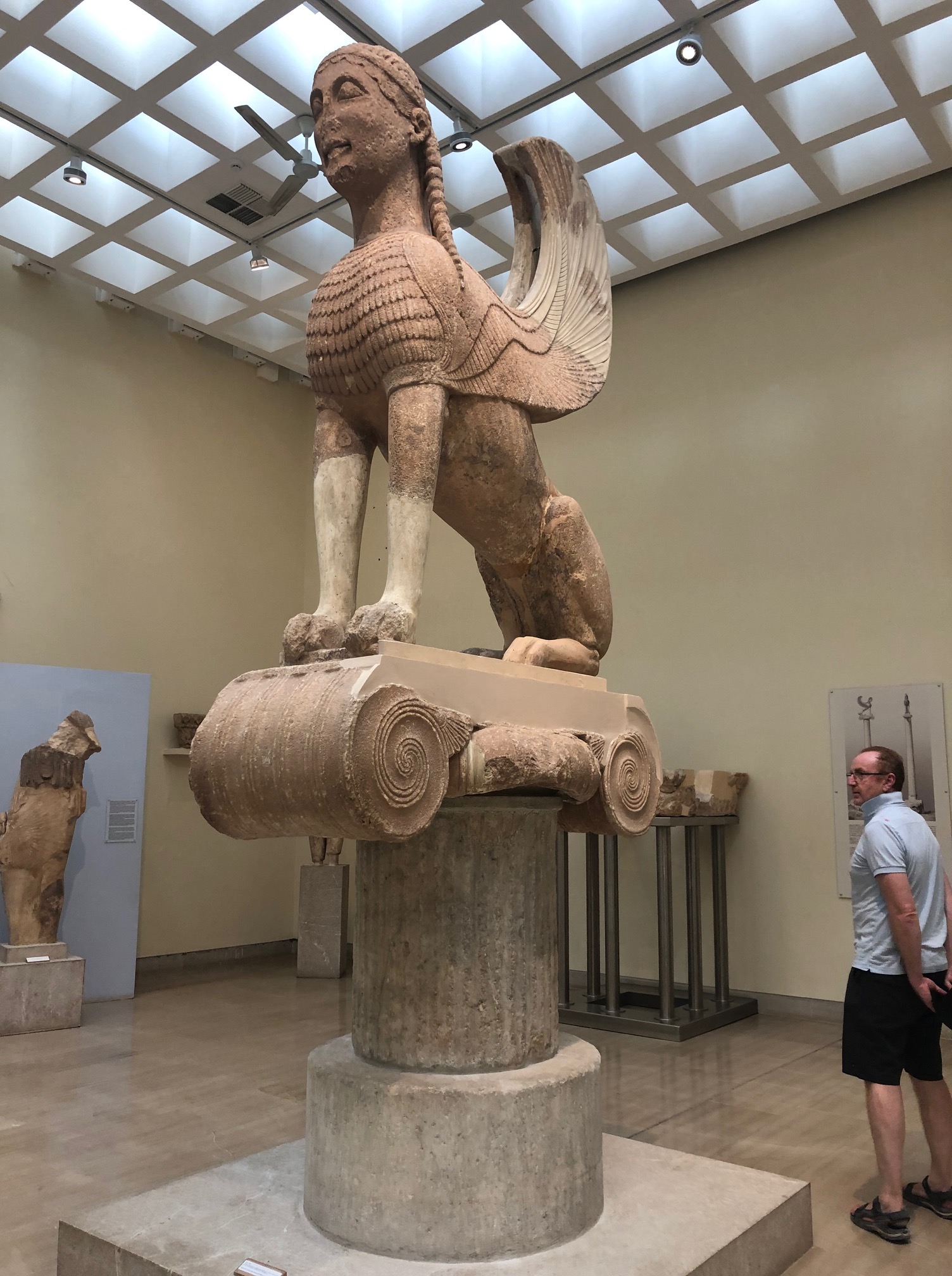
The Sphinx, a gift from the island of Naxos, given to Apollo Delphi to gain the gods’ favor.
Aghias, son of Aknonis. An athlete (that’s why he’s nude) and shows how the ancient Greeks used contrapposto, which is an assymetrical arrangement of the body. Contrapposto allows a more natural stance.
The bronze Charioteer is the grand finale of the museum.
We spent about four-plus hours total touring the archaeological sites and the museum. We started in about 9 a.m. and finished up around 1:30 p.m. The weather was very warm, but very nice in the shade.
We had about an hour before the tour buses arrived, so the sites really weren’t that crowded. And because many if not most people don’t go down to the Tholos of Delphi and the Sanctuary of Athena (which are located down the hill and separate from the main complex), we felt like we had a very thorough visit.
Tomorrow… on to Olympia!
Thanks for reading! Leave a comment if you’ve been to Delphi! What was your favorite part of your time there? Follow my blog for more stories from our 2019 Greece trip.
Parenting seems to be the same around the world. Whether you live in the United States or Greece, all parents have their hands full with a four-year-old boy.
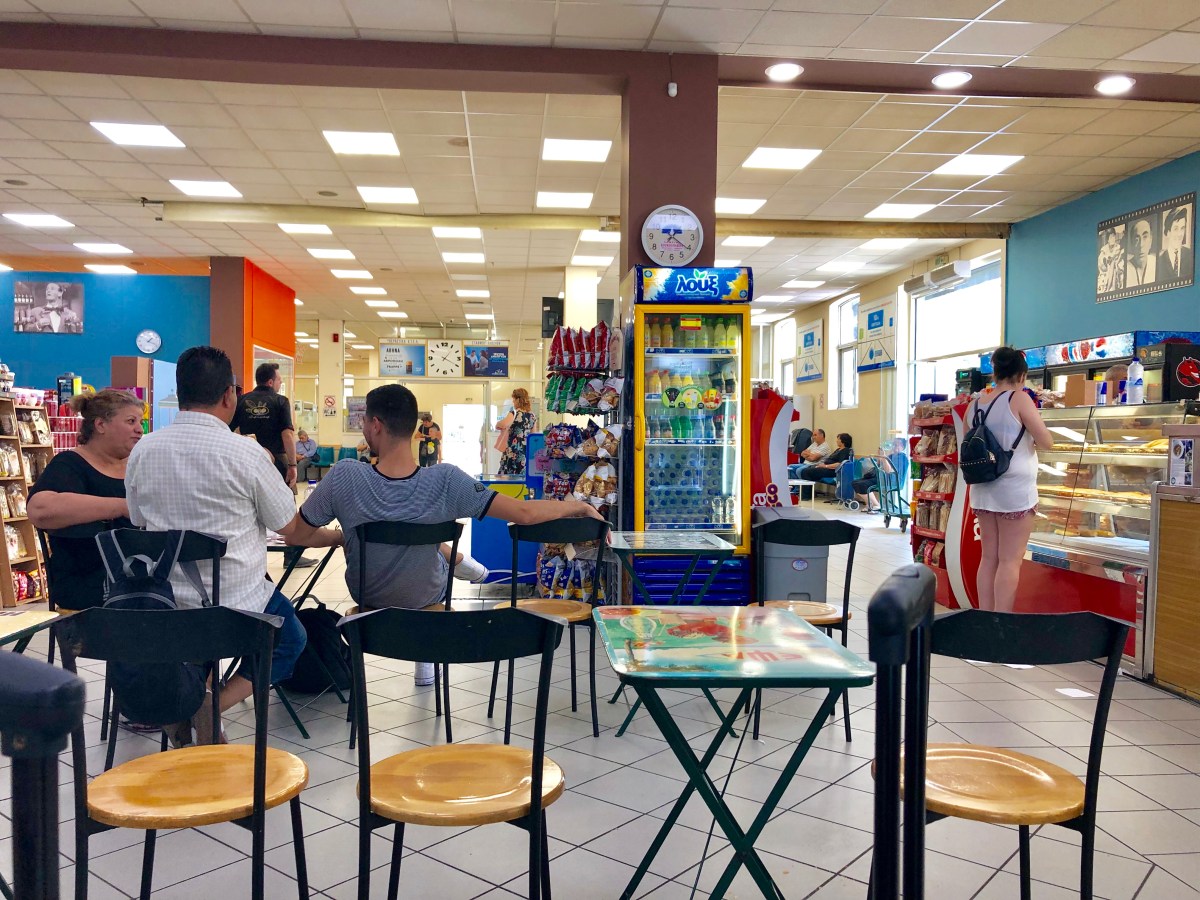
Today, I’m watching a mother, father and their son who looks to be about four at the Liosion Bus Station in central Athens.
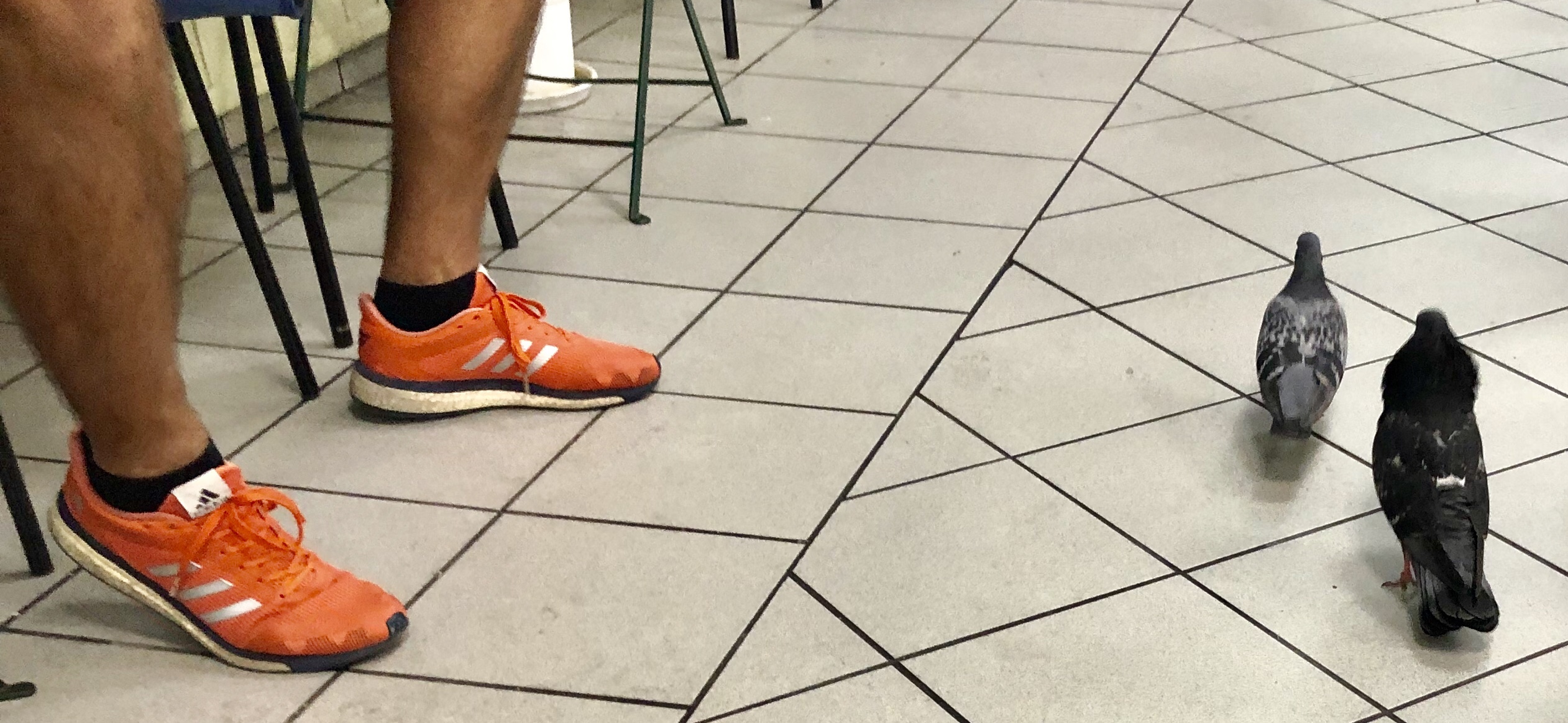
A pigeon is swooping its way through the bus station lobby, which includes a cafe, a mini-grocery, a trinket shop, and a bookstore. The pigeon flutters from one side of the lobby to the other.
The patient father follows his son casually around the lobby. The boy jumps high whenever the pigeon swoops low. He can’t reach it, much less catch it. In his green t-shirt with a tiger emblem and bright yellow shorts, ankle socks and grey tennis shoes, he reminds me of my own son many years ago.
He squeals whenever he swipes at the bird, but eventually gives up when the pigeon escapes out the lobby door into the crisp, early afternoon sun.
All the while, Mom has been arranging bags and luggage around a small table in the cafe specifically purposed to provide pastries, sandwiches, candy, and drinks to waiting bus riders.
Eventually Dad and the boy return from their pigeon escapade. Now the boy wants to investigate things over here.
The boy’s mother, wearing jeans and a white t-shirt emblazoned with BEAUTY in large black capital letters, leads him to a freezer case of ice cream novelties. He isn’t interested, but she pulls a treat from the case anyway.
They both step over to the cafe counter to pay. As she pays, the boy lifts a bag of almonds from a nearby display, runs back to the freezer case, and drops the nuts inside. Mom misses it all.
They both return to Dad. He’s wearing a faded blue polo-style shirt with a Union Jack flag on the sleeve and the words GREAT BRITAIN embroidered along the lower edge.
Mom is carrying the ice cream bar, now unwrapped. It’s a strawberry pink bar in the shape of a foot. The toes are dipped in chocolate. She bites off the big toe and sits down.
She spouts off a string of fluent Greek to her husband who nods and smiles.
As she cools off, her son decides to tidy up the place. He picks a plastic straw wrapper off the next table over and wanders over to a nearby trash can and drops it in. At least this time, the object being dropped belongs there.
A tanned old man is sitting by the trash can. He scowls at the boy and glances at his wife as she sips from a can of Coca-Cola Light.
An announcement is made from the station intercom. Time to pack up.
Mom pats her black canvas crossover bag, and then straps on a blue backpack in the shape of an owl. Next, she hoists a purple floral backpack onto her other shoulder.
Next, she lifts the handle on a wheeled suitcase, grabs a plastic grocery bag from the tabletop, and—nearly invisible behind all the luggage—hauls herself out to the platform area.
Dad grabs the boy. Based on the boys’ earlier antics, I’d say the parents have divided the workload evenly.
My eyes return to Mom gliding across the lobby. Two giant black eyes on her owl backpack glare menacingly as they jostle out of sight.
Thanks for reading! I’m sitting in Athens at a bus station watching what’s happening around me as we wait on our 3 o’clock bus to Delphi.
Click like, leave a comment, and follow my blog for more travel stories.



































 Marilyn Yung