In May 2024, I traveled to Montenegro in southern Europe with my husband Mitch, my son Collin and his wife Gabby, and my daughter Katherine and her husband Andrija. The purpose of our trip? To celebrate Katherine’s and Andrija’s marriage at a reception for local family and friends, which was hosted by Andrija’s parents, Marko and Marija Markovic. From their home base in the capital city of Podgorica, our hosts provided us with an unforgettable introductory visit to a country I admittedly knew little about.
True, I had known that Montenegro had been part of Yugoslavia during most of the 20th century, and that the U.S. had supported Montenegro during the Bosnian War of the 1990s. But honestly, my knowledge about the Balkans was scant… embarrassingly so. However, — and remember that I’m a high school English teacher, so that explains what follows — my main familiarity with Montenegro was due to its brief appearance in my favorite novel, The Great Gatsby, by F. Scott Fitzgerald.
Montenegro appears in chapter 4, when the tragic hero Jay Gatsby, tells his neighbor, the novel’s narrator Nick Carraway, about his service as a soldier in World War One:
“Then came the war, old sport. It was a great relief, and I tried very hard to die, but I seemed to bear an enchanted life. I accepted a commission as first lieutenant when it began. In the Argonne Forest I took two machine-gun detachments so far forward that there was a half mile gap on either side of us where the infantry couldn’t advance. We stayed there two days and two nights, a hundred and thirty men with sixteen Lewis guns, and when the infantry came up at last they found the insignia of three German divisions among the piles of dead. I was promoted to be a major, and every Allied government gave me a decoration — even Montenegro, little Montenegro down on the Adriatic Sea!”
Little Montenegro! He lifted up the words and nodded at them — with his smile. The smile comprehended Montenegro’s troubled history and sympathized with the brave struggles of the Montenegrin people. It appreciated fully the chain of national circumstances which had elicited this tribute from Montenegro’s warm little heart. My incredulity was submerged in fascination now; it was like skimming hastily through a dozen magazines.
He reached in his pocket, and a piece of metal, slung on a ribbon, fell into my palm.
“That’s the one from Montenegro.”
To my astonishment, the thing had an authentic look. “Orderi di Danilo,” ran the circular legend, “Montenegro, Nicolas Rex.”
“Turn it.” “Major Jay Gatsby,” I read, “For Valour Extraordinary.”
It’s interesting to note that when Gatsby tells his suspiciously grandiose story about receiving a “decoration” from every Allied nation, he specifically mentions Montenegro and then even carries that particular medal, the “Orderi di Danilo”, in his possession. (The inscription on the medal, by the way, refers to the Montenegrin Prince Danilo Petrovic Njegos who ruled from 1851-1860 and his successor, his brother’s son, King Nicholas I who ruled as prince from 1860-1910 and as king from 1910-1918.)
This high school English teacher will tell you that authors make specific choices for specific reasons; therefore, there was a reason Fitzgerald employed Montenegro in this passage. He could have used France, but he didn’t. He could have used Belgium, but he didn’t. So why Montenegro? Did Montenegro possess a characteristic that Fitzgerald sought to personify in Jay Gatsby? Did he merely prefer the swingy sound of the sentence… “even Montenegro, little Montenegro down on the Adriatic Sea!” Did he want to draw parallels between the small, yet independent and determined, Balkan nation and Gatsby’s always optimistic, hardscrabble persona?
Obviously, I will never know Fitzgerald’s intent, but it’s fun to think about. Of all the nations, Montenegro was the one he chose. I’m sure it’s a detail I will return to again and again when I teach the book in my classes each year. Of course, we plan to return someday to Montenegro to see our new family members there and also more of the country. Perhaps on that return visit, I will come closer to pinpointing the connection Fitzgerald wished to make between Montenegro and Jay Gatsby.
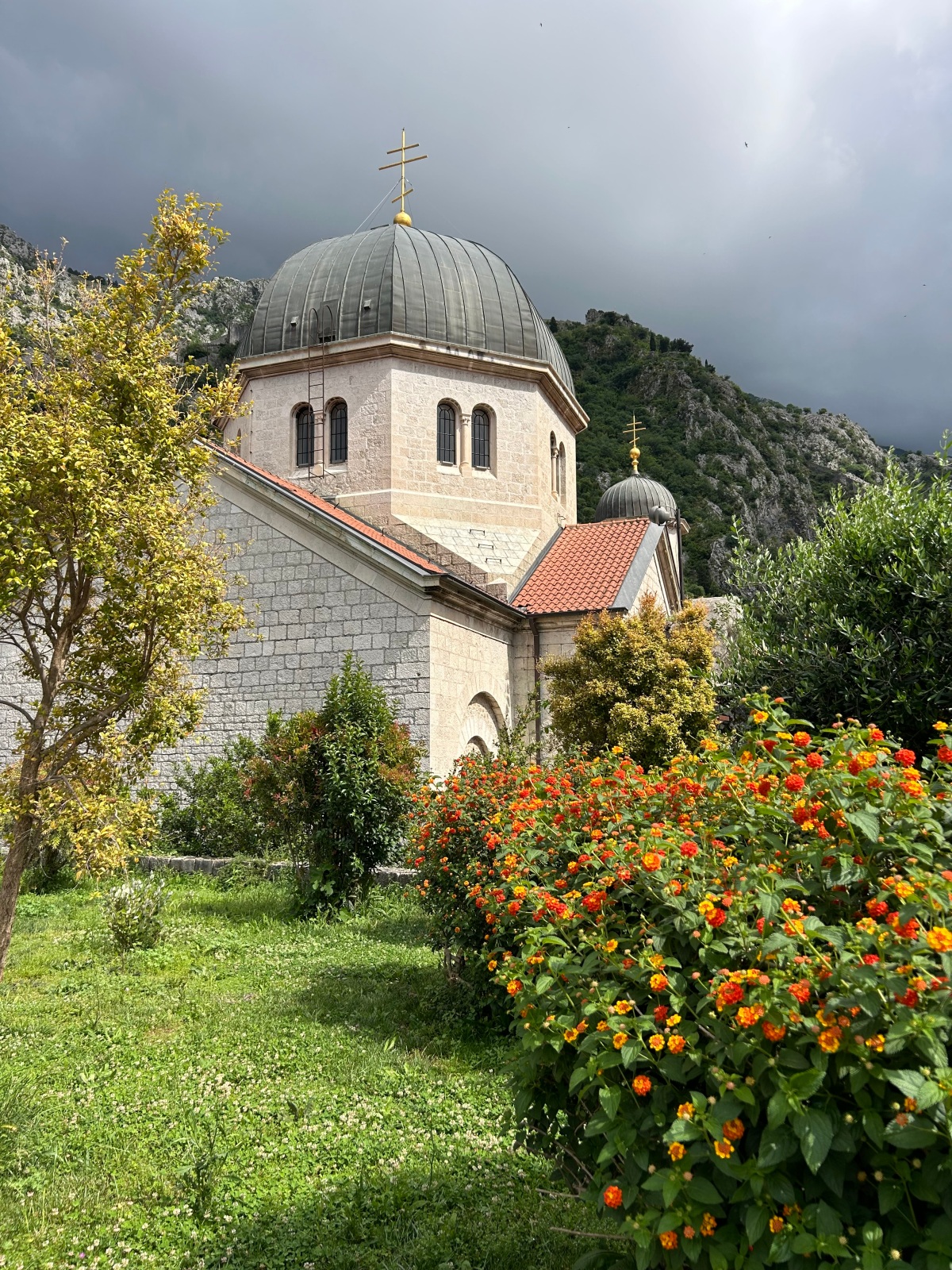
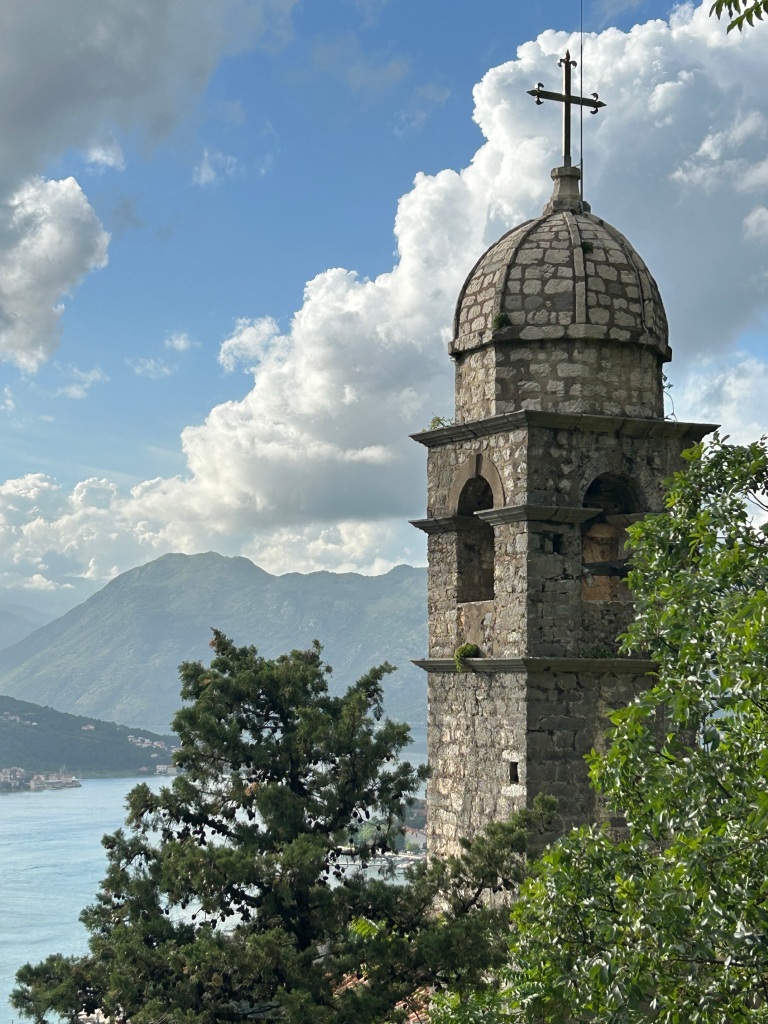
Until then, here’s another photo from our daytrip to Kotor, a medieval village in Montenegro.
Kotor, Montenegro
Thanks for reading! Over the past year, I’ve taken quite some time off from this blog; however, I plan to start adding to it on a biweekly basis. I have quite a bit more to share about Montenegro, Florence, Rome, and yes, even more on Venice. Follow my blog for more travel posts, including this one from our final day in Greece when we visited the site of Paul’s To an Unknown God sermon.
Note: This is a post published originally on Medium.com a few years ago. Kohl’s did acknowledge my concerns with a post on Twitter. A subsequent catalog’s cover featured a shirt with a more positive message. Read about that shirt here.
I’m a middle school language arts teacher. When I found this catalog in my mailbox the day before my district’s in-service workshops began, I cringed. Why must a retailer encourage the “attitude” that we as educators are trained to discourage and prevent? Because I couldn’t be a bystander, here goes…
Is this shirt supposed to be funny, Kohl’s? Because it’s really just mean.
Did you know that back-to-school should be a time of building students up, not tearing them down? “Nobody cares” has no place in an environment structured for emotional growth and learning.
Do you realize the clothing you sell affects the social climate? Sure, maybe we don’t read and reflect on messages like the one on this shirt, but I think our minds do absorb its spirit.
Do you know this shirt also says “You don’t matter”? It extends the “Whatever!” attitude with an added dose of disdain and egotism.
Do you know how a message like this can harm someone who’s having a bad day? I’m a middle school teacher. Messages like this are the last thing a middle schooler needs to see.
Could you sell this shirt without the wording? Because it appears to have a nice fit and I like the longer length.
Your buyers searched the markets for new back-to-school fashions, and this is the best they found? And then you put it on the cover of your catalog?
Do you know that the world doesn’t need this shirt? We’ll all get along better if we don’t cover our bodies in snarky comments.
Do you realize that people actually do care about other people? In fact, I contend there is a greater capacity for compassion among humans than there is for scorn.
Do you really want to associate your brand with such disrespect? I didn’t think so. You’re better than that, Kohl’s.
Kohl’s acknowledged this post by tweeting a message that they would take my thoughts into consideration. A subsequent Kohl’s catalog showed a shirt with a kinder message. Here’s a post about that.
Ever see a product that makes you ask, “Why??????” Leave a message on my contact page to let me know I’m not alone.
And other observations during a two-night trip to Florence
Excuse me, but how did this post that I published on Medium.com a few years back not make it onto my blog?! Here it is, regardless. (In case you’re wondering how I figured out about the literal missing link… it’s because in attending a class to prepare for another trip to Italy in May, I started scrolling through my previous posts, and dear old Florence was missing. Not anymore.
My daughter spent three months living in Venice in 2017 as an intern at the Peggy Guggenheim Collection, a small, yet world-renowned modern art museum located on the Grand Canal. Her time there was magical, challenging, beautiful, and life-changing. During her last week in Venice, she and three of her intern friends spent three days in Florence, home to 705,000 residents and located on the Arno River in central Italy. Since her return, we’ve enjoyed many conversations about her time in Italy.
The interview answers are just the two of us talking; see the photo captions for more detailed notes and facts about her trip.
Marilyn Yung
How far is Florence from Venice? It’s about a two-hour train ride. We left from the Santa Lucia train station around eight o’clock and got to Florence mid- to late morning.
What did you do first? When we got there, the first thing we did was walk to find our Airbnb. After dropping off our bags, we confirmed exactly what we wanted to do over the next few hours. On the train, we had talked about what we wanted to do. Our goal was to see as much art as possible — obviously, we were in Florence — and there were five or six major things that we knew would require extra planning and waiting in lines for. We had looked up the opening hours of all the museums, cost, and the amount of time to plan for each one. We didn’t give ourselves time to meander.
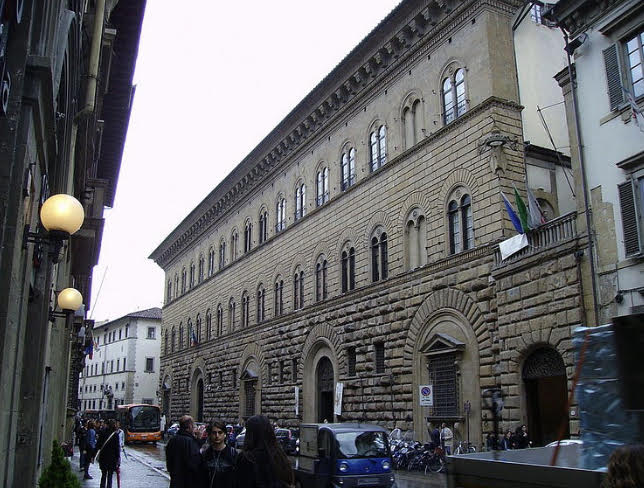
So what was first on your itinerary? The first thing we went to was the Medici Riccardi Palace. It’s got three levels of distinct architecture (see the caption for photo below). The palace is absolutely huge and nearly impossible to photograph from the outside.
This photo shows the exterior of Medici Riccardi Palace in Florence. The bottom level is rough in keeping with the era’s sumptuary laws that forbade ostentatious displays of wealth. Building of the palace began in 1444. The second level looks less rustic and the third displays a more refined, smooth texture on the stone. By Yair Haklai [CC BY-SA 3.0 (https://creativecommons.org/licenses/by-sa/3.0) or GFDL (http://www.gnu.org/copyleft/fdl.html)], from Wikimedia Commons
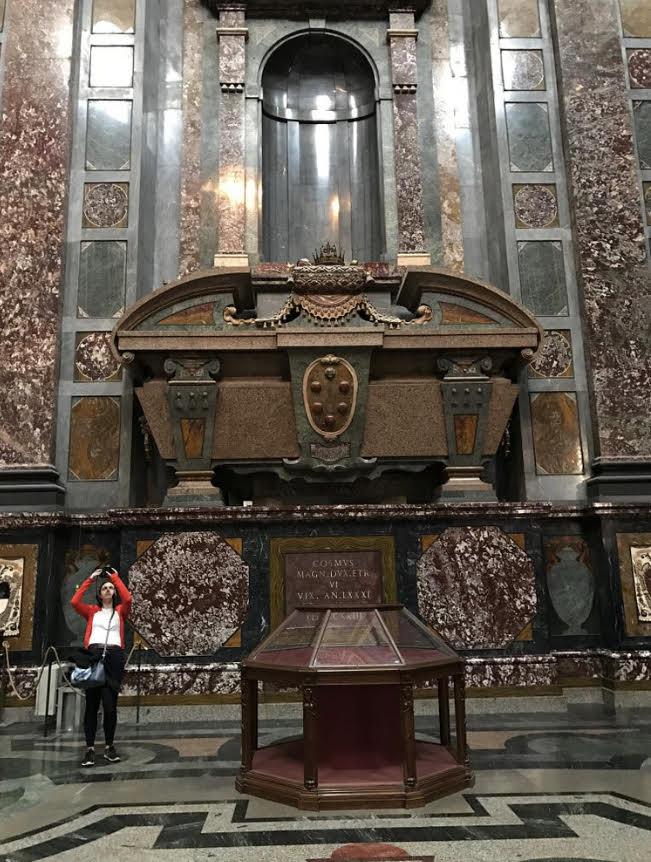
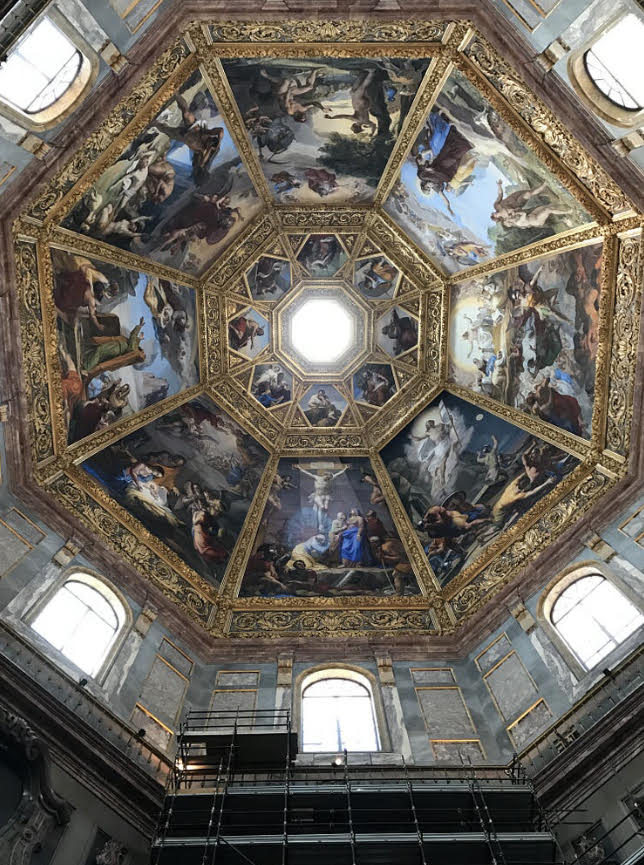
What was next? The Medici Chapel. Absolutely incredible! The exterior is very misleading. It doesn’t look that big on the outside but then you go inside and it’s massive! The inside uses a really dark marble pretty much throughout. The dome is painted in frescoes. There are relics everywhere. The chapel is covered in ornate paintings. It is truly one of the most beautiful places I’ve ever seen.
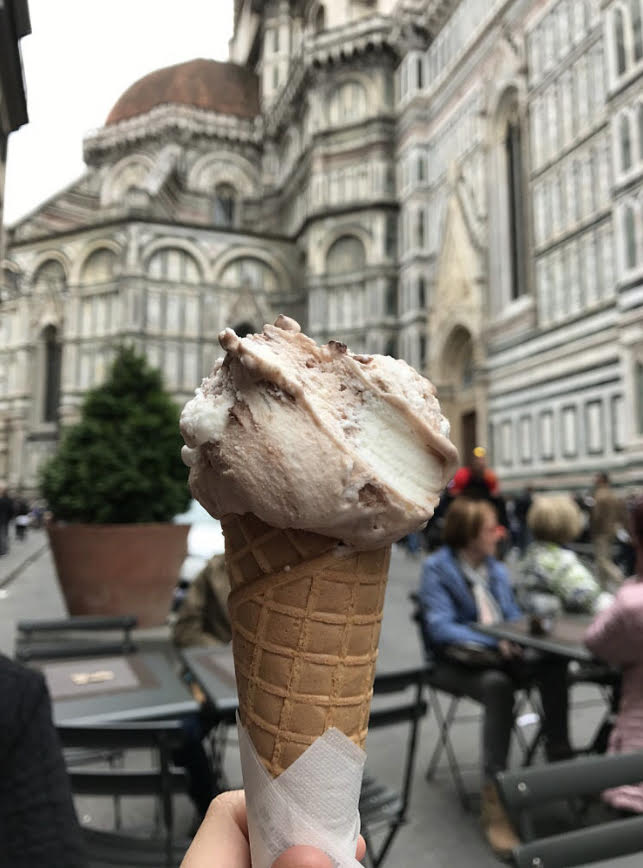
So after the Medici Chapel, what did you have for lunch? We went to a little cafe that was very good. I decided to try gnocchi for the first time. Gnocchi are soft dumplings made from potatoes. They can be made from other things like flour or cheese, but potato gnocchi are the most popular. I really had no idea whether I would like it or not and it was very good. I followed that up with a lemon and mint gelato, which was amazing.
It’s hard to believe, but this is lemon-mint gelato. | Photo: K. Yung
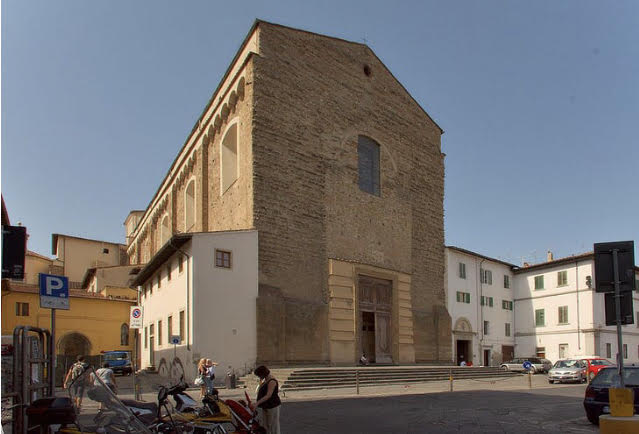
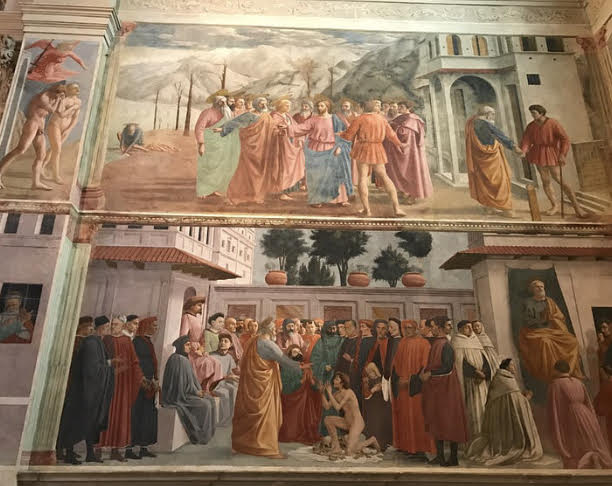
And then? After that, we went to The Brancacci Chapel. It’s part of Santa Maria del Carmine church. The main purpose to seeing this chapel, other than the architecture, was Masaccio’s paintings called “The Tribute Money” and “The Expulsion from the Garden of Eden.” These are discussed in any art history textbook. These two paintings are important because they are some of the first that show one-point perspective used correctly.
The Brancacci Chapel is located within the nondescript Santa Maria del Carmine church. One would never know that inside this chapel are the masterpieces that follow in the next photos. Photo: giovanni sighele [CC BY 3.0 (https://creativecommons.org/licenses/by/3.0)], via Wikimedia CommonsFocus on the top half of this image. At the far left is Masaccio’s “Expulsion from the Garden of Eden,” one of Masaccio’s most famous paintings. Why is it important? It shows non-idealized human figures showing horrified emotion. “The Tribute Money” is the main panel. Art history buffs visit the chapel specifically to see these works. | Photo: K. Yung
The Brancacci is a teeny tiny chapel actually, and it’s weird to think that super-famous paintings are inside a room that’s about the size of someone’s living room. But compared to the Scrovegni Chapel, I would say it’s larger. One chapel within the church is about the size of the total Scrovegni. Also, all of the paintings in the Scrovegni are by Giotto, whereas in the Brancacci, there are works by Masaccio and others. For example, one chapel had paintings from the Baroque era…a totally different time period and style.
What did you see after the Brancacci Chapel? We went to the Palazzo Strozzi to see an exhibition of video installations by Bill Viola. He’s an American artist and the show was called Electric Renaissance. It was kind of nice to see this contemporary art — made by someone from Queens, New York, no less — contrasting with the old. They brought in some Renaissance paintings and placed them near Viola’s work.
So enough contemporary work, right? You’re in Florence after all. What was next on the agenda? A friend had recommended to us that we go to the Museo Nove Cento. It was a big disappointment, however, The curation was poor and by that I mean that there was little direction for visitors inside. We couldn’t tell which direction to start walking. There were many pieces without wall texts, those cards that are mounted next to the painting or whatever the art is that tells you about the artist, the media, the date and such. Sometimes there were way too many works placed on the wall, which would make it hard for a piece to stand on its own with space to contemplate it. None of us was impressed with it at all. And we were starting to get really hungry, so we went back to our Airbnb to relax for a bit before going out for dinner.
Did you find a great Florentine restaurant? Well, actually we found a restaurant called La Petite and of all things, I decided to get a burger and sticks. Sticks was the name they gave to classic French fries. It was all very good. We passed on drinks that night and just had waters.
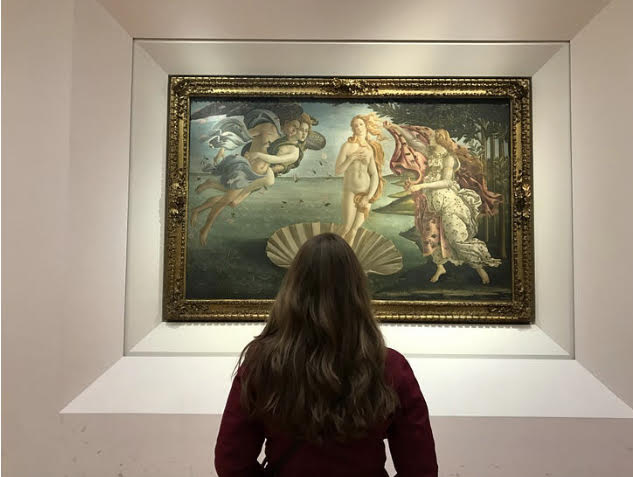
What was on tap for Saturday? We went to the Uffizi Gallery. This is where the two of Botticelli’s most important pieces are: The Birth of Venus and Primavera. The Uffizi is probably the most revered museum in Florence.
My daughter looking at Sandro Botticelli’s “The Birth of Venus” inside the Uffizi Museum. This is one of the Renaissance’s most well-known and iconic paintings. | Photo: K. Yung.Sandro Botticelli’s “Primavera.” | Photo: K. Yung
There are also other incredible works by Raphael, Van Der Goes, da Vinci, Caravaggio, and Parmigianino. The Uffizi is seriously a huge museum chock full of art and hands-down the most renowned. It’s a sin to go to Florence and not go there.
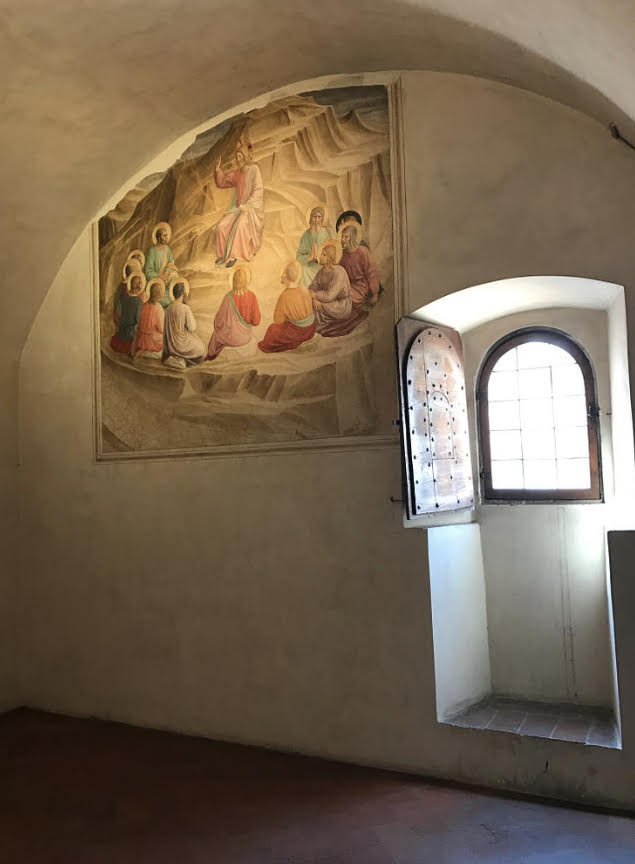
After the Uffizi, where did you go? We went to the Convent of San Marco. This is a convent with incredible cell-like living quarters. Inside each cell is a beautiful fresco that’s painted on the wall.
Beautiful frescoes inside a cell at the Convent of San Marco. | Photo: K. Yung
Even though those are interesting to see, the main reason people go to the convent is to see a fresco called the annunciation” by Fra Angelico. It’s amazing. You can find it at the top of the stairs. The convent also has a collection of antique books owned by former residents.
The Annunciation at the Convent of San Marco. | Photo: K. Yung
Where did you have lunch on Saturday? After that, we got lunch at a little nondescript café –have no idea what it was called — and then we decided to take a break from art and went shopping at a Cos store on Via Della Spada. I had never been to Cos before and I thought it was the coolest place ever. Several of us tried a few things on and made a few purchases. We also went to Zara, a popular, inexpensive clothing store. The place was absolutely jam- packed. There was a 45-minute wait just to get into the dressing room. So that didn’t last long because we still had to get to the Accademia Gallery to see Michelangelo’s David.
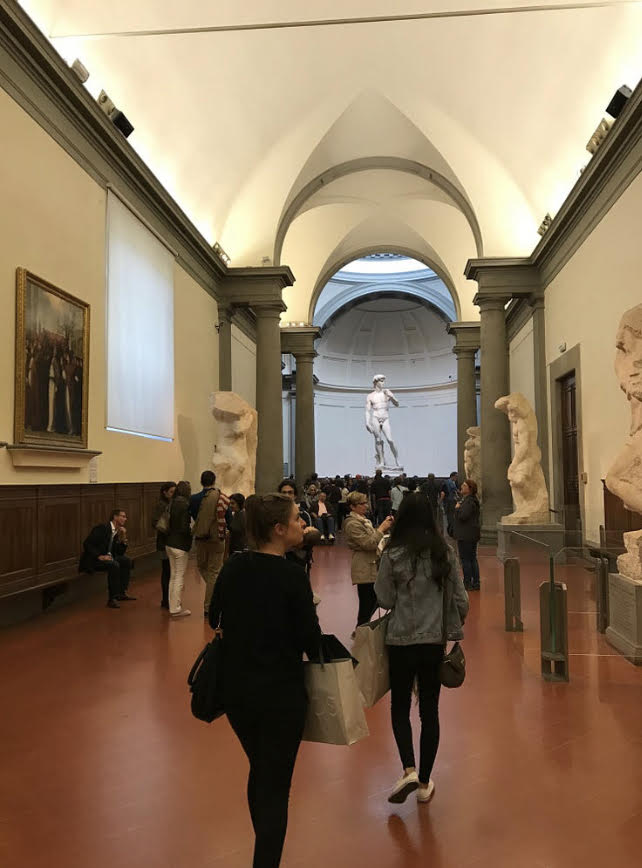
How was that? Seeing The David was the most amazing thing. I’ve never been stopped in my tracks by something until that moment. It is presented beautifully. You walk down a hall, turn a corner and it’s at the end of a long entry hall.
The hall leading to The David provides a prelude to this great work of art. | Photo: K. Yung
Sunlight streams in from above. It is majestic. Stunning. The David makes you ask, How did someone create that? Its size is part of the spectacle because I didn’t expect it be that large. The hands on The David are disproportionately large to highlight the importance of his hands in slaying Goliath.
We spent about an hour looking at The David, awestruck, and then suddenly we realized it was just about time for dinner.
Another burger? Very funny. No, even better… Mexican! We went to Tijuana Mexican Bar and Restaurant. Actually, it was excellent. I had the best tequila I’ve ever had there. I also ordered a quesadilla with black beans on the side. It was delicious. That night while we were eating, I had this bittersweet realization that it would be one of the last times I would be out with my friends since my internship would be over in about four days.
So you were sad to be leaving? Yes, I guess… sad to leave Florence the next morning, but then also sad to be leaving Italy. I was ready to go home, but at the same time, not ready at all for my time in Italy to be over. I felt like I was just becoming accustomed to living in Venice. I knew my way around. I could manage the language better that I ever dreamed I’d be able to. I could have stayed another three months, honestly.
What was still on your bucket list for Florence? Well, we still hadn’t been to the Duomo, so we knew the next morning would be when we would go see it. However, we had found out on the way to Florence that tickets were sold out for touring the Brunelleschi dome, so we decided to go up the bell tower — Giotto’s Campanile— nearby instead. So we got up on Sunday and by 10 a.m. we were in line to get tickets to go up.
It was still so soon after the campanile ticket office opened that there wasn’t a line yet. So we decided to go on up. Climbing was tiring and you’re just squished up against the walls, rubbing along bodies — there were already other people coming down — as you climb. We got the pictures of the actual dome … the Duomo from the top of the campanile (see image at top of this article). It was a beautiful moment. Incredibly picture-worthy!
After we got back down to the ground, there was a huge line to go up. It was easily a two-hour wait. We’re glad we got there close to when they opened.
The line to Giotto’s Campanile grows very long by mid-morning. | Photo: K. Yung
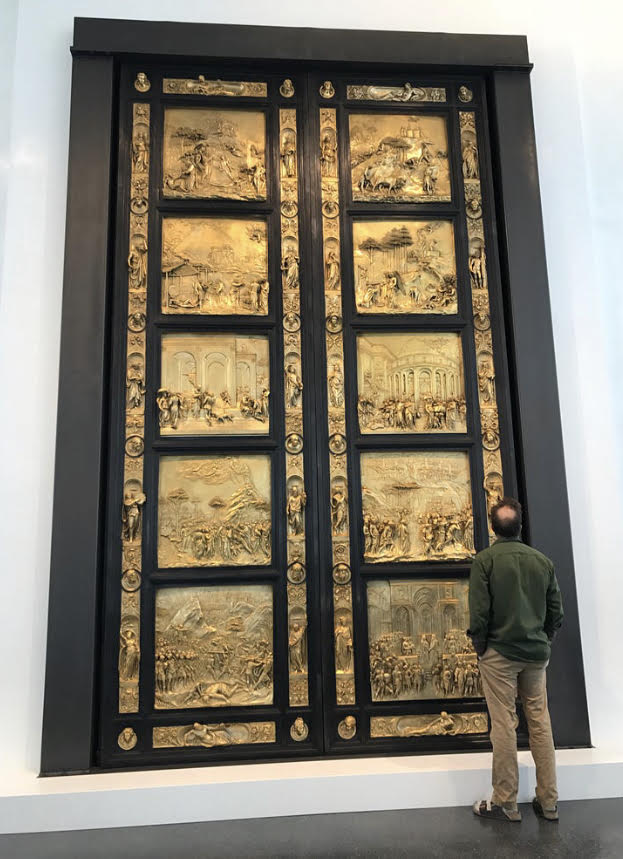
Then we grabbed a sandwich at a spot near the Duomo and we still wanted to go inside the baptistery of St. John and see the Ghiberti’s Gates of Paradise. As we were eating, we noticed a really long line to get inside, so two of us decided to wait in line while the other two of us went inside the baptistery where the gates are. And then we switched off.
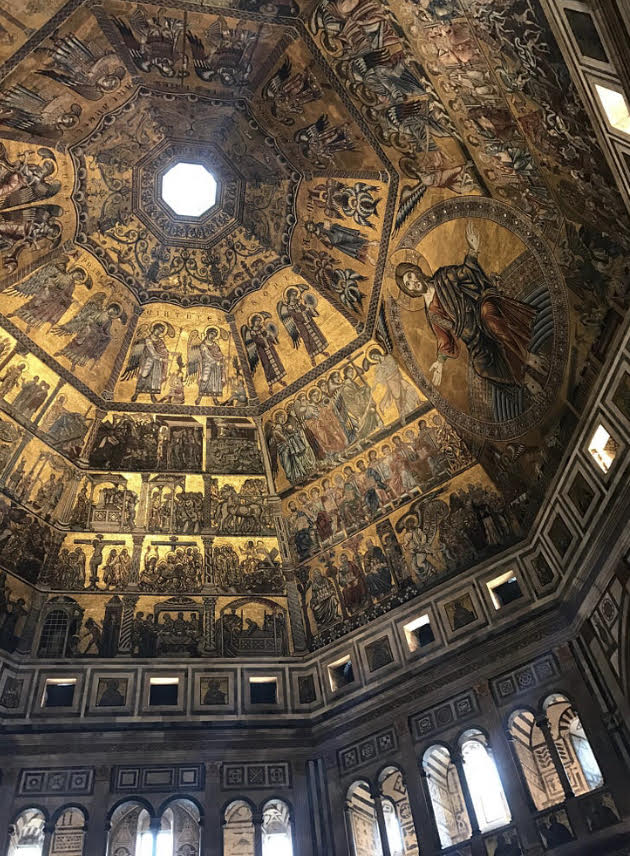
Gold sparkles on the ceiling inside the baptistery at the Duomo . Because many visit here primarily to see the Gates of Paradise, they are surprised at the beauty of the interior of the baptistery. | Photo: K. Yung
Inside the baptistery, I totally did not expect that it would be completely gold. In art history classes, you usually just study the Gates, which are gold, but the inside of the baptistery is also covered in gold mosaics. The gates show biblical scenes
As for the Duomo, which by the way is part of the Santa Maria del Fiore Cathedral, the exterior of the building is spectacular with its green, orange and white marble stone.
This photo doesn’t show the extreme ornamentation of the Duomo at Santa Maria del Fiore Cathedral, but it does convey how the Duomo is prominent in many views of the city. | Photo: K. Yung
The entrance to the museum at the Duomo is underground and that’s also where the original Gates of Paradise are. But for some reason, the museum was closed that day. So, I still haven’t seen the original gates, but I have seen the two copies that exist. One copy is in the baptistery above the museum and the other is at the Nelson-Atkins Museum of Art in Kansas City.
A copy of Ghiberti’s Gates of Paradise were recently added to the permanent collection of the Nelson-Atkins Museum of Art in Kansas City, Mo. | The original gates are in the baptistery of St. John at the Duomo in Florence. Lorenza Ghiberti, a goldsmith and sculptor, created the gates from 1425–1452. | Photo: K. Yung
So was that the end of your time in Florence? Not quite. After that, we went to go see Santa Maria Novella church because we had passed it coming into Florence, and since we were heading out to leave we thought we should go ahead and see it.
The Santa Maria Novella church in Florence. | Photo: K. Yung
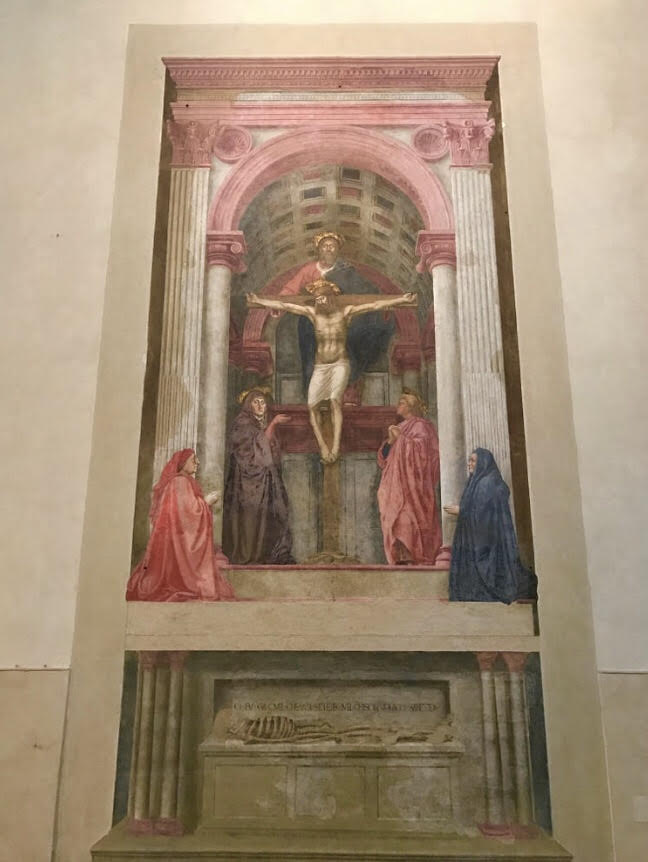
Inside there is Masacchio’s Trinity. It’s very important in that it shows the first official correctly-used one-point perspective. It’s actually just a fresco on the wall. And while the church has so much more to see, seeing Trinity was our priority. I remember wishing I wasn’t so tired and could have enjoyed it more, but we were so exhausted from just going-going-going the previous three days.
The Santa Maria Novella church in Florence. | Photo: K. Yung
Any unexpected surprises? Yes. I know it sounds funny, but seeing the trash being collected was amazing. There are above-ground trash bins with large in-ground canisters below them. These automated trucks came along and a huge arm with a giant magnet on it pivots over and picks up the canisters and empties them into the truck. I thought it was interesting to watch, really.
Trash haulers remove garbage from underground vaults. | Photo: K. Yung
How was your Airbnb, by the way? It was great. The owner was really helpful. I definitely remember it being very loud there with all the traffic. In Venice, it’s relatively quiet without all the cars and I think I was just used to that. It was a gated apartment. There was a loft with a queen-sized bed and another bedroom with a twin bed. Down below on the main floor there was a nice couch. It also had a full kitchen. Everything was stone and so nothing absorbed any sound.
So, after seeing Santa Maria Novella, it was time to board the train? Yeah, we went back and got our bags, got on an express train and returned home to Venice for a party that evening. We left around 4 o’clock in the afternoon and got back to Venice around 6. Then we took the vaporetto to Guidecca for a party. We all chipped in for some pizzas and then hustled our way out to the party.
How would you sum up Florence? So. Much. Art. Everywhere you look there is something important. Florence is all about the art. Rome has the coliseum. Venice has the water. Florence has the art.
I make no apologies. As a writer and parent, I feel perfectly entitled to take full advantage of my daughter’s 2017 experience in Italy by wringing every possible story from it! Yes, our family did visit her there for a week that year and while we saw so much in that short time, we envied the luxury of time her three-month internship allowed.
We’ll be returning in May 2023 for a two-week trip to Florence, Siena, Venice, and Rome. Become a follower to catch those posts when they publish. Thanks for reading!
I’m reblogging this post from The Gen X Travels, a fellow WordPress blogger, for two reasons: 1) it has some great “in the moment” photos that I think my travel readers will enjoy and 2) because I want to be able to find it later when I’m planning my own trip to southern Italy. All of my Italian travel has involved northern Italy and I’m dying to head south. Enjoy!
I traveled to Italy, April 2022 and my first stop was Naples, where I enjoyed a walking tour of the old town. This trip was with a group of women and…
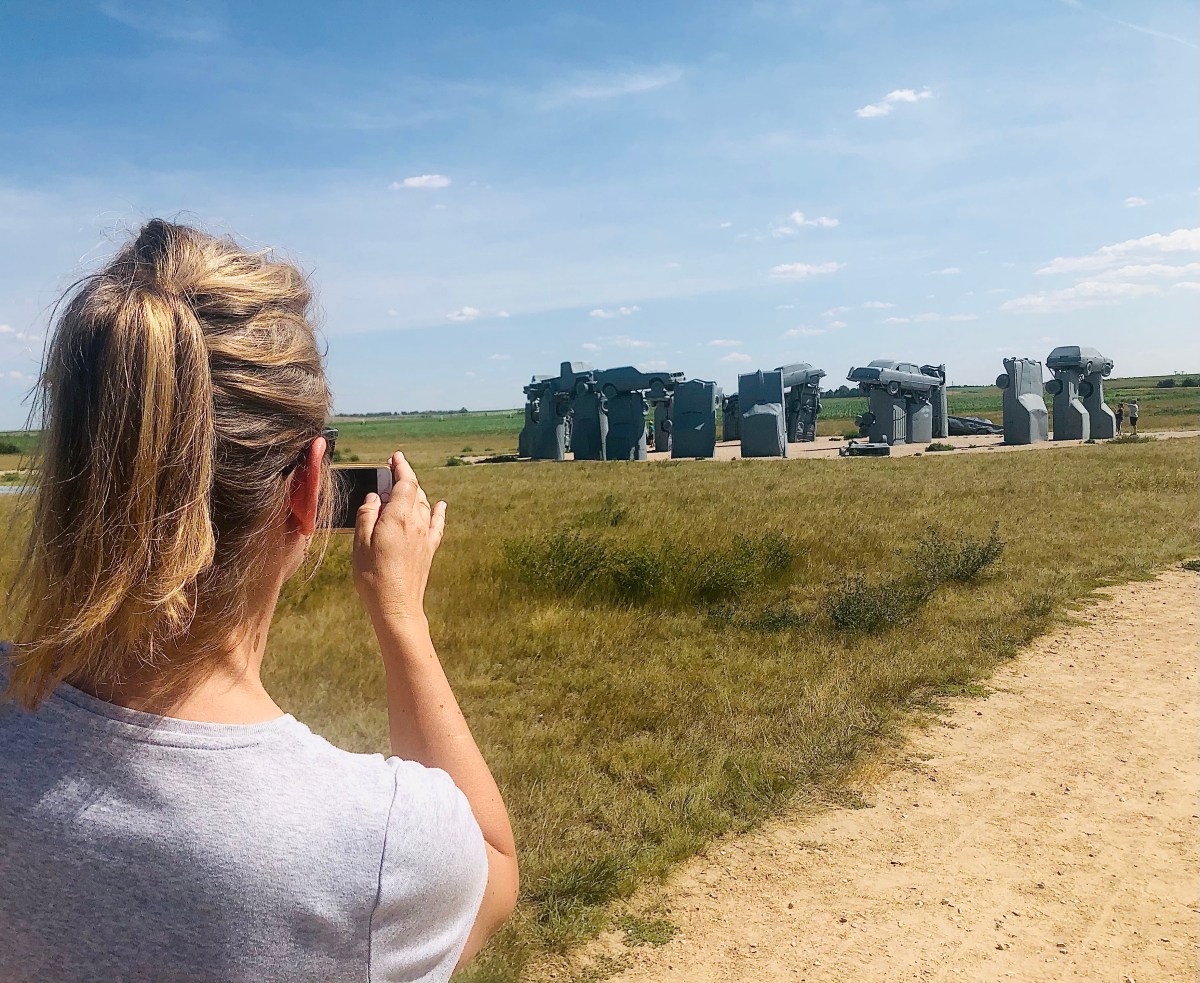
Last week, my husband and I took a three-day trip to Mount Rushmore from southwest Missouri. On the way to and from, we ventured off the beaten path to see some less-visited sites. One of those was Carhenge.
Can you guess what it is? Yep, you’re right. It’s a Stonehenge made of cars.
At left, the UNESCO World Heritage Site of Stonehenge in England and at right, Carhenge in Alliance, Nebraska.
And believe it or not, it’s been on the back-burner of our mental bucket list of places to see for several years now. So you can imagine our delight last Thursday when we learned (thanks to Google Maps) that we would be within a few miles of Carhenge when we passed through Alliance, Nebraska (pop. 8,500) later that afternoon.
Another shot
I first heard of Carhenge right around the time I graduated from the University of Kansas in 1988. The project’s completion in 1987 made the news back then in the Midwest for a little while. Then gradually, the news died down, and it became another one of those odd-ball sights the Great Plains is known for.
Let’s get to it. Here’s a quick video of me simply rotating the camera around the central site:
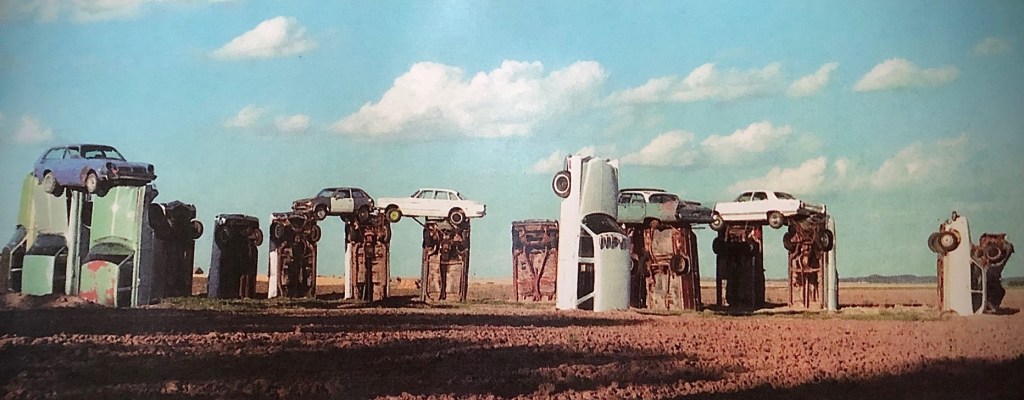
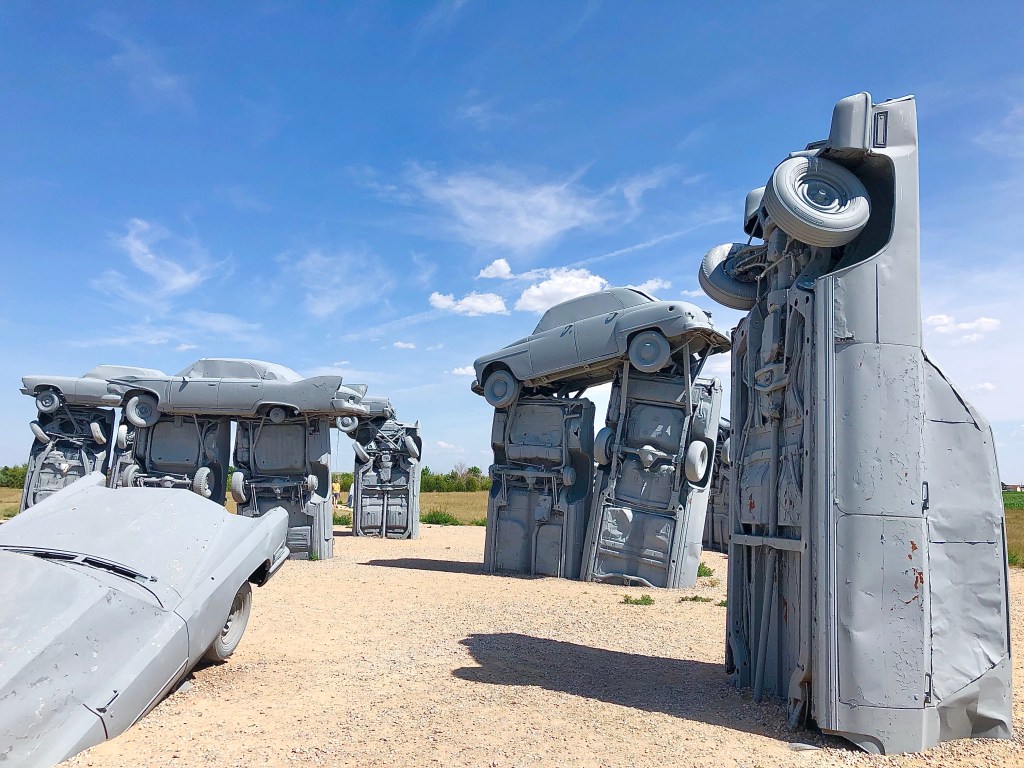
The cars were at one time left in their original paint colors. But I would imagine that over time, the paint began to wear and/or the metal finishes began to rust, so a “Stonehenge gray” color was eventually applied to all. Works for me.
Here’s a photo of the site before the cars were painted gray.
You can buy this postcard in a very sparse information center/gift shop for 79 cents. That’s cool.
Some of the pits that hold the upright cars are five feet deep.
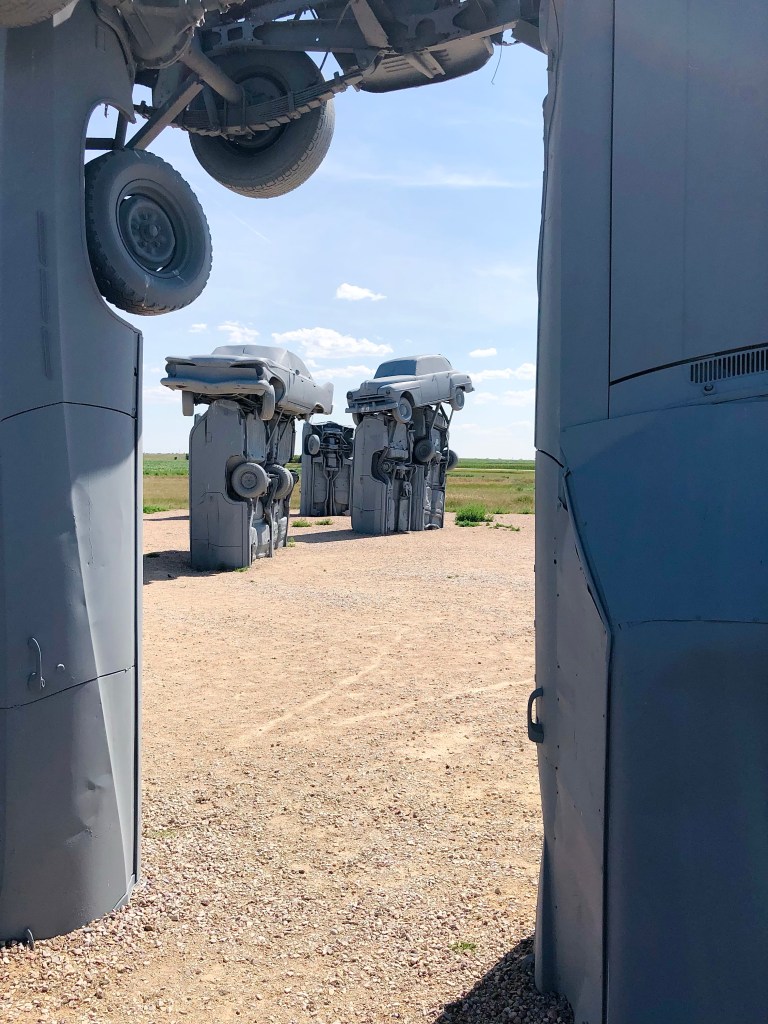
The cars that form the arches are welded to form a complete structure.
Reinders built Carhenge as a memorial to his father and while living in England studied Stonehenge to learn its size and proportions.
During the solar eclipse of August 2017, the path of totality (the path that would experience a total eclipse) passed right over Carhenge. Four thousand people, including the governor, viewed the eclipse from the site.
Another shotTrucks were also used to form the monumental sculpture.Needless to say, Carhenge is an unusual experience.
The information sign below tells about the main Carhenge circle and some outlying sculptures made of found objects, farm implements, and auto parts.
The sign
Sign here, please.
While you can walk right up to the main sculpture, don’t write anything on the cars. If you feel the need to leave your mark, do it on this white car placed here specifically for that purpose.
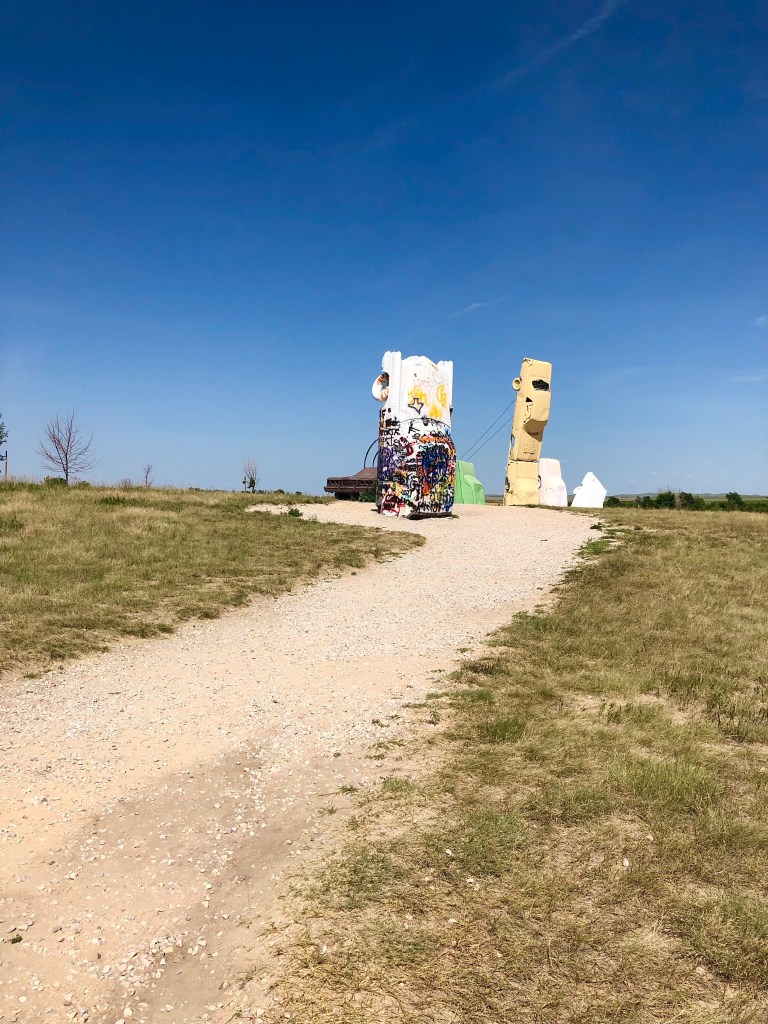
Sign here, please. To the right of the autograph car is an assemblage also made by Jim Reinders called “The Fourd Seasons,” inspired by Vivaldi’s Four Seasons. The sculpture includes all Ford automobiles and represents the four seasons of Nebraska.
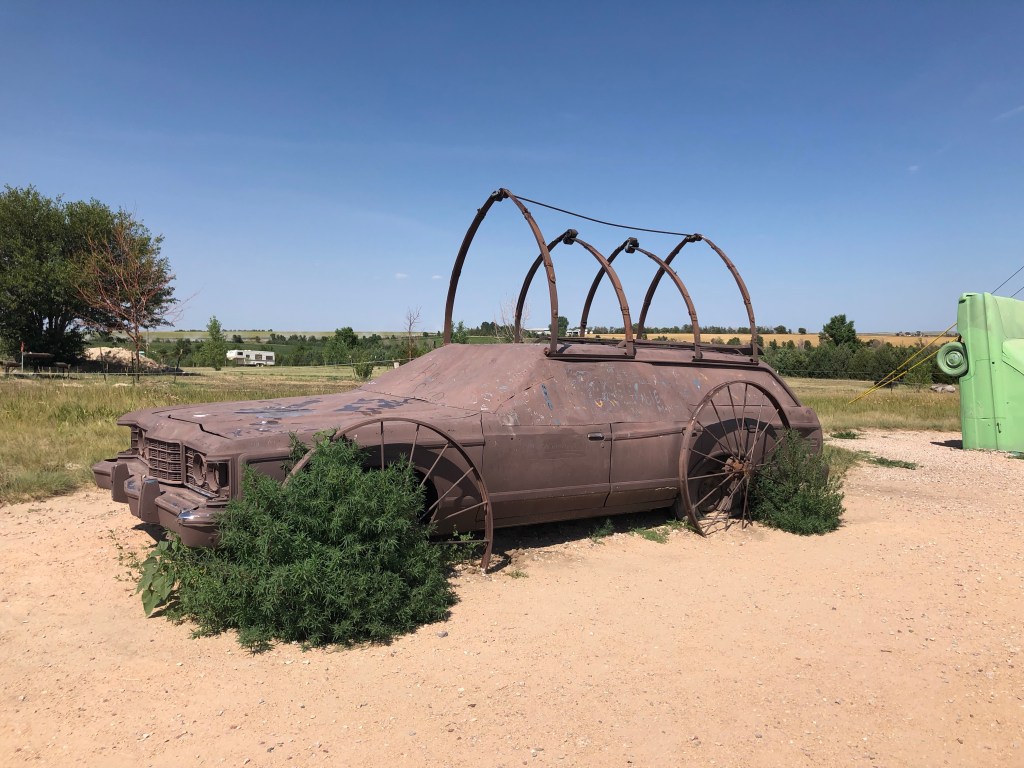
Here’s another example of some of the outlying pieces around Carhenge. This is called Carnestoga after the old Conestoga wagons that at one time were the High Plains vehicle of choice.
CarnestogaHere’s one final shot as we left Carhenge.
Don’t forget to visit the small information center/gift shop at the site to drop in a donation and buy a souvenir. They have t-shirts, postcards, key rings, cold drinks, and a few snacks et al to make your Carhenge visit complete.
The bucket list
I can now cross Carhenge off my bucket list. If Carhenge isn’t on your bucket list, add it pronto. And then get thee to Alliance, Nebraska to see this funky testament to creativity and cars.
On our way to Mount Rushmore, we also took a quick two-hour tour of De Smet, South Dakota to see the Laura Ingalls Wilder Historic Homes. I’ll do a short post about that soon. Thanks for reading!
While you’re here, check out another post that celebrates the culture and art of the Midwest.































 Marilyn Yung