Listen carefully for the summer sounds of Skopelos, Greece.
Some enchanted evening. Like for real.
My husband and I were sitting on our balcony high above the harbor of Skopelos Town. We could see people walking, dining, and socializing way down below on the waterfront street. Later, as we sipped our wine, I heard a chorus of voices singing a melody in a minor key.
It was beautiful, and my phone was near. Enjoy!
Listen carefully… can you hear it? Last summer, I heard voices rising from the depths of Skopelos Town on the island of the same name in Greece. I don’t know who was singing or for what reason, but it was a beautiful moment and one I had to capture and share. The sense of community in this village is strong. Enjoy this brief glimpse of Skopelos life! For a post from my blog full of photos of Skopelos, click here.
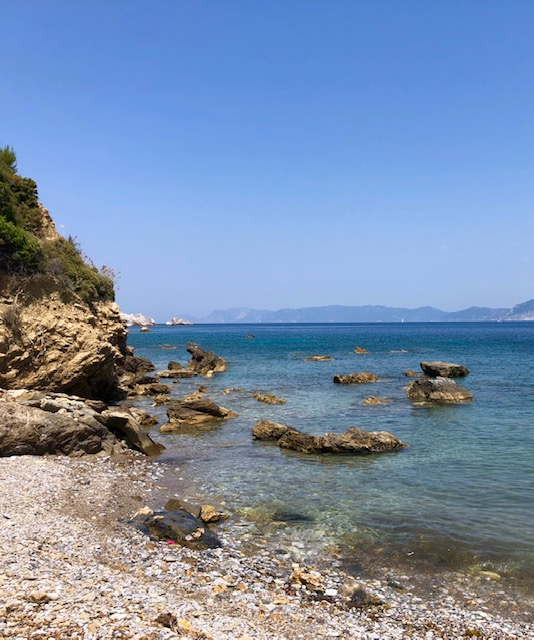
Crystal clear Aegean waters frame these rugged rocks just offshore the beach below Panagitsa Tower in Skopelos Old Town on Skopelos Island in Greece’s Northern Sporades Islands.
To read more about our three weeks in Skopelos, check out this post.
A peek into the past in the hills of southern Crete
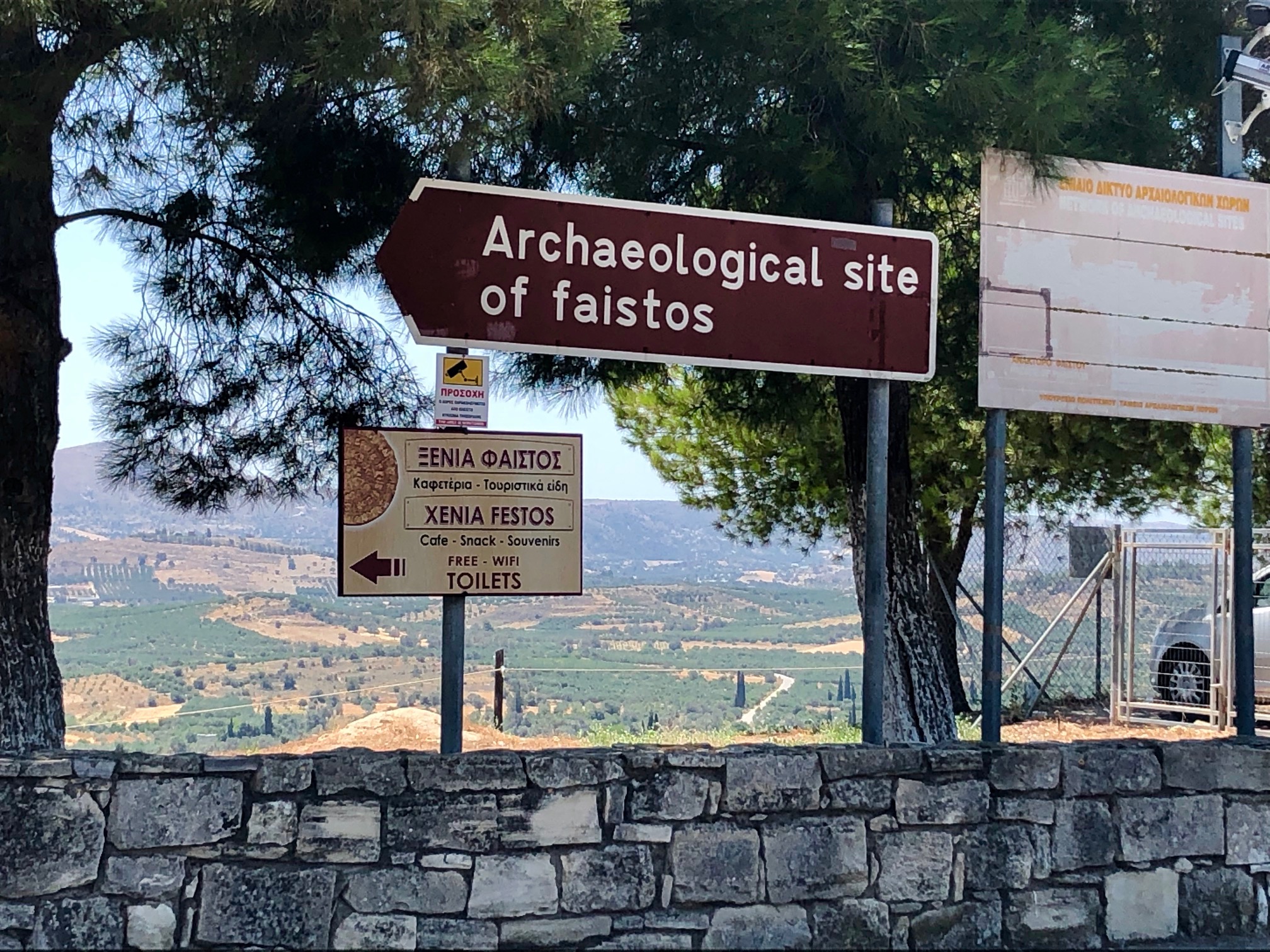
Phaistos. Phaestos. Festos. Faistos. And then in Greek, it’s spelled Φαιστός. No matter how you spell it, each name refers to Phaistos Minoan Palace, the second most important site (after Knossos Palace in Heraklion) of the Minoan civilization on the island of Crete.
We visited Phaistos last summer in late June. After touring the archaeological sites at Athens, Mycenae, Delphi, Olympia, and Knossos, we made a final stop at Phaistos. After a confusing morning journey by public bus from Heraklion, we made it to Phaistos in plenty of time to take a leisurely self-guided tour, eat a small lunch beneath a pine tree, and have a cold drink and ice cream in the small, on-site gift shop before hopping on a bus back to Heraklion. Here’s my post about how to get from Heraklion to Phaistos, click here.
If Minoans are new to you, here are a few facts about the culture from my husband:
The Minoans, named for their ruler, the mythical King Minos, are known for their advanced civilization that settled the island of Crete and other surrounding islands.
The Minoans were great sea travelers.
They built enormously sophisticated palaces for their royalty. The palaces were very “high tech” for the time period and exhibited a distinctive and advanced architectural style.
Phaistos was the region that produced Kamares ware, a pottery style dating from the 1800-1700 BC. Kamares ware, named for the nearby cave where it was found, is known for its dark background and white brushwork. Kamares wares were considered luxurious to own and were exported throughout the Mediterranean to Cyprus, Egypt and Palestine.
Kamares ware, including these vessels, were found at the Minoan palaces at Knossos and Phaistos. | Photo: M. Yung
A self-guided tour of Phaistos is relaxing and quiet. Unlike Knossos, there are no guides-for-hire who approach you as you enter offering to walk you through the site for a fee.
While these guides are likely very helpful for many tourists, we doubted that they were truly needed, considering the large number of detailed placards placed throughout the site. Granted, that assumes one doesn’t mind reading.
When you do stop to read the signs, you can learn a lot. Here are some basic facts taken from a placard found at the entry to the main site:
The hill of Phaistos was inhabited as early as 4500-3200 BC in the Final Neolithic Age.
The first palace of Phaistos was active from 1900-1700 BC. The palace controlled the plains and valleys found below the palace hilltop.
The city of Phaistos — and Minoan culture in general — flourished until 323-367 BC.
The Phaistos Palace grounds included a central court, surrounding wings, multi-story buildings (similar to Knossos), gateways and open balconies.
More facts follow the next few photos.
Phaistos is found on a hilltop in southern Crete. The valleys on all sides of the hilltop are blanketed with olive trees, grape vineyards, cypress trees, and farms. There are several caves in the surrounding hills also. Many items, including pottery, have been found in these caves. | Photo: M. Yung
The first Phaistos Palace was built around 1900 BC.
It covered 8,000 square kilometers over three terraces.
Tickets to the Phaistos site are 8€ each. Getting there is inexpensive, too, via public bus.
The original palace was inhabited for 250 years and destroyed and rebuilt three times.
It was destroyed the last time by an earthquake around 1700 BC.
It’s amazing that visitors are allowed to walk on stones laid nearly 3,700 years ago!
Little at Phaistos seems to have changed since the 1919 photo above. It’s still isolated, quiet, and remote. | Photo: M. Yung
After the earthquake, the ruins were covered and a new palace was constructed on that.
This last palatial site was smaller, but according to the placard, “more monumental.”
This last Phaistos Palace was destroyed in 1450 BC, but not rebuilt.
Two more facts follow below.
It’s amazing how little has changed over the years. This photo from 1919 shows the steps leading to the West Court. The theatral area and diagonal wall appear in the lower half of the picture. | Frederic Boissonnas [Public domain]
The city of Phaistos continued to be inhabited and thrived in Hellenistic times from 323-367 BC.
In 150 BC, Phaistos was finally destroyed by Gortys. When Rome conquered Crete in 67 BC, Gortys became the capital, replacing Knossos.
But back to our tour…
The main reason we wanted to visit Phaistos: the pithoi.
Two pithoi appear below a reconstructed walkway. | Photo: M. Yung
These pithoi (the singular word is pithois) are well-known in art history circles and Phaistos is considered the premier site for this particular kind of storage vessel. In fact, my husband hoped the site would have more available to see, as he had seen photos of many more pithoi on display here.
A room with storage jars known as pithoi. | Photo: M. Yung
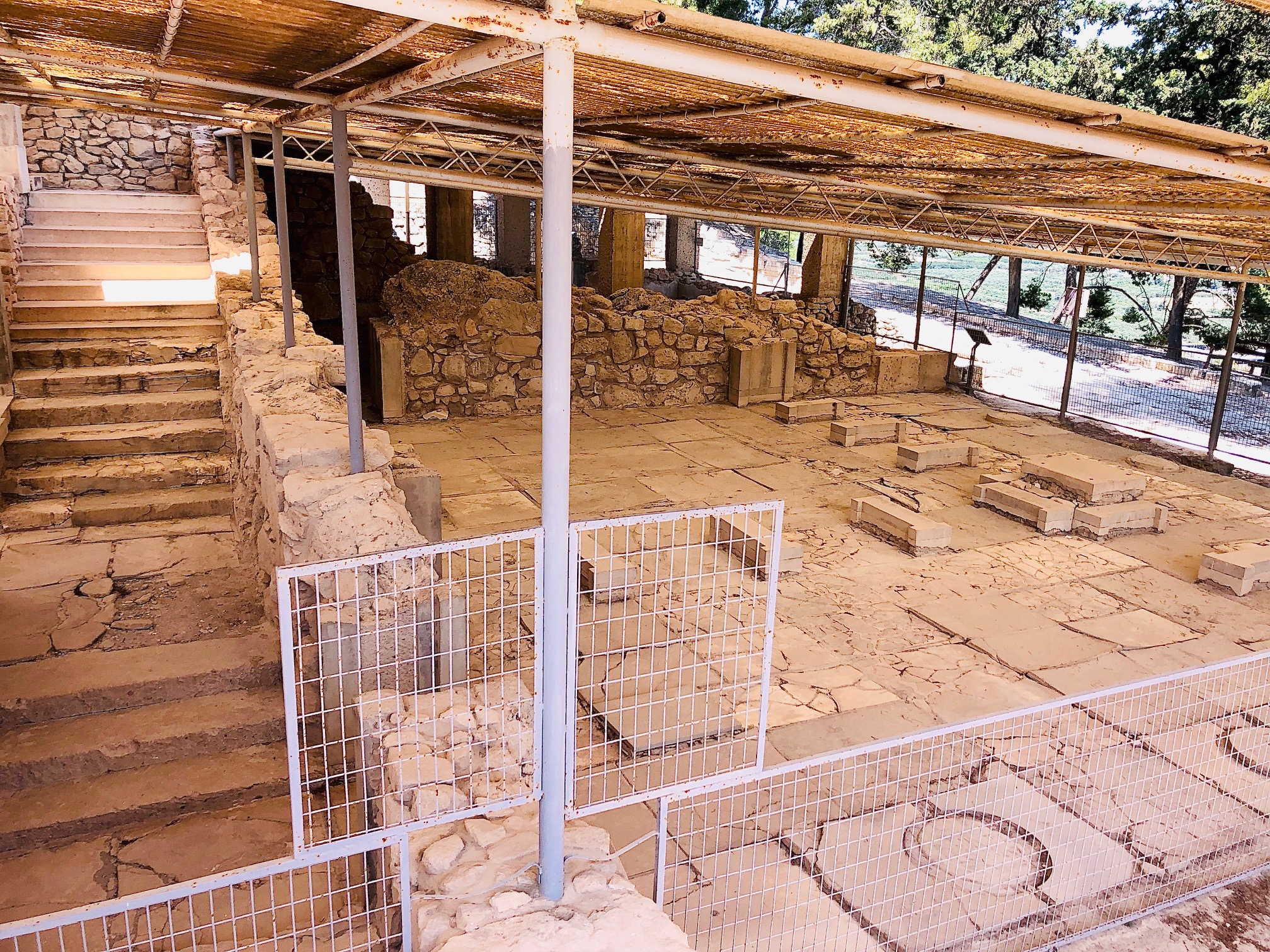
Still, it was fun to wander the grounds and find a pithois tucked away here and there. There were more to see in an area of the grounds covered with metal shelters; however, these shelters were in large areas closed off to visitors.
Mitch walked as far as he could into the Magazine of the Giant Pithoi, a room that contained several large pithoi jars. | Photo: M. Yung
In fact, this was our main disappointment with Phaistos:
a good portion of the site was closed.
The shrines of the West Wing were predominantly small rectangular rooms that contained benches. According to the placard, inside these rooms excavators found ritual vessels, figurines of deities and other cult objects. | Photo: M. Yung
There was definitely a feeling that Phaistos is overlooked and forgotten.
a few signs were missing
some barriers were broken
a wooden observation deck had missing boards
Generally, Phaistos seemed neglected. And this isn’t really surprising, considering Greece’s other economic priorities.
True, due to its location, Phaistos sees fewer visitors than other more popular Greek archaeological sites. In fact, Phaistos doesn’t even make this Top 20 list of Greek ruins.
Photo: M. Yung
Still, Phaistos is a valuable peek into the past, and among art historians, it’s well-known and revered.
The Phaistos Minoan Palace reminds us that we shouldn’t underestimate the abilities and ingenuity of ancient cultures. For example, precisely placed stairs and drainage pipes made of solid stone show us the resourcefulness of the Minoans.
Drainage pipes were used at Phaistos. | M. YungThis is the Queen’s Megaron (throne room) found at Phaistos. It is covered by a metal shelter on this side……and this side, too. | Photo: M. YungThe Phaistos Disk is on display at the Heraklion Archaeological Museum. The disk represents one of the greatest mysteries of archaeology. No one knows the meaning of the symbols incised into the clay. It was made between 2000-1000 BC. It measures about six inches in diameter. | Photo: M. YungPhoto: M. Yung
It was a beautiful sunny day when we visited Phaistos. In fact, by early afternoon, we were ready to hop on an air-conditioned bus and make the trip back to Heraklion.
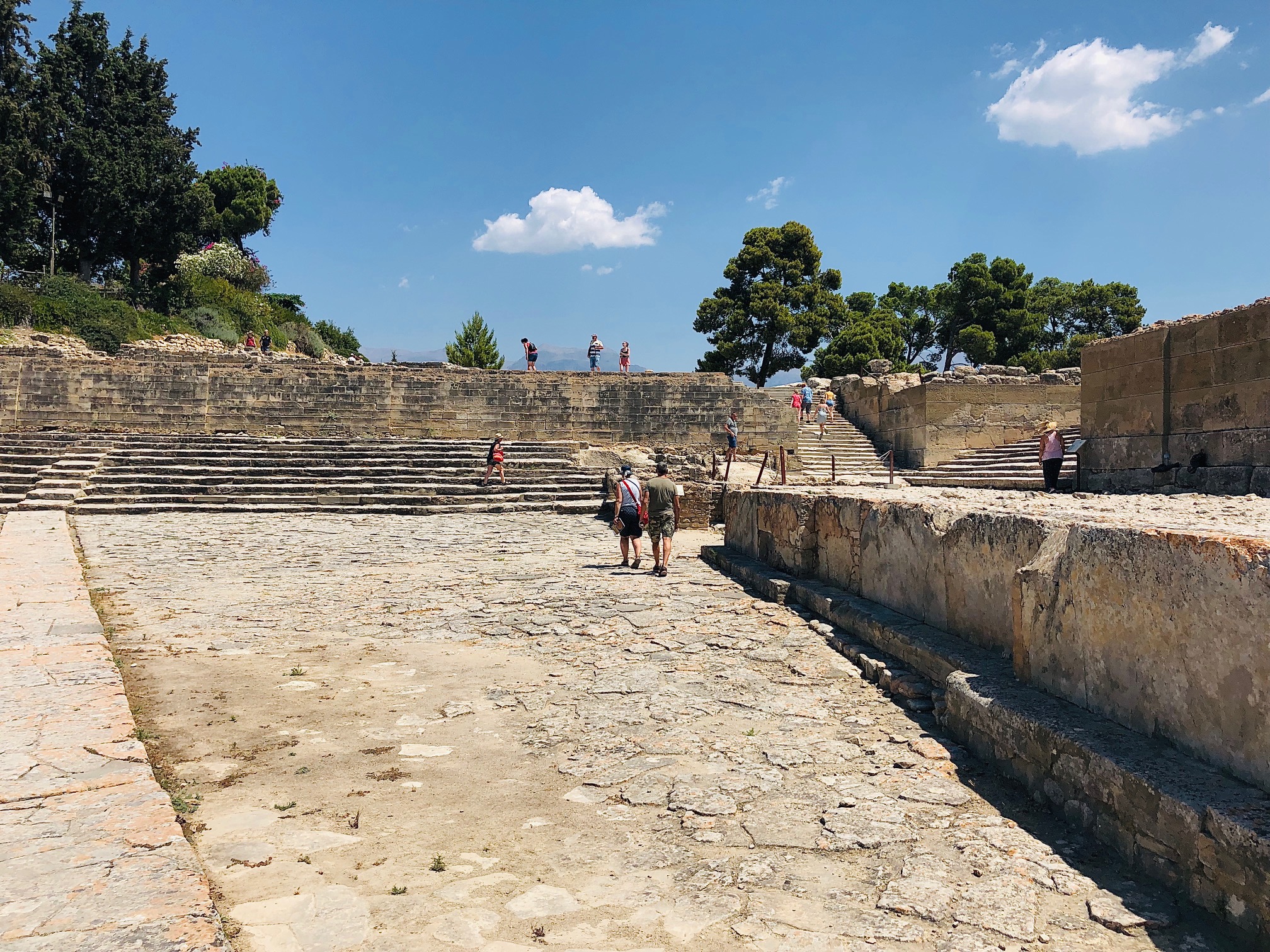
This photo shows the theatral area on the left and stairway to the West Court on the right. | Photo: M. Yung
Here I am walking near the theatral area in the West Court. The wall to my left can be seen on the left side of the preceding photo.
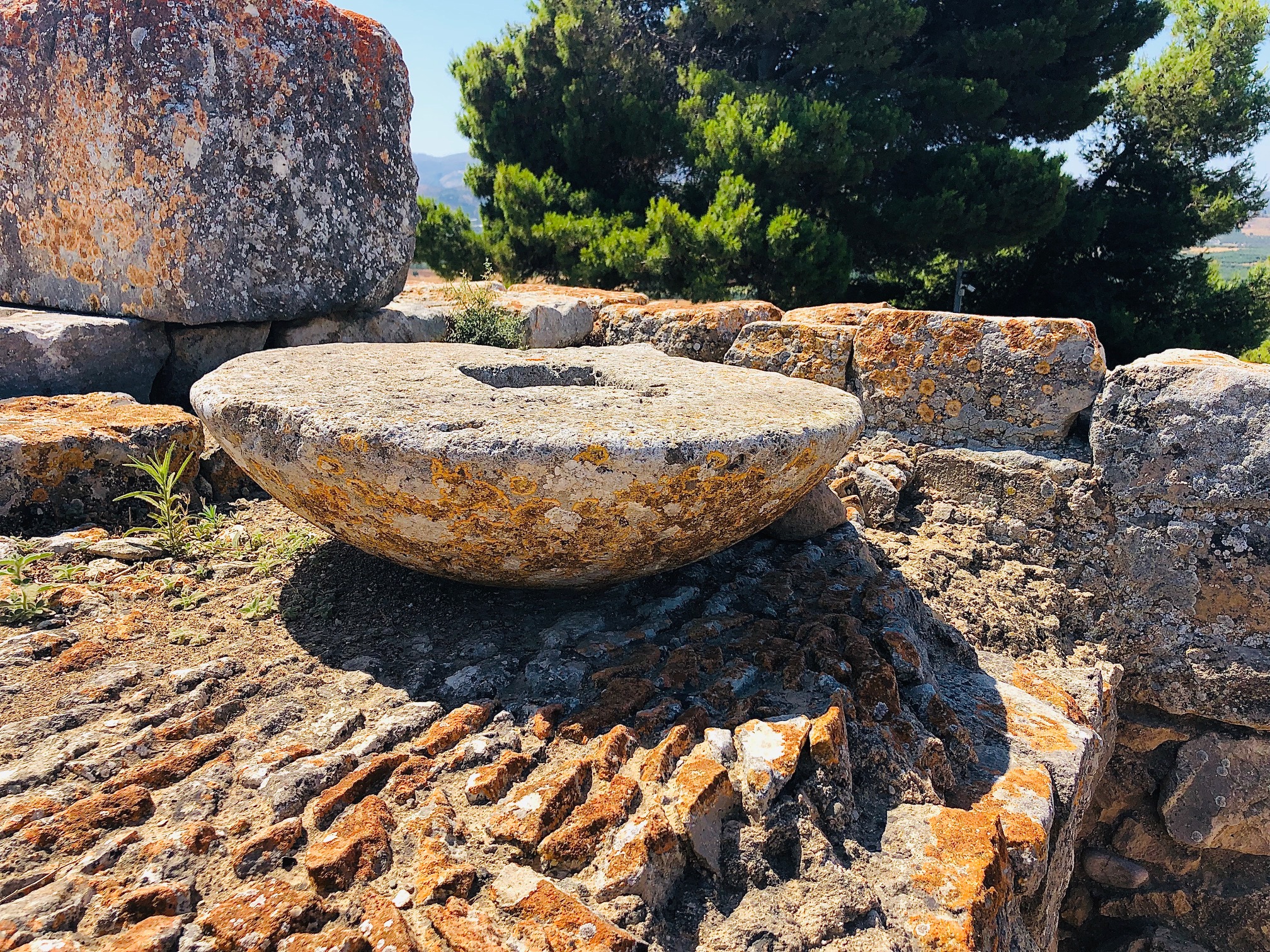
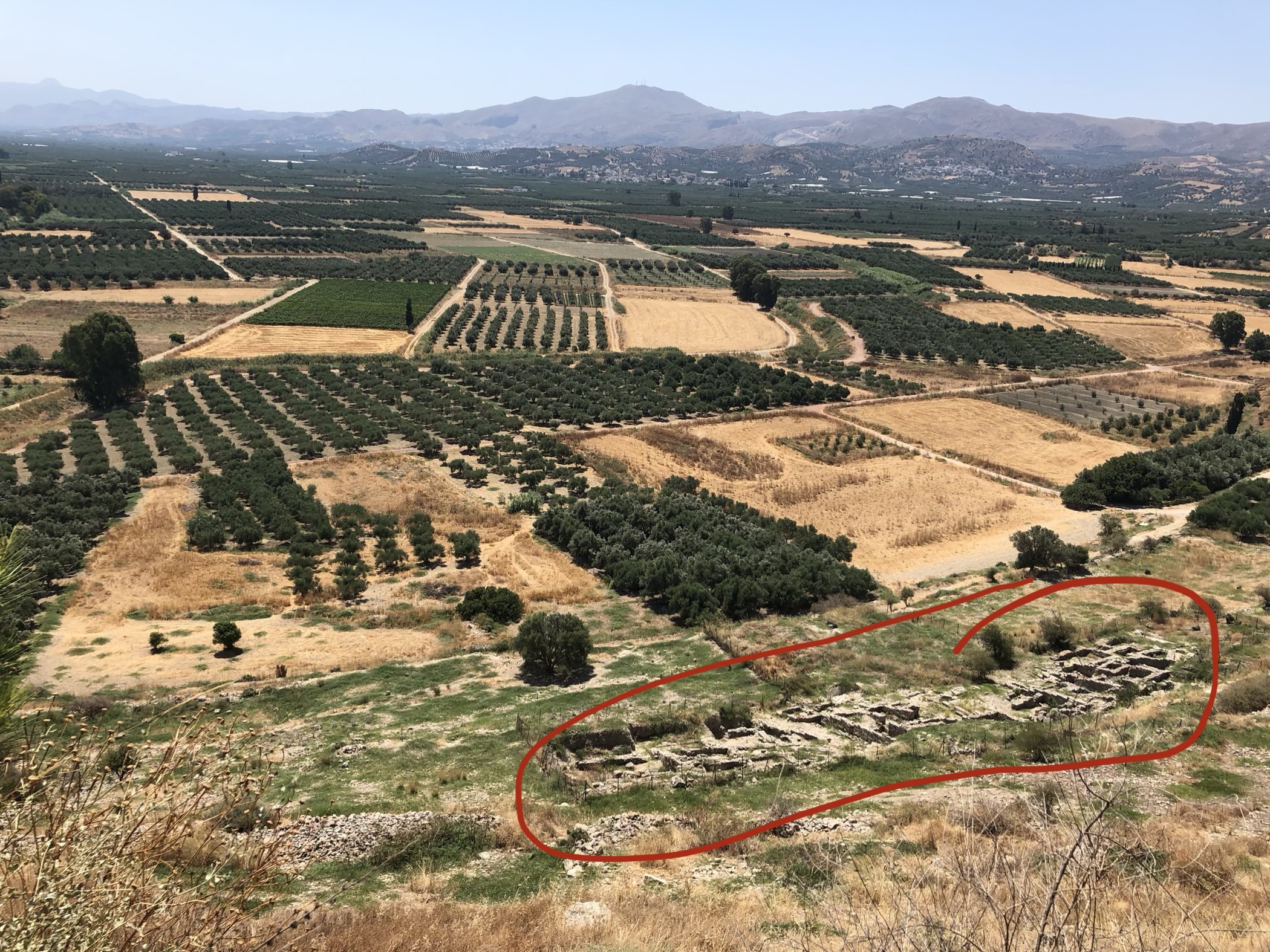
Kouloures, large stone-built structures, show time-consuming craftsmanship. | Photo: M. YungRelics from the past are scattered across the grounds. | Photo: M. YungThis photos shows the surrounding hillsides. I’ve circled in red additional outlying structures that were subordinate to the palatial hilltop above. We ate our lunch (that we had packed and brought with us) on benches beneath a pine tree right above this scene. | Photo: M. Yung
Mysteriously, no one knows for sure the reasons for the collapse of Minoan culture, including the civilization at Phaistos.
Perhaps that’s a fitting conclusion for this archaeological site that today is still out-of-the-way, obscure, and famous.
Thanks for reading! This post is another installment from our cross-country Greek odyssey last summer. It’s amazing how many more sights I have yet to write about. Follow my blog for more travel posts, including this one from our final day in Greece when we visited the site of Paul’s To an Unknown God sermon.
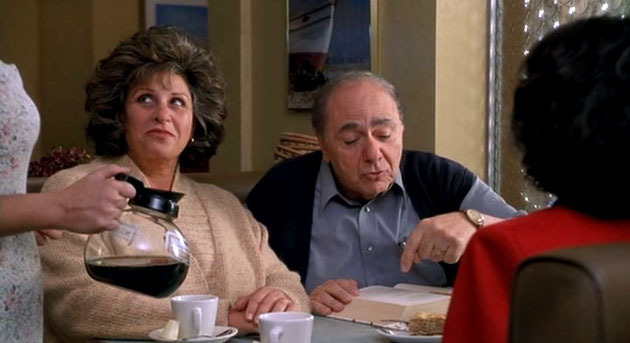
You know in the movie My Big Fat Greek Wedding when the father, Gus, explains how every English word can be traced back to the Greek language? Here’s what Gus says in the movie: Now, give me a word… any word… and I show you, how the root of that word… is Greek. How about “arachnophobia”? “Arachna,” that comes from the Greek word for spider… and “phobia” is a phobia, it means “fear.” So, “fear of spiders.”
Well, he’s right on that point when you look at the name for the group of islands that my husband and I are visiting: the twenty-four Sporades Islands along the east coast of Greece. (Actually, we’re only visiting one of those islands, Skopelos.)
Only four of the twenty-four Sporades Islands are permanently inhabited: Skiathos, Skopelos, Alonnisos, and Skyros.
When you look at the twenty-four islands that make up the Sporades on a map, they appear to have been scattered into the Aegean Sea. Picture in your mind seeds or spores that have been tossed across a field by a farmer. Or consider the seemingly random process in which cells scatter and germinate. It’s a very visual and literal way to describe these islands.
Now let’s do what Gus would do.
Ever think about the English word “sporadic”? According to Merriam-Webster, this word “describes the distribution of something across space or time that is not frequent enough to fill an area or period, often in scattered instances or isolated outbursts.”
See? The English word sporadic can be traced directly back to the “Guh-leek,” as Gus would say.
For even deeper backstory, there’s this from Merriam-Webster:
Sporadic “comes from Medieval Latin sporadicus, which is itself derived from Greek sporadēn, meaning “here and there.” It is also related to the Greek verb speirein (“to sow”), the ancestor from which we get our word spore (the reproductive cell of a fungus, microorganism, or some plants), hinting at the seeming scattered nature by which such cells distribute and germinate.”
So when when the islands were created or “sown,” they were scattered like spores. What better name to call these islands other than the Sporades Islands?
I’m a word nerd. I love learning where words come from and how they have changed over time. Click “like” if you enjoyed this post and leave a comment about a word you find interesting. Follow my blog for more posts as we continue our month in Greece.
I thought it might be interesting to write a post about our lodging here in Skopelos Town, sometimes called the Chora, on Skopelos Island in Greece.
Here’s our front door.
We’re staying in a room that sleeps three people at Mayorka Studios, which is located just a three-minute walk down the hill from Skopelos Foundation for the Arts (Skopart). This is the arts center where my husband Mitch is pursuing a three-week artist’s residency.
The studio we’re staying in runs €40-80 night, depending on the time of year. July and August are the most expensive times; it varies greatly after that. In addition, if you come to the island to participate in a Skopart artist residency, your rates may be lower.
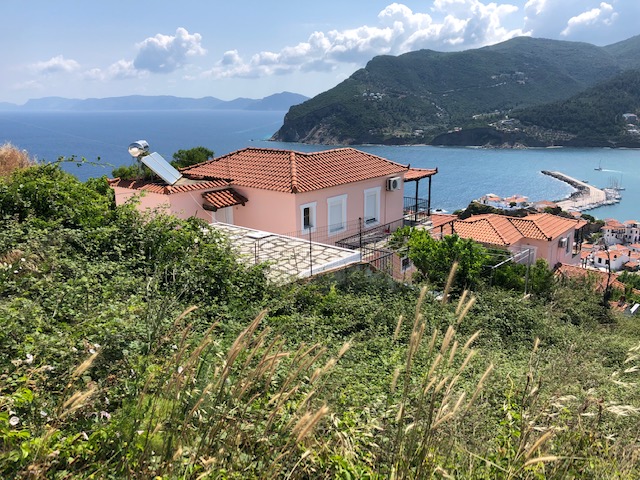
Mayorka Studios comprises twelve units perched high on the hill that overlooks Skopelos Town below. In fact, if you look in the picture below, you can see the apartments in the extreme upper left corner. They are not white, but instead are painted a light coral color and have red tile roofs.
You can see Mayorka Studios in the very top left of this picture, right along the edge.
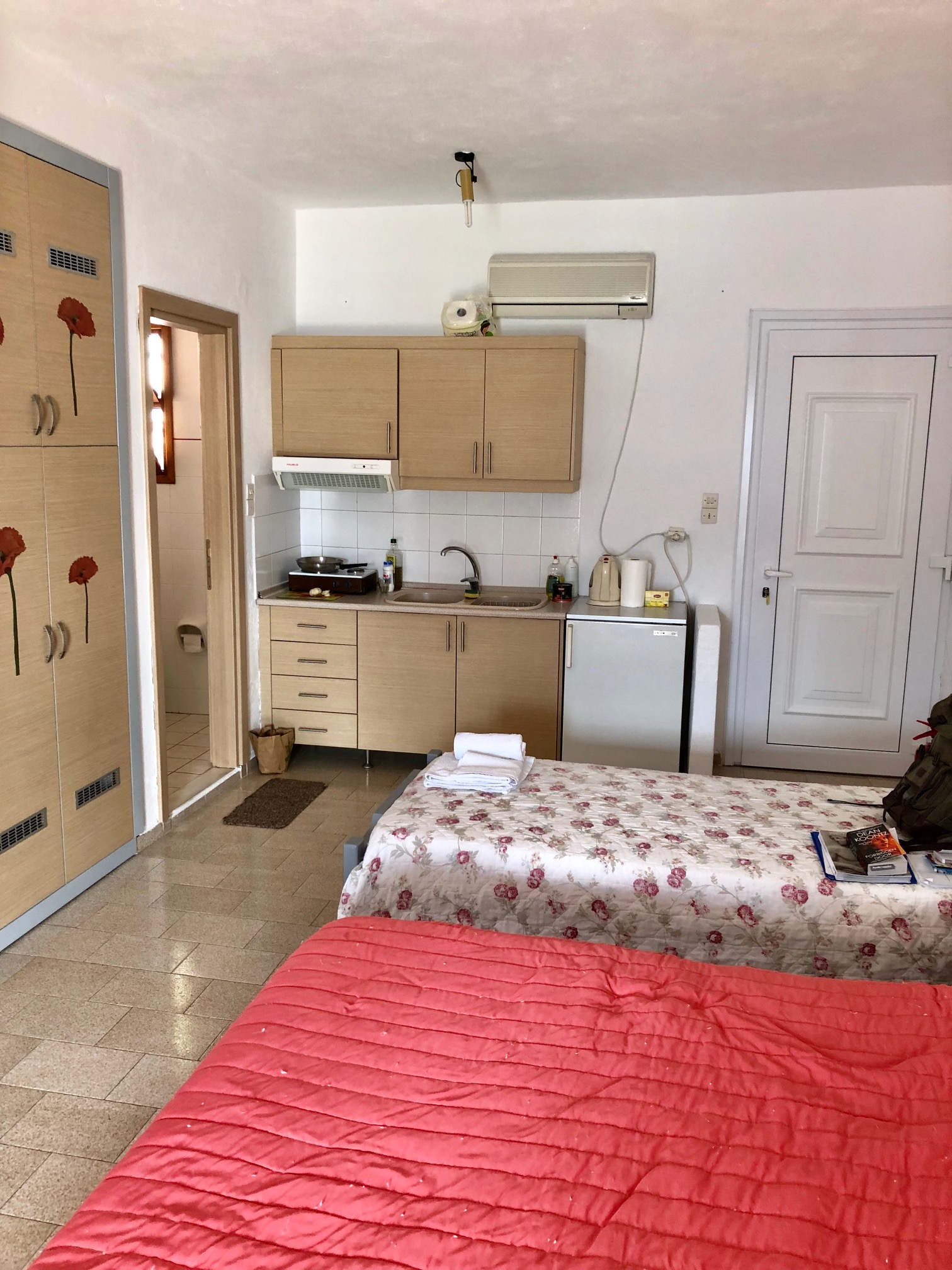
Our room has a king-size bed and a twin. It also has a limited kitchen with a few pots and pans, an ice cold fridge, double sink, a small two-burner stove, …
and a kettle that boils water in no time flat.
The entrance. You can park on the lot there by the scooter, but no one here right now has a car.
The kitchen has the main appliances we need, but not a microwave or oven; however, I don’t think that microwaves are as popular here as they are in the U.S. As for the oven, yes, I would like to have one of those–even more so than a microwave, actually– but oh, well. My daughter’s apartment during her first internship in Venice didn’t have an “oh-ven” either.
Rather plain Jane, but perfectly adequate.
The kitchen also contains the basic utensils needed, but we did have to go buy a sharp serrated knife for slicing tomatoes. (We have Greek salads with nearly every meal to make sure we get our daily allowance of feta cheese.)
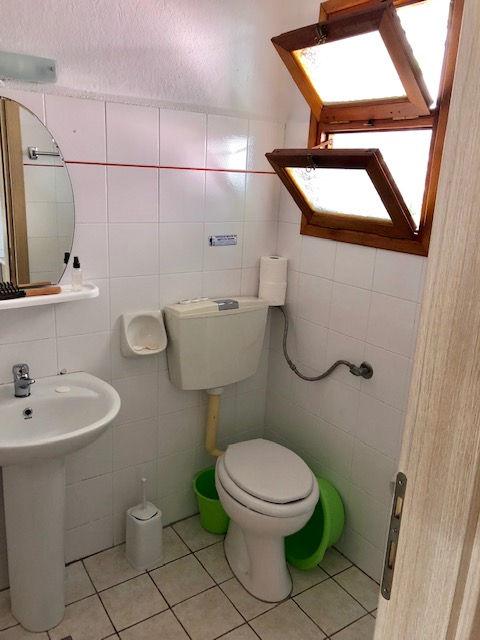
The bathroom has a small shower and a hand-held shower head that hangs over the faucet. The shower at our AirBnb in Athens featured this same type of shower setup, so it must be common here. It’s a little awkward to get used to… you’re never just standing under flowing water. You have to hold the shower head. Kind of a pain. Man, am I a whiner or what?!
And now for the other angle.
The toilet functions, except for “the rule.”
That would be the “never flush paper” rule, which was also awkward to get used to. Flush NO paper, not even the dirtiest paper? Nope. Apparently, it clogs up the pipes. So, instead of tossing your paper into the toilet, you just toss it into the lidded trashcan. I noticed this same rule at a hillside restaurant near the Acropolis in Athens. That place had a large lidded basket for the used paper.
Our king-size bed is very comfortable and firm. There are plenty of good pillows also. The place is spotless thanks to the housekeeper who drops in every morning around 10.
Yep, that’s a bathroom. Notice “washing machine” next to toilet.
The TV (an old tube version) doesn’t seem to work. I suspect that the batteries in one of the remote controls are dead; however, I still can’t seem to get the little black box that sits on top of the TV to be friends with the actual TV.
Shower with hand-held faucet. This was a new one for me.
But it doesn’t really matter, since the one night I was able to get something to watch, it was a soccer game with a Greek-speaking commentator (duh). So it was no great loss, but still. I get a kick out of watching TV when I’m in another country. I think it’s fun to learn what people in different countries are interested in, their perspectives and priorities.
As for laundry, we wash it by hand.
Yes, you read that right. In fact, there’s a lime green plastic washtub wedged between the toilet and the wall specifically for the purpose. We take the tub, put it on the floor of the shower, turn on the water, sprinkle in some powdered Tide for handwashing and get to washing.
The housekeeper dries the sheets in the breeze.
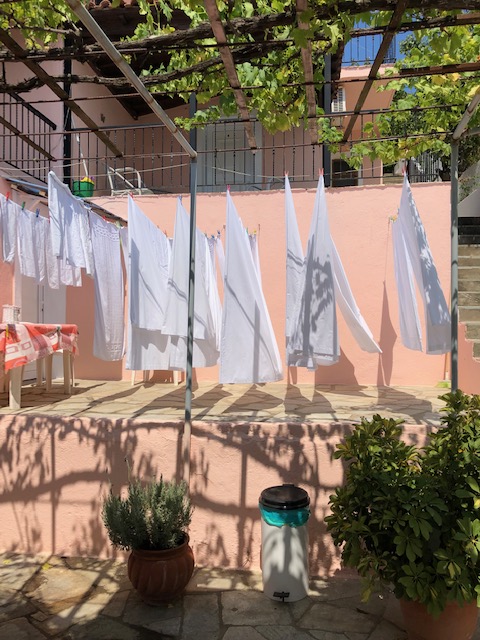
Then we rinse (sometimes in the tub, sometimes just in running water) and hang the wet duds on the clothesline on our balcony just like everyone else.
Outside our door
It works really pretty well, and yes, saves a lot of energy. I can handle not having a dryer, but a washer really would be nice. Our place in Athens had one, and even though we were there for only two nights, we washed a load of laundry. (And honestly, I do think it might be a little unusual to not have one in our unit.)
So even though we handwash our own clothes, can’t flush toilet paper, and the TV doesn’t work, this place is still the bomb. And that’s because…
it’s all about the balcony.
The view is absolutely incredible. In fact, who needs a TV when you have a front row seat to the best show in town all day and all night?
View from the balcony
Watching the ferries, tour cruises, and boats of all shapes and sizes sail in, unload, and sail back out will probably be one of my best memories from this entire trip. We can also see people way down there walking up and down the harbor front street. And late at night, when the balcony doors are open (and they usually are, because it’s quiet and safe up here), you can hear live Greek folk music rising on the breeze from the Paganitsa Tower taverna. It’s heavenly.
I guess you could argue that the balcony is our only sitting area, however. You’d be right. There is no indoor dining area, for example, or an easy chair to sit in.
If you stand along the railing on the balcony, this is the view of the town to the right of the port.
Last Saturday night, during the second night of the music and dance festival, when students were showcasing their modern dance routines, someone must have been performing to “Perfect” by Ed Sheeran. Those crazy-good chords floated up from the performance at the City School down below…
another nice memory.
So, except when we’re in the kitchen fixing meals, if we’re in the apartment, then we’re on the balcony sitting in the two wicker rattan love seats, looking out at the Aegean Sea, and maybe sipping a glass of wine. There’s a glass-topped table there and that’s where we have breakfast, lunch and dinner.
This just shows the top of the apartments. Notice the solar water heater on the top unit. Each unit has one of these. Hottest water ever!
We’ve dined out only twice in the week and a half that we’ve been here. We head to the grocery store downtown (or catch a ride with friends from Skopart) whenever we need to pick up a few things. I know we’ll eat out a few more times eventually, but I’m perfectly fine with eating in, shopping at the little market, and buying just what we really need for that day.
That seems to be the way they do things here.
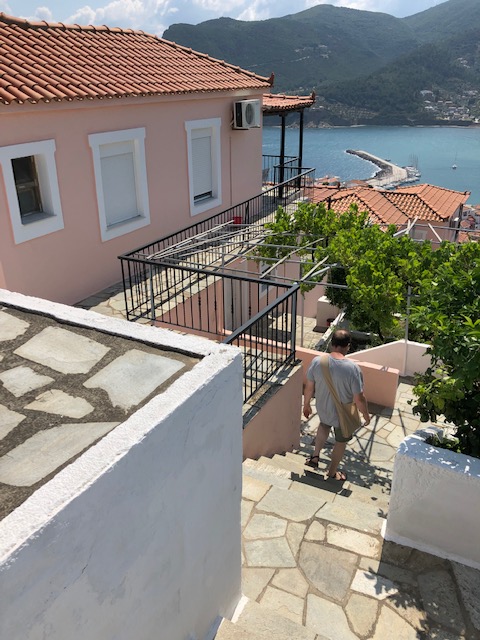
Mitch walking down to our apartment.
Right outside our door. Almost to the killer stairs… see next photo.
A shot of the studios from down below on the stairs that descend all the way into Skopelos Chora. These stairs are killers. Wear good shoes. Walk slowly so your knees aren’t jarred with every step. You’ll get very fit just walking around Skopelos on a daily basis.
Thanks for reading! I thought it would be interesting to show our digs while we’re on Skopelos Island in Greece. The rates for lodging are highest in July-August; however, Greece is still relatively inexpensive compared to other locales. Click “like” if you found this interesting and feel free to leave a comment. If you’ve stayed in Greece before, what was your experience like?
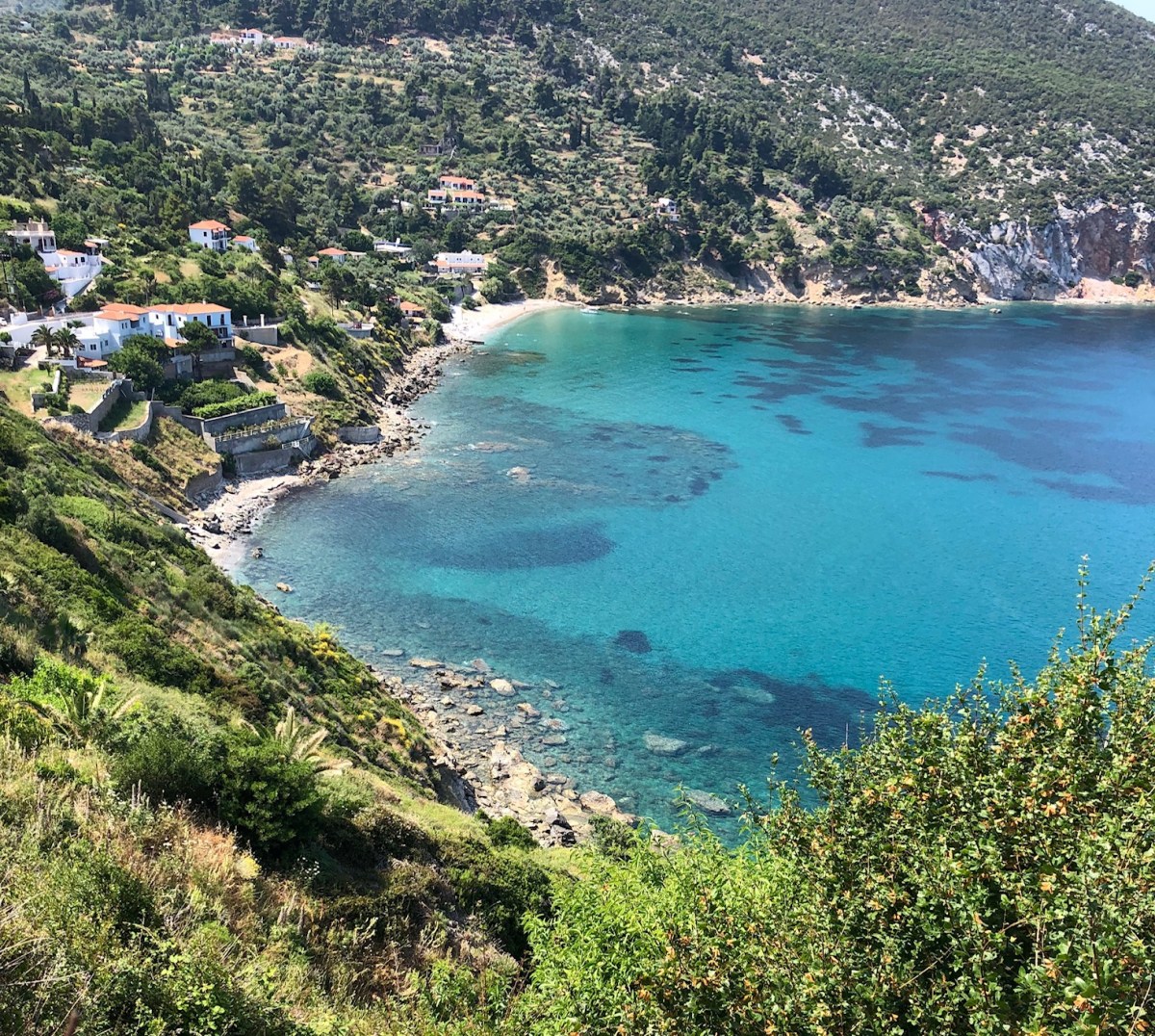
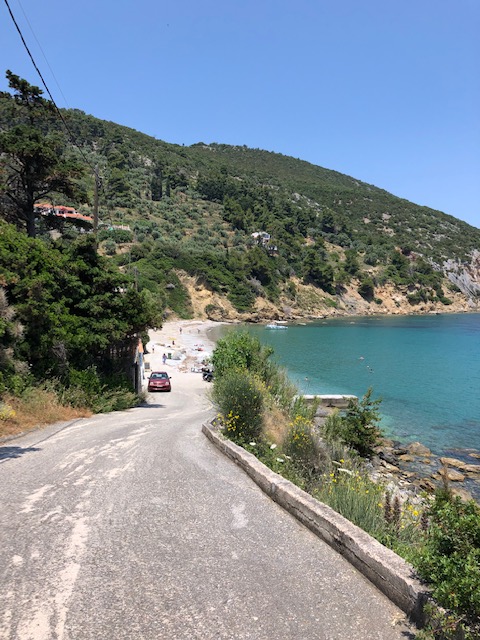
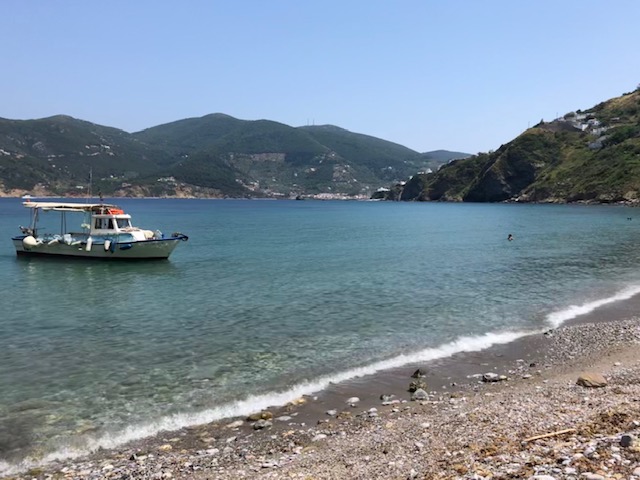
We downsized our Sunday afternoon with a walk to this nearby beach
We had planned to go to Stafylos Beach, about one mile away across Skopelos Island. However, that would require a bus, and we didn’t know if there would be buses running on a Sunday, since Greek Orthodoxy does play a major role here in Sunday activities.
In fact, every Sunday morning, you can hear Greek Orthodox monks chanting via loud speakers throughout the “bowl” that is Skopelos Chora (the main town).
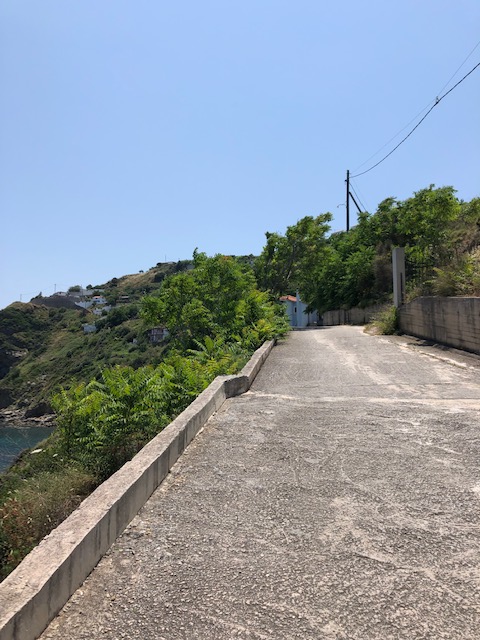
At one point, our walk down to the Glifoneri Beach followed this concrete road.
From my vantage point high up on the hill overlooking the harbor and town, however, I would say that yes, the buses do run on Sundays, since I don’t see any down below parked at the bus station on the main street. I’m assuming they must be out and about. Oh look, one is pulling in right now, in fact.
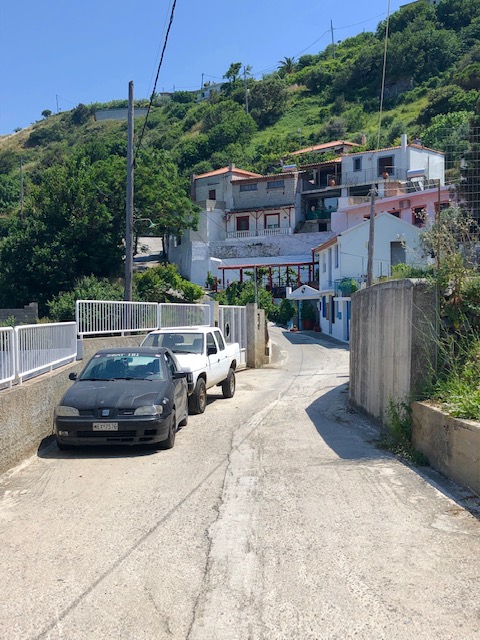
So instead, we walked down to Glifoneri Beach. We passed houses (some beautiful, some ramshackle), chicken coops, and abandoned stone sheds along our way.
The beach is about a half-mile walk away, all downhill. It’s named after the small “taverna” that operates across the little street from the beach; however, it’s also known as Agios Konstatinos Beach for the church that is on the hillside above. I haven’t seen the church, but there are so many (around 123) on the island of all shapes and sizes that it’s possible I’m just not seeing it.
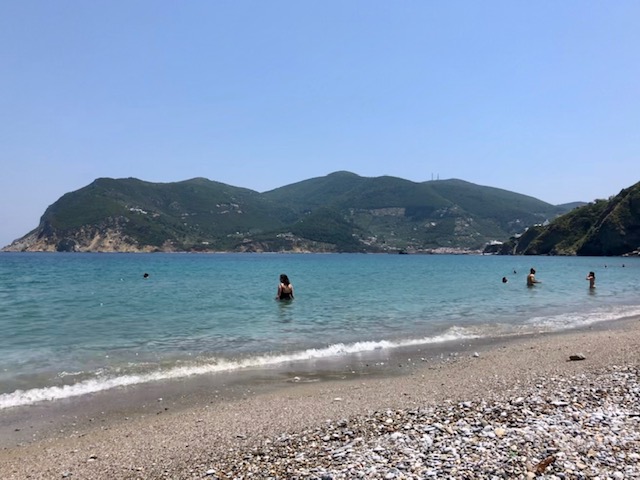
On the outcropping on the far right in the photo, you can barely see the white churches that overlook Skopelos Harbor. The most prominent of these is Panagitsa Tower, the Church of the Virgin Mary.
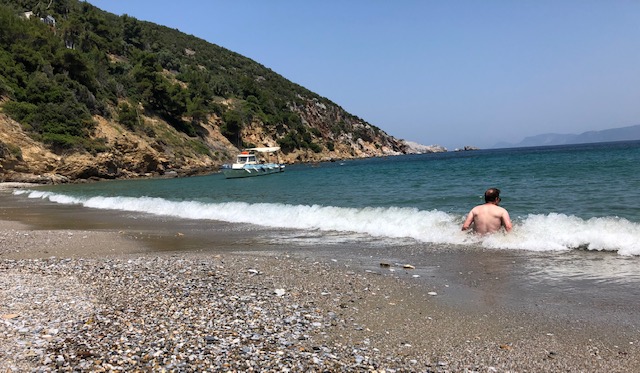
When we arrived, the water was quiet. It was stunningly aqua in color, but quiet and serene. Approximately thirty people were there. Kids played in the waves, middle aged couples lounged and slept in the sand, and young twenty-somethings ventured out further into the waters.
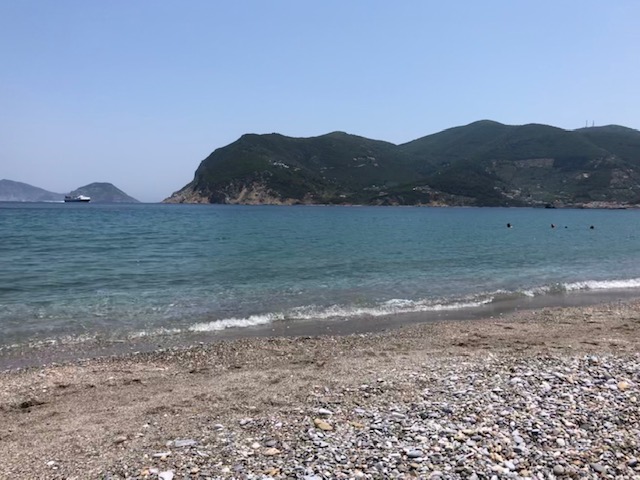
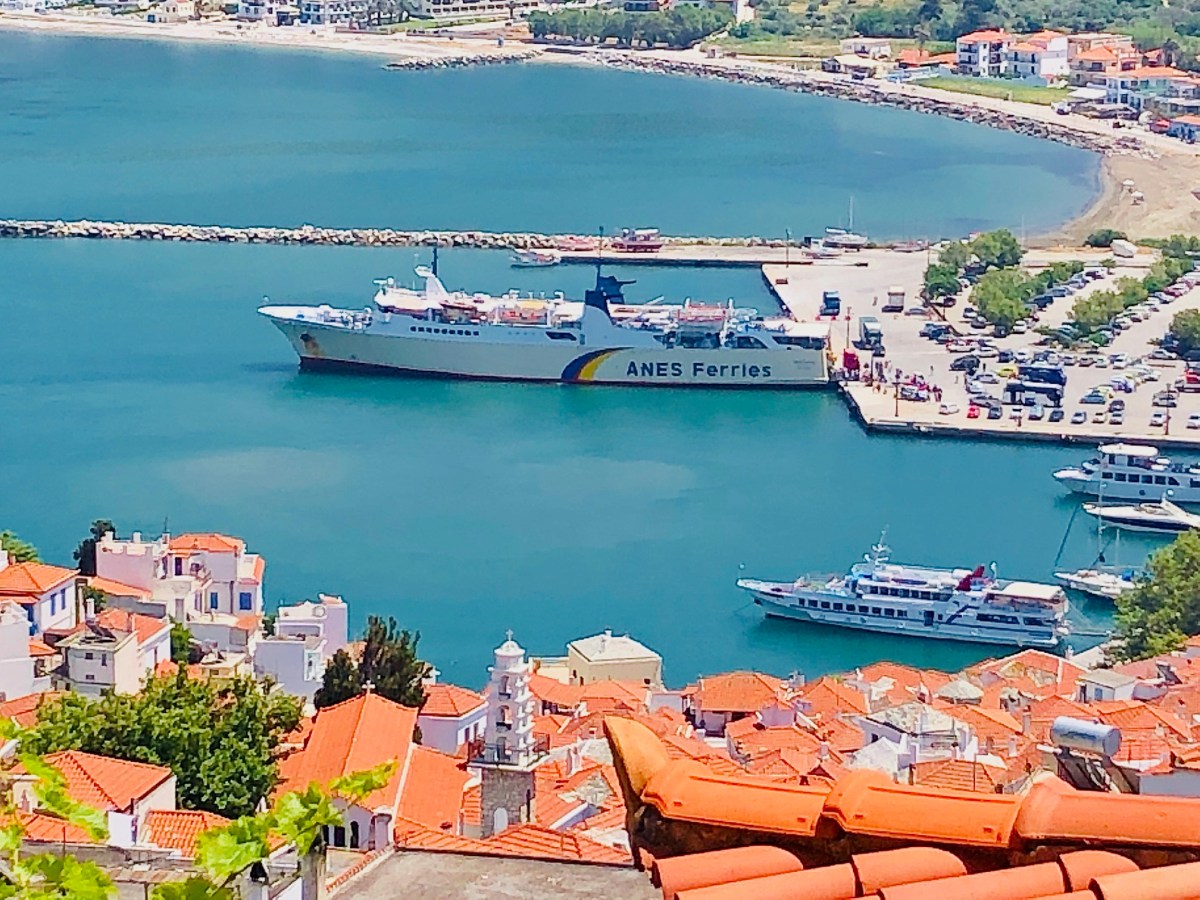
A Hellenic Seaways ferry makes its way into the Skopelos harbor.
Around 1:30 p.m., however, a procession of waves began rolling in. First, the waves were small, but then they gradually built in size to the point where I turned around to see if the water was reaching our backpack and beach bag. It wasn’t, but it was only about a foot away.
We sat at the edge and watched the water roll in, bringing with it bits of leaves, sand, tiny stones and sand. Eventually we decided to dog paddle over a narrow band of larger rocks to where Mitch said the bottom was covered with a fine, white sand. He was right. The bottom was soft to walk on and firm.
And, of course, our return meant we had to do it all again… only going up. This photo shows just a short part of the trip. There were several more escalating hairpin curves to arrive at our studio apartment that overlooks the town and harbor.
We swam out about twenty feet and felt the mixture of currents rolling in from the Aegean. Distinct layers of icy cold waters mingled with warm. We didn’t know whether to relish in the sensation or climb back onto the beach.
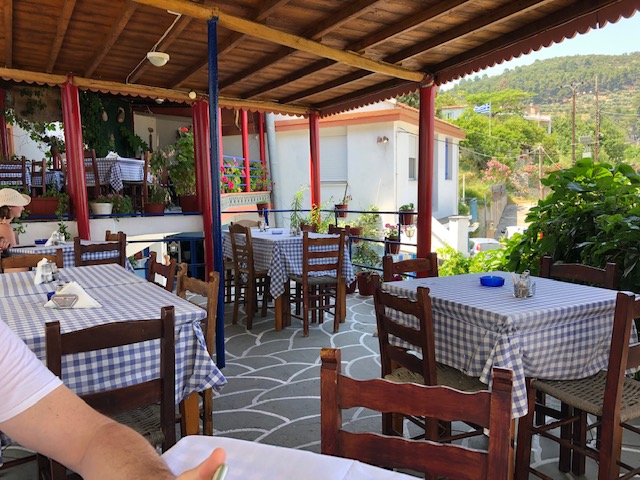
Stella Taverna is in the lower part of the large white house in the photo. It’s a little oasis with incredible views.
We saw a Hellenic Seaways ferry glided around the island from the south and entered the Skopelos Harbor, disappearing from view around Panagitsa Tower, the Church of the Virgin Mary. As it chugged into town, four bright white streams of seafoam trailed behind it, vivid against the inky blue Aegean waters. Ten minutes later, it emerged again and continued on to its next stop, probably Glossa (the next largest town on the island) or Skiathos Island next door.
Stella Taverna was quiet in the middle of a Sunday afternoon. Just two more couples were there.
After spending about an hour and a half at Glyfoneri, we began our walk home back up the hill to Mayorca Studios, where we are staying.
Fresh, fried squid. We usually call it calamari.
On the way, we stopped at Stella Taverna and ordered some fried squid (calamari) and two Cokes.
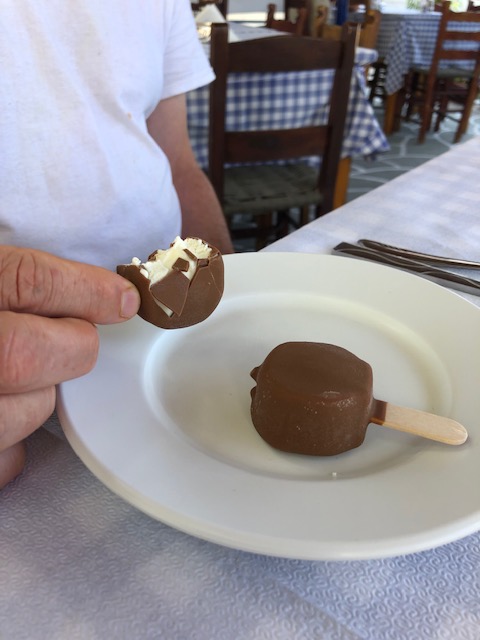
Look at these super cute little ice cream bars. The perfect touch!
Sesame-encrusted bread was served alongside the squid and complimentary miniature chocolate-covered ice cream bars were given to us after we paid our €12 bill.
And, yes, there was even this picturesque boat anchored nearby.
We interrupted our steep walk back home with several breaks to enjoy the view and rest our aching knees and calves. Skopelos terrain will challenge anyone!
Alonnisos Island, the third of Greece’s Northern Sporades Islands, sits in the distance.
Thanks for reading! My husband is serving an artist’s residency at Skopelos Foundation for the Arts on Skopelos Island, Greece. I’m writing as much as I can about our trip and working on some other projects as well. On the agenda for tomorrow: securing ferry tickets for my trip on Thursday to Venice, Italy to see my daughter, who is serving an internship at the Venice Biennale U.S. Pavilion. I have a direct flight out of Skiathos and plan to stay there for five nights.
Traveling to new places can make you appreciate or at least think differently about the rules and procedures of your own country. And when it comes to safety procedures, sometimes I think the United States tries too hard to keep people safe. We’ve gone so far in the name of safety (and in the name of avoiding lawsuits, too) that Americans no longer need to think for themselves. That wasn’t the case on the Greek island of Skiathos last weekend.
Last Saturday, my husband Mitch and I took a 30-minute flight from Athens over the Aegean Sea to Skiathos Island, the smallest of three isles that compose Greece’s Sporades Islands. After a three-minute taxi ride down dusty, narrow lanes from the Skiathos Airport to the harbor, we confirmed our passage at a ferry ticket office and then made our way across the crowded main street to an assemblage of casual chaos.
The port of Skiathos as our ferry departed from the harbor.
The noonday sun beat down on the dusty parking lot filled with tourists carrying luggage and others just out for a weekend excursion. Music from the row of restaurants drifted from across the busy street, an incongruous backdrop to the hectic activity of the dock.
As we approached the crowd of waiting passengers, a young man was backing up a semi tractor into the lower hold of the ferry. He craned his neck left and right to peer into his rear view mirrors, guiding the tractor cab in reverse toward the gaping hold of the ferry. He jostled and bumped his way onto the ramp, clearing the opening on both sides and above by less than a foot and then disappeared within the ship.
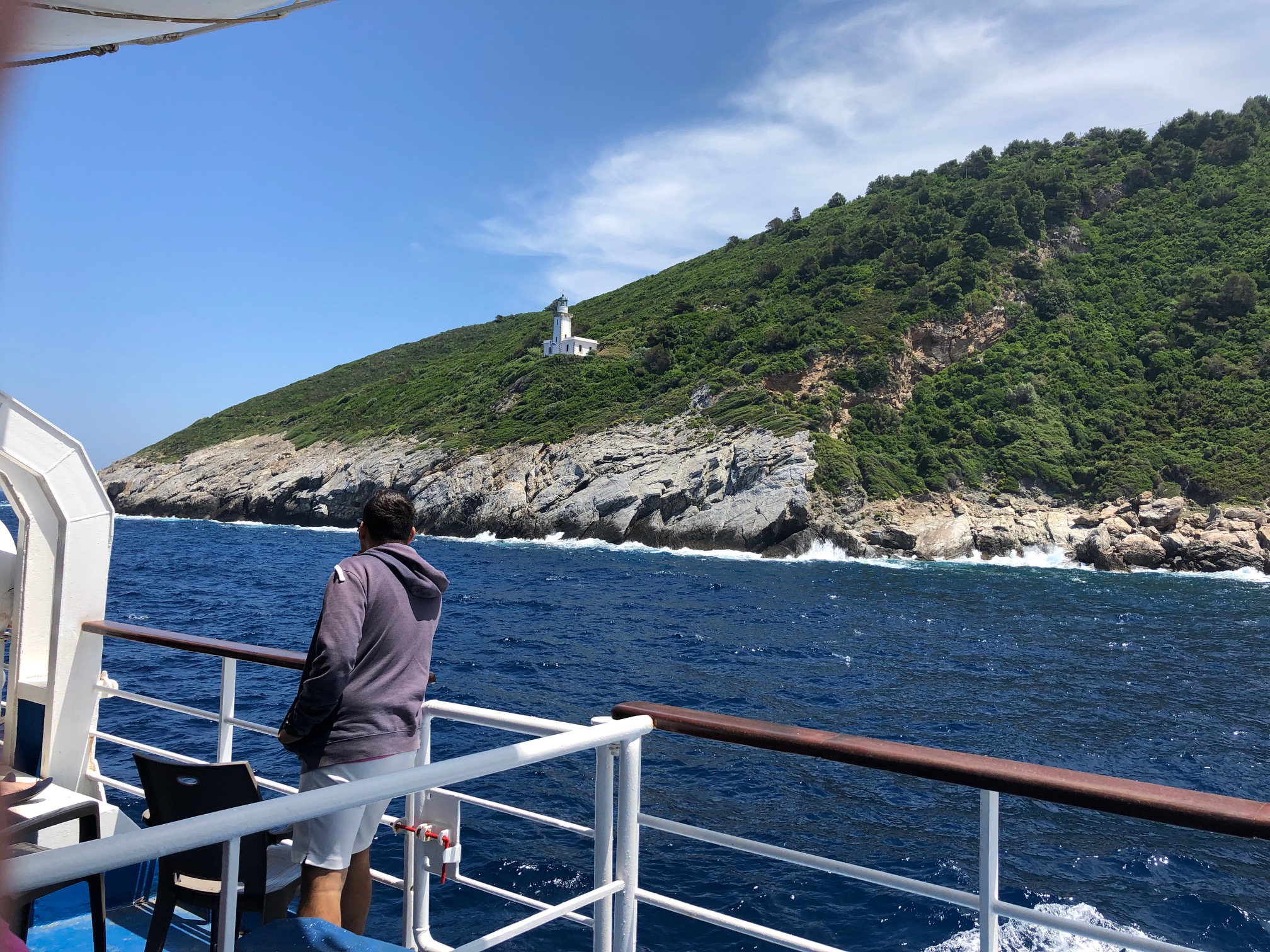
A lighthouse on the southern tip of Skopelos Island.
About two minutes later, he emerged with a fully-loaded trailer of goods. Brushing his sweaty forehead with one hand and steering with the other, he maneuvered the rig, first in drive and then in reverse, to the edge of the parking lot near where we stood. And then he did it all over again, four more times to be exact.
All the while during his performance, a stream of disembarking ferry passengers had been descending the staircases along the side of the hold. A quiet procession of bag-bearing zombies, they inched down the staircase, watching their feet with each step, one step at a time. Once they reached the last stair, they wandered across the tractor’s loading area, where ferry workers, professionally dressed in white shirts, ties and dark trousers, ushered them along, guiding them out of the path of the semi that was soon to emerge from the ship.
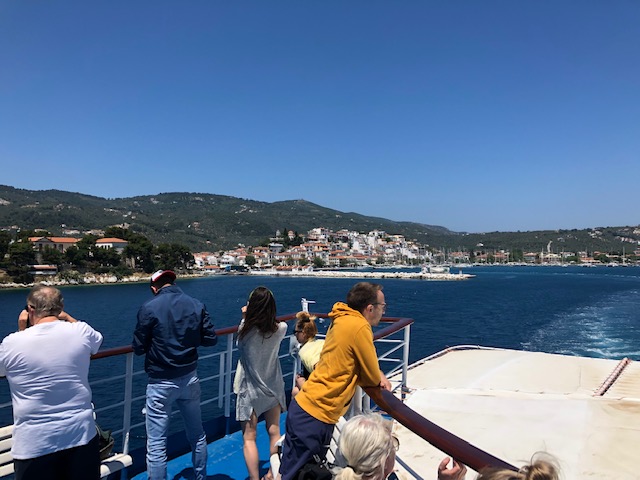
Pulling into Skopelos Town, the largest city on Skopelos Island.
It was very casually run for being so chaotic. There was no yelling. No running back and forth. Just a toot of the semi’s horn when one man stopped in the middle of the path to check his phone. Just an occasional raising of a dockhand’s arm to direct people along and keep them out of harm’s way.
We talked quietly between ourselves about how different this would be in the states. There would be a beep screeching from the semi tractor every time it backed into the hold. There would be traffic cones arranged to keep the area clear. Passengers would likely be contained in a holding area off to the side. But not here. Here, apparently, you have to pay attention and watch.You have to think.
Finally, with the ship’s hold empty, it was time for passenger boarding. We fell into a line and inched up the yellow-painted staircase where we slung our bags into loosely formed stacks and onto odd-shaped ledges and shelves that lined the stairway. There was no exchange of baggage receipts, no record that we had dropped off a bag at all. It would be our responsibility to retrieve our luggage when we descended upon reaching our destination. When we arrived in Skopelos, we would have to remember and pay attention. We would have to think.
Ascending the stairs, I placed my new, shiny wheeled carry-on onto a wobbly stack of suitcases and thought about how differently this procedure would be handled back home. There would be tags to keep track of or a ticket to scan. Thought would be taken out of the process. Without a doubt, I would get my bags back, but I wouldn’t have to think to make that happen.
“Leave here. Get later,” I heard a Greek ferry worker say to some passengers climbing up behind me.
An even closer view of Skopelos as our ferry entered the harbor.
Thank you for reading! My husband is serving a three-week artist residency at Skopelos Foundation for the Arts on Skopelos Island in Greece. I’m along for the ride, writing and posting and otherwise enjoying my summer off from teaching middle school English Language Arts. Follow this blog for more articles and find me on Medium.com under Parenting, Education, and Travel.



















 Marilyn Yung